Fincantieri Gets Order Valued at Over $2.3B for Three Princess Cruise Ships
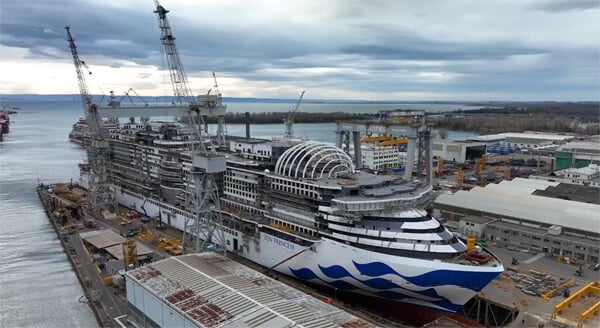
Italian shipbuilder Fincantieri and Carnival Corporation’s Princess Cruises confirmed an order for three new large cruise ships valued at over $2.3 billion (€2 billion), extending the record cruise ship orderbook. The orders are in keeping with Carnival Corporation’s declared strategy of strategically pacing its new ship orders for metered growth in its brands.
The cruise line is calling the new ships the largest and most advanced platform for its brand. At an estimated 183,000 gross tons and with a passenger capacity of 4,700 in lower berths, the ships will be approximately three percent larger in size while increasing capacity by more than nine percent versus the sister ships Sun Princess and Star Princess, built by Fincantieri and delivered in 2024 and 2025.
Princess is calling the ships “a next-generation platform” designed to further enhance its cruise experience while saying the new ships will build upon the Sphere Class platform (i.e. Sun Princess and Star Princess) previously developed by Fincantieri. The line said the new ships will feature completely reimagined outer decks, staterooms, and Piazza designs that cater to the brand's global travelers and diverse deployments.
Similar to the two recently delivered Princess ships, the new Voyager class ships will be dual-fuel powered, primarily using Liquefied Natural Gas (LNG). It has become the fuel of choice for much of the cruise industry after the first cruise ship, AIDAnova, was introduced in 2018 with LNG-fueled engines. The new Princess ships will be Carnival Corporation's 19th, 20th, and 21st LNG-based vessels and are part of the company's ongoing fleet enhancement efforts.
In keeping with Carnival’s strategy, however, the deliveries are scheduled for late 2035, 2038, and 2039, extending the industry’s orderbook beyond the newbuilds due for Norwegian Cruise Line and Oceania Cruises in 2037. Carnival Corporation previously had seven additional new ships under contract that are scheduled for delivery between 2027 and 2033.
The new ships, which will be the largest by capacity in the Princess Cruises fleet, will be built at Fincantieri's shipyard in Monfalcone, Italy. They add to Fincantieri’s large cruise ship orderbook, which also includes 200,000-plus gross ton ships for Carnival Cruise Line and Norwegian Cruise Line.
“These new orders secure a robust workload for our shipyards through 2039 and further support the profitable development of our cruise business, as outlined in our 2026–2030 Industrial Plan,” said Pierroberto Folgiero, CEO and Managing Director of Fincantieri. With the new Voyager-class ships, we are once again leveraging Fincantieri's distinctive expertise in sustainable, next?generation shipbuilding, supporting Princess Cruises in its growth trajectory and reaffirming our role as a trusted industrial partner for the evolution of the cruise industry."
The orders also demonstrate the industry’s confidence in long-term future growth. Globally, the cruise ship orderbook had already reached a record $86 billion, according to data released this week by Seatrade Cruise. They calculated that there were 76 firm orders for cruise ships and said that with several projects pending, the cruise ship orderbook is likely to soon exceed $100 billion. Yet, there are only about 350 cruise ships in service out of more than 60,000 commercial ships.
The trade group CLIA (Cruise Lines International Association) has forecasted that cruising will reach 40 million passengers annually by the end of this decade.
The Case for Luxury
(Article originally published in Jan/Feb 2026 edition.)
The global cruise industry is having its moment as passenger counts rise and amazing new ships are delivered. There's something for everyone – short cruises, long cruises; budget cruises, luxury cruises; family cruises, adults-only cruises – and everything in between. Not to mention the destinations, which are endless.
Founded in 1966 as Norwegian Caribbean Lines by Knut Kloster, Norwegian was a pioneer in the industry. It helped make the Caribbean the most popular destination in the world, and it's gone through all kinds of permutations in its 60-year history, achieving many firsts along the way.
Remember "Cruise Like a Norwegian" and "Freestyle Cruising"? Known especially for its innovative marketing campaigns, it helped popularize cruising among the American public and was one of the first to use mainstream TV.
It changed hands a number of times over the years, and it wasn't until 2014 that the company, as we know it today, came together. That's when the renamed Norwegian Cruise Line, having gone public the year before, bought Prestige Cruise Holdings, which included the Oceania Cruises and Regent Seven Seas brands.
The lineup was complete. Three brands – each a leader in its category – with plenty of room for growth.
FOCUS ON LUXURY
Today, the company is realizing its full potential, and it's doing so by focusing on luxury and the upscale, affluent cruiser.
Not entirely, of course. Its contemporary Norwegian Cruise Line brand appeals to a wide audience of families, young couples and first-time cruisers, but even Norwegian has its luxury element in the form of The Haven, an exclusive retreat on all of its ships that caters to affluent guests.
The other two brands, Oceania Cruises and Regent Seven Seas, are all about luxury, and a year ago Jason Montague came back to run them.
Since then, the company has announced plans for five newbuilds for its Oceania Cruises brand and four for Regent Seven Seas, adding much needed capacity and representing the biggest expansion in the two brands' history. Why? Because there's a massive amount of wealth out there and massive demand for luxury at sea, and Norwegian intends to substantially increase its presence in the luxury segment and help meet that demand.
THE FINEST CUISINE AT SEA®
Oceania is known for its cuisine and bills itself as "the world's leading culinary- and destination-focused cruise line." It used to be Norwegian's upper premium brand, but under Montague's leadership it's transformed itself into a fully luxury offering.
It's also now "adults only," emphasizing its focus on "experiential cruising" and "immersive experiences" (Montague's terms) for like-minded adults, who value their privacy while enjoying each other's company.
In January, Oceania Cruises announced to great fanfare the first of its new Sonata Class vessels – Oceania Sonata – due in August of 2027. Demand was extraordinary, and it's more than a year away! Sister ships will follow in 2029, 2032, 2035 and 2037. The new vessels are larger than the previous Allura Class and can accommodate about 200 additional guests, reflecting the increased demand for luxury travel where pricing seems to be no obstacle.
Moreover, one-third of all guest accommodations will be suites, up from 25 percent previously, including four new two-bedroom Owner's Suites and two entirely new categories, Horizon Suites and Penthouse Deluxe Suites.
THE WORLD'S MOST LUXURIOUS FLEET®
While Oceania Cruises is luxury, Regent Seven Seas is ultra-luxury – for those who want the ultimate in cruising.
"There's simply nothing like it," says Montague, and it's hard to argue the point. Everything is included – Business Class air, all onboard amenities, gratuities, liquor, unlimited shore excursions, WiFi, laundry. Even a private car and driver at certain ports if requested. "We really try to deliver an all-inclusive and unrivaled experience," Montague adds.
The staff-to-guest ratio aboard Regent ships is unparalleled and almost one-to-one. Everyone feels like a VIP.
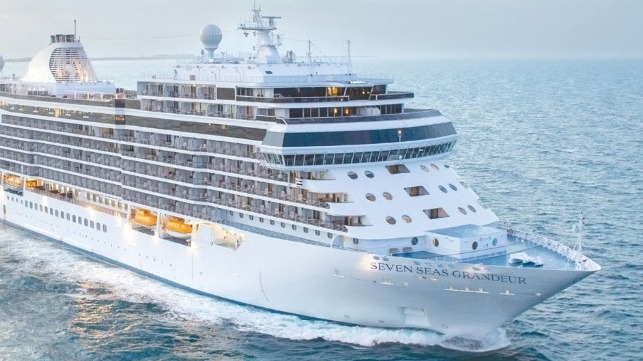
The first of Regent's four new Prestige Class vessels, the Seven Seas Prestige, is due in December with three more arriving in 2030, 2033 and 2036. According to the company, Prestige "embodies Regent's vision for the future of ocean travel and furthers the brand's commitment to excellence as reflected in every aspect of her elevated design." Demand is through the roof.
Of special note is the re-imagined Regent Skyview Suite at nearly 9,000 square feet and going for $25,000 a night. No problem. Guests are lining up to experience it. It's the largest suite at sea and, while other cruise lines may build the biggest ships, Regent will offer the biggest suites.
"It's all about the experience," Montague explains. "That's what our guests want, whether it be on the ship or off. They have money, but they don't always have time. So when they travel to different parts of the world, they want to get the most out of that experience, and that's where we thrive. We help deliver the maximum experience they can get when they cruise with us."
Montague is in his element, and he couldn't be happier. Asked what his biggest challenge is, what keeps him up at night, he replies, "I sleep like a baby. Geopolitical tensions can cause problems, of course, but you just move the ship. You go someplace else. We're not a physical asset that's stuck in one place like our land-based competitors."
VALUE PROPOSITION
Cruising is having its moment, and so is luxury.
And with so much money floating around – what with Baby Boomers wanting to enjoy their retirement and the stock market being up, not to mention the desire for immersive experiences rather than material things – why not take advantage of it?
Oceania and Regent are uniquely positioned to do just that. They have the product, and pricing is apparently no object. In fact, the higher the price, the more people seem to want it.
"We're just a great value proposition compared to land-based hotels and other forms of travel where you have to pack and unpack if you want to see more than one spot," Montague says.
Tony Munoz is the magazine's founder, publisher and editor-in-chief.
The opinions expressed herein are the author's and not necessarily those of The Maritime Executive.