Thursday, April 16, 2026


Why Iran Is Determined to Protect Hezbollah in Any Peace Deal

  • Hezbollah launched attacks on Israel following the U.S. and Israeli attacks on Iran, opening a new front in the conflict.

  • Israel has since escalated with airstrikes and a ground campaign in Lebanon, killing over 2,000 people and displacing more than 1.2 million.

  • Iran is pushing to shield Hezbollah in negotiations, making the group’s fate a central obstacle to any broader peace deal.

Just 48 hours after the United States and Israel launched a massive bombing campaign of Iran, Lebanese militant group Hezbollah entered the fray and backed its patron.

Tehran's closest nonstate ally, Hezbollah, has fired hundreds of rockets, missiles, and drones at neighboring Israel since March 2, opening a new front in the war and stretching Israel's military resources.

Hezbollah is both a militant group and a political party that controls much of southern Lebanon. It is considered a terrorist organization by the United States, although the European Union has only blacklisted its armed wing.


Israel has launched a ground invasion of southern Lebanon and waged a devastating campaign of air strikes in response to Hezbollah's attacks, killing over 2,000 people and displacing more than 1.2 million, according to local health authorities.

Now, as Tehran and Washington engage in negotiations over a possible peace deal, Iran has made an end to attacks against its proxies in the region -- specifically Israel's strikes on Hezbollah -- one of its core demands.

'Most Valuable Regional Asset'

"Iran sees Hezbollah as its most valuable regional asset -- its front line against Israel -- so leaving Lebanon out would mean accepting continued Israeli degradation of its core deterrent," said Sanam Vakil, director of the Middle East and North Africa Program at the London-based think tank Chatham House.

"Unlike Iraqi or Yemeni groups, Hezbollah sits on Israel's border with a large missile arsenal, making it uniquely central to Iran's leverage in both war and negotiations," she added.

Hezbollah is the bedrock of the so-called axis of resistance, Iran's network of armed proxies and Tehran-backed militant groups. They include Yemen's Houthi rebels and pro-Iranian militias in Iraq, allies that have also joined the war.

Built over decades, the axis of resistance has been a key element of Tehran's forward defense strategy of projecting power beyond its borders while reducing the need for direct confrontation with archfoes Israel and the United States.

The alliance has suffered a series of blows in recent years. A major military and political force in Lebanon, Hezbollah has been weakened after a bruising yearlong war with Israel that killed the group's longtime leader, Hassan Nasrallah. Even after a fragile cease-fire ended the conflict in late 2024, Israel continued to target the group's leadership and military arsenal.

Hezbollah was largely down and out; at least, that was the widely held view. But the group has surprised many observers by its consistent attacks on Israel, suggesting it still possesses a sizeable arsenal of rockets and missiles.

"Despite recent losses, Iran still treats Hezbollah as its primary deterrent and insurance policy against Israeli strikes, capable of threatening Israel directly if Iran is attacked," said Vakil.

Dispute Over Truce

When Iran and the United States agreed to a two-week cease-fire on April 7, the truce almost immediately collapsed after a dispute over whether it included Lebanon. Washington said the deal did not include a halt to Israeli attacks on Hezbollah, but Tehran said it did.

Less than 24 hours after the truce went into force, Israel carried out its deadliest attacks on Lebanon, killing over 300 people and wounding more than 1,000, triggering widespread outrage. Israel has since scaled back its attacks in the country.

Writing on X, Iranian President Masud Pezeshkian said the Israeli strikes "signal deception and noncompliance" with the cease-fire. "Iran will never forsake its Lebanese brothers and sisters," he added.

Iran did not retaliate by hitting Israel, but Tehran has refused to reopen the Strait of Hormuz -- a key artery for global oil and gas supplies and a key component of the cease-fire -- further straining the already fragile truce. The US Navy has since imposed a blockade on Iranian ports and traffic in the strait with the aim of stopping Tehran from exporting its oil and gas.

Ahead of peace talks between US and Iranian officials in Islamabad on April 11, Tehran threatened to back out of the negotiations at the last minute over Israel's continued attacks against Hezbollah. The Iranian delegation ended up attending the talks, although the sides failed to clinch a deal to end the war.

Before the Islamabad talks, Iran had issued a 10-point peace plan that included, among other demands, an end to American and Israeli attacks against its armed allies in Lebanon, Iraq, and Yemen.

Power Projection

Experts said protecting Hezbollah and including it in any peace deal will be a priority for Iran.

"Hezbollah has been Iran's oldest and most important ally and proxy in the region, and it entered the latest round of the war in support of Iran, so Iran wants to reciprocate as much as it can," said Farzin Nadimi, an Iran defense specialist at the Washington Institute.

"They also want to keep their most important proxy relevant and prevent its further weakening," added Nadimi.

Iran helped establish Hezbollah in 1982 in response to Israel's invasion that year of Lebanon, which was embroiled in a devastating civil war. Since it was formed, the Shi'ite political and military organization has received significant financial and political assistance from Iran, a Shi'a-majority country.

Naysan Rafati, senior Iran analyst at the International Crisis Group, said defending Hezbollah has taken on greater importance since Syrian President Bashar al-Assad, a longtime ally of Tehran, was ousted from power in December 2024. Under Assad, Syria was the only other state actor in the axis of resistance.

"Over the past year and half, Iran's influence and power projection in the Levant has taken significant hits," said Rafati.

That also includes the weakening of Hezbollah, which has faced growing domestic and international pressure to disarm. The Lebanese army has also been deployed in the country's south, Hezbollah's stronghold, in another blow to the group.

Ideology and geography make Hezbollah an ally Tehran does not want to abandon, said Rafati.

"In trying to include it into a wider cease-fire [and peace deal], the Iranians seem intent on ensuring that the group can live to fight another day, be it as a political actor or more literally as a military force across Israel's northern frontier," he said.

It is unclear if Israel will agree to end its strikes on Hezbollah and withdraw its forces from southern Lebanon as part of any US-Iranian peace deal. Israeli Prime Minister Benjamin Netanyahu has vowed to continue the country's attacks on Hezbollah and destroy the group.

The Israeli and Lebanese ambassadors to the United States will meet in Washington on April 14 in talks mediated by Secretary of State Marco Rubio.

Lebanon has called for a cease-fire, but Israel has rejected a truce with Hezbollah and insists on the disarmament of the group. Hezbollah chief Naim Qassem has urged Lebanon to cancel the talks in Washington.

By RFE/RL

Iran War Sends Shockwaves Through Central Asia’s Fragile Economies

  • Cargo shipments through Iran are delayed for weeks, forcing costly overland rerouting and supply chain disruptions

  • Shipping costs and energy prices are surging, putting pressure on households and government budgets across the region

  • Landlocked Central Asian economies face rising inflation and slower growth due to their heavy reliance on Iranian trade corridors

In Dubai, rows of cars bound for Kyrgyzstan are sitting idle. Aktilik Alipbay uulu, a Kyrgyz importer based in the city, isn't sure when they'll move.

"We haven't received clear information like 'load now, it will arrive in 35–40 days,'" he says. "So, we are keeping the cars in garages. These are entrusted goods. If something happens at the port, it would mean losses for us."

Previously, cars shipped by ferry across the Persian Gulf to Iranian ports then traveled overland to Bishkek. With the war in Iran, that supply chain has slowed significantly.

"The strait is not completely closed, cars are still moving, but they are being held in ports for 15–20 days or even up to a month. We are trying to get them out to Kyrgyzstan, but there are serious delays. They are stuck in Iranian ports," says Alipbay uulu.

"People at the ports are afraid to release shipments because missiles are being fired across the Persian Gulf. That's why the cargo is being held up. That's why everything is being held up."

Shipping Rerouted Over Land

As expected, the launching of US and Israeli air strikes on Iran on February 28 -- and subsequent strikes by Tehran on targets around the Middle East -- has hit the economies of the region.

Economic shock waves are also being felt in countries just outside the region, such as those in Central Asia who rely on goods from Iran. And with shipping traffic through the Gulf route slowed, cargo is increasingly rerouted overland, adding time and cost.

Ayzamat Jumabekov, chairman of Kyrgyzstan's Association of International Freight Carriers, says disruptions from the war in Iran mean cargo from major distribution centers in places such as Saudi Arabia now takes about an extra 10 days, as shipments are forced onto longer routes to avoid the Strait of Hormuz.

"Previously, we moved goods by sea; now, we are going overland. Saudi Arabia, and then other countries -- each has its own rules," he told RFE/RL.

"A 10-day delay is significant to traders, but it is not our fault. They can see that it depends on the geopolitical situation."

Those shock waves reverberate even further as consumers begin to bear the brunt of increase shipping costs through higher prices

The fighting has blocked overland trade routes, halted the flow of food supplies, and pushed up energy prices for consumers in countries where the average wage rarely rises above $500 a month.

According to the World Bank, Central Asia's economies grew strongly in 2025, expanding 7 percent thanks to rising household consumption, remittances, and investment.

But the war in Iran is creating new risks. Disruptions to the Strait of Hormuz are driving up energy and trade costs, pushing inflation in Europe and Central Asia (ECA) to 8.1 percent in February 2026 --the highest in the region, according to the Washington-based lending arm of the International Monetary Fund (IMF).

Energy Costs Skyrocketing

Energy-importing countries like Kyrgyzstan and Tajikistan are particularly exposed.

Higher oil prices are straining government budgets, weighing on household spending, and slowing growth. Delays in imports, from cars to food and industrial goods, are adding to inflationary pressures and disrupting supply chains.

The World Bank warns that if the Middle East conflict continues, growth across Europe and Central Asia could slow sharply in 2026, falling to 2.1 percent from earlier projections of 2.4 percent. That would be the slowest pace since 2020.

"Countries like China, India, Japan, and South Korea used to receive much of their oil through the Strait of Hormuz. Now they are turning to Russia, and volumes are increasing day by day," said Kanatbek Eshatov, president of the Kyrgyz Association of Oil Traders..

"As a result, prices in Russia are rising sharply. We used to buy at $700 per ton; now it is approaching $900."

Kyrgyzstan depends heavily on imported used cars.

In 2025, around 139,000 vehicles arrived from South Korea, China, Japan, and the United States, often passing through Dubai and Iran's Bandar Abbas port. Many cars are re-exported to Russia, benefiting Kyrgyz dealers due to favorable tax rules.

Since the Iran conflict started, shipping costs from the UAE have jumped 125–180 percent, from $1,300–$3,000 to $3,500–$6,000+ per car, threatening both domestic sales and re-export profits.

In Tajikistan, ordinary consumers are seeing daily goods become scarcer and more expensive. Food, household items, and construction materials, often transported via the same Iranian corridors, are arriving late.

Zulfiya Sultonova, a resident of Dushanbe, notices the change: "Before, I bought laundry detergent for 50 somoni. ($5) Now it's 65. It's been about a week."

Shopkeepers are struggling to keep their shelves stocked.

Azam Yunusov, the owner of a small store in the Tajik capital, says he has been able to hold the line on prices by selling off goods he had in stock. That has kept prices in check, at least for now, but pressure is building up quickly in the system.

"Traders report that prices are beginning to climb as replacements take longer to arrive," he said.

Before the war, Iran was one of Tajikistan's top five trading partners, supplying a wide range of industrial and consumer goods and handling nearly $484 million in trade in 2025.

"If the situation does not change, if the war continues, it will drive prices even higher in Tajikistan," warned Tajik economist Hojimuhammad Umarov.

Some economists also note the flow of goods goes both ways.

Landlocked Central Asia

Landlocked Central Asia has been historically dependent on Soviet-era transport networks that headed north to pass through Russia.

Since the breakup of the Soviet Union, the region has spent the last three decades developing transportation and logistical networks to the south and west. Iranian ports have become a major gateway for goods exported from Central Asia to the rest of the world.

"Efforts to address the impact of the crisis will be needed in many countries, with a focus on targeted measures to protect the most vulnerable," the World Bank said in its April update of economic forecasts for the region.

"Pressing ahead with policy reforms for firm growth and job creation will also help to mitigate crisis impacts and strengthen economic resilience and dynamism."

By RFE/RL


All at Sea: The Gulf in China's Foreign Policy Position

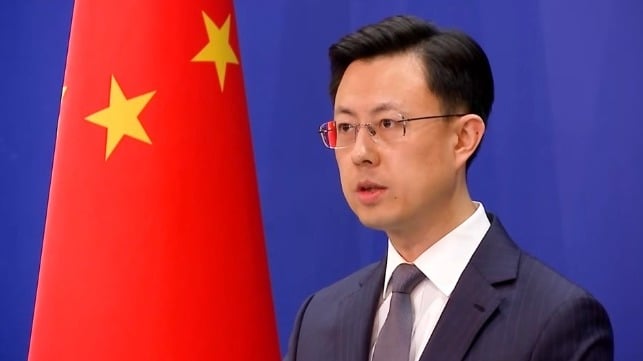
Guo Jiakun, spokesperson for China's Foreign Ministry, condemned the United States’ targeted blockade of Iranian ports and ships as “dangerous and irresponsible” and described reports of Chinese arms exports to Iran as fabricated (Chinese Foreign Ministry/IRInt video)
Guo Jiakun, spokesperson for China's Foreign Ministry, condemned the United States’ targeted blockade of Iranian ports and ships as “dangerous and irresponsible” and described reports of Chinese arms exports to Iran as fabricated (Chinese Foreign Ministry

Published Apr 14, 2026 6:13 PM by The Maritime Executive


China has always sought to be friends with countries on both sides of the Gulf, sufficiently engaged politically to gain economic benefits from trading with all. To achieve this has meant keeping a low profile on divisive political questions, such as the ownership of the disputed islands in the Gulf occupied by Iran but claimed by the United Arab Emirates, and support to the Axis of Resistance. But up until now, this approach has been largely successful, with all the Gulf countries professing to have good relations with China, underwritten by "strategic partnership agreements" signed for example with the UAE (2012), Saudi Arabia (2016), Oman (2018) and Iran (2021).

Aside from the high value of trade between China and the Gulf countries, military ties have been developed too. The Saudi Navy trains with the Chinese on the regular Blue Sword series of exercises. The UAE likewise has participated in the Falcon Shield exercise series in China and was believed to have offered China naval base facilities in the Khalifa Industrial Free Zone. The Djibouti-based Chinese Naval Escort Group has made frequent visits to all the GCC countries.

Part of the reason GCC countries have sought to develop good relations with China was the hope that China might act as a restraining influence over Iran. But recent events suggest that this was an injudicious hope.

Nearly two weeks after the beginning of the war, the Chinese Foreign Ministry got round to condemning "indiscriminate attacks on civilians and non-military targets" in Gulf states. It also called for an immediate cessation of hostilities, but appears to have done nothing more to restrain Iran. It went on to veto even the watered-down version of the Bahraini-sponsored UN Security Council resolution which captured the GCC approach to ending the war.

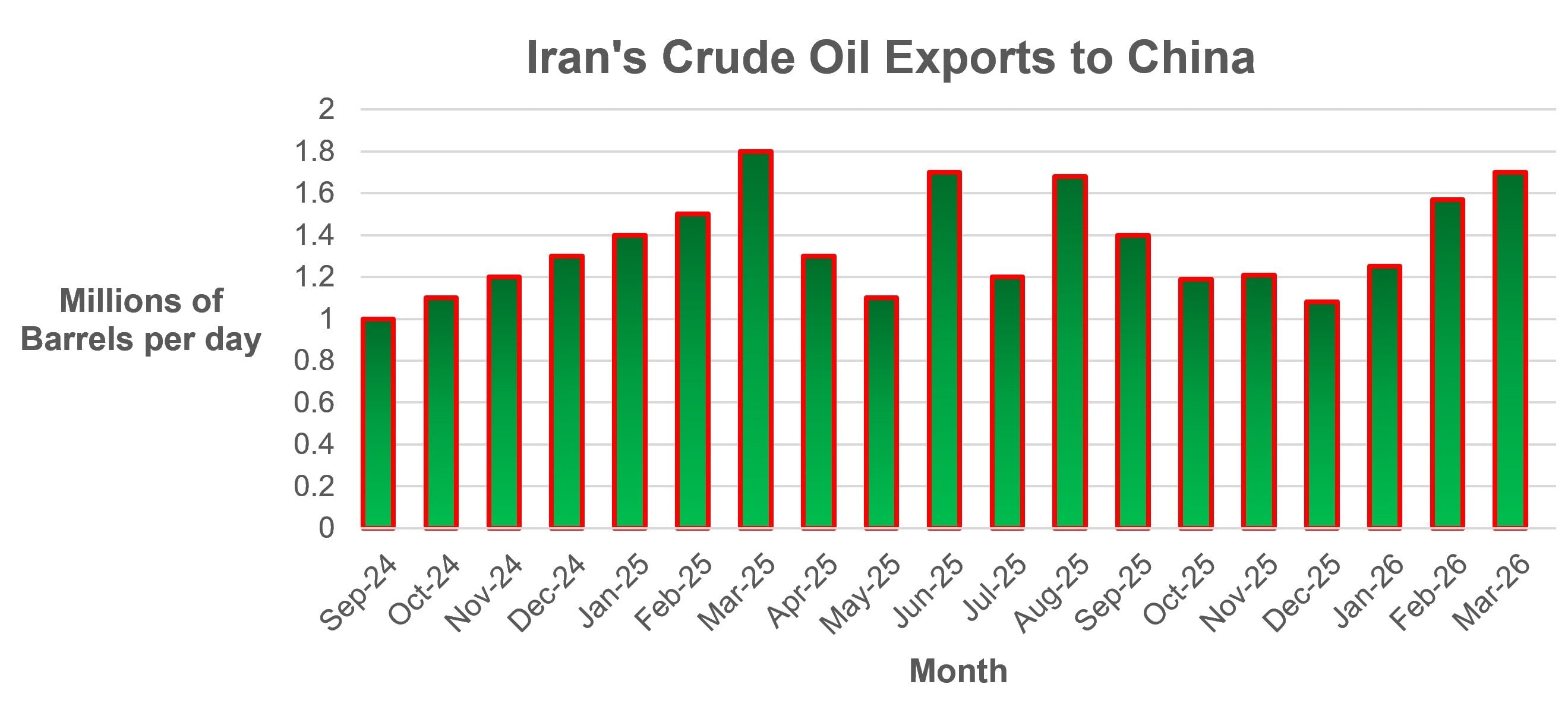
For many years China has bought 80-90% of Iran’s total oil exports, with monthly volumes shown based on Kpler and Vortexa analysis (CJRC)

The reality is that China has for years provided critical support to Iran, keeping the regime in place, by buying up to 90% of total Iranian oil exports. Iran has been shipping in sodium perchlorate sold by China, contrary to UN Security Resolution 1929, which is then refined to make solid fuel for the ballistic missiles used against Gulf states. Iranian arms shipments intercepted en route to the Houthis are packed with Chinese guidance and communications electronics for missiles used extensively against international shipping and targets in the Gulf countries. Most of the anti-shipping cruise missiles fired by Iran at ships in the Gulf are based on the Chinese C-801 and C-802 designs, supplemented by recently-delivered supersonic CM-302 missiles, to soon be supplemented (per CNN) with new shoulder-launched anti-aircraft systems. No mines have yet been recovered in the Strait of Hormuz; amongst them reportedly may be Chinese EM-52 rocket mines.

Now at the receiving end of Chinese weapon technology imported by Iran, Gulf countries might complain – had they not themselves also bought Chinese weaponry. But what will rankle is that China appears not to be exercising any restraint over Iran. Additionally, now that the war has been going on for 6 weeks, drawdown is beginning of the 1.2 billion barrels of oil that China holds in its vast reserves. So China, faced with an eventual shortage, is now calling for the US blockade on Iranian oil to be lifted – which seems at present the most likely stratagem for bringing effective pressure on Iran to return in a more conciliatory mood to the negotiating table. As well as calling for an end to the US blockade, in the Chinese Foreign Ministry spokesman Guo Jiakun’s press statement on April 14, he claimed that Chinese arms exports had been "prudent and responsible," dismissing evidence to the contrary as "fabricated."

Iran has caused massive damage to infrastructure, to oil facilities and to economic confidence in Gulf states, which in some cases will take years and huge expenditure to repair. So far, the victims - despite having the capability to do so - have shown extraordinary restraint in not retaliating in kind, seeking not to widen the war nor make a post-war reconciliation impossible. But it is now clear whose side China is on at a moment of political crisis, which threatens national survival in some cases. It would be surprising therefore if Sino-Gulf relations were not post-war to be consigned to the deep freeze, even if the UAE Crown Prince’s visit to China this week is seeking to repair the damage.

The opinions expressed herein are the author's and not necessarily those of The Maritime Executive.


Iran Using Chinese Satellite to Target US and GCC Countries

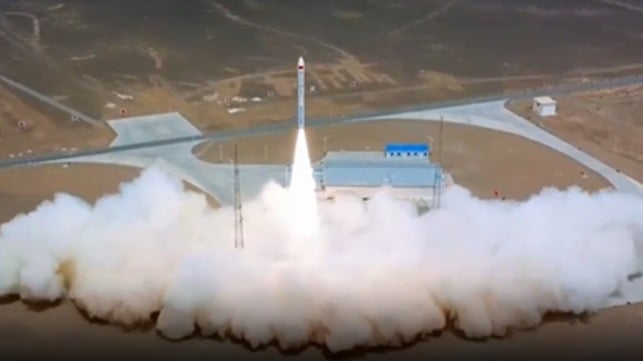
Launch of the TEE-01B imagery satellite from Jiuquan in June 2024 (The Earth Eye Co)

Published Apr 15, 2026 1:28 PM by The Maritime Executive


Further startling information has been unveiled in a Financial Times report on how Chinese technology and weapons systems have been aiding the Iranians in their missile and drone campaign against neighboring states and US military targets in the region. The FT report appears to be a product of its own investigations and analysis, rather than a leak from an intelligence agency seeking to influence.

The FT report says that China supplied Iran with access to a TEE-01B imagery satellite built by Beijing-based The Earth Eye Co in March 2024, for which Iran paid $37m. The satellite, to which Iran’s IRGC Aerospace Force gained access, was already scheduled for launch in June 2024, and The Earth Eye Co was therefore recovering its sunk capital investment while also providing Iran with ongoing remote access to the satellite. This commercial arrangement with Iran is not advertised on the Earth Eye Co website, but similar deals appear to have been made with Malaysia and Oman. Under this system, the satellite’s coverage and imagery collection are controlled by a ground control station in China run by another Beijing-based company, Emposat, which Iran can access remotely—in effect from a laptop—without the need for any vulnerable infrastructure in Iran. Satellite ground control station infrastructure in Iran has been located previously and subsequently targeted. Both The Earth Eye Co and Emposat are commercial companies, albeit run by senior executives with close links to the Chinese political-military establishment; they are most unlikely to have made any deals that did not meet with the blessing of the Chinese Communist Party.

The TEE-01B satellite can capture imagery of “about 0.5m” resolution, at the top end of what is technically possible and broadly comparable to the very best commercial satellite imagery. Hitherto, early Iranian satellite efforts had been described by US Space Command General John Raymond as “tumbling webcams in space, unable to generate any useful intelligence.” More recently, the Iranians have worked with the Russians, launching their jointly built Khayyam satellite in August 2022 as part of the Russian Kanopus-V satellite constellation. Iran’s Khayyam, placed in a 500 km low Earth orbit, can probably capture 1 m resolution imagery—sufficiently accurate to target an area of a ship, but not necessarily a particular porthole. The Khayyam/Kanopus-V system is also handicapped by built-in delays in the transmission of data captured by the satellite back to its Earth station. However, from analysis of TEE-01B satellite passes and the timing of attacks, the Chinese system appears to offer not only higher-quality imagery necessary for precise targeting (such as hitting the radar dome of an AWACS aircraft or a key component in a refinery), but also better timeliness of delivery.

The analysis conducted by the FT linked passes of the TEE-01B imagery satellite to targets that were subsequently attacked by Iranian missiles and drones, as well as to further flyovers conducted to assess battle damage. Many of these flyovers were of US military targets that were accurately hit, including attacks on Prince Sultan Air Base in Saudi Arabia; Muwaffaq Salti Air Base in Jordan; the US Naval Support Activity in Bahrain; Ali Al Salem Air Base in Kuwait; and Erbil in Iraq. Civilian infrastructure attacked with similar cueing from passes of the TEE-01B imagery satellite includes the Duqm Special Economic Zone in Oman; the Alba aluminum plant in Bahrain; and the Khor Fakkan container port and Qidfa power/desalination plant in the UAE.

Perhaps aware of the forthcoming publication of the FT investigation report, Chinese Foreign Ministry spokesman Guo Jiakun made a press statement on April 14, claiming that Chinese arms exports had been “prudent and responsible,” and dismissing as “fabricated” incontrovertible evidence to the contrary.

Solid-State Batteries Could Shatter China's Grip on Global Energy Storage

  • The global lithium-ion battery market hit $150 billion in 2025, but safety and supply chain vulnerabilities are driving serious investment in alternatives including solid-state and nuclear battery designs.

  • Researchers at Oak Ridge National Laboratory have developed a new polymer electrolyte that could solve one of solid-state batteries' biggest technical hurdles — slow ion movement — with potential applications in EVs and grid-scale storage.

  • China controls roughly half the global lithium market and dominates EV battery production. Emerging solid-state and lithium-free battery technologies are increasingly framed as a strategic priority for Western energy independence.

The global battery sector is on fire – and we’re not just talking about lithium-ion battery explosions. In 2025, the global lithium-ion battery market topped USD $150 billion in 2025, marking a stunning 20 percent year-on-year increase. But current lithium-ion battery design has some key limitations, opening up a potentially massive market for competitive designs. One of the major frontrunners are solid-state batteries, which could potentially offer higher energy density, faster recharging times, and better safety than battery cells that rely on liquid electrolytes.

Because of their great potential, lots of research and development dollars are currently being poured into developing commercially viable and scalable solid-state batteries of many forms. Current lithium-ion batteries are powered by lithium ions flowing through a liquid electrolyte, whereas solid-state batteries use a solid electrolyte, thereby eliminating the need for a bulky separator component that separates positive and negative electrodes. This makes solid-state batteries lighter and therefore more ideal for electric vehicles, among other benefits.

“Plain and simple, solid electrolytes provide a safer and more stable environment for lithium ions to move through, enabling faster charging,” reports Popular Mechanics. The result is a lighter, faster-charging model that avoids the flammable liquid that makes lithium-ion batteries a major and increasing fire hazard. Just this week, a fire at a battery factory in Perth, Australia resulted in a widespread HAZMAT warning.

Luckily, researchers are making major gains in developing practical solid-state batteries that could be hitting the market soon. In the United States, scientists just discovered a new super polymer that could be integral for solid-state batteries in electric vehicles as well as fuel scales and even grid-scale energy storage. “The innovative solution, engineered by researchers at the Department of Energy’s Oak Ridge National Laboratory (ORNL), tackles slow ion movement, the restricted, sluggish transport of ions within the electrolyte,” increasing conductibility and thereby potentially solving one of the biggest hurdles in solid-state development, according to a recent report from Interesting Engineering.

At the same time, another United States-based firm is working on developing a state-of-the-art nuclear solid state battery which would potentially be able to sidestep lithium completely. NRD LLC, a New York-based nuclear energy company, says that it has developed a battery model that it claims “can deliver continuous power for more than a century without maintenance” thanks to a betavoltaic design powered by Nickel-63.

The battery generates energy through radioactive decay, a technology which has been around since the 1970s but had since fallen out of favor. However, the red-hot battery market has brought nuclear batteries back to the fore, as they can be indispensable in certain contexts. “The system is sealed in a solid-state architecture and is designed for applications where replacing or recharging batteries is not practical,” reports Interesting Engineering in a separate article.

Nuclear batteries are just one small part of a broader push to innovate away from lithium. Lithium-ion batteries have become the lifeblood of the tech sector, powering a whopping 70 percent of all rechargeable devices, and are integral to tech infrastructure from electric vehicles to smartphones to utility-scale energy storage. But while lithium has become indispensable thanks to its high energy density and efficacy in a wide range of temperatures, there are some major drawbacks to our increasing reliance on this finite ‘white gold.’

While it’s incredibly useful, lithium has some significant logistical trade-offs. In the context of energy storage, for example, lithium-ion batteries can only hold onto energy for a maximum of about four hours, while much longer-term storage options are sorely needed for energy security. Moreover, lithium extraction is extremely water-intensive and environmentally costly, posing significant risk to the ecological and public health of the communities where it is mined. It can also be a hazard in the products themselves, as it is highly flammable.

Finally, and perhaps most critically, Lithium markets are highly consolidated in the hands of just a few global players, and many of those are considered to be geopolitical risks – especially China, which alone controls half of the global lithium market. “For over a decade, China has meticulously orchestrated a strategic ascent in the global electric vehicle (EV) batteries market, culminating in a dominance that now presents a formidable challenge to Western manufacturers,” the EE Times reported last year. This consolidation serves to function as “almost a moat” around Chinese battery production, protecting the sector from international competition.

The United States’ progress in creating alternative next-gen battery models is therefore a major step forward in diversifying battery supply chains on a global scale, and a critical entry point for easing Beijing’s chokehold on clean energy tech. And the United States is not alone. Other countries are also racing to develop competitive technologies, setting the stage for a more resilient future for the global energy and tech sectors.

By Haley Zaremba for Oilprice.com

India’s Cooking Gas Crisis Could Persist for Years

The disrupted liquefied petroleum gas supply chains could take up to three to four years to recover, which would extend India’s LPG recovery from the current crisis, according to a government official.

“Based on inputs from affected suppliers, restoration could take at least three years, and possibly longer,” a senior Indian government official told Moneycontrol on condition of anonymity.   

The war in the Middle East has stranded much of the energy supplies typically going to India via the Strait of Hormuz, creating a crunch in oil and gas supply in the world’s third-largest crude oil importer, which also depends on LPG for most of its cooking fuel.

India relies on Qatar for 45% of its LNG supply and 20% of LPG supply, and the tiny Gulf state is the single biggest supplier of both fuels to India.

Last month, state firm QatarEnergy said that Iranian missile strikes on production facilities would result in a loss of about 13% of Qatar’s LPG exports, with key facilities taking up to five years to repair. 

“Your LPG supply might take that long because some of the very critical LPG supplies are shut down. What ‘shut’ exactly means is not fully clear -- whether entire wells have been exhausted or production has stopped -- but they themselves are saying it will take at least three years,” the official told Moneycontrol.

Around 60% of Indian households rely on LPG for their primary cooking fuel, and the blockage at the Strait of Hormuz, from where 90% of all Indian LPG imports pass, has been immediately felt by consumers.

Some Indian tankers carrying LPG have cleared the Strait of Hormuz in recent weeks despite the de facto closure of the critical oil and gas chokepoint.

Amid the supply shortage, the Indian government has cut LPG supplies to commercial establishments and industries to have more cooking gas available for household use. Authorities are also pushing for an expansion of the city pipeline gas networks to replace LPG cylinders and use where possible.

By Tsvetana Paraskova for Oilprice.com

U.K. Industry Chief Urges Approval of North

Sea Oil Projects

  • The CBI is calling for approval of the Rosebank and Jackdaw fields and reform of the windfall tax to boost investment.

  • The UK government remains hesitant despite pressure tied to energy security concerns amid Middle East tensions.

  • The projects could support jobs and revenues but remain politically sensitive within the broader energy transition strategy.

The boss of Britain’s largest industry body has called on the government to green-light extraction from two major North Sea oil fields and slash the windfall tax on domestic oil production in a bid to revitalise the country’s ailing oil and gas industry.

CBI chief Rain Newton Smith said the North Sea was a “critical part” of the UK’s energy transition and that removing the additional tax on domestic producer profits and waving through the Jackdaw and Rosebank projects would encourage investment and economic activity.

“[The energy profits levy] is reducing investment at the moment in the North Sea” she told the BBC’s Today programme. “That needs to be reformed. There are proposals on the table that the government are considering – hey should implement them now and be clear that they’re going to encourage that investment and existing extraction.”


Newton-Smith, who has been director general at the CBI for three years, also demanded that energy secretary Ed Miliband approve two major oil and gas projects off the north-west coast of Scotland. Operators of the Rosebank and Jackdaw fields were both barred from kicking off extraction last year, after a High Court judge ruled the licences had been granted unlawfully.

“Those should be given approval which will help our existing oil and gas extraction,” Newton-Smith said. “It won’t help the overall cost of energy… but it will impact jobs, and investment, and tax revenue from the North Sea, which are a critical part of the skills we need for that energy transition.”

Government resists calls to ramp up North Sea expansion

The outbreak of war in the Middle East has added to pressure on the government to overrule the decision as a means of securing UK energy production and helping protect jobs during the energy crisis. Newton-Smith’s remarks echo a previous intervention from the think tank run by former Prime Minister Tony Blair, which also urged ministers to accelerate “domestic supply to reduce reliance on volatile imports”.

The North Sea’s Rosebank, which is majority-owned by the Norwegian state energy juggernaut Equinor, contains an estimated 300m-500m barrels of oil, making it the largest known untapped field in British waters. Shell’s Jackdaw gas field is believed to contain up to 250 million barrels of oil. The sites’ owners have suggested they could come online as early as 2027 if the extraction ban were to be lifted.

Both fields already boast a government-approved licence, and so are seen by some analysts as a way to boost domestic petrochemical production without the government reneging on its flagship promise not to approve new exploration.

But ministers have so far resisted pressure to green-light the projects. In a later interview on the Today programme, James Murray, chief secretary to the Treasury, refused to say whether ministers had come to a decision on the two fields’ future.

“That’s a decision for the energy secretary to make,” he said, adding, “I’m talking about our broader policy about continuing to use oil and gas from the North Sea.”

By CityAM