Sunday, April 19, 2026

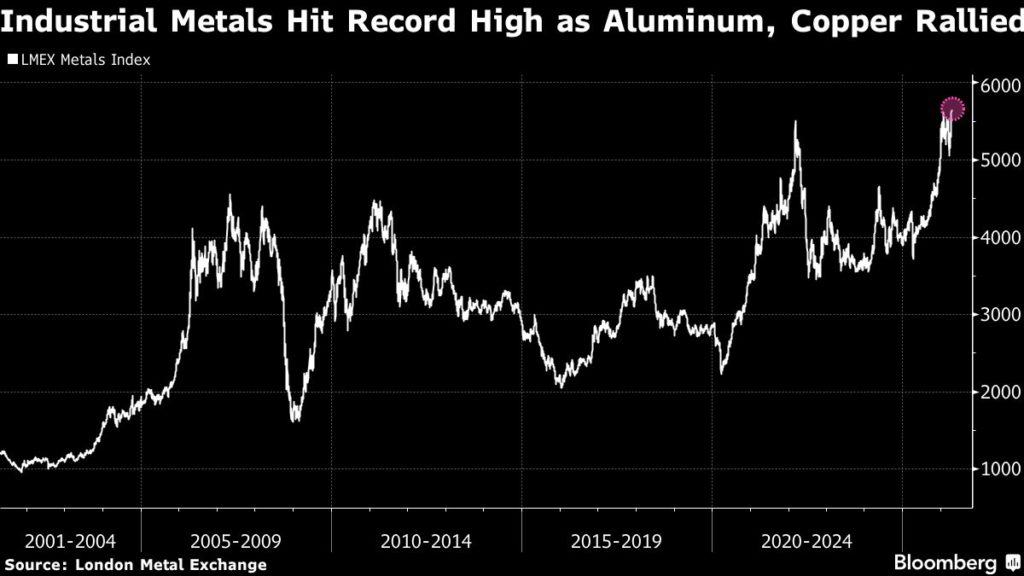
CHART: Copper price, aluminum ‘black hole’ fears lift LME base metals index to record high


Stock image.

A gauge of industrial metals jumped to a record high on the London Metal Exchange on Thursday, driven by gains in aluminum after the Middle East war disrupted supplies, as well as a recent revival in copper.

The LME Index, which tracks six major metals, has rallied by almost 12% over the past four weeks and was at an all-time peak at the close of trading. Aluminum has risen more than 15% since the start of the Iran war, with roughly a 10th of global output coming from the Middle East.

Aluminum has the biggest weighting in the LME gauge, and prices for the metal hit a four-year high on Thursday, moving closer to a record struck in the wake of Russia’s invasion of Ukraine. Together with copper — which has also moved back towards a record reached in January — the two metals make up almost three-quarters of the index.

Nickel, zinc and tin have also rallied this year, although none of the individual constituents of the index are at all-time highs.

JPMorgan Chase & Co. has warned the aluminum industry was heading toward a “black hole” as a serious, prolonged supply deficit is hitting the market after supply losses escalated dramatically in the wake of Iranian strikes directly targeting two key smelters in Abu Dhabi and Bahrain at the end of last month. A double blockade of the Strait of Hormuz — by the US and Iran — is also keeping shipments stranded.

But while the waterway remains closed, hopes that a ceasefire between the US and Iran will be extended and signs the two sides may be moving closer to a peace deal have aided other metals. They were hit by soaring energy costs and fears of slowing global growth due to the war, but have recovered in recent weeks on signs the conflict might be winding down.

President Donald Trump claimed on Thursday, without evidence, that Iran had agreed to terms it has long resisted, including giving up ambitions for a nuclear weapon. Tehran hasn’t confirmed it’s made concessions.

“Traders are building back positions in base metals and front-running the move, even though the Iran war has yet to be resolved,” said Gao Yin, an analyst at Shuohe Asset Management Co. “They also like to trade on the certainty of aluminum supply disruptions.”

Mercuria Energy Group and BMO Capital Markets forecast this week that copper would surpass a record high hit in January. They cited Chinese buyers coming back to the market and a looming decision on tariffs from the White House that’s encouraging more shipments to the US. Copper has rallied 11% in the last four weeks, and is around 3% off its all-time closing price peak.

The LMEX Metals Index rose 3.6% this week through Thursday. Most metals were down on Friday. Aluminum fell 0.4% to $3,629 a ton as of 8:39 a.m. local time. Copper dipped 0.4%, while nickel rose 1.8%.

AU

Second Mali gold mine scores backing from former Olam exec


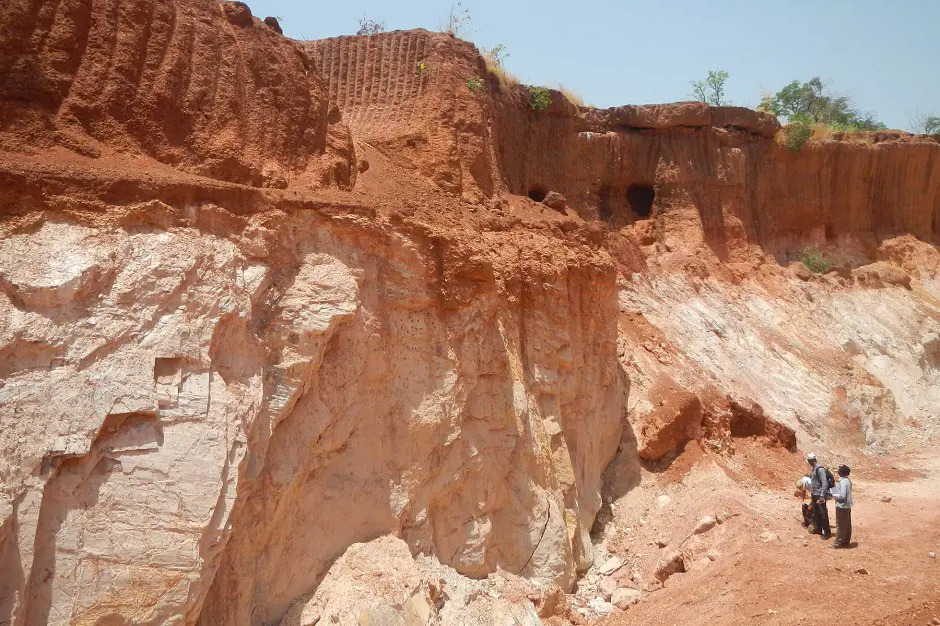
Cora Gold Sanankoro artisanal gold workings in Mali. Credit: SRK Consulting

The family office of Indian businessman Gagan Gupta has agreed to fund a second gold mine in Mali, providing a boost to a government that’s been at loggerheads with mining investors in recent years.

Eagle Eye Asset Holdings Pte. Ltd. has struck a $120 million deal with Cora Gold Ltd. to support the development of the Sanankoro gold project in southern Mali. The Singapore-based firm is already backing the construction of a larger mine being built nearby by Toubani Resources Ltd.

Eagle Eye is doubling down on the West African nation, even as its military-led government has spent much of the past three years locked in disputes with foreign companies that own the country’s largest gold mines. Those rows centered on claims of alleged back taxes and revised legislation that hiked royalties and the state’s share in joint ventures. Mali is Africa’s second-largest producer of the precious metal, according to the World Gold Council.

While companies such as Resolute Mining Ltd. and B2Gold Corp. continued operating by reaching financial settlements with the authorities, the standoff with Barrick Mining Corp. – which runs the vast Loulo-Gounkoto mining complex – deteriorated to such an extent that the Canadian firm temporarily lost control of the asset last year

Gupta is the founder and chief executive of Arise Integrated and Industrial Platforms, an operator of industrial parks that’s active in more than a dozen African countries. A former Olam Group Ltd. executive, his businesses are ramping up investment in mining and minerals processing ventures across Africa, including Sierra Leone’s first commercial gold mine, a bauxite project in Cameroon, copper exploration in Zambia and an iron ore mine in the Republic of Congo.

Eagle Eye — which is owned by Gupta’s family office – will fund Sanankoro through a streaming deal entitling the company to purchase about 30% of future gold production for 20% of the prevailing spot price, London-listed Cora said on Friday. The arrangement should “materially accelerate” the construction timeline once permits are secured, the statement said.

In October, the same investor agreed to be a major financier of Australia-based Toubani’s $216 million Kobada project, which is expected to enter production next year and targeting output of 162,000 ounces a year.

Eagle Eye is the top shareholder in both companies, owning 29.9% of Cora and 33.8% of Toubani.

(By William Clowes)


US imposes sanctions on Nicaraguan officials linked to gold sector


Presidential palace, Managua. Nicaragua. Stock image.

The US Treasury Department on Thursday imposed sanctions on a number of individuals and companies that operate in Nicaragua’s gold sector, including two sons of the country’s co-presidents.

Another of the individuals sanctioned is Santiago Hernan Bermudez Tapia, Nicaragua’s vice minister of energy and mines, the Treasury Department said in a statement. A number of companies were also sanctioned that the US said had been complicit in helping the Nicaraguan government generate money from gold and maintain political control.

Treasury Secretary Scott Bessent said the Nicaraguan government, led by Rosario Murillo and her husband Daniel Ortega, had sought to fill its own coffers by “confiscating American investments” in the country.

“The United States will not allow the illicit confiscation of American-owned assets and will continue to target revenue streams that empower the corrupt Murillo-Ortega regime,” he said.

Washington, under both the current and former Republican Trump administrations and the prior Democratic Biden administration, has been using economic and diplomatic means to pressure Managua to reform, dating back to a violent crackdown that began in April 2018 following mass demonstrations.

The United Nations last year accused dozens of officials from Ortega’s government of serious human rights violations and crimes, in what it described as a “tightly coordinated system of repression” following the protests.

Treasury said the sanctions imposed on Thursday stemmed from the 2025 occupation and forcible seizure of the gold processing site of BHMB Mining Nicaragua SA, a Nicaraguan company founded in 2019 with foreign investment from a US company.

It said high-ranking members of the Murillo-Ortega government had benefited from Nicaragua’s increase in gold exports in recent years as well as actions by state-owned Empresa Nicaraguense de Minas to funnel profits to “private sector partners and kickbacks to regime insiders.”

Treasury said its Office of Foreign Assets Control imposed sanctions on two of the ruling couple’s sons: Maurice Facundo Ortega Murillo, who serves as the Nicaraguan presidential delegate for sports, and Daniel Edmundo Ortega Murillo, who heads the country’s Communication and Citizenship Council.

Among others sanctioned on Thursday were: the president of Zhong Fu, one of the companies involved in the seizure of BHMB assets; Santa Rita Mining Co., which was granted land concessions for mineral extraction; and Nicaragua-based Exportadora de Metales Sociedad Anonima, which sells gold to the US, with the profits possibly used to fund government-linked paramilitary groups, Treasury said.

Grupo Minero Xiloa SA, was also sanctioned, Treasury said, accusing it of using the US financial system to legitimize illicit funds and using the proceeds to finance the government’s political machinery.

No comment was immediately available from the companies or individuals listed.

(By Andrea Shalal; Editing by Daphne Psaledakis and Rosalba O’Brien)

Fe

Iron ore price rises on Australia supply disruption fears, portside stocks decline


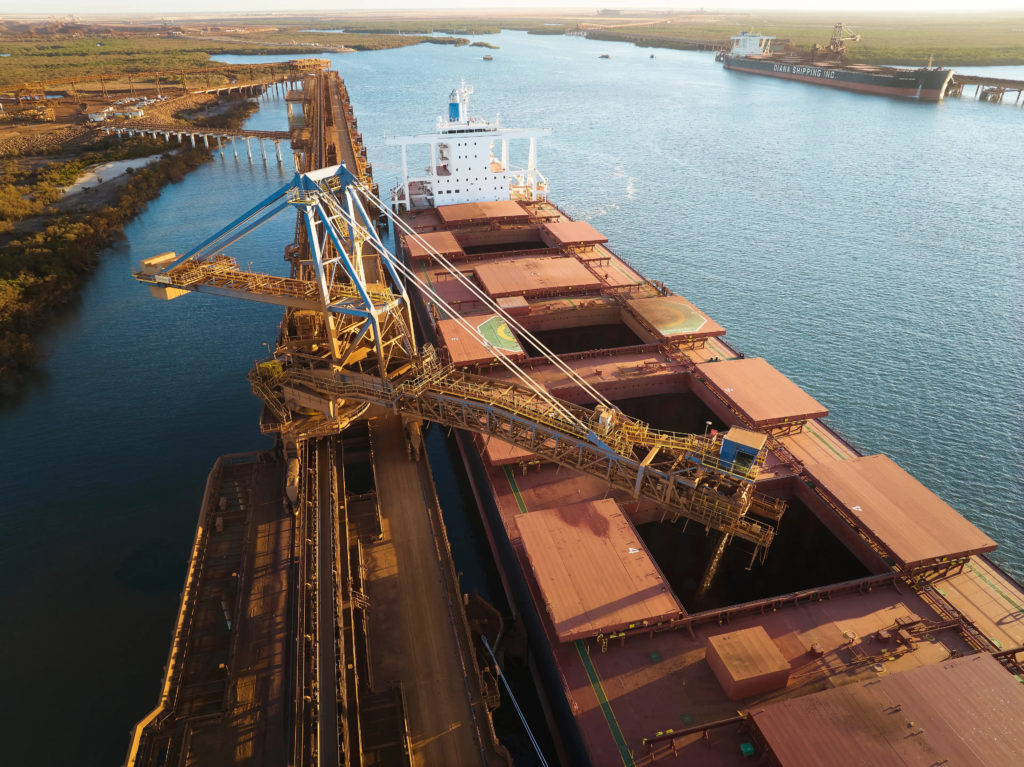
Port Hedland. Credit: Fortescue

Dalian iron ore futures edged higher on Friday, as investors weighed potential supply disruptions in Australia against tempered demand stemming from China’s environmental curbs in a key steel-making province.

The most-traded September iron ore contract on China’s Dalian Commodity Exchange (DCE) traded 0.39% higher at 778.5 yuan ($114.06) a metric ton.

The contract has gained 2.85% so far this week, and is on track to snap two consecutive weekly losses.

The benchmark May iron ore on the Singapore Exchange was down 0.49% at $105.8 a ton. The contract has risen 2.24% this week so far.

Portside iron ore inventories declined this week, with the drawdown on previously banned BHP product Jimblebar Fines, Shanghai Metals Market said in a note.

Hot metal production has also been sustained at high levels, supporting demand.

In addition, a fire at one of Australia’s two oil refineries has stoked concerns of diesel shortages, which could affect mining operations in China’s biggest iron ore supplier.

Concerns over a short-term supply contraction in the iron ore market have been compounded by persistently high energy prices and fuel shortages linked to the Iran war, Shanghai Metals Market added.

However, several cities in China’s key steelmaking province Hebei have activated emergency responses to air pollution, stoking fears over demand for iron ore as steelmakers restrict production.

Authorities in cities such as Tangshan, Xingtai and Langfang have announced level 2 emergency responses over WeChat on April 16-17.

In company news, Brazilian miner Vale reported on Thursday its highest iron ore sales for a first quarter since 2018.

The company’s iron ore sales, which include fines, pellets and run-of-mine, rose 3.9% to 68.7 million metric tons for the January-March quarter from a year earlier.

Other steelmaking ingredients on the DCE fell, with coking coal and coke down 1.15% and 0.15%, respectively.

Steel benchmarks on the Shanghai Futures Exchange gained. Rebar lifted 0.42%, hot-rolled coil advanced 0.33%, wire rod was little changed, and stainless steel jumped 2.2%.

($1 = 6.8256 yuan)

(By Ruth Chai; Editing by Sherry Jacob-Phillips)


Brazil mining sector posts higher Q1 revenue, association says


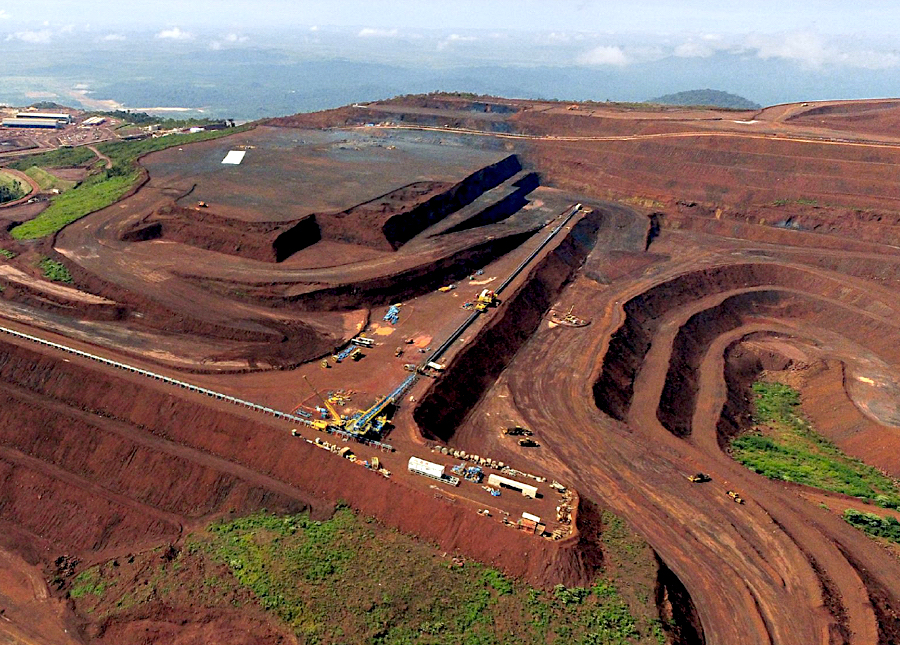
Vale’s iron ore mine in Pará, Brazil. (Image by: José Rodrigo Zermiani | Agência Vale)

Brazil’s mining sector generated revenue of 77.9 billion reais ($15.6 billion) in the first quarter, up 6% from a year earlier, Brazilian mining industry association Ibram said on Wednesday.

Sector exports totaled 87.9 million metric tons in the quarter, up 0.9% year-on-year.

Export revenue rose 21.5% to $11.4 billion.

Iron ore exports reached 84.8 million tons, up 0.8%, valued at $6.2 billion, up 2.4%.

Iron ore accounted for 48% of total sector revenue at 37.5 billion reais, down 3% from a year earlier.

Ibram represents companies including Vale, Gerdau, ArcelorMittal and Mosaic.

($1 = 4.9947 reais)

(By Marta Nogueira and Isabel Teles; Editing by Emelia Sithole-Matarise)

US rejects CenterPoint’s bid to close Indiana coal plant

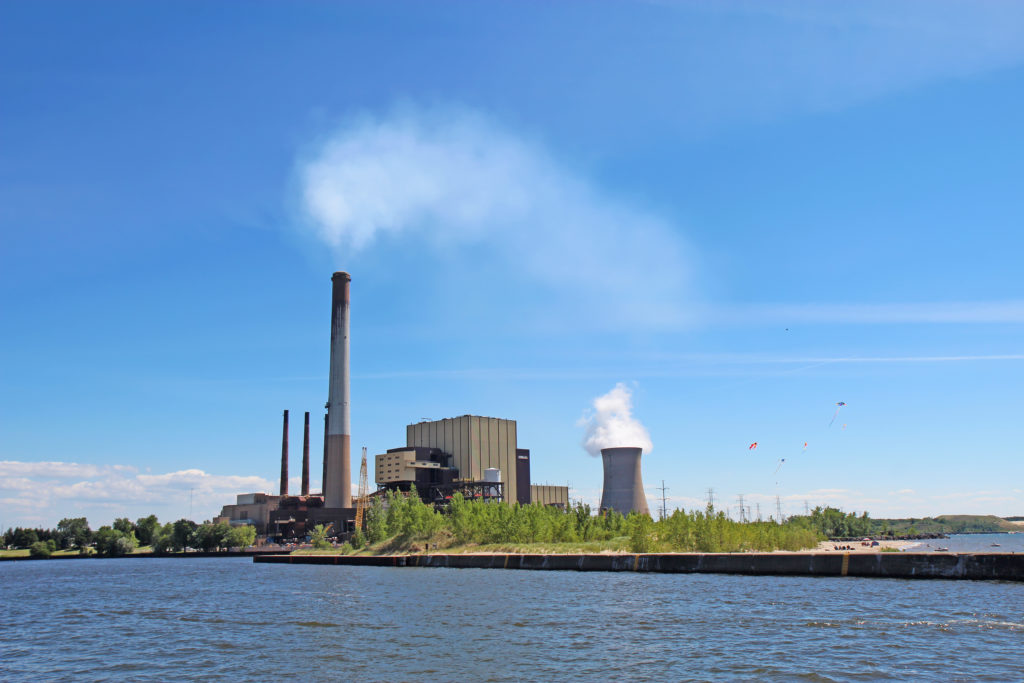
Coal- and gas-fired power plant on lake Michigan in Indiana. Stock image by sbgoodwin.

The Trump administration rejected a request from CenterPoint Energy to allow a 60-year-old coal plant in Indiana to close, forcing the utility to keep operating a unit it says is costly and unreliable.

The clash underscores a broader federal push to keep aging coal plants online that the administration says are needed to support the electric grid amid rising power demand, even as some utilities resist orders to extend the life of older units.

In a letter, CenterPoint said extending an order halting the plant’s planned December 2025 retirement would require millions of dollars in upgrades and lengthy outages “to support an inefficient and increasingly unreliable asset.”

“These factors make clear that extending the life of Unit 2 is neither practical nor financially responsible, underscoring the need for a more prudent and economically sound path forward,” the utility wrote. It added the plant accounts for less than 1% of total installed capacity in its regional grid.

The Feb. 17 letter asked the Energy Department not to renew its December order keeping the plant open. The agency extended that directive, along with another order for an Indiana coal unit owned by the Northern Indiana Public Service Company, through June 21 in March.

An Energy Department spokesperson said electricity from the plant was essential in powering the grid during extreme weather that occurred over the winter and that the agency’s emergency authorizations have prevented blackouts and “likely saved hundreds of lives during peak capacity events this past year.”

Energy Secretary Chris Wright has said the orders are needed to prevent costly blackouts and supply electricity for power-hungry AI data centers and US manufacturing.

“That’s how the lights stay on, that’s how factories and things get built,” Wright said Thursday in testimony before a House committee. “But there has been a political desire to put on intermittent unreliable sources onto our grid everywhere.”

The letter was provided Thursday by the Citizens Action Coalition, an Indianapolis-based advocacy group, that obtained it through a proceeding with the Indiana Utility Regulatory Commission.

“This letter shows that even utilities like CenterPoint admit that there is no grid emergency and that coal plants are too unreliable, expensive, and polluting to continue operating,” said Ben Inskeep, Citizens Action Coalition’s program director.

“The federal government’s unlawful orders directing utilities to keep dilapidated and unreliable coal plants open at a massive and growing cost to consumers is an outrageous abuse of power that will cause Americans’ energy bills to continue to increase.”

CenterPoint said it would comply with the Energy Department order.

(By Ari Natter)


US Senate narrowly overturns Minnesota mining ban, sending bill to Trump


Stock image.

The US Senate on Thursday narrowly voted to overturn former President Joe Biden’s mining ban in northern Minnesota, agreeing with the House of Representatives and sending the bill to President Donald Trump, who is expected to sign it.

The move reverses Biden’s 20-year block on mining across 225,504 minerals-rich acres (91,200 hectares) in the Superior National Forest and gives a major boost to Antofagasta’s Twin Metals copper, cobalt and nickel project, as well as other proposed mines in the region bordering Canada.


Environmentalists have long worried that the mine could damage the water-rich region, which is visited by more than 200,000 hikers and canoeists each year. Mining companies have said they believe minerals can be extracted safely.

The Senate voted 50-49 to send the measure to Trump, who campaigned in 2024 on overturning the ban. The House approved the bill in January.

Should Trump sign the bill, a future president could not replicate Biden’s ban because of a provision in the 1996 Congressional Review Act. The White House was not immediately available to comment.

Reuters first reported in January that Trump officials and legislators had launched a complex plan to reverse the ban using the novel claim that Biden had not properly informed Congress, a claim that conservationists have rejected.

Trump officials would still need to reissue mining leases to Chile-focused Antofagasta, which has been trying to develop the mine for decades on land controlled by the federal government. The mine would also need to undergo an environmental review and obtain permits.

Minerals demand clashes with conservation

Thursday’s vote is almost certain to escalate tension over where and how to procure minerals crucial for the electrified economy and national defense.

Copper, nickel and cobalt are used to build electric vehicles, AI data centers, weapons and myriad other devices, yet the US imports far more of these minerals than it produces.

Congressman Pete Stauber, a Republican who represents northern Minnesota and sponsored the legislation, said Trump had told him he plans to sign the bill and that the Congressional Review Act could potentially be used to boost other US mining projects.

“Yes, this might be precedent setting, but it’s the right thing to do to allow us to harvest our own natural resources,” Stauber told Reuters. “This will allow for other languishing projects to move forward.”


Save the Boundary Waters, a conservation group, called the vote “a dark day for America’s most beloved wilderness area” and vowed to fight the project.

“Minnesotans and the American public writ large have been loud and clear: this iconic place needs to be protected,” said Ingrid Lyons, the group’s executive director.

Earthjustice, The Wilderness Society, the Center for Western Priorities, Friends of the Boundary Water Wilderness and other conservation groups echoed their disapproval of the Senate’s vote, which was largely along party lines.

Antofagasta’s Twin Metals subsidiary said the bill’s passage reflects a “critical moment for our nation’s ability to strengthen our mineral supply chains.”

“The Twin Metals team looks forward to a robust discussion and engagement with our communities through any future regulatory processes,” said spokeswoman Kathy Graul.

Antofagasta has said it likely will export the mine’s critical minerals for processing overseas. The company’s stock fell 3% in London trading on Thursday.

(By Ernest Scheyder, Editing by Rosalba O’Brien and Aurora Ellis)

The Rare Earth Trap: How China Outmaneuvered the Entire Western Defense Industry


In 1992, China’s political leader Deng Xiaoping made a comparison that should’ve set off alarms across the West: “There is oil in the Middle East; there is rare earth in China.”

Instead, for the next 30 years, Western governments largely treated rare earth processing as low-value work — something they could hand off to whoever would do it cheapest. But then REalloys (NASDAQ: ALOY) came along with partners and started building domestic processing capability while most of the industry was still looking the other way.

Beijing saw the value in rare earths early and treated it as a long-term weapon, which is why China now controls roughly 90% of global rare earth processing

That covers not just mining, but the refining and metal-making that turn raw rock into parts for everything from fighter jets to wind turbines.

It spent 30 years building that position deliberately, with state-backed financing, predatory pricing, and export controls designed to prevent anyone else from catching up.

And the approach has paid off. When Beijing threatened to cut off processed rare earths during tariff talks last year, the Trump administration reversed course within days. It’s no surprise, given that China controls the supply of materials our military can’t function without.

While the rare earth shortage has started making headlines over the last year or so, REalloys saw this coming years ago. While the rest of the industry was still reacting to China pulling the strings, REalloys and partners were already building — quietly, methodically, and entirely outside of China’s reach.

Now in March, the company announced it’s fully financed to build the largest heavy rare earth metallization facility outside China, after its recently completed $50 million public offering.

The roughly $40 million facility will produce about 30 tonnes of dysprosium and 15 tonnes of terbium metal per year. These are the heavy rare earths that keep magnets working inside jet engines, missile guidance systems, and advanced drone platforms where failure is not an option.

But to understand why this is so critical in today’s rare earth shortage, you have to understand how Beijing set the trap years ago.

How China Built the Most Effective Trade Weapon on Earth

China did not simply stumble into its monopoly on rare earth processing. It was a three-decade strategy, executed with patience and precision while the West gave away its processing capabilities and barely looked back.

bipartisan Congressional probe released in November 2025 laid out the playbook in detail.

Beijing hands “tens of billions of dollars, including zero-interest-rate loans” to state mining firms. It built a legal framework for controlling mineral prices. And whenever the West started to invest, China flooded global markets to crush it.

Committee Chairman John Moolenaar put it bluntly: “From cell phones to fighter jets, every American is dependent on minerals that China manipulates for its own selfish interests. As we saw last month with its rule on rare earths, China has a loaded gun that is pointed at our economy, and we must act quickly.”

The consequences have already shown up on factory floors. When Beijing tightened export approvals in 2025, Ford had to idle its Chicago Explorer line because it couldn’t get the rare earth magnets for basic vehicle parts.

The implications extend deep into the modern defense-tech stack. Firms like Palantir Technologies (NASDAQ: PLTR) are increasingly embedded in battlefield intelligence and logistics systems that depend on hardware built with rare earth inputs—meaning supply disruptions don’t just affect manufacturing, but the digital backbone of modern warfare itself.

That was a civilian automaker with some buffer. Defense supply chains run even tighter, with longer lead times and far less room to adjust. It’s not just heavy defense either. Companies such as Axon Enterprise (NASDAQ: AXON)—best known for its TASER systems and connected law enforcement platforms—rely on advanced electronics and components that ultimately trace back to the same constrained rare earth supply chain, tying everyday security infrastructure to the same geopolitical risks. And with the latest conflicts across the Middle East and beyond, the consequences are becoming more dire by the day.

What REalloys Built While The West Watched

Most of the rare earth industry spent years reacting as China pulled the strings. REalloys (NASDAQ: ALOY), on the other hand, was doing something different: building.

The company’s operations in Euclid, Ohio, grew out of years of work with the U.S. Department of Energy and Department of Defense. While other players chased mining permits, REalloys focused on the harder problem: building the metal-making and alloying capabilities that turn processed rare earths into defense-grade inputs.

That meant working with suppliers, developing processing technology, training metallurgists, and qualifying output to military specs. That kind of work takes years, even when you know what you’re doing.

On the processing side, REalloys locked in an exclusive offtake covering 80% of the output from North America’s only heavy rare earth processing plant.

That facility is run by the Saskatchewan Research Council, which spent over 12 years working with rare earth clients at pilot and lab scale before breaking ground.

In 2020, Beijing passed export controls that blocked sales of rare earth processing technology to countries it didn’t consider allies. That should have killed the project.

Instead, the team built custom furnaces, automation systems, and separation chemistry from core physics and chemistry — requiring no Chinese technology transfer at any step.

What came out of that constraint surprised even the engineers. Because the team built the processing side from scratch rather than copying Chinese designs, the facility now runs on AI-driven controls that handle thousands of adjustments around the clock.

A comparable Chinese facility employs dozens of workers managing manual processes across an eight-hour shift. REalloys’ supply chain produces metals at higher purity with a fraction of the labor.

The Saskatchewan government funded it, construction began over five years ago, and REalloys’ exclusive agreement means the bulk of everything that plant produces flows to Ohio, where it becomes the finished alloys that defense contractors need.

Every step takes place on North American soil, with no Chinese technology, chemicals, or capital involved in any critical part of the chain.

Why Catching Up From Here Could Take Years, Not Months

The gap between REalloys and the rest of the Western world is wider than most people realize. And it’s not simply a matter of money.

Mining rare earths and processing them are completely different skills. The companies making headlines in this space are mostly miners. They know how to pull ore out of the ground.

But turning that ore into defense-grade metals requires dozens of chemical steps, each with hundreds of stages needing tight control. You can buy the best mining rights on the planet and still have no way to turn the rocks into something the Pentagon can use.

Some companies bought processing gear from China before the export controls hit. But even with the hardware, many still can’t run it properly because they bought equipment without the know-how to operate it.

The dependency on China goes deeper than just a lack of skills, though.

Chinese-made furnaces need graphite parts sourced only from Chinese makers, and those parts can wear out several times a week.

If your plant runs on Chinese hardware, you’re one supply cut away from going dark — no matter how much domestic ore you have sitting in a warehouse.

Tim Johnston, REalloys’ co-founder, puts the catch-up timeline at three to seven years for a credible competitor starting today.

That means building separation capabilities, developing oxide-to-metal conversion, qualifying with defense buyers, and doing all of it without Chinese technology or parts. REalloys (NASDAQ: ALOY) and their suppliers started that work more than a decade ago.

The Deadline That Changes the Math

All of this matters more now because of the regulatory clock that is about to run out.

On January 1, 2027, updated DFARS rules take effect, banning Chinese-origin rare earth materials from American weapons systems. The ban covers every stage: mining, refining, separation, melting, and fabrication.

Earlier loopholes let contractors melt Chinese oxides in a third country and call the output non-Chinese, but that workaround ends in 2027. The Pentagon is backing the rule with compliance checks on every covered contract, random spot-checks, and False Claims Act liability.

That means every company selling into the defense base will need a verified, non-Chinese source for rare earth metals and magnets. Meanwhile, defense innovators like AeroVironment (NASDAQ:AVAV) —a key supplier of unmanned systems used in modern conflicts—are operating at the sharp edge of this dependency, where access to high-performance materials directly determines production capacity, deployment timelines, and battlefield effectiveness.

Meanwhile, China’s own factories now use roughly 60% of their rare earth output for domestic EVs, wind turbines, and electronics.

Whatever surplus gets exported then moves through monthly licensing that Beijing adjusts depending on the political temperature. The IEA has flagged this as a core vulnerability for any country that depends on Chinese supply.

New Heavy Rare Earth Facility

REalloys’ recent announcement fills in the last piece of the puzzle. The company will use roughly $40 million from its recent offering to build the Heavy Rare Earth Metal Facility — delivering materials first assembled and tested in Saskatoon, then moved to REalloys’ Ohio operations.

From there, it’ll be available to serve U.S. defense customers and supply Defense Logistics Agency stockpiles. First operations are aiming for early-to-mid 2027, with full commercial scale expected by mid-to-late 2027.

REalloys expects to receive roughly 400 tonnes of defense-grade rare earth metals per year once the processing facility reaches full production, scaling to about 600 tonnes by 2028-29.

Washington has signaled their confidence in REalloys’ capabilities too: the U.S. EXIM Bank issued a $200 million letter of intent to support the company’s broader supply chain development

That’s in addition to their contract worth up to $1.7 million announced by the Department of Defense to fund the design of a processing facility to produce metals for weapons and electronics

Now, as the company approaches Phase 2, it plans to target an annual output of about 18,000 tonnes of heavy rare earth permanent magnets.

As the West finally faces the consequences of relying on China for these critical resources, strategic moves like those by REalloys may help America close the gap.

Here’s the honest picture: China will still process the bulk of the world’s rare earths for years to come. The goal was never to take half the market from Beijing. After three decades of state-backed dominance, that isn’t realistic on such a short timeline.

The goal is to lock in enough non-Chinese capacity to keep the Western defense base running on its own and give the U.S. real leverage where it has none today. REalloys is one of a small number of companies working with the U.S. government to achieve this goal.

That required someone to start building before the rare earths crisis made it obvious, and to keep building through every cycle where Chinese pricing threatened it.

REalloys appeared to see this crisis coming years ago. With their recent funding news, the path from plan to production is fully paid for — and the 2027 deadline is now less than ten months away.

By. Charles Kennedy
Fast-tracking US critical minerals could backfire without safeguards, Oxfam warns


Checks and balances. AI-generated stock image.

The United States is moving at unprecedented speed to secure domestic supplies of critical minerals, but in the rush to build mines and processing hubs, some experts warn the strategy could ultimately slow projects down rather than accelerate them.

Driven by geopolitical tensions and supply chain vulnerabilities, policymakers are pushing to fast-track permitting and financing for mining projects across the country.

President Trump’s critical minerals executive order was issued in March 2025 to boost the US ability to produce as part of a broad effort to ramp up development of domestic natural resources to render the country less reliant on foreign imports.

But according to Oxfam America, accelerating mining without robust environmental safeguards and community engagement risks triggering the very disruptions the policy is meant to avoid.

“If you build a house on a shaky foundation, you pay for it over the long term,” co-lead of Oxfam America’s Natural Resource Justice team lead Emily Greenspan told MINING.COM in an interview. .

At the center of the debate is the concept of “social license to operate” — once a top risk for mining companies — now re-emerging as projects face increasing scrutiny.

Andrew Bogrand, policy lead at Oxfam America, said companies that fail to secure community support can face costly delays, legal battles and even shutdowns.

“We’ve seen projects stall or go into force majeure linked to social disruption, costing companies millions,” Bogrand said.

Beyond direct financial losses, disruptions can tie up legal teams, distract executives and derail project timelines, adding another layer of risk in an already complex supply chain.

The warning comes as US policymakers emphasize speed, with some industry players reporting permits issued in as little as 20 days. While that may signal progress, critics argue it may also indicate insufficient risk assessment.

Standards as a baseline—not a ceiling

Oxfam argues that existing global frameworks should serve as a minimum requirement for projects receiving public financing.

The International Finance Corporation (IFC), the World Bank’s private lending arm, has environmental and social performance standards adopted by more than 150 financial institutions worldwide, but those standards should be seen “not as a ceiling, but as a floor,” Bogrand said.

Instead, Oxfam points to the Initiative for Responsible Mining Assurance (IRMA) as the current “gold standard” for voluntary mining practices, as it offers more rigorous oversight on environmental and social impacts.

The group is advocating for US government-backed financing, such as export credit and development loans, to be tied to these frameworks.

Reality check for “America First” supply chains

While Washington pushes for domestic sourcing, the vision of fully localized supply chains may be overly simplistic, Oxfam warns.

Mining supply chains are inherently global, involving extraction, processing and refining stages that often span multiple countries. Even as the US looks to expand mining at home, processing capacity, particularly for critical minerals, remains heavily concentrated overseas.

“There’s a real question of whether policymakers fully appreciate how complex these supply chains are,” Bogrand said.

Companies operating in major mining regions such as Africa’s Copperbelt, he added, still see a continued role for international partners, including China, in refining and intermediate processing.

Oxfam’s central concern is that compressing timelines could undermine the very stability the US is seeking.

Without thorough environmental reviews and inclusive community consultations, projects could risk facing opposition that can delay development far longer than initial permitting would have taken.

Examples from both the US and from abroad suggest the dynamics are similar across jurisdictions: where engagement is weak, conflict can follow.

“You want to get your foundation right,” Greenspan said, noting that early-stage consultation can prevent costly disputes later.

Such oversights, Greenspan said, highlight how incomplete engagement can translate into operational risk.

At the same time, a new industry-led Consolidated Mining Standard Initiative is gaining traction among major mining groups.

Oxfam has raised concerns that the framework could weaken existing standards and enable “greenwashing” if not strengthened.

“There’s a real risk that it could dilute what good practice looks like,” Greenspan said.

Despite the risks, Oxfam notes a shift within parts of the mining industry, with some companies showing greater willingness to engage on environmental and social issues.

“There’s an appetite to understand the risks and do things better,” Bogrand said.

The question now is whether that momentum will align with policy decisions being made in Washington.

As the US accelerates its push for critical minerals, the balance between speed and diligence may determine whether projects move forward smoothly — or face costly setbacks.

Environmental group sues US Interior for approving rare earth mining in Mojave Desert


The Mojave Preserve is one of the largest national park sites in the lower 48 states and provides habitat for bighorn sheep. Stock image.

An environmental advocacy group is suing the Department of the Interior (DOI) over its decision to greenlight a rare earth mining project located within the Mojave National Preserve a year ago.

The lawsuit, filed last week by environmental law firm Earthjustice on behalf of the National Parks Conservation Association (NPCA), relates to the Department’s approval last year of the Colosseum mine project being developed by Australia’s Dateline Resources (ASX: DTR).

In its filing, Earthjustice said that the National Park Service (NPS) — a bureau under the DOI managing national reserves like the Mojave — signed off on the project without a “valid plan of operations or the necessary permits and approvals.”

In approving mining activities, the NPS had broken “numerous federal laws,” the lawsuit said, noting that the agency had for years denied Dateline’s efforts to advance the project.

Potential mine near Mountain Pass

The Colosseum project, which sits within Mojave’s Clark Mountain region, was previously mined for gold and silver during the 1990s, but it is now also being explored for rare earth elements. Dateline, which acquired the project in 2021, identified the project’s rare earth potential after a review of historic government data and drew geological similarities to MP Materials’ (NYSE: MP) Mountain Pass — the only rare earth mine in the US, located just 10 km away.

In response to US President Donald Trump’s executive order to bolster America’s critical minerals supply chain, the Interior Department approved Dateline’s mining rights last April. The project subsequently received public backing from Interior Secretary Doug Burgum, who called the revival of the Colosseum project a “pivotal step” in the Trump administration’s efforts to build a secure supply of minerals such as rare earths.

While there is no current rare earth resource estimated for the project, Dateline had claimed there is potential for rare-earth-bearing ore within the project claim boundary.

Earlier this year, the Australian miner added a second project in California, where it highlighted its prospectivity for heavy rare earths.

‘Threat’ to Mojave Preserve

The attorney representing Earthjustice views the DOI’s approval of the project as “a blatant threat to the Mojave Preserve, setting a dangerous precedent that industrial mining interests can override decades of established park protections.”

“Laws and policies were put in place to protect national parks from destructive, speculative mining for a reason, and no administration is above the law when it ignores them,“ said Chance Wilcox, NPCA’s California Desert Program Manager.

Established by Congress in 1994, the Mojave is one of the largest national park sites in the lower 48 states. It provides habitat for bighorn sheep and is said to host the second-highest density of rare plants of any of the mountain ranges in California. Before the NPS, the Bureau of Land Management, also under the DOI, was the agency responsible for activity in the area and had approved mining in the 1980s.

In response to the legal proceedings against the DOI, Dateline said the activities at Colosseum will continue as planned, as the legal proceedings only target the aforementioned federal agencies.

Shares of Dateline Resources plunged over 9.5% at market close Friday on the legal uncertainty over its project, sending its market capitalization down to A$1.23 billion.