It’s possible that I shall make an ass of myself. But in that case one can always get out of it with a little dialectic. I have, of course, so worded my proposition as to be right either way (K.Marx, Letter to F.Engels on the Indian Mutiny)
Saturday, December 28, 2024
Vietnam Completes Construction of Its Largest Bulk Carrier
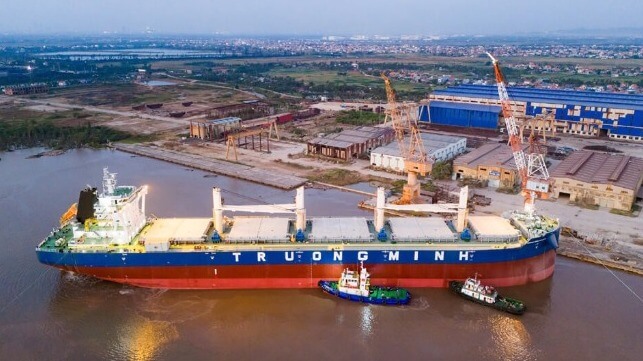
Truong Minh Dream is the largest dry bulk carrier ever built in Vietnam and the first of four vessels on order (SBIC)
Vietnamese officials were on hand for the handover of the largest dry bulk carrier ever built in a domestic shipyard. The 65,000 dwt Truong Minh Dream was hailed as a key advancement and in keeping with the government’s plans to expand shipbuilding and shipping to support the growth of the country.
The vessel which measures 656 feet (approximately 200 meters) is classed by Japan’s ClassNK with officials saying it signifies the vessel meets broad international standards and can operate globally. It was designed in a joint effort between Vietnam Shipbuilding Engineering JSC (VISEC) and Bluetech Finland.
It is a double-bottom, single-propeller bulk carrier with a total of five cargo holds. Furthermore, it is fitted with hydraulically operated double-sided hatch covers and four cranes with a lifting capacity of 30 tons. While a fairly standard bulk carrier it is significantly larger than the vessels previously built in the country. The main engine is a licensed design from MAN and built in Japan.
The construction was undertaken by the Nam Trieu Shipbuilding Company, a subsidiary of the Shipbuilding Industry Corporation (SBIC). The shipyard reports the project was executed smoothly with the vessel launched on May 11 and completed sea trials on December 4. It was able to proceed with the project while SBIC is currently being reorganized under a state-run bankruptcy. The government The Ministry of Transport is presiding over the process and coordinating with the Ministry of National Defense. The corporation is to submit a plan to the Prime Minister for approval in the first quarter of 2025 to improve the capacity of the domestic shipbuilding industry. Vietnam looks to expand its shipbuilding to present a cost-effective alternative to the traditional shipbuilding countries as China continues to squeeze out competition from Japan and now South Korea.
The bulker was handed over on December 26 to Dong Bac Shipbuilding Industry JSC which will be responsible for its operation. The company initially ordered two 65,000 dwt bulkers, with work starting on the second vessel after the launch in May of the Truong Minh Dream. The vessel will be operating from the northern port city of Hai Phong.
During the handover ceremony, it was announced the shipping company had placed an order for two more vessels of the class. Government officials said it would support the party and state’s strategy for developing Vietnam’s maritime economy.
China Floats Largest, Next-Generation Amphibious Assault Ship
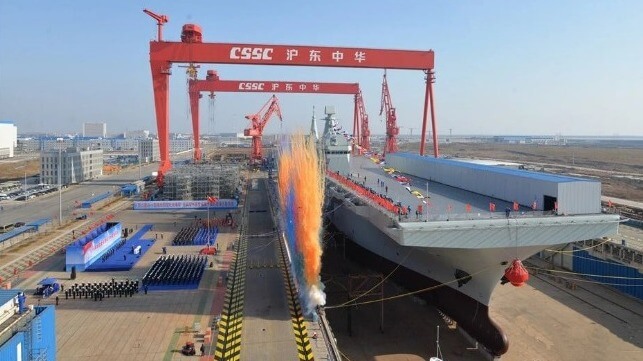
Naming and float out ceremony for China's next-generation amphibious assault ship Sichuan (CSSC)
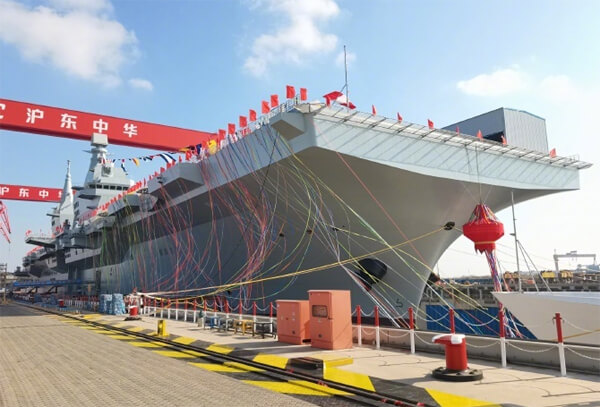
The Chinese PLA Navy today, December 27, celebrated the float out of the first of its next-generation amphibious assault ships. The vessel named Sichuan is reported to be the largest of its kind and incorporates advanced technology.
The new ship was built at Hudong-Zhonghau Shipbuilding, a division of China State Shipbuilding Corporation (CSSC). Remarkably, China claims the vessel is just four years from design to float out. It will now undergo outfitting before starting dock and later sea trials.
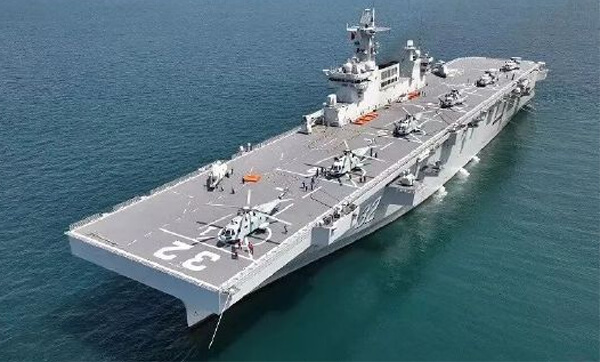
According to the statement from the PLA, the vessel exceeds 40,000 tons displacement, making it significantly larger than China’s first generation of amphib commissioned in 2021. Among the surprises in the design, the PLA reports the vessel incorporates an electromagnetic catapult and arresting system. This means that the vessel which was originally thought to be capable of helicopters and landing craft will also be able to launch a manned fixed-wing aircraft. It is also thought to be a large base for Chinese drones.
In appearance, the vessel features a full-length flight deck. The Chinese also highlighted a configuration with a two-island superstructure, the first time this feature has been used on a Chinese vessel. They said it is designed to better facilitate aviation operations.
China’s previous amphibs, Type 75, are deployed with helicopters and landing crafts. China built three of the first class. The new vessel is the first of Type 76.
Rendering of the vessel which when completed will rival the U.S. fleet (CSSC
China already reports to have the world’s largest navy and continues to rapidly expand its fleet with new capabilities. Chinese officials hailed the new amphib saying it was a critical part of the efforts to expand the reach and capabilities of China’s Navy. In addition to the new amphib, China continues the outfitting of its new aircraft carrier.
The vessel is seen as a rival to the U.S. which traditionally has had the largest vessels of the type. The Wasp and America class vessels operated by the U.S. are approximately 844 feet (257 meters) in length with reports the new Chinese class is 853 feet (260 meters) although the Chinese only said its displacement would exceed 40,000 tons. That would make it similar in size to the Wasp-class and smaller than the America class which is 45,000 tons displacement. Observers had previously predicted the Chinese vessel would reach 50,000 tons displacement.
Houthis Claim Retaliatory Attack on Maersk Ship and Israel’s Airport
Houthis claimed a missile attack on Israel's international airport and a drone launched at a Maersk vessel
A day after Israel pounded Houthi targets including reports of paralyzing all three Red Sea seaports in Yemen, the militants claimed to have responded with attacks on a containership and Israel’s international airport. Spokesperson Yahya Sare'e claimed direct hits which were quickly refuted by both Maersk and Israel.
According to the statement, the containership Santa Ursula (93,400 dwt) a Danish-flagged vessel was targeted while it was sailing near Socotra Island in the Indian Ocean south of Yemen. The vessel, which was built in 2012 and operated for Hamburg Sud until the consolidation into Maersk, is showing on its AIS signal that it was inbound to Salalah, Oman. The ship which has a capacity of 7,090 TEU was coming from Algeciras.
The Houthis claimed to have launched a drone attack on the vessel. If the attack did take place, it would be the first in weeks against a foreign flag vessel in the region. Maersk quickly denied an attack and monitoring services including the UK Maritime Trade Operation did not report the incident.
In the same statement, the Houthis claimed to have launched another hypersonic rocket targeting Ben Gurion Airport and another at the region around Tel Aviv. They claimed that “the missile succeeded in reaching its target despite the enemy’s censorship, and the operation resulted in casualties and the cessation of navigation at the airport.”
The Israel Defense Forces later confirmed that as a precaution flights have been halted from the international airport for approximately 30 minutes. It said however that the missile was successfully intercepted without injuries.
Israel’s Prime Minister, Benjamin Netanyahu, yesterday said that the Houthis would continue to be a target. The military cited the repeated attacks with missiles and drones while the Prime Minister said Israel would be using the same level of force to stop the threats.
Cargo Pump Failure on Newbuild Sparks Vibration Warning
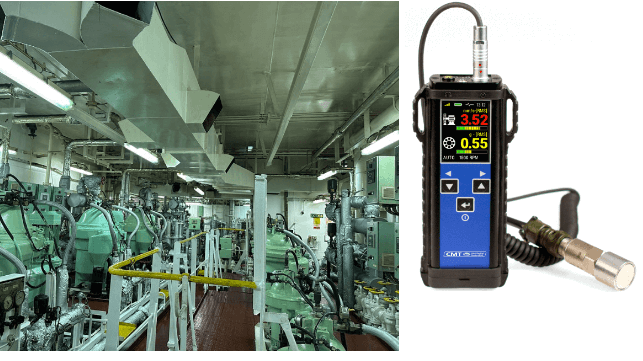
An on-going monitoring strategy is crucial to maintaining the service life of rotating equipment, troubleshooting problems, and preventing failures, and subsequent costs
The failure of a cargo pump onboard a newbuild tanker has highlighted the need for crews to regularly monitor rotating machinery for excessive wear and vibration, if unnecessary downtime and costs are to be prevented.
The German owner took delivery of a 2021-built chemical tanker from a Chinese yard in 2021, but the long shaft driving the cargo pump’s impeller was not correctly installed, destroying the pump beyond repair and delaying cargo loading operations.
CM Technologies’ Sales Director Uwe Krüger cites other examples where ships’ pumps appeared to be in sound condition, but were in fact close to being written off.
“During the physical inspections of three pumps aboard a 58,000dwt containership, initial checks indicated acceptable values for balance and shaft alignment, but a second test using our Vibration Meter Marine immediately alerted the crew to a bearing close to seizure,” he said.
The bearings on all three cargo pumps were found to have the same potentially catastrophic pitting damage, requiring costly overhaul.
“Ships’ fire, freshwater, cargo, sewage and ballast water pumps are critical but often overlooked pieces of machinery,” said Krüger. “Yet, despite the importance of the humble pump to ship operations, rotating machinery is still often monitored and serviced only on fixed maintenance schedules. Pump failure can place the can place ship, cargo and crew at risk.”
CMT recommends that regular vibration analysis should start at system commissioning and continue throughout the operational life of the vessel. An on-going monitoring strategy is crucial to maintaining the service life of rotating equipment, troubleshooting problems, and preventing failures, and subsequent costs,” he said.
CMT’s Managing Director Matthias Winkler furthered: “A replacement bearing can cost as little as US$20. But finding out you needed one after the motor has burnt out could easily cost thousands of dollars to put right. And Murphy’s Law dictates that this is likely to happen in a Port Said or somewhere while the next available motor can be found in Rotterdam or Singapore, so you can add significant logistics and agent costs on top of that.”
Columbia Shipmanagement and Hamburg based shipping group RHL Reederei Hamburger Lloyd are just two shipping companies that have been using CMT´s Vibration Meter Marine since the product was unveiled in 2015.
“These ship managers wanted a monitoring system capable of immediate analysis of existing problems without requiring the user to have any special knowledge, explained Winkler. “Regular use of the system has alerted crews to bearing defects before breakdown, averting costly damages. The technology has already justified the investment.”
Vibration analysis provides insights into the most common cause of machinery damage and reduced service life. Bearing damage is particularly prevalent, caused by shaft misalignment, insufficient or incorrect lubrication and general wear and tear. Pump health can be easily assessed by analysing vibration.
“Crews of seagoing vessels are under constant stress, and crew changes occur at fixed intervals, so vibration monitoring devices need to be easy to use with measurement readings that are simple to understand by crew members with limited technical knowledge.
“Our Vibration Meter Marine is a powerful, expert system that provides on-the-spot usable results without the need to send information to shore for evaluation. Even beginners can understand what the readings are telling them,” said Winkler.
Alongside a range of vibration meters, monitors, software and analytical tools, the CMT´s Vibration Meter Marine has been specifically designed for the harsh marine environment. The hand-held device, acceleration sensor, software, and accessories are delivered in a small, rugged case designed for easy storage in between usage.
The meter also includes a mode to monitor the lubricating performance of greased, water, or oil lubricated bearings in pumps and rotating machinery. As an option, data can be stored for trend analysis using the diagnostic software.
“Our goal is to provide crews and superintendents with a practical solution that will enable them to detect pump problems early and shift from fixed inspection schedules to more effective condition-based protocols. Vibration analysis does need to be part of the regular machinery checks crews make on their rounds.”
The products and services herein described in this press release are not endorsed by The Maritime Executive.
NATO to boost military presence in Baltic after cables ‘sabotage’
By Raziye Akkoc AFP· 28 Dec, 2024 The Finnish Border Guard's ship Turva (front) and the oil tanker Eagle S on the sea near Porkkalanniemi. Image / poliisi.fi NATO will bolster its military presence in the Baltic Sea after the suspected sabotage of an undersea power cable linking Finland and Estonia this week, the Western military alliance’s chief Mark Rutte said on Friday.
On Christmas Day, the Estlink 2 submarine cable that carries electricity from Finland to Estonia was disconnected from the grid, just over a month after two telecommunications cables were severed in Swedish territorial waters in the Baltic. Finnish authorities on Thursday said they were investigating the oil tanker, Eagle S, that sailed from a Russian port, as part of a probe for “aggravated sabotage”. Finnish President Alexander Stubb said on Friday: “We’ve got the situation under control, and we have to continue to work together vigilantly to make sure that our critical infrastructure is not damaged by outsiders.” Officials suspect the tanker is part of the Russian “shadow fleet”, which refers to ships that transport Russian crude and oil products embargoed because of Russia’s 2022 invasion of Ukraine. The Eagle S vessel, which flies under the flag of the Cook Islands in the South Pacific, was en route to Port Said in Egypt. Police suspect that the oil tanker’s anchor might have damaged the power cable. Rutte said he spoke to President Stubb about Finland’s probe, adding in a post on X: “I expressed my full solidarity and support. Nato will enhance its military presence in the Baltic Sea.” Estonian Defence Minister Hanno Pevkur earlier on Friday said on X that the country began naval patrols to protect the undersea cable supplying electricity from Finland. In a separate statement, he said Tallinn wanted to send a clear message it was ready to protect its power connections with Finland with military and non-military means. Rutte on Thursday promised Nato support to Estonia and Finland, and condemned attacks on critical infrastructure after speaking to Estonian Prime Minister Kristen Michal. More EU sanctions The European Union has also threatened further sanctions against Russia’s shadow fleet after this week’s incident. The bloc’s 27 member states agreed earlier this month to blacklist around 50 more oil tankers from Russia’s shadow fleet used to circumvent Western sanctions, taking the number targeted to around 80. Ukraine’s international backers have looked to curb funds going to the Kremlin’s war machine by imposing a price cap and restrictions on Russia’s key oil exports. To skirt the measures, Russia has resorted to using a so-called “shadow fleet” of often ageing vessels that operate under dubious ownership or without proper insurance. Tensions have mounted around the Baltic since Russia’s invasion of Ukraine. In September 2022, a series of underwater blasts ruptured the Nord Stream pipelines that carried Russian gas to Europe, the cause of which has yet to be determined. In October 2023, an undersea gas pipeline between Finland and Estonia was shut down after it was damaged by the anchor of a Chinese cargo ship. On November 17 and 18 this year, sections of two telecom cables were cut in Swedish territorial waters. Suspicions have been directed at the Yi Peng 3, which according to ship tracking sites had sailed over the cables around the time they were cut.
Finnish Police Investigate Tanker as Report Says Spy Equipment Was Found
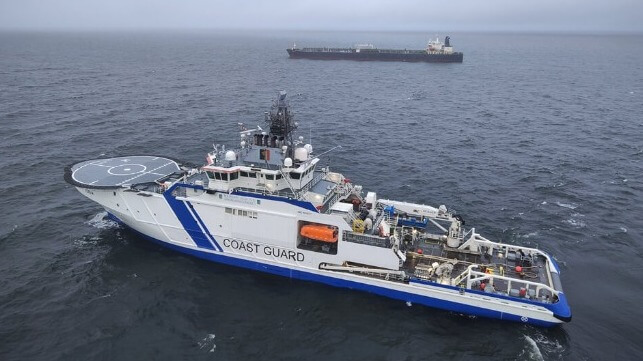
Finnish Coast Guard is detaining the Eagle S tanker nine miles offshore (Finnish Police)
The Finnish police authorities provided a brief update on the ongoing investigation into the damage on Christmas Day to the power cable and several internet cables connecting Finland and Estonia. The Finnish Border Patrol is detaining the tanker Eagle S while investigators shuttle on to and off the vessel and begin an underwater investigation at the location of the damage.
“Although the initial investigation has been fast-paced, it is overall a demanding and time-consuming investigation,” said the general director of the investigation, Criminal Inspector Sami Paila. The Helsinki Police is leading the cooperation between the authorities reporting that the effort has continued around the clock for the past two days. The Finnish National Criminal Police is responsible for the elements of the investigation. It termed the investigation as “aggravated vandalism,” but declined to release specific details.
The vessel however is reported to be “loaded with spying equipment,” according to a report published by Lloyd’s List. Lloyds Intelligence is saying that hi-tech equipment was found which its sources termed “abnormal for a merchant ship.” The outlet says that it was told there are transmitting and receiving devices installed that turned the aging tanker into a “spy ship.” They believe the vessel was monitoring and recording transmissions from NATO ships and aircraft and placed sensors in the English Channel. They report there are Russian, Turkish, and Indian radio officers on the vessel.
The Finnish authorities confirmed that they had boarded the tanker which is being detained about nine miles offshore. Customs seized the fuel cargo aboard for an investigation reported Director of Supervision at Customs Hannu Sinkkonen. Customs is looking for an “aggravated regulatory offence.”
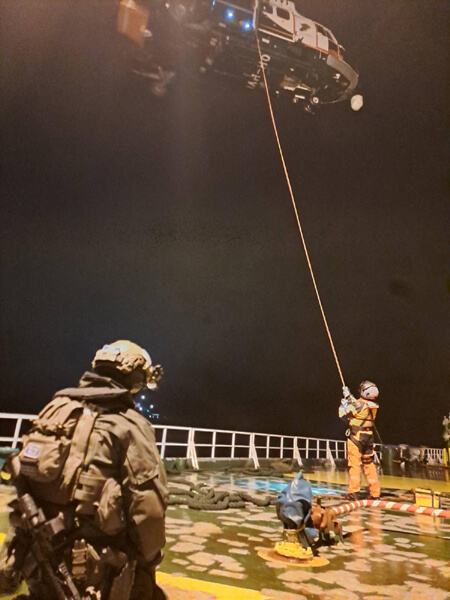
Police and investigators were moving on and off the tanker by helicopter (Finnish Police)
The police confirmed that “material has been collected” from the tanker Eagle S and that the analysis has begun. At the same time, they reported interviews have commenced with the crew which is reported to number approximately 20 individuals. Finnish media is saying the crew is from Georgia and India but said the police did not confirm the nationality of the vessel’s officers. Reports said no arrests or detention of the individual crew members have been made so far.
The Finnish Border Guard was taking the Finnish National Criminal Police to the site of the incident today, December 27, to begin seabed investigations. They said it would be assisting with the underwater investigation. They were reported at the site of the Estlink 2 power cable today.
“Conditions currently allow for full-scale operations in the Gulf of Finland,” said Commander Mikko Hirvi, Deputy Commander of the Gulf of Finland Coast Guard.
The Finnish news outlet Yle News published details of the investigation into the track of the Eagle S. They reported the vessel’s documents showed it departing Ust-Lugu in Russia and reporting a destination of Port Said, Egypt. On Christmas Day, December 25, at midday, the vessel made a “U-turn” back to Russia and proceeded about half a kilometer and then “hooked back” onto its original route about two hours after the first turn. Grid operator Fingrid reports the interruption on the power cable at 12:26 p.m. and the analysis shows the Eagle S was moving around the cables at that time.
About six hours later, the tanker was in the vicinity of the three data cables that were also damaged.
Pictures leaked on the Internet today showed the vessel missing its port side anchor.
The Finnish authorities said that they were satisfied the situation was under control and that the investigation would be proceeding. Several Baltic nations however reported that they have increased patrols with Finland and Estonia also reporting they agreed to make a request to NATO for additional support to protect the remaining power cable between the two countries.
Estonia reportedly experienced power supply problems shortly after the cable was damaged but the Prime Minister said today the power is stable and communications are functioning despite the damaged cables. Operator Fingrid however said in a statement that the repairs will take months and there is a risk of outages due to power shortages, especially during the peak winter months.
Baltic Countries Increase Infrastructure Patrols and Call for NATO Support
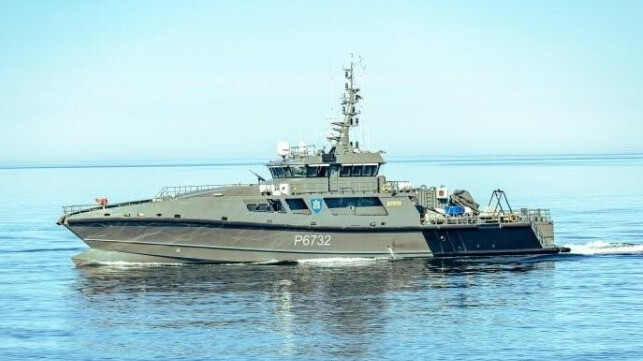
The Estonian Navy patrol ship Raju is protecting the second power cable in the Baltic (Estonian Navy)
The nations of the Baltic region, including Estonia, Lithuania, Sweden, and Finland, all report they have launched new efforts to monitor and protect critical undersea infrastructure in response to the Christmas Day incident which damaged a key power cable between Finland and Estonia as well as internet connections. While the possibility of invoking the mutual protection clauses of the NATO Treaty was mentioned, the EU and NATO immediately said they would also move to increase protection of the critical infrastructure.
Estonia’s Foreign Minister Margus Tsahkna stated that the frequency of the incidents in the Baltic made it difficult to believe they were all caused by accidents or poor seamanship. In addition to this week’s damage to the power and internet cables, they highlighted last month’s severing of two telecom cables in Swedish waters which have been linked to a Chinese vessel. Last year, another Chinese vessel was suspected of damaging a gas pipeline running between Finland and Estonia, and the 2022 damage to the Nord Stream pipelines remains under investigation for sabotage.
The governments of Finland and Estonia each convened meetings and reported that their presidents had discussed the situation as Finland leads the investigation into this week’s damage to the cables. Prime Minister of Estonia Kristen Michal highlighted the close cooperation between the two countries noting Finland’s detention of the tanker Eagle S was the first time a suspect ship has been held.
Michal stressed while the investigation is underway, “the most important thing right now is to increase the level of protection of infrastructure at sea and on land.” The Prime Minister sought to reassure everyone saying that Estonia’s security of electricity and Finland-Estonia communication services are not at risk.
Estonia’s Minister of Defense Hanno Pevkur and Commander of the Defense Forces Major General Andrus Merilo announced on Friday, December 27, that the Estonia Navy has sent its patrol ship Raju into the Baltic to protect the Estlink 1 cable, a second but smaller 358 MW cable running between Estonia and Finland.
"The task of the Defence Forces is to repel military attacks against the Republic of Estonia. The Defence Forces are also ready to prevent attacks on our energy infrastructure at sea using non-military means and to organize military cooperation in ensuring maritime security," said Major General Andrus Merilo.
Swedish Coast Guard is increasing its monitoring using aircraft and vessels along with efforts by Estonia, Finland, and Luthiania (Swedish Coast Guard)
Lithuania also reported on Friday that its navy has increased surveillance and patrols in the Baltic. The Swedish Coast Guard said that it is cooperating closely with the Swedish Navy and other government agencies. Sweden said it will increase its presence for maritime surveillance with vessels and aircraft to protect critical undersea infrastructure.
News of the increased patrols came after the European Commission issued a statement on Thursday reporting, “We are strengthening efforts to protect undersea cables.” Among the efforts mentioned were enhanced information exchange, new detection technologies, and undersea repair capabilities.
Estonia’s Prime Minister Michal however issued a call on TV for reinforcements from NATO to act as a further deterrent. He said Estonia, if necessary, would invoke Article 4 of the NATO Treaty that provides for mutual support if any one nation feels threatened.
"We need to create a better picture, together with our allies, of what is happening with our critical infrastructure, both underwater and above water. It is not possible to protect every square kilometer all the time, because the perpetrators only need to succeed once, but the defenders need to succeed every time. The navy, together with various NATO allies, must take a more active stance in guarding and monitoring critical infrastructure," said Prime Minister Michal.
Finland’s President Alexander Stubb and the Ministerial Committee on Foreign and Security Policy also said after its meeting that “Finland considers it important to increase NATO’s maritime presence in the Baltic Sea in order to secure underwater infrastructure.” Stubb told a news conference that Finland and Estonia had agreed to communicate to NATO a wish for a stronger presence.
NATO Secretary General Mark Rutte reported that he had spoken with Finland’s president. Rutte posted a message on social media saying, “I expressed my full solidarity and support. NATO will enhance its military presence in the Baltic Sea.”
Estonia also reports it will seek new measures at the International Maritime Organization to strengthen the legal ramifications. The Ministry of Justice and Ministry of Foreign Affairs will lead the effort saying that with the allies, it must strive to ensure that the law of the sea also becomes more modern. “There must be a better way to stop these ships,” said Prime Minister Michal calling for ways to identify the perpetrators more quickly.
Finland has said it believes the tanker Eagle S which damaged the cables this week is part of Russia’s shadow fleet of tankers for the oil trade. Russia has remained silent on the matter saying it was a matter for the Western countries. Russian officials in the past denied involvement in any of the Baltic infrastructure incidents.
Russian authorities continue to present a wide range of claims associated with the sinking of the cargo ship Ursa Major off Spain at the beginning of the week. After saying that it was an act of terrorism, the shipowner and Russia’s Dmitry Medvedev today extended the accusations to a Norwegian ship linking it to a larger plot by the West and the continuing “Russophobia.”
Oboronlogistics which operated the Ursa Major for the Russian government claimed that there were three explosions aboard the vessel calling them terrorism. Now it extended its accusations to the Norwegian-flagged cargo ship Oslo Carrier 3, which they said was nearby but refused to take the crew aboard. The company claimed the Norwegian ship had Russians in its crew and had some type of ban which caused it to refuse to take the crew aboard. They called it “a gross violation” of international conventions.
Medvedev who is a frequent critic of the West then wrote on his Telegram social media account, “Why so harshly? How else, given such facts? The Norwegian-flagged Oslo Carrier 3 refused to take on board the Russian sailors from the Ursa Major who were drowning in the Mediterranean Sea. Do we need any more explanation? This cannot be forgiven!”
A Kremlin spokesperson tempered it slightly, saying to Reuters “if indeed no assistance was rendered” it was contrary to maritime laws. Dmitry Peskov told Reuters the actions would be “an outrageous case that deserves total condemnation.”
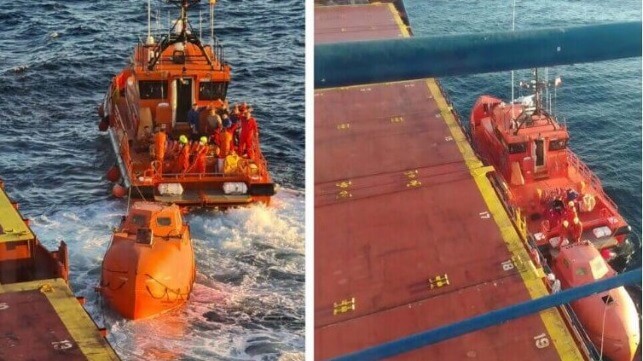
Oslo Bulk which operates the vessel refuted the Russian claims and supported it with pictures from the rescue operation. The company said the Maritime Rescue Coordinating Center in Cartagena, Spain was responsible for the operation. They said the rescue center instructed the Oslo Carrier 3 not to take the survivors from the Ursa Major aboard from the lifeboat as its rescue vessel was on its way to the scene.
Oslo Bulk says and presented photos showing as much, that the lifeboat with the 14 survivors from the Ursa Major was secured alongside the Oslo Carrier 3. It facilitated the transfer of the crew to the Salvamento Marítimo vessel which transferred the survivors to shore.
Further, the company says the crew was in no immediate danger once it had boarded the lifeboat. They point out that the weather was good at the time and none of the crewmembers were injured.
Salvamento Marítimo told the Spanish press that it dispatched two rescue boats and a helicopter when the distress call was received. The ship sank 67 miles from the Spanish coast. Two crewmembers were reported missing and the Spanish authorities highlighted its aircraft continued the search for the missing crewmembers. Today, it was reported that a Spanish aircraft was again seen circling over the shipwreck area.
Vessels Trapped on Saar and Moselle Freed So That Lock Repairs Can Begin
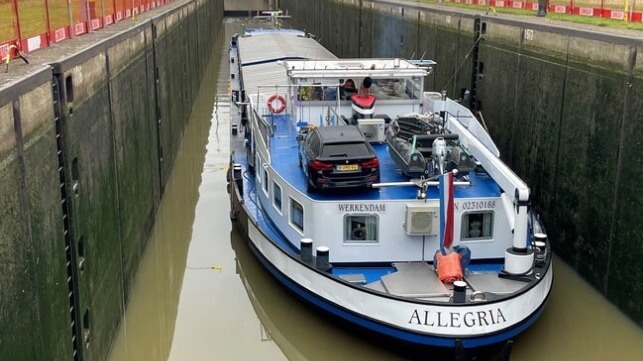
Allegria was the first of 72 vessels freed in an operation requiring 192 hours of continuous operations (WSA)
The Federal Waterways and Shipping Administration reported that as of today all the vessels that had been trapped on the Saar in France and the Moselle in Germany above the lock at Müden, Germany have now been freed. They were able to complete this phase of the recovery effort ahead of schedule and now believe they will be able to reopen the lock by the beginning of February more than a month ahead of the previously announced timeline.
A total of 78 emergency lock operations were carried out in 10 days with a total of 72 vessels that had been stuck along the rivers cleared to continue their journeys. WSA reports it was a Herculean task that required cooperation and coordination.
The lock gates were destroyed when a ship failed to stop during a locking operation on December 8. A temporary solution to free the trapped vessels was worked out, but it required manually placing for each locking operation the removable dam beams which are normally only used to seal and drain the lock chamber for maintenance.
It required 192 hours of continuous operation in all weather conditions with the first vessel passing through the lock on December 16. The beams with the help of a crane were placed over 1,000 times and chain hooks were attacked over 4,000 times. Divers had to enter the chamber 1,840 times to hook the chains into the eyelets.
After eight days, the WSA reports a total of 70 ships had passed through the lock. The final two vessels had scheduled their transit for today, December 27. A small passenger ship, Sunisha arrived at the lock around 0800 local time and when the fog lifted it made the transit. Three hours later a river cargo vessel Tunica became the last to leave the lock. No vessels had been able to use the lock to enter Luxembourg and France since the accident.
“At the moment, the Saar and the German Moselle are completely empty of cargo ships, tankers, or passenger ships,” WSA reported today. Only a few ships which spend the winter on the rivers remain.
The lock is now closed with the beams to be set into place and the chamber drained. Scaffolding will be required, and the concrete will be sandblasted. Two new sealing strips, each measuring 12 meters, had to be fabricated and installed, and new concrete poured to repair the damage. Two gate frames that were manufactured in 2005 need to be prepared and panels installed plus four new neck bearing blocks also have to be manufactured. The timeline now calls for moving all the components to the lock at Müden on January 15 and then starting to reassemble the operation.
The lock is now closed until the repairs can be completed. Steelmaker ArcelorMittal with operations in Luxembourg was forced to plan alternate routes to move its material. The authorities in Luxembourg worked with the company to temporarily change rules for the transit of heavy goods by road.
The Müden lock provides a vital link for the movement of goods, fuel, and passengers coming from the Rhine and traveling into Western Germany, Luxembourg, and France.
Video: Tugs Fail to Free Bulker Grounded in the St. Lawrence
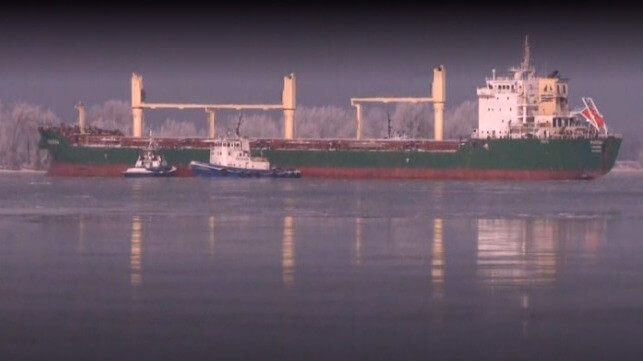
A first effort was undertaken today in an attempt to pull the bulker Maccoa (30,898 dwt) free from its position north of Montreal. The vessel veered out of the channel early on December 24 and has remained stuck with Coast Guard officials saying the recovery was being slowed by the Christmas holiday.
The Canadian Coast Guard reported Tuesday that the 607 feet (185 meters) in length vessel is “sideways outside the navigation channel.” It is not obstructing traffic on the river.
The reports said there were no injuries, no damage to the ship’s hull, and no pollution spotted in the water from the grounding which may have been caused by a blackout shortly after the vessel left the dock in Montreal. Conditions, however, had grown harsh as winter weather spread over the region.
Authorities sent generators, heaters, and supplies to the 20 crew members aboard.
The Canadian Coast Guard reported the refloating effort would begin at approximately 11:00 a.m. local time on Friday, December 27. They were planning to put drones overhead and possibly a helicopter they told the Canadian Press to monitor the efforts.
Three tugs, Ocean Serge Genois, Ocean Charlie, and Ocean A. Gauthier, were seen alongside the vessel today and they apparently made several attempts but were unsuccessful. As of the end of the day, the vessel’s AIS signal reports it is still aground. The Coast Guard has not yet commented on the possible next steps.
The Maccoa was bound for Ireland and from the pictures appears to be sitting about its waterline. There are no reports if any cargo is aboard.
Earlier in the month another Laker bulker was stuck further south on the river below Montreal. Initial efforts to refloat the Tim S Dool were also unsuccessful. They had to bring in a crane and barges to partially offload the vessel before they were able to free it.
How George Orwell was right — and Steve Jobs was wrong
AlterNet December 28, 2024 Screenshot of Apple SuperBowl ad, 1984
A fascinating article in The New York Timesthis week by Kurt Gray, professor of psychology and neuroscience at the University of North Carolina at Chapel Hill, gives us the beginnings of an understanding of how and why social media is so destructive to society.
Gray points out that most people assume humans have historically been predators, the metaphorical big cats of the jungle. In fact, Gray says, we’ve historically been prey, the victims of predators: “This picture of fearfulness is consistent with our understanding of human psychology. We’re hard-wired to detect threats quickly and to stay fixated on places where threats once appeared, even after they have vanished. We fear that ‘child predators’ will abduct our kids even when they are safer than ever. “Modern humans, ensconced in towns and cities, are now mostly safe from animal predators, but we are still easily frightened. Whether we’re scrolling social media or voting for a presidential candidate, we all still carry the legacy of our ancestors, who worried about big cats lurking in the darkness.”
Thus, if you could invent a drug that would cause people to be fearful — and thus stimulate the rage that comes from fear — you could have incredible control over a population if you could simply tell them where and against whom to direct that fear-induced rage.
We all have opiate receptors in our brains that modulate our response to pain. Compounds that bind to these receptors are produced naturally by our body in response to extreme pain and shock, and numerous plants—most famously, opium poppies—naturally produce chemicals that bind to and activate our opiate receptors.
When we lived in Germany back in the late 1980s, I loved to visit a nearby castle in Kulmbach and order mohnkuchen, a piecrust filled with poppy seeds ground into a paste with sugar and a few spices. I always felt so good after eating a slice or two of the pie; when we had a glass of a fresh German Riesling with it, my smile went from ear to ear for hours.
The mohnkuchen seemed to constipate me a bit, and when I noticed one afternoon that my pupils were pinned so small as to nearly vanish, the same as I’d noticed whenever I’d taken narcotic painkillers after injuries and surgery, the penny dropped. Turns out I was enjoying opium in that little German café in a way that people around the world have for millennia.
Similarly, I once shared a few days with a shaman from Peru; he had a bag of coca leaves, and we each chewed a few along with a tiny piece of alkalized ash to release its active ingredient as an afternoon pick-me-up. The buzz I experienced was considerably less strong than what a two or three cups of coffee provide.
Mountain-dwelling Andean tribes have been doing this for as long as there have been people in the region; they consume coca the way people in India and parts of China consume local tea leaves. We consumed coca leaf extract here in the US, too, from 1886 to 1929, in a drink called Coca Cola.
Somewhere on the spectrum from these drugs’ original state to their becoming increasingly concentrated and purified, a toxic/addictive threshold or tipping point is reached. I never experienced withdrawal symptoms from mohnkucken, but I did from the highly concentrated opiate painkiller (Oxycontin) I took for a few weeks for severe sciatica prior to spinal surgery and for a week after. It wasn’t terrible; a few nights of trouble sleeping and sensitivity to pain and touch, but there it was.
Heroin is concentrated opium poppy. Cocaine is concentrated coca leaf. Substances that are otherwise benign become both potent and deadly when they’re super-concentrated.
Which is exactly what the algorithms deployed in secret by social media do: they purify and concentrate hate and spread fear across the broader social media site, distilling the most potent memes and messages to the top and shoving them into people’s brains.
But that’s just the beginning of the damage these top-secret algorithms are doing to our societies and politics. By increasing our individual levels of fear and rage, they create a broader social sense of fear and rage, making these emotions far more easy to exploit.
Enter stage right “populist” politicians and media sites who push people’s now-sensitized fear and rage buttons for political gain. (Not to mention the billions earned by social media billionaires pushing this psychological heroin while absolutely refusing to publish their algorithms.)
Numerous studies show that when people believe crime is a serious problem in their own communities and lives, they measurably shift toward the political right of the spectrum. Law-and-order campaigns and promises of severe punishment acquire a sudden appeal, as Joe Biden and Bill Clinton discovered in the early 1990s and politicians everywhere since the pandemic have seen.
Fear of crime — and fear more generally (of your kids being victims of trans people or renegade surgeons in public schools, for example, or of immigrants raping your wife or taking your job) — push people toward an embrace of conservative and then authoritarian politics and governance.
When media promote narratives about crime being out of control — whether true or not — they measurably drive acceptance of more reactionary crime control legislation along with rejection of efforts at rehabilitation and reform.
There may be an even wider impact of social media’s promotion of fear and rage.
The Transcendental Meditation group reported in the Journal of Mind and Behavior on several 1970s and 1980s studies showing that when a certain relatively small threshold number of people in a particular community meditated daily, crime and violence went down.
Another report in Social Indicators Research found that when a group of meditators moved to Washington, DC between 1988 and 1993 that over those following years crime went down by an impressive 23.3%.
A comprehensive study was run during the 1883 Lebanon war, when a group of meditators took up residence in Jerusalem and meditated daily for two years. The result, almost certainly exceeding any possibility of coincidence, was:
— A 76% reduction in war deaths in Lebanon on days when there was high participation in the meditating group,
— A 71% decrease in war-related fatalities, — A 68% reduction in war-related injuries, — A 48% drop in the level of conflict, and — A 66% increase in cooperation among antagonists.
If a certain threshold of people being intentionally peaceful for a year or two can lower crime rates, what happens when a certain threshold of people are daily enraged by the injection of fear and hate into their psychological bloodstreams?
Could it be that social media is directly (or indirectly) responsible for much of the swing we’re seeing around the world toward bigotry, hate, and violence? That rightwing movements are emerging as a result of the impact of social media, rather than social media merely and passively reflecting the trend as the social media companies argue?
The meditation studies are controversial, but it’s hard to dispute the assertion that as more and more individuals in a given society are racked with fear and rage, the result, as I lay out in The Hidden History of Big Brother, will be more hate and violence.
Republican Senator Josh Hawley has been thinking along the same lines. In his book The Tyranny of Big Tech, he wrote:
“Big tech has embraced a business model of addiction. Too much of the ‘innovation’ in this space is designed not to create better products, but to capture more attention by using psychological tricks that make it difficult to look away.”
The past two years have shown America and the world what happens when a social media company is captured by an unaccountable billionaire with a specific political goal. The site that was once Twitter is now a veritable sewer, filled with hate and Nazi-level extremists.
Is it possible this is making the world less stable, less peaceful, and more violent through a reverse “Maharishi Effect”? Are wars around the world and the recent assassination of a healthcare CEO demonstrations of the power social media has over society? School shootings? The rise of Nazi-adjacent militia groups here and in Europe?
The simple reality is that we won’t know until government steps in and requires these companies to both publish and moderate their algorithms and monitor/control the naked hate on their platforms. And that day can’t come too soon.
Hericium erinaceus (commonly known as lion's mane). Image: Alison Northup, CC 3.0
Superfoods come and go. The latest is the mushroom Lion’s mane (Hericium erinaceus), which may have benefits for the immune system as well as reducing inflammation and improving sleep. This is according to the food producer Urban Farm.
“Lion’s Mane mushrooms (Hericium erinaceus) are showing incredible promise for their potential to support mental health and cognitive function,” Webb has told Digital Journal. “They may encourage the growth of beneficial gut bacteria, which could strengthen the immune system while also positively impacting brain health.”
Webb highlights studies suggesting that lion’s mane could help with anxiety and mood: “In research involving participants with mild mental health complaints, those who consumed Lion’s Mane extract reported lower levels of anxiety and irritation compared to those who didn’t. This suggests lion’s mane may have calming properties, although more studies are needed to confirm this.”
Native to North America and Eurasia, the mushrooms are common during late summer and autumn on hardwoods.
For older adults, Lion’s Mane could be particularly beneficial. Here Webb explains: “There’s evidence that Lion’s Mane may help with cognitive decline. In one study, older participants with mild cognitive impairment who consumed Lion’s Mane over 16 weeks showed improved scores in cognitive function tests compared to those on a placebo.”
Shiitake mushrooms may also be of benefit, indicates Webb: “Shiitake mushrooms contain beta-glucans, a type of dietary fibre that could support immune health and help reduce inflammation,” Webb says. “Their natural compounds may also help lower cholesterol and blood pressure, offering potential cardiovascular benefits.”
Webb adds: “Shiitake mushrooms could help protect against chronic diseases associated with inflammation. They’re not just a culinary favourite but also a valuable addition to a balanced diet.”
H. erinaceus contains diverse phytochemicals, including polysaccharides, such as β-glucan, as well as hericenones and erinacines.
Both Lion’s Mane and Shiitake mushrooms may provide antioxidant benefits. Webb finds: “These mushrooms contain compounds that could protect cells from oxidative stress and reduce inflammation,” Webb explains. “This makes them a potential ally in maintaining overall health.”
Proceed with Caution
While the potential of these mushrooms is exciting, Webb advises caution: “Always consult with your doctor before introducing medicinal mushrooms to your diet, particularly if you have existing health conditions or take medication. It’s essential to ensure they’re suitable for you.”
Digital Journal note: Many alternative medical practices are pseudoscientific, with the majority of treatments having no robust evidence of effectiveness or logical mechanism of action. The reader is advised to always seek professional medical advice.