It’s possible that I shall make an ass of myself. But in that case one can always get out of it with a little dialectic. I have, of course, so worded my proposition as to be right either way (K.Marx, Letter to F.Engels on the Indian Mutiny)
Sunday, February 16, 2025
German president says Trump team ignoring ‘established rules’
“Democracy is not a business model. It is not a playground for disruption.”
By AFP February 14, 2025 'It makes a difference when the leading democracy and world power says: we can do without rules,' Steinmeier said - Copyright APA/AFP
Johann GRODER
German President Frank-Walter Steinmeier on Friday said the Trump administration “has no regard for established rules” as he opened the Munich Security Conference.
“The new American administration has a very different world view to ours,” Steinmeier said. “One that has no regard for established rules, partnership and established trust.”
“We cannot change that. We have to accept that and we can deal with it,” he said in unusually strong language at the event where US Vice President JD Vance was also attending.
The German head of state urged European leaders to keep calm in the face of a blizzard of disruptive policy announcements from Washington since Trump returned to the White House.
“We must not allow ourselves to be paralysed by the flood of announcements,” he said.
“We must not freeze in fear, or as the English saying goes: Let’s not be a deer caught in the headlights.
“But I am convinced that it is not in the interests of the international community for this world view to become the dominant paradigm.
“A lack of rules must not become the model for a reorganisation of the world.”
Steinmeier added: “It makes a difference when the leading democracy and world power says: we can do without rules.
“That is why my appeal is: let’s stick to what helps us. Cooperation helps us. Partnerships and alliances are worthwhile.
“Democracy is not a business model. It is not a playground for disruption.”
'Democracy rests on the sacred principle that the voice of the people matters,' said Vance - Copyright APA/AFP
Johann GRODER
US Vice-President JD Vance Friday urged Germany’s mainstream political parties to drop resistance to cooperating with the far right, hours after Berlin rejected American “meddling” ahead of its election.
“Democracy rests on the sacred principle that the voice of the people matters,” said Vance in a speech to the Munich Security Conference.
“There’s no room for firewalls,” he added, referring to the long-standing position of Germany’s established parties not to work with the far right.
Friedrich Merz, leader of the opposition Christian Democrats and tipped as Germany’s next chancellor, was last month accused of breaching this taboo when the far-right Alternative for Germany backed a proposal he put forward to toughen up immigration law.
Earlier Friday, German government spokesman Steffen Hebestreit criticised similar comments that Vance had made in an interview with the Wall Street Journal.
Outsiders should not be “meddling in the internal affairs of a friendly country”, he said, adding they “may not have a full overview of the political debate” in Germany.
The comments come amidst a German election campaign that has been dominated by immigration and security.
There have been several high-profile attacks blamed on asylum seekers and migrants, prompting the AfD to further intensify its anti-migrant campaigns.
Most recently, an Afghan asylum seeker is suspected of having rammed a car into a crowd in Munich on Thursday, leaving 36 people wounded.
– A ‘stricter approach’ –
The AfD looks set for its best ever result of around 20 percent in the election on February 23, according to current polling.
Merz insists he would not govern with the AfD or actively seek its support.
Vance also told the Wall Street Journal that the threat to European democracy from online disinformation — including narratives pushed by Russia — had been overstated.
“If your democratic society can be taken down by $200,000 of social media ads, then you should think seriously about how strong your grip on or how strong your understanding of the will of the people actually is,” he said.
However Hebestreit insisted that disinformation was something that had to be “closely observed”.
“And when it goes against our laws, then we will act,” he said.
He added: “We here in Germany have a stricter approach to free speech than in the US, on account of our historical experience.”
He gave as an example Nazi ideology which, he said, “can be freely expressed there but which would be strictly forbidden here”.
FASCISTS OF A FEATHER GATHER TOGETHER
Germany’s far-right AfD basks in spotlight of Musk support
By AFP February 15, 2025 Tech billionaire Elon Musk appeared by video link at an AfD party rally
- Copyright AFP/File -
Frank Zeller and Femke Colborne
All other German parties see the far-right AfD as a threat to democracy, but the anti-immigration party has a powerful friend abroad: Elon Musk, the loudhailer voice of Team Trump.
“Let’s go, guys, let’s go — fight for a great future for Germany!” the tech billionaire shouted via video link at a recent campaign rally of the Alternative for Germany (AfD).
“It’s good to be proud of German culture, German values, and not to lose that in some sort of multiculturalism that dilutes everything,” he told the jubilant crowd in Halle in the party’s ex-communist eastern heartland.
While mainstream Berlin has reacted with a shudder to the new leadership in Washington, the AfD has cheered its ideological allies in the fight against migrants, wind farms, gender politics and all things “woke”.
As Europe’s top economy careens towards February 23 polls, Musk has weighed in on the campaign with volleys of online crossfire.
As well as backing the AfD, the man behind SpaceX, Tesla and X has also trolled centre-left Chancellor Olaf Scholz with insults such as “fool” and “Oaf Schitz”.
“You must vote for change,” Musk told Germans in a streamed conversation with the party’s top election candidate Alice Weidel. “And that is why I’m really strongly recommending that people vote for AfD.”
On Friday, US Vice President JD Vance backed that stance in a speech to a security meeting in Munich where he berated EU leaders for ignoring the wishes of voters worried about immigration in a broadside later hailed by Trump.
Long shunned as outsiders in Germany, the subject of mass protests and security services surveillance, the AfD has gloated about the attention lavished on it from across the Atlantic as it polls at a record 20 percent.
“It’s a good time for the AfD because we are getting a lot of support from the Trump administration,” said the party’s Berlin boss, architect Kristin Brinker.
“If the richest man in the world and people from Trump’s circle say that the AfD is okay, you can work with them, then that’s the best thing that could have happened — and I think it will open even more doors for us.”
– Right-arm salute –
The AfD was invited to Trump’s inauguration, a day on which a jubilant Musk gave a right-arm salute many interpreted as the Nazi greeting outlawed in post-war Germany.
Musk has denied any such meaning, but many of his critics were not convinced — including political activists who beamed the image and the word “Heil” onto the Tesla electric-car plant outside Berlin.
When Musk addressed the AfD campaign rally, he told the crowd via video link to be proud of their “millennia-old” culture and worry less about their historical guilt.
It played well with the party, whose senior figures have called for an end to Germany’s post-World War II culture of repentance and dubbed Berlin’s Holocaust remembrance site a “memorial of shame”.
Musk has delighted in deriding Germany’s centrist politicians, who have been stunned by the new hostility from the United States, long their most important ally.
Scholz has tried to push back, including on Trump’s stated designs on Greenland, seeking to signal a quietly resolute stance while avoiding further stirring up a hornets’ nest.
Trump — who often rails against Germany over insufficient NATO spending and its huge trade surplus — has also issued threats, such as tariffs that would hammer Germany’s already ailing economy.
Conservative election frontrunner Friedrich Merz, who boasts a business world background, has vowed to speak to Trump, whom he has characterised as “predictably unpredictable”.
– ‘Insane, woke, leftist’ –
While Berlin’s political establishment is in a flap over Trump 2.0, the AfD cannot believe its luck.
In her streamed X chat with Musk, Weidel claimed the AfD had been “negatively framed” as an extremist group. She insisted it was really a “conservative libertarian” party.
Like Musk, she spoke admiringly of Trump and said it had caused her “physical pain to see how he has been disparaged” in Germany.
Both voiced their shared disdain for German bureaucracy and online “censorship” and agreed heartily when Weidel slammed Germany’s “insane, woke, leftist, socialist” education system.
When the conversation turned to Germany’s Nazi history, Weidel insisted Hitler was a “communist”. They also discussed the Middle East and religion, before their exchanges took an interstellar turn.
Weidel asked Musk about his plans to settle Mars, leading the Space X chief to expound at length on his vision for humans to become “a multi-planet species”.
While their chat was widely ridiculed in German media, political scientist Wolfgang Schroeder of Kassel University predicted Musk’s praise for the AfD would have “a mobilising effect” and presented “a kind of ennoblement”.
‘Fatal mistake’: Activists say climate ignored in German polls
Climate activists rallied at Berlin's Brandenburg Gate ahead of next week's German election - Copyright APA/AFP Johann GRODER
Clement KASSER with Sam REEVES in Frankfurt
German activists rallied on Friday to push the climate crisis up the agenda in an election campaign where the issue has been overshadowed by debates on immigration and the economy.
Thousands gathered in Berlin waving banners that read “vote for climate justice”.
Other demonstrations also took place across the country.
“The topic of climate is clearly under-represented,” protestor Fabian Pensel, 41, told AFP near the capital’s Brandenburg Gate.
“The future of our planet is very important and far too little is said about it.”
For years, there seemed to be a broad consensus in Germany society that major new measures were needed to fight climate change.
But resistance has grown amid questions about the cost of the energy transition for households.
During campaigning for the February 23 snap polls, mainstream parties have often appeared wary of bringing up the subject at all and, when they have, it has sometimes been to suggest slowing the pace of the transition.
Meanwhile the resurgent far-right Alternative for Germany (AfD), buoyed by the US presidential victory of climate change denier Donald Trump, has frequently attacked green policies.
It has taken particular aim at wind turbines, which it alleges are “windmills of shame” that blight the landscape.
“Fridays for Future”, the group organising the demonstrations, said the main parties — including the Greens — had made a “fatal mistake” by not focusing on climate enough during the campaign for the election.
“We must not leave the question of climate protection policy to the right and right-wing extremists,” said Carla Reemtsma, spokeswoman for the group’s German branch.
The campaign has been dominated by debate over immigration following deadly attacks blamed on migrants and asylum seekers.
The latest was a car ramming that injured 36 people in Munich on Thursday. An Afghan man has been arrested as a suspect.
Worries about how to revive Europe’s top economy, which has shrank for the past two years, have also been prominent.
– Shifting public mood –
When the climate has featured, politicians have sometimes sought to appease concerns among some voters that the shift towards green policies has been too quick.
Centre-right opposition leader Friedrich Merz, tipped to become the next chancellor, rejected the idea of phasing out coal and gas if the move might damage Germany’s ailing industrial sector.
He has also spoken out against “green steel” produced using hydrogen, which he complains is costly, and railed against what he calls “ideological commitments in energy policy”.
Still, both the CDU and Chancellor Olaf Scholz’s SPD are aligned with the Greens in supporting Germany’s current goal of achieving climate neutrality by 2045.
The mood was starkly different at the last German national election in 2021, when urging faster action to combat climate change was seen as more of a vote winner.
The Green party’s popularity jumped, propelling it into Scholz’s three-party ruling coalition, with one of its leading members, Robert Habeck, becoming both vice chancellor and minister for economy and climate action.
While Habeck enjoyed some successes in decarbonising the economy, he soon found himself attacked from both the left — for not doing enough — and the right — for saddling households with extra costs.
His party has nevertheless held relatively steady in opinion polls on around 15 percent, and he still seeks to hammer home the importance of climate policies.
In an impassioned speech to parliament last week, Habeck said next week’s election was vital for climate protection.
The vote is “not about the past but about how we shape the future”, he told lawmakers.
Protesters in Berlin on Friday were also hoping to shift public attention towards the crucial topic of global heating.
“People may no longer feel this fire for the issue and it has been pushed a bit out of the political arena,” Marie Wenger, a 26-year-old law student, told AFP.
“So it’s all the more important that people still take to the streets today.”
German election favourite Merz sets out foreign policy plans
Germany’s conservative election frontrunner Friedrich Merz pledged a stronger role for Berlin in the EU and muscular support for Ukraine as he outlined his foreign policy vision at the Munich Security Conference.
In what German media dubbed Merz’s “diplomatic speed-dating”, the CDU leader hoping to be the next chancellor joined speaking panels and met a long list of international policy-makers at the annual event.
Merz, 69, is a committed European and trans-Atlanticist who has argued the EU must be united to deal confidently with US President Donald Trump, whom he has labelled “predictably unpredictable”.
He may soon get to try his theories in practice if the polls are right, giving him a strong lead over centre-left Chancellor Olaf Scholz ahead of elections a little over a week away.
In talks with global leaders at the conference, Merz said he was “hearing very often… that there is obviously a lack of German leadership within the European Union”.
“I fully agree with all those who are demanding more leadership from Germany and frankly I’m willing to do that because I’m seeing that Germany is in a strategic position in the centre of Europe,” Merz said from the main stage.
– In chancellor mode –
Merz’s agenda for the conference, which attracts high-level guests from around the globe, was packed out “like a chancellor’s”, German daily Bild said.
On social media, Merz posted pictures of himself already in chancellor mode, shaking hands with NATO chief Mark Rutte, EU foreign policy boss Kaja Kallas and the Chinese Foreign Minister Wang Yi.
German weekly Der Spiegel said that while Merz was engaged in “diplomatic speed-dating” to prepare the ground for his expected turn of office, Scholz looked like a “lame duck”.
Unlike Scholz, who was seemingly snubbed by Vice President JD Vance during the conference — having met him earlier in the week in Paris — Merz was granted an audience with the number two man to Trump.
They agreed the Ukraine war must “end as soon as possible”, Merz said afterwards, adding that he had impressed upon Vance the need for “close coordination between America and Europe”.
However, after Vance then delivered a blistering attack on the EU and its policies on immigration and free speech that stunned many, Merz said the intervention was an “overreach”.
Merz was welcomed by others at the conference as if the outcome of the February vote was a foregone conclusion.
The moderator of a panel with Merz and political leaders from Sweden, Denmark and the Czech Republic mistakenly introduced the candidate as “chancellor” before correcting herself.
– Ukraine support –
Merz used the event, sitting alongside heads of state and government, to emphasise what he would do differently to Scholz as chancellor, including on the Ukraine war raging for almost three years.
Whereas Scholz has flatly refused to send long-range missiles to Kyiv, Merz said his intent “remains to deliver, within a European coordinated framework, more weapons to Ukraine”.
He also sketched out his position vis-a-vis Germany’s most signficant ally, the United States, after Trump shocked allies by starting direct talks with Russian President Vladimir Putin to end the conflict in Ukraine.
Trump said Kyiv’s desire to join NATO was impractical, but Merz affirmed his backing for Ukrainian accession to the military alliance.
“There is an agreement within NATO that Ukraine gets the perspective of becoming a member… I don’t agree with anybody who is putting NATO membership off the table,” Merz said.
Merz has also sketched out plans to bolster ties with European allies, notably Paris and Warsaw, which he says deteriorated badly under Scholz, and backed calls to spend more on defence.
But in the midst of the election campaign, Merz did not commit to a spending target or say where the money for more arms would come from.
“From 2027 on, we have to spend much more money from the regular budget… and the question is open where this money comes from,” he said. “I’m open to have any debate on resources.”
A burst of enthusiasm among the membership has given Germany’s socialist party Die Linke what might be its last chance at renewal. But becoming a party of the working class will take a lot more than a last-minute turnaround at the polls.
When former Die Linke leader Sahra Wagenknecht and her supporters quit to form their own party in October 2023, both sides of the split seemed confident that they would be the main beneficiaries. Her Sahra Wagenknecht Alliance (BSW) hoped that, finally freed of their former comrades’ “lifestyle leftism,” they could reach out to the broad middle of society and win back disillusioned voters who had drifted to the far-right Alternative für Deutschland (AfD). Die Linke’s own leaders claimed they could now win back those who had abandoned the party over Wagenknecht’s alleged xenophobia and finally break out of the downward spiral that had seen its polling numbers plummet to 3 percent, well below the 5-percent threshold to remain in parliament.
At first, BSW appeared to have more realistically estimated its electoral potential. It took hundreds of thousands of votes away from its former comrades in the 2024 European and state elections and hit 10 percent in nationwide polls, while Die Linke faced its worst ever results. In the meantime, Die Linke launched a new corporate design, elected a new leadership (including a former Jacobin editor), and noticeably improved its digital outreach, yet remained stuck at 3 percent, increasingly relegated to a footnote by media.
The last few weeks, however, suggest that the tide may have turned. Repeated polls have placed Die Linke at 5 or 6 percent for the first time in years, and tens of thousands of new members have joined, including some 11,000 in January alone. Two weeks before the 2025 election, BSW and Die Linke are suddenly polling neck and neck, and mainstream media are beginning to cautiously speak of a “comeback” for a party that, just a few months ago, was only ever discussed in terms of decline and inevitable extinction.
What is fueling this new fighting spirit? Contrary to the leadership’s (understandable) claims that internal harmony reigns following BSW’s departure, the deep strategic and political rifts within the party have hardly been healed. This is particularly visible over Gaza, where a small but persistent minority of MPs continues to openly support Israel — flying in the face of the party’s official position, the international left and most scholars of international law. Nor have the party faithful exactly rallied around a coherent strategy: while one Die Linke campaign slogan boasts “Everyone wants to govern, we want to change,” in the eastern state of Saxony, its tiny parliamentary group, decimated after its worst-ever election result last September, has decided to tolerate a minority government led by the Christian Democrats (CDU).Contrary to the leadership’s (understandable) claims that internal harmony reigns following Sahra Wagenknecht’s departure, the deep strategic and political rifts within Die Linke have hardly been healed.
Thus, it would seem that the party’s turnaround is fueled not so much by a newfound sense of political purpose so much as a shared desire to survive — and a relatively favorable political conjuncture. The party has benefited from the rightward shift on migration policy across the political spectrum, BSW included, as well as the latter’s decision to participate in two state governments less than a year after its founding. With support for the AfD growing by the day, Die Linke is gaining an unexpected boost from voters (and new members) aghast at the prospect of losing a left-wing parliamentary opposition.
It is a small irony of history that a far-right surge could prove to be the Left’s saving grace, but beggars can’t be choosers. Should Die Linke achieve a surprise success on February 23, it could give the party a chance to rethink and rebuild. But that will only happen if it avoids returning to the holding pattern of the past decade. Dizzy With Success
Like many of its siblings among European “New Left” parties, Die Linke was founded on a platform that consisted primarily of opposition — to the center-left government’s labor-market reforms, to neoliberal economics, and to the destructive, illegal wars waged against Iraq and Afghanistan. What it was campaigning for, let alone how it was to achieve it, remained considerably vaguer.
The two parties that merged to form Die Linke in 2007 came from very different backgrounds. Labor and Social Justice – the Electoral Alternative (WASG) was a split from the governing Social Democratic Party (SPD), which they had deserted over its record in government under Gerhard Schröder. For them, any new formation would inevitably have to sharply demarcate itself from their former comrades. The ex-Communists of the Party of Democratic Socialism (PDS), conversely, had spent fifteen years seeking to distance themselves from the record of East Germany, and quite a few of them probably would have joined the SPD after German reunification had only they been allowed. Governing together with the SPD, as they did in both Berlin and Mecklenburg-Western Pomerania in the 2000s, became the horizon of their political ambitions at least in practice, if not in theory.
Bridging this gap would inevitably prove difficult. But the question of how Die Linke should relate to the center-left was initially resolved in practice by the SPD and Greens’ refusal to entertain any cooperation whatsoever with them. Die Linke’s then leader Oskar Lafontaine, formerly of the SPD, attempted to formulate a political response in the form of what he called “red stop lines,” a set of minimum demands for joining government. It is no coincidence that Die Linke reached its greatest influence during this period, serving as the only meaningful political opposition to the neoliberal zeal gripping the political mainstream at the time. Die Linke rolled into one state parliament after another and, in just a few years, achieved an institutional presence that bore little meaningful relation to its actual social weight or organizational strength.
But this constellation would not last, as symbolized by Lafontaine’s surprise resignation from the party leadership in 2010. Die Linke’s electoral advances came to a standstill and soon morphed into a long, slow retreat. Meanwhile, the party was unable to find a shared response to the situation. None of the successors to Lafontaine and coleader Gregor Gysi could unite the party around a common strategy.
In some states, Die Linke joined or even led regional governments whose policies were practically indistinguishable from the SPD. In others, it remained a marginal parliamentary presence, largely restricted to agitation and propaganda. While Syriza in Greece or Jeremy Corbyn’s Labour Party shot to prominence, Die Linke drifted through the 2010s in a series of shifting alliances between rival factions with sometimes very different political ideas, increasingly held together by the routines and financial resources of parliament itself, until its near-total defeat in 2021 made it clear that something had gone fundamentally wrong. Behind the Curtain
One cannot help but wonder whether Die Linke’s early success was not something of a poisoned chalice: precisely when the young party needed capable, enthusiastic grassroots leaders to build structures and develop a lively political culture, many of its best and brightest were drawn into the parliamentary apparatus, often to the detriment of party-building on the ground. Though Die Linke was briefly the country’s third-largest party by membership, a disproportionately high number of those members were already retirees. It was clear from the outset that it would quickly lose momentum without serious base-building.The development of Die Linke over the last fifteen years is less a case of ‘bourgeoisification’ as of a gradual domestication, largely caused by institutional inertia.
Parliament is a crucial arena of political conflict in any capitalist democracy — but also one inherently biased against forces that seek to advance the interests of the working majority over those of the propertied elites. This is why socialist parties have historically always combined electoral campaigning with workplace and community organizing to bolster their forces both inside and outside parliament. Governments can easily bypass a parliamentary vote or even a referendum, as the Berlin campaign to expropriate private housing corporations proved a few years ago. A permanent organization that can threaten strikes and mass mobilizations, on the other hand, cannot be ignored so easily.
This kind of dual strategy was never seriously pursued by Die Linke, at least not in a coherent form, nor did a unified vision for party-building ever emerge. Many of its elected representatives probably had little interest in such a strategy from the outset, but they also had a compelling argument on their side: joining government coalitions was a much more immediate and tangible prospect than the abstract proposition of building class power outside the state. Indeed, what would that even look like in Germany, a country where parties to the left of the SPD had been marginal since the 1950s?
Not everyone in the party took this parliamentary drift sitting down. But organizational gestures toward a more interventionist strategy, such as the “connective” or “active members’ party” (to quote two slogans from the 2010s), remained half-hearted and paralyzed by a party apparatus inherited from the PDS, largely structured around parliamentary imperatives.
“Linksaktiv,” Die Linke’s first attempt at party-building, exemplified this dilemma: while a team of staff, interns, and volunteers conducted dozens of organizer trainings designed to use the 2009 election campaign as a recruiting tool, another section of the party apparatus launched a bizarre social network under the same label — a cheap Facebook knockoff for party supporters that was soon forgotten. Initiatives from the former Wagenknecht camp, above all the infamous “Aufstehen” campaign that claimed to represent a cross-party mobilization for social justice, sought to address this same dilemma by copying promising models from abroad.
The development of the party over the last fifteen years is thus less one of “bourgeoisification,” as some critics on the Left might claim, than a gradual domestication, largely caused by institutional inertia. On paper, the party’s positions have not moved rightward as such, but the gap between rhetoric and practice has widened. In the absence of a tangible alternative, parliamentary pragmatism dominates, coupled with abstract verbal radicalism and trendy culture war politics — a reflection of the changing composition of the membership. This drift in turn successively undermines Die Linke’s claim to the protest vote and thus its electoral fortunes. It is no coincidence that as this vicious circle appeared to be coming to an end, various prominent members from the so-called “reformer” wing announced their resignation or early retirement late last year. There was simply nothing left for them to gain in a party approaching electoral oblivion. Best in Show
Looking back, it is fair to say that Die Linke’s outsize institutional presence served to disguise its fragile underpinnings and delay the realization that more radical change was needed. We will never know whether it could have been transformed into a workers’ party then, but now, as the party appears to be dragging itself out of the mud, there may be a chance to at least try.The number of trade unionists among Die Linke’s members and voters has fallen almost continuously.
Even prior to the reverse in fortunes in recent weeks, there had been calls for Die Linke to learn from the successes of sister parties such as the Workers’ Party of Belgium (PTB) and focus on implanting itself in working-class communities and supporting labor struggles. These voices received a big boost at the recent party congress last October, even if they remain merely part of a much broader leadership. Their success is to be welcomed, but the innovators still have a long way to go — after all, the distance between Die Linke and Germany’s working class has never been greater.
In a recent study for the party-aligned Rosa Luxemburg Foundation, sociologist Carsten Braband shows how Die Linke’s electoral support among blue-collar and service workers has fallen continuously since its founding, from almost 20 percent in 2009 to 3 or 4 percent today. Though we have no comparable data on the composition of the membership, we can imagine that it is heading in the same direction. How could it be otherwise? Political activism in developed capitalist democracies has long been the domain of the middle class, a trend to which left-wing organizations are by no means immune.
The number of trade unionists among Die Linke’s members and voters has also fallen almost continuously. This reflects both leaders’ lack of a labor strategy as well as Die Linke’s weakening relevance for the trade unions as its parliamentary weight declines. Instead, their places are taken by new members and full-time officials, most of whom come from the professional middle class, or what Braband calls “socio-cultural experts.” Due to their socialization, members of this milieu tend toward the kind of politics that has become commonplace in capitalist democracies generally: “campaigning,” social media activism, flash mobs, and, ultimately, parliamentarianism. Their aesthetics may differ from the traditionalists, but it’s the same low-mobilization model.
Slowly, the realization seems to be seeping in that the status quo is no longer tenable. Yet reversing the current trend would require a concerted push throughout the party, also reflected in changing priorities in the organization and training of members. The often-cited example of Belgium’s PTB, which developed from a micro-party of a few hundred people into a small “mass party” with around 25,000 members since the 2000s, suggests that such a transformation is at least possible.
However, probably the most important lesson from this Belgian experience is that party-building takes time. For decades, the PTB fought on the fringes of political life, strategically identifying and organizing energetic campaigns around wedge issues and systematically training party cadres in a way that simply has no tradition in Die Linke. The Belgian comrades’ recent electoral successes were not the catalyst for broader organization, but the result of it.Even if the political terrain is not ideal, there is no shortage of issues in Germany that a socialist party can organize people around.
For Die Linke, such a change of course would essentially mean starting from scratch, without the political discipline and ideological coherence that characterizes small parties like the earlier-generation PTB. It would mean a considerable redeployment of resources and personnel with no guarantee of short-term gains, and would thus likely face considerable internal pushback. Reentering parliament would give the party a few years of breathing space to begin such an undertaking. It would also mean that some of the most change-resistant elements of the party would remain in place. This makes it especially important that the new leadership remains tenacious and resists the temptation to compromise at the first available opportunity — lest the cycle start all over again after the elections. On Rocky Terrain
The last few weeks of campaigning, and particularly Die Linke’s impressive membership gains, are nevertheless grounds for cautious optimism. New challenges keep adding to existing contradictions: the two state governments still including Die Linke are unlikely to survive upcoming elections, and the institutional strength of the old guard will likely continue to decline, crowded out by the massive influx of young members in recent months. Moreover, BSW’s ongoing strength in Die Linke’s former eastern heartlands means that a return to the status quo will be impossible. The party will have no choice but to explore new strategies.
None of these developments ensure that Die Linke is on the way to becoming a socialist party rooted in the working class. Nevertheless, there is some reason to believe that a left-wing strategy focused on party-building and campaigning on working-class issues can succeed today. The BSW may pose an existential threat to Die Linke in these elections, but this media-heavy vehicle’s political approach does not envisage building a class organization or politics outside parliament at all. Its strategic alliance with sections of small and medium-sized business would also make such an orientation impractical, to say the least.
In this sense, the field is wide open. Even if the political terrain is not ideal, there is no shortage of issues in Germany that a socialist party can organize people around. Exploding rents — the only issue with which Die Linke has had any meaningful success in recent years — is the most obvious choice, but there are others. German complicity in Israel’s war in Gaza, which every party from the AfD to the SPD and Greens supports unreservedly, would be another issue on which a fighting left could make its mark in an increasingly crowded political field.
Given Die Linke’s less-than-impressive track record, a pessimist could conclude that socialist politics is impossible in Germany — and, some days, it can feel like that. A slightly more optimistic view would be that Die Linke, for all its faults, proved that socialist ideas appeal to a sizable proportion of the German population, but the institutional structures it inherited proved insufficient to translate that appeal into meaningful organization.
Given the lack of alternatives, Die Linke will remain a central point of reference for socialist politics in Germany regardless of what happens on February 23. In the best-case scenario, it will boast a small but loud parliamentary opposition, and tens of thousands of highly motivated new members to hit the ground running. However, all of this will only matter if it uses its recent stroke of luck to not just copy the slogans of its more successful neighbors while continuing with business as usual, but finally clarify its political priorities and develop a real strategy to pursue them.
Exxon is Quietly Planning a New $8.6 Billion Plastics Plant in Texas
Exxon's proposal for a plastics factory on the Gulf Coast raises alarms for a community already dealing with pollution.
Free plough on landfill site image, public domain CC0 photo. More: View public domain image source here
Diane Wilson had heard rumors for months that Exxon might be coming to Point Comfort, Texas, which sits on the Gulf Coast south of Galveston. She recalls whispers about the global behemoth hiring local electricians and negotiating railroad access. Two days before Christmas, the first confirmation quietly arrived: an application for tax subsidies to build an $8.6 billion plastics manufacturing plant.
Wilson found the news particularly alarming. She has spent years fighting to clean up pollution from another petrochemical plant and won a $50 million settlement against its owners, Formosa, in 2019. Exxon would build its proposed facility across from that factory and discharge waste into the same waterways Wilson has spent decades fighting to protect.
“We have been cleaning the piss out of [Cox Creek], and this is the very place where Exxon is going to try to put its plastics plant,” Wilson, who lives in nearby Seadrift, said of the facility’s potential location. “You see this nightmare of another plant, trying to do the very same thing.”
Exxon’s proposal calls for a steam cracker, a facility that uses oil and natural gas to make ethylene and propylene — the chemical building blocks of plastic. Factories like this produce and sell plastic pellets, called nurdles, to other manufacturers who turn them into intermediary or final goods, like bottles and packaging. Besides ethylene and propylene, steam crackers produce climate pollution and hazardous chemicals like ammonia, benzene, toluene, and methanol.
“It looks like a big facility,” Alexandra Shaykevich, research manager for the Environmental Integrity Project, which tracks fossil fuel development, said of the plan Exxon has dubbed the Coastal Plain Project. But she said that because much of the application was redacted and the company hasn’t made a public announcement, few details are available. “We’re going to be looking at this one closely.”
Beyond the Formosa plant, Point Comfort is home to a nitrile factory, a plastics facility, and a Superfund site. Several other industrial sites dot the coast around Galveston. Many of them sit alongside communities, and previous analyses have shown that steam crackers in particular are disproportionately sited near marginalized groups. According to an environmental justice mapping tool from the U.S. Environmental Protection Agency, more than half of Point Comfort residents are people of color, more than half have less than a high school diploma, and more than half of households speak limited English.
“They talk about a sacrifice zone — this is the real deal,” said Wilson.
Exxon filed for tax subsidies from the Calhoun County Independent School District under the state’s Jobs, Energy, Technology and Innovation, or JETI, Act, which uses tax incentives to lure businesses to the state. Lawmakers passed that law in 2023 to replace an earlier tax-break program that critics said undermined school finances and amounted to “corporate welfare.”
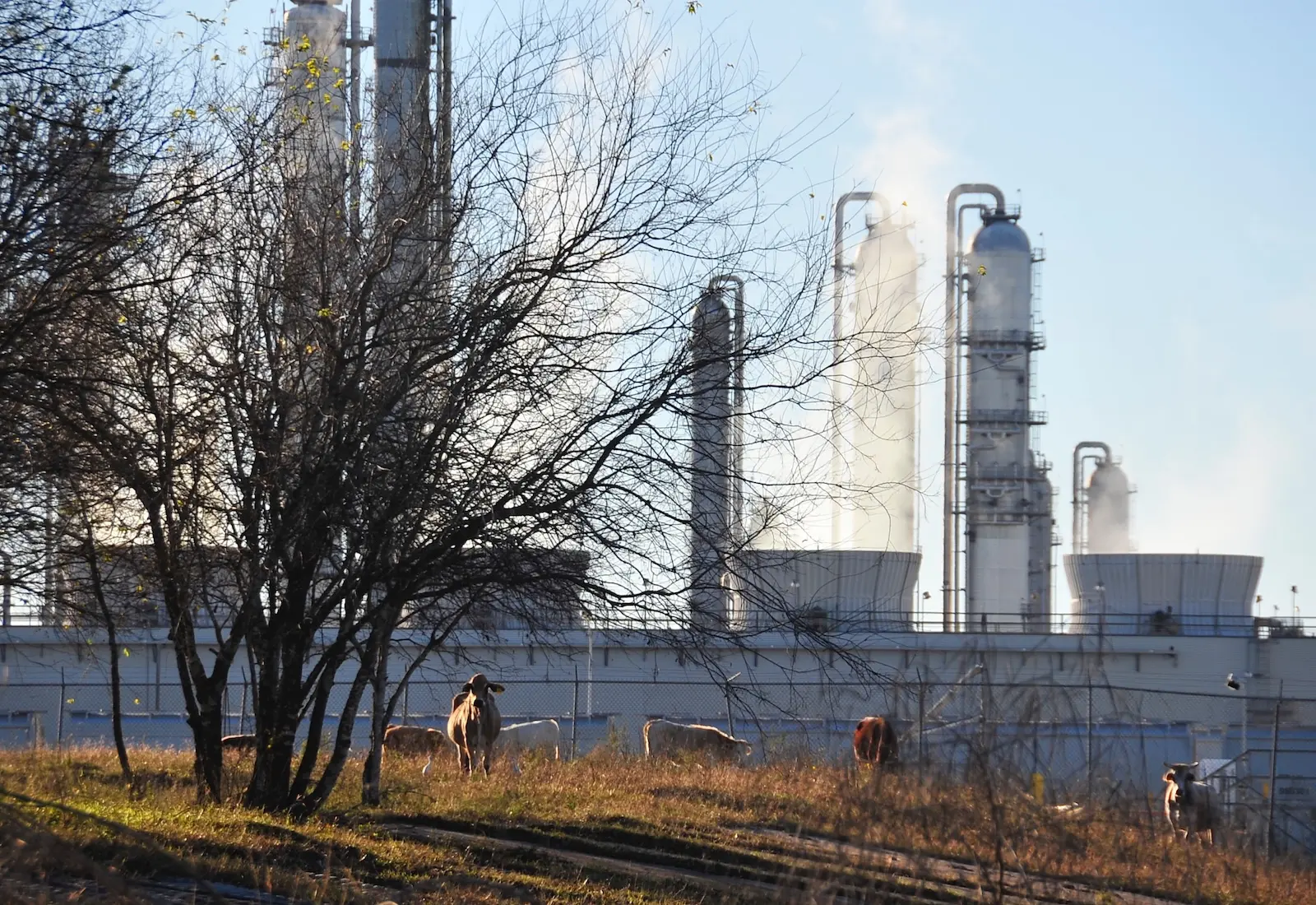
Cattle graze outside the Formosa Plastics facility in Point Comfort, Texas. The operation has long released pollution into the air and a nearby creek, and some in town worry the factory Exxon may build there will do the same. Courtesy of Diane Wilson
Exxon wrote in its application that it plans to apply for more abatements from the county, groundwater conservation district, and port authority. In return, it argued, the facility would create 300 jobs during its first five years in operation. Construction would begin next year and, once it’s operating at full capacity in 2032, Exxon says the operation will raise the state’s economic output by $3.6 billion a year.
“These tax incentives have become one of the early battles in these facilities,” said Robin Schneider, executive director Texas Campaign for the Environment, an advocacy organization. She estimates that Exxon could get about $250 million in local tax breaks over a 10-year period — almost $1 million per job.
“Why is this massively profitable business getting this money from taxpayers?” she asked. Exxon brought in $33.7 billion last year, on record-high production, and distributed more money to shareholders than ever before.
School district officials did not respond to requests for comment and, in an email, County Judge (the title given to county administrators in Texas) Vern Lyssy did not answer specific questions, only repeated the language used in Exxon’s statement. A county commissioner, Joel Behrens, expressed support for Exxon and the economic development it could bring, comparing the opportunity to his positive experiences with Formosa. “If they were to pick this area to come to, they’d probably be just as good a neighbor as Formosa,” he said. “They’ve helped the county out when the county needed help.”
Exxon did not respond to questions about the pollution a new steam cracker might create. Company spokesperson Lauren Kight said the application for tax subsidies in Calhoun County does not mean Exxon has committed to building there. The company indicated in its JETI filing that its focus was on “the U.S. Gulf Coast” but that it is still considering other locations, including abroad. “The Gulf Coast presents tremendous advantages,” said Kight, but it’s “very early in our evaluation process.”
The proposal comes at a time of booming growth for the plastics industry, and for the pollution that it inevitably creates. The world produces about 57 million metric tons of plastic pollution every year, according to a study published in September in the journal Nature. World leaders have spent the past two and a half years negotiating a United Nations treaty to “end plastic pollution,” and at least 69 countries say they want to do that by limiting how much is created in the first place.
Plants like the one Exxon is planning are “the absolute opposite direction we should be going,” said Judith Enck, a former Environmental Protection Agency official and president of the nonprofit Beyond Plastics. She worries that this facility, like others, would spew pollution for decades. “Once these things are built, it’s hard to get them to stop operating.”
Setting aside the environmental argument, financial analysts say it’s imprudent to investin more plastic production. All three credit rating agencies have issued warnings over expanding fossil fuel and plastics infrastructure, including one from Standard & Poor’s in 2021 that cited oversupply of petrochemicals, protests from local residents, and “surging global pressure to reduce carbon emissions as well as chemical and plastic pollution worldwide.”
Nurdles in Cox Creek, behind a Formosa Plastics facility. Courtesy of Diane Wilson
Abhishek Sinha, an energy finance analyst for the nonprofit Institute for Energy Economics and Financial Analysis, said that while the Trump administration may be ushering in a period of lax regulation for polluting industries, the petrochemical sector is in “structural decline” — as shown by the poor returns Shell’s chemicals division and Formosa Plastics recently reported.
“I think it’s going to be the same story that’s being told again and again,” Sinha said, referring to Exxon’s proposed steam cracker. “This is not going to be a positive value-add project for them; it’s going to be detrimental to the equity holders in the long run.”
Kight did not directly address these concerns but said that Exxon would “continue to evaluate the market conditions before we make a decision.”
For Wilson, Exxon’s proposal feels like déjà vu. More than three decades ago, the Taiwanese petrochemical conglomerate Formosa proposed its plant, just miles from the Gulf of Mexico, where Wilson’s family had been shrimpers for generations. Her fight against the company started with hunger strikes to protest its permits and eventually became a lawsuit over the exact outcomes she had feared.
Wilson and former plant workers joined environmental activists to collect tens of thousands of nurdles from Lavaca Bay and nearby waterways like Cox Creek, and alleged that Formosa had illegally dumped them along with other pollutants. Her $50 million settlement is the largest award in a citizen suit against an industrial polluter in the history of the federal Clean Water Act.
The settlement funded dozens of projects, including cleaning up waterways, and provided $20 million for a fishing cooperative aimed at helping rebuild that battered industry. But Wilson worries another mega-factory coming to the area would undermine that work.
“Where Exxon is going to put their bloody plant is smack-dab in front of [what will be] one of the largest oyster farms in Texas,” said Wilson, who is not convinced that any plastics factory can operate without polluting. She noted that Formosa has already violated its settlement agreement nearly 800 times, racking up over $25 million in fines. “Exxon is going to be exactly like Formosa.”
Wilson considers the fact that Exxon could still decide not to build in Calhoun County an opportunity to resist, and plans to fight the company at every step of the process.
“A lot of people over the years have asked me what my one regret is, and I always say: ‘I didn’t try hard enough to stop Formosa,’” reflected Wilson. This time, she said, “I will do everything I can, for as long as I live, to stop that plant from coming in.”
The black half of this drawing is the logo for Sun Day, with huge thanks to Brian Collins, Eron Lutterman, and Beth Johnson. The orange half is illustrative of what we need from you right now—your drawing of the sun.
We’re a week in, and the Trump blitzkrieg has had its desired effect—everyone is stunned by the sweep and depth of the cruelty and silliness on display, bludgeoned into a kind of fish-faced silence because what, really, do you say to someone who has just by fiat renamed the Gulf of Mexico?
The attacks on sensible energy policy have been swift and savage. We exited the Paris climate accords, paused IRA spending, halted wind and solar projects, gutted the effort to help us transition to electric vehicles, lifted the pause on new LNG export projects, canceled the Climate Corps just as it was getting off the ground, and closed the various government agencies dedicated to environmental justice. Oh, and we declared an “energy emergency” to make it easier to do all of the above. “The dizzying pace of announcements gives the impression that the nation’s entire climate landscape has changed in less than a week,” Bloomberg reported (though as Lever News added, the Biden administration did succeed in shoveling a good deal of money out the door in its final weeks, dollars that will be hard for the new guys to claw back.)
I don’t plan on taking apart every one of these dumb decisions—I’ve written a lot about why they were worthy and important efforts, and in any event the Trump administration and the Congress are not responding to reason or evidence. As the Guardian just reported, Big Oil spent $445 million in the last election cycle, and they now have a firm grip on the controls of power. The question is how to erode that grip—which won’t happen in a week, or a year. It will take steady organizing, occurring against the stern backdrop of physics, which will be piling up climate damage even as we work. No easy answers or quick victories; November’s loss was deep and profound.
Some of the fronts on which we’ll fight are obvious. Lawyers from the big environmental groups are already heading to court to try and blunt the worst of Trump’s measures, many of which are blatant attempts to override statutory process engrained in federal law. We shall see how robust the commitment of our judiciary to that law remains.
And in blue states and cities we can continue to pass important legislation. I think the most promising measures may be modelled on New York’s recently adopted Climate Superfund “polluter pays” laws—a similar effort is now gaining steam for obvious reasons in California, and may be spreading to Illinois. These are huge economies; they matter. And there are lots and lots of other things to be done, some of which don’t require vast amounts of federal money—Manhattan’s new congestion pricing law, for instance, has produced 51% fewer crashes and injuries. There are a thousand such good ideas in the air, and places we can enact them.
But we have, I think, a bigger task, which is to shift the zeitgeist around energy.
For some time now, the climate movement has perceived a central task as resisting the depredations of the fossil fuel industry. Since those are manifold, it’s been important work, and often effective. As Cynthia Kaufman writes in an important new paper, activists have been attempting to undermine the power of Big Oil in many ways, from stopping pipelines to divesting pension funds. Power, she writes,
can be challenged in a piecemeal fashion, and a movement can move forward in a somewhat uncoordinated way, something like the game of Jenga, where supports for a structure are removed in a piecemeal fashion. As with the game of Jenga, it is never clear which undermining move will cause the tower to topple. But at some point, with enough challenges, the structure becomes unstable and small moves can have large consequences.
That’s been, I think, the theory that unites many of these efforts, and to a very great extent it worked: the IRA could not have been passed, for instance, without the two proceeding decades of resistance, most of which had nothing to do with the IRA.
But two things have changed. One is that the second Trump presidency seems to be unlike anything that came before it (including his ugly but befuddled first administration). We are seeing a triumph of illiberalism unlike anything in our recent history, when cruelty is not obscured but exalted. I think for me the single most disheartening news of the past week—not close to the most important, but somehow the most illustrative—was the news that the Air Force would no longer be telling its new recruits about the history of the Tuskegee Airmen. That is to say, our proto-fascists want to erase the history of men who fought fascism in Germany and, by their example, helped erode racism in America. (Co-president Musk this weekend called on Germans to “move beyond” any guilt over their history).
The at-least-temporary triumph of this kind of illiberalism narrows somewhat the scope for protest of the sort that’s been useful in the past. Much of the American tradition of nonviolent movement building draws on the epic history of the civil rights movement. We were reminded of that noble history this weekend when Thomas Gaither died at the age of 86. He’d helped to bravely pioneer the “jail no bail” tactics of the early sit-ins, opting for thirty days on the chain gang in Rock Hill South Carolina rather than pay a $100 fine, a gesture that made life difficult for southern sheriffs whose jails began to fill to overflowing, but also underscored the seriousness of the commitment of these young people. That commitment mattered enormously—in a fast-liberalizing country, which was America in the 1960s, it helped build the momentum that within a few years would pass the Civil Rights Act and the Voting Rights Act.
But we are not a liberalizing country right now—we’re closer to a reactionary one, where many people are consumed with grievance real or imagined. And so such gestures have less purchase on the broad center that defines political outcomes. That center is—again, at least for the moment—not broadly responding to this kind of sacrifice; indeed, the ascendant Trumpians welcome resistance so they can smash it, physically (the Proud Boys celebrated their release from jail this week with vows of revenge) and legally—I suspect that the sentences for protest going forward may not be thirty days, but closer to the brutal ones imposed last year on climate protesters in the UK, now languishing in jail for many years to come. (Here is the superb prison diary of one of these protesters, and here is the insane and maddening story of one of her colleagues, a 78-year-old woman returned to jail yesterday because the authorities couldn’t find an ankle or wrist monitor small enough to fit her bones).
It’s not that protest needs to end; it’s that we need to explore some new ways. And there’s plenty to choose from. If there’s one book I’d recommend spending some time with, just to stretch your thinking, it’s volume two of Gene Sharp’s Methods of Nonviolent Action—here, thanks to the War Resister’s League, is a crib sheet of his catalogue of 198 practices, most of which bear little resemblance to the canonical civil rights sit ins. Many of them won’t fit, because in a divided country they produce more anger than resolve. But some will—again, a guide from elsewhere can be found in the history of Otpor, the Serbian resistance movement that eventually overthrew the country’s totalitarian leader Slobodan Milosevic. As one of its leaders, Ivan Marcovic, told Waging Nonviolence last year:
When we started, society was largely in a state of despair and apathy. And that is why we decided to use hope as one of our major forms of messaging. People were like, “How can you be hopeful? It looks like things are getting worse by the day.” But we didn’t care how people reacted to the message of hope, or that they reacted with skepticism. What we were focused on was whether people had a need for hope — and they did. They desperately wanted to hope. They were skeptical because they didn’t want to get hurt or disappointed. Cynicism and apathy were at the surface, but below that was actually a common desire to live in a normal country. That’s why one of our slogans was “We want Serbia to be a normal country.” It was silly because just wanting things to be normal was kind of outrageous. But this is why persistence is important.
To me, that sounds a bit like where we are right now. Otpor famously used humor to make its points; I think that will be key here too (The Emperor’s New Clothes should be standard reading too).
And in the climate movement we have something else going for us. All those years of pipeline fights and divestment battles occurred in a period when fossil fuel was the cheapest way to power a society. That’s no longer true; now it’s Trump and his friends fighting uphill against economic gravity. And they know it—Trump moved so fast to ban new wind and solar—indeed to literally define ‘energy’ to exclude them—because every poll shows they are far more popular than hydrocarbons.
We need to figure out how to leverage those facts in the years ahead—creatively, in ways that make use of our advantage in truth and beauty and minimize our current lack of political power. That’ll be part two, and it may come with an assignment!
First things first—this is the most desperate moment I can remember in my life as an American, and neither I, nor anyone else, has any plan that’s going to fix it in short order.
Real and painful things are happening by the minute—just in our world of climate advocacy, as Zahra Hirji and Canielle Bochove made clear with excellent reporting this morning, illegal funding cutoffs have caused “confusion and panic among groups and researchers that work on clean energy, climate change and environmental justice.” If you’re a glutton for punishment, the Times has a litany of similar stories from IRA-funded projects across the nation. And that’s nothing compared to the trauma that immigrants, and transgender Americans, and federal workers, and overseas AIDS patients, and lots of others are feeling. Even for those who are not for the moment directly affected, the sight of Elon Musk and his minions enthusiastically trashing systems that took decades of careful bipartisan work to build is nauseating. W
That said, there are signs these last days that some kind of opposition is finally starting to find its feet—that the shock and awe are producing a reaction of gathering resolve. As groups like Third Act and Indivisible have flooded switchboards with calls and rallied outside the Treasury, some Congressional leaders have begun to find their voice. Predictably, it was the ever-eloquent Jamie Raskin who, outside the shuttered offices of USAID yesterday, summed it up with the first great line of this resistance: “There’s not a fourth branch of government called Elon Musk.”
The lawsuits are beginning to be filed—which is good, but also scary, since there’s no guarantee that if the courts stand up for the constitution, Trump will obey their rulings. (And if he doesn’t then God knows). Foreign leaders are finding a voice, too—it appears that the Canadians and Mexicans managed to call his bluff on tariffs, at least for now.
All of us need to keep up this pressure. I’ve been talking to Senators from across the country, but I’ve also been calling my state congressional offices daily—we don’t need, I keep telling them, another press release. “We need you, out in front like Raskin or AOC have been, speaking boldly and without fear.” There are other beautiful ideas emerging. Beginning tomorrow, a group called Choose Democracy is asking all of us to take one minute each Wednesday to pause for silent reflection on the damage being done—it’s happening at 12:53 p.m., which is the moment that thugs breached the Capitol on January 6, and also apparently the precise time that the billionaires took their seats for Trump’s inauguration. This won’t by itself do a thing—but as Ivan Marovic, the Serbian nonviolence guru, told a bunch of us the other night, in an authoritarian regime, simply paying witness is crucial. People will assemble at state capitols tomorrow; they rallied outside the Treasury this afternoon.
As is often the case, I think the political commentator Josh Marshall has sage advice. Our job is not to stop what Trump is doing, because we can’t. For the moment, he has the power he needs, though Congressional Democrats can find some small fingerholds—the need to extend the country’s debt ceiling, for instance—and use them to exact concessions. Our basic job is to make what he’s doing is deeply unpopular, because that will stiffen the backbone of the courts and any remaining moderate Republicans, and set us up for possible gains if and when we next have elections. So: witness, communicate, ridicule, amplify strong voices.
It’s defense, and in a moment like this defense is crucial.
But it’s also not enough. So I want to talk about the slightly longer term as well—about the chances for going on offense, especially on climate where the passage of time is literally deadly. We simply don’t have four years to lay on the ropes absorbing blows, because physics could care less about the political cycle: I mean, it was 20 degrees Celsius above normal at the North Pole today, which means ice was melting there in midwinter. So, we have to look for the place where we have an advantage, and then work like hell to exploit it. We have to go on offense too.
Bill McKibben is an author, environmentalist, and activist. In 1988 he wrote The End of Nature, the first book for a common audience about global warming. He is a co-founder and Senior Advisor at 350.org, an international climate campaign that works in 188 countries around the world.