SKIPPING CHICAGO CAUSE THEY SHOWED CHUTZPAH
Alexander Willis
September 27, 2025
RAW STORY
President Donald Trump faced a wave of scrutiny Saturday after dubbing Portland, Oregon as “war-ravaged,” a characterization he cited to justify ordering a new military deployment to the city.
"Oh, okay, I get it now. YOU took a lot of Tylenol, didn’t you?” wrote X user “Nickie B,” a self-described critic of Trump and the MAGA movement, mocking Trump’s recent announcement linking, with disputed evidence, autism to Tylenol. “Now I get why we should stay away from it. Thanks for your attention to this matter!”
Trump has already deployed the military to patrol the streets of Washington, D.C., and has threatened on numerous occasions to do the same to Chicago, Illinois, and doing so in an ominous manner alongside an artificial intelligence-made image depicting the U.S. military invading the Illinois capital.
Trump’s announcement came in the wake of threats from Portland city officials threatening to evict federal immigration officials from a facility over alleged permit violations, which itself was followed by a sudden, unexplained “influx of federal agents” in the city.
Now that Trump has actually pulled the trigger and announced a military deployment to Portland, while also declaring the city to be “war-ravaged,” critics quickly pounced on the president’s rhetoric.
“Portland saw 17 homicides in the first half of 2025, a decline of 51%,” wrote Jay Bookman, journalist and author, in a post on X to his more than 20,000 followers.
“Yet Trump and the ‘secretary of war’ are sending the U.S. military into the city, authorizing American troops to use ‘Full Force’ against American civilians. What are we doing here, people?”
Some even argued that Trump’s characterization of Portland as “war-ravaged” was an impeachable offense, including Mehdi Hasan, journalist and former MSNBC host.
“If ever there was a time not to normalize Trump’s authoritarian fever dreams, this is it,” Hasan wrote to his more than 1.8 followers on X.
“This should be impeachable. ‘War ravaged’ Portland? He’s insane – and insanely power hungry. The script is set – call an imaginary group a terror group and then send in the troops.”
The city of Portland has violent crime rates higher than the national average, though the figures have declined dramatically in recent years.Homicides generally declined in Portland from 2000 to 2019 before spiking during the COVID-19 pandemic. Following the spike in homicides, rates began to fall again starting in 2023, then further dropping by 8% between 2023 and 2024, and further still during the first half of 2025, where homicides dropped by 51% when compared to the same time period the previous year.\\
September 27, 2025
RAW STORY
President Donald Trump faced a wave of scrutiny Saturday after dubbing Portland, Oregon as “war-ravaged,” a characterization he cited to justify ordering a new military deployment to the city.
"Oh, okay, I get it now. YOU took a lot of Tylenol, didn’t you?” wrote X user “Nickie B,” a self-described critic of Trump and the MAGA movement, mocking Trump’s recent announcement linking, with disputed evidence, autism to Tylenol. “Now I get why we should stay away from it. Thanks for your attention to this matter!”
Trump has already deployed the military to patrol the streets of Washington, D.C., and has threatened on numerous occasions to do the same to Chicago, Illinois, and doing so in an ominous manner alongside an artificial intelligence-made image depicting the U.S. military invading the Illinois capital.
Trump’s announcement came in the wake of threats from Portland city officials threatening to evict federal immigration officials from a facility over alleged permit violations, which itself was followed by a sudden, unexplained “influx of federal agents” in the city.
Now that Trump has actually pulled the trigger and announced a military deployment to Portland, while also declaring the city to be “war-ravaged,” critics quickly pounced on the president’s rhetoric.
“Portland saw 17 homicides in the first half of 2025, a decline of 51%,” wrote Jay Bookman, journalist and author, in a post on X to his more than 20,000 followers.
“Yet Trump and the ‘secretary of war’ are sending the U.S. military into the city, authorizing American troops to use ‘Full Force’ against American civilians. What are we doing here, people?”
Some even argued that Trump’s characterization of Portland as “war-ravaged” was an impeachable offense, including Mehdi Hasan, journalist and former MSNBC host.
“If ever there was a time not to normalize Trump’s authoritarian fever dreams, this is it,” Hasan wrote to his more than 1.8 followers on X.
“This should be impeachable. ‘War ravaged’ Portland? He’s insane – and insanely power hungry. The script is set – call an imaginary group a terror group and then send in the troops.”
The city of Portland has violent crime rates higher than the national average, though the figures have declined dramatically in recent years.Homicides generally declined in Portland from 2000 to 2019 before spiking during the COVID-19 pandemic. Following the spike in homicides, rates began to fall again starting in 2023, then further dropping by 8% between 2023 and 2024, and further still during the first half of 2025, where homicides dropped by 51% when compared to the same time period the previous year.\\
Trump 'authorizing Full Force, if necessary' as military deploys to another US city
GENERAL BONESPURS DECLARES WAR ON PORTLAND
 |
| CHICAGO STOOD UP TO BONESPURS SO ITS OFF THE AGENDA |
Alexander Willis
September 27, 2025
RAW STORY
President Donald Trump announced Saturday that he would be directing Department of Defense Secretary Pete Hegeseth to “provide all necessary troops” to protect “war-ravaged Portland,” Oregon, and in an effort to protect Immigration Customs and Enforcement facilities in the city.
“At the request of Secretary of Homeland Security [Secretary] Kristi Noem, I am directing Secretary of War, Pete Hegseth, to provide all necessary Troops to protect War ravaged Portland, and any of our ICE Facilities under siege from attack by Antifa, and other domestic terrorists,” Trump wrote on his social media platform Truth Social Saturday. “I am also authorizing Full Force, if necessary. Thank you for your attention to this matter!”
Trump’s announcement comes shortly after Portland city officials threatened to evict ICE from its facility over alleged permit violations.
On Friday, Portland city officials held an emergency press conference after observing “a sudden influx of federal agents” in the city.
“We did not ask for them to come,” said Portland Mayor Keith Wilson during the press conference, according to a report from KOIN, a CBS affiliated station.
“If the federal government isn’t here to lend us a hand, take a hike…it’s just a big show. The president has sent agents here to create chaos and riots in Portland. [Trump] wants to induce a violent exchange. Let’s not grant him that wish…Say no to an authoritarian president.”
Portland police official worries Trump just made things worse: 'Will increase protesters'
David McAfee
September 27, 2025
RAW STORY
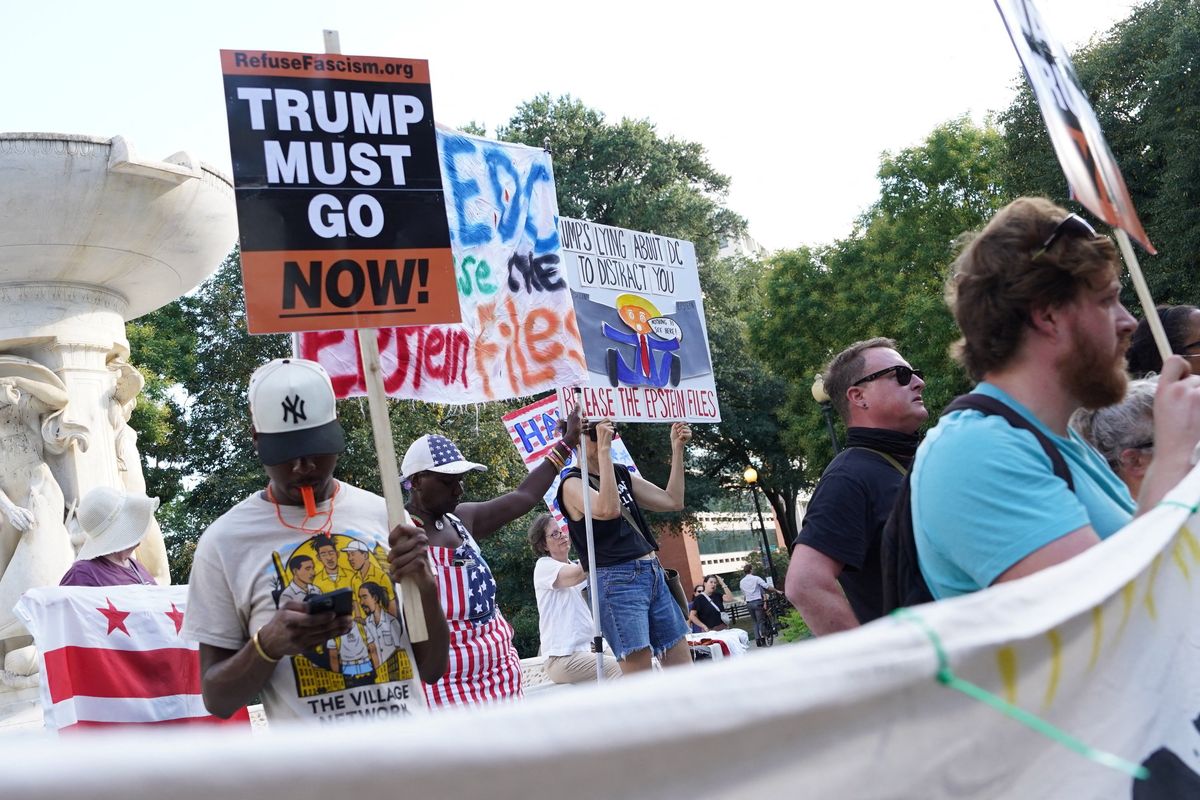
People protest after U.S. President Donald Trump announced he would deploy the National Guard to the nation's capital and place D.C.'s Metropolitan Police Department under federal control, in Washington, D.C., U.S., August 11, 2025. REUTERS/Ken Cedeno
Donald Trump has announced his intentions to send troops to Portland, Oregon, and one local senior police official is worried the president will just be making matters worse.
Politico on Saturday published an article called Why Donald Trump is obsessed with Portland, in which the outlet attempts to explain the president's "fixation" on the city.
"Five years ago, rioters in Portland set fire to government buildings, epitomizing for many on the right the lawlessness and chaos that swirled around the George Floyd protests," according to the report. "President Donald Trump never forgot."
After elaborating on Trump's motives, Politico shares pieces of an interview with a senior police official in Oregon. The official was not allowed to speak about the issue, so was left with anonymity.
"But a senior police official at the Portland Police Department, who was granted anonymity because he was not authorized to talk about police operations, said sending in additional federal forces would escalate the situation," according to the report. "'It will increase the number of protesters,' he said. When asked what the PPD would do if that happens, he added: 'I truly don’t know.'"
The report goes on the shed some more light on the current ICE protests.
"The senior police official said the situation continues to escalate as federal officers are doxxed, threatened or physically hurt — and then in turn take a more adversarial approach to the late-night protesters," the report states.
“It is a political nightmare,” he said, according to Politico.
Read the article here.
People protest after U.S. President Donald Trump announced he would deploy the National Guard to the nation's capital and place D.C.'s Metropolitan Police Department under federal control, in Washington, D.C., U.S., August 11, 2025. REUTERS/Ken Cedeno
Donald Trump has announced his intentions to send troops to Portland, Oregon, and one local senior police official is worried the president will just be making matters worse.
Politico on Saturday published an article called Why Donald Trump is obsessed with Portland, in which the outlet attempts to explain the president's "fixation" on the city.
"Five years ago, rioters in Portland set fire to government buildings, epitomizing for many on the right the lawlessness and chaos that swirled around the George Floyd protests," according to the report. "President Donald Trump never forgot."
After elaborating on Trump's motives, Politico shares pieces of an interview with a senior police official in Oregon. The official was not allowed to speak about the issue, so was left with anonymity.
"But a senior police official at the Portland Police Department, who was granted anonymity because he was not authorized to talk about police operations, said sending in additional federal forces would escalate the situation," according to the report. "'It will increase the number of protesters,' he said. When asked what the PPD would do if that happens, he added: 'I truly don’t know.'"
The report goes on the shed some more light on the current ICE protests.
"The senior police official said the situation continues to escalate as federal officers are doxxed, threatened or physically hurt — and then in turn take a more adversarial approach to the late-night protesters," the report states.
“It is a political nightmare,” he said, according to Politico.
Read the article here.
‘An Egregious Abuse of Power’: Trump Orders Troops to Portland, Ore; OKs ‘Full Force’
“This unilateral action represents an abuse of executive authority, seeks to incite violence, and undermines the constitutional balance of power between the federal government and states,” Oregon lawmakers wrote.
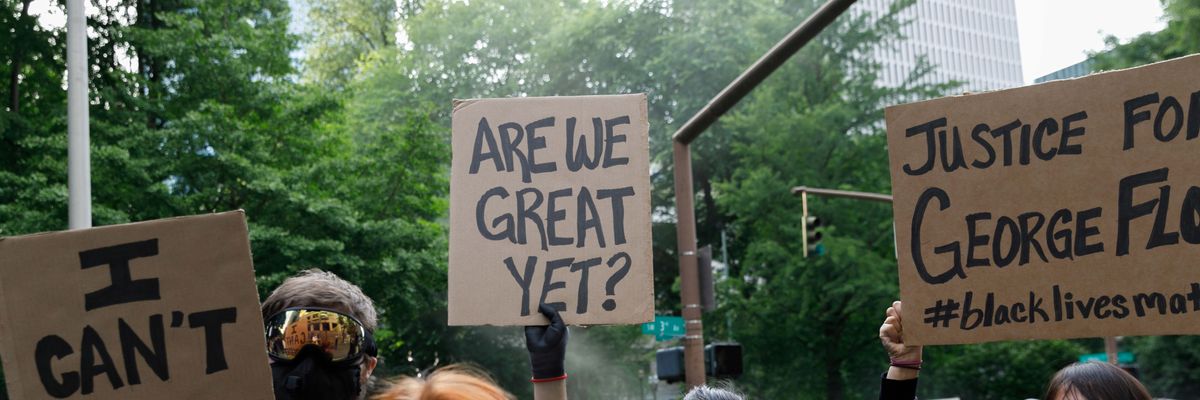
People carrying banners march to protest over the death of George Floyd, an unarmed black man who died after being pinned down by a white police officer, on May 31, 2020 in Portland, Oregon.
(Photo by John Rudoff/Anadolu Agency via Getty Images)
Olivia Rosane
Sep 27, 2025
COMMON DREAMS
In his latest attempt to turn the US military on an American city, President Donald Trump said on Saturday that he was sending troops to Portland, Oregon and had authorized them to use “Full Force, if necessary.”
“At the request of Secretary of Homeland Security, Kristi Noem, I am directing Secretary of War, Pete Hegseth, to provide all necessary Troops to protect War ravaged Portland, and any of our ICE Facilities under siege from attack by Antifa, and other domestic terrorists,” Trump wrote on Truth Social.

‘No Trump! No Troops!’ Thousands March in Chicago as President Threatens ‘War’
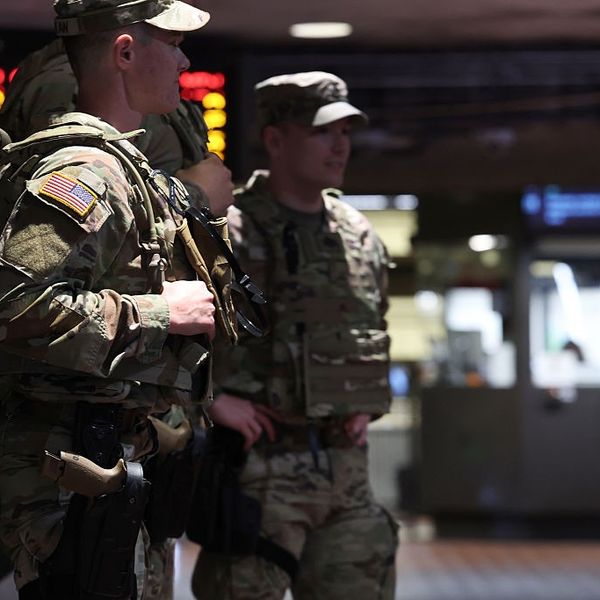
DC Sues Over Trump Troop Deployment as National Guard Members Say They’re Being Used as ‘Toy Soldiers’
Trump’s announcement follows his deployment of the National Guard in Los Angeles and Washington, DC, as well as his threats to send the military to Chicago and Memphis. These deployments have been widely condemned and legally challenged as a massive overreach of executive authority.
Portland and Oregon leaders were no less vehement in their opposition to Trump’s order for their city.
“Trump is plunging further into authoritarianism every single day.”
“President Trump has directed ‘all necessary Troops’ to Portland, Oregon. The number of necessary troops is zero, in Portland and any other American city,” Portland Mayor Keith Wilson said in a statement on Saturday. “Our nation has a long memory for acts of oppression, and the president will not find lawlessness or violence here unless he plans to perpetrate it.”
Democratic Oregon Gov. Tina Kotek said that she had not been informed ahead of time of any reason for the deployment of federal troops.
“In my conversations directly with President Trump and Secretary Noem, I have been abundantly clear that Portland and the State of Oregon believe in the rule of law and can manage our own local public safety needs,” she wrote on social media. “There is no insurrection. There is no threat to national security.”
Rep. Maxine Dexter (D-Ore.) said in a statement: “The President of the United States is directing his self-proclaimed ‘Secretary of War’ to unleash militarized federal forces in an American city he disagrees with. This is an egregious abuse of power and a betrayal of our most basic American values.”
“Authoritarians rely on fear to divide us,” she continued. “Portland will not give them that. We will not be intimidated. We have prepared for this moment since Trump first took office, and we will meet it with every tool available to us: litigation, legislation, and the power of peaceful public pressure.”
Dexter also posted a photograph of a tranquil park on social media, mocking the idea that Portland was a war zone.
Sen. Ron Wyden (D-Ore.) adopted a similar strategy, posting videos of downtown Portland and of an Immigration and Customs Enforcement (ICE) facility that has been the site of protests Trump has characterized as out-of-control.
Dexter and Wyden were among the seven members of Oregon’s congressional delegation who sent a letter to Trump, Noem, and Hegseth on Saturday urging them to reconsider.
“Portland is a vibrant and peaceful city, and does not require any deployment of federal troops or additional federal agents to keep our community safe,” the lawmakers wrote. “This unilateral action represents an abuse of executive authority, seeks to incite violence, and undermines the constitutional balance of power between the federal government and states. We urge you to rescind this decision, and withdraw any military personnel and federal agents you have recently sought to deploy.”
As of Saturday, Oregon National Guard spokesperson Lt. Col. Stephen Bomar told The Associated Press in an email that “no official requests have been received at this time.” However, Oregon officials noted an uptick in the presence of federal agents and armored vehicles in Portland on Friday.
In a press conference Friday evening, Mayor Wilson suggested that the deployment was a “distraction” from the looming GOP-driven government shutdown.
“Imagine if the federal government sent instead 100 teachers or 100 engineers or 100 addiction specialists,” Wilson said.
Earlier in the week, Trump also smeered Portland protesters as “professional agitators and anarchists,” according to the Portland Tribune.
“We’re going to get out there and we’re going to do a pretty big number on those people in Portland,” Trump said.
The federal deployment threatens to reopen wounds from 2020, when Portland was the site of massive protests sparked by the police killing of George Floyd and the first Trump administration sent federal and border agents to the city.
As the Oregon lawmakers wrote:
Portland residents experienced the consequences of an unnecessary and outrageous federal deployment five years ago. In summer of 2020, the White House unleashed federal agents on Portland like an occupying army, complete with military-grade equipment and violent tactics that were utterly unacceptable on American soil. A federal agent shot a peaceful protester in the head with a crowd-control munition, sending the man to the hospital with a fractured skull. Federal agents were captured on video jumping out of unmarked vans and grabbing people off the streets without explanation. A county commissioner was tear gassed along with other non-violent protestors. A Navy veteran was filmed being beaten by federal agents after he questioned them about their actions. These examples, and many more that occurred in Portland, demonstrate that the federal agents who were parachuted into Portland incited violence and trampled over the constitutional rights of Americans. There is no question that another deployment by your administration will result in similar abuses.
However, the risks of abuses are perhaps even higher as the second Trump administration has designated “antifa,” which is not an actual, coherent group, as a domestic terrorist organization, a dubious legal move that experts warn is an attempt to restrict the First Amendment rights of leftists and others critical of the administration.
“If ever there was a time not to normalize Trump’s authoritarian fever dreams, this is it,” said journalist Mehdi Hasan on social media. “This should be impeachable. ‘War ravaged’ Portland? He’s insane—& insanely power hungry. The script is set—call an imaginary group a terror group and then send in the troops.”
Sen. Jeff Merkley (D-Ore.) urged his constituents not to give Trump the confrontation he is clearly seeking.
“Trump is sending troops to Portland with the goal of ‘doing a number’ on the city. We know what this means. He wants to stoke fear and chaos and trigger violent interactions and riots to justify expanded authoritarian control,” he said in a video posted on social media. “Let’s not take the bait! Portland is peaceful and strong and we will take care of each other.
Other advocates and lawmakers also took issue with Trump’s characterization of Portland.
Human Rights lawyer Qasim Rashid pointed out that Portland had actually experienced the most dramatic drop in homicides among all US cities during the first half of 2025.
“This unilateral action represents an abuse of executive authority, seeks to incite violence, and undermines the constitutional balance of power between the federal government and states,” Oregon lawmakers wrote.
People carrying banners march to protest over the death of George Floyd, an unarmed black man who died after being pinned down by a white police officer, on May 31, 2020 in Portland, Oregon.
(Photo by John Rudoff/Anadolu Agency via Getty Images)
Olivia Rosane
Sep 27, 2025
COMMON DREAMS
In his latest attempt to turn the US military on an American city, President Donald Trump said on Saturday that he was sending troops to Portland, Oregon and had authorized them to use “Full Force, if necessary.”
“At the request of Secretary of Homeland Security, Kristi Noem, I am directing Secretary of War, Pete Hegseth, to provide all necessary Troops to protect War ravaged Portland, and any of our ICE Facilities under siege from attack by Antifa, and other domestic terrorists,” Trump wrote on Truth Social.
‘No Trump! No Troops!’ Thousands March in Chicago as President Threatens ‘War’
DC Sues Over Trump Troop Deployment as National Guard Members Say They’re Being Used as ‘Toy Soldiers’
Trump’s announcement follows his deployment of the National Guard in Los Angeles and Washington, DC, as well as his threats to send the military to Chicago and Memphis. These deployments have been widely condemned and legally challenged as a massive overreach of executive authority.
Portland and Oregon leaders were no less vehement in their opposition to Trump’s order for their city.
“Trump is plunging further into authoritarianism every single day.”
“President Trump has directed ‘all necessary Troops’ to Portland, Oregon. The number of necessary troops is zero, in Portland and any other American city,” Portland Mayor Keith Wilson said in a statement on Saturday. “Our nation has a long memory for acts of oppression, and the president will not find lawlessness or violence here unless he plans to perpetrate it.”
Democratic Oregon Gov. Tina Kotek said that she had not been informed ahead of time of any reason for the deployment of federal troops.
“In my conversations directly with President Trump and Secretary Noem, I have been abundantly clear that Portland and the State of Oregon believe in the rule of law and can manage our own local public safety needs,” she wrote on social media. “There is no insurrection. There is no threat to national security.”
Rep. Maxine Dexter (D-Ore.) said in a statement: “The President of the United States is directing his self-proclaimed ‘Secretary of War’ to unleash militarized federal forces in an American city he disagrees with. This is an egregious abuse of power and a betrayal of our most basic American values.”
“Authoritarians rely on fear to divide us,” she continued. “Portland will not give them that. We will not be intimidated. We have prepared for this moment since Trump first took office, and we will meet it with every tool available to us: litigation, legislation, and the power of peaceful public pressure.”
Dexter also posted a photograph of a tranquil park on social media, mocking the idea that Portland was a war zone.
Sen. Ron Wyden (D-Ore.) adopted a similar strategy, posting videos of downtown Portland and of an Immigration and Customs Enforcement (ICE) facility that has been the site of protests Trump has characterized as out-of-control.
Dexter and Wyden were among the seven members of Oregon’s congressional delegation who sent a letter to Trump, Noem, and Hegseth on Saturday urging them to reconsider.
“Portland is a vibrant and peaceful city, and does not require any deployment of federal troops or additional federal agents to keep our community safe,” the lawmakers wrote. “This unilateral action represents an abuse of executive authority, seeks to incite violence, and undermines the constitutional balance of power between the federal government and states. We urge you to rescind this decision, and withdraw any military personnel and federal agents you have recently sought to deploy.”
As of Saturday, Oregon National Guard spokesperson Lt. Col. Stephen Bomar told The Associated Press in an email that “no official requests have been received at this time.” However, Oregon officials noted an uptick in the presence of federal agents and armored vehicles in Portland on Friday.
In a press conference Friday evening, Mayor Wilson suggested that the deployment was a “distraction” from the looming GOP-driven government shutdown.
“Imagine if the federal government sent instead 100 teachers or 100 engineers or 100 addiction specialists,” Wilson said.
Earlier in the week, Trump also smeered Portland protesters as “professional agitators and anarchists,” according to the Portland Tribune.
“We’re going to get out there and we’re going to do a pretty big number on those people in Portland,” Trump said.
The federal deployment threatens to reopen wounds from 2020, when Portland was the site of massive protests sparked by the police killing of George Floyd and the first Trump administration sent federal and border agents to the city.
As the Oregon lawmakers wrote:
Portland residents experienced the consequences of an unnecessary and outrageous federal deployment five years ago. In summer of 2020, the White House unleashed federal agents on Portland like an occupying army, complete with military-grade equipment and violent tactics that were utterly unacceptable on American soil. A federal agent shot a peaceful protester in the head with a crowd-control munition, sending the man to the hospital with a fractured skull. Federal agents were captured on video jumping out of unmarked vans and grabbing people off the streets without explanation. A county commissioner was tear gassed along with other non-violent protestors. A Navy veteran was filmed being beaten by federal agents after he questioned them about their actions. These examples, and many more that occurred in Portland, demonstrate that the federal agents who were parachuted into Portland incited violence and trampled over the constitutional rights of Americans. There is no question that another deployment by your administration will result in similar abuses.
However, the risks of abuses are perhaps even higher as the second Trump administration has designated “antifa,” which is not an actual, coherent group, as a domestic terrorist organization, a dubious legal move that experts warn is an attempt to restrict the First Amendment rights of leftists and others critical of the administration.
“If ever there was a time not to normalize Trump’s authoritarian fever dreams, this is it,” said journalist Mehdi Hasan on social media. “This should be impeachable. ‘War ravaged’ Portland? He’s insane—& insanely power hungry. The script is set—call an imaginary group a terror group and then send in the troops.”
Sen. Jeff Merkley (D-Ore.) urged his constituents not to give Trump the confrontation he is clearly seeking.
“Trump is sending troops to Portland with the goal of ‘doing a number’ on the city. We know what this means. He wants to stoke fear and chaos and trigger violent interactions and riots to justify expanded authoritarian control,” he said in a video posted on social media. “Let’s not take the bait! Portland is peaceful and strong and we will take care of each other.
Other advocates and lawmakers also took issue with Trump’s characterization of Portland.
Human Rights lawyer Qasim Rashid pointed out that Portland had actually experienced the most dramatic drop in homicides among all US cities during the first half of 2025.
Sen. Elizabeth Warren (D-Mass.) said the description of Portland as “war ravaged” was “delusional and dangerous.”
“Sending troops into American cities doesn’t make our communities safer—it just stokes fear and stirs up chaos,” she wrote on social media. “Trump is plunging further into authoritarianism every single day.”
Civil rights lawyer and author Alec Karakatsanis said that the mainstream media needed to reflect on how its reporting had enabled Trump’s false narrative about Portland.
“This kind of outrageous misinformation would not be possible without the culture of fear spread for years by the mainstream media,” Karakatsanis wrote on social media. “He is playing on the prodigious ignorance and irrational fear cultivated by the way the news media distorts our sense of safety.”
“Portland, needless to say, is nothing remotely like what Trump describes,” he continued. “But the mass media has created an entirely delusional public perception of what threats we face and from whom.”
“Sending troops into American cities doesn’t make our communities safer—it just stokes fear and stirs up chaos,” she wrote on social media. “Trump is plunging further into authoritarianism every single day.”
Civil rights lawyer and author Alec Karakatsanis said that the mainstream media needed to reflect on how its reporting had enabled Trump’s false narrative about Portland.
“This kind of outrageous misinformation would not be possible without the culture of fear spread for years by the mainstream media,” Karakatsanis wrote on social media. “He is playing on the prodigious ignorance and irrational fear cultivated by the way the news media distorts our sense of safety.”
“Portland, needless to say, is nothing remotely like what Trump describes,” he continued. “But the mass media has created an entirely delusional public perception of what threats we face and from whom.”



.jpeg)