Monday, February 23, 2026

Jesuits say Olympians are more Christian than Trump and his ungodly lies


President Donald Trump holds up a Bible outside of a church in Washington, DC in 2020 (Image: Screengrab via C-SPAN / YouTube)

February 19, 2026
ALTERNET


President Donald Trump criticized America’s Olympic freestyle skier Hunter Hess as a “real loser” for criticizing his policies, but according to a prominent Catholic magazine, Hess and other anti-Trump Olympians are acting in the Christian spirit.

“Mr. Trump understands greatness differently from the U.S. athletes,” wrote Patrick Kelly, S.J., a contributor to the Jesuit publication America Magazine and an occasional Vatican consultant. “He has a very hard time admitting that he failed or made a mistake. He told the big lie that his 2020 election loss to Joe Biden was stolen, and he continues to peddle this lie up to the present.”

Trump repeatedly claims that the 2020 election was stolen from him even though Joe Biden’s victory has been repeatedly proved beyond a reasonable doubt. Before entering politics ,Trump accused the Emmy Awards of being rigged when he was snubbed for "The Apprentice." After losing the 2016 Iowa GOP caucuses to Sen. Ted Cruz (R-Texas), Trump baselessly alleged fraud and demanded a second election. Throughout the 2016 campaign Trump declared he'd only accept the results if he won. After winning the Electoral College but losing the popular vote, Trump falsely blamed millions of illegal ballots, despite never finding evidence of that. In 2020, Trump preemptively undermined mail-in voting, declared victory prematurely on Election Night and falsely claimed votes were being "dumped" against him. In fact Biden won convincingly in both the popular vote (81.3 million to 74.2 million) and the Electoral College (306-232), the latter being the same margin Trump had won by in 2016. Trump nonetheless continues falsely claiming to this day that he won the 2020 election.

“Someone should read to him ‘Lost, Not Stolen,’ a 2022 report by eight conservatives (two former Republican senators, three former federal appellate judges, a former Republican solicitor general, and two Republican election law specialists),” Republican columnist George F. Will recently wrote for The Washington Post. “They examined all 187 counts in the 64 court challenges filed in multiple states by Trump and his supporters. Twenty cases were dismissed before hearings on their merits, 14 were voluntarily dismissed by Trump and his supporters before hearings. Of the 30 that reached hearings on the merits, Trump’s side prevailed in only one, Pennsylvania, involving far too few votes to change the state’s result.”

Kelly, proceeding from the fact that Trump is lying when he says he won the 2020 election, explained that this lie is both sinful and socially harmful.

“It has now become part of the ‘organized lying’ in segments of his administration and among some of his allies,” Kelly wrote. “It was the rationale for the FBI. seizing sensitive voting records from the 2020 election in Fulton County, Ga., recently. If the president was able to admit that he lost to Joe Biden, he might be able to learn something from it and grow as a person and a leader. But the lying keeps him stuck where he is.”

Kelly then quoted the Catechism of the Catholic Church, which says that “since it violates the virtue of truthfulness, a lie does real violence to another. It affects his ability to know, which is a condition of every judgment and decision. It contains the seed of discord and all consequent evils.”

He concluded, “Lying is destructive of society; it undermines trust among people and tears apart the fabric of social relationships (No. 2486).”

Kelly is not alone among prominent Christians to denounce Trump’s policies and actions as un-Christian. Describing Trump’s “might makes right” foreign policy as inconsistent with Christianity, former director of church and society at the World Council of Churches in Geneva Wesley Granberg-Michaelson wrote for the Christian publication Sojourners Magazine that Trump’s approach is in fact “narcissistic grandiosity.” Because Trump unilaterally invaded Venezuela, Granberg-Michaelson worried that he will soon go after Denmark (for Greenland), Colombia, Mexico, Cuba, Iran, Nigeria, Syria and other nations he has threatened, as well as sabotage NATO and other world peacekeeping institutions.

"The ‘Donroe Doctrine,’ an egocentric name for reasserting U.S. primacy in Western Hemisphere, won’t geographically limit Trump’s military intervention to the continental neighborhood,” Granberg-Michaelson wrote. In response people of faith should “bear witness” as “our nation is on an unpredictable glide path with no guardrails."

"We should remember the strident biblical resistance to unaccountable power, including the divine warnings about the desire for kings (1 Samuel 8) and placing trust in chariots and horses (Psalm 20:7),” Granberg-Michaelson concluded. “The prophets continually challenged the pretense, pride, and self-serving power of rulers that fomented injustice and violated God’s intentions for the world. Jesus proclaimed a promised reign of God breaking into the world, undermining the false claims of the reigning empire. The power of might was subverted by the power of love."

Former Republican Rep. Joe Walsh of Illinois recently wrote on his Substack that, instead of being Christians, Trump’s supporters act like they are in a cult.

“I thought you wanted him to end wars all over the world,” Walsh wrote. “You said you wanted him to end American entanglement in conflicts and wars around the world. America shouldn’t be involved in these wars, you said. That’s why you’re voting for Trump, you said.” Then, despite Trump’s actions against Denmark, Venezuela and Iran, they still support him.

Walsh concluded, “And you don’t like when people call you a cult, Trump voters? What else are people to think when you voted for Trump to get us the hell out of wars around the world, and instead he gets us involved in wars around the world and starts new wars, and you still sing his praises and support him? What are we to think, MAGA, but that you are a cult?”

'Strident Biblical resistance': Religious leader urges Christians to oppose Trump
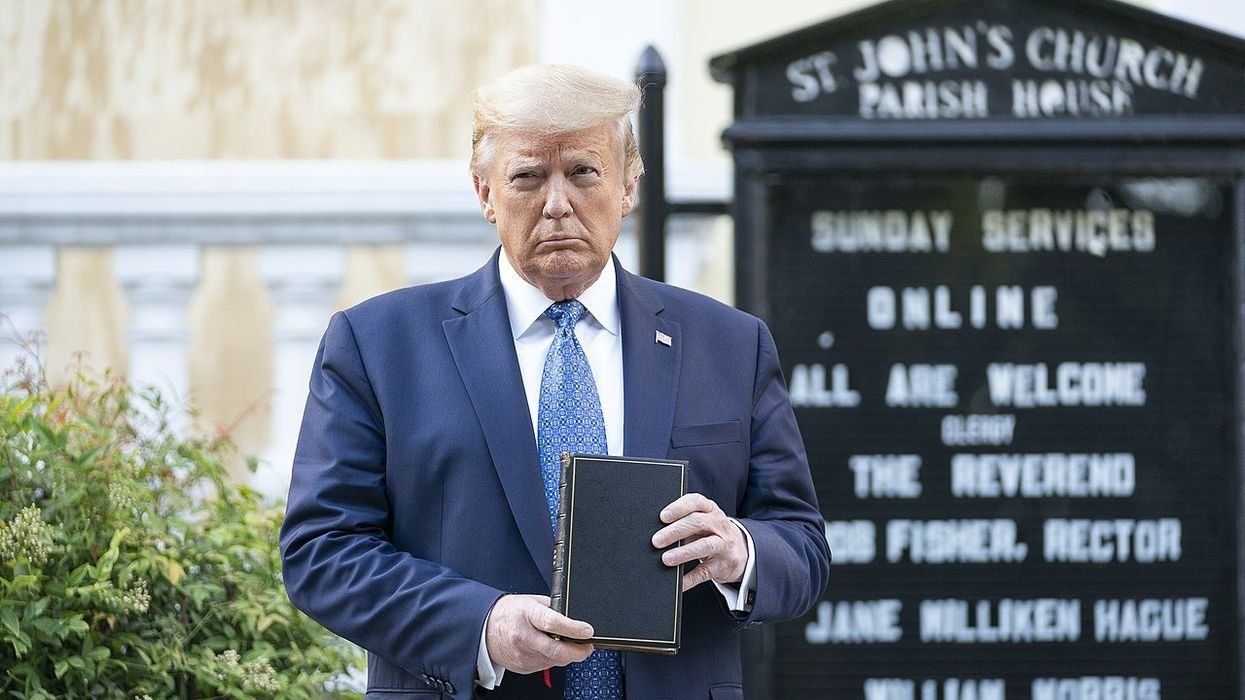

Donald Trump outside St. John's Episcopal Church in Washington, D.C. on June 1, 2020 (Official White House Photo by Shealah Craighead/Flickr)
February 19, 2026
ALTERNET


A major Christian world leader is urging people of faith everywhere to engage in “strident Biblical resistance” against President Donald Trump’s foreign policy.

"Trump’s worldview was expressed transparently by Stephen Miller, his trusted deputy chief of staff," wrote Sojourners contributing editor Wesley Granberg-Michaelson, former general secretary of the Reformed Church in America and former director of church and society at the World Council of Churches. "After Venezuela, Miller explained that 'strength,' 'force,' and 'power' are the 'iron laws' that govern the world. It’s all a matter of transactional relations, where deals enriching the U.S. are obtained by force."

Arguing that “might makes right” is inconsistent with Christianity, which focuses on helping the poor and powerless, Granberg-Michaelson described Trump’s approach as “narcissistic grandiosity.” He also predicted that, because Trump has already unilaterally invaded Venezuela, the rest of the world should expect similar operations in Mexico, Colombia, Cuba, Nigeria, Iran, Syria and elsewhere. Trump will also undercut NATO and other world peacekeeping institutions.

"The ‘Donroe Doctrine,’ an egocentric name for reasserting U.S. primacy in Western Hemisphere, won’t geographically limit Trump’s military intervention to the continental neighborhood,” Granberg-Michaelson wrote. He then argued that people of faith should “bear witness” to Trump’s un-Christian behavior as “our nation is on an unpredictable glide path with no guardrails."

"We should remember the strident biblical resistance to unaccountable power, including the divine warnings about the desire for kings (1 Samuel 8) and placing trust in chariots and horses (Psalm 20:7),” Granberg-Michaelson wrote. “The prophets continually challenged the pretense, pride, and self-serving power of rulers that fomented injustice and violated God’s intentions for the world. Jesus proclaimed a promised reign of God breaking into the world, undermining the false claims of the reigning empire. The power of might was subverted by the power of love."

Pointing out that democracy bases its theological rationale on institutional and personal accountability, and that these things cannot be reconciled with autocratic power, he argued that “shared systems of mutual constraint are required to protect the common good. But all of that can crumble.”

"We are facing modern expressions of ancient idolatry,” Granberg-Michaelson concluded. “Always, in such times, people of God are called first to faithfulness. Proclaiming ‘Jesus is Lord’ had direct political, as well as personal, meaning for those first called Christians. It does as well for us in our day. For if everything is Caesar’s, nothing is God’s."

Other religious people are also speaking out against Trump. Never Trump conservative David French, writing for The New York Times, warned that Trump-supporting Christians are abandoning their faith’s core tenet by eschewing empathy.

"Now, let's talk about empathy," French wrote. "A year ago this month, I wrote a newsletter warning about a new trend on the MAGA Christian Right. Christian theologians and influencers had begun warning about the 'sin of empathy' or 'toxic empathy.' In books, essays, podcasts and speeches, prominent Christian influencers, ministers and theologians sounded the alarm that secular progressives were leading Christians astray by appealing to their emotions at the expense of their reason."

Yet the MAGA anti-empathy argument is not reasonable, as French pointed out, but rather an excuse to ignore how Trump’s actions cannot be made logically consistent with Christian teachings.

"Evangelicals are desperate to rationalize their support for a man who gratuitously and intentionally inflicts unnecessary suffering on his opponents," French wrote. "That's exactly how empathy becomes a sin….. Many in MAGA decided that cruelty was a virtue, decency a vice, and — worst of all — that empathy was a sin. Now, we live in the harsh new world they made."

Meanwhile Andrew Egger of The Bulwark, another conservative publication, bashed Trump for not believing he could do whatever he wanted morally because of his widespread support among the Christian right.

"He sees himself as Christianity’s Punisher, the guy who will blacken his own soul to do what must be done to protect the righteous," Egger wrote.


Christian conservative demolishes MAGA evangelical talking point


First Lady Melania Trump at an evangelical White House dinner on August 27, 2018 (Official White House Photo by Andrea Hanks/Flickr)

February 19, 2026
ALTERNET

In the past, the word "empathy" was hardly controversial among conservatives. President Ronald Reagan and Sen. Barry Goldwater (R-Arizona) never used "empathy" as an insult. But in recent years, many far-right MAGA Republicans and evangelical Christian nationalists are attacking "empathy" as a major weakness — and when they accuse conservative or libertarian of showing "empathy," it is meant as an insult.

Never Trump conservative David French, in a biting February 19 column for the New York Times, cites Christian nationalists' anti-empathy arguments as a prime example of how twisted MAGA's view of Christianity is.

"Now, let's talk about empathy," French writes. "A year ago this month, I wrote a newsletter warning about a new trend on the MAGA Christian Right. Christian theologians and influencers had begun warning about the 'sin of empathy' or 'toxic empathy.' In books, essays, podcasts and speeches, prominent Christian influencers, ministers and theologians sounded the alarm that secular progressives were leading Christians astray by appealing to their emotions at the expense of their reason."

The conservative columnist continues, "The steel man version of their case goes like this: Progressives have turned Christians' soft hearts against hard truths. Progressives have persuaded all too many Christians that the suffering of, say, undocumented immigrants or women facing unwanted pregnancies should override their concerns about the economic and social costs of large-scale immigration, or their compassion for victims of crimes committed by immigrants, or their concerns about the plight of the unborn child."

But MAGA anti-empathy argument, French stresses, isn't promoting strength — it's promoting "cruelty" while demeaning a "vital human virtue."

"Given the sharp differences between Trump and every other Republican president of the modern era…. evangelicals are desperate to rationalize their support for a man who gratuitously and intentionally inflicts unnecessary suffering on his opponents," French laments. "That's exactly how empathy becomes a sin….. Many in MAGA decided that cruelty was a virtue, decency a vice, and — worst of all — that empathy was a sin. Now, we live in the harsh new world they made."


THE EPSTEIN CLASS


UK journalist attacks America's 'culture of complete impunity'
February 21, 2026 

British police released former Prince Andrew on Thursday after 11 hours in custody, with his shocking arrest earlier in the day making him the first senior British royal to be arrested in nearly 400 years. Police are probing his connections to the deceased sexual predator Jeffrey Epstein and whether he shared classified government information with him while serving as a U.K. trade representative from 2001 to 2011. King Charles’ brother, now known as Andrew Mountbatten-Windsor after being stripped of his royal title, is the most high-profile figure in the U.K. to be implicated in a widening scandal over ties to Epstein, who died in a New York jail in 2019 awaiting trial on sex trafficking. Authorities did not reference sexual abuse allegations against Mountbatten-Windsor or Epstein’s sex trafficking case; Mountbatten-Windsor settled a lawsuit with Epstein survivor Virginia Roberts Giuffre in 2022 and has denied all wrongdoing.

Investigative journalist Carole Cadwalladr says this week’s arrest feels like a “rupture” in British society because the royals are seen as “sacrosanct” and rarely subjected to such treatment. “And in America, what are we seeing? We’re seeing this sort of culture of complete impunity, where it appears the law is not equal, where there are people who are above it.”


This is a rush transcript. Copy may not be in its final form.

AMY GOODMAN: This is Democracy Now!, Democracynow.org, the War and Peace Report. I’m Amy Goodman. We begin today’s show in London following the arrest of former Prince Andrew on Thursday. He was held in police custody for 11 hours before being released in the latest fallout from the release of the Jeffrey Epstein files. Andrew is the brother of King Charles and the son of the late Queen Elizabeth. The former prince is the first senior member of the royal family to be arrested in almost 400 years.

Police are investigating whether he committed misconduct in public office by sharing confidential government documents with Jeffrey Epstein while serving as U.K. trade envoy, a breach of the Official Secrets Act. King Charles has said he will give his “full and wholehearted support” to the investigation, saying “the law must take its course.” Andrew’s ties to Epstein have been known for years.

Virginia Roberts Giuffre, who died last year in an apparent suicide, said she was forced to have sex with the prince three times beginning when she was 17. On Thursday, Virginia’s brother Sky Roberts and his wife Amanda responded to the arrest of the former prince.

SKY ROBERTS: Moving forward, we don’t know but we we are hopeful. I think we’re very hopeful that this is the start of the domino effect. This is where the house of cards starts falling. And kudos to the U.K. for taking the first step. For saying, you know what? We are going to arrest somebody who is held to one of the highest esteems out there, somebody who was a former prince. I mean, this hasn’t been before, and so to know what we should expect, it’s really naive to say that we do. But we won’t stop. Virginia said it so clearly in her statements and I will say it again here today: We won’t stop until justice is served.

AMANDA ROBERTS: We are trailing too far behind in justice, especially when we are sitting on the mountains of information that we have. Whether this administration likes it or not, it is sitting at your doorstep. You do not have a choice now, OK? The world is looking at us to do the right thing here. And if they can’t do the right thing, they should resign.


AMY GOODMAN: That was Amanda Roberts and her husband Sky Roberts, the brother of Virginia Roberts Giuffre. We go now to London where we are joined by Carole Cadwalladr, award-winning investigative journalist whose Substack is How to Survive the Broligarchy. She gained international recognition for her exposé on the Facebook-Cambridge Analytica data scandal in 2018. Carole is also the co-founder of an independent news outlet called The Nerve launched with five former Guardian journalists. Carole, welcome back to Democracy Now!

First, this news of the last 24 hours that the former Prince Andrew, the brother of the king, was arrested on his 66th birthday. The picture of him as he was released after 11 hours, now under investigation with his homes being raided, is startling. It’s stunning. To say the least, a deer caught in headlights. Explain the significance of this moment for British society when a senior royal has not been arrested in, what, over 400 years.

CAROLE CADWALLADR: Hi Amy. Thanks so much for having me back. Yeah, it feels like a really significant moment in Britain. And almost a rupture, because the royals have been sacrosanct in Britain. They are treated with such reverence and respect by the British media. I think in all honesty, we didn’t see this coming because it just hasn’t happened before. So it was definitely a sort of incredible moment in Britain. That image that you refer to, that is splashed across every single newspaper in Britain this morning, across the tabloids. I think it is sort of indelible now, that photo. It is going to be a sort of a moment in time, I think.

But I think the thing that I would say is that this isn’t just an incredible moment in Britain. It is an even more incredible moment in America. Because we are the old country, we are the country with a monarchy, with absolute rule that you had to have a revolution to get away from. And yet here we are, arresting an only very recently former prince. And in America, what are we seeing? We are seeing this sort of culture of complete impunity where it appears the law is not equal, where there are people who are above it. So I think it is less a moment of reckoning for Britain, because we are doing the right thing. I mean, I think we are proud of it. It shows that we are equal before the law. I think in America, it is hugely embarrassing, it’s significant, and it should be a wake-up call.

AMY GOODMAN: Interestingly, the former prince, Andrew, was not arrested over assaulting this teenager, assaulting Virginia Giuffre. In her book Nobody’s Girl and when she was alive, she talked about how he knew she was underage because someone said to him, “Do you know how old she is? What’s your guess?” And he said, “17.” But he has been arrested for passing on information that could financially benefit Jeffrey Epstein. The same is the case with Peter Mandelson, who is the former U.K. ambassador to Washington, D.C. Very close to the prime minister, Starmer, leading to questions in British society, the possibility of the toppling of Starmer for not having Mandelson investigated properly. But he, too, was a trade envoy for Britain and he, too, now that these emails have come out, is being investigated for passing on financial information, something that really increased Epstein’s power over so many as he networked both bringing in underage girls and women to be assaulted in the United States or in the U.S. Virgin Islands, but also just creating this network of people that gained financially from knowing Epstein.

CAROLE CADWALLADR: Sorry, Amy, you are absolutely completely right there. The tragedy of it is the thing I think to really hang onto in this moment. As you say, the police did not arrest and question Prince Andrew for the alleged crimes which Virginia Giuffre retold in that book. I mean, it’s heartrending, really, because what if they had? What if she had been believed? What if there had been accountability while she was still alive? So I think the debt that we owe to Virginia Giuffre, her courage, her strength in telling this story, it is why we are here now. And it’s just a terrible, terrible indictment that it wasn’t because a woman’s word was sufficient for this investigation to take place; It was what on the surface of it are lesser, less significant crimes that we are now having sort of the wheels of justice turning.

AMY GOODMAN: Interestingly, as you are talking, Carole, we are showing that famous, famous photograph of Andrew, the man formerly known as Prince, with his arm around Virginia Giuffre standing next to Ghislaine Maxwell. I think it was in Ghislaine Maxwell’s apartment in London when she was first assaulted by the former prince. And you see a flash in the window reflected beyond them because Epstein is taking this picture on Virginia’s own camera. She asked for it—incredibly, prophetically—and this is what has taken him down.

You also have, here in the United States, Les Wexner, who is the former head of Victoria’s Secret, Limited, L Brands, being questioned at his Ohio mansion by the House Oversight Committee. Interestingly, no Republican went for that questioning even though when they put out the video yesterday I think there was a picture emblazoned across the video—”GOP oversight.” I want to go to the clip. You can hear Wexner’s lawyer, as he is being questioned by the congressmembers, saying, “I’ll effing kill you if you answer another question in more than five words.”

LES WEXNER: It was just regularly done.

MICHAEL LEVY: I will [bleeping] kill you if you answer another question with more than five words, OK?

LES WEXNER: [laughs]

MICHAEL LEVY: Answer the question. OK.

PERSON: A discrete question on a different topic.

AMY GOODMAN: I mean, amazing that we can hear this over the mic, the lawyer warning him. But this goes to a bigger point and it goes to the word, part of the title of your Substack, the Broligarchy. On the one hand you have Andrew being arrested, and in this country the man that bankrolled him, possibly to the tune of billions of dollars, how he had his mansion in New York, how he had his island in the U.S. Virgin Islands, and his mansions now being investigated, the Zorro Ranch in New Mexico, and using Ohio, the mention of Les Wexner. He could possibly maybe have had even this huge sex trafficking network that has led now to a sex trafficking investigation in as far as Latvia, and the former prime minister of Norway being investigated, two investigations in France being opened. But this, Les Wexner hearing this and having the U.S. Attorney General saying “There are no investigations, the case is closed,” even though they haven’t released another 3 million pages, and President Trump saying, “See? I’ve been exonerated.”

CAROLE CADWALLADR: Amy, you are so completely right. I think that if you don’t look at this story about Epstein and see that it is part of something much, much bigger, if you don’t connect it to the political moment that America is in and the absence of inquiry and leadership and actual accountability in any sense around this story—I wrote a piece and I said, “It’s the dog that doesn’t bark.” And if it doesn’t bark now, it is not going to bark when the midterm elections come and what many people I think see is going to be a sort of authoritarian assault on them. I think you don’t want to look back and look back at this moment and see that there is this moment in which Congress didn’t act, in which the press didn’t summon the necessary sort of fire and fury, and realize that, actually, it’s a bellwether, it’s a sign, it’s this culture of impunity.

And so I think that’s my sort of message from here in Britain, in this old class-ridden society that, as I say, you had to have a revolution to get away from. We are actually able in this moment to show that there is accountability, to show that people are equal before the law, and you are not. You no longer can. America is no longer the land of the free. Your constitution is breaking down in real time. And I think Epstein is such a symbol of this. And I think in exactly the same way that these women were not believed, that it took these files to come out for suddenly people to go, oh, actually, it turns out that it was not only true that it went to a far, far, far bigger scandal and story than we realized. It feels like a parallel moment in that you’re not actually believing what they are telling you now, what the story is telling you now. You are still in complete denial over it.

I am speaking here, as I say, from this vantage point in London and saying this should be the moment when you realize that—you know this thing, “The call is coming from inside the house”? That actually you really need to step up now. And if you cannot realize that this huge, vast, money laundering, international sex trafficking operation that involves every single institution in your country—it involves banks, it involves people who are part of the government, it involves people who are part of the press. It’s everywhere. And I know it must feel kind of overwhelming because it is so pervasive, but I think really the thing which is missing I suppose is this sort of leadership in being able to signal this and call it out and to demand that the steps are taken now.

AMY GOODMAN: Finally, we just have 30 seconds, but you just republished “The US Coup: one year on.” Explain why.

CAROLE CADWALLADR: Because, well, a year ago I published this article in which I put what I thought should have been the headline on the front pages of The New York Times which was, “It’s a Coup.” And I did that because historians of authoritarianism—Tim Snyder, Ruth Ben-Ghiat—they were calling it out. They were saying that the overturning of the rule of law and this sort of blitzkrieg of executive orders that Trump was doing, they said, “This is a coup.”

The thing which, the vantage point that I came from in my work of looking at the way that data is used, it was the assault by DOGE, the illegal assault by DOGE on the U.S. Treasury in which they illegally captured and data harvested the personal data of the entire U.S. population. Then they went to do that across the U.S. government. Now in the age in which we live, knowledge is power and data is knowledge, and that power was being concentrated in, as I said, this totally illegal data gathering operation. That for me is the foundation of a surveillance state. That is what we can see now coming into being. That is what is happening in Minnesota.

And I think it’s really important to mark these landmarks, that we are a year on from that moment and nothing has got better, everything has got worse. This is now consolidating and you’re now in the final stretch. You now have—it is months now, not years, in terms of the midterm elections, really. Is that going to be a performative election in which it is going to look like democracy as it is in Hungary, as it is in Turkey? Or do you have a chance now to save your country? I think it is really, really uncertain. There is still time, but you have to recognize the moment that you’re in, and I think there’s a lot of people out there who still aren’t.

Carole Cadwalladr, thank you for being with us, award-winning investigative journalist. We will link to your Substack, How to Survive the Broligarchy:https://broligarchy.substack.com/. Gained international recognition for her exposé on the Facebook-Cambridge Analytica data scandal in 2018. Co-founder of independent news outlet The Nerve, launched with five former Guardian journalists.


OPINION
If Prince Andrew can be arrested, so can King Trump


(REUTERS)

February 19, 2026 
ALTERNET


Police in the United Kingdom have arrested Andrew Mountbatten-Windsor, the former Prince Andrew and Duke of York, on suspicion of misconduct in public office—after the disclosure of emails between Mountbatten-Windsor and the late disgraced banker Jeffrey Epstein. As I write this, Mountbatten-Windsor remains in custody.

We don’t know yet the specific charges. But we do know that the late Virginia Giuffre, an Epstein victim, accused Mountbatten-Windsor of raping her.

We also know that Mountbatten-Windsor was the UK’s trade envoy between 2001 and 2011, and appears to have forwarded to Epstein confidential government reports from visits to Vietnam, Singapore, and China, including investment opportunities in gold and uranium in Afghanistan.

Prime Minister Keir Starmer says, “No one is above the law.” The family of Virginia Giuffre says, “No one is above the law, not even royalty.” Britain’s chief prosecutor says, “No one is above the law.”

Instead of bureaucracies, America now has a royal entourage. Instead of institutions, we now have royal prerogative.

All of which raises awkward questions about the people implicated on this side of the pond, including the person in the Oval Office who loves to be treated like a king, and who appears in the Epstein files 1,433 times (that is, the files that have been released so far). Prince Andrew appears in them 1,821 times.

America likes to believe we gave up kings almost 250 years ago and adopted a system in which “no one is above the law.”

But President Donald Trump’s foreign policy has become a personal tool for him to channel money and status to himself and his closest associates. Since the 2024 election, the Trump family’s personal wealth has increased by at least $4 billion.

As with the British royalty of the 16th century, it’s all personal with Trump—all about expanding his power and enlarging his and his family’s wealth. Proceeds from the sale of Venezuelan oil? “That money will be controlled by me,” he says. The gift of a plane from Qatar? “Mine.” Investments by Middle-East kingdoms in his family’s crypto racket? “Perfectly fine.”

Like the British royalty of yore, King Trump has arbitrary power. He raises Switzerland’s tariff from 30-39% because its former president Karin Keller-Sutter “just rubbed me the wrong way.” He imposes a 50% tariff on Brazil because Brazil refused to halt its prosecution of Trump’s political ally, the former Brazilian President Jair Bolsonaro, who was found guilty of plotting a coup. Vietnam fast-tracks approval of a $1.5 billion Trump family golf course at the same time it seeks to reduce its tariff rate.

Trump claims that Greenland is “psychologically needed,” although the United States already has a military presence there and an open invitation to expand its bases. He muses about making Canada the “51st state.” These are throwbacks to the 16th-century age of empire.


***

Meanwhile, Trump has created a system of tribute and allegiance that would make Henry VIII jealous.

Apple’s Tim Cook delivers a gold-based plaque and a donation to Trump’s planned ballroom. Swiss billionaires bring a gold bar and a Rolex desk clock to the Oval Office. Jeff Bezos backs a vapid movie of Melania and hands her a check for $28 million.

Trump pardons Changpeng Zhao, the billionaire mogul who pled guilty to money-laundering violations in 2023, after which time Zhao’s Binance digital-coin trading platform becomes the engine of the Trump family’s crypto business, World Liberty Financial.

King Trump was evidently involved in Jeffrey Epstein’s nefarious doings. We don’t know exactly how because there’s been no criminal investigation. But shouldn’t there be?

Elon Musk’s humongous quarter-billion-dollar contribution to Trump’s 2024 campaign earns Musk a dukedom—a “department of government efficiency”—and the keys to the kingdom in the form of sensitive US Treasury Department software systems used to manage federal payments.

But when the Duke of DOGE starts becoming more visible than King Trump, the king banishes him and revokes his dukedom. When the banished Musk begins openly criticizing Trump, the king threatens to cut off Musk’s head in the form of cutting him and his SpaceX off from valuable government contracts. This puts an end to Musk’s impertinence.

The new TikTok (on which Trump has more than 16 million followers) will continue operating in the United States—but now with the financial backing of Trump ally Larry Ellison’s Oracle;Trump’s allied Emirati investment firm MGX (which has already invested in the Trump family’s cryptocurrency company); and Silver Lake, teamed up with the private equity firm founded by Trump’s son-in-law Jared Kushner.

Trump allows Nvidia to sell chips to the United Arab Emirates and Saudi Arabia and extends military guarantees to Qatar—all of which have invested in the Trump family empire. (Emirati-backed investors plowed $2 billion into World Liberty Financial.)

Instead of national glory, Trump demands personal glory—to get the Nobel Peace Prize, to put his name on the Kennedy Center and Penn Station, and other major monuments and buildings.

If his commands are not met, he punishes. Because Norway didn’t give him a Nobel (it wasn’t Norway’s to give anyway), he “no longer feels obliged to think only of peace.” Because performers refuse to appear at the “Trump-Kennedy” Center, he shutters it.

Instead of bureaucracies, America now has a royal entourage. Instead of institutions, we now have royal prerogative. Instead of legitimacy based on the will of the people, there’s divine right (“I had God on my side,” “God was protecting me,” “God is on our side”).


***

We will march against King Trump on the next “No Kings Day” on March 28—hopefully making it the biggest protest in American history.

But the arrest of the former Prince Andrew raises an issue that goes way beyond protesting and marching. King Trump was evidently involved in Jeffrey Epstein’s nefarious doings. We don’t know exactly how because there’s been no criminal investigation. But shouldn’t there be?

Pam Bondi obviously won’t investigate Trump because she’s part of King Trump’s court. But what about a group of state attorneys general?

Trump has also been enriching himself and his family through his public office, violating multiple laws about conflicts of interest.

If the UK can arrest the former Prince Andrew on evidence of such wrongdoing, why shouldn’t America arrest King Trump? If no one is above the law in the UK, not even royalty, presumably no one is above the law in the US, not even a president.

Pam Bondi obviously won’t investigate Trump because she’s part of King Trump’s court. But what about a group of state attorneys general?

Almost 250 years after we broke with George III, the question must now be faced: Are we a monarchy or a nation of laws?

Robert Reich is a professor of public policy at Berkeley and former secretary of labor. His writings can be found at https://robertreich.substack.com/.


There's a reason why powerful people in America remain above the law


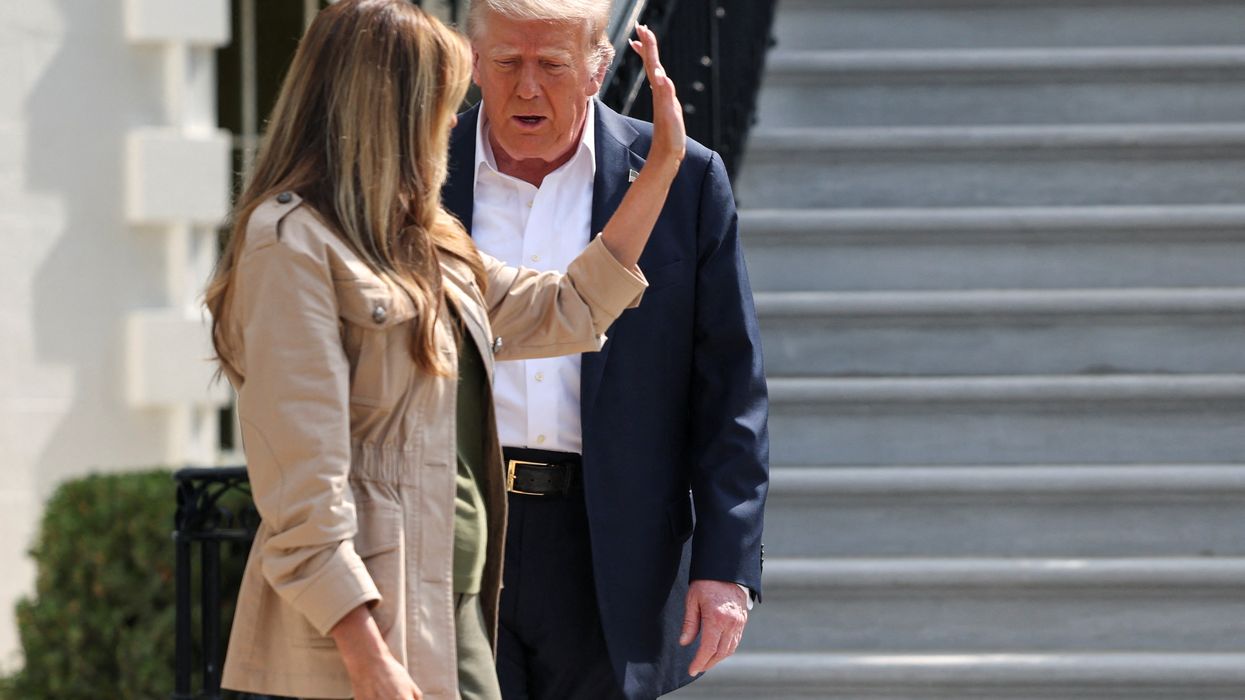
U.S. President Donald Trump and lady Melania Trump depart for travel to Texas to tour areas affected by deadly flash flooding, from the South Lawn of the White House in Washington, D.C., U.S., July 11, 2025. REUTERS/Jonathan Ernst

February 19, 2026  
ALTERNET

Here in America, before the royal formerly known as Prince Andrew was arrested in the UK, Reuters reported the results of a new public survey. Ipsos, the pollster, found nearly 70 percent of Americans believe the system is rigged, allowing elites to act with impunity.

Some 69 percent of respondents in the four-day poll, which concluded on Monday, said their views were captured "very well" or "extremely well" by a statement that the Epstein files "show that powerful people in the U.S. are rarely held accountable for their actions."

Then came news this morning of Andrew Mountbatten-Windsor, the brother of King Charles III, being arrested “on suspicion of misconduct in public office” – what American media might call insider trading.

Andrew allegedly shared “confidential trade reports” with Jeffrey Epstein in 2010 when the former prince was the UK’s special envoy for international trade. Their correspondence was part of the latest cache of Epstein-related emails released by the US Department of Justice.

The news appears to be the beginning of a kind of accountability. There’s probably enough evidence for British authorities to bring a massive sex-crimes case against Andrew. But that would be devastating to the king’s image. Better to bring Andrew up on discrete and boring white collar crimes than risk greater public scrutiny of who in the royal family knew about his reputed predilection for underaged girls.

In other words, it’s justice through the backdoor, if you can call it justice, but even that is more than anyone can say in America.

In Europe, “heads are rolling over the Jeffrey Epstein revelations,” according to Politico earlier this month. A prominent diplomat in Norway was suspended. A member of the British House of Lords was forced to resign. Andrew can no longer be called the Duke of York.

The British prime minister apologized for hiring Lord Peter Mandelson as ambassador to the US after it was revealed that Mandelson, in addition to keeping up his relationship with Epstein after Epstein’s 2008 conviction, gave him “sensitive government information.”

But the fallout faced by political elites over their association with a convicted sex offender and alleged child-sex trafficker has stood in contrast to the near-total absence of accountability in America. The taint of Epstein can rock the European continent, but not American elites, especially those close to the president of the United States.

And, per Reuters, Americans are noticing the difference. We don’t agree on much of anything, but a vast majority of us agree “powerful people in the US are rarely held accountable for their actions”

Here, I want to suggest a few things.

One, that this and other polls point to a growing awareness of the gathering unfairness that has shaped American life since at least the 2007-2008 financial crisis and proceeding Great Recession.

Two, that this awareness has been gaining momentum over those years and has now reached a tipping point. Data journalist G Elliott Morris said the new swing voter is an “anti-system voter.” In his latest, he cites new research identifying “a key bloc of swing voters who distrust both parties, believe elites are corrupt and think the political system is rigged against people like them.”

Third, that a majority, or a near-majority, now equates unfairness with Epstein and is opposed to a rigged system that rewards elites, including Donald Trump, while despoiling everyone else.

I don’t think voters have a full understanding of the various forces bearing down on them. But unlike when we had mostly abstractions to argue for change, we now have, for the first time in the 21st century, a human face to put on an inhuman system rigged against the people.

Here’s how US Senator Jon Ossoff put it recently:

“Now you remember, we were told that maga was for working-class Americans. But this is a government of, by and for the ultra rich. It is the wealthiest cabinet ever. This is the Epstein class” (my italics).

He went on:

They are the elites they pretend to hate. Prices are up. Jobs are going away. Medicaid and school lunches are slashed. Nursing homes are getting defunded. If you’re Steve Bannon and your pitch was Trump for “the forgotten man and woman,” how do you sell any of this?

Trump was supposed to fight for the working class. Instead, he’s literally closing rural clinics and hospitals to cut taxes for George Soros and Elon Musk. He was supposed to end globalist world police foreign policy. Instead, we’re doing war-for-oil and nation-building again, and threatening to conquer Greenland. He was supposed to “drain the swamp.” Instead, this is the most corrupt administration of all time and everybody knows it. Everybody knows it.

Will there be justice for Epstein’s victims? Will the elites who conspired to bring us despoliation face a jury? Frankly, I doubt it. In South Korea, justice means leaders of insurrections go to prison for life. Here, it means they get criminal immunity to continue their insurrections.

That said, there is some hope. As the Democrats prosecute their political case against the president, binding him and his allies ever more tightly to Jeffrey Epstein, they are probably going to end up grinding to dust the reputations of elites associated with his crimes.

For instance, Les Wexner. The billionaire former owner of Victoria’s Secret was named in the Epstein files as a “co-conspirator,” though he never faced criminal charges. Epstein managed his fortune until nine months before his 2008 conviction on sex-with-minors charges. This week, House Democrats deposed Wexner as part of their investigation.

This is what Robert Garcia, ranking member of the House Oversight Committee, said about Wexner: “We should be very clear that there would be no Epstein island. There would be no Epstein plane. There would be no money to traffic women and girls. Mr. Epstein would not be the wealthy man he was without the support of Les Wexner.”

With sufficient time, Les Wexner’s reputation could become collateral damage in the Democrats’ larger fight against Trump and his party.

That’s not enough justice. No one should be satisfied.

But like the white-collar charges against Andrew for giving Epstein secret trade reports, it is the beginning of a kind of accountability.


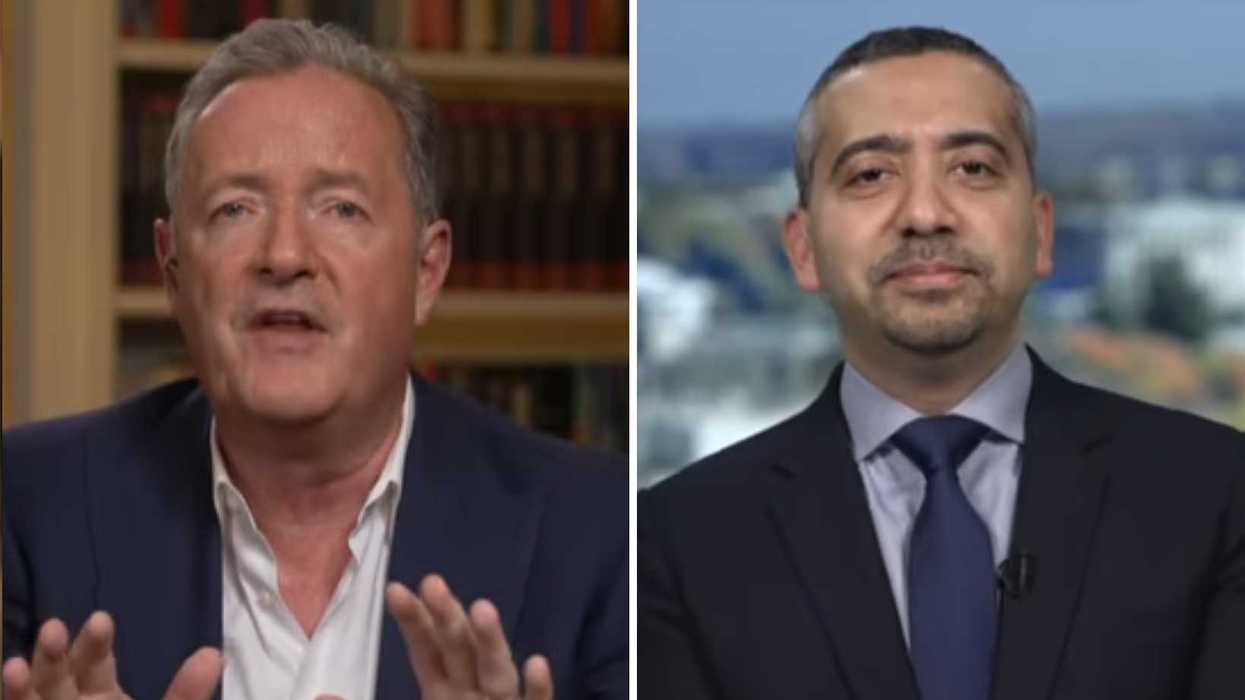
'Quick to defend your pal': Piers Morgan faces pushback over Trump-Epstein defense


British Broadcaster Piers Morgan and Zeteo Founder Mehdi Hassan
 (YouTube Screengrab)
February 19, 2026
ALTERNET

Zeteo founder Mehdi Hassan battled British conservative Piers Morgan into agreeing that the U.S. Justice Department must investigate the connection of President Donald Trump to his close friend, convicted sex-trafficker Jeffrey Epstein.

Hassan pushed Morgan to grudging agreement after pointing out the numerous times Trump lied about the facts of his relationship with Epstein.

“Donald Trump travelled on Epstein’s private jet many more times than has previously been reported or that we were aware: That’s an email from one of his own DOJ lawyers in 2020,” Mehdi told Morgan. “Trump lied, Piers, when he said he ‘never’ went on the plane. He went on the plane eight times. We know for example that Epstein wrote in 2011 that ‘Donald Trump spent hours at my house with a victim.’ He referred to Trump being at his house as ‘the dog that hasn’t barked.’ He said in 2019 that Trump knew about the girls.”

“Now, Epstein could be lying,” added Hassan. “He was a horrible convicted sex offender but the point is we’ve not had full investigations. The media has barely touched this, Piers. There’s been a lot of coverage of Prince Andrew … Peter Thiel and Elon Musk and all sorts of people … but if this was any other president or politician this would be a huge scandal.”

Morgan pointed out that there is no outright evidence of Trump’s criminality, however much the president’s name saturates the Epstein files.

“Oh, I agree that we haven’t got evidence of criminality,” agreed Hassan, before pulling out a 21-page FBI PowerPoint presentation entitled: “Prominent Names.”

“Donald Trump’s at the top here with two allegations on there. I’m not saying there’s a proven allegation, but the idea that the American public’s not even familiar with those allegations [we in the media] need to be talking amore about what a huge scandal this is and how many lies have been told by the people in power. Not just Donald Trump,” Hassan said, adding that “I can no longer just laugh at people who come up with conspiracy theories anymore.”

Morgan conceded that he also “would be prepare to believe any conspiracy theory related to the Epstein scandal because so much of it is actually coming true.”

“Although you’re quick to defend your pal Donald Trump, who was close to him,” Hassan quipped.

“I’m only quick to defend him about one part of it,” insisted Morgan, adding that “a lot of stuff in those files that are clearly fantastic and malicious.”

“And there’s A lot of it is also redacted, Piers, so how do we know?” Hassan said “… There hasn’t been a full investigation with [FBI Director] Kash Patel and [US AG] Pam Bondi shutting it down. Why are they shutting it down?”

“I agree! Buddy, you’re preaching to the choir,” Morgan said, adding “I always feel a bit disconcerted when we agree.”


'Just read the files!' Dem lawmaker scolds irate host over Trump-Epstein ties

Alexander Willis
February 22, 2026  
RAW STORY


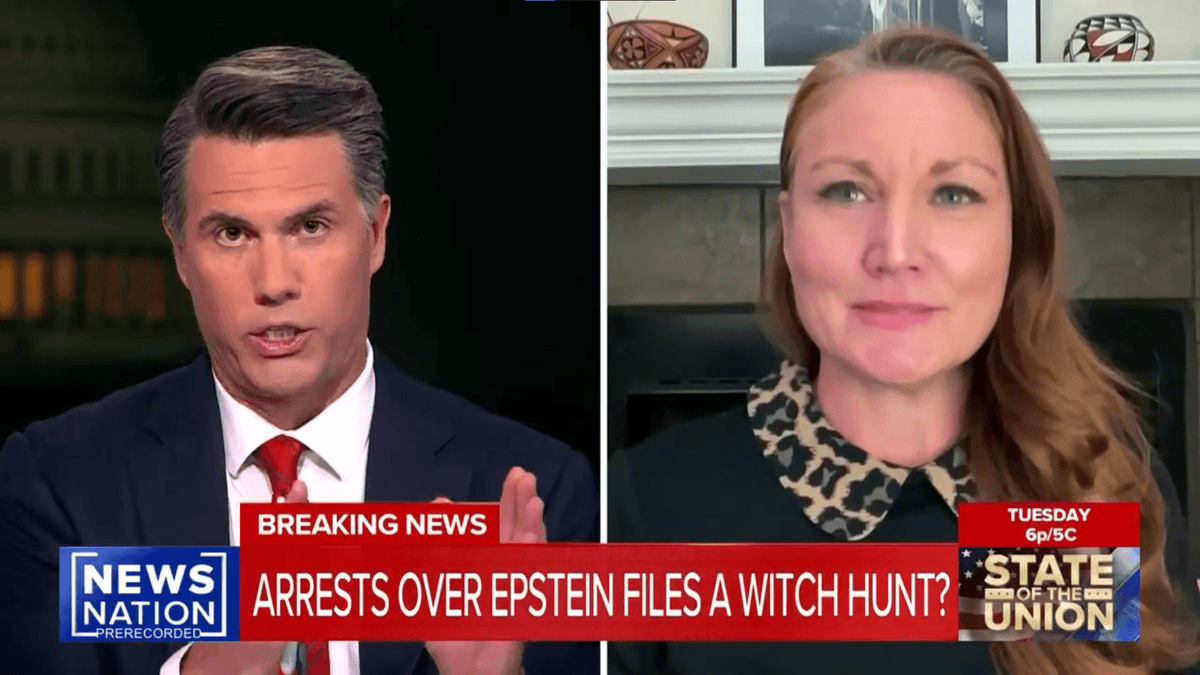
Rep. Melanie Stansbury (right) appears on News Nation with Leland Vittert (left), Feb. 20, 2026. (Screengrab / News Nation)

Rep. Melanie Stansbury (D-NM) held her own in a recent interview with NewsNation’s Leland Vittert in defending her calls for accountability with respect to President Donald Trump and the serious allegations leveled against him involving Jeffrey Epstein.

Stansbury was confronted Friday by Vittert over a social media post she made last week that referenced the recent arrest of Andrew Mountbatten-Windsor, the former British prince who was briefly jailed over his past ties to Epstein.

“If a Prince can be held accountable, so can a President,” Stansbury wrote in a social media post on X last Thursday.

“What crime should Donald Trump be charged with?” Vittert asked Stansbury in an aggressive tone, as seen in a clip of the exchange that went viral on Sunday.

“Donald Trump was investigated by the FBI for abuse of a minor, and there are multiple statements from witnesses that the FBI took as tips, and they investigated as allegations,” Stansbury said. “Those, as far as we know, were never taken to the fullest extent of their investigation.”

Vittert, visibly frustrated, continually tried to interject as Stansbury continued speaking, interjections that rose to the level of shouting. In response, Stansbury offered Vittert some advice.

“Sir, I didn’t come on your program to argue. I came to present the facts to the American public," she said. "The files are there. I don’t have to argue with you on the air. Just go read the files, my friend!”

Family member reveals what Trump has told them about aliens


Thomas Kika
February 18, 2026
ALTERNET


As stories and rumors about what the U.S. government knows about UFOs and aliens are once again going viral, Lara Trump revealed during a podcast what she has heard about her father-in-law, Donald Trump's official plans regarding "extraterrestrial life."

Lara Trump, the wife of Eric Trump and one-time co-chair of the Republican National Committee, on Wednesday made an appearance on the New York Post's "Pod Force One" podcast, where host Miranda Devine pressed her about what the president has said about aliens and "unidentified aerial phenomenon." She claimed that, as far as her direct interactions, he has largely "played a little coy" about it.

"What's funny is, we've kind of asked my father-in-law about this, cause we're like, 'well, what do you know?'" Lara Trump said. "And he played a little coy with us. And so, that of course led us to believe, Eric and I were like, 'oh my gosh, if he won't even fully tell us, maybe there's more to it."

She added, however, that she has "heard kind of around" that Trump has told certain people that he has an address prepared discussing the topic, which might be given "at the right time."

"I think my father-in-law actually said it," she continued. "There is some speech he has that I guess at the right time he’s gonna break out, and it has to do with maybe some sort of extraterrestrial life."

Lara Trump's claims in the interview, for now, remain unsubstantiated. Despite mounting public interest, the federal government has only acknowledged "UAPs" as anomalous matters that it is aware of, and which might present a threat to national security, while stressing that it has no evidence that they are examples of extraterrestrial life.

Over the weekend, former President Barack Obama made headlines when he said in an interview with liberal content creator Brian Tyler Cohen that aliens are "real," while also stressing that they are not being held in Area 51. He later clarified in a post that this was merely his own personal opinion about the nature of the universe, not something based on knowledge he received as president.

Earlier this week, British writer and ufologist Mark Christopher Lee told Newsweek that he had heard a speech prepared for Trump regarding alien life, something that echoed Lara Trump's claim from Wednesday. He identified his source only as a "Washington insider," whose name he could not reveal.

"A Washington insider I have known personally and conducted business with – has repeatedly affirmed that President Trump has prepared a historic speech acknowledging extraterrestrial visitation and the existence of recovered non-human materials and craft," Lee wrote in an email to the outlet.


Astrologers think Donald Trump's destiny is tied to the eclipse

February 17, 2026 

The Moon crossed the Sun’s path on February 17, causing what is known as an annular solar eclipse. The Sun was not covered completely, but the Moon blocked enough of its light to leave a fiery ring. Unless you’re deep in the southern hemisphere, you won’t have noticed.

However, astrologically speaking, eclipses have effects regardless of who is watching. In astrology, an ancient tradition that lacks scientific grounding, eclipses are regarded as being powerful and politically significant celestial events. They are traditionally associated with the destiny of rulers – and some astrologers think Donald Trump is no exception.

Astrologers interpret the meaning of eclipses through horoscopes, celestial maps that locate the Sun, Moon and planets within the 12 signs of the Zodiac that encircle our solar system. During the eclipse, the Sun and Moon were at the edges of the sign Aquarius, a position astrologers associate with endings and shakeups.

This, alongside various other factors including Trump being born during a lunar eclipse in 1946, has led some astrologers to suggest that the eclipse could mark the start of a severe crisis for the US president – even his death.

Predictions like this come around fairly often, and Trump has outlasted many of them before. But these extreme forecasts follow a very old script. For thousands of years, eclipses have been treated as political events, read as omens about kingdoms and their rulers.

Bad omens

Eclipses have been connected with the fate of rulers since at least ancient Mesopotamia, around 4,000 years ago. Keen observers there, in what is now modern-day Iraq, kept lists of phenomena they believed were linked to specific outcomes.

“If a lizard gives birth in the walkway of a house, the household will fall” and “if a white partridge is seen in the city, commercial activity will diminish” are two examples. But one omen has long outlived the others: “if there is an eclipse, the king will die”.

With such high stakes, ancient astronomers invested in systematic observation, record-keeping and calculation to predict eclipses with ever-greater accuracy. This enabled the so-called “substitute king” ritual, where royals tried to avoid their fate by temporarily making someone else king until an eclipse passed.

The link between eclipses and the death of kings spread widely in the ancient world. Egyptian papyri show evidence of this belief, and Greek and Roman history is full of stories connecting eclipses with prominent deaths.

Roman historian Cassius Dio recorded a solar eclipse around the death of the first Roman emperor, Augustus, in AD14, during which “most of the sky seemed to be on fire”. In the gospels of Matthew, Mark and Luke, the death of Jesus is also marked by darkened Sun.

In the medieval period, when Arabic chroniclers recorded eclipses, they usually noted concurrent deaths of rulers. And in Europe, a solar eclipse in 1133 was so closely associated with the 1135 death of King Henry I of England that it became known as “King Henry’s Eclipse”.

Premodern rulers often hired astrologers to interpret their birth charts – the horoscope cast for the moment they were born. Ideally, the astrologer would pick out an aspect of the chart they could say justified the ruler’s leadership and foretold a long and prosperous reign. This was useful astrological propaganda.

But rulers were less happy when astrologers did this without authorisation – especially if they forecast illness or death. Astrologers were expelled from ancient Rome on numerous occasions for doing just that.

In his book, Lives of the Caesars, Roman historian Suetonius recounted the fate of an astrologer called Ascletarion (or Ascletario). Ascletarion’s predictions of the Emperor Domitian’s imminent downfall in the first century AD prompted the angry emperor to order his execution.

More than 1,400 years later, an astrologer in Oxford was executed for predicting the death of the reigning English monarch, Edward IV. And in 1581, Queen Elizabeth I of England made it a felony to use horoscopes to predict her death or her successor.

Similarly in France, royal pronouncements in 1560, 1579 and 1628 prohibited astrological predictions about princes, states and public affairs. Around the same time, astrologers in Italy got into serious trouble for predicting the deaths of popes.

This was not just a matter of anxiety on the part of rulers. It was also a question of maintaining public order and political stability. State powers were concerned with the ability of astrological predictions to cause general chaos and even prompt protests and rebellions.

They were right to worry. In a time when astrology was taken very seriously, predictions could cause collective panic. During the so-called wars of the three kingdoms, a series of conflicts fought between 1639 and 1653 in England, Scotland and Ireland, astrologers’ radical political predictions about the fate of the English monarchy fed revolutionary sentiment.

One of these astrologers, Nicholas Culpeper, published predictions of the downfall of all European monarchies on the basis of a solar eclipse in 1652.

Astrology left the world of universities and political courts in the 17th century, but astrologers did not stop making political predictions. In 1790s London, an astrologer called William Gilbert predicted the death of King Gustav III of Sweden. His prophecy was fulfilled a few months later.

And after his attempted assassination in 1981, the then-US president, Ronald Reagan, asked astrologer Joan Quigley whether she could have predicted it. She said yes. Quigley worked for the Reagans for many years, and claimed that she provided advice not just on personal affairs but also on matters of the state, including the best timing to make political announcements.

Although astrology is no longer counted as a science, it remains a player in contemporary politics. Whether or not eclipse predictions come to pass is almost besides the point. Historically, what made eclipses politically dangerous was the speculation often attached to them.

Michelle Pfeffer, Research Fellow in Early Modern History, University of Oxford

This article is republished from The Conversation under a Creative Commons license. Read the original article.


New research shows high-IQ men reject conservative politics: report


A supporter of President Donald Trump in Milwaukee, Wisconsin on August 23, 2023 (Image: Shutterstock)
February 18, 2026 
ALTERNET

PsyPost reports a new study is revealing that average-intelligence men have a more conservative mentality, while gifted men and women tend to be more varied.

The study, “Exploring exceptional minds: Political orientations of gifted adults,” authored by Maximilian Krolo, Jörn R. Sparfeldt, and Detlef H. Rost, sought to discover if distinct political patterns emerge when comparing gifted adults to a control group of average intelligence.

The exhaustive multi-decade study began by administering more than 7,000 third-grade students standardized intelligence tests to measure reasoning abilities and the speed at which students processed information. Administrators then identified a group of gifted students with an IQ of 130 or higher and a control group of non-gifted students.

Six years later, when the students were in the ninth grade, the team tested them again to confirm their IQ and rule out a fluke test or lucky streak. Then, roughly 35 years after they were first identified, researchers sent them surveys to assess their political orientations.

“Specifically, non-gifted men scored higher on conservatism than gifted men,” reports PsyPost. “The non-gifted men were more likely to endorse values related to tradition and strict social order. Gifted men were less likely to hold these traditional conservative views.”

Researchers noted the difference among the women in the study was not so obvious, however, with gifted and non-gifted women both showing similar levels of comparatively lower conservatism. The divergence, reports researchers, was unique to the male participants.

“The team interpreted the findings through the lens of cognitive flexibility,” reports PsyPost. “They suggest that non-gifted men might rely more on traditional perspectives when processing complex social issues. This reliance could lead to higher conservatism scores.”

On the other hand, researchers believe gifted men may possess greater cognitive flexibility, which allows them to more easily process diverse perspectives. Consequently, they may be less inclined to adhere to rigid traditional norms.

Gifted adults appear to be as politically diverse and moderate as the rest of the population, but researchers say the “one notable exception” regarding non-gifted men’s preference for conservatism warrants further investigation.

The study relied on self-reported beliefs retrieved through surveys, however. And while honest reporting is assumed, researchers say it is possible that respondents sometimes describe themselves “differently than their actions might suggest.”


Trump supporters' extreme views driven by personal insecurity: research


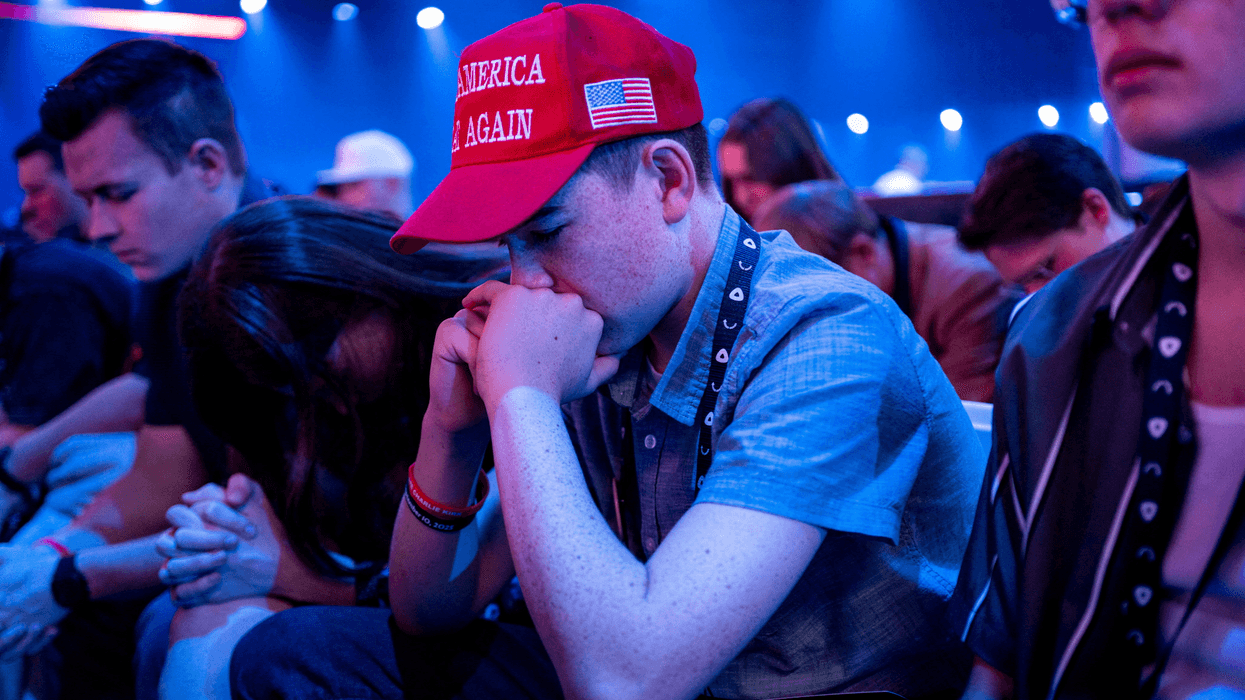
Attendees pray during AmericaFest, the first Turning Point USA summit since the death of Charlie Kirk, in Phoenix, Arizona, U.S. December 20, 2025. REUTERS/Cheney Orr


February 17, 2026
ALTERNET

PsyPost reports that a new study published in the journal Advances in Psychology suggests that White people who personally perceive themselves as ranking at the bottom of the racial economic hierarchy or “tied” with Black Americans were the most likely to support President Donald Trump.

Previous research identified a phenomenon known as “last place aversion,” where people fear being at the very bottom of a social hierarchy — and Trump voters apparently feel the sting of smallness more acutely than others, whether or not they are actually at the bottom rung of the ladder

Surprisingly, researchers found that these attitudes were not driven by actual poverty. 

The researchers controlled for objective indicators of socioeconomic status, such as income and education levels. They found that belonging to the “last place” profile predicted Trump support and anti-DEI attitudes regardless of how much money or education the participant actually had.

“We … [expected] a subset of non-Hispanic, white Americans who feel ‘last place.’ That said, we expected this profile to be more likely among working class individuals,” Cooley told PsyPost. “However, perceiving oneself to be ‘last place’ was not associated with the lowest objective income nor the lowest objective education among the White Americans in our samples.”

The United States currently exhibits a significant racial wealth gap with economic statistics consistently showing that the average white family holds considerably more wealth than the average Black or Hispanic family. But despite this reality, surveys indicate that many white Americans feel they are “personally falling behind” in terms of status without realistically weighing the resources at their disposal.


“This line of research was motivated by recent political trends among some white Americans, including support for DEI bans, alignment with alt-right ideology, and endorsement of political violence in pursuit of political goals (e.g., January 6th),” said study authors Erin Cooley and Jazmin Brown-Iannuzzi, associate professors of psychology at Colgate University and the University of Virginia, respectively. “Many of these attitudes are not only extreme but also anti-democratic, raising questions about how such views can coexist with identities centered on being ‘most American’ (e.g., white nationalist belief systems).”

The tool researchers used to assess personal status was a box measure called the “Perceived Self-Group Hierarchy.” Participants viewed a diagram representing a status ladder based on money, education, and job prestige, and they were asked to place markers representing themselves, white people, Black people, Asian people, and Hispanic people onto this ladder.

Researchers found a consistent link between this “last place” profile and specific political views.


“White Americans who fit this profile reported the highest levels of support for Donald Trump throughout the campaign season. They also expressed the strongest intention to vote for him. When surveyed the day after the election, this group was the most likely to report having cast their ballot for Trump,” PsyPost reports.

This same group of insecure white people also showed “the strongest opposition to DEI programs, favoring policies that would ban such initiatives in universities.” Additionally, they showed higher alignment with alt-right ideologies, agreeing more frequently with statements such as “White people are generally under attack in the U.S.” and “The government threatens my personal rights.”

Sunday, February 22, 2026

THE EPSTEIN CLASS


How Britain's right wing is benefiting from the Epstein scandal


(REUTERS)

February 22, 2026


The arrest of Andrew Mountbatten-Windsor on suspicion of misconduct in public office will heap yet more pressure on the beleaguered government of Prime Minister Keir Starmer.


Mountbatten-Windsor’s arrest over allegations he passed government documents to sex offender Jeffrey Epstein comes directly on the heels of the resignation of Peter Mandelson, Starmer’s ambassador to the United States, due to his own alleged associations with Epstein.

The fallout from the scandal is hugely damaging to public trust in both the political establishment and institutions in the United Kingdom, including the royal family.

Trust in the royals already declining

It’s hard to separate the fate and popularity of the royal family from the institutions of British governance because they’re very much part of it.

The monarchy, specifically the Crown, is part of the British constitution. The monarch gives assent to all legislation that’s passed by parliament (in other words, he or she has to sign it for it to pass). While that might seem like a rubber-stamping exercise and that the monarch is a mere symbol in British politics, King Charles and, in slightly different ways, Queen Elizabeth II certainly have had their political preferences.

And despite the impression you get during royal occasions like weddings, funerals and coronations, the royals don’t enjoy unanimous support in Britain. In fact, public support has been declining in recent years, especially among the young.

In an Ipsos survey released this week, just 47% of Britons said they had a favourable opinion of the royal family on the whole (a seven-point decline from November). And just 28% of Britons believe the royal family has handled the allegations against Mountbatten-Windsor well, compared to 37% in November.

Importantly, there’s been a long-term trend of steady decline in support for the monarchy since 1983, when the British Social Attitudes survey first asked about this.

More broadly, and in common with many other liberal democracies, there is a pervasive sense the Epstein scandal is more evidence of the existence of a self-serving, corrupt elite making good for itself and harming others, while many people in the “left behind” and “squeezed middle” of society are struggling.

Politically, this perception adds further fuel to the notion that the inequality between the rulers and the ruled has become unjustifiable. Something has to change.

Pressure mounting on Labour

Starmer’s Labour government was already deeply unpopular before Mandelson’s alleged ties to Epstein were revealed. Now, it has entered some sort of permanent crisis mode.

Mandelson was one of the key figures behind the so-called “New Labour” project associated with the leadership of Prime Minister Tony Blair from 1997–2007.

New Labour has a dual legacy in British politics. On one level, it was the most electorally successful Labour government ever. But that electoral success seemed to come at the expense of a clearly defined sense of what a Labour Party stood for. Key players like Mandelson courted wealthy backers and moved Labour to the centre of British politics to, not unreasonably, win elections.

As such, many Labour supporters started to drift away from the party and towards other, at times diametrically opposed, political parties. In Scotland, this benefited the pro-independence parties. In England, it benefitted the radical-right Reform UK.

Reform has precious little governing experience, but that is its appeal. Its radical messages are finding traction with a large number of voters, many of whom formerly supported Conservative or Labour.

So in this context, when Mandelson, an already divisive figure, was named ambassador to the US in the belief he could help manage President Donald Trump, Starmer’s political gamble to reinstate him to a public role backfired.

Reform could ultimately benefit

The British government’s travails represent another gilt-edged opportunity for Reform UK to capitalise on the unpopularity of Starmer, Labour and politics more broadly. But there is a risk for Reform, too.

Radical-right parties tend to place a great emphasis on the figure of the leader. For Reform UK, this is Nigel Farage.

Farage has had an incredible impact on British politics, especially since Brexit. But Farage, a former merchant banker, is also part of this global elite, despite pitching his politics at the “left behinds”. He has spent years courting Trump’s friendship. So, while there are no allegations against him related to Epstein, the public anger towards elites in general may eventually rebound on Farage, too.

Reform UK, however, is positioning itself successfully as an alternative to the two major parties in the UK, and could form a minority government at the next UK-wide elections in 2029.

The Conservative Party has shot its bolt as a result of its 14 years in government. And Labour came to power more as a rejection of the Conservatives than an endorsement of its policies. It has thus far excelled in failing to meet these low expectations, to Reform’s benefit.

Excluding a by-election in February, the first major political test will be local government elections in England, and elections to the Scottish Parliament and Welsh Senedd in May. A poor Labour showing will quite possibly lead to a leadership challenge against Starmer, whose government seems incapable of stemming the rise of support for an emboldened Reform.

A boost to republicanism

“Unprecedented” is an over-worn term. However, the arrest of a member of the royal family is the first in England since 1647 (it didn’t end well).

Prince William is still very popular. But there could still be very serious consequences for support for the monarchy in the various nations of the United Kingdom.

There isn’t the same sort of support for republicanism in England as there is in Australia, where republicans can de-legitimnise the king as a “foreign” monarch. Although this argument is made by republicans in Northern Ireland, English republicanism needs to be driven by some other sentiment.

And the Epstein crisis could be it, given it is drawing attention to gross inequality and damaging entitlement. It’s hard to see where exactly all this will end up, but it is quite possible this will give the greatest boost to anti-monarchical sentiment in England for some centuries.

It is important not to forget the women and girls who were victims of this rich man’s cabal. Yet, one great harm of the Epstein scandal in Britain is the further damage done to trust in institutions of governance and the boost it provides for the illiberal critics of what seems like a decaying order.

Ben Wellings, Associate Professor in Politics and International Relations, Monash University

This article is republished from The Conversation under a Creative Commons license. Read the original article.


OPINION

Bannon's crusade to expose gays in the Catholic church didn't die with Epstein


"War Room" host Steve Bannon in Las Vegas, Nevada on January 30, 2024 (Gage Skidmore/Flickr)
February 22, 2026 

Frédéric Martel, the author of the 2019 international bestseller, “In the Closet of the Vatican: Power, Homosexuality, Hypocrisy,” told me over the weekend about the time he was invited to lunch by Steve Bannon, who asked him to come to Bannon’s palatial Paris hotel suite shortly after his book was published.

“I didn’t know why he asked me to come,” he said.

The meeting was arranged via one of Martel’s right-wing Catholic sources who was allied with Bannon. Martel, a journalist who covers the far right in Europe and is working on a new book focused on it, certainly had a professional interest in meeting Bannon.

“It was at the Hotel Bristol,” he explained to me by phone from Paris, “in a suite that costs 8,000 euros per night.” Per the exchange rate at that time, that would have been about $8950 per night. Forbes reports suites at the hotel begin at $3200 per night and go up to as high as $46,000 per night.

It was June of 2019. And he was surprised about what Bannon wanted from him.

“He said during the lunch that he wanted to make a movie about my book,” Martel explained, noting that he “wouldn’t have ever given that [permission] to Bannon.” But he offered Bannon a more polite truth. “I don’t have the rights to the book [for a film],” Martel said he told Bannon, as his publisher had already sold those rights.

That was the end of the discussion on the book, and Martel was perplexed because, as he explained, the book is “probably the most pro-Francis” book, and Bannon, a Catholic “traditionalist” connected to all of the most extreme radical right elements of the church, was working with his allies to take down Francis because of his progressive reforms and his criticism of populist right-wing governments, including Donald Trump’s.

“In the Closet of the Vatican” exposes the hypocrisy of a church hierarchy built up over many decades—including under the virulently homophobic Pope Benedict—which included many powerful closeted gay priests, monsignors, and cardinals who were publicly working against gay rights while privately leading lives counter to their pronouncements and harmful actions.

While exposing all of that might bring down some of the very people on the Catholic right Bannon was courting—many inside the church itself, among the clergy and the hierarchy—he clearly didn’t see the nuance. Bannon is all about chaos and destruction, and was laser-focused on hurting Francis’ leadership and influence. He asked his good friend Jeffrey Epstein for help in his project.

In the Epstein files there are thousands of text message exchanges between Bannon and Epstein, as Bannon sought the help of Epstein—a true globalist within the uber-wealthy elite—to promote his faux populist, supposedly anti-globalist movement across Europe.

As CNN reports:

Bannon had been highly critical of Francis whom he saw as an opponent to his “sovereigntist” vision, a brand of nationalist populism which swept through Europe in 2018 and 2019. The released documents from the DOJ appear to show that Epstein had been helping Bannon to build his movement.


Bannon, after being pushed out in 2017 as Trump’s national security adviser, was living in Rome, traveling to Paris, London, and throughout Europe, and asking Epstein to connect him to powerful people. Epstein offered the use of his jet and homes for Bannon’s travels, while Bannon offered media training and advice for Epstein to grotesquely help clean up the convicted pedophile’s reputation. And Bannon recorded many hours of interviews, 12 hours of which have been released among the files, for a documentary film he was making on Epstein, the aim of which no doubt was to promote a media makeover for Epstein.

Epstein’s jet, per the files, was unavailable when Bannon asked if he could use it to fly from Rome to Paris in one instance, but there is evidence in the files that Bannon stayed at a grand apartment where Epstein was living near the Arc de Triomphe in Paris on that trip. Epstein invited Bannon to stay in a March 29th, 2019 text; Bannon said he was “Enroute,” and then Epstein texted someone else the next morning: “Steve Bannon is here with me.”

Bannon’s spokesperson told The New York Times that Bannon didn’t stay there (and that he never stayed at Epstein’s homes or flew on his plane) and decided to stay at a hotel instead. But the Times noted the spokesperson didn’t provide a receipt. My question would have been, even if that’s so, who paid for the hotel—again, Bannon’s spokesperson didn’t show the Times any receipt—and was it in fact the lavish Hotel Bristol, the same place where he met Martel later in June? After all, per the files, Epstein did offer to pay for a charter flight for Bannon when Epstein said his jet was unavailable. (There’s no indication as to whether he did or didn’t pay for a charter flight.)


Around that same time, Bannon expressed to Epstein his interest in making Martel’s book into a film and having Epstein fund it as executive producer.

“Have you read ‘in the closet of the vatican’ yet,” Bannon wrote, to which Epstein appears to reply ‘yes,’ amid chats about getting Bannon connected to global players.

“You are now exec producer of ‘ITCOTV’ (In the closet of the Vatican),” Bannon continued. “Will take down (Pope) Francis.The Clintons, Xi, Francis, EU – come on brother.”

It’s not clear whether Epstein was taking seriously the idea of the film—which Martel had already told Bannon was not going to happen—but Epstein, on April 1, 2019, did email himself “in the closet of the vatican,” and later, in June of 2019, he sent Bannon an article headlined, “Pope Francis or Steve Bannon? Catholics must choose.”


The two were planning to meet in New York weeks later, on the first weekend of July. But on July 6th, 2019, Epstein would be arrested on sex trafficking charges in New York. On August 10th he’d be found dead in his jail cell. And obviously no film was made.

Bannon continued in his war against the pope, but a split developed that very summer of Epstein’s arrest and death between Bannon and some of his far-right allies. Cardinal Raymond Burke, an angry American MAGA foe of Francis’ (whom Francis would eventually kick out of his massive Vatican apartment, in 2023), had collaborated with Bannon in an organization working against Francis, Dignitatis Humanae Institute, a Rome-based think tank that aimed to create a “populist academy” in a monastery in Trisulti, Italy.

But Burke broke with Bannon in June of 2019, after he learned that Bannon wanted to make a film out of Martel’s book. Martel had gone public about his lunch with Bannon, and it didn’t sit well with Burke, who is portrayed in an entire chapter as a scheming and unrepentant nemesis of Pope Francis.

Burke and many of his allies in the church had much to fear about any film outing prominent homophobic closet cases in the church, bringing the book to a much wider audience. Burke put out a statement, resigning from DHI, where he’d collaborated with Bannon:

I have been made aware of a June 24 LifeSiteNews online article…entitled ‘Steve Bannon hints at making film exposing homosexuality in the Vatican’…
I do not, in any way, agree with Mr. Bannon’s assessment of the book in question, Furthermore, I am not at all of the mind that the book should be made into a film.


But other Bannon compatriots would later appear to draw both on the information in Martel’s book and on his research methods. In “In the Closet of the Vatican,” Martel discusses gay dating and sex apps like Grindr, Scruff, and Tinder, and how prevalent users were in and around the Vatican, even carrying out his own experiments with his researchers, using Grindr and other apps.

“According to several priests, Grindr has become a very widespread phenomenon in seminaries and priests’ meetings,” Martel reports in the book.

It may be a coincidence, but two years later, in July of 2021, in a story I covered extensively, a right-wing Catholic site here on Substack, The Pillar, used geolocation data from Grindr to force the resignation of Monsignor Jeffrey Burrill, the General Secretary of the U.S. Conference of Catholic Bishops.

As I wrote at the time, the right-wing editors of The Pillar:
“obtained” geolocation data of Grindr interactions from his phone — even claiming to have located him in a bathhouse in Las Vegas at one point — over a period of time going back to 2018.
And then they went to the Catholic bishops with the information — dates and times of Burrill allegedly connecting with various men on Grindr, and locations, including the bathhouse. Soon after, the USCCB announced Burrill had resigned because of “impending media reports alleging possible improper behavior.”


There was much speculation about where The Pillar got its funding and also about who purchased the geolocation information for it—information that would cost a lot of money. Grindr had previously sold information to third parties for advertising purposes (and stopped after it was criticized), believing there was no identifying information. But as I explain in my piece of the time in depth, technology experts say there’s a way for that identifying information to be found, and there’s no guarantee that third parties don’t turn around and sell geolocation data to more nefarious entities.

Almost two years after The Pillar’s actions, in March of 2023, The Washington Post indeed revealed that it was wealthy Catholics on the far right, the people in the same circles as Bannon, who paid for the geolocation data that The Pillar had “obtained.” They also sent the information to Catholic bishops:
A group of conservative Colorado Catholics has spent millions of dollars to buy mobile app tracking data that identified priests who used gay dating and hookup apps and then shared it with bishops around the country.
The secretive effort was the work of a Denver nonprofit called Catholic Laity and Clergy for Renewal, whose trustees are philanthropists Mark Bauman, John Martin and Tim Reichert, according to public records, an audio recording of the nonprofit’s president discussing its mission and other documents…
…The Post has seen copies of two different reports presented to bishops. One is from the Renewal group to a diocese and the other is the one that the Pillar presented to the USCCB about Burrill. The information in both is mostly about Grindr, although the reports also say they have used data from other gay dating apps Growlr, Scruff and Jack’d, as well as OkCupid.


Reichert is a former GOP congressional candidate. Jayd Henricks, executive director of the group Reichert and his rich buddies founded and which bought the geolocation information it gave to The Pillar, had, like Bannon, been a fierce critic of Francis.

All of these men are aligned in efforts against church reforms, whether working together directly or not. Hendricks has written for the orthodox World Catholic Report, which has also written glowingly about Bannon and his “populist nationalism” effort in Europe, describing it as “renewed appreciation for the nation-state and national sovereignty—and growing suspicion of the managerial elites in Washington, London, and Brussels.”

It’s not a stretch to believe that the Colorado wealthy right-wing Catholics got their ideas on using Grindr to help bring down church leaders from the attention brought to “In the Closet of the Vatican.” Nor is it a stretch to believe that they even worked directly or indirectly with fellow traveler Bannon, who was very much focused on the book and who had by then lost the convicted pedophile billionaire he was hoping would bankroll weaponizing the ideas within the book in the way The Pillar outrageously did.

Epstein files reveal ties to Catholic conservatives' anti-Francis campaign

VATICAN CITY (RNS) — The newly released Epstein files show that Jeffrey Epstein and Steve Bannon discussed opposition to Pope Francis, including a move that Bannon claimed would ‘take down Francis.’


Former White House senior adviser Steve Bannon, second from left, in the East Room at the White House on April 12, 2017, in Washington. (AP Photo/Andrew Harnik)

Claire Giangravé
February 11, 2026
RNS


VATICAN CITY (RNS) — Newly released files by the U.S. Department of Justice show that convicted sex offender and financier Jeffrey Epstein and former Trump aide Steve Bannon discussed strategies to undermine Pope Francis, revealing how the Vatican was viewed as a geopolitical pressure point by Epstein’s network of political and financial leaders.

In text messages between Bannon and Epstein from June 2019, Bannon seems to suggest that Epstein was an executive producer of a documentary film that never got made, based on a 2019 book by French journalist and researcher Frédéric Martel, “In the Closet of the Vatican.”

“Will take down Francis,” Bannon writes about the film. “The Clintons, Xi, Francis, EU — come on brother.”

Martel’s book delves into the culture of secrecy and hypocrisy regarding homosexuality at the Vatican. When it was published, the book galvanized conservative outrage because it included claims stating that 80% of Vatican clergy are gay.
RELATED: Cardinal Cupich says feds stopped priests, demanded citizenship proof

Martel told Religion News Service that he had several meetings with Bannon, who told Martel that he “loved” the book. The two met in Paris, in the penthouse suite of the Hôtel Bristol, where Bannon first floated the idea of adapting the book into a film. “He told me that he would like to do a movie about it,” Martel said, adding that “he was very enthusiastic.”

Martel clarified that he never accepted Bannon’s offer and never received any payment from him, as his French publisher controlled the rights to the book. Martel said he had no contact with Epstein.


A text thread between Bannon and Epstein including reference to Pope Francis that was released as part of the larger collection of Epstein files. Screenshot

Bannon’s interest in Martel’s book was enough to lead U.S. Cardinal Raymond Burke to cut ties with the Dignitatis Humanae Institute, a conservative Catholic organization that Burke felt had become too identified with Bannon. “I am not at all of the mind that the book should be made into a film,” Burke wrote in a letter dated June 25, 2019.

The correspondence between Epstein and Bannon took place at the height of concerted conservative efforts to oppose Francis, who had signaled his openness toward LGBTQ Catholics and divorced or remarried Catholics and who expressed concern for migrants and the environment in his public statements and written documents.

Overall, Francis had shifted the church’s tone from his immediate predecessors’ emphasis on enforcing doctrine, toward inclusion. The 2014-15 Synod on the Family, a meeting of Catholic bishops in Rome, broadened the church’s views on family life and ended with an apostolic exhortation that preached about “a church of mercy.” In its wake, conservative cardinals — including Burke — issued a challenge, known as a dubia, to Francis’ teaching.

The dissent reached its climax when the former papal representative to the United States, Archbishop Carlo Maria Viganò, published a scathing public letter accusing Francis of covering up the abuse by former Cardinal Theodore McCarrick.

“There’s a clear concerted campaign among a number of traditionalist figures and institutions to bring down Francis in the name of some sort of ‘purification,’ which culminates in the Viganò letter,” said Francis biographer Austen Ivereigh, who said the connections revealed in the Epstein files were an interesting new element. “What obviously is clear, though, is that they had formed an alliance of sorts.”

Emails between Bannon and Epstein dating to 2018 lament the Vatican’s push against xenophobia, racism and populism, as well as the Holy See’s relationship with China.

Epstein is often dismissive toward the papacy and Francis in the released correspondence. When Francis visited the U.S. in 2015, Epstein noted that the pope was staying near Epstein’s residence in New York. “I thought id invite him for a massage,” Epstein wrote in an email to his brother, Mark Epstein, followed by lewd remarks.

Jeffrey Epstein also seems to have had an interest in the Vatican’s finances. He was familiar with the book “Who Killed God’s Banker?: A 30 Year Investigation” by Edward Jay Epstein, detailing the financial structure of the Institute for Works of Religion, commonly referred to as the Vatican bank. In particular, the book comments on the 1982 collapse of Banco Ambrosiano, after which its president, Roberto Calvi, was found hanging from a noose under London’s Blackfriars Bridge.

In an email to Epstein in August 2014 about blockchain and digital currency, the Italian cybersecurity researcher Vincenzo Iozzo pointed to “the Vatican and Monaco” as small sovereign states that could be “viable” grounds for experimentation. “You said you like great hacks — selling companies and/or big western countries a currency that doesn’t actually exist is probably the ultimate hack in the world,” Iozzo wrote.

At the time, Francis had launched a major effort to reform the Vatican’s troubled and often opaque finances and appointed Cardinal George Pell to lead the newly formed Secretariat for the Economy. Francis also closed thousands of suspect accounts by non-Vatican City citizens.

An FBI report included in the DOJ’s release includes a source who claims that an Italian cybersecurity figure described as “Epstein’s Hacker” may have held a Vatican City passport.