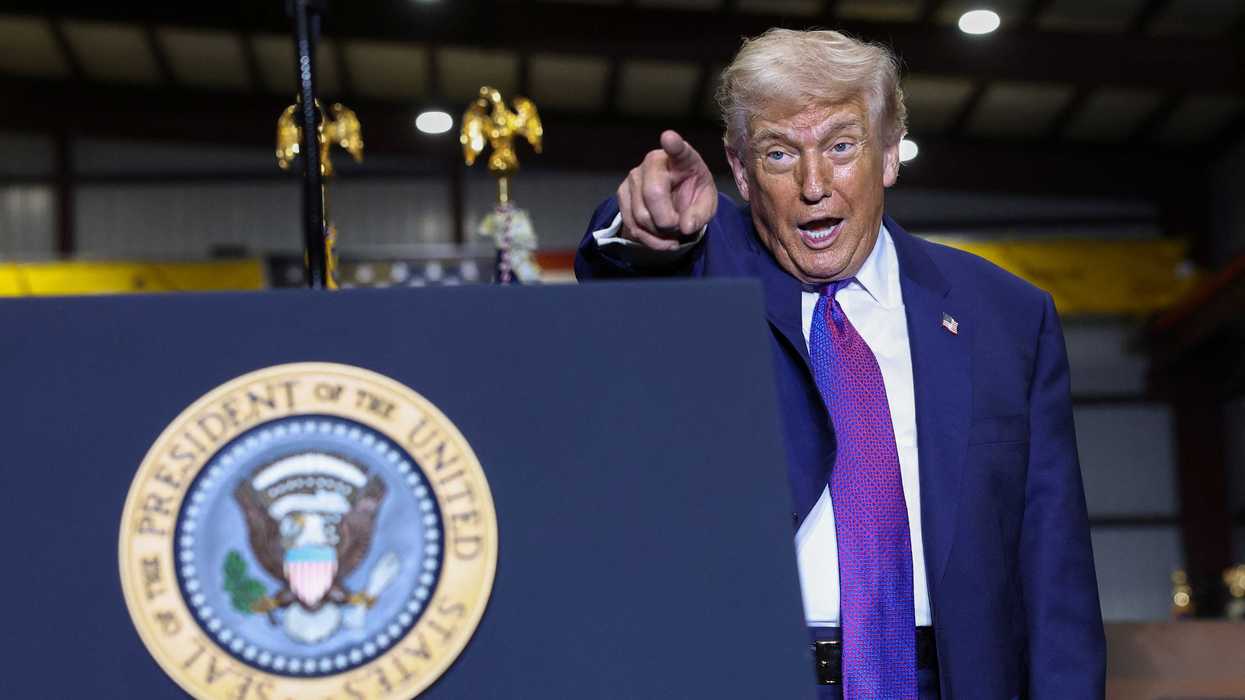
U.S. President Donald Trump in Rome, Georgia, U.S., February 19, 2026.
President Donald Trump's trade policies are drawing strong criticism from liberal economists like Paul Krugman and Robert Reich as well as students of the late Milton Friedman, who believed that steep tariffs are bad both businesses and consumers. Regardless, Trump and Commerce Secretary Howard Lutnick are doubling down on tariffs, which Trump claims will reduce the United States' national debt and eventually eliminate the need for federal income taxes.
Trump is also claiming major trade deficit reductions. In a Wednesday, February 18 post on his Truth Social platform, the president wrote, in all caps, "THE UNITED STATES TRADE DEFICIT HAS BEEN REDUCED BY 78% BECAUSE OF THE TARIFFS BEING CHARGED TO OTHER COMPANIES AND COUNTRIES."
But the conservative National Review disagrees strongly with Trump's claims in an editorial published on February 20.
"Talk about bad timing," the National Review editors argue. "On Wednesday, President Trump boasted on social media that the U.S. trade deficit had been reduced by 78 percent thanks to his comprehensive tariff regime, a claim apparently based on his cherry-picking of data between October and January. Less than 12 hours later, the Census Bureau published its annual trade report. It reveals that the U.S. trade deficit declined by just 0.2 percent in 2025 — a far cry from Trump's figure — from $903.5 billion in 2024 to $901.5 billion last year."sents money lost to other count
"In reality, the balance of trade has no bearing on a country's economic prosperity," the conservatives explain. "The United States is one of the wealthiest countries in the world per capita, and it also runs the largest trade deficit. Several countries that are desperately poor, such as Libya and Papua New Guinea, run trade surpluses…. Tariffs…. have proven unable to meaningfully shift the full balance of trade. President Trump imposed a suite of sweeping duties last year, resulting in an average pre-substitution rate of 14.5 percent across all imported goods."
They add, "Previously, the average rate hovered around 2.5 percent. Yet while this stunning increase has mangled trade in certain products and with particular countries, it has hardly put a dent in the deficit."
Alexander Willis
February 22, 2026
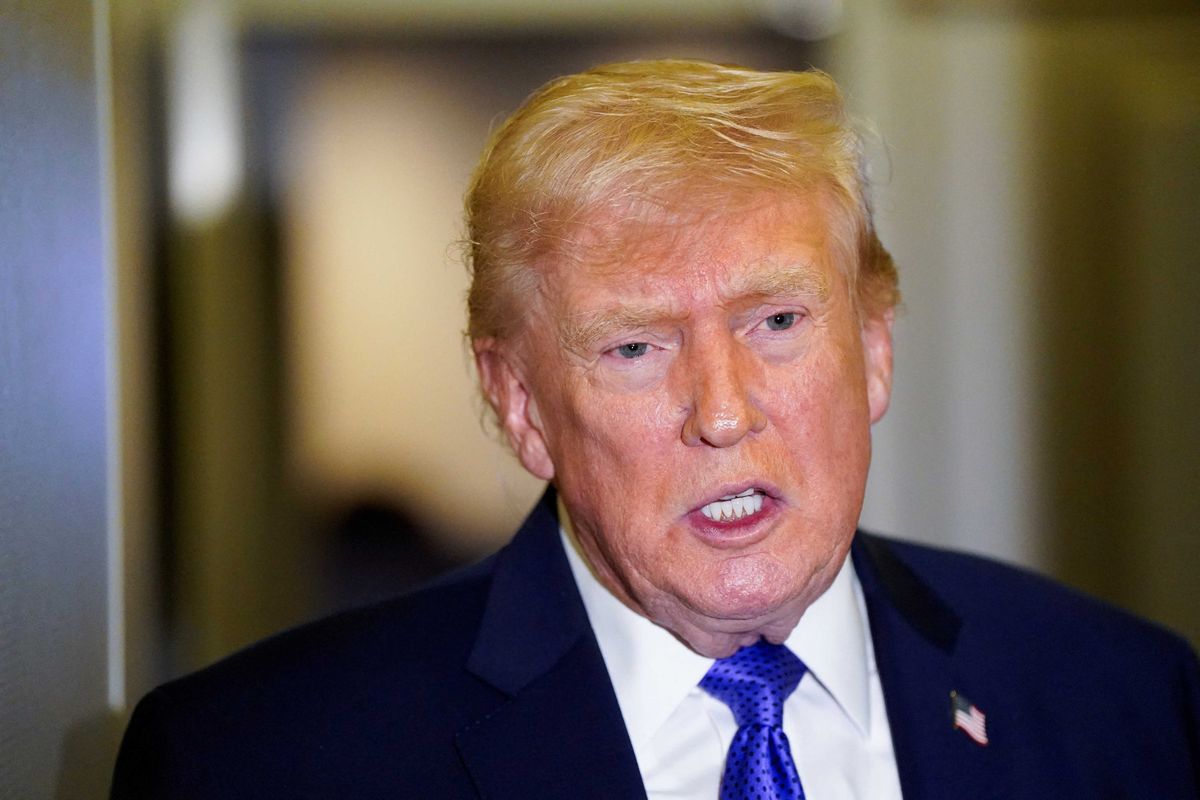
U.S. President Donald Trump speaks to reporters onboard Air Force One, on travel from West Palm Beach, Florida, to Joint Base Andrews, Maryland, U.S., February 16, 2026. REUTERS/Elizabeth Frantz
The Supreme Court’s stunning ruling Friday that President Donald Trump’s tariffs were unlawful may very well have set the Republican Party up for failure in the upcoming midterm elections, a Wall Street Journal report published on Saturday suggested.
Within hours of the court’s ruling, Trump vowed to pursue alternative methods for imposing his so-called reciprocal tariffs on other nations, and less than 24 hours later, hiked global tariffs from 10% to 15%. And, while Trump has yet to provide full details as to what those “alternatives” may look like, the Journal noted that all options available to him would set his trade policy “on a collision course with the midterm campaign season.”
“Some of the new tariffs Trump wants to impose require congressional approval to extend beyond five months. Others require months of investigations before they can be put into place,” wrote Journal trade and economic policy reporter Gavin Bade.
“In both cases, that pushes key tariff decisions into the summer, just months before November’s midterms when many Republicans are likely to be especially sensitive to complaints about inflation and affordability.”
Of the tariff options available to Trump that require Congressional approval, Kevin Brady, a former Republican member of Congress from Texas, told the Journal that lawmakers would be hesitant to support new tariffs just months away from the midterms.
“The potential that they could be asked by the White House to vote to levy higher tariffs on their constituents is not something Congress would look forward to,” Brady told the Journal. “The conventional wisdom is that there isn’t support for that.”
Americans have largely soured on Trump’s tariffs, with a new Washington Post-ABC News-Ipsos poll revealing this weekend that 64% of Americans disapprove of Trump’s tariffs. Trump’s tariffs have increased prices across a range of different sectors, and a recent study found that 96% of all tariff-induced cost increases were paid directly by American consumers.
Robert Reich
February 21, 2026
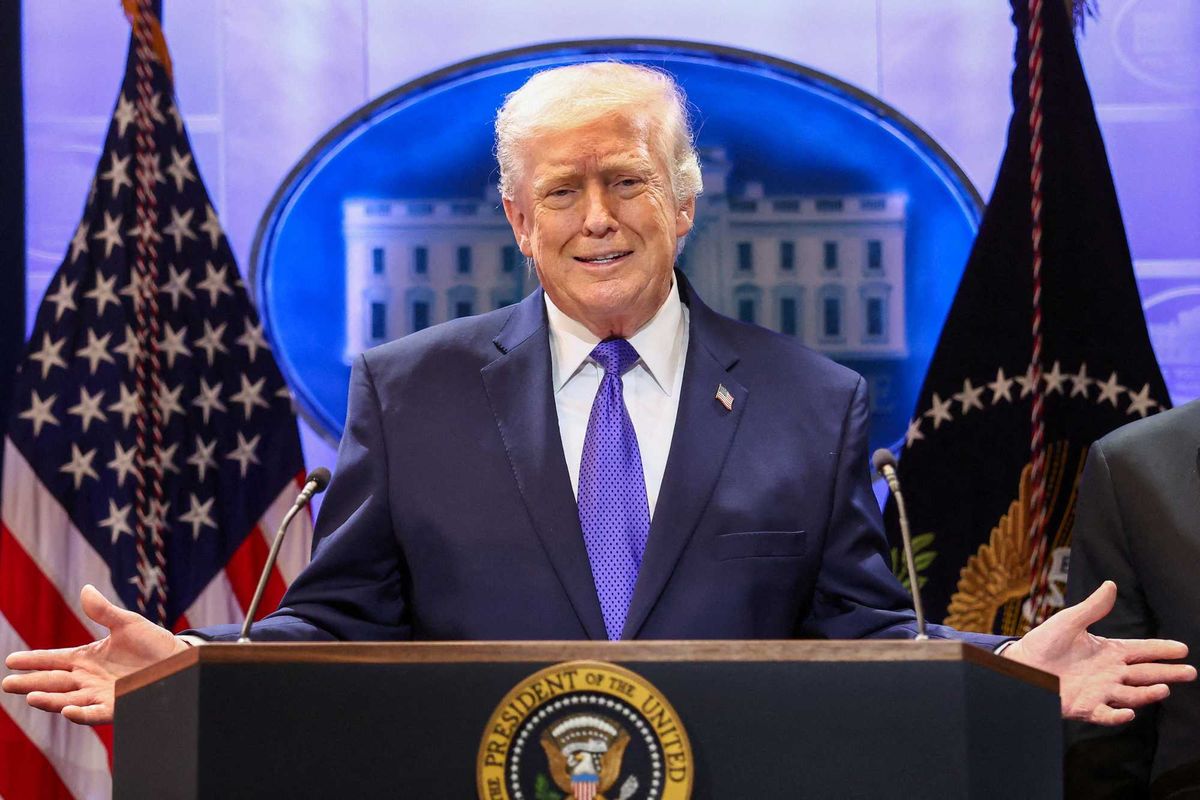
Donald Trump speaks following the Supreme Court's ruling on his tariffs. REUTERS/Kevin Lamarque
A 6-3 majority of the Supreme Court decided yesterday that Donald Trump cannot take core powers that the Constitution gives Congress. Instead, Congress must delegate that power clearly and unambiguously.
This is a big decision. It goes far beyond merely interpreting the 1997 International Emergency Economic Powers Act not to give Trump the power over tariffs that he claims to have. It reaffirms a basic constitutional principle about the division and separation of powers between Congress and the president.
On its face, this decision clarifies that Trump cannot decide on his own not to spend money Congress has authorized and appropriated — such as the funds for USAID he refused to spend. And he cannot on his own decide to go to war.
“The Court has long expressed ‘reluctan[ce] to read into ambiguous statutory test’ extraordinary delegations of Congress’s powers,” Chief Justice John Roberts wrote for himself and five other justices in the opinion released yesterday in Learning Resources vs. Trump.
He continued: “In several cases involving ‘major questions,’ the Court has reasoned that ‘both separation of powers principles and a practical understanding of legislative intent’ suggest Congress would not have delegated ‘highly consequential power’ through ambiguous language.”
Exactly. Trump has no authority on his own to impose tariffs because the Constitution gives that authority to Congress.
But by the same Supreme Court logic, Trump has no authority to impound money Congress has appropriated because the Constitution has given Congress the “core congressional power of the purse,” as the Court stated yesterday.
Hence, the $410 to $425 billion billion in funding that Trump has blocked or delayed violates the Impoundment Control Act, which requires Congressional approval for spending pauses. This includes funding withheld for foreign aid, FEMA, Head Start, Harvard and Columbia universities, and public health.
Nor, by this same Supreme Court logic, does Trump have authority to go to war because Article I, Section 8, Clause 11 of the Constitution grants Congress the power to "declare War … and make Rules concerning Captures on Land and Water" — and Congress would not have delegated this highly consequential power to a president through ambiguous language.
Presumably this is why Congress enacted the War Powers Act of 1973, which requires a president to notify Congress within 48 hours of deploying troops and requires their withdrawal within 60 to 90 days unless Congress declares war or authorizes an extension. Iran, anyone?
The press has reported on yesterday’s Supreme Court decision as if it were only about tariffs. Wrong. It’s far bigger and even more important.
Note that the decision was written by Chief Justice John Roberts — the same justice who wrote the Court’s 2024 decision in Trump v. United States, another 6-3 decision in which the Court ruled that former presidents have absolute immunity for actions taken within their core constitutional powers and at least presumptive immunity for all other official acts.
I think Roberts intentionally wrote yesterday’s decision in Learning Resources v. Trump as a bookend to Trump v. United States.
Both are intended to clarify the powers of the president and of Congress. A president has immunity for actions taken within his core constitutional powers. But a president has no authority to take core powers that the Constitution gives to Congress.
In these two decisions, the Chief Justice and five of his colleagues on the Court have laid out a roadmap for what they see as the boundary separating the power of the president from the powers of Congress, and what they will decide about future cases along that boundary.
Trump will pay no heed, of course. He accepts no limits to his power and has shown no respect for the Constitution, Congress, the Supreme Court, or the rule of law.
But the rest of us should now have a fairly good idea about what to expect from the Supreme Court in the months ahead.
Trump Increases Across-the-Board Tariff Rate to 15 Percent
On Saturday, U.S. President Donald Trump said that he would raise the United States' global baseline tariff rate to 15 percent in order to compensate for the suspension of the country-by-country tariffs he enacted under the International Emergency Economic Powers Act (IEEPA), which have been tossed out by the Supreme Court. The new tariff hike takes advantage of a never-before-used power under Section 122 of the Trade Act of 1974, which lets the president raise tariffs to a maximum of 15 percent for up to 150 days in the event of a "large and serious balance-of-payment deficit."
On Friday, Trump declared a Section 122 global tariff of 10 percent, with exclusions for certain strategic goods like critical minerals, components for defense manufacturing. Though the president announced a hike from 10 percent to 15 percent over the weekend, there were no immediate signs that the increase went into effect.
The previous IEEPA tariff regime was targeted at individual countries, and the administration used changes in tariff levels to extract concessions - for example, convincing India to moderate its purchases of Russian oil, with reduced tariffs as a reward.
Before the Supreme Court decision, the most favorable tariff rate that the administration was willing to allow its closest allies was 10 percent. Now that best-case scenario is below the baseline for all countries, regardless of concessions made.
The Office of the U.S. Trade Representative (USTR) is at work on legal ways to resurrect the previous tariff regime by alternative means. The USTR can investigated countries for unfair trade practices and take countervailing action using Section 301 of the Trade Act; though not as swift or as flexible as IEEPA, Section 301 can be used to rebuild the previous tariff arrangement, Trade Representative Jamieson Greer says.
"So even though the Supreme Court struck down tariffs under one authority, tariffs under other national security elements remain in place," Greer told CBS on Sunday. "And during that time [the next 150 days], we're going to conduct investigations that can allow us to impose tariffs if it's justified by the investigation. So we expect to have continuity in the president's tariff program."
In the meantime, across-the-board Section 122 tariff will have an effect on importers and on foreign manufacturers in many verticals. When including Friday's announcement of a 10 percent Section 122 tariff, the average tariff rate for all U.S. imports comes to 13.7 percent, according to the Yale Budget Lab, down from 16 percent under the now-defunct IEEPA tariff regime.
America's closest allies are among the nations most affected by the changing tariff rates. Australia and the UK, which had negotiated for a 10 percent rate, will see tariffs on their exports go up again. UK businesses view the sudden shifts unfavorably, the British Chamber of Commerce's trade chief told BBC.
"There is a weariness about the constant changes, the lack of any clarity and certainty in terms of tariffs, and therefore the prices that companies can charge for the goods in terms of customers in the US," said the chamber's head of trade policy, William Bain, speaking to BBC.
‘Not the end’: Small US firms wary but hopeful on tariff upheaval
By AFP
February 20, 2026

The Supreme Court decision on tariffs does not mark an end to the difficult trade environment some businesses are dealing with - Copyright AFP/File LEANDRO LOZADA
Beiyi SEOW
Small American businesses warned Friday that a tougher trade landscape was here to stay, as the Supreme Court’s rejection of sweeping tariffs was quickly followed by President Donald Trump’s pledge to impose new duties.
“It’s certainly not the end of the difficult trade environment that we’re trying to deal with,” said Ben Knepler, co-founder of outdoor chair maker True Places.
He was forced to radically scale back his Pennsylvania-based business last year after Trump imposed new tariffs on virtually all trading partners.
The high court’s decision on Friday that these country-specific tariffs were illegal brought limited comfort.
“Even with this ruling, there’s too much uncertainty for us to be able to restart production for the US,” he told AFP.
Knepler had shifted his supply chain out of China to Cambodia at heavy cost after Trump’s trade war with Beijing during his first presidency.
But Trump’s new 19-percent tariff on Cambodia imports last year forced him to halt manufacturing. He is now working on selling the remainder of his inventory rather than continuing production while he plans his next steps.
But he said: “It does give us a little bit of hope that at least there’s some kind of check on what was previously unlimited power outside of Congress.”
– ‘Surgical approach’ –
Josh Staph, chief executive of Ohio-based Duncan Toys Company, urged a “more surgical approach to tariffs” after Trump announced his plan to impose new and sweeping 10-percent duties on imports.
Duncan Toys has been producing yo-yos, flying discs and model gliders in China, and Washington’s escalating tariffs with Beijing last year similarly forced him to pause imports.
He was “cautiously optimistic” over the Supreme Court ruling.
But he said he “knows the administration is committed to imposing these tariffs, despite their impact on US toy companies and consumers.”
Boyd Stephenson, who runs retailer Game Kastle in Maryland, told AFP he was “very excited to hear that the tariffs have been struck down.”
He believes the legal limits can do “wonderful things for the gaming and toy industry over the next year,” but conceded “the devil’s always in the details.”
“It’s very much a wait to see how the removal of the tariffs percolates through the supply chain,” he added.
Meanwhile, the effects of Trump’s incoming duties remain uncertain.
– ‘A setback’ –
Drew Greenblatt, president of Baltimore-based metal product manufacturer Marlin Steel, worries however that Friday’s court ruling was “a setback” for the United States.
Greenblatt has been supportive of Trump’s steel levies, which alongside other sector-specific tariffs were not impacted by the high court’s decision.
But he expressed concern that the outcome would hamper Trump’s ability to navigate and negotiate trade deals with an aim of boosting US manufacturing.
“Do you think if we get into an adversarial relationship with one of these trading entities, they’re going to supply us ships?” he asked. “Do you think they’re going to supply us critical materials?”
“The wider concern is we need a robust manufacturing industry,” he told AFP.
By Paul Wallis
EDITOR AT LARGE
February 20, 2026

Image: © AFP
In a day, Trump has “announced” a new global tariff of 10% after the Supreme Court specifically ruled that he had no power to impose tariffs. Anybody else would at least know it was game over.
It’s also anyone’s guess whether these new tariffs will stick or can be challenged.
Trump is so heavily invested in tariffs as the one and only idea for managing trade and revenue that he simply has nowhere else to go. To back down would look weak, but there’s no way around this ruling, either.
To complicate matters, the SCOTUS ruling also means possible years of refunds to importers, which are estimated at $175 billion. This is a truly unholy administrative mess, and it’s not going to get simpler over time.
Refunding the total amount of tariffs paid could be incredibly expensive in processing alone. It was mentioned at the time the tariffs were introduced that the legality of the “economic emergency powers” was in question.
That may or may not be a basis for future legal action against the administration and set up a punitive, net-loss environment for revenue.
Trump has been “trumpeting” tariffs as the cure for America’s trade debt, and revenue problems, but the numbers have never stacked up and still don’t. The net revenue is absolutely minuscule in comparison with America’s massive debt bill.
The other problem is the sheer abrasiveness of the tariffs. These tariffs have rubbed the world the wrong way, and retaliatory tariffs are still in play.
It’s also an unmitigated disaster for the administration in terms of power projection. The tariffs were supposedly pointed at China, which has enjoyed an excellent trade surplus within 12 months of their introduction.
Having also effectively neutered revenue from the tariffs due to refunds, the question is now how the administration plans to fund spending. This is an unavoidable issues, particularly with much-hyped possible tax cuts.

It doesn’t look like a healthy budget is possible. The net result is likely to be a very unconvincing time of desperate damage control up to the midterms.
__________________________________________________
Disclaimer
The opinions expressed in this Op-Ed are those of the author. They do not purport to reflect the opinions or views of the Digital Journal or its members.

No comments:
Post a Comment