Trump’s foreign interventions may pave the way for techno-fascist city-states to seize sovereignty.
By Beth Geglia ,
February 21, 2026

Aerial view of Pier Juan Griego in Margarita Island, Nueva Esparta State, Venezuela, on November 25, 2024. A blockchain-based residential settlement called CryptoCity spans 35 hectares on Margarita Island and is promoted to German and other foreign investors as a highly exclusive enclave.
JUAN BARRETO / AFP via Getty Images
Truthout is an indispensable resource for activists, movement leaders and workers everywhere. Please make this work possible with a quick donation.
On January 3, 2026, Tim Stern, a German investor, was sleeping peacefully at his Venezuela residence when the phone on his small bedside table suddenly went wild. As he explained to Timothy Allen of the “Free Cities Podcast,” calls streamed in immediately after news broke that the United States had bombed Caracas in the early hours of the morning. Within hours, it was clear that Venezuelan President Nicolás Maduro had been captured and was being sent to the United States — a change, Stern said in the podcast, that “is going to be the start of an absolute bonanza here in Venezuela.”
Oil interests were at the center of the U.S. invasion of Venezuela; U.S. President Donald Trump has made clear his intentions to reclaim nationalized Venezuelan oil for U.S. companies and to oversee the sale of Venezuelan crude. However, Stern is not involved in the oil industry. Instead, he’s the co-founder of a blockchain-based residential settlement called CryptoCity, a luxury real estate development spanning 35 hectares on Venezuela’s Margarita Island. Margarita, an island with duty-free port status and a population of around 490,000, depends largely on the tourism industry and has suffered hardships due to Venezuela’s economic crisis. However, CryptoCity is promoted to German and other foreign investors as a highly exclusive enclave. It boasts of luxury living for “high net-worth” entrepreneurs fully vetted and selected through a rigorous process. All transactions in the zone must be made in crypto, and residents form part of a “brain pool” aimed at generating joint business ventures through a Decentralized Autonomous Organization (DAO).
CryptoCity is one example of how Trump’s foreign policy is benefitting a venture-capital fueled private city and “network state” movement. The project is featured on the page of the Free Cities Foundation, a leading private city promotor led by German economist Titus Gebel that has also championed the crypto-libertarian movement’s flagship project, a self-governing jurisdiction in Honduras called the Próspera ZEDE (Economic Development and Employment Zone). According to Stern, property in Margarita sold so rapidly after the U.S.’s attack on January 3 that their company was running out of apartments to sell. Property values shot up, properties for $20,000-$30,000 were nowhere to be found, and CryptoCity experienced an influx of investors interested in visiting the island, he maintained.
While libertarians have long fantasized about sovereign, “free-market” enclaves, a movement for so-called private cities, built in highly autonomous special jurisdictions, gained new momentum after the 2008 economic crisis. Palantir co-founder Peter Thiel is one of the most prominent backers of the movement. The billionaire first backed the Seasteading Institute — an organization promoting ocean colonization — and then VC firm Pronomos Capital, an early investor in Próspera. In 2022, crypto investor Balaji Srinivasan took the tech-futurist and land-hungry movement to the next level, coining the idea of the “network state.” A network state refers to an online community that pools capital, forms a blockchain “nation,” and then crowdsources land and exploits legal exemptions to build para-national territories.
Truthout is an indispensable resource for activists, movement leaders and workers everywhere. Please make this work possible with a quick donation.
On January 3, 2026, Tim Stern, a German investor, was sleeping peacefully at his Venezuela residence when the phone on his small bedside table suddenly went wild. As he explained to Timothy Allen of the “Free Cities Podcast,” calls streamed in immediately after news broke that the United States had bombed Caracas in the early hours of the morning. Within hours, it was clear that Venezuelan President Nicolás Maduro had been captured and was being sent to the United States — a change, Stern said in the podcast, that “is going to be the start of an absolute bonanza here in Venezuela.”
Oil interests were at the center of the U.S. invasion of Venezuela; U.S. President Donald Trump has made clear his intentions to reclaim nationalized Venezuelan oil for U.S. companies and to oversee the sale of Venezuelan crude. However, Stern is not involved in the oil industry. Instead, he’s the co-founder of a blockchain-based residential settlement called CryptoCity, a luxury real estate development spanning 35 hectares on Venezuela’s Margarita Island. Margarita, an island with duty-free port status and a population of around 490,000, depends largely on the tourism industry and has suffered hardships due to Venezuela’s economic crisis. However, CryptoCity is promoted to German and other foreign investors as a highly exclusive enclave. It boasts of luxury living for “high net-worth” entrepreneurs fully vetted and selected through a rigorous process. All transactions in the zone must be made in crypto, and residents form part of a “brain pool” aimed at generating joint business ventures through a Decentralized Autonomous Organization (DAO).
CryptoCity is one example of how Trump’s foreign policy is benefitting a venture-capital fueled private city and “network state” movement. The project is featured on the page of the Free Cities Foundation, a leading private city promotor led by German economist Titus Gebel that has also championed the crypto-libertarian movement’s flagship project, a self-governing jurisdiction in Honduras called the Próspera ZEDE (Economic Development and Employment Zone). According to Stern, property in Margarita sold so rapidly after the U.S.’s attack on January 3 that their company was running out of apartments to sell. Property values shot up, properties for $20,000-$30,000 were nowhere to be found, and CryptoCity experienced an influx of investors interested in visiting the island, he maintained.
While libertarians have long fantasized about sovereign, “free-market” enclaves, a movement for so-called private cities, built in highly autonomous special jurisdictions, gained new momentum after the 2008 economic crisis. Palantir co-founder Peter Thiel is one of the most prominent backers of the movement. The billionaire first backed the Seasteading Institute — an organization promoting ocean colonization — and then VC firm Pronomos Capital, an early investor in Próspera. In 2022, crypto investor Balaji Srinivasan took the tech-futurist and land-hungry movement to the next level, coining the idea of the “network state.” A network state refers to an online community that pools capital, forms a blockchain “nation,” and then crowdsources land and exploits legal exemptions to build para-national territories.
Military Bases Could Open Doors for Private Sovereignty
At the end of the recent World Economic Forum in Davos, Switzerland, Trump’s rhetoric on Greenland took a sharp turn, easing concerns over potential military conflict or crushing tariffs against European countries. Trump now claims to have reached a framework for a deal with NATO over Greenland and the Arctic, rumored to include sovereign territories for U.S. military bases, similar to the arrangement the U.S. holds in Guantánamo, Cuba.
Although official details have not been released and a larger conflict seems to have been averted, small territorial concessions in Greenland are still aligned with the interests of Trump’s tech oligarch allies and present a serious threat to the island. This is because even small pockets of U.S. territory could pave the way for venture capitalist interests in private jurisdiction development under the “network state” rubric.
Early in Trump’s second term, a rising network state project called Praxis — in fact a self-proclaimed “network empire” — enthusiastically backed Trump’s resolve to annex Greenland from Denmark, declaring plans to make it the first physical site for their digital nation. A week after Trump’s election, Praxis co-founder Dryden Brown announced that he had visited Greenland “to try to buy it.” Meanwhile Trump’s support for “Freedom Cities” within the United States (later named “Acceleration Zones”), an offshoot of Honduras’s Economic Development and Employment Zones (ZEDEs) like Próspera, moved from a campaign promise to official policy. Praxis — also backed by a group of mega tech and crypto investors including Pronomos, Balaji Srinivasan, Patri Friedman of the Seasteading Institute, Palantir co-founder Joe Lonsdale, Sam Bankman-Fried’s trading firm Alameda Research, and Apollo Ventures (the VC firm of OpenAI’s Sam Altman) — circulated a White House X post on November 5, 2025, that featured President Trump inside a pattern resembling the Praxian flag, adding a note: “Praxians in control.” The image leaves little room for doubt of Trump’s alliance with the right-wing network nation.
As the prospect of a full U.S. takeover of Greenland has grown increasingly remote, the idea of a Greenland-based “Freedom City” has understandably faded from view — but it has not disappeared entirely. An expanded U.S.–Denmark military base agreement could still create openings, depending on how its terms are structured. This possibility is underscored by Praxis’s focus on military defense and space exploration and its affinity towards designing cities adjacent to military installations.
In June 2025, Praxis proposed Atlas, a “defense-focused spaceport city on 3,850 acres at the Vandenberg Space Force Base,” in California, demonstrating its will to merge military development with network state plans. Praxis proposes launching Atlas first as a beachside industrial town to attract elite technical talent. Its close proximity to Department of Defense assets and Space Force installations on the base would enable “rapid test-to-deployment cycles” for AI-driven defense technology innovation. Estimated to attract 50,000 residents and produce $35 billion in income, Praxis promotes Atlas as a way to “defend the West on Earth and beyond.”
Early in Trump’s second term, a rising network state project called Praxis — in fact a self-proclaimed “network empire” — enthusiastically backed Trump’s resolve to annex Greenland from Denmark, declaring plans to make it the first physical site for their digital nation. A week after Trump’s election, Praxis co-founder Dryden Brown announced that he had visited Greenland “to try to buy it.” Meanwhile Trump’s support for “Freedom Cities” within the United States (later named “Acceleration Zones”), an offshoot of Honduras’s Economic Development and Employment Zones (ZEDEs) like Próspera, moved from a campaign promise to official policy. Praxis — also backed by a group of mega tech and crypto investors including Pronomos, Balaji Srinivasan, Patri Friedman of the Seasteading Institute, Palantir co-founder Joe Lonsdale, Sam Bankman-Fried’s trading firm Alameda Research, and Apollo Ventures (the VC firm of OpenAI’s Sam Altman) — circulated a White House X post on November 5, 2025, that featured President Trump inside a pattern resembling the Praxian flag, adding a note: “Praxians in control.” The image leaves little room for doubt of Trump’s alliance with the right-wing network nation.
As the prospect of a full U.S. takeover of Greenland has grown increasingly remote, the idea of a Greenland-based “Freedom City” has understandably faded from view — but it has not disappeared entirely. An expanded U.S.–Denmark military base agreement could still create openings, depending on how its terms are structured. This possibility is underscored by Praxis’s focus on military defense and space exploration and its affinity towards designing cities adjacent to military installations.
In June 2025, Praxis proposed Atlas, a “defense-focused spaceport city on 3,850 acres at the Vandenberg Space Force Base,” in California, demonstrating its will to merge military development with network state plans. Praxis proposes launching Atlas first as a beachside industrial town to attract elite technical talent. Its close proximity to Department of Defense assets and Space Force installations on the base would enable “rapid test-to-deployment cycles” for AI-driven defense technology innovation. Estimated to attract 50,000 residents and produce $35 billion in income, Praxis promotes Atlas as a way to “defend the West on Earth and beyond.”
Danger of Expansion
In Honduras, small extensions of land were used by private city investors as a foothold to claim sovereignty and resist government oversight. The legislation backing ZEDEs was designed for these small footholds to grow over time. Honduras’s ZEDE law, which was passed in 2013, repealed in 2022, and ultimately ruled unconstitutional by the Honduran Supreme Court in 2024, contained a few key articles that insured the private territories would be difficult to contain. For instance, the law designated entire coastal areas with low population density as subject to the special ZEDE regime without a plebiscite or congressional approval, while also allowing new territory to be easily merged into the special jurisdiction if sold or voluntarily incorporated by a private landowner. The Próspera ZEDE, located on the Honduran island of Roatán, set a precedent for this when it purchased the Satuye Port, a non-contiguous territory on mainland Honduras, and placed it under the jurisdiction of the Próspera government. Próspera continued to operate as a self-governing territory and raise investment even after the Supreme Court’s ruling struck the ZEDE framework from the Honduran Constitution.
Praxis is a particularly extreme player in the network state movement. Western chauvinism is mixed with Mars colonization fantasies and allusions to white supremacist ideology in Praxis’s online discourse. One Praxis X post, for example, invokes the imperative to save the “corpse of Albion” — a term that refers to a fictitious independent island nation in the gaming world, but is also used by some ethnonationalist and neo-Nazi groups to reference a mythical, pre-modern, and “pure” Britain. Commenters responded to the post with “HAIL Praxis.” On February 6, 2025, Praxis boosted an X post titled “Make Rhodesia Great Again,” featuring a series of videoclips of colonial violence, and added “Praxians, are you ready for action?” Rhodesia, a former settler-colonial state in present-day Zimbabwe known for its systematic domination of the Black majority, is a widely recognized symbol of white nationalism. Praxis deploys other pre-fascist cultural concepts that were later adopted by European fascists and the Nazi Party, such as that of the “eternal city” and the “Faustian spirit.”
Taken together, Trump’s open disregard for the sovereignty of other nations does more than disrupt diplomatic norms; it paves the way for private city and network-state projects that revive long-standing logics of colonialism. If the Honduras case is any example, the legal details of an agreement between the United States and Denmark will be instrumental in determining the extent of the damage done to the island of Greenland and the self-determination of its people.
This article is licensed under Creative Commons (CC BY-NC-ND 4.0), and you are free to share and republish under the terms of the license.
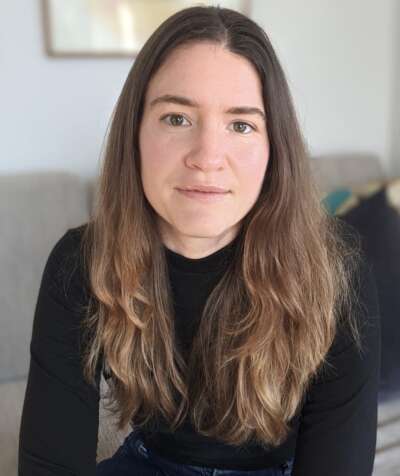
Beth Geglia is an anthropologist and documentarian focused on urban political economy, land politics, and tech-futurist territorial movements. She holds a Ph.D. from American University and is based in Washington, D.C. and Barcelona.
Op-Ed
By Edith Romero ,
Próspera (one of the three ZEDEs in Honduras) even has a Bitcoin center paired with tech companies that offer $25,000 gene therapy and “subdermal implantation services and a variety of cybernetic upgrades.” Próspera is located in Roatan, a Honduran island named one of the World’s Greatest Places in 2023 by TIME magazine. Roatan is a Caribbean tropical beauty surrounded by the second-largest coral reef in the world, and home to rich Afro-descendant culture, the Garifuna people who have been fighting threats to their sovereignty for centuries. A sought-after spot for foreign luxury tourism and investment, Roatan saw the foundation of Próspera in 2017 with funding from the likes of Peter Thiel and Pronomos Capital led by Patri Friedman, a grandson of Milton Friedman, seen by many as the father of neoliberalism, deregulation, and privatization.
There are endless reasons why ZEDEs are dangerous for the Honduran people. Human rights organizations have rung the alarm on how they have been displacing Indigenous communities who have ancestral ties to the land and expropriating their territory.
Greicy, an Indigenous Garífuna woman from Triunfo de la Cruz on the coast of Honduras, identifies similarities between the ZEDE in Próspera and other illegal land grabs and land dispossession in her ancestral hometown. Due to safety concerns, Greicy is only sharing her first name for this article.
“Even though they say otherwise, I see that only the rich are benefiting, knowing full well that we Garífuna people live off the beach, we live off tourism, we live off fishing, and we also live off growing our own food, cultivating our own food, harvesting and planting our own food. Right? But now we don’t have any land left,” she said.
Harassment, violence, and threats from the Honduran police force led Greicy to migrate North to New Orleans, standing as a living testimony of how neocolonialism has displaced millions of families in the Global South.
Greicy’s family was part of the 2015 Inter-American Court ruling that found the state of Honduras guilty of violating the rights of the Garifuna people in Triunfo de la Cruz and Punta Piedra, and ordered the state to pay restitution for their communal land rights. Despite the ruling, the Honduran state has not started any process of restitution, with threats and violence towards Garifuna leaders persisting. Greicy sees ZEDEs as the ultimate tool to dispossess the Garifuna people of their ancestral homeland.
“In Honduras, the ruling has not been carried out, the demands have not been met. And I imagine there would be even more land dispossession [with more ZEDES], dispossession not only of homes, but of people’s very means of survival. Yes, it would be worse because we know that all these special economic development zones benefit high-ranking officials, wealthy individuals with investments, and foreign investors who attend political meetings. And how does this benefit the people? Not at all. Exactly,” she explained.
Concerns regarding ZEDEs and neocolonialist dispossession of communities on the North coast of Honduras often involve drug-trafficking activity, including money laundering, says Greicy.
“Those who are going to invest there are Americans. One reason is to bring in their prohibited substances, because we know that’s also included in the deal. Money laundering is also involved, right? When they go to the beaches, supposedly for tourists, and all that, that’s also money laundering, because the beach is a free zone, merchandise is smuggled there, everything is sold there. And someone like me, living in the town, just stays quiet because of fear…. If I were in Honduras, I tell you, I wouldn’t be telling you this,” she said.
Greicy’s fear is not unfounded: Research on special economic zones such as the ones in China has documented “economic gray zones” inside the enclaves where drugs, money laundering, and human trafficking abound. Others are concerned about how ZEDEs have the power to create inhumane labor laws to exploit Hondurans, but let’s take a moment to look at the big picture.
ZEDEs are the tech billionaire representation of neocolonialism; taking hold of Honduran land, resources, and a workforce to build playground empires for tech billionaires to avoid constitutional protections, government accountability, or even human rights protections.
In 2022, the new government of Honduras repealed the ZEDEs law, which led to a $10.7 billion lawsuit from Thiel’s Próspera that could bankrupt an already struggling country. Unfortunately, the ZEDEs law has a loophole that has allowed the so-called “digital nations” like Próspera to continue.
In December 2025, Honduras concluded a presidential election completely tainted by U.S. intervention via Donald Trump’s public support for the right-wing Nationalist Party candidate Nasry Asfura, as well as Trump’s threats to cut U.S. aid to Honduras if another candidate won. The connection of special interests between Trump, his tech billionaire friends, and ZEDEs are clear, and Nasry stands as the champion that will do Trump’s and Thiel’s bidding at the expense of the lives and rights of the Honduran people.
Greicy explained the dire position of immigrants facing dispossession in their ancestral homeland — and detention, surveillance, and violence in the United States at the hand of the same powerful forces.
If the expansion of more ZEDEs in Honduras were to happen, “immigration is going to get worse, because we know that those of us who are here want to leave, and the people who are there are being forced out and will come here. They will come seeking political asylum, something that will be denied to them,” she said.
It is not the first time Thiel has used people of color in crisis as a laboratory for his monstrous oligarchic fantasies. Thiel’s Palantir is one of the main providers of advanced AI targeting software and hardware to Israeli forces; the technology is used to target, surveil, and murder Palestinians. As a genocide continues under a ceasefire that has not been respected by Israel, Palantir continues to, as its CEO Alex Karp said in an understatement, “occasionally kill people.” Palantir not only provides the technology to massacre Palestinians but also trained its AI models with secretly received National Security Agency raw data of emails and phone conversations between Palestinians in occupied territories and their family in the U.S.
In 2020, Karp admitted that Palantir “[finds] people in our country who are undocumented,” referring to contracts with the Department of Homeland Security to use Palantir to surveil undocumented immigrants. Thiel and his billionaire gang are building a new profit frontier off of the livelihoods of people of color. The theft of land and resources, the mass surveillance and endless data collection — Thiel’s pet projects regard immigrants and people of color as expendable. We are one more resource they will gladly extract, whether it is our land, labor, data, or our own lives. As data centers gobble up resources in the form of drinkable water and energy, the technology they house exploits people of color, whether it’s through biased facial recognition tech or predictive policing technology that tries to criminalize us.
Just like the Spanish colonized Latin America through forced labor, extraction of resources, and subjugation of the Indigenous peoples, Peter Thiel and his gang of tech billionaires are drafting up plans to re-colonize Latin America, occupying land, displacing native inhabitants, and then profiting from surveilling and incarcerating them after they are forced to flee to the United States. Thiel, conveniently, has lately been preaching the coming of an “antichrist” in the guise of environmentalism, guardrails on technology, and international agencies, even singling out Greta Thunberg as the possible antichrist. On the topic of the libertarian utopia of “charter cities” like Próspera, Thiel has said “the nature of government is about to change at a very fundamental level.”
Ultimately, Palantir’s ImmigrationOS is a weapon that ICE and other government agencies use to detain kidnapped immigrants under inhumane conditions and force them to perform manual labor in detention centers. A trans detainee in a Louisiana ICE jail denounced this forced manual labor in 2025 — in his case, he was force to carry cinder blocks — and then faced sexual harassment after speaking out against this unsanctioned practice. As Palantir facilitates forced labor schemes, Thiel amasses power through his investments in Facebook, Donald Trump, and ZEDEs.
From the U.S. to Honduras, tech billionaires are waging a war on people of color. These oligarchs are employing the old and overused re-packaging of neocolonialism and repression as “development” and “progress” — even labeling AI tech as “inevitable.” When feeling overwhelmed by the power and influence of tech billionaires who care not about our lives or the planet but only about endless profit, I remind myself that they are quite literally a 1 percent. We are an undeniable winning force if we come together.
Tech billionaires are not the future. They are just another colonizer looking for a scheme to grow power and wealth on our backs. To start, we can always hit them where they care the most, their money — boycott generative AI, fight against data centers, fight against and denounce Palantir contracts being paid with our tax money, and support Indigenous communities fighting against ZEDEs. Let’s ditch the glorification of billionaires like Thiel and Musk who care only about power and profit. Let’s call them what they are: colonizers that see us, people of color, as their new profit frontier.
This article is licensed under Creative Commons (CC BY-NC-ND 4.0), and you are free to share and republish under the terms of the license.

Edith Romero is a Honduran community organizer, researcher, writer, and a Public Voices fellow of The OpEd Project, The National Latina Institute for Reproductive Justice, and the Every Page Foundation.
Peter Thiel Is Unleashing a Neocolonial Billionaire Fantasy in Honduras
Tech billionaires want to create their own city-states. Hondurans pay the price.
Tech billionaires want to create their own city-states. Hondurans pay the price.
By Edith Romero ,
February 16, 2026
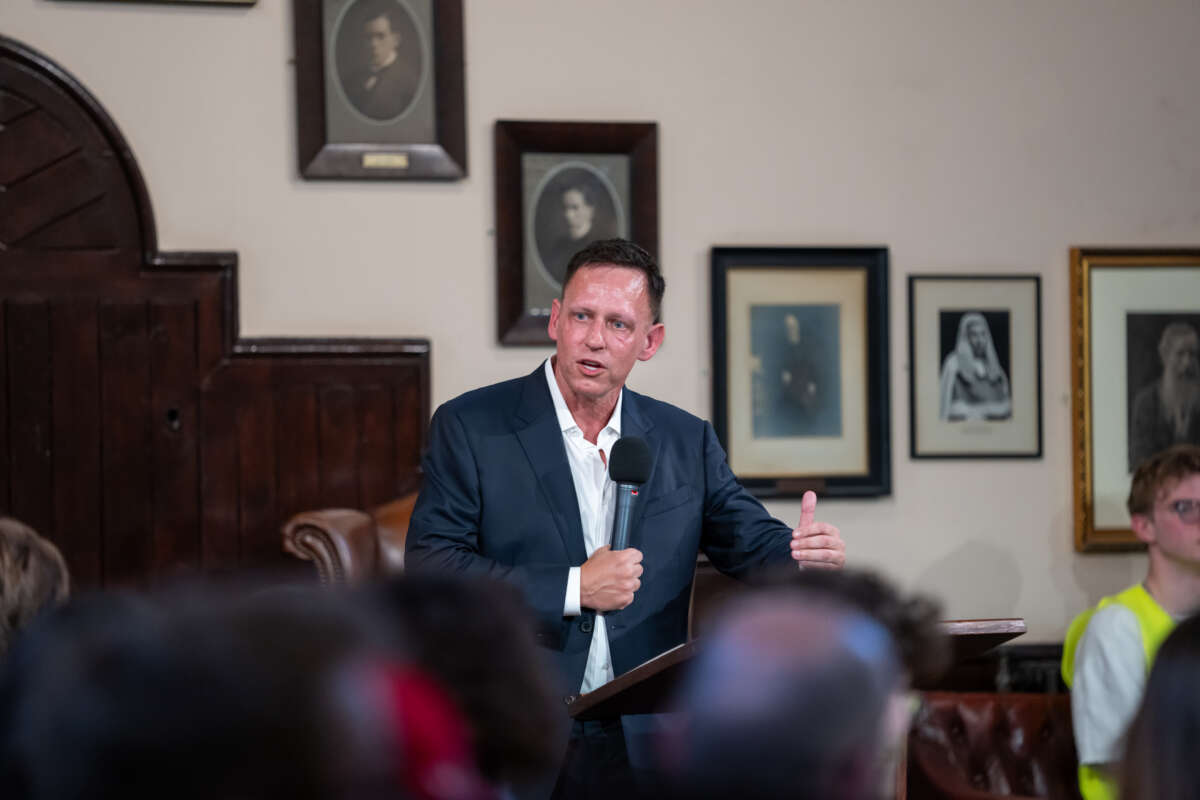
Peter Thiel speaks at The Cambridge Union on May 8, 2024, in Cambridge, Cambridgeshire, England.
Nordin Catic / Getty Images for The Cambridge Union
In April 2025, Peter Thiel’s Palantir made headlines after documents were released detailing its partnership with Immigration and Customs Enforcement (ICE) to create ImmigrationOS, a massive database of information gathered from a variety of sources including the IRS, in order to surveil, detain, and deport immigrants. Thiel is not new to spearheading endeavors that aim to dehumanize and attack people of color. In fact, the tech mogul is one of the billionaires leading our modern-day version of tech neocolonialism, the new-yet-old imperial monster that colonizes land, extracts resources, exploits natives, and is happy to profit off of their suffering.
As a Honduran immigrant myself, I would know.
In 2009, Honduras found itself in turmoil after a military coup destabilized the country leading to unprecedented levels of violence and repression. Taking a page out of the “shock doctrine” playbook, the elite political actors behind the coup (including narco-dictator Juan Orlando Hernández, now pardoned by Donald Trump after being sentenced to 45 years in prison for drug trafficking and weapons charges) watered down environmental protections on Honduran land and approved illegal contracts to sell Indigenous and protected land to the highest bidder.
Among other corrupt dealings and land grabs, the government approved a law that enabled the creation of Peter Thiel’s Zones for Employment and Economic Development (ZEDEs). ZEDEs derive from the idea of “charter cities.” Proposed by former World Bank executive and economist Paul Romer, these proposed cities are enclaves within lower-income nations that “promote economic growth” through privatization and the disposal of national regulations, while gifting major tax incentives for foreign nations to invest in businesses. Special economic zones in Kenya, Bangladesh, and Ethiopia have faced criticism due to low wages, harsh working conditions, and threats to rights to free association and collective bargaining. Romer, one of the initial proponents of ZEDEs in Honduras, expressed criticism in 2015 regarding the Honduran ZEDEs and their lack of accountability to local laws, and anti-democratic governance.
These ZEDEs are a project of Praxis, a tech billionaire-funded start-up that aims to create libertarian city-states to “restore Western Civilization.” The ZEDEs are allowed to have their own government, police force, courts, laws, and any taxes collected would not be paid to the Honduran government but to the ZEDEs themselves. ZEDEs are a tech billionaire’s dream: unbridled power, tech fantasy, and resource hoarding, where the government is run by AI and cryptocurrency is the main currency.

Who Gained the Most During Trump’s First Year? Billionaires and Corporations.
Big banks saw their stocks skyrocket by 29 percent during Trump’s first year. Here’s who else cashed in. By Derek Seidman , Truthout January 20, 2026
In April 2025, Peter Thiel’s Palantir made headlines after documents were released detailing its partnership with Immigration and Customs Enforcement (ICE) to create ImmigrationOS, a massive database of information gathered from a variety of sources including the IRS, in order to surveil, detain, and deport immigrants. Thiel is not new to spearheading endeavors that aim to dehumanize and attack people of color. In fact, the tech mogul is one of the billionaires leading our modern-day version of tech neocolonialism, the new-yet-old imperial monster that colonizes land, extracts resources, exploits natives, and is happy to profit off of their suffering.
As a Honduran immigrant myself, I would know.
In 2009, Honduras found itself in turmoil after a military coup destabilized the country leading to unprecedented levels of violence and repression. Taking a page out of the “shock doctrine” playbook, the elite political actors behind the coup (including narco-dictator Juan Orlando Hernández, now pardoned by Donald Trump after being sentenced to 45 years in prison for drug trafficking and weapons charges) watered down environmental protections on Honduran land and approved illegal contracts to sell Indigenous and protected land to the highest bidder.
Among other corrupt dealings and land grabs, the government approved a law that enabled the creation of Peter Thiel’s Zones for Employment and Economic Development (ZEDEs). ZEDEs derive from the idea of “charter cities.” Proposed by former World Bank executive and economist Paul Romer, these proposed cities are enclaves within lower-income nations that “promote economic growth” through privatization and the disposal of national regulations, while gifting major tax incentives for foreign nations to invest in businesses. Special economic zones in Kenya, Bangladesh, and Ethiopia have faced criticism due to low wages, harsh working conditions, and threats to rights to free association and collective bargaining. Romer, one of the initial proponents of ZEDEs in Honduras, expressed criticism in 2015 regarding the Honduran ZEDEs and their lack of accountability to local laws, and anti-democratic governance.
These ZEDEs are a project of Praxis, a tech billionaire-funded start-up that aims to create libertarian city-states to “restore Western Civilization.” The ZEDEs are allowed to have their own government, police force, courts, laws, and any taxes collected would not be paid to the Honduran government but to the ZEDEs themselves. ZEDEs are a tech billionaire’s dream: unbridled power, tech fantasy, and resource hoarding, where the government is run by AI and cryptocurrency is the main currency.
Who Gained the Most During Trump’s First Year? Billionaires and Corporations.
Big banks saw their stocks skyrocket by 29 percent during Trump’s first year. Here’s who else cashed in. By Derek Seidman , Truthout January 20, 2026
Próspera (one of the three ZEDEs in Honduras) even has a Bitcoin center paired with tech companies that offer $25,000 gene therapy and “subdermal implantation services and a variety of cybernetic upgrades.” Próspera is located in Roatan, a Honduran island named one of the World’s Greatest Places in 2023 by TIME magazine. Roatan is a Caribbean tropical beauty surrounded by the second-largest coral reef in the world, and home to rich Afro-descendant culture, the Garifuna people who have been fighting threats to their sovereignty for centuries. A sought-after spot for foreign luxury tourism and investment, Roatan saw the foundation of Próspera in 2017 with funding from the likes of Peter Thiel and Pronomos Capital led by Patri Friedman, a grandson of Milton Friedman, seen by many as the father of neoliberalism, deregulation, and privatization.
There are endless reasons why ZEDEs are dangerous for the Honduran people. Human rights organizations have rung the alarm on how they have been displacing Indigenous communities who have ancestral ties to the land and expropriating their territory.
Greicy, an Indigenous Garífuna woman from Triunfo de la Cruz on the coast of Honduras, identifies similarities between the ZEDE in Próspera and other illegal land grabs and land dispossession in her ancestral hometown. Due to safety concerns, Greicy is only sharing her first name for this article.
“Even though they say otherwise, I see that only the rich are benefiting, knowing full well that we Garífuna people live off the beach, we live off tourism, we live off fishing, and we also live off growing our own food, cultivating our own food, harvesting and planting our own food. Right? But now we don’t have any land left,” she said.
Harassment, violence, and threats from the Honduran police force led Greicy to migrate North to New Orleans, standing as a living testimony of how neocolonialism has displaced millions of families in the Global South.
Greicy’s family was part of the 2015 Inter-American Court ruling that found the state of Honduras guilty of violating the rights of the Garifuna people in Triunfo de la Cruz and Punta Piedra, and ordered the state to pay restitution for their communal land rights. Despite the ruling, the Honduran state has not started any process of restitution, with threats and violence towards Garifuna leaders persisting. Greicy sees ZEDEs as the ultimate tool to dispossess the Garifuna people of their ancestral homeland.
“In Honduras, the ruling has not been carried out, the demands have not been met. And I imagine there would be even more land dispossession [with more ZEDES], dispossession not only of homes, but of people’s very means of survival. Yes, it would be worse because we know that all these special economic development zones benefit high-ranking officials, wealthy individuals with investments, and foreign investors who attend political meetings. And how does this benefit the people? Not at all. Exactly,” she explained.
Concerns regarding ZEDEs and neocolonialist dispossession of communities on the North coast of Honduras often involve drug-trafficking activity, including money laundering, says Greicy.
“Those who are going to invest there are Americans. One reason is to bring in their prohibited substances, because we know that’s also included in the deal. Money laundering is also involved, right? When they go to the beaches, supposedly for tourists, and all that, that’s also money laundering, because the beach is a free zone, merchandise is smuggled there, everything is sold there. And someone like me, living in the town, just stays quiet because of fear…. If I were in Honduras, I tell you, I wouldn’t be telling you this,” she said.
Greicy’s fear is not unfounded: Research on special economic zones such as the ones in China has documented “economic gray zones” inside the enclaves where drugs, money laundering, and human trafficking abound. Others are concerned about how ZEDEs have the power to create inhumane labor laws to exploit Hondurans, but let’s take a moment to look at the big picture.
ZEDEs are the tech billionaire representation of neocolonialism; taking hold of Honduran land, resources, and a workforce to build playground empires for tech billionaires to avoid constitutional protections, government accountability, or even human rights protections.
In 2022, the new government of Honduras repealed the ZEDEs law, which led to a $10.7 billion lawsuit from Thiel’s Próspera that could bankrupt an already struggling country. Unfortunately, the ZEDEs law has a loophole that has allowed the so-called “digital nations” like Próspera to continue.
In December 2025, Honduras concluded a presidential election completely tainted by U.S. intervention via Donald Trump’s public support for the right-wing Nationalist Party candidate Nasry Asfura, as well as Trump’s threats to cut U.S. aid to Honduras if another candidate won. The connection of special interests between Trump, his tech billionaire friends, and ZEDEs are clear, and Nasry stands as the champion that will do Trump’s and Thiel’s bidding at the expense of the lives and rights of the Honduran people.
Greicy explained the dire position of immigrants facing dispossession in their ancestral homeland — and detention, surveillance, and violence in the United States at the hand of the same powerful forces.
If the expansion of more ZEDEs in Honduras were to happen, “immigration is going to get worse, because we know that those of us who are here want to leave, and the people who are there are being forced out and will come here. They will come seeking political asylum, something that will be denied to them,” she said.
It is not the first time Thiel has used people of color in crisis as a laboratory for his monstrous oligarchic fantasies. Thiel’s Palantir is one of the main providers of advanced AI targeting software and hardware to Israeli forces; the technology is used to target, surveil, and murder Palestinians. As a genocide continues under a ceasefire that has not been respected by Israel, Palantir continues to, as its CEO Alex Karp said in an understatement, “occasionally kill people.” Palantir not only provides the technology to massacre Palestinians but also trained its AI models with secretly received National Security Agency raw data of emails and phone conversations between Palestinians in occupied territories and their family in the U.S.
In 2020, Karp admitted that Palantir “[finds] people in our country who are undocumented,” referring to contracts with the Department of Homeland Security to use Palantir to surveil undocumented immigrants. Thiel and his billionaire gang are building a new profit frontier off of the livelihoods of people of color. The theft of land and resources, the mass surveillance and endless data collection — Thiel’s pet projects regard immigrants and people of color as expendable. We are one more resource they will gladly extract, whether it is our land, labor, data, or our own lives. As data centers gobble up resources in the form of drinkable water and energy, the technology they house exploits people of color, whether it’s through biased facial recognition tech or predictive policing technology that tries to criminalize us.
Just like the Spanish colonized Latin America through forced labor, extraction of resources, and subjugation of the Indigenous peoples, Peter Thiel and his gang of tech billionaires are drafting up plans to re-colonize Latin America, occupying land, displacing native inhabitants, and then profiting from surveilling and incarcerating them after they are forced to flee to the United States. Thiel, conveniently, has lately been preaching the coming of an “antichrist” in the guise of environmentalism, guardrails on technology, and international agencies, even singling out Greta Thunberg as the possible antichrist. On the topic of the libertarian utopia of “charter cities” like Próspera, Thiel has said “the nature of government is about to change at a very fundamental level.”
Ultimately, Palantir’s ImmigrationOS is a weapon that ICE and other government agencies use to detain kidnapped immigrants under inhumane conditions and force them to perform manual labor in detention centers. A trans detainee in a Louisiana ICE jail denounced this forced manual labor in 2025 — in his case, he was force to carry cinder blocks — and then faced sexual harassment after speaking out against this unsanctioned practice. As Palantir facilitates forced labor schemes, Thiel amasses power through his investments in Facebook, Donald Trump, and ZEDEs.
From the U.S. to Honduras, tech billionaires are waging a war on people of color. These oligarchs are employing the old and overused re-packaging of neocolonialism and repression as “development” and “progress” — even labeling AI tech as “inevitable.” When feeling overwhelmed by the power and influence of tech billionaires who care not about our lives or the planet but only about endless profit, I remind myself that they are quite literally a 1 percent. We are an undeniable winning force if we come together.
Tech billionaires are not the future. They are just another colonizer looking for a scheme to grow power and wealth on our backs. To start, we can always hit them where they care the most, their money — boycott generative AI, fight against data centers, fight against and denounce Palantir contracts being paid with our tax money, and support Indigenous communities fighting against ZEDEs. Let’s ditch the glorification of billionaires like Thiel and Musk who care only about power and profit. Let’s call them what they are: colonizers that see us, people of color, as their new profit frontier.
This article is licensed under Creative Commons (CC BY-NC-ND 4.0), and you are free to share and republish under the terms of the license.
Edith Romero is a Honduran community organizer, researcher, writer, and a Public Voices fellow of The OpEd Project, The National Latina Institute for Reproductive Justice, and the Every Page Foundation.


No comments:
Post a Comment