Israel Is Expanding Control in West Bank Under Guise of “Heritage Preservation”
New changes could undermine Palestinian sovereignty and pave the way for further illegal settlements in the West Bank.
By Theia Chatelle ,
February 21, 2026
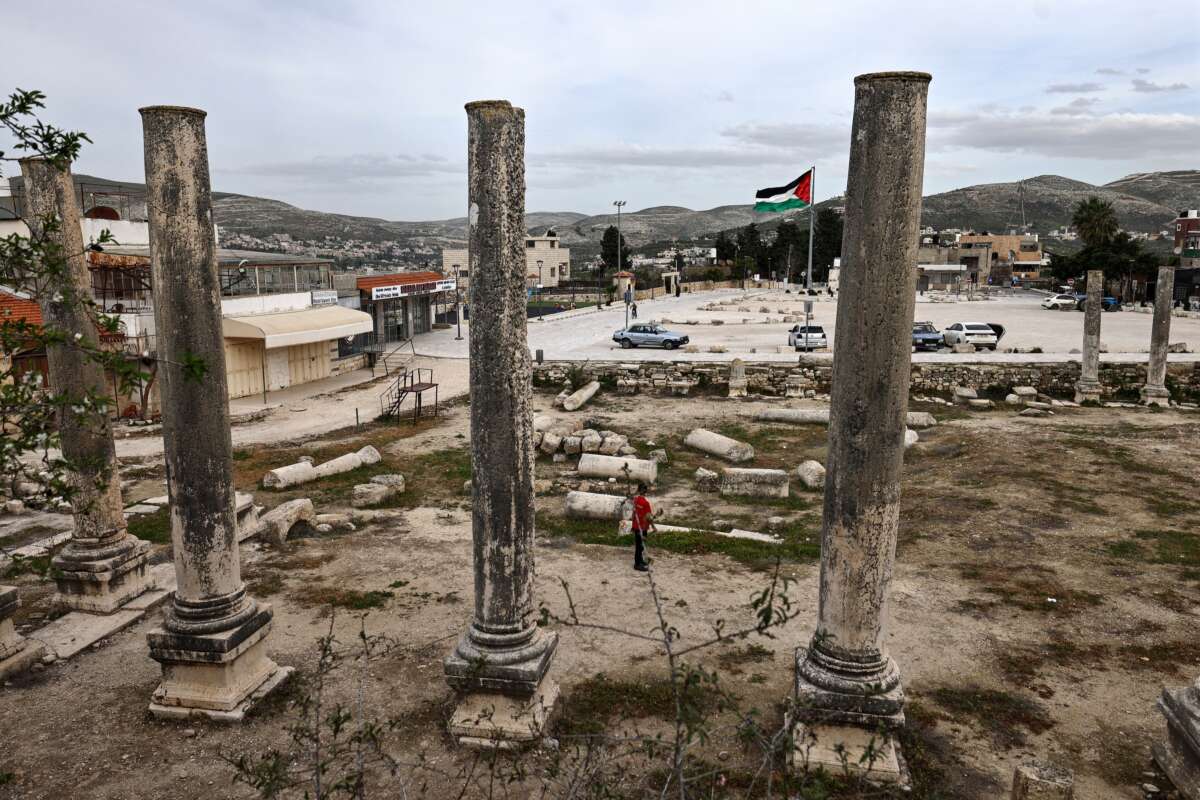
This picture taken on February 12, 2026, shows a view of the archaeological site of Sebastia, west of the occupied West Bank city of Nablus.
Zain JAAFAR / AFP via Getty Images
Ramallah — On February 8, the Cabinet of Israel approved a slew of changes to further undermine Palestinian self-rule in the West Bank.
While still awaiting final approval by the Knesset, the changes, according to a statement released by Finance Minister Bezalel Smotrich, “will continue to bury the idea of a Palestinian state.”
Under the Oslo Accords, Areas A and B of the West Bank — which together comprise 40 percent of the West Bank — fall under the control of the Palestinian Authority.
However, due to the new changes approved by the Cabinet of Israel this month, the Israeli Civil Administration, which is in charge of civil affairs in the Israeli-occupied West Bank, will now claim jurisdiction in Areas A and B under the guise of environmental and archaeological protection.
Archaeological preservation of Jewish heritage in the West Bank has long been used as a justification for the assertion of Israeli sovereignty and the expansion of Israeli settlements there, which are illegal under international law.
Palestinians Displaced in West Bank by Israeli Settlers Ask: Where Can We Go?
Settlers have destroyed homes in the West Bank, forcibly displacing Palestinians from nearly 50 Bedouin communities. By Theia Chatelle , Truthout August 9, 2025
The Cabinet decisions build on the 2023 antiquities bill, which created a body called the Israel Antiquities Authority that was given expanded legal authority to extend into parts of the West Bank, in order to assert responsibility for archaeological sites there. Now, Israeli politicians are seeking to establish a new Israeli body called the West Bank Heritage Authority, which would have even more invasive power, regulating vast swaths of Palestinian territory and representing another step toward de facto annexation.
The Tomb of the Patriarchs, located in Hebron, and the Palestinian city of Sebastia, which independent journalist Jasper Nathaniel has reported on as emblematic of Israel’s use of religiously significant sites to justify expulsion and land theft, are two sites that have been subject to varying degrees of Israeli control; under new legal frameworks, including the antiquities bill and Israeli Cabinet decisions, they are increasingly incorporated into Israeli-managed heritage development.
The slew of changes by the Israeli Cabinet also opened the Palestinian land registries, which document land claims across the West Bank. These registries had previously been kept confidential due to concerns that Israeli settlers and settlement organizations would use the information to assert fraudulent claims to Palestinian land.
“Everywhere here has heritage. It’s just an excuse to expand settlements and take Palestinian land.”
Allowing, for the first time, Israelis to purchase land directly from Palestinians in Areas A and B could open up the potential for the establishment of illegal Israeli settlements in the middle of Palestinian cities like Ramallah, which have served as the last strongholds of Palestinian self-rule in the West Bank.
Ubai Aboudi, the director of BISAN, a human rights organization based in Ramallah, told Truthout in an interview that the spate of Cabinet decisions is about continuing the farce of a legal regime enforced by the Israeli occupation in the West Bank that is meant to legitimize the settlement enterprise.
At face value, the changes might appear to be piecemeal and far from solidifying the path to legal annexation, as many headlines have proclaimed. But the changes, if nothing else, are just another step by the Israeli government to undermine Palestinian sovereignty in the West Bank.
While the Oslo agreements created the framework of Palestinian self-rule in the Israeli-occupied West Bank, the constant drumbeat of settlement expansion and Israeli military activity in the territory has shattered any hope of Palestinian self-rule in the short term, according to Shawan Jabarin, the director of Al-Haq, a Palestinian human rights organization that has frequently been targeted by Israeli authorities, who joined Truthout for an interview at the organization’s offices in Ramallah.
He emphasized that this “farce” of a legal regime serves Israel’s interests in that it justifies expansion and violations of international law beyond simply expelling Palestinians from their land.
“For example, when it comes to house demolitions, they demolish the home because you did not get a permit. ‘But you did not give it to me,’” Jabarin said.
On February 15, the Israeli Cabinet also announced, for the first time since 1967, that it would begin a process of registering Palestinian land in Area C, which is under the civil and military control of Israel. Under this new change, invalid property claims, to be decided by the Israeli Civil Administration, will lead to “vacant” land being claimed as Israeli state property.
Allowing the Israeli Civil Administration jurisdiction in Area A, which per the Oslo Accords should be under the full civil and military control of the Palestinian Authority, not only undermines the limited degree of Palestinian self-rule in its fragmented scattering of municipalities but also legally justifies the almost constant intervention by Israeli forces within Area A — which includes escorting Israeli settlers into religious sites such as Joseph’s Tomb in Nablus.
Jabarin said, “If you look at all of these things and put them together, you will see the complete picture: ‘We do not want Palestinians there. We do everything in our capacity in order to push them out and bring in settlers and replace the Palestinians with settlers.’”
For Aboudi, environmental and archaeological protection are simply a means to an end for Ministers Smotrich and Itamar Ben-Gvir to put into reality Israel’s Decisive Plan, which Smotrich published in 2017. It calls for a continual expansion of settlements and Jewish sovereignty in the West Bank, including the forcible expulsion of Palestinians.
“Everywhere here has heritage. It’s just an excuse to expand settlements and take Palestinian land,” Aboudi said.
The Israeli NGO Emek Shaveh, which advocates for access to religious sites for both Palestinians and Israelis, said in a statement, “Taken together, these developments constitute a fundamental turning point. Empowering an Israeli civilian authority to carry out enforcement measures, expropriations, and excavations deep inside Palestinian Authority Areas B and A effectively dismantles the framework established under the Oslo II Accords.”
At least 1,050 Palestinians, including at least 230 children, have been killed by Israeli forces in the West Bank between October 7, 2023, and January 27, 2026, according to a UNRWA situation report. Israeli forces on Feb. 17 invaded a village just south of Jenin, chasing local Palestinian journalists with a military vehicle.
The Palestinian Ministry of Foreign Affairs said in a statement, “The ministry stresses that these measures amount to de facto annexation of Palestinian land and directly contradict the declared position of U.S. President Donald Trump rejecting annexation and settlement expansion.”
Whether the Trump administration would put that relationship in jeopardy during what appears to be an increasingly likely conflict with Iran — as the U.S. reportedly shifts military assets into the Gulf — is unlikely.
At play is also a careful calculus on the part of the Israeli government to continue the project outlined by Smotrich, but without drawing the ire of the Trump administration, which has stated that it opposes Israel’s annexation of the West Bank.
But on the ground in Ramallah, many Palestinian residents who spoke with Truthout did not appear concerned about the Israeli cabinet decisions, with many stating that these changes do little to change the reality for most Palestinians.
The Palestinian economy is on the brink. Since October 7, 2023, Palestinians have been largely banned from working inside Israel, cutting out a significant source of income, with daily wages in the West Bank hovering at 125 shekels instead of 250 in Israel.
With the start of Ramadan on Tuesday, festivities are muted. Where there would typically be lights dangling from apartments in downtown Ramallah al-Tahta, this year, despite the ceasefire in Gaza, which one resident described as “in name only,” celebrations remain subdued.
These changes by the Israeli Cabinet are just another step that cements what Jabarin called “a complete war on Palestinian life on the West Bank meant to kill any hope for self-determination.”
This article is licensed under Creative Commons (CC BY-NC-ND 4.0), and you are free to share and republish under the terms of the license.

Theia Chatelle is a conflict correspondent based between Ramallah and New Haven. She has written for The Intercept, The Nation, The New Arab, etc. She is an alumnus of the International Women’s Media Foundation and the Rory Peck Trust.
CHRISTIAN ZIONISM
Trump's Israel ambassador ignites international firestorm with 'deranged' new remarks
Huckabee has appeared to endorse the idea of “Greater Israel” referring to the territorial aspirations of some Israelis to significantly expand the nation’s borders.
Alexander Willis
February 22, 2026
RAW STORY
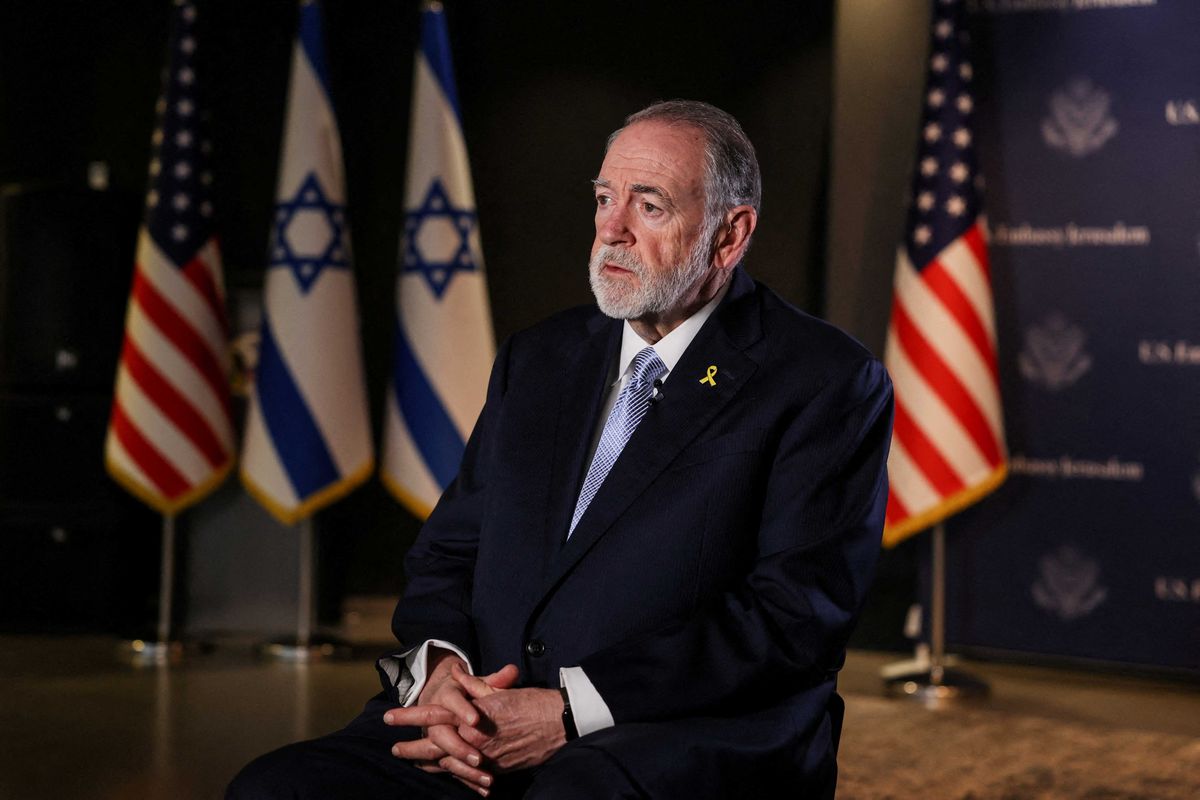
U.S. Ambassador to Israel Mike Huckabee looks on during an interview with Reuters in Jerusalem, September 10, 2025. REUTERS/Ronen Zvulun/File Photo
U.S. Ambassador to Israel Mike Huckabee ignited an international firestorm this weekend after appearing to endorse the idea of Israel taking control of the entire Middle East, remarks that prompted a swift response from more than a dozen Arab nations, including the United States’ own allies.
Huckabee sat down with conservative media figure Tucker Carlson recently for a lengthy interview that was published on Saturday, during which, Carlson pressed the former Arkansas governor on specifically what regions in the Middle East he believed Israel to be Biblically entitled to.
“Does Israel have the right to that land?” Carlson asked, making reference to what he described as “basically the entire Middle East,” including Jordan, Syria, Lebanon, and sizable portions of Saudi Arabia, Iraq and Jordan.
“It would be fine if they took it all,” Huckabee responded.
The comments drew an immediate backlash from more than a dozen Arab nations in the Middle East and North Africa, all of which signed onto a joint statement condemning the remarks as “extremist and lacking any sound basis,” NBC News reported Sunday.
Saudi Arabia, a U.S. ally, described Huckabee’s remarks as “extremist rhetoric,” and Egypt called them a “flagrant breach” of international law, NBC News reported.
Huckabee has appeared to endorse the idea of “Greater Israel” in the past, with “Greater Israel” referring to the territorial aspirations of some Israelis to significantly expand the nation’s borders. Israeli Prime Minister Benjamin Netanyahu – who was indicted by the International Criminal Court for war crimes last year – said as recently as last August that he “absolutely” subscribed to a “vision” for “Greater Israel.”“I don’t think we have fully [realized] how deranged the people driving US policy truly are,” wrote Bruno Macaes, an author, writer and geopolitical analyst, in a social media post on X Sunday in response to Huckabee’s remarks.
Battered by Gaza war, Israel’s tech sector in recovery mode
By AFP
February 20, 2026

US chip giant Nvidia said in December it would create a massive research and development centre in northern Israel - Copyright AFP Idrees MOHAMMED
Delphine MATTHIEUSSENT
Israel’s vital tech sector, dragged down by the war in Gaza, is showing early signs of recovery, buoyed by a surge in defence innovation and fresh investment momentum.
Cutting-edge technologies represent 17 percent of the country’s GDP, 11.5 percent of jobs and 57 percent of exports, according to the latest available data from the Israel Innovation Authority (IIA), published in September 2025.
But like the rest of the economy, the sector was not spared the knock-on effects of the war, which began in October 2023 and led to staffing shortages and skittishness from would-be backers.
Now, with a ceasefire largely holding in Gaza since October, Israel’s appeal is gradually returning, as illustrated in mid-December, when US chip giant Nvidia announced it would create a massive research and development centre in the north that could host up to 10,000 employees.
“Investors are coming to Israel nonstop,” Prime Minister Benjamin Netanyahu said at the time.
After the war, the recovery can’t come soon enough.
“High-tech companies had to overcome massive staffing cuts, because 15 to 20 percent of employees, and sometimes more, were called up” to the front as reservists, IIA director Dror Bin told AFP.
To make matters worse, in late 2023 and 2024, “air traffic, a crucial element of this globalised sector, was suspended, and foreign investors froze everything while waiting to see what would happen”, he added.
The war also sparked a brain drain in Israel.
Between October 2023 and July 2024, about 8,300 employees in advanced technologies left the country for a year or more, according to an IIA report published in April 2025.
The figure represents around 2.1 percent of the sector’s workforce.
The report did not specify how many employees left Israel to work for foreign companies versus Israeli firms based abroad, or how many have since returned to Israel.
– Rise in defence startups –
In 2023, the tech sector far outpaced GDP growth, increasing by 13.7 percent compared to 1.8 percent for GDP.
But the sector’s output stagnated in 2024 and 2025, according to IIA figures.
Industry professionals now believe the industry is turning a corner.
Israeli high-tech companies raised $15.6 billion in private funding in 2025, up from $12.2 billion in 2024, according to preliminary figures published in December by Startup Nation Central (SNC), a non-profit organisation that promotes Israeli innovation.
Deep tech — innovation based on major scientific or engineering advances such as artificial intelligence, biotech and quantum computing — returned in 2025 to its pre-2021 levels, according to the IIA.
The year 2021 is considered a historic peak for Israeli tech.
The past two years have also seen a surge in Israeli defence technologies, with the military engaged on several fronts from Lebanon and Syria to Iran, Yemen, Gaza and the occupied West Bank.
Between July 2024 and April 2025, the number of startups in the defence sector nearly doubled, from 160 to 312, according to SNC.
Of the more than 300 emerging companies collaborating with the research and development department of Israel’s defence ministry, “over 130 joined our operations during the war”, Director General Amir Baram said in December.
Until then, the ministry had primarily sourced from Israel’s large defence firms, said Menahem Landau, head of Caveret Ventures, a defence tech investment company.
But he said the war pushed the ministry “to accept products that were not necessarily fully finished and tested, coming from startups”.
“Defence-related technologies have replaced cybersecurity as the most in-demand high-tech sector,” the reserve lieutenant colonel explained.
“Not only in Israel but worldwide, due to the war between Russia and Ukraine and tensions with China”.

No comments:
Post a Comment