
Iran Signals Openness to Nuclear Deal as U.S. Military Pressure Mounts
- Iran and the United States are set to resume Omani-mediated nuclear negotiations in Geneva amid rising regional military tensions.
- The Trump administration has escalated pressure through naval deployments and warnings, while Tehran signals cautious openness to diplomacy.
- Growing anti-government protests at home and reports of a new arms deal with Russia add further complexity to Iran’s strategic position.
The Iranian government, facing pressure at home with a growing opposition and globally with threats of a US military strike, appears ready for a third round of Omani-mediated talks with American negotiators in the upcoming week.
Omani Foreign Minister Badr Albusaidi on February 22 said talks would resume on February 26 in Geneva "with a positive push to go the extra mile toward finalizing the deal" over Iran’s nuclear program.
In separate remarks, the Iranian government suggested talks in the Swiss city on that date. US officials did not immediately comment.
The US administration has been pressuring Iran to agree to curtail its nuclear program, which Tehran insists is intended for peaceful, civilian purposes, such as electricity generation. Washington, along with Israel and others in the West, has accused Tehran of intending to build atomic weapons.
Trump Warnings On Protests
US President Donald Trump has also warned Tehran against further violence against anti-government demonstrators and threatened military action against the regime.
Trump dispatched two aircraft carrier strike groups, with dozens of fighter jets and bombers to the region, and other military planes and supporting forces have been spotted flying into air bases in the Middle East.
In a speech broadcast live by state TV on February 21, Iranian President Masud Pezeshkian said his country would not give in to pressure from world powers.
"World powers are lining up to force us to bow our heads...but we will not bow our heads despite all the problems that they are creating for us," Pezeshkian said.
'Encouraging Signs'
However, in a social media post on February 22, Pezeshkian -- considered a relative moderate by many observers -- said previous talks had "yielded encouraging signals."
Tehran has said it was in the process of drafting a proposal for an agreement that would avert military action.
"I believe that when we meet, probably [February 26] in Geneva again, we can work on those elements and prepare a good text and come to a fast deal," Iranian Foreign Minister Abbas Araqchi told CBS-TV on February 22.
"If the US attacks us, then we have every right to defend ourselves," Araqchi said. Still, he added, "there is a good chance to have a diplomatic solution."
Trump 'Curious' About Iranian Stance
Meanwhile, US envoy Steve Witkoff said Trump has questioned why Tehran has not "capitulated" in the face of a massive buildup of the US military near Iran.
In a Fox News interview recorded on February 19 and broadcast on February 22, Witkoff said Trump was "curious" about Iran's position after he had issued warnings of a military attack should the country's leaders fail to agree to a new nuclear deal.
"I don't want to use the word 'frustrated,' because he understands he has plenty of alternatives, but he's curious as to why they haven't...I don't want to use the word 'capitulated,' but why they haven't capitulated," Witkoff said.
"Why, under this pressure, with the amount of sea power and naval power over there, why haven't they come to us and said, 'We profess we don't want a weapon, so here's what we're prepared to do'? And yet it's sort of hard to get them to that place."
Iran in 2015 agreed to a landmark nuclear deal, the Joint Comprehensive Plan of Action (JCPOA), with world powers aimed at preventing it from developing a nuclear weapon in return for an easing of economic sanctions.
However, it started rolling back its commitments after Trump, during his first term, withdrew the United States from the deal in 2018 and reimposed sanctions on Tehran
Massive Street Protests
At home, the Iranian government in recent months has seen a growing opposition. At least 7,000 people were killed during nationwide protests that erupted in late December 2025, according to human rights groups, although the real death toll is believed to be significantly higher.
Most of the killings reportedly occurred from January 8-10, the peak of the crackdown.
The latest protest erupted on February 22 outside the Amir Kabir University of Technology as students confronted soldiers from the Basij, a volunteer paramilitary force that has played a prominent role in quashing past political protests.
The students could be heard chanting anti-government slogans, according to the social media videos. Others could be seen waving the Iranian national flag.
Similar rallies were previously reported at five other universities across the country, including Tehran's Sharif University.
Universities in Tehran have often been the scene of student protests that have taken place since the 1979 revolution and resulted in brutal crackdowns by the security forces.
Iran-Russia Arms Deal Reported
Meanwhile, in a report that could further inflame tensions with the United States and the West, The Financial Times reported that Iran agreed to a secret $589 million arms deal ?with Russia ?to acquire thousands of advanced shoulder-fired missiles.
The report said the agreement was signed in Moscow in December and ?commits Russia to provide 500 soldier-portable Verba launch units and 2,500 9M336 missiles over three years.
The FT cited as its sources leaked Russian documents it had seen and several people familiar with the deal.
By RFE/RL
By AFP
February 22, 2026

Iran's governmnet is under pressure from both dmoestic protests and the threat of US military action - Copyright AFP Atta KENARE
Iranian students gathered for fresh pro- and anti-government rallies Sunday commemorating those killed in recent protests, as fears loomed of renewed conflict with the United States over the country’s nuclear programme.
The initial demonstrations were sparked in December by economic hardship in the sanctions-hit country, but quickly expanded into mass anti-government protests that marked one of the largest challenges to the Islamic republic’s clerical leadership in years.
US President Donald Trump had initially cheered on the protesters, threatening to intervene on their behalf as authorities launched a deadly crackdown, but his threats soon shifted to Iran’s nuclear programme, which the West believes is aimed at developing atomic weapons.
Washington and Tehran have since returned to the negotiating table, but Trump has simultaneously pursued a major military build-up in the Middle East aimed at pressuring Iran to cut a deal.
Following campus rallies commemorating the protest dead on Saturday, the Fars news agency on Sunday published videos of fresh crowds of dozens of people waving Iranian flags and carrying memorial photographs at universities in the capital Tehran.
One showed a rowdy gathering at Sharif University of Technology shouting “death to the shah” — a reference to the monarchy ousted by the 1979 Islamic revolution — as they faced off with another group, with men in uniforms between them.
Fars said there had been “tensions” at at least three universities in Tehran where some students chanted “anti-establishment” slogans.
Iran International, a media outlet based outside the country and branded a “terrorist” organisation by Tehran, shared a video on social media of students holding up the pre-revolution flag at Sharif University, as well as videos of rallies at other institutions of higher learning.
A video geolocated by AFP of what appeared to be the demonstration at Sharif University showed a large crowd chanting anti-government slogans as they thronged around students waving the flag of the toppled monarchy.
The authorities acknowledge more than 3,000 deaths in the unrest, including members of the security forces and bystanders, but say the violence was caused by “terrorist acts” fuelled by Iran’s enemies.
The US-based Human Rights Activists News Agency (HRANA), however, has recorded more than 7,000 killings in the crackdown, the vast majority protesters, though the toll may be far higher.
– Negotiations –
Representatives of the US and Iran recently met in Geneva for a second round of Oman-mediated nuclear talks, with Iran promising to send a draft proposal for a deal to avert military action in the coming days.
Axios reported on Sunday, citing an unnamed senior US official, that if Iran submitted its proposal in the next 48 hours, Washington was ready to meet again “in Geneva on Friday in order to start detailed negotiations to see if we can get a nuclear deal”.
The US has dispatched two aircraft carriers to the region, along with other jets and ships, and has also shored up its air defences in the Middle East.
Trump’s chief Middle East negotiator Steve Witkoff said Saturday in a Fox News interview that the president was questioning why Iran had not yet given in to US pressure.
“He’s curious as to why they haven’t… I don’t want to use the word ‘capitulated’, but why they haven’t capitulated,” he said.
“Why, under this pressure, with the amount of seapower and naval power over there, why haven’t they come to us and said, ‘We profess we don’t want a weapon, so here’s what we’re prepared to do’?”
Iran has long denied it is trying to produce nuclear weapons, but insists on its right to enrich uranium for civilian purposes.
– Fears of war –
A previous round of nuclear diplomacy last year was interrupted by Israel’s surprise bombing campaign against the Islamic republic.
That sparked a 12-day conflict in June that the US briefly joined with strikes on nuclear facilities
Iran has maintained that it will defend itself in the event of any new attack.
Despite the latest talks, Iranians’ fears of a new conflict have grown.
“I don’t sleep well at night even while taking pills,” Tehran resident Hamid told AFP, saying he worried for his “family’s health… my kids and grandchildren”.
IT technician Mina Ahmadvand, 46, believes that “at this stage, war between Iran and the US as well as Israel is inevitable and I’ve prepared myself for that eventuality”.
“I don’t want war to happen, but one should not fool around with the realities on the ground.”
The concerns have prompted several foreign countries to urge their citizens to leave Iran, including Sweden, Serbia, Poland and Australia, which warned “commercial flights are currently available but this could change quickly”.
Fears of renewed conflict haunt Tehran as US issues threats
By AFP
February 21, 2026

Fears of renewed conflict haunt Tehran, as the United States and Iran trade threats of military action, even as the arch-foes pursue fresh negotiations - Copyright AFP -
Tehran resident Hamid struggles to sleep as fears of renewed conflict haunt the Iranian capital after last year’s 12-day war with Israel.
“I don’t sleep well at night even while taking pills,” Hamid told AFP, as he expressed concern for his “family’s health… my kids and grandchildren”.
The city woke up to blasts overnight from June 12 to 13 last year as Iran’s arch-enemy Israel launched an unprecedented military campaign.
The war erupted as Iran was preparing for another round of talks with the United States, which briefly joined Israel in attacking key Iranian nuclear sites.
The attacks prompted Iran to respond with drone and missile strikes, with thousands of people killed in Iran and dozens in Israel.
Iran has now resumed talks with Washington, with Iran insisting they be limited to the nuclear issue, though Washington has previously pushed for Tehran’s ballistic missiles programme and support for armed groups in the region to be on the table.
Still, the outcome of diplomacy remains uncertain.
On Thursday, US President Donald Trump said that “bad things” would happen if Tehran did not strike a deal within 10 days, which he subsequently extended to 15.
In this atmosphere, Hamid is worried about his children and grandchildren.
“I’ve lived my life, but they haven’t done anything good in their lives, they had no fun, no comfort, no leisure and no peace,” he said.
“I want them to at least experience life for a bit. But I’m afraid they might not get the chance.”
Others share his concerns.
Hanieh, a ceramist from Tehran, thinks war will occur “within 10 days”.
The 31-year-old has stored some essentials at her home to get through a possible military attack by the United States after its build-up in the region.
“I am getting more scared because my mother and I had lots of difficulties during the past 12-day war,” she told AFP. “We had to go to another city.”
Mina Ahmadvand, 46, also believes another conflict is in store.
“I think at this stage, war between Iran and the US as well as Israel is inevitable and I’ve prepared myself for that eventuality,” the IT technician told AFP.
“I bought a dozen canned foods including tuna fish and beans as well as packs of biscuits, bottled water and some extra batteries, among other things.”
– ‘Lessons learnt’ –
Iranians are applying “the lessons learnt during the 12-day war”, Hanieh said, as windows taped up with duct tape can be seen across Tehran.
Supreme leader Ayatollah Ali Khamenei has warned that any military campaign against Iran would lead to a “regional war”.
Tehran has repeatedly said it would target Israel and US bases in the region, as when it attacked a US base in Qatar during the 12-day war.
The situation has forced Iranians to follow the news closely, and only adds to anxiety over surging prices and the plunging national currency following widespread protests.
On Saturday, the euro was trading at above 1.9 million rials while the US dollar surpassed the 1.6 million mark.
For Hanieh, there has been a sense of “life on hold” since the mass protests and Iranian communications shutdown that lasted nearly three weeks.
But in Tehran, shops and offices remain open, even though cafes and restaurants are mostly closed for the month of Ramadan, which started on Thursday in Shiite Iran.
Meanwhile, Ahmadvand is preparing for the worst.
“I don’t want war to happen, but one should not fool around with the realities on the ground.”
As Trump Threatens Iran, We’re On the Brink of a Generational Catastrophe
A US war with Iran would be illegal, immoral,
By Negin Owliaei , TruthoutPublishedFebruary 20, 2026
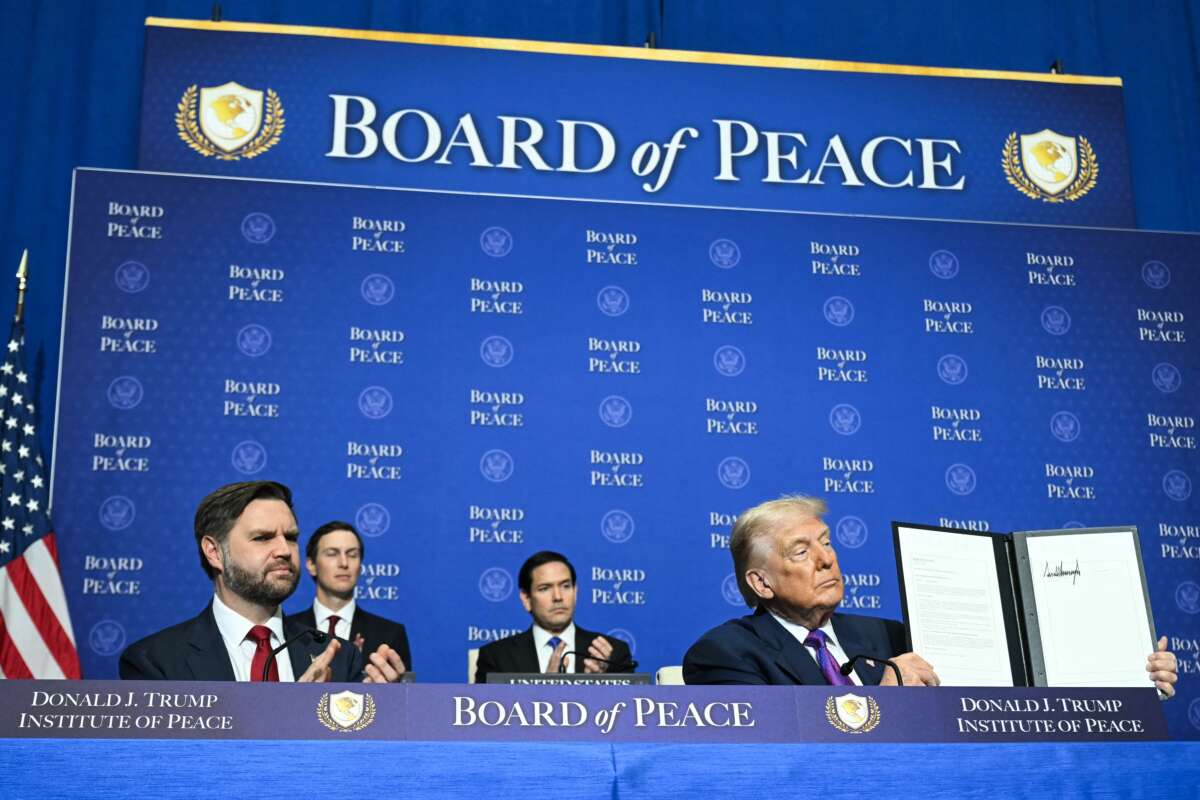
Wielding a golden gavel and a playlist featuring the Beach Boys, Donald Trump ushered in a new era of international humiliation at the inaugural meeting of the U.S.-led Board of Peace. The new body, while established by Trump, has been tasked by a UN Security Council resolution to administer Gaza’s reconstruction efforts. But Trump has also suggested his ambitions for the board go far beyond Gaza, saying it would “almost be looking over the United Nations and making sure it runs properly.”
Trump has demanded that world leaders pony up $1 billion for a permanent seat on the ostensible peacekeeping body, even as he defunds the actual peacekeeping mission of the United Nations, which he has suggested his new institution will supplant. Altogether, the February 19 inaugural meeting was a perfect distillation of Trump’s preferred method of extortion masked as diplomacy.
As soon as the Board of Peace was created, Palestinians and solidarity activists decried it as a farce and as a naked display of imperial ambition; the entire reason for its existence is to fully sidestep Palestinian autonomy in the rebuilding of Gaza. But any lingering doubts about the president’s lack of interest in peace were fully wiped away by his multiple references to bombing Iran during the Board of Peace’s first meeting, which took place in the newly branded Donald J. Trump Institute of Peace.
“Bad things will happen,” Trump said, if Iran does not submit to U.S. negotiations on a nebulous deal.
Meanwhile Trump has initiated a huge military buildup near Iran including multiple aircraft carriers and warships. The buildup is so massive it has drawn parallels to the buildup preceding the U.S. invasion of Iraq in 2003.
The buildup comes on the heels of the U.S.’s June 2025 aggression against Iran, when the U.S. bombed multiple Iranian nuclear sites during negotiations over the same nuclear program that the U.S. claims to be negotiating over today. That attack came during Israel’s 12-day war with Iran, which was conducted with U.S. arms and logistical support and funded with the help of U.S. taxpayers. During that war, more than 1,000 Iranians were killed. Trump has now said that Iran has “10 to 15 days” to make a deal. Following the charade of last year’s negotiations, analysts expect a U.S. attack on Iran to now come at any moment. New reporting has suggested that U.S. strikes could even target individual Iranian leaders, with the aim of bringing about regime change in the country.
New reporting has suggested that U.S. strikes could target individual Iranian leaders, with the aim of bringing about regime change in the country.
A war between the U.S. and Iran would be undeniably disastrous. U.S. allies across the region have spent weeks urging restraint. Even the U.K., in an uncharacteristically defiant move, has reportedly told Trump it would not allow the U.S. military to use Diego Garcia, the Indian Ocean island that the two countries ethnically cleansed in order to build a military base, to bomb Iran, for fear of violating international law.
The majority of people in the U.S. are also against such an attack. Multiple U.S. polls from recent weeks have shown broad resistance to the use of military force in Iran, and a strong desire for Trump to seek congressional approval before launching an attack against another country.
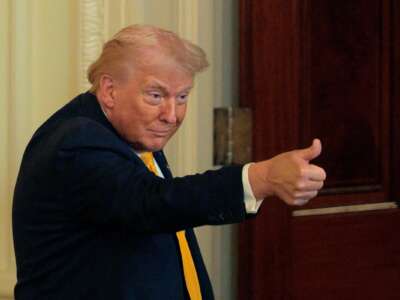
Trump Admin Contradicts Itself on Rationale for Potential Iran Strikes
The White House cites Iran’s nuclear capabilities — while maintaining their nuclear facilities were “obliterated.” By Sharon Zhang , Truthout February 20, 2026
So how did we arrive in this position, where, despite widespread domestic and international opposition, Trump’s murderous impulses are treated as inevitable? Over and over, pundits have framed this as a war that the U.S. is falling into, or one that it is sleepwalking toward. But there is not some gravitational force pulling the U.S. and Iran toward major military catastrophe. This is a war of choice by the U.S., and we must remember that it could be stopped in an instant.
This is a war of choice by the U.S., and we must remember that it could be stopped in an instant.
We’ve been on a slow march toward this outcome, both over the decades that the powers that be in the U.S. and Israel have worked to manufacture consent for military action against Iran, and more deeply since they broke the dam on such an attack last June. There has been no accountability for that illegal attack, just as there has been no accountability for the U.S. kidnapping of Venezuelan President Nicolas Maduro — neither move was met with articles of impeachment for Trump nor for the cabinet members who orchestrated the attack. And there has been no accountability for the U.S.’s backing of Israel’s genocide in Gaza, even when some of those backers acknowledge themselves that U.S. support for the Israeli military went against domestic law.
And even before these last years, there has been no real accountability for the invasion of Iraq, to which a war with Iran has long been compared. Many of the architects of that war have proceeded to build storied careers in government and media without seeing so much as a single consequence for their devastating actions. In a grim twist of irony, even former Bush speechwriter David Frum — the same man who labeled Iran a member of the “axis of evil” — is now wringing his hands about the lack of consent from Congress or the U.S. public for a regime change war in the Middle East, writing: “We are poised days away from a major regime-change war in the Middle East, and not only has Congress not been consulted, but probably not 1 American in 10 has any idea that such a war is imminent.”
Trump is getting away with this because, for decades, we have let warmongers unleash their worst with little to no repercussions. But when it comes to Congress, part of the lack of opposition is because, at some level, there actually is a lack of opposition: Coercing other countries, especially Iran, has long been a bipartisan pastime.
During the Obama administration, Senate Minority Leader Chuck Schumer (D-New York) bucked his own party to come out against the landmark nuclear deal with Iran, which is widely considered to have been one of the most successful tools keeping escalations like this from happening. After Trump’s prior attack against Iran in June, Schumer hit him from the right, accusing the president of folding too early and letting Iran “get away with everything.” Meanwhile, House Minority Leader Hakeem Jeffries (D-New York) has been largely silent about Trump’s saber-rattling, save for a singular reference to Congress’s authority to declare war.
House Minority Leader Hakeem Jeffries has been largely silent about Trump’s saber-rattling, save for a singular reference to Congress’s authority to declare war.
While some lawmakers have been more vocal in their opposition to Trump’s buildup, the only halfway meaningful response from Congress to the Trump administration has come from Reps. Ro Khanna (D-California) and Thomas Massie (R-Kentucky), who are moving to force a war powers vote next week, to bring Congress on the record about whether Trump should be forced to terminate his military plans against Iran. But while these kinds of votes are necessary — anything that could potentially stop such a disaster is necessary — real opposition to Trump’s warmaking would require more than these process-oriented critiques.
A war with Iran is wrong because it’s morally wrong — not only because it’s illegal under the Constitution, or under international law. Laws can be useful tools for stopping military action — indeed, it appears the U.K.’s concerns about running afoul of international law could in fact materially affect Trump’s plans for military action. But we must be honest about the limitations of such laws as we hear the drumbeats for war, illegal or not, grow louder. We need real, principled opposition that will put fear of accountability into the hearts of the architects and defenders of this aggression, whether that comes from the streets or the ballot box or legal avenues or the halls of Congress.
Inherent in some of the critiques of Trump’s buildup is the idea that a war with Iran could be conducted a “right” way — with congressional permission, with actual strategic objectives, or as a more limited air war compared to a 2003-style invasion with boots on the ground. But there is no right way to conduct this war; no matter what happens, no matter who approves it, it will be deadly and dangerous and lead to further terror across the entirety of the region.
There is no right way to conduct this war; no matter what happens, no matter who approves it, it will be deadly and dangerous and lead to further terror across the entirety of the region.
This escalation also comes at an especially brutal time for Iranian civilians, who faced a marked increase in state repression in response to anti-government protests earlier this year. As U.S. airpower moved into place, Iranians were observing traditional 40-day mourning ceremonies for the thousands of people killed in the violent crackdown on protesters. The grief has been heavy to bear. And as Hanieh Jodat wrote in Truthout last month, the back-and-forth threats from the United States have added a burden of psychological warfare to those of us with ties to Iran — we were already struggling to reach loved ones in our homeland due to the state-imposed communications shutdown there.
While some in the diaspora have cheered on an invasion out of rage toward the Iranian state, those of us who study history know there is no such thing as bombing a country into liberation, especially not at the hands of the same people who have spent years backing genocide in Palestine. As it did last year, the Iranian state will use the instability and fear of a war to further crack down on labor, student, and feminist movements pushing for liberatory change within the country. A war would only inflict further trauma on a population onto which a desperate amount of violence and repression has been forced in under a year.
Back in July, after Israel’s assault on Iran, a video emerged that put to rest the already laughable idea that Israel’s “precision attacks” were targeting Iranian military sites, as if that would have made a war of choice more defensible. The video shows a densely populated street in Tehran’s Tajrish district. Two missiles strike in quick succession, one hitting a building and another hitting the city street, forcefully pushing cars into the air. The video is dramatic and heartbreaking, especially because it features a popular area that anyone familiar with Tehran likely knows well. Iranian authorities said that 17 people were killed in the strike, including two children and one pregnant person.
That is what war looks like. That is what the U.S. could impose on Iran yet again if we do not act to stop it. And the consequences this time around could be far more wide-ranging and disastrous for everyone involved.
This article is licensed under Creative Commons (CC BY-NC-ND 4.0), and you are free to share and republish under the terms of the license.

Negin Owliaei is Truthout‘s editor-in-chief. An award-winning journalist, she previously worked at Al Jazeera‘s flagship daily news podcast, The Take. She lives in Washington, D.C.

No comments:
Post a Comment