Tuesday, March 03, 2026

NOT THAT URGENT

US Congress to debate Trump’s war powers

A vote in the Senate on Kaine’s bill is expected this week, as is a possible vote in the House on the other bill to curb Trump.

By AFP
March 2, 2026


The US Congress, seen here, is the only body in America which can declare war - Copyright AFP Alex WROBLEWSKI
Robin LEGRAND

The US Congress is scheduled to vote this week on motions seeking to curb President Donald Trump as he wages war against Iran but the Republican majority will probably shield him.

Trump has sought to expand executive power dramatically since returning to the White House in 2025, overshadowing the legislature. So some lawmakers now want to reassert the role of Congress, which under the US constitution is the only body that can declare war.

“Trump has launched an unnecessary, idiotic, and illegal war against Iran,” Senator Tim Kaine wrote on X shortly after the United States and Israel began it overnight Friday into Saturday.

In late January, as a huge US military buildup in the Middle East rumbled on, Kaine introduced a bill designed to force Trump to obtain authorization from Congress to engage in any military conflict with Iran. On Saturday he urged Congress to return immediately from recess to vote on his resolution.

In an opinion piece published Sunday in The Wall Street Journal, Kaine said that as a member of key legislative committees with access to classified information, “I can state plainly that there was no imminent threat from Iran to America sufficient to warrant committing our sons and daughters to another war in the Middle East.”


– Is the war legal? –


This issue of whether there was an imminent threat from Iran is at the heart of the debate over the war that Trump has now begun with Israel.

Although only Congress can declare war, a law dating back to 1973 allows the president to launch a limited military intervention in response to an emergency situation created by an attack on the United States.

At a news conference Monday, Pentagon chief Pete Hegseth used the word “war” to describe the conflict with Iran, not just a limited military intervention.

In a video broadcast in the middle of the night from Friday into Saturday to announce the start of major combat operations, Trump asserted that Iran posed an “imminent” threat to the United States.

Daniel Shapiro, an analyst with the Atlantic Council, a think tank in Washington, said Trump failed to explain “the urgency or the imminent threat that required a war now.”

“Typically, before launching such major operations, presidents and their senior advisers have explained to the American people the reason major military operations are required, and the strategic objective they are intended to achieve,” Shapiro wrote.

“They also customarily brief Congress, so the people’s representatives can express their view,” Shapiro wrote.

But Trump did not do any of this, he said, except for a briefing with eight congressional leaders a few days before the bombs started falling on Iran.


– Sixty days –


The White House said Sunday that right before the attack started it gave these same eight leaders formal notice of hostilities.

The 1973 War Powers Act states that Trump must now obtain permission from Congress if he wants to keep fighting beyond a 60-day time limit.

Republican congressman Thomas Massie, one of few in Trump’s camp that speaks out regularly to challenge him, condemned the Iran war on Saturday.

This conservative lawmaker said he would present a bill in the House of Representatives along with Democratic colleague Ro Khanna to force a vote by Congress on the war with Iran.

“The Constitution requires a vote, and your Representative needs to be on record as opposing or supporting this war,” Massie wrote on X.

A vote in the Senate on Kaine’s bill is expected this week, as is a possible vote in the House on the other bill to curb Trump.

But most Republicans, who are against tying Trump’s hands, are expected to vote against these bills.

And even if they pass, they would probably not survive a veto by Trump because overriding him requires a two-thirds majority in both chambers.
WHO IS THE REAL PUPPETMASTER

Rubio says Israel’s strike plan triggered US attack on Iran


By AFP
March 2, 2026


US Secretary of State Marco Rubio addresses the press before briefing House and Senate leaders on US military action in Iran - Copyright AFP Brendan SMIALOWSKI

The United States attacked Iran only after learning that ally Israel was going to strike and fearing Tehran would retaliate against US forces, Secretary of State Marco Rubio said Monday.

“We knew that there was going to be an Israeli action. We knew that that would precipitate an attack against American forces, and we knew that if we didn’t preemptively go after them before they launched those attacks, we would suffer higher casualties,” Rubio told reporters.

Rubio, who was preparing to brief key US lawmakers, said that Iran had told field commanders to respond automatically against US forces if there was an attack.

“If we stood and waited for that attack to come first before we hit them, we would suffer much higher casualties. And so the president made the very wise decision” to hit alongside Israel, Rubio said.

Asked if the United States faced an imminent threat from Iran — a key threshold in the United States as Congress constitutionally has the power to declare war — Rubio again pointed to the Israeli plans.

“There absolutely was an imminent threat, and the imminent threat was that we knew that if Iran was attacked — and we believed they would be attacked — that they would immediately come after us,” Rubio said.

“We were not going to sit there and absorb a blow,” Rubio said, adding that if Iran hit US forces first, “we would all be here answering questions about why we knew that and didn’t act.”

Defense Secretary Pete Hegseth earlier said that it was Israel that carried out the strike Saturday in Tehran that killed Iran’s supreme leader, Ayatollah Ali Khamenei, and other key officials, after intelligence emerged that they were meeting.

Rubio, however, said that President Donald Trump’s administration believed in the need to strike Iran, regardless of how the timing was triggered.

“No matter what, ultimately this operation needed to happen,” Rubio said.

Rubio said that the United States would like to see the overthrow of the Iran’s clerical state but that that was not the goal.

“We hope that the Iranian people can overthrow this government and establish a new future for that country. We would love for that to be possible,” Rubio said.

“But the objective of this mission is the destruction of their ballistic missile capabilities and of their naval capabilities.”
Trump denounces UK, Spain over Iran stance


By AFP
March 3, 2026


Oil prices surged and stocks sank after US and Israeli forces began striking Iran at the weekend - Copyright US NAVY/US CENTRAL COMMAND/AFP -

US President Donald Trump on Tuesday lashed out at Britain and Spain for not fully backing his attack on Iran, as he threatened to end “all trade” with Spain.

“I’m not happy with the UK,” Trump said, as he said of British Prime Minister Keir Starmer: “This is not Winston Churchill that we’re dealing with.”

Britain, a steadfast ally of the United States throughout the two world wars and in the Iraq and Afghanistan wars, decided not to join the assault on Iran that Trump launched with Israel on Saturday.

Starmer said that US fighter jets could use two UK air bases for a “specific and limited defensive purpose” — one in Gloucestershire in western England and the other at the joint UK-US Diego Garcia base in the Indian Ocean.

Starmer said that the United States was not authorized to use UK bases in Cyprus, one of which was struck by an Iranian-made drone.

“It’s taken three, four days for us to work out where we can land. There would have been much more convenient landing there, as opposed to flying many extra hours,” Trump said in apparent reference to Diego Garcia.

Trump, after a series of flip-flops, has criticized Starmer for agreeing to return the Chagos Islands, where Diego Garcia lies and whose people were expelled by Britain, to Mauritius and instead to lease the base.

“I will say the UK has been very, very uncooperative with that stupid island that they have,” said Trump, who was speaking next to German Chancellor Friedrich Merz at the White House.


US President Donald Trump criticized the UK and Spain during an Oval Office meeting with German Chancellor Friedrich Merz – Copyright AFP ANDREW CABALLERO-REYNOLDS

Trump voiced fury at Spain, where the left-wing government of Prime Minister Pedro Sanchez has not allowed the United States to attack Iran through bases long used by US forces.

“Spain has been terrible,” Trump said, adding that he has asked Treasury Secretary Scott Bessent to “cut off all dealings with Spain.”

He also pointed to Sanchez’s public refusal to join NATO allies in a pledge to boost defense spending to five percent of GDP, a level pushed by Trump which says the United States bears too much of a burden.

“So we’re going to cut off all trade with Spain. We don’t want anything to do with Spain.”

It remains unclear what power Trump would have to “end” trade with Spain, after the Supreme Court struck down his use of emergency powers to slap arbitrary tariffs on other countries.

Spanish Foreign Minister Jose Manuel Albares earlier said that his government would only allow the use of the Naval Base Rota and Moron Air Base for activities consistent with the United Nations Charter.


Trump says US-UK relationship ‘not like it used to be’


By AFP
March 3, 2026


The Union Jack flag in Whitehall, central London. — © AFP

US President Donald Trump said the historical relationship between his country and Britain was “not like it used to be,” in an interview to British daily newspaper The Sun, amid a major transatlantic fall out over US-Israeli strikes against Iran.

“This was the most solid relationship of all. And now we have very strong relationships with other countries in Europe,” he said, singling out France and Germany, after UK Prime Minister Keir Starmer’s initial refusal to allow the United States to use British military bases in its war with Iran.

Trump said Starmer “has not been helpful,” adding: “I never thought I’d see that. I never thought I’d see that from the UK. We love the UK.”

In a telephone interview from the White House on Monday evening, Trump said: “This was the most solid relationship of all. And now we have very strong relationships with other countries in Europe.”

“It’s a different world, actually. It’s just a much different kind of relationship that we’ve had with your country before.

“It’s very sad to see that the relationship is obviously not what it was,” he added.

The scathing comments come a day after Trump described Starmer’s reaction as “very disappointing” in an interview with The Daily Telegraph.

He added that Starmer’s later decision to allow the use of UK bases on specific grounds as “useful” but said it “took far too much time”.

Any potential military action in the Middle East is politically sensitive in the UK following former prime minister Tony Blair’s disastrous support for the US-led invasion of Iraq.

– ‘National interest’ –

Starmer defended his position to parliament on Monday.


“President Trump has expressed his disagreement with our decision not to get involved in the initial strikes, but it is my duty to judge what is in Britain’s national interest,” he told lawmakers.

“That is what I have done and I stand by it,” he added.


After initially refusing to have any role in the strikes, Starmer on Sunday announced that he had agreed to a US request to use British military bases for a “specific and limited defensive purpose”.

His Downing Street office said Starmer took the decision after Iran fired missiles over the weekend that put British interests and people “at risk”.

“We all remember the mistakes of Iraq, and we have learnt those lessons. Any UK actions must always have a lawful basis and a viable thought-through plan,” he added in parliament.


Trump said Starmer ‘had not been helpful’ – Copyright NOTICIAS ARGENTINAS/AFP STR

The prime minister also said that British military bases in Cyprus “are not being used by US bombers” during the US-Israeli war with Iran.

Britain’s Akrotiri air force base on Cyprus came under attack by an unmanned Iranian drone that hit the base’s runway early on Monday.

Starmer said the strike “was not in response to any decision that we have taken,” adding that the British government believed the drone “was launched prior to our announcement”.

Iran’s approach is becoming “more reckless and more dangerous”, Starmer said.

“They are working ruthlessly and deliberately through a plan to strike, not only military targets, but also economic targets in the region, with no regard for civilian casualties. That is the situation we face today and to which we must respond,” he added.
‘Thank you, madam president’: Melania Trump leads UN Security Council as Iran war rages


By AFP
March 2, 2026


US Ambassador to the United Nations Mike Waltz and US First Lady Melania Trump - Copyright AFP CHARLY TRIBALLEAU


Gregory WALTON

First Lady Melania Trump pressed the cause of children caught in conflict as she chaired a UN Security Council meeting on Monday as the US-Israeli war against Iran raged.

Ambassadors from all of the Security Council’s members, including Washington’s rivals Russia and China, lined up to meet with Trump, representing the US as it takes over the monthly rotating presidency of the Security Council.

She opened the meeting with a strike of a ceremonial gavel before thanking Britain for its month-long presidency, and spoke again later apparently to honor US service members killed in the war on Iran.

“To the families who have lost their heroes who sacrifice their lives for freedom, their bravery and dedication will always be remembered,” she said before the packed chamber.

“Enduring peace will be achieved when knowledge and understanding are fully valued within all our societies,” she added. “Societies ruled by knowledge and wisdom are therefore more peaceful.”

Ahead of the meeting, Iran’s ambassador to the UN Amir Saeid Iravani said “it is deeply shameful and hypocritical that on the very first day of its presidency of the Security Council, the United States convened a high-level meeting on protecting children.”

Moments later the First Lady said “the US stands with all of the children throughout the world. I hope soon peace will be yours” — without referring directly to the attacks across the Middle East.

She was warmly received by the countries represented in the Council however, with Greece’s ambassador Aglaia Balta saying “thank you madam president,” while France’s envoy compared her to the celebrated former first lady and activist Eleanor Roosevelt.

– Financial, political tensions –

Stephane Dujarric, spokesperson for the UN secretary-general, confirmed that Melania Trump’s appearance was the first time a first lady — or first gentleman — has presided a Security Council meeting.

The United States holds the Council’s rotating presidency for March.

President Donald Trump’s third wife has dabbled in diplomacy before, notably working to try to secure the release of Ukrainian children abducted by Russia.

Rosemary DiCarlo, the UN Under-Secretary-General for Political and Peacebuilding Affairs, paid tribute to her “for her work to give visibility to the issue of children in conflict, and particularly for her personal engagement to reunite Ukrainian children with their families.”

Political and financial tensions have mounted between the United States and the United Nations in recent years, with Washington chafing at its role as the main contributor to the body’s cash-strapped budget.

Many observers say the US president intends to bypass the Security Council with his new “Board of Peace,” which held its inaugural session in Washington last month, with several countries pledging funds and personnel to rebuild Gaza.

At the meeting, Trump repeated his stance that the UN had failed in its mission.

Since returning to the White House last year, he has withdrawn support from several major UN agencies, including the World Health Organization.

The world body has recently launched a reform program, and a few days ago Washington paid $160 million into the organization’s regular budget — after paying nothing in 2025.

But the United States is still $4 billion in arrears to the UN for its regular budget and its peacekeeping budget, with UN Secretary-General Antonio Guterres warning of imminent financial collapse.

Iran war threatens Trump fight with inflation


By AFP
March 3, 2026


Economists expect US gas prices to rise following attacks on Iran and Tehran's retaliation - Copyright AFP Frederic J. BROWN


Beiyi SEOW

US-Israeli strikes in Iran, and Tehran’s retaliation, are set to trigger a surge in US gas prices with a potential knock-on inflationary hit that could pile pressure on President Donald Trump domestically as midterm elections approach.

Economists warn that costs at the gas pump — a politically sensitive issue — could jump in just days, while inflation risks would make the Federal Reserve more cautious of cutting interest rates.

The conflict started with strikes over the weekend that killed the Iranian supreme leader, and oil prices have soared as the war disrupted supplies.

The crucial Strait of Hormuz, through which 20 percent of global oil transits, has been effectively closed and energy infrastructure across the Middle East hit.

“Prices at the pump are likely to rise within days,” Oxford Economics lead analyst John Canavan told AFP.

Gas prices have been “slowly but steadily increasing since early January,” he said, adding that “retailers are typically quick to respond to any developments pushing prices higher.”

Already, the price of Brent crude has momentarily jumped to its highest level since July 2024.

Additional costs will stretch US households, threatening consumer spending which makes up two-thirds of US GDP, analysts say.

– ‘Pain point’ –

As steeper prices filter through the economy, this could mean higher fares on airlines and other modes of transport, alongside elevated logistic costs, said economist James Knightley of ING.

Even if the United States is self-sufficient in natural gas, these costs still take their cue from global markets. This means higher international prices could also push up electricity costs.

“This is undoubtedly going to be a pain point for the US economy,” Knightley said.

The US energy sector might get a boost but that could be offset by a hit to consumer confidence that is already weak from tariff and job security worries.

“If you’ve suddenly got to spend a whole lot more filling up your gas tank and paying more for your utility bills, that’s only going to intensify the pressure on consumer finances,” he said.

All of this could weigh on US economic growth if the war lasts for more than a couple of weeks, he added.

The Trump administration is likely wary and will try to mitigate energy price hikes, Nationwide chief economist Kathy Bostjancic told AFP.

“They know affordability is an issue for many households,” she said. “They’re very aware and would be sensitive that higher gasoline prices would negatively impact consumer confidence and sentiment.”

“That could show up in the voting booth in November,” she added.

– Fed caution –

For the US central bank, the risk of higher inflation and the chance of weakening growth and employment pull policymakers in different directions.

While the Fed would be inclined to keep interest rates elevated to rein in inflation, a deteriorating economy could trigger the need for cuts.

“We’ll have to wait and see,” New York Fed President John Williams told reporters Tuesday.

While the conflict affects prices, he said: “We’ll have to see how persistent this is and how long this is.”

Higher rates in the meantime would mean elevated borrowing costs, sustaining the pressure that firms and consumers face.

Bostjancic expects that if the rise in oil prices is largely contained and reverses soon, the Fed would have reason and room to cut rates still.

“We haven’t changed our baseline forecast yet,” she added. She expects two rate cuts in 2026, starting mid-year.

Inflation risks could make rate cuts “a difficult sell” for the Fed for now, said ING’s Knightley.

The bank has to “optimize policy for two very different goals” of low inflation and maximum employment, he added.

“I still think there is a case for rate cuts, but the near-term inflation dynamics mean that it’s more likely to be delayed,” he said.

Mideast war exposes fragile oil, gas dependency


By AFP
March 3, 2026


Image: © Saudi Aramco/AFP JOE LYNCH


Ali BEKHTAOUI

As in 2022 when Russia invaded Ukraine, the new war in the Middle East is exposing once again how far Europe and others lag in replacing imported fossil fuels with domestic solar and wind power, specialists say.

The Russian invasion in 2022 triggered a massive energy crisis, particularly in Europe, where gas prices — then largely dependent on imports from Russia — soared.

Four years later, the continent is instead importing liquid natural gas (LNG) in large volumes, notably from Qatar — one of the countries caught up in Iran’s retaliation against US and Israeli attacks.

Europe also remains dependent on oil from the Middle East, where ships have been blocked and sometimes targeted by Iranian strikes.

Regarding its energy security, “Europe is facing the biggest wake‑up call since the invasion in Ukraine”, said Ana Maria Jaller‑Makarewicz, analyst for the Institute for Energy Economics and Financial Analysis (IEEFA).

For Jan Rosenow, professor of energy and climate policy at the University of Oxford, the latest conflict prompted a sense of “deja vu”, recalling 2022.

“What this shows is that we haven’t really learned the lessons that we should have learned from that experience. When you look at the dependency rate of Europe on oil and gas — it hasn’t really gone down.”

– Energy transition –

Despite countries’ pledging to reduce their burning of planet-warming fossil fuels, Europe remains dependent on them for more than two-thirds of its energy consumption — primarily for vehicles, heating and industry — according to the International Energy Agency.

Only electricity generation has clearly decarbonised in recent years. Fossil fuels produced just 29 percent of the European Union’s electricity last year, according to research group Ember.

Across Europe, political appetite for further investment in renewable energy for the wider economy has faded.

Countries are far short of global targets for shifting away from fossil fuels despite pledges under the 2015 Paris climate agreement, with some countries — notably the United States — even rolling back commitments.

The new war meanwhile drove up oil prices by about seven percent on Monday, while European gas prices skyrocketed by more than 30 percent.

For climate leaders, this highlights the need to get the transition back on track.

“The global transition is still too slow,” United Nations climate chief Simon Stiell warned on LinkedIn.

Renewables, he wrote, are now “the obvious pathway to energy security and sovereignty”.

– Fossil fuel reliance –

Even if gas dependency has shifted from Russia to suppliers such as the United States, the fresh unrest exposes Europe’s “continued reliance on imported fossil fuels traded on volatile global markets”, said Simone Tagliapietra, a researcher at European think tank Bruegel.

“Rather than slowing down the low-carbon transition, the new tensions show that the deployment of clean, domestically produced energy sources should be accelerated,” he said.

“Only by reducing structural dependence on oil and LNG imports can Europe durably shield its economy from recurrent external shocks.”

Between 10 and 15 percent of Europe’s gas imports come from Qatar.

European gas prices jumped after QatarEnergy, the state‑owned energy company, announced a halt in LNG production following an Iranian drone attack.

“Historically, fossil fuels were promised to deliver… some form of freedom, some form of democracy, some form of growth, and above all, some form of security,” said Pauline Heinrichs, a climate diplomacy specialist at King’s College London.

“I think this illegal and unnecessary war is both a reminder that this is obviously false and, second, that this is, at least in security terms, an illusion.”


Will US oil companies be the big winners from the Iran war?

By AFP
March 3, 2026


Image: — © AFP/File Hussein FALEH


John BIERS

Energy prices have surged dramatically since the United States and Israel launched their attack on Iran Saturday, and that will almost certainly translate into bigger profits.

But the question remains whether the new war in the Middle East also leads to increased oilfield investment.


– What does the Middle East war mean for US oil industry profits? –


Geopolitical crises lift oil industry profits if a supply disruption causes commodity prices to spike. That’s what happened after Russia invaded Ukraine.

In the third quarter of 2022, ExxonMobil and Chevron reported more than $30 billion in profits between the two companies. The results were boosted by a surge in crude and natural gas prices.

Brent oil futures briefly surged above $85 a barrel Tuesday, while European natural gas prices reached their highest level in 2023.

These increases show the market’s response to the effective shutdown of the Strait of Hormuz, a waterway accounting for some 20 percent of global crude supplies. The jump in the natural gas market is due to QatarEnergy’s suspension of liquefied natural gas (LNG) production.

“Certainly, the producers get a benefit when prices go up like this,” said Again Capital’s John Kilduff. “This will definitely help their bottom lines.”

The question is whether commodity prices will stay high.


– Will US companies invest to produce more oil and natural gas? –


Energy industry analysts don’t expect companies to drill more wells or increase capital budgets unless they conclude the outages will be lengthy. Investments in projects that don’t come online for months or years requires confidence prices will stay high.

“What US companies would need to see would be a sustained higher price,” said Dan Pickering of Pickering Energy partners in Houston, who thinks oil prices could reach $100 a barrel if the Strait of Hormuz stays empty for a meaningful duration.

But such a lengthy outage is far from a sure thing.

President Donald Trump — closely attuned to the political implications of gasoline prices ahead of mid-term elections — said Tuesday that the US navy would escort oil tankers through the Strait of Hormuz if needed, and ordered Washington to provide insurance for shipping.

The announcement prompted a modest pullback in oil prices, which finished below session highs.

Oil prices could retreat further if the United States, China and other countries tap emergency stockpiles, said Ken Medlock, a fellow at the Baker Institute for Public Policy at Rice University in Houston.

Futures markets currently show oil prices retreating gradually in the second half of 2026, implying “the market is seeing it as a short-term” disruption, Medlock said.


– How much could US energy supply grow and where would investments go? –


While the US energy industry is poised to benefit from Middle East oil and gas outages, the United States “cannot simply ‘flip a switch’ to replace large, sudden Middle Eastern outages,” said Brian Kessens, portfolio manager at Tortoise Capital.

Some elements of the petroleum industry have already benefited from the upheaval. Kessens said refined products dislocated by the Hormuz outage has boosted profit margins for Gulf Coast refiners.

Other short-term winners include LNG exporters who have capacity not committed in contracts.

Despite this, “meaningful incremental supply typically requires months to years,” Kessens said.

Among the potential upstream oil and gas candidates, analysts said the most likely pick for incremental additional investment would be shale properties such as the Permian Basin in the US, where oil companies are already active and which have a shorter payback compared with other prospects.

“The focus would be on short-cycle, quick results activity. US shale, maybe a little bit of Venezuela,” Pickering said. “Then it would move to longer-term projects like exploration and offshore.”


Mideast war risks sending global economy into stagflation


By AFP
March 2, 2026


The duration of the conflict will be key to determining its impact on the global economy, say economists - Copyright US NAVY/AFP -


Sophie LAUBIE


An extended conflict in the Middle East after the US and Israel launched strikes on Iran could trigger global stagflation — a troublesome blend of high inflation and anaemic growth — due to spiking oil and gas prices, economists warned.


– Will there be an oil shock ? –


The conflict has nearly halted traffic through the Strait of Hormuz, through which around 20 percent of global seaborne oil passes, with several ships attacked.

Global oil prices shot higher on Monday, with the Brent crude international reference oil contract up nearly nine percent at $79.30 per barrel at 1410 GMT.

It briefly surpassed $80 per barrel earlier in the day, and was up considerably from the $61 per barrel at the start of the year.

Economist Sylvain Bersinger said the war risks “creating a third oil shock after those in 1973 and 1979 and the 2022 gas shock”.

Europe’s benchmark gas price shot more than 50 percent higher on Monday.

He said the price of oil could rise to $110 per barrel, but added that was no longer exceptional as oil prices had risen over $140 in 2008 and were above $100 in the 2010s.

Adam Hetts at asset manager Janus Henderson said that while oil prices would certainly rise, the increase should remain “at reasonable levels”.


– What impact on global trade? –


The conflict could act as a shock to trade “at the worst possible moment”, said economists at ING bank.

The global trading system is already under stress from US President Donald Trump’s tariff offensive as well as the fragmentation of supply chains since Covid and the war in Ukraine.

Moreover the closure of the Gulf airspace is disrupting aviation between European and Asia, they noted.

For Ruben Nizard, head of political risk research at Coface, a trade credit insurance company, this crisis could also “throw another wrench into the works by driving up maritime freight costs” and pushing up inflation.

“At the global level, this would open the door to an economic scenario of stagflation,” he added, referring to a situation with high inflation and weak or non-existent growth.


– What impact on the global economy? –


According to economists at Natixis bank, a prolonged disruption of traffic in the Strait of Hormuz “would have major implications for markets, but also for inflation dynamics and overall economic stability”.

They added that “China would be particularly affected by this war.”

Cyrille Poirier-Coutansais, director of the research department at the French Navy’s Centre for Strategic Studies, agreed that China is particularly dependent upon oil shipped through the Strait of Hormuz.

“The question is whether there will be enough fuel to keep the world’s factory running,” he told AFP.

For the economist Sylvain Bersinger the impact on Europe will likely be less than the 2022 gas shock, which would help France in particular to avoid a recession.

In a sign of declining investor confidence, the interest rate on European sovereign bonds climbed on Monday.

The yield on 10-year German government bonds, the benchmark in the eurozone, stood at 2.70 percent in afternoon trading, compared with 2.64 percent on Friday.


– What risks in a long war? –


The intensity and duration of the conflict will be key in determining its impact.

“In a prolonged conflict, the combination of higher energy costs, disrupted logistics, and a generalised confidence shock would constitute a meaningful drag on global trade volumes at precisely the moment the world economy was still digesting the inflationary and growth consequences of the tariff shock,” said economists at ING bank.

Coface’s Nizard said they estimated that “an increase of roughly 15 dollars in the price of Brent over a prolonged period could shave about 0.2 percentage points off global growth and add almost half a point to inflation.”

These are “not insignificant” effects in a context of “fairly fragile global economic growth”, he added.

Energy infrastructure emerges as war target, lifting prices


By AFP
March 2, 2026


Qatar's state-run energy firm said it had halted liquefied natural gas production following Iranian attacks on facilities at two of its main gas processing bases - Copyright AFP/File Fadel SENNA


Théo MARIE-COURTOIS with Pol-Malo LE BRIS in London

Energy prices surged Monday as the war in the Middle East led to outages of key energy production operations and a critical waterway was essentially emptied of traffic.

European natural gas prices finished the day up more than 39 percent after surging more than 50 percent earlier in the day.

Brent oil futures rose to above $82 dollars a barrel, a gain of more than 13 percent early in the session. The benchmark finished up 7.3 percent at $77.74 a barrel, up around $15 compared with the start of 2026.

US benchmark West Texas Intermediate ended at $71.23 a barrel, up 6.3 percent.


– Suspended output –


The surge in prices comes as key energy facilities emerge as targets in the war.

Qatar’s state-run energy firm said it had halted liquefied natural gas production following Iranian attacks on facilities at two of its main gas processing bases.

Earlier, the massive Ras Tanura refinery on Saudi Arabia’s Gulf coast went into partial shutdown after a strike by drones led to a fire.

A terminal in Abu Dhabi was also attacked by a drone.


– Hormuz exodus –


In parallel, energy markets are also absorbing a de facto halt to traffic in the Strait of Hormuz, through which about 20 percent of global supply of oil and LNG travel.

The waterway has not technically been closed, but major maritime companies have suspended travel through it as insurance costs soar amid heightened risk.

Since Israel and the United States launched strikes on Iran on Saturday, the world’s largest shipping firms — Italian-Swiss MSC, Denmark’s Maersk, France’s CMA CGM, Germany’s Hapaq Lloyd and China’s Cosco — have ordered their ships to find shelter and stay safe.

The exodus of ships from the waterway will prevent some 15 million barrels per day of oil from reaching global markets, estimated Rystad Energy senior vice president Jorge Leon.

“Whether the Strait is closed by force or rendered inaccessible by risk avoidance, the impact on flows is largely the same,” Leon said in a note. “Nations with strategic petroleum reserves may take action and release volumes if the disruption of the Strait risks being extended.”


– Asia, Europe impacted –


The upheaval in the Middle East poses particular risks for Asian countries, the market for about 80 percent of the petroleum through the Hormuz, according to the International Energy Agency.

But the conflict also poses risks to Europe, a major market for LNG from Qatar.

“The closure has potentially severe implications for Europe’s energy security,” said a note from Eurasia Group that pointed out that European gas markets are “very tight” after a cold winter.


– $100 oil? –


Petroleum-importing countries within the Organization for Economic Co-operation and Development are required to keep 90 days of emergency crude stockpiles that in theory should limit price increases.

But under a “worst-case scenario” gamed out by Eurasia Group, damage to Iran’s oilfields permanently hits the country’s exports, while the precarity to Hormuz traffic persists.

“In that case, the combination of heightened risk to traffic, the long-term loss of Iranian exports, and the short-term loss of other regional production would be enough to push the Brent per barrel price close to $100 per barrel,” said Eurasia, which projected prices of $75-$85 a barrel as a more likely outcome.

The last time oil prices topped $100 a barrel was at the start of the Ukraine war, when natural gas prices also spiked well above Monday’s level.

Kpler analyst Michelle Brouhard described high oil prices as “the Achilles heel of (US President Donald) Trump,” adding that Iran was likely to look to keep crude prices lofty to pressure the US president ahead of midterm elections in November.

Trump himself has said he expects the operation to go four or five weeks.

After a bad start, Wall Street stocks finished Monday’s session mixed, a sign investors don’t expect an especially lengthy impact.

Oxford Economics predicted that Iran would struggle to keep the Strait of Hormuz quiet for long, but that a period of “lower-level disruption to trade flows” was more plausible.

Oxford expects oil prices to rise to almost $80 a barrel in the second quarter before eventually dropping back to $60.

“The duration of the conflict and the nature of any regime change in Iran is key to understanding the economic impact, but these remain highly uncertain,” Oxford said.

Iran war spells danger for global airlines


By AFP
March 2, 2026


Dubai suspended operations after its international airport was hit - Copyright US NAVY/AFP -


Tangi QUEMENER

Air routes closed, airports damaged and hundreds of thousands of passengers stranded: the new war in the Middle East has again highlighted the global aviation sector’s vulnerability to geopolitical upheaval.

Much of the region’s airspace has been shut after the US and Israeli attack on Iran and its retaliatory strikes in the region — further disrupting a global air-traffic scene already complicated by Russia’s war in Ukraine.

Dubai International Airport, Kuwait’s main airport and a British military airbase in Cyprus were hit during Iran’s response.

Iran, Iraq, Israel, Syria, Kuwait, Qatar and the United Arab Emirates all announced at least partial closures of their skies.

The International Air Transport Association (IATA) on Monday called on all sides to refrain from targeting civilian aircraft and airports.

For commercial airlines, the conflict raised memories of disasters such as that of Malaysia Airlines flight MH17, destroyed by a missile over Ukraine in 2014 with 298 people killed, or the Ukrainian Boeing accidentally shot down by Iran in 2020, killing 176.

“It is critical that states respect their obligation to keep civilians and civil aviation free from harm,” said the head of IATA, Willie Walsh, head of the International Air Transport Association.

“We all hope for an early peaceful resolution to the current hostilities.”


– Thousands of flights cancelled –


Dubai’s airports announced they would resume limited flights on Monday evening but Air France said it was extending its suspension of flights to that and three other airports until March 5.

According to the aeronautical data provider Cirium, at least 1,560 inbound flights to the Middle East out of 3,779 were cancelled on Monday.

On Sunday, 2,000 cancellations were recorded out of 4,000 flights — representing about 900,000 aircraft seats.

Beyond Iran, no civil aircraft were flying on Monday afternoon over the Emirates, Qatar, Kuwait or Iraq, according to the online mapping tool of the website Flightradar24.

The major air corridor over the Euphrates Valley in Iraq was empty.

Aircraft connecting Europe to Asia were flying either via the Gulf of Suez and then through central Saudi Arabia and Oman, or much further north through the narrow Armenia–Azerbaijan corridor.

These two countries, lying between Iran and the Russian Caucasus, have become essential to aviation since Russia’s invasion of Ukraine in 2022.

Moscow barred Western and Japanese airlines from its airspace in retaliation for similar measures targeting its own carriers.

No-fly “red zones” have multiplied in recent years — notably linked to the war in Gaza and clashes between Israel and Lebanon’s Hezbollah, but also in Africa, Afghanistan and Pakistan.


Strait of Hormuz impasse squeezes world shipping


By AFP
March 2, 2026


The conflict has upended shipping in the region - Copyright AFP Karim SAHIB


Isabel MALSANG

With few captains willing to brave the Strait of Hormuz as war rages around the Gulf, companies will have to do business without one of the world’s most vital shipping lanes, especially for oil and gas.


– What is the strait’s importance to world markets? –


The strait is especially key to the world energy markets, with around 20 percent of global seaborne oil passing through.

That said, analysts believe that cutting off access, as Iran has threatened to do, will not affect the major Asia-Europe shipping route, with the Gulf ending in a cul-de-sac by the shores of Kuwait, Iraq and Iran.

But the strait is essential to all regional trade as it allows access to Dubai’s Jebel Ali port, the world’s 10th-largest container port and a redistribution hub for more than a dozen countries in the region.

In Jebel Ali, container ships are unloaded onto smaller vessels bound for countries ranging from east Africa to India, noted Anne-Sophie Fribourg, vice-president of France’s TLF freighters union.


– Has it ever been closed? –


The Strait of Hormuz has always been open for business.

Even during the Iran-Iraq war between 1980 and 1988, commercial passage was maintained despite attacks on oil tankers, said Paul Tourret, director of the French High Institute for Maritime Economy.

The current “freeze” on goods transiting through the strait is “unprecedented”, said Cyrille Poirier-Coutansais, research director at the French Navy’s Strategic Studies Centre.

Since Israel and the United States launched strikes on Iran on Saturday, the world’s largest shipping firms — Italian-Swiss MSC, Denmark’s Maersk, France’s CMA CGM, Germany’s Hapaq Lloyd and China’s Cosco — have ordered their ships to find shelter and stay safe.

On the Marine Traffic map, which tracks world shipping movements, you can make out clusters of ships, mainly tankers, anchored far to the north near Kuwait, as well as off the coast near Dubai.

The Iranian merchant navy is likewise visible off the Iranian port of Bandar Abbas on the other side of the strait.

Several other distinct groups of ships can be seen just before the entry to Hormuz, Tourret said.


– What goods transit through Hormuz? –


Germany ships cars, machinery and industrial products via the strait, while France mainly sells cereals and agricultural products, cosmetics, luxury goods and pharmaceuticals.

Italy, meanwhile, exports food, large quantities of marble and ceramics, said TLF’s Fribourg.

In the other direction, besides oil and gas, from which fertilisers and plastics are derived, the Middle East accounts for nine percent of the world’s primary aluminium production, nearly all of which is exported, according to TD Commodities.


– Will there be delays? Price increases? –


Several online shopping platforms have warned their clients that delivery times may increase.

Temu and Shein have warned of delays of several days, while Amazon forecast even longer waits, according to Bloomberg.

Freight costs are already rising as a result of the additional charges shipping companies are imposing for transit in the region.

For the Europe-Asia route, ships are also no longer using the passage through the Red Sea and the Suez Canal due to fears of renewed attacks by Iran’s allies in Yemen, the Houthis.

Rounding the Cape of Good Hope, at the tip of South Africa, adds around 10 extra days at sea and increases costs by roughly 30 percent.


“We have never been in such a difficult situation,” Thierry Oriol, a senior representative of French airline pilots’ union SNPL, told AFP.

“Even during the Cold War, everyone flew all over the place. There weren’t all these no-fly zones.”


– EasyJet cancellations –


The fallout from the conflict extended beyond the Gulf, with a British military airbase in Cyprus hit on Monday by an Iranian drone.

UK low-cost airline EasyJet later said it was cancelling three flights to Britain scheduled from the Mediterranean island, while Paphos Airport in the west was evacuated.

IATA says Middle Eastern airlines accounted for 9.5 percent of global air traffic last year.

Via hubs such as of Dubai and Doha, Gulf-based carriers such as Emirates, Etihad and Qatar Airways with their long‑haul fleets connect Europe and the Americas with Asia and Oceania.

With annual revenues exceeding a trillion dollar among its 360 airline members, IATA had forecast records in traffic and profits this year, with 5.2 billion passengers.

It warned on Monday that the war unleashed uncertainty over air traffic levels and — crucially — fuel costs.


Maersk suspends vessel transit through Strait of Hormuz


By AFP
March 1, 2026


State media in Oman said Sunday an oil tanker off its coast had been targeted - Copyright UGC/AFP -

Maersk, the major container shipping company, said Sunday it was halting passage through the Suez Canal and the narrow Strait of Hormuz in the Gulf, next to Iran, for “safety” reasons.

The Danish group was the latest of several shipping groups to make similar announcements after Iran’s Revolutionary Guards declared the strait closed on Saturday.

“We have decided… to pause future Trans-Suez sailings through the Bab el-Mandeb Strait for the time being,” Maersk said in an online advisory.

“We are suspending all vessel crossings in the Strait of Hormuz until further notice,” it added.

“The safety of our crews, vessels and customers’ cargo remains our key priority.”

The Strait of Hormuz is a strategic waterway through which passes nearly a quarter of the world’s seaborne oil supplies, as well as a significant amount of cargo to and from Gulf ports.

Egypt’s Suez Canal is the region’s other vital waterway, connecting the Mediterranean Sea to the Red Sea, a long relied-on shortcut from Europe to Asia’s ports on the Indian Ocean.

Maersk said it would be rerouting ships around the Cape of Good Hope — the southern tip of Africa — adding thousands of miles to the journey.

It also said it would be closing its offices in the United Arab Emirates, Qatar and Oman.


– ‘Maximum caution’ –


MSC, another big shipping company, told its vessels in the Gulf “to proceed to designated safe shelter areas until further notice”.

State media in Oman, which sits on the other side of the strait, said Sunday an oil tanker off its coast had been targeted and four of its crew hurt.

And the United Kingdom Maritime Trade Operations (UKMTO) Centre said Sunday that another ship, this one off the UAE’s coast also near the Strait of Hormuz, reported being hit “by an unknown projectile causing a fire”.

International Maritime Organization chief Arsenio Dominguez said in a statement Sunday: “I urge all shipping companies to exercise maximum caution.

“Where possible, vessels should avoid transiting the affected region until conditions improve,” he added.

Already on Saturday, two other major shipping firms had warned its vessels away from the area for security reasons.

German shipowners Hapag-Lloyd, the fifth largest in the world, said it was suspending traffic by its vessels through the Strait of Hormuz.

And France’s CMA CGM told its vessels in the Gulf to “take shelter” and also suspended passage through the Suez Canal.

Strait of Hormuz closure to impact global fertiliser market
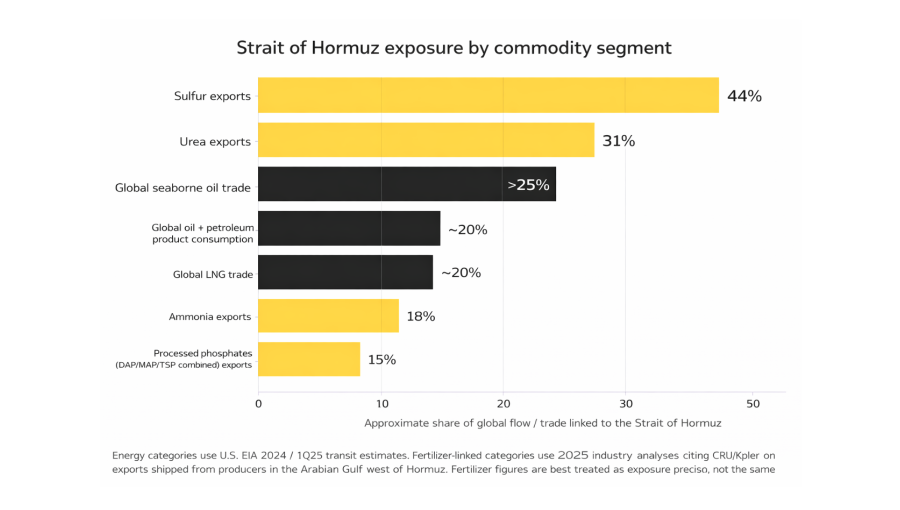


Closure of the Strait of Hormuz threatens global fertiliser supplies as nearly half of sulphur and a third of urea shipments transit the corridor. / bne IntelliNews

By Ben Aris in Berlin March 3, 2026


The closure of the Strait of Hormuz will impact the global fertilizers market as more fertilizers traverse the straits on the way to the international market than hydrocarbons do.

The straits were closed by the Iranian Revolutionary Guard Corps (IRGC) on March 2 and reportedly no ships are currently moving in the tight bottleneck that sees a large share of the world’s energy and commodities pass through on the way to customers around the globe.

With nearly half of global sulphur flows and close to a third of urea shipments moving through the corridor the impact of the conflict will reverberate around the world.

Roughly 44% of globally traded sulphur, a critical input for phosphate fertilisers, passes through the strait. The route also handles about 31% of urea flows, 18% of ammonia shipments and 15% of phosphates, according to industry estimates. That compares to a fifth of the world’s oil and LNG that is shipped from Gulf producers to worldwide customers.

Any disruption to maritime traffic in the corridor has immediate implications for fertiliser supply chains and farm input costs everywhere.

Sulphur is primarily produced as a by-product of oil and gas processing in Gulf states, making exports heavily dependent on uninterrupted energy production and shipping. Urea and ammonia, both nitrogen-based fertilisers, are widely used in staple crop production including wheat, maize and rice, while phosphates are essential for maintaining soil fertility.

The concentration of these exports in the Gulf region means that a halt to exports via the Strait of Hormuz can quickly translate into price volatility. Fertiliser markets are already sensitive to energy prices, as natural gas is a key feedstock for ammonia and urea production. Disruptions to transport routes add an additional layer of risk.

Agricultural producers in major importing regions such as south Asia, sub-Saharan Africa and parts of Latin America rely on steady fertiliser supplies to sustain crop yields. Higher fertiliser prices can feed through into food inflation, particularly in countries dependent on imports.

The Pentagon strongarmed AI firms before Iran strikes – in dark news for the future of ‘ethical AI’


THE CONVERSATION
Published: March 1, 2026 


In the leadup to the weekend’s US and Israeli attacks on Iran, the US Department of Defense was locked in tense negotiations with artificial intelligence (AI) company Anthropic over exactly how the Pentagon could use the firm’s technology.

Anthropic wanted guarantees its Claude systems would not be used for purposes such as domestic surveillance in the US and operating autonomous weapons without human control.

In response, US president Donald Trump on Friday directed all US federal agencies to cease using Anthropic’s technology, saying he would “never allow a radical left, woke company to dictate how our great military fights and wins wars!”

Hours later, rival AI lab OpenAI (maker of ChatGPT) announced it had struck its own deal with the Department of Defense. The key difference appears to be that OpenAI permits “all lawful uses” of its tools, without specifying ethical lines OpenAI won’t cross.

What does this mean for military AI? Is it the end for the idea of “ethical AI” in warfare?
AI companies and regulation

Last week’s events come at what was already a worrying time for AI ethics. The Trump administration last year banned states from regulating AI, claiming that it threatens innovation.

Our mission is to share knowledge and inform decisions.About us

Meanwhile, many AI companies have aligned themselves with the administration, with executives including OpenAI boss Sam Altman making million-dollar donations to Trump’s inauguration fund. (Altman noted at the time that he has also donated to Democratic politicians.)

Anthropic has been less effusive, working on national security while warning that AI can sometimes undermine democracy and that current systems are not reliable enough to power fully autonomous weapons.
An emerging international consensus

Much of the concern around military applications of AI has focused on lethal autonomous weapons systems. These are devices and software which can choose targets and attack them without human intervention.

Just a few years ago, an international consensus about the risks of these weapons seemed to be emerging among governments and technology companies.

In February 2020 the US Department of Defense announced principles for the use of AI across the entire organisation: it needed to be responsible, equitable, traceable, reliable and governable.

Likewise, in 2021 NATO formulated similar principles, as did the United Kingdom in 2022.

The US plays a unique leading role among its international allies in shaping global norms around military conduct. These principles signalled to countries such as Russia, China, Brazil and India how the US and its allies believed military use of AI should be governed.
Military AI and private enterprise

Military AI has relied extensively on partnerships with private industry, as the most advanced technology has been developed by private companies.

Project Maven, which set out in 2017 to increase the use of machine learning and data integration in US military intelligence, relied heavily on commercial tech companies.

The US Defense Innovation Board noted in 2019 that in AI the key data, knowledge and personnel are all in the private sector.

This is still the case today. However, the norms around how AI should be used are shifting rapidly, both in government and in much of the industry.
Trump and Silicon Valley

When Trump was re-elected in 2024, many in Silicon Valley welcomed the prospect of less regulation. Billionaire venture capitalist Marc Andreessen, author of The Techno-Optimist Manifesto, claimed Trump’s victory “felt like a boot off the throat”.

Joe Lonsdale, cofounder of AI-powered data analytics company Palantir, has been another vocal Trump backer. OpenAI president and cofounder Greg Brockman personally gave US$25 million to a Trump-supporting organisation last year.

We are a long way from the days of 2019 and 2020.
AI ethics assumes democratic norms

The question of whether an AI-enabled system is ethical or not is often seen as a question about the technology itself, rather than how it is used.

In this view, with the right design you can make an inherently ethical AI system. This often includes “algorithmic transparency” – being clear and honest about the rules the system uses to make decisions. The idea here is that ethics can be “baked in” to these rules.

The idea of ethical military AI also assumes it is operating under democratic principles. The idea behind algorithmic transparency is that “the people” should know how these systems work, because “the people” ultimately hold power in a democracy.

However, in an autocratic regime it doesn’t matter how transparent the algorithms are. There is no sense that civilians have a stake, and deserve to know what their government is doing, that its activities are in accordance with the law.

Free and public discussion is often seen as a key feature of liberal democracies. While eventual consensus may be valued, constructive disagreement and even conflict can be signs of a healthy democracy.
Decisions and consequences

In this light, Anthropic’s desire to have genuine discussions with the government about ethical red lines is an example of democratic practice in action. The company signalled both a desire for reasoned communication and the value of constructive disagreement.

In return, the Trump administration on Friday labelled Anthropic a “supply chain risk”, a rare designation previously only given to foreign companies, with secretary of defense Pete Hegseth writing that effective immediately, no contractor, supplier, or partner that does business with the United States military may conduct any commercial activity with Anthropic.

Anthropic plans to challenge the declaration in court, as it may have profound economic and reputational consequences for the company.

Meanwhile, OpenAI has largely conceded that it will have no ethical limits, only legal ones. As a result, it is open for business with the US government – but faces reputational consequences of its own as consumer backlash mounts.
AI in a world without democratic norms

What does it all mean for ethical AI in the military? One hard-to-avoid conclusion is that if we want military AI to be used in an ethical way – following transparent rules and laws – we need strong democratic norms, which are in peril as the rules-based international order crumbles.

So far, little has changed in practice. Mere hours after Trump’s denunciation of Anthropic, the US launched strikes on Iran – reportedly planned with the aid of the company’s software.

Author
Bianca Baggiarini
Lecturer, International Relations, Deakin University

Disclosure statement
Bianca Baggiarini receives funding from the Australian Defence Strategic Policy Grant program.

Google adopts advanced AI deepfake detection


By Dr. Tim Sandle
SCIENCE EDITOR
DIGITAL JOURNAL
March 3, 2026


Activists wearing eye masks, hold posters reading ‘Repeated deepfake sex crimes, the state is an accomplice too’ during a protest against deepfake porn in Seoul on August 30, 2024 - Copyright AFP Anthony WALLACE

The European Commission is continuing its investigation into Elon Musk’s X over concerns its AI tool Grok was used to create sexualised images of real people. This follows a similar announcement in January from the UK watchdog Ofcom.

If Musk’s site is found to have breached the rules of EU’s under the Digital Services Act, the Commission could fine the company up to 6% of its global annual turnover.

Meanwhile, other technology firms are adopting a more progressive stance to deepfake. OmniSpeech, the Maryland-based tech startup who earlier this year introduced the AI Detect™ plugin to the Zoom Marketplace, is set to bring their technology to Google Chrome.


Deepfake detection is the process of determining whether a video, audio clip, or image has been artificially manipulated or created using AI.

With AI voice clones getting more realistic by the day and deepfake content proliferating rapidly, there is a clear and present need for reliable tools that help guard against this strange new security threat. Google is one example of a technology firm seeking to alert users to the rising tide of deepfake imagery and voices.
A rapidly evolving landscape

AI Detect™ for Google Chrome employs a proprietary Gen 2 model that is optimised for previously unseen data sets. This approach ensures a high degree of analytical accuracy irrespective of generator, language, codec, or environment, setting OmniSpeech apart from other companies who tend to rely on brittle signature-based approaches which can’t keep up with the rapid pace of deepfake technology evolution.

The plugin can analyse voice audio in real-time from any source including live video calls and pre-recorded clips, making it a highly flexible tool for any number of applications. OmniSpeech also offers API integration for seamless interfacing with cybersecurity and fraud-prevention platforms, enterprise communication tools, and any other application requiring voice authenticity assurance.
Activists hold eye masks during a protest against deepfake porn in Seoul 
– Copyright AFP Anthony WALLACE

The technology is aimed at:Journalists & researchers: To verify the authenticity of online interviews, leaked recordings, and user-generated audio before publication.
Business professionals & executives: To add an additional layer of trust during browser-based calls, negotiations, and identity-sensitive conversations.
Compliance & security teams: To detect voice spoofing and impersonation attempts across cloud tools, web platforms, and for legal evidence.
Educators & students: To evaluate lectures, submissions, or online media for AI-generated speech.
Consumers: To scan suspicious voice messages, scam videos, or viral audio encountered on social media, YouTube, or websites directly in Chrome.

The deepfake detection tool functions by analysing visual, audio, and metadata signals to reveal whether a piece of media has been artificially generated. The software does so by looking for irregular patterns that do not appear in genuine human speech, movement, or image formation.
Vietnam AI law takes effect, first in Southeast Asia


By AFP
February 28, 2026


Vietnam' National Assembly passed the law, which requires human oversight of generative AI, in December - Copyright AFP Nhac NGUYEN


Tran Thi Minh Ha

A law regulating artificial intelligence went into effect in Vietnam on Sunday, making it the first country in Southeast Asia with a comprehensive framework on the booming technology.

Passed by the National Assembly in December, the law focuses on the risks posed by generative AI, requiring human oversight and control along the lines of the European Union’s landmark AI Act.

Many nations are moving to address the dangers of chatbots and image generators — from misinformation to online abuse and copyright violations — but few have enacted legislation.

The legislation, which is in force as of March 1, “paves the way for Vietnam to deeply integrate with international standards while maintaining digital sovereignty”, the government said in a December report.

It requires companies to clearly label AI-generated content such as deepfakes that cannot readily be differentiated from reality.

It also requires them to disclose to customers when they are interacting with an artificial rather than human agent.

The law applies to developers as well as providers and deployers of the technology, whether they are Vietnamese organisations or foreign entities operating in the country.

Vietnam has set ambitious double-digit growth targets for the next five years, with expansion of the digital economy a key part of its development strategy.

AI and the data economy are “pillars” of a “more sustainable and smarter new development” model, Prime Minister Pham Minh Chinh was quoted as saying Wednesday on the government’s website.

Under the law, the government will establish a national AI computing centre, improved data resources and large language models in Vietnamese.


– ‘Not the final word’ –


So far only a handful of countries have implemented far-reaching regulatory frameworks on AI.

The United States has opposed what Vice President JD Vance called “excessive regulation”, warning it could stifle innovation in the key sector.

In January, South Korea became the first country to have an AI law take full effect, while the European Union is gradually phasing in a set of rules that will become completely applicable in 2027.

While Vietnam’s law is a regulatory milestone, analysts said its impact would depend on how the government enforces it and on what guidance it issues on implementation.

The law is “not the final word” but rather a “decisive starting point”, Vietnam-based LNT & Partners law firm said in an analysis on its website.

“It establishes responsibility, human control, and risk management as the governing themes of AI regulation,” the firm said.

However, it added, “the true impact will depend on implementing decrees, sectoral regulations, and enforcement practice”.

Patrick Keil, senior legal adviser at law firm DFDL, called the law “a significant statement of national ambition” but told AFP businesses will continue to face some uncertainty about their obligations until the government issues further guidance.

At an AI summit hosted by New Delhi in February, 91 countries and international organisations called for “secure, trustworthy and robust” AI.

But their declaration, signed by the United States and China, was criticised by AI safety campaigners for being too generic to protect the public.
Europe should focus on industrial AI, SAP says


By AFP
March 3, 2026


Image: © AFP Josep LAGO
Sam Reeves

Europe should focus on competing in industrial AI, a top executive at German software giant SAP said, as the continent plays catch-up in the race for the cutting-edge technology against the United States and China.

Artificial intelligence for use in industry is “where I believe Europe can succeed big time around the globe,” Thomas Saueressig, a board member at the continent’s biggest software maker, told AFP in an interview.

This was because of “the industrial knowledge and the industrial data and competency we have in Europe”, he said at the company’s headquarters in Walldorf, southwest Germany.

Europe is seen as lagging behind the world’s top two economies in the strategic sector: the US with major players from OpenAI to Google, and China, which has a buzzing AI scene and hosts influential labs such as DeepSeek.

But fraying ties with Beijing, which Europe accuses of engaging in unfair trade practices, and the United States under President Donald Trump have given the continent fresh impetus to step up its efforts.

Industrial AI applications are typically smaller and less energy-intensive than the large models produced by major players, and designed for specific tasks that could range from developing construction plans to optimising electrical wiring in devices.


German software giant SAP believes Europe must step up its efforts on industrial AI – Copyright AFP Kirill KUDRYAVTSEV

That is where “we can differentiate ourselves in Europe” by “leveraging the industrial expertise, the data expertise for specific models,” said Saueressig, SAP’s chief customer officer.

“We don’t need to think about only the large language models, we also need to talk about the specific industry models.”

– ‘New potential’ –

High-tech processes are nothing new on factory floors but AI promises to turbocharge them, and there are already signs efforts are being ramped up in Germany, Europe’s biggest economy.

Last week, auto giant BMW unveiled a pilot project to deploy two AI-powered humanoid robots in a German factory this year to help in the production process.

“Advances in AI system performance unlock new potentials for automation,” said Milan Nedeljkovic, who is BMW’s head of production and is set to take over as CEO in May.

The carmaker has been building up its AI capabilities for some time and was moving “towards autonomous AI which can be used in manufacturing to take its own decisions”, Nedeljkovic told journalists, including from AFP, in Munich.

German telecoms giant Deutsche Telekom and US chip juggernaut Nvidia recently launched an industrial AI hub aimed at helping European companies use the technology in processes ranging from design to robotics.

The hub says it offers a “sovereign AI platform” that can reduce “risky dependencies” on Chinese and US tech.

Europe’s drive to boost its AI capabilities ties in with broader efforts to ensure “digital sovereignty”, by dialling back a heavy reliance in particular on US tech giants and ensuring Europeans’ data is stored safely at home.

Saueressig said SAP, which makes a wide range of business software, had seen “exponentially increased demand” for products that guarantee “digital sovereignty”.

But the executive, who oversees the group’s cloud computing operations, said some concerns about reliance on US tech were “overdone” and urged Europe to focus on producing world class technology so it could compete globally.

– AI disruption –

SAP has faced worries that new AI products could threaten its business, with its share price falling heavily in recent months.

But Saueressig says the group, which has been developing AI tools for its clients, can benefit as the technology provides “growth opportunities and more value for our customers”.

Europe faces many challenges when it comes to building up its industrial AI offerings, experts warn.

These range from lower data centre computing power compared with the US and China, challenges in the field from manufacturing powerhouse China, and a lack of funding for promising start-ups.

Despite the challenges, the continent has plenty of opportunity and the AI race is in its early stages, said Antonio Krueger, head of the German Research Centre for Artificial Intelligence (DFKI).

“We don’t know exactly where this will end and when it will end,” he told AFP.

“It is not justifiable to claim that the race has been lost.”
China’s overstretched healthcare looks to AI boom


By AFP
March 2, 2026


Wang Yifan (left) says paediatrician avatars helped answer questions about her baby, reducing trips to hospital - Copyright AFP Jade GAO
Rebecca BAILEY

Throughout her first pregnancy, Wang Yifan had lots of questions, which she usually put to renowned obstetrician Duan Tao — or rather, an AI clone of the top Shanghai-based doctor.

Duan has created a digital double for healthcare app AQ, which now boasts more than 100 million users in a display of how high-tech parts of China’s medical sector have become.

A state-driven digitisation, aiming to inject efficiency into the overstretched healthcare system, has been underway for over a decade.

But with rapid developments in AI and robotics, the government, companies and practitioners see an opportunity to turbocharge that transition.

“Three to five years at most, and our entire medical model will be radically transformed,” the soft-spoken Duan told AFP.

To train his avatar, Duan selected material, including textbooks, clinical case studies and content from his social platforms — followed by more than 10 million — to capture his tone.

The chatbot cannot prescribe medication, and AQ’s maker, tech giant Ant Group, says it is not a substitute for treatment.

“At the beginning, I did have concerns,” Duan said. “I value my personal reputation.”

But he believes in “actively embracing” technology to help improve it.


– ‘Democratising access’ –


Beijing is soon expected to release its 15th Five-Year Plan, a blueprint for the world’s second-largest economy until 2030 with technological transformation at its heart.

An October framework called for scientific breakthroughs to “enter practical application quickly”, and referenced intelligent healthcare solutions.

AQ, or Afu in Chinese, now has more than 1,000 expert digital doubles.

The app “gives any ordinary user — no matter where they are — the opportunity to get good answers to their questions,” Duan said.

“What we’re doing is democratising access to medical knowledge.”

That’s especially appealing in China, where “waiting all morning for a three-minute appointment” is common, he said.

Within half a year, Duan’s AI bot had 160,000 patients.

During Wang’s pregnancy, digital Duan was a trusted mediator when she and her husband disagreed, for example on using cooking wine in food.

Since giving birth, she has used AQ even more, asking paediatrician avatars about rashes or for general care advice.

While the app can’t replace doctors, “it can reduce the number of questions we need to ask doctors directly”, Wang told AFP as her baby dozed in her Shanghai apartment.

“If I take my baby to hospital, I worry about cross-infection.”


– ‘Urgency drives change’ –


China’s vast population and territory have always posed challenges to consistent, evenly distributed healthcare –- and as its citizens age, stress on the system is increasing.

The challenges are similar to other countries’, but are happening “at a greater scale and a greater pace”, said Ruby Wang, a writer and director of LINTRIS Health consultancy.

“China’s health technology landscape is maturing so quickly, partly because… urgency drives change,” she said.

And “state-industry alignment allows many pilots to occur quickly”, Wang added.

Chatbot DeepSeek is already used in hundreds of Chinese hospitals, according to one study, and Beijing’s prestigious Tsinghua University runs a hospital it says is designed to use AI in almost all its processes.

Nationwide, there are more than 100 AI medical projects, an official said recently.

In a top Shanghai hospital, a specialised AI model called CardioMind supports cardiology diagnoses, while a tool called PANDA is being deployed, including in remote towns, to flag early stage pancreatic cancer.

Robotics companies tout their healthcare potential, with firms like Fourier already supplying rural rehab centres with devices like mechanical arms for physiotherapy.

Enthusiasm for AI in healthcare is signalled culturally too.

This year’s televised Spring Festival Gala, a state broadcaster-run New Year ritual, featured a sketch that referenced AQ, and one starring humanoid robots caring for a neglected grandmother.


– Human decisions –


At a busy health centre in Shanghai, Yan Sulian, an energetic 65-year-old volunteer, helped older patients with electronic registration.

“Many elderly people just can’t keep up with the smartphone era, so we volunteer to teach them how to adapt,” she told AFP.

Yan said she and her friends all used AQ, after initially crosschecking its answers with doctors.

Life is already highly digitised in China, which explains the broad uptake of high-tech healthcare, said LINTRIS’ Wang, with data and privacy not often cited as a concern.

Globally, its accuracy has come under scrutiny though.

Studies suggest while AI chatbots can match human doctors in exam conditions, they are less effective in messier, real-life conversations.

“We must always remember (AI) can hallucinate,” obstetrician Duan said.

“Humans must retain the ultimate decision-making and choice.”

But infectious disease expert Zhang Wenhong, a top doctor in China’s Covid-19 fight, has voiced concerns that if AI becomes default, “without systematic training, doctors will lose the ability to judge whether AI’s conclusions are correct”.

Others emphasised that the adoption of AI in healthcare will be cautious.

“Doctors as a group are very conservative,” Duan said.

“We insist on safety… because the nature of the profession puts us in that mindset.”