Sunday, March 15, 2026

The violence of liberation: How war is sold through the language of women’s rights


When military interventions are framed as rescue missions for women, feminism risks becoming a tool of empire rather than a challenge to it.
Published March 12, 2026
DAWN

In contemporary international politics, the language of gender equality has increasingly appeared within the moral vocabulary of war over the past few decades. Western governments and political commentators have framed military interventions as necessary not only for security but also for the protection of women and girls in societies portrayed as oppressive or patriarchal.

This discourse presents intervention as a form of humanitarian responsibility. Yet when the material consequences of such interventions are examined, a profound contradiction emerges.

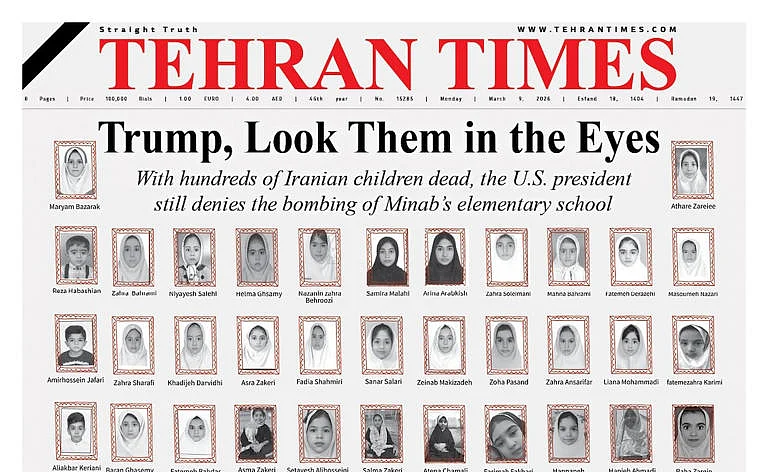
The recent bombing of a girls’ elementary school in Tehran during the US and Israeli strikes demonstrates this contradiction with stark clarity. When schoolchildren become casualties of imperial wars rhetorically justified through the language of women’s liberation, the ethical foundations of such claims demand serious scrutiny.

The politics of ‘saving’ Muslim women

The use of women’s rights as a moral justification for military intervention is not new. Since the early 2000s, Western foreign policy discourse has repeatedly invoked the condition of Muslim women as evidence of the necessity of external intervention.

The invasion of Afghanistan in 2001 remains one of the most prominent examples. Political leaders and media narratives consistently emphasised the oppression of Afghan women under Taliban rule as a central rationale for war. Images of veiled women circulated widely in Western media. Such representations reduced Afghan women to passive victims awaiting rescue and helped frame the invasion as a humanitarian project.Yet the outcomes of this intervention exposed the limits of that narrative.

Despite two decades of military presence, the structural transformation of Afghan society remained fragile and uneven. When the Afghan government collapsed in 2021 and the Taliban returned to power, the promise of liberation that had accompanied the invasion appeared increasingly hollow. Many Afghan women themselves emphasised that meaningful empowerment could not be delivered through foreign military intervention, but required sustained social, economic, and political change within Afghan society.

Scholars in feminist international relations have critically examined this phenomenon. American anthropologist Lila Abu-Lughod famously questioned the assumption deeply rooted in such discourse by asking whether Muslim women genuinely need saving. Her critique was not a denial of gender inequality in particular societies, but rather a challenge to the idea that military intervention by foreign powers could serve as a credible path toward women’s emancipation.

According to Abu-Lughod, framing war as a rescue mission reproduces colonial patterns of thinking in which Western societies imagine themselves as civilising agents tasked with reforming supposedly backward cultures. The language of liberation thus becomes deeply entangled with geopolitical power.

Chandra Talpade Mohanty, a distinguished professor of women’s and gender studies, similarly argued that Western feminist discourse has historically constructed the “Third World Woman” as a singular, passive figure defined primarily by victimhood. Such representations erase the political agency of women in non-Western societies and obscure the diverse forms of activism and resistance that exist within those communities.

When the suffering of women is mobilised to justify military action, the result is a paradoxical form of advocacy in which feminist language is used to legitimise violence that ultimately harms the very populations it claims to defend.

The rise of militarised feminism

The ethical contradiction becomes even sharper when such events occur within a discourse that celebrates military action as a defence of women’s rights.

Recently, a Spanish politician criticised the celebration of strikes against Iran through feminist rhetoric, remarking that those who claim to defend Iranian women cannot simultaneously applaud the killing of schoolgirls. The statement resonated widely because it exposed the moral incoherence in the language of militarised feminism. If the stated objective is the protection of women and girls, the killing of those very girls cannot simply be dismissed as collateral damage.

Critical scholarship increasingly describes this phenomenon as the instrumentalisation of feminism. British sociologist Sara Farris has referred to similar dynamics in European politics as “femonationalism” — a process through which gender equality is invoked selectively to advance nationalist or neoliberalism agendas. While her work focuses primarily on immigration debates in Europe, the underlying logic extends to foreign policy as well.

Gender equality becomes a symbolic resource that states deploy when it strengthens their political position, but it rarely serves as a consistent guiding principle across all contexts.

This pattern of imperial or militarised feminism extends to the current strikes on Iran, where the role of female Israeli Air Force pilots has been highlighted in celebratory narratives. Posts and media coverage underscore that dozens of Israeli women pilots and navigators took part in the bombing campaign, presenting their participation as empowerment while obscuring the fact that these strikes constituted a direct military intervention against a sovereign state.

The bombings are framed as a form of feminist justice against a regime accused of oppressing women, turning military violence into a spectacle of liberation. A recent cartoon circulating on social media depicts an Israeli female fighter pilot bombing bearded men in Iran, visually reinforcing this rhetoric.

Such imagery demonises Muslim men as archetypal oppressors; portrayed as bearded, patriarchal figures deserving of violent retribution, while positioning Western-aligned (or Israeli) women as empowered liberators.

The caricature exemplifies how imperial feminism is weaponised to racialise and dehumanise Muslim men, casting military violence as a gendered civilisational clash rather than a geopolitical conflict. It perpetuates orientalist tropes that reduce complex societies to stereotypes of backward masculinity in need of forceful correction by “enlightened” female agents from the West or its allies.

The selective deployment of feminist rhetoric

An example of this instrumentalisation also occurred in the aftermath of the October 7, 2023, attacks. Israeli officials and supporters amplified unverified allegations of widespread and systematic sexual violence, including rape, allegedly committed by Hamas forces during the attacks. Despite a lack of independent evidence or conclusions from international investigators such as those affiliated with Amnesty International or even UN experts, these claims were used to frame the subsequent military aggression in Gaza as a necessary defence of women’s rights and a response to gender-based atrocities.

At the same time, a number of human rights organisations and UN experts have raised serious concerns about sexual violence perpetrated by Israeli forces against Palestinian detainees during the Gaza war. Reports by organisations such as Human Rights Watch, B’Tselem, and the United Nations Independent International Commission of Inquiry (COI) on the Occupied Palestinian Territory, including East Jerusalem, and Israel have documented evidence of sexual abuse, humiliation, and rape against Palestinian detainees held in Israeli custody, including in detention facilities such as Sde Teiman.

More broadly, the pattern of invoking humanitarian and feminist rhetoric to justify war has appeared in multiple interventions across the Middle East. The invasion of Iraq in 2003, the Nato intervention in Libya in 2011, and ongoing debates around Iran have all included arguments that frame military aggression as necessary to defend human rights.

Yet the conduct of intervening forces has often contradicted these claims. The abuses uncovered at Abu Ghraib prison during the Iraq War remain one of the most notorious examples. Investigations by organisations such as the Amnesty International documented detainees being subjected to forced nudity, sexual humiliation, threats of rape, and other degrading treatment by US personnel.

From a normative perspective, the idea that liberation can be achieved through aerial bombardment is deeply problematic. Political freedom and social reform cannot emerge from environments defined by destruction and insecurity.

If gender equality is invoked as a universal value, then its defence must remain consistent regardless of geopolitical alignment. Yet the selective deployment of feminist rhetoric suggests that states frequently condemn gender oppression in “adversarial” societies while remaining relatively silent about similar issues among allies. Such inconsistency risks transforming feminism from a universal ethical commitment into a geopolitical instrument.

Rethinking feminism in an age of war

In the face of endless wars, the myth of imperial salvation crumbles under the weight of its own hypocrisy.

Women in the Global South do not owe gratitude to a version of liberal feminism that appears in the language of liberation while bombs fall on their societies. Veiled women in Tehran, Kabul, or Gaza do not need to thank distant advocates in pantsuits for military campaigns that destroy their schools, homes, and communities.

The idea that war can be presented as a gift of emancipation reflects a deeply paternalistic assumption that these women lack agency and must be rescued by outsiders. Genuine solidarity with women across the world requires consistency, humility, and a commitment to peace rather than the destructive promise of liberation delivered from the sky.

Header image created with Generative AI

The Handmaid's Tale: From Cuba To Iran, A Dystopian Landscape

From The Handmaid’s Tale to the politics of modern wars, the language of women’s liberation is repeatedly invoked to justify power, intervention and regime change.


Chinki Sinha
Updated on: 11 March 2026 
OUTLOOK INDIA


In Atwood’s novel, Gilead is a country that was formerly the United States, where women are treated as host bodies as a fertility crisis begins to dictate politics. Photo: Source: IMDB


Summary of this article


The slogan from Margaret Atwood’s The Handmaid’s Tale becomes a lens to examine how women’s rights are often invoked to legitimise wars and geopolitical agendas.


From Afghanistan in 2001 to present conflicts in West Asia, political leaders have repeatedly framed military action as a mission to “liberate” women.


History shows, however, that militarised interventions rarely deliver gender justice, and often undermine feminist movements instead.


“There is more than one kind of freedom,” said Aunt Lydia. “Freedom to and freedom from. In the days of anarchy, it was freedom to. Now you are being given freedom from. Don’t underrate it.”
—Margaret Atwood, The Handmaid’s Tale


That’s how it all happens. Freedom from the regime. That’s the justification. There are others, but those have been refuted. Like nuclear capability that would threaten Israel’s right to exist. This also means rights are never really equal.


This book, published in 1985, must be the Bible of our times. By us, I mean mostly women. We must then be vigilant. Dystopias exist. They just haven’t been marked on the map. We know now that changing the name of a place is easy. Expansion is now only a question of military might. Nobody can ask questions. There are consequences, we are told.

Related Content
Turbulence In Tehran: Decoding The Lineages Of The Protests Against Clerics


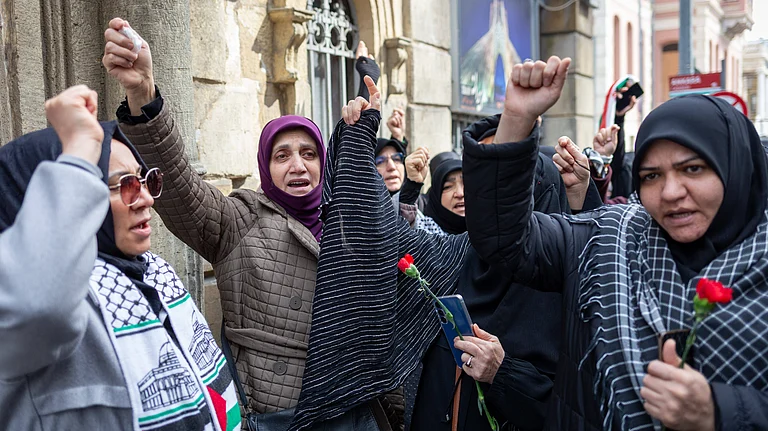
Not In Our Name: Iranian Women Reject Liberation By Bombs

Women Of The World: Remembering Iran’s Women-Led Uprising

How Language Prepares The Ground For Exploitation

Cover Story: Bombs Do Not Liberate Women


In Atwood’s novel, Gilead is a country that was formerly the United States, where women are treated as host bodies as a fertility crisis begins to dictate politics. Fertile women are kept in captivity and must serve the mandate to produce children. They are raped and denied basic dignity. They must not talk. There will be consequences, they are told. Women are to take care of the family if they are wives. They can’t read. They can’t make decisions. Any “immoral behaviour” will not be tolerated. Atwood didn’t have to imagine it all. There was a cult called the ‘People of Hope’ that was started in 1975 by a New York stockbroker and ordained Catholic priest named Robert Gallic, that viewed at women as handmaidens of god who were to be subservient to their husbands. Then there was Canadian MP Dave Nickerson, who cited Canada’s fertility rate dropping to an all-time low and said families should have more children.

In this book, the handmaids of Gilead organise themselves despite the brutal regime.


We live in similar dystopias.

Tehran Times Publishes Faces Of Slain Children, Issues Direct Challenge To Trump

In 2023, the Nobel Peace Prize Committee honoured Iran’s “Woman, Life, Freedom” activists and awarded the coveted prize to the well-known and currently imprisoned women’s rights activist Narges Mohammadi. Women are capable. They don’t want to be rescued.

One must always write disclaimers these days. I am not an apologist for the regime in Iran. Nor do I condone this war. Not that I matter, but still, my tiny voice must find its place.

The war is streaming live. Some truths, a lot of propaganda, a lot of fake news. It is easy then to rejoice over the killings in the name of liberation. It is also easy to defend the regime that brutally crushed the protests in Iran. Black smoke, gutted buildings and sirens going off are the new normal. All spectacular images. Like 9/11 when the Twin Towers were struck.

Not much is making sense anymore. Least of all, this war on Iran in the name of regime change to ‘liberate’ women under an oppressive regime. The war, whose first act led to the killing of Iran’s Supreme Leader, Ali Khamenei. Now, Israel’s Benjamin Netanyahu is citing Jina Mahsa Amini and her killing in Iran and the slogan “Woman, Life, Freedom,” to justify his attack on Iran using ‘women’s rights’ to legitimise war, while the war on Gaza continues and women and children keep becoming casualties. Selective wars are too obvious.

The legitimate aspirations to autonomy and self-deter­mination of Iranian women have been set aside. Agency denied.

All scripts for regime changes are pre-determined and similar. The “military attack-cum-regime change” pattern based on “gender disorder” is not new. In 1898, Cuba was depicted as a “damsel in distress” by major US newspapers and the Monroe Doctrine was chalked out to justify the US claim to the Americas, which was yet another case of using women’s iconography to make war.

Former US First Lady Laura Bush had declared in 2001 that the “fight against terrorism is also a fight for the rights and dignity of women” in the case of Afghanistan. We know what panned out in Afghanistan later.

There are many such examples. There is now another war on the horizon. A friendly takeover of Cuba.


Video | Liberation Or Violation? The Legal & Moral Questions Behind The US-Israel Strike On Iran
BY Anwiti Singh


Political agendas hide conveniently behind the slogans of freedom, human rights, saving women and in desperation, we want to believe them. We want to continue hoping. But takeovers are not rescue efforts.

Militarised men do not bring freedom or equal rights. That is what past experience has shown women. Liberation cannot begin with bombs. Feminism cannot be part of the war machine. When militarised projects co-opt the language of feminism, developed through long struggles for rights, they damage movements led by women.

One should remember that during his 2016 presidential campaign, US President Donald Trump said, “You have to ban” abortion. As president, he appointed Supreme Court justices who later formed the majority that overturned Roe v. Wade, the 1973 ruling in which the US Supreme Court recognised a constitutional right protecting a woman’s decision to terminate a pregnancy. In 2022, the decision in Dobbs v. Jackson Women’s Health Organization marked the removal of the constitutional right to abortion.

These are facts one must remember. There are many others. But readers know where to look. Who liberates whom is then the question? Who gives freedom to and freedom from?

I must quote from The Handmaid’s Tale again.

“As all historians know, the past is a great darkness, and filled with echoes.”


Hear the echoes then. And don’t let Gilead become a reality. Don’t let the bastards grind you down.


Chinki Sinha is editor, outlook Magazine

This article is part of Outlook 's March 21 issue 'Bombs Do Not Liberate Women' which looks at the conflict in West Asia following US and Israel’s attacks on Iran leading to the assassination of Ayatollah Ali Khamenei, while the world wondered in loud silence, again, Whose War Is It Anyway?
War on the poor

Aasim Sajjad Akhtar 
Published March 13, 2026 
DAWN

IF truth is the first casualty in war, then the biggest casualty is almost always the poor. This is as true in the warzone itself — Iran and the Gulf countries — as here in Pakistan. The petrol bomb has already wreaked havoc, but what if a poor family forced to deal with what is effectively a cost of living crisis had to deal with their home being demolished?

The story I narrate here is of the federal capital, and one that I have written about on these pages before. The protagonist is the Capital Development Authority and the hybrid regime that oversees it. On the other side are the poor residents of informal settlements, the biggest of which, Muslim Colony near Bari Imam, was razed to the ground in December. The distractions of the Zionist attack on Iran are now providing cover for the CDA to go after others.

The latest targets of the ruling regime are Islamabad’s Christian katchi abadis. It is cruel irony that many whose homes are under threat actually work for the CDA’s sanitation department. What better evidence of the utterly instrumental and brutalising logics of Pakistani statecraft that the workers who clean the capital’s streets, homes and offices are being evicted from their shanties?

Christian working-class communities contend with a unique combination of communal apartheid, caste untouchability and brazen class exclusion that makes them amongst the most persecuted and depressed segments of society. Think about the rabid lynch mobs who seek their blood, the bulldozers that flatten their homes, the abuse they encounter as domestic servants — these are literally the wretched of the earth.


The war on the poor has grown more intense.

The authority’s main aim is to rip down the huge katchi abadi in sector H9 of the capital which goes by the name Rimsha Colony. It was in 2012 that Rimsha Masih, then 14 years old, was arrested by Islamabad Police on the charge of having committed blasphemy. She was exonerated a year later, and the CDA itself shifted hundreds of Christian families to Sector H9 under the guise of protection. The settlement has since grown and is now home to almost 25,000 residents, most of whom are Christian.

The same CDA now wants to evict them in order to build the 10th Avenue highway. Only in the world of our colonial bureaucracy do roads have more rights than people. For what it’s worth, the largely powerless Environmental Protection Agency conducted a public hearing in 2022 to determine the viability of the 10th Avenue project and concluded that both the environmental and social impacts of Rimsha Colony’s demolition could not be condoned. It is also worth being reminded that a Supreme Court stay order from 2015 remains in effect to this day that prevents any governmental agency from engaging in summary evictions without providing adequate resettlement.


But who cares about such inconvenient truths here, especially when the clamour of wars abroad drowns out all else? Christian katchi abadi residents are as vulnerable as any in a war on the poor that knows no limits.

Take, for example, millions of working people in Balochistan who are currently being suffocated by the shutdown of the Iran border trade. Pakistani officialdom sees this matter only through the lens of ‘national security’, but as Akbar Notezai has masterfully documented, a vast array of goods, most notably oil, travel across the border on a daily basis, providing a daily wage to drivers, small traders and more. There is also the dark business of human smuggl­ing, powered by the demand of a brutalised population without hope. Border closures mean that working people who have not yet succumbed to hu­man smugglers are literally being starved of their meagre livelihoods.

Cross-border trade on the Torkham and Chaman borders also remains largely suspended as the state remains militarily engaged with its former protégés, the Afghan Taliban.

Here too, the drums of war take their toll on civilians killed by bombs and guns and a much wider demographic of ordinary working people — both Pakistani and Afghan — that rely on everyday trade for their survival.

There are many, many more examples of the war on the poor that has now only grown more intense with the wars of destruction taking place on our western borders.

It makes sense that many are currently unable to focus on much more than bloody geopolitics, and the bloodlust of US imperialism and the Zionist fascists that wreak havoc across West Asia in particular. But where we raise our voice to resist the wars abroad, we can and must do so to resist the wars within too.

Published in Dawn, March 13th, 2026

The writer teaches at Quaid-i-Azam University, Islamabad.

The arrogance of Trump’s America


Robert Grenier 
Published March 13, 2026
DAWN
The writer is a former US official and author of 88 Days to Kandahar.


IT is a very curious thing that some 13 days into a war which has encompassed most of the Middle East and engaged the critical interests of virtually the entire globe, the prime perpetrator of that war, a global superpower, cannot provide a coherent rationale for it. President Trump has said much on the topic, but his ramblings provide little clarity. By some reckonings, Trump has cited 10 different, often contradictory reasons at one time or another, running from the simply false (Iran has intercontinental ballistic missiles posing an imminent threat to America; Iran is two weeks from fielding a nuclear weapon) to the absurd (Trump had a ‘feeling’ Iran might launch a pre-emptive strike). If it’s understanding we seek, we will have to look elsewhere.

For a true answer, it might be more useful to look at the negotiations which immediately preceded hostilities. The US side focused on three issues: eliminating the threat of an Iranian nuclear weapon; eliminating the threat of Iran’s ballistic missiles; and eliminating Iranian support to its allies in the Axis of Resistance. In short, the American aim was Iran’s unilateral disarmament, apparently believing that its relative military weakness would force it to capitulate.

There is much we don’t know about these talks, but given reporting from many sources we probably have all we need to judge their seriousness and intent. Regarding nuclear weapons, Iran was apparently showing remarkable flexibility, including willingness to ‘downblend’ its highly enriched uranium to low-enriched reactor fuel, strictly limit its nuclear fuel stocks, and place the entire system under intrusive international monitoring. Although insisting as a matter of principle on its right to enrich uranium, this, too, was to be subject to an international consortium which would put Iranian enrichment under multilateral control. Considerable work remained to be done, but Iran seemed to be on a glidepath to an agreement substantially more stringent than the 2015 JCPOA which Trump abrogated in 2018. Still, this apparently was not enough. One must ask why.

Regarding Iran’s so-called ‘proxies’ (a maddeningly misleading description), they hardly pose the short- or even medium-term threat they once did. Hamas has been all but annihilated, Lebanese Hezbollah is little better off, and even the relatively intact forces of the Houthi militia are sufficiently cowed as not to have dared enter the current conflict.


The US president’s current policy towards Iran, and potentially a host of others, can be summed up in three words: ‘submit, or die.’

That leaves missiles, about which Iran apparently refused all discussion. But just what was actually at stake here from a US perspective? Iran is assessed as being at least 10 years away from producing a projectile capable of reaching the US. We don’t know what practical range limits the US would have sought (or its Israeli ally would have insisted upon), but we can safely assume these limits would not have protected the Arab Gulf. They would surely have aimed to protect Israel, however. That is the nub of the issue.

Over the year-plus of Trump’s second term, we have seen him grow progressively more confident, arrogant and aggressive in his use of overwhelming American military power, especially against those whom he assesses as being incapable of defending themselves. An examination of last June’s 12-day war is instructive. At the outset, Trump was sceptical of Israel’s attacks on Iran, and refused to be drawn in. As Israeli successes mounted and as it became clear that Iran could be struck from the air with impunity, however, the tone changed. Trump began to refer to Israeli actions as what “we” were doing; assured he could not be seriously harmed, the school-yard bully in him could not resist: soon he would exult triumphantly in the “obliteration” of Iran’s nuclear facilities.


Fast-forward to the present, and Trump is fairly drunk with his ability to militarily coerce lesser powers: Venezuela yesterday; Iran today; perhaps Cuba tomorrow. It is all of a seamless piece with his ongoing trade-related bullying of anyone, including European allies, whom he deems vulnerable to intimidation. America, which once had pretensions, at least, to moral leadership, is now a global gangster.

Viewed in this context, it is clear that Trump’s decision to attack Iran had less to do with the substance of negotiations than with the fact that Iran dared negotiate at all. His current policy towards Iran, and potentially a host of others, can be summed up in three words: ‘submit, or die.’ The fact that Trump was admittedly surprised that Iran would react by attacking his Arab allies only underscores the point.

Having reached this stage in his devolution, Trump’s enthusiastic military alliance with Netanyahu makes eminent sense. As Israel enters the endgame in its progressive dispossession of the Palestinians, its consistent message to the Palestinians themselves and to any in the region who rise to their aid — from Gaza, to Ramallah, to Beirut, to Sana, to Damascus, to Tehran — is clear: resistance is futile.

If Israel were an innocent victim of aggression from Iran and its regional allies, Trump’s insistence on Iran’s permanent disarmament vis-à-vis Israel might have an ethical justification. If US policy combined taming Iranian radicalism and achieving justice for Palestinians, it might be worthy of respect. But no such respect is due.

As former chief of counterterrorism at CIA, I know a bit about the subject. Terrorism is the use of violence against non-combatants to achieve a political end. Iran has long shown little compunction regarding use of terrorism, but neither has Israel. If there were any ambiguity on the latter account, Israel’s ongoing obliteration of Gaza and its state-sanctioned murders of West Bank Palestinians have erased it.

Indeed, as the war drags on, we are already seeing Israel’s target set in Iran slide towards civilian infrastructure and cultural sites, reportedly to the Americans’ alarm. We can soon anticipate the ‘Gazafication’ of Iran.

The latest tragedy of the Trump presidency is that he has fully harnessed American power to Israeli ends. Trump’s own shifting motivations in pursuing this war may be a muddled mix of strategic confusion and primitive instincts, but its objective rationale is clear: to make the world safe for Israeli war crimes and apartheid. Strip away the excuses and self-deception, and that’s all we have left.

Published in Dawn, March 13th, 2026
POLITICS: THE RHETORIC OF WAR

Casey Ryan Kelly 
Published March 15, 2026 
DAWN/EOS


IS HE WEARING BRYLCREME OR WILDROOT?!


US Secretary of Defence Pete Hegseth holds a briefing at the Pentagon on March 2, 2026, as joint US-Israel airstrikes target cities across Iran: many observers have been taken aback by Hegseth’s haughty tone, hypermasculine preoccupation with domination, giddiness about violence and casual attitude toward death | Reuters


When US Secretary of Defence James Mattis addressed the intensification of US combat operations against the Islamic State group in 2017, he assured the American public of his commitment to “get the strategy right” while maintaining “the rules of engagement” to “protect the innocent.”

Mattis’ professional tone was a stark contrast to [current US] Secretary Pete Hegseth’s remarks following the first days of the joint US-Israeli combat operations in Iran.

On March 2, 2026, after bragging about the awe-inspiring lethality of US “B-2s, fighters, drones, missiles”, Hegseth casually brushed aside concerns about long-term geopolitical strategy, declaring “no stupid rules of engagement, no nation-building quagmire, no democracy-building exercise, no politically correct wars. We fight to win.”

Admonishing the press for anything less than total assent, he commanded, “to the media outlets and political left screaming ‘endless wars’: Stop. This is not Iraq.”

Instead of briefi ng the public on the Iran war, US Secretary of Defence Pete Hegseth is performing for a Maga audience that measures success in dominance, killstreaks and owned liberals. A decade-long scholar of far-right rhetoric explains what his language actually means…

Two days later, Hegseth gloated about “dominance” and “control”, while asserting that the preoccupation of the “fake news media” with casualties was motivated by liberal media bias and hatred of President [Donald] Trump.

“Tragic things happen — the press only wants to make the president look bad,” he said. He dismissed concerns about the rules of engagement, declaring that “this was never meant to be a fair fight. We are punching them while they are down, as it should be.”

I’m a communication scholar who has studied Maga [Make America Great Again] rhetoric for a decade. I have observed how Hegseth and other officials in the second Trump administration refuse to abide by what recurring rhetorical situations — urgent public matters that compel speech to audiences capable of being influenced — typically demand of public officials.

The theme of this administration is that no one is going to tell it what to say or how to say it. It will be encumbered neither by norms nor the exigencies that compel speech in a democratic society.

THE BIG MAN

When the US goes to war, the public expects the president and the defence secretary to convince them of the appropriateness of the action. They do this by detailing the justification for military action, but also by addressing the public in a manner that conveys the seriousness and competence required for such a grave task as waging war.

But during the first week of the Iran war, Hegseth’s press briefings deviated from the measured tone expected from high-ranking military officials.

Hegseth flippantly employed villainous colloquialism — “they are toast and they know it”, “we play for keeps”, and “President Trump got the last laugh” — delivered with a combative tone that communicated masculine self-assurance.

Many observers were taken aback by his haughty tone, hypermasculine preoccupation with domination, giddiness about violence and casual attitude toward death.

During Trump’s first term, this penchant for rule-breaking was by and large isolated to the president, whose transgressions were part of his populist appeal. Although Trump’s first cabinet members agreed on most political objectives, they attempted to rein in what they saw as the president’s more dangerous whims.

But with loyalty as the new bona fide qualification for administration officials, Trump’s second cabinet is populated with a large contingent of right and far-right media personalities like Hegseth, including Kash Patel, Sean Duffy and Mehmet Oz. The anti-institutional ethos of far-right media explains why these officials refuse to conform to “elite” expectations and instead speak in a manner that is bombastic, outrageous and perverse.

Among them, there is little reverence for what they may perceive of as emasculating rules of tradition and politeness in a media marketplace where “owning”, “dominating” and “triggering” your enemy is precious currency. Far-right media personalities are adept at commanding attention with showmanship and swagger.

Trump appears to have chosen Hegseth for precisely this reason: he performs the role of the big man to perfection.

‘KILL TALK’

Hegseth’s language choices and petulant tone do not demonstrate an ignorance of what rhetorical situations demand of him; instead, they reflect a refusal to be emasculated by such cumbersome norms.

When making statements about the first week of the war, Hegseth grinned as he delivered action-movie one-liners, like “turns out the regime who chanted ‘Death to America’ and ‘Death to Israel’ was gifted death from America and death from Israel.”

Hegseth engaged in what is known as “kill talk”, a verbal strategy, typically directed at new military recruits, that denies the enemy’s humanity and disguises the terrible costs of violence. His repetition of words like “death”, “killing”, “destruction”, “control”, “warriors” and “dominance” framed violence in heroic terms that are detached from the realities of war.

In my view, Hegseth addressed the public as a squad leader addresses military recruits. Hegseth apparently delighted in dispensing death and elevating and glorifying war. He said virtually nothing of long-term strategy beyond “winning.”

In the Maga media world, winning is really all that matters. If winning is the only goal, then war is, by profound inference, a game, a test of masculine fortitude.

This point was made clear when the White House posted a video that interspersed footage of airstrikes on Iran with “killstreak animation” from the popular video game Call of Duty: Modern Warfare. In the game, when a player kills multiple opponents without also dying, they are rewarded with the ability to conduct a missile strike to exterminate an opposing team. Again, this message gamifies violence and obscures the destructive toll of war.

Informed by the contemptuous hypermasculinity of far-right media culture, all this taboo behaviour and glorified portrayals of death convey one fundamental message: when the public most needs explanation and justification for the actions of their government, the powerful owe the public neither explanation — nor comfort.

The writer is Professor of Communication Studies, University of Nebraska-Lincoln in the US

Republished from The Conversation

Published in Dawn, EOS, March 15th, 2026


‘I am dead … for coffee’: Israeli PM Netanyahu posts his video amid speculation about his death

Published March 15, 2026 

A video posted on Israeli Prime Minister Benjamin Netanyahu’s X account is being seen as his response to the rumours of his death, which were earlier debunked by his office.

The video was posted on Sunday evening, in which Netanyahu is seen getting himself a coffee and being asked about the rumours, Israeli news website Jerusalem Post reported.

The post also had a caption stating: “They say I am what?”

During the conversation taking place in what appears to be Hebrew, Jerusalem Post quoted Netanyahu as saying: “I love … coffee, I love my nation.” The report further elaborated that he also used the Hebrew slang word “met” during the conversation, which, according to Jerusalem Post, means “love” and is also the Hebrew word for “dead”.

To simplify, his remarks could be translated to: “I am dead … for coffee.”


According to Jerusalem Post, Netanyahu also asked the person filming him whether they wanted to count his fingers, seemingly mocking people speculating that a recent video of his was AI-generated and that he may be dead.

He raised “both hands to the camera, directly responding to online theorists who’ve circulated the rumor that a Friday video published on his X account was AI-generated and allegedly showed him with six fingers”, the report said.

Reuters verified the video’s location from file imagery of the cafe, which matched the interiors seen in ​the video. The date was verified from multiple videos and photos ​of Netanyahu’s visit posted by the cafe on Sunday.

Earlier, Netanyahu’s office also dismissed social media claims that suggested he had been killed in an Iranian response to US and Israeli strikes.

An Anadolu Agency correspondent asked the office if they had a statement on increasing claims on social media that “Netanyahu has been assassinated”.

“These are fake news; the prime minister is fine,” the office replied.

The rumours were fuelled by several social media users speculating about his death, saying that he had missed a war council meeting in recent days.

Moreover, some even referred to a video of Netanyahu’s address — which was shared on his X account — saying that he seemed to have six fingers in the clip and speculating about his death.

The speculation has come against the backdrop of an ongoing war in the Middle East, which began with the US and Israel launching deadly attacks on Iran on February 28. The same day, Iran’s supreme leader Ayatollah Khamenei was also assassinated in a US-Israeli strike.

Earlier today, Iran’s Revolutionary Guards vowed to target Netanyahu. “If this child-killing criminal is alive, we will continue to pursue and kill him with full force,” said the Guards on their website Sepah News.

Additional input from AFP and Reuters


אומרים שאני מה? צפו >>
1:00 / 1:00