Sunday, April 19, 2026

India-Zambia talks on critical minerals stall over mining rights


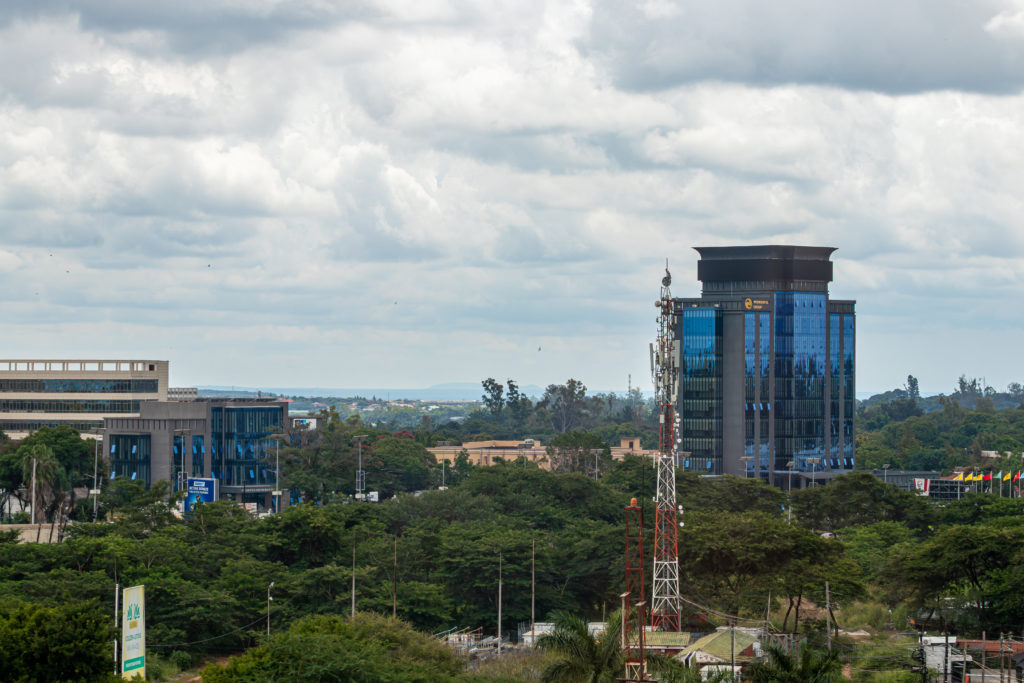
Lusaka, Zambia. Stock image.

India’s talks with Zambia over critical minerals mining have stalled amid a lack of assurances from Lusaka on mining rights, two sources familiar with the matter told Reuters.

India last year received an allocation of 9,000 square km (3,474.92 square miles) to explore cobalt — a key component in batteries for electric vehicles and mobile phones — as well as copper, widely used in power generation, electronics and construction.

India dispatched a team of geologists last year, who have since returned with samples of minerals, including cobalt and copper.

The exploration program in Zambia was set to run for three years, after which New Delhi had planned to invite private sector companies to participate, subject to securing mining rights.

It was not immediately clear why Zambia was withholding assurances for mining rights.

New Delhi is making efforts to restart discussions with Zambia, but the situation is still uncertain, one of the sources said.

They declined to be identified as the discussions are not public. India’s federal Ministry of Mines did not respond to a Reuters request for comment.

India has been in talks with several African countries to acquire critical mineral blocks on a government-to-government basis, while also exploring opportunities in Australia and Latin America.

The Indian government last year held internal discussions over the country’s growing vulnerability to a tightening global copper market and ways to secure supplies from resource-rich countries during ongoing trade negotiations.

India’s copper imports have risen sharply since the 2018 closure of Vedanta’s Sterlite copper smelter. The country imported 1.2 million metric tons of copper in the fiscal year ending March 2025, up 4% from the previous year.

India is almost entirely dependent on cobalt imports, with shipments of cobalt oxide rising 20% in 2024-25 to 693 metric tons, government data showed.

(By Neha Arora; Editing by Mayank Bhardwaj and Janane Venkatraman)

Critical Metals stock surges after taking full control of Greenland rare earth project


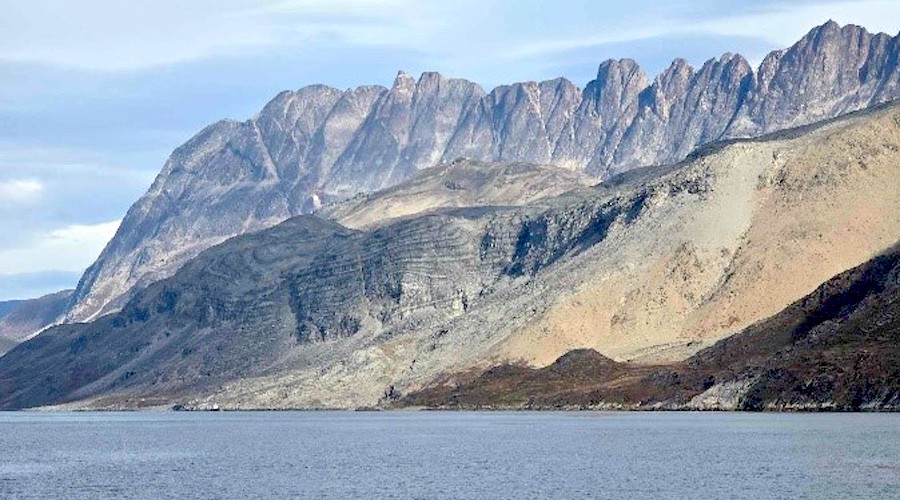
Tanbreez project in Greeland. (Image courtesy of Critical Metals.)

Greenland has approved the indirect transfer of the mining licence for the Tanbreez rare earth project after Critical Metals Corp. (NASDAQ: CRML) increased its ownership in the developer, the territory’s ministry for mineral resources and business said on Friday.

The approval clears the way for Critical Metals to complete its move to a 92.5% interest in the southern Greenland asset, while the licence itself remains held by Tanbreez Mining Greenland A/S. Under Greenland’s mining framework, an indirect transfer means the legal licence holder does not change, but ownership of the company behind that licence does. European Lithium holds the remaining 7.5% interest.

Shares in Critical Metals Corp surged by 23.6% in pre-market trading exchanging hands for $11.46 a share and affording the company a $1.4B market cap. The stock is up nearly four-fold over the last year but still nowhere near the peak hit in October last year.

Tanbreez, located at Killavaat Alannguat in southern Greenland, is regarded as one of the largest undeveloped heavy rare earth deposits outside China. A preliminary economic assessment released in March 2025 valued the project at about $3 billion based on a 4.7B tonne resource.

The Tanbreez project will follow a phased growth strategy, with initial production of around 85,000 tonnes of rare earth oxides per annum, scalable to 425,000 tonnes after expansion. The resource base is 45 million tonnes grading 0.40% total rare earth oxides with 27% in heavy rare earths (Dy, Tb, Y). Critical Metals is currently working on a feasibility study.

Last year the Trump administration discussed taking a stake in Critical Metals, underscoring Washington’s growing focus on securing supply, particularly of scarce and expensive heavy magnet rare earths. The project also qualifies for up to $120 million in potential US Export-Import Bank financing.

Tanbreez has continued to advance on multiple fronts. Critical Metals a year ago entered into a partnership with GreenMet to co-develop the project and in January this year signed, a 10-year offtake arrangement tied to Ucore’s Louisiana processing facility and at the same time approved the construction of a multi-use storage and pilot facility in Qaqortoq, Greenland.

Soaring tungsten prices add impetus to Vietnam mine sale effort


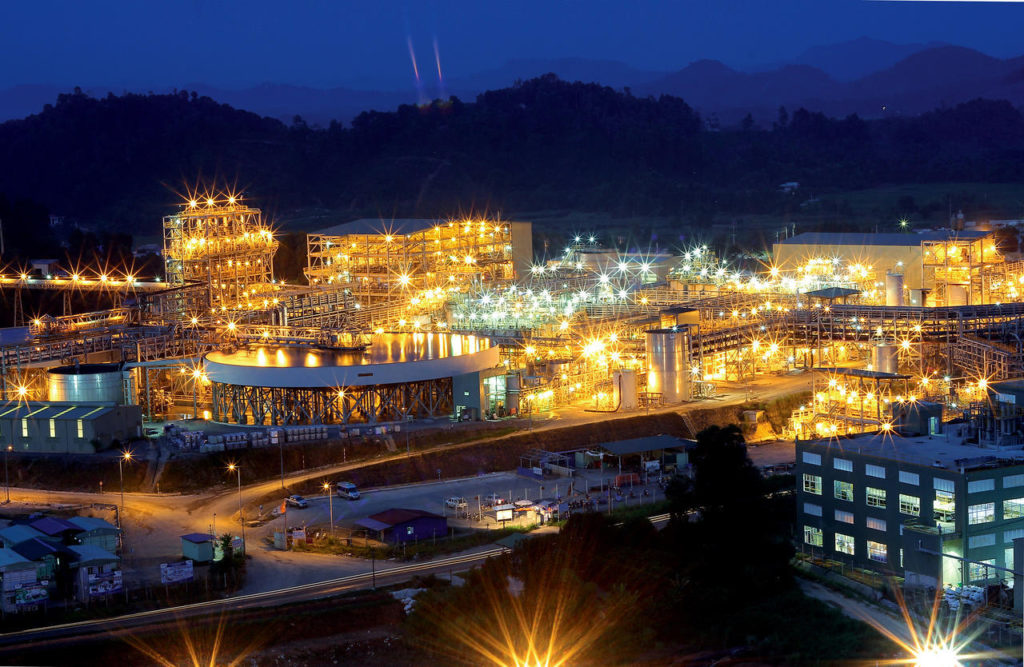
Some 80 kilometers (50 miles) north of Hanoi, in Thai Nguyen province, a massive open-cut mine tears into the landscape. Ringed by dense, green hills, the vast, stepped crater is raw gray and brown. Along its sides, huge trucks creep along, while a murky pool lies stagnant at the bottom.

This is Nui Phao, a mine that’s key to Vietnam’s foothold in the global critical minerals market. It contains one of the world’s most important, and largest, non-China sources of tungsten, a metal essential for everything from chips and drilling equipment to armor-piercing weaponry.

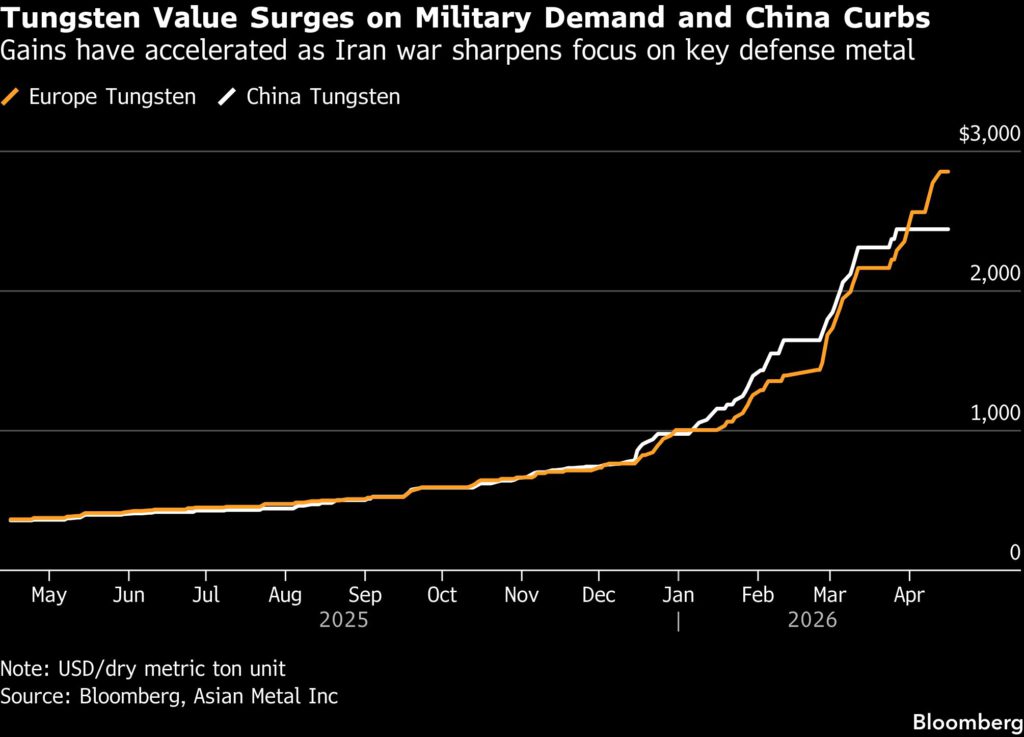
With the value of the super-dense material soaring as countries ramp up defense budgets, it’s little wonder Nui Phao’s owner, Masan High-Tech Materials, a unit of Masan Group, is amping up its search for strategic investors.

“We’ve been talking to Japanese, Australian, European and American strategic” investors, Masan Group deputy chief executive officer Michael Hung Nguyen told Bloomberg News after a media tour of the mine on Friday. “A lot of interest is coming from people who want to secure supply.”

With Masan looking to conduct a public listing at some point, “anybody with a strategic equity stake we would obviously be providing a progressive offtake agreement to sweeten the deal and make it long term.”

Masan High-Tech is currently preparing to transfer its shares from Vietnam’s Unlisted Public Company Market, or UpCom, to the Ho Chi Minh City Stock Exchange and hopes that can be done as early as the first quarter of 2027, Masan Group CEO Danny Le told a shareholder meeting on Thursday.

China is the world’s main producer of tungsten and also holds the largest reserves. In February last year, it tightened tungsten export controls to protect its own domestic stash. As the Trump administration intensifies efforts to reduce reliance on Chinese supply chains, the material has become one of the metals caught in the crossfire.

“Tungsten is in many ways the model ‘critical mineral’ — production is dominated by China, Beijing has implemented export controls, the US has no domestic mine production, and it is an essential and difficult-to-substitute input to important commercial and defense technologies,” said Chris Kennedy, economic statecraft lead, Bloomberg Economics.

The 921-hectare Nui Phao project, which is licensed until 2034, is one of the biggest producers of tungsten outside China, according to the mine’s operator. With an estimated 3,000 tons in total, Vietnam was the world’s No. 2 producer of tungsten behind Beijing last year, according to the US Geological Survey.

Although Masan is seeking to reduce its stake in Masan High-Tech and bring in a strategic partner, with tungsten central to advanced manufacturing and defense supply chains, any transaction will carry geopolitical significance.

Prospective investors will likely be evaluated not only on financial terms but also on their alignment with party chief and newly appointed President To Lam’s broader industrial policy objectives, including technology transfer, downstream processing and long-term value creation within the domestic economy.

“Critical minerals are a highly sensitive area in Vietnam, so bringing in a partner is in many ways also about choosing a long-term technological partner,” Nguyen Khac Giang, a visiting fellow at ISEAS-Yusof Ishak Institute said. “The government is likely to look beyond the financial terms and ask whether a prospective investor fits Vietnam’s broader ambitions.”

Even though Masan is a private company, it will “still need to take those considerations into account,” he said.

Vietnam holds other significant critical minerals deposits too, notably bauxite and titanium, and it’s home to the world’s sixth-largest reserves of rare earths. This could provide Hanoi with leverage as it seeks to develop an industry essential to powering cutting-edge technologies, electric vehicles and the broader green transition.

Masan High-Tech’s mine also produces fluorspar, an industrial mineral that’s used in lithium-ion batteries, bismuth, a metal that’s used in green energy and high-tech electronics, and copper.

But despite its abundant reserves, Vietnam has so far failed to capitalize well on its natural resources.

Complex regulatory hurdles and opaque licensing processes have deterred investors, along with a corruption scandal involving one of the biggest Vietnamese rare earth firms. A new Geology and Mineral Law in 2024 was aimed at improving access to more foreign investors.

In December, the law was amended to restrict exports of unprocessed rare earth ores, signaling a shift toward higher-value domestic processing. That fits with To Lam’s desire to move up the value chain as the country strives for 10% growth.

The European Union, the US and Australia are all positioning themselves to access Vietnam’s critical materials. In January’s upgrade of ties with the EU, both sides agreed to deepen cooperation, including through promoting sustainable mining and processing technologies.

“The EU is ready to support Vietnam in developing its own independent value chain to ensure its strategic autonomy and ensure that both the EU and Vietnam have the necessary critical raw materials for the energy and digital transitions,” EU Ambassador to Vietnam, Julien Guerrier, said. “This is very much in line with what we agreed on in January as we upgraded our partnership with Vietnam to a comprehensive strategic one.”

The US meanwhile, when then-President Joe Biden visited Hanoi in 2023, highlighted improving technical cooperation to support Vietnam’s efforts on rare earth reserves. Last August, Australia hosted a Vietnamese fact-finding delegation aimed at expanding sustainable mineral development as part of its deepening cooperation with the Southeast Asian nation.

While Vietnam is seeking foreign capital and technical overseas know-how, the sector remains dominated by state-owned groups such as Vinacomin, with international investors typically limited to joint ventures.

Australia’s Blackstone Minerals holds a majority interest in the Ban Phuc nickel mine in Son La province. However the mine was suspended between 2016 and 2018 due to financial losses.

In the company’s latest half-year financial report, it said it had struck an agreement with Xuan Loc Tho Co. to progress development, although it classified the mine and planned refinery as a “discontinued operation.”

Masan has had some success wooing overseas suitors before. In 2024, it sold its stake in H.C. Starck’s global tungsten business to Japan’s Mitsubishi Materials Corp. and used the proceeds to pay down debt and refocus on its core business.

Masan High-Tech reported preliminary net profit after tax of 537 billion dong ($20.4 million) in the first quarter, surpassing what it cleared for all of 2025.

The company plans to tap into a further 28 million tons of underground reserves in the current complex, and another 20-21 million tons in the mine’s west pit.

“We have already submitted the application for the exploration license that we are expecting to get within this year,” Aditya Agarwal, Masan High-Tech Materials deputy CEO said.

(By Francesca Stevens and Nguyen Dieu Tu Uyen)


Ho Chi Minh City Approves $5B MSC Container Terminal

Can Gio International
Courtesy HCMC

Published Apr 17, 2026 2:58 PM by The Maritime Executive


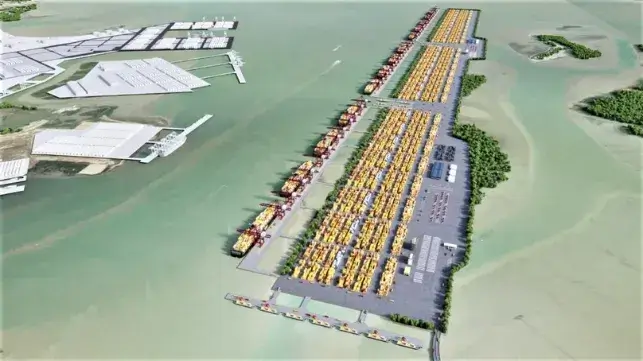
Vietnam’s transshipment port project Can Gio International has made progress, with Ho Chi Minh City this week approving the consortium to lead its development. The partners under the consortium are led by MSC’s Terminal Investment Limited (TIL) with a 49% stake, Vietnam Maritime Corporation with 36% and Saigon Port, a subsidiary of VIMC, with 15%.

The joint venture will see the development of Vietnam’s biggest transshipment port, with Ho Chi Minh City looking to raise its status as a global maritime hub. The development proposal for a transshipment port project has been awaiting the city’s approval for almost four years. The $4.9 billion Can Gio International will be built over an area of 570 hectares on an offshore islet, Go Con Sho, at the mouth of the Cai Mep River. The port is designed to have an initial capacity for 4.8 million TEU by 2030, reaching 16.9 million TEU by 2047.

In the first phase, the port will have up to four berths capable of handling vessels of up to 250,000 tons. The long term goal is for the port to have 13 berths and a total quay length of 7.5 kilometers. In the selection of the consortium, the city had indicated it would focus on among other factors including financial capability and port operation expertise.

The port project significantly increases MSC’s footprint in Vietnam's extensive port system. The world’s largest ocean carrier already has a presence in Ho Chi Minh City, operating in the Cai Mep port cluster. Currently, MSC handles more than one million TEU of Vietnamese imports and exports each year.

If implemented, Can Gio adds to the massive port investments being carried out by Ho Chi Minh City. Early this year, the city approved expansion to the Cai Mep cluster, which will see development of the new Cai Mep Ha port project at a cost of $1.95 billion. This port will raise the city’s port system capacity by 10.8 million TEU annually. The port project is designed to serve a dual-role of a national gateway and also as an international transshipment hub.


"Energy Dominance" In Action

Middle East crisis has made the U.S. the marginal supplier

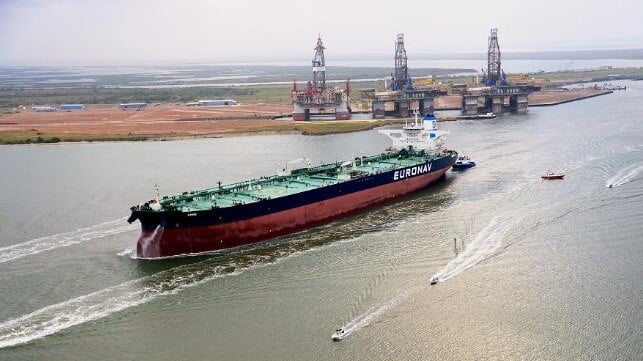
A VLCC in ballast arrives at Port of Corpus Christi (file image courtesy Port of Corpus Christi)

Published Apr 17, 2026 7:38 PM by Erik Broekhuizen / Poten & Partners


The crisis in the Middle East and in particular the effective closure of the Strait of Hormuz has upended global oil markets. Both crude oil and refined products are now in short supply. Refiners around the world are desperate to get their hands on alternative sources of crude oil, almost at any price. However, the options are limited and dwindling. The volume of Russian and Iranian oil in floating storage is shrinking fast since the U.S. has lifted some of its restrictions, allowing countries to buy these previously sanctioned barrels. Several countries have tapped into their strategic petroleum reserves, but most of this oil is being allocated to domestic refiners and not traded internationally. So, the focus has shifted to the Atlantic Basin, where several producers (Venezuela, Canada, Brazil) have some capability to ramp up production and exports. However, in this Weekly Tanker Opinion we want to highlight the United States.

The United States is by far the largest oil producer in the world. In 2018 it surpassed Russia and Saudi Arabia due to advancements in hydraulic fracturing (fracking) and horizontal drilling. U.S. crude oil exports, which (re)started in earnest after the crude export ban was lifted about 10 years ago, quickly ramped up from 500,000 barrels per day in early 2016 to average more than 4.0 Mb/d in 2023 and 2024. According to data released by the U.S. Energy Information Administration (EIA) on Wednesday, exports climbed to 5.2 million bpd, the highest in seven months. This was due to record demand from Asian and European buyers, who are scrambling to replace barrels from the Middle East that are trapped inside the Persian Gulf because of the war.

U.S. crude oil exporters are expanding their reach. Greece has bought U.S. crude for the first time ever, while Turkey bought a cargo for the first time in a year. The one limitation that could cap the U.S. export potential is the specifications of the U.S. crude. West Texas Intermediate (WTI), the main U.S. export, is a light sweet crude, while the refiners are trying to replace medium sour barrels from the Middle East. Mars crude is a medium sour grade produced in the U.S. Gulf of Mexico, but its production volumes are limited.

At the same time as exports surged, U.S. crude imports took a dive. Imports from Canada were at their lowest level for this year. Flows from Saudi Arabia and Iraq were down significantly as well, for obvious reasons. As a result, net imports of crude oil (the difference between imports and exports), narrowed to 66,000 barrels per day last week, the lowest on record in weekly data that goes back to 2001. This means that the U.S. nearly turned into a net crude exporter last week for the first time since World War II. Exports are expected to increase significantly in the coming weeks and this switch to a net exporter could become reality.

However, as a result of this ramp up in flows, the U.S. is approaching its export capacity. The U.S. is capable to export up to 6.0 Mb/d, according to estimates from industry experts. Pipeline capacity and export infrastructure are the limiting factors. U.S. exporters have become very adept at maximizing exports with a combination of direct loadings in U.S. Gulf ports and reverse lightering in designated areas offshore. However, outside of Corpus Christi, which can partially load a VLCC (only one reverse lightering needed), the Louisiana Offshore Oil Port (LOOP) is the only U.S. facility in the U.S. Gulf that can fully load a VLCC. More deepwater terminals are being planned, but none are available during this crisis.

U.S. refiners have also ramped up production and exports, motivated by strong refining margins and high crack spreads. In recent weeks, we have seen seaborne clean product exports (excluding LPG, lubes and chemicals) exceed 3.5 Mb/d driven by increased flows to Asia. These volumes represent record-highs.

The booming crude oil and refined product exports from the U.S. have benefited all tanker segments. The desire to get access to barrels (and get them quickly) has motivated certain Asian charterers to import crude from the U.S. Gulf on Aframaxes, routing it via the Panama Canal. These are not trades you would expect to see in normal circumstances, but these are not normal circumstances. When the conflict ends, vessels will reposition and eventually normal trade patterns will resume. Until that time, we do expect increased volatility and higher freight rates for most tanker segments to continue.

This research note appears courtesy of Poten & Partners.

The opinions expressed herein are the author's and not necessarily those of The Maritime Executive.


Riding the LNG Wave

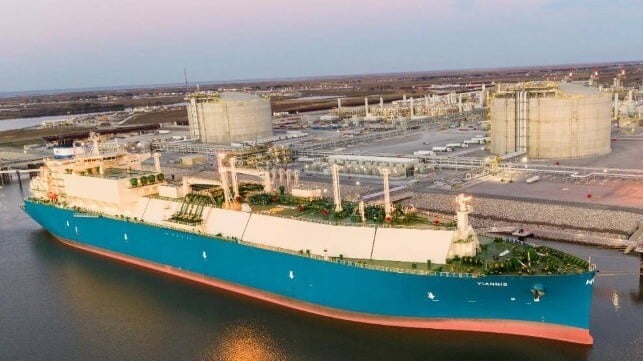
Calcasieu pass
File image courtesy Venture Global LNG

Published Apr 17, 2026 11:42 PM by Sean Hogue

(Article originally published in Jan/Feb 2026 edition.)


The age of global LNG is upon us.

In the latter half of 2025, the global supply increased nearly seven percent. This came largely from North America, which frankly has LNG down to a science. It's abundant here. We know how to extract it in an environmentally conscious manner, and we have the infrastructure to process, store and move it.

New U.S. LNG projects reaching final investment decisions in 2025 included Louisiana LNG, Corpus Christi Trains 8 & 9, CP2 phase 1, Rio Grande LNG Train 4 and Port Arthur Phase 2. This new wave further solidifies the U.S.'s position as the world's largest LNG supplier with global market share expected to increase from about 25 percent last year to 33 percent by the end of the decade.

The rise in supply is expected to drive increased global demand in 2026, primarily from Asia, but also from other global markets as they invest in infrastructure to effectively import this clean, abundant energy source.

And as LNG produces 30 percent less CO? than heavy fuel oil and nearly zero sulfur oxides, it's the cleanest of fossil fuels and an ideal choice for meeting emissions targets over the next decade.

Although achieving that goal is not without its challenges.

Class guidance

In ABS's 2025 Sustainability Outlook, "Vision Meets Reality," the authors rightly note that "from a total cost of ownership perspective, clean fuels currently present a weak economic case due to their high costs and limited availability." And while clean fuels such as ammonia may play a role in the energy transition, they're unlikely to achieve significant decarbonization by 2040.

Conversely, LNG offers lower base costs and an established supply chain, contributing to its being specified in over 70 percent of alternative-fuel newbuild orders.

The cruise, ro/ro, car-carrying and container industries have widely adopted alternative fuels over conventional ones. As ABS has become the largest classification society by gross tonnage in service as of 2025 while maintaining a strong presence in the tanker, gas carrier and containership sectors, it stands perfectly positioned to guide shipowners in their transition journey.

Lloyds Register (LR) is another source of expert advice to vessel operators in their energy transition journey.

The energy transition challenge is really a risk management problem. What fuel to choose? What equipment to purchase? Which ones will be readily available long term with the global infrastructure to support them?

LR's approach is not prescriptive – it remains firmly fuel agnostic. The company has invested significantly in the study of all alternative fuels including its involvement in the Methane Abatement in Maritime Innovation Initiative. This collaboration, led by Safetytech Accelerator, unites industry leaders, tech innovators and maritime stakeholders working together toward the goal of significantly reducing methane emissions from LNG use as a marine fuel.

"Methane slip," as it's known, is the release of unburned methane into the atmosphere from engines using natural gas or liquefied natural gas (LNG) as fuel. It occurs when combustion isn't 100 percent efficient. Because methane is a potent greenhouse gas (over 25 times stronger than CO? over 100 years), minimizing slip is crucial for climate change mitigation.

A significant milestone for LR is the recent renewal surveys and drydocks for P&O Cruises' Iona and Carnival Cruise Line's Mardi Gras – the first major LNG drydocks for large passenger vessels in Europe. The work represented the execution of a highly sophisticated technical program, the culmination of more than a year of detailed collaboration, planning and risk management.

Drydocking a LNG-fueled cruise ship is a fundamentally different exercise from a conventional refit. With vessels spending only a brief period out of service, LNG system maintenance windows are correspondingly narrow.

"Starting 18 months in advance," explains Andrew Bennett, Machinery Survey Policy Manager in LR's Technical Directorate, "we worked closely with the client to understand their specific operation, maintenance and drydocking challenges and helped them develop detailed schedules with optimized surveys agreed in advance and aligned to meet their requirements."

Bunkering Expertise

Running on LNG requires a bunkering infrastructure to support the operation.

Headquartered in Jacksonville, Florida, TOTE Services is playing a critical role in bringing LNG fuel to the maritime sector through their design and construction of the bunker barges Clean Jacksonville and Clean Everglades, operated by Seaside LNG.

The Clean Jacksonville was the first membrane LNG barge in the world. Membrane technology provides a better space-to-weight ratio and replaces the older, pressure vessel technology used previously for storage and transport. TOTE has completed over 400 bunkering operations with the Clean Jacksonville since it was first launched.

Another newbuild support vessel entering the market in 2025 was the Soaring Eagle, an inland tug operated by Colonial Towing, a subsidiary of the Colonial Group. It will operate as part of an articulated tug-and-barge unit transporting up to 32,000 barrels of fuel products between Charleston, South Carolina and Jacksonville, Florida. Soaring Eagle is the fourth vessel to join the current active fleet of Colonial Towing.

Also in Florida, Glander International Bunkering is making moves with a recent change of leadership. Michael Cammarata replaced long-time Managing Director Larry Messina, who retired after 34 years of service. Cammarata has spent his entire career in bunkering, having joined the company back in 1988.

As such, he brings decades of experience and deep market insight into his role. He also brings strong relationships across the industry. His appointment ensures continuity for the Florida office. It also supports future growth and long-term success.

Global FIDs

We've looked at the U.S.-based projects. But what about the rest of the world?

Chevron's Gorgon LNG project received a $2 billion final investment decision at the end of 2025 to develop Stage 3 off Australia's northwest coast. The development will be used as backfill for the existing LNG export operation and will link the offshore Geryon and Eurytion natural gas fields to Gorgon's existing infrastructure on Barrow Island.

In Gorgon Stage 3, six wells will be drilled across two fields, part of a series of planned subsea tiebacks.

Shell's plans for drilling at the Crux field, also offshore northern Australia, were accepted around the same time. Crux's gas will be sent as backfill to the Prelude floating LNG vessel, the world's largest.

In southern Australia, U.S. oil company ConocoPhillips has just finished its first exploration well in the region and will now move to a nearby location for a second well.

Chevron also made a final investment decision early in January to expand Israel's Leviathan natural gas field, a move that will significantly boost gas production in the eastern Mediterranean. The decision comes weeks after Israel finalized what Prime Minister Benjamin Netanyahu described as the largest energy deal in the country's history – a long-term gas export agreement with Egypt valued at about 112 billion shekels, roughly $35 billion.

The Leviathan expansion provides the upstream capacity needed to support those larger export commitments over time. Chevron operates Leviathan alongside Israeli partners. When the expanded project comes online later this decade, it will further help entrench Israel's role as a regional gas supplier.

A strong outlook

With new projects sanctioned, infrastructure expanding, and class, operators and bunkering providers aligned around practical risk management, the LNG market enters 2026 with strong momentum.

Growth will be in delivered capacity, proven technology and real-world operating experience. As demand accelerates and standards continue to evolve, LNG is positioned to remain the cornerstone of global marine and energy growth through the next decade.


The opinions expressed herein are the author's and not necessarily those of The Maritime Executive.


US Coast Guard Plans to Homeport First Two Finnish Icebreakers in Alaska

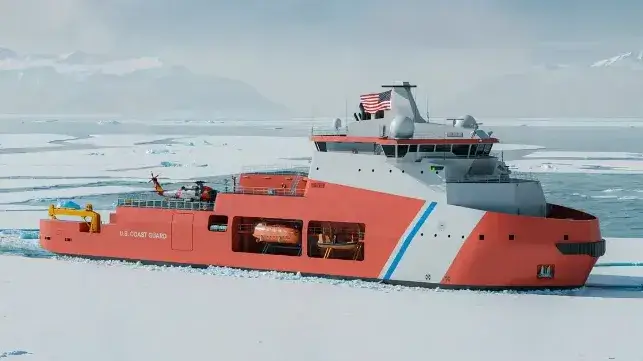
The Davie/Helsinki Shipyard variant of the Arctic Security Cutter (Davie)

Published Apr 16, 2026 10:34 PM by The Maritime Executive


After considerable pressure from Alaska's congressional delegation, the Coast Guard has decided that the first two of its new Finnish-built icebreakers will be homeported in Alaska, where they will be close to sea ice but far from the Lower 48's maintenance infrastructure and housing markets.

The new Arctic Security Cutter is a medium icebreaker program with two designs and two contracting consortia. The first contract award covers up to six hulls and went to Finland's Rauma Marine (two hulls) and Gulf Coast yard Bollinger (four hulls). The second award for up to five hulls went to Canadian shipbuilder Davie and its Finnish subsidiary, Helsinki Shipyard. The first two will be built in Finland, the remaining three at Davie's yards in Port Arthur and Galveston, formerly owned by Gulf Copper. Davie and Helsinki will be working to a different, well-established design. The award will yield two classes of vessel (or variants, per the Coast Guard) in one program of record - not unlike the Littoral Combat Ship (LCS) or the Medium Endurance Cutter (WMEC). 

The first two hulls should deliver by the end of 2028; a third vessel could also end up in Alaska, according to the state's congressional delegation. Once commissioned, they will need homeport facilities and housing for crew and support staff, the service emphasized. 

“Homeporting these two Arctic Security Cutters in Alaska is a decisive step forward in securing America’s Arctic frontier,” said Secretary of Homeland Security Markwayne Mullin in a statement. “These vessels will deliver the enduring operational presence our nation needs to protect sovereignty, deter foreign adversaries, and safeguard vital resources for the American people.”

Alaska is on the front lines of contact with Russian and Chinese interests in the Arctic, and that competition has been heating up in recent years. Adm. Kevin Lunday, Coast Guard commandant, described the homeporting decision as a strategic choice. 

"By strategically positioning these state-of-the-art icebreakers in Alaska, the Coast Guard will maximize our ability to defend our northern border and approaches, while reinforcing America’s maritime dominance in a crucial region," he said. 

The Coast Guard is also investing in infrastructure improvements in Juneau, Alaska to accommodate the newly-purchased commercial icebreaker Aiviq, now renamed USCGC Storis. The new base will cost about $300 million - but may not be ready until 2029, Adm. Lunday told a Senate hearing in February. 

The West Coast's large commercial drydock facilities are concentrated in Seattle, Portland and San Diego, supported by a network of suppliers and well-developed housing and labor markets. Almost all of the large fishing companies, cruise operators and domestic shipping services for the Alaska market are based out of Seattle, the closest metropolis in the Continental U.S. to the northern reaches of the Pacific. Seattle is also the Coast Guard's primary base for icebreakers. 

Alaska has a critical housing shortage, a hurdle for opening new operations centers in the state. "In almost every community, housing is an issue, and it’s an issue throughout the whole state," said Sen. Dan Sullivan (R-AK), speaking to the Alaska Beacon. "This is where we need to get the state, the cities, the boroughs also, to come to the table."


Pacific Basin Cancels Methanol Vessels Due to Climate-Rules Uncertainty

Pacific Basin
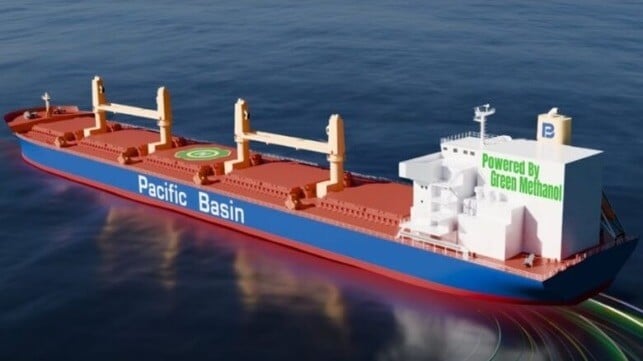
Illustration courtesy Pacific Basin

Published Apr 17, 2026 3:37 PM by The Maritime Executive


Pacific Basin Shipping, one of the world's largest operators of dry bulk vessels, is partially abandoning plans to anchor its future fleet growth on green methanol after terminating a contract for four dual-fuel Ultramax newbuilds.

As one of the world's leading owners and operators of Handysize, Supramax and Ultramax dry bulk vessels, Pacific Basin operates around 250 ships, of which over 100 are owned and the rest chartered. Four years ago, the Hong Kong-based shipping company said it was putting green methanol at the center of its ambitions to build zero-emission vessels. In November 2024, it went ahead and placed its first order for the construction of four 64,000 dwt dual-fuel vessels at Nihon Shipyard Co. through Mitsui & Co.

In a reversal announced April 16, the company announced it had reached agreements with the two yards to terminate the contract for the four vessels and convert the agreements into a purchase of four conventional Ultramax newbuilds, with an option for two more. In making the decision, Pacific Basin cited renewed uncertainty around the timing and final shape of a global regulatory framework designed to drive the green fuel transition.

Converting the deal from dual-fuel to conventional vessels means the company will spend $39.2 million for each of the vessels ($156.8 million cumulatively) as opposed to spending $45.4 million each on the methanol ships ($181.6 million cumulatively). The vessels are expected to be delivered between 2028 and mid-2029.

Despite altering the deal, the company highlighted that the agreement with Mitsui & Co. includes an option to acquire two 64,000 dwt dual-fuel (methanol/fuel oil) Ultramax newbuilds at a cost of $45.5 million each ($91 million in total) with delivery expected between April 2030 and March 2031.

Pacific Basin said that the decision is a financially prudent response to uncertainty around the timing and final shape of the Net-Zero Framework (NZF), the IMO proposal designed to create a global standard for shipping decarbonization. In October last year, International Maritime Organization member states failed to adopt the previously agreed-upon framework owing to political divisions. Members voted to adjourn discussions for one year, and the mechanism's future is uncertain. 

Though Pacific Basin expects some form of a NZF-type global mechanism to be adopted eventually, the company sees a better deal for its shareholders if it avoids a near-term investment in expensive dual-fuel vessels. 

"The disciplined renewal and growth of our fleet with modern, efficient ships is a core priority for Pacific Basin so that we can continue to meet strong customer demand, comply with tightening fuel-efficiency regulations, increase our market outperformance and deliver long-term shareholder value," said Martin Fruergaard, Pacific Basin CEO.

He added that while the newbuild commitments align well with that priority, the importance of having vessels with super-efficient designs cannot be overstated in the current high-fuel-cost environment.

Pacific Basin has also placed another order for two 40,000 dwt Handysize newbuilds at a cost of $59.6 million. The ships, in addition to an order for two placed last year, will be built at China's Jiangmen Nanyang Ship Engineering Co. yard and are expected to be delivered in the second half of 2028.  


Russian Strike Hits Foreign-Flagged Bulker Off Coast of Odesa

Russian strike
Courtesy State Emergency Service of Ukraine

Published Apr 15, 2026 9:46 PM by The Maritime Executive


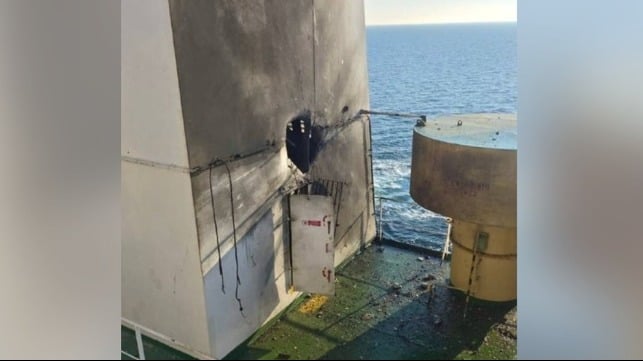
On Tuesday morning, Russian forces hit a foreign-flagged merchant ship at a port in the Odesa region, according to Ukrainian authorities. It is the latest in a long string of Russian strikes on civilian vessels in and around Ukraine, part of Moscow's effort to damage the Ukrainian economy. 

"A Russian drone hit a civilian merchant ship under the Liberian flag, which was heading along the sea corridor to load corn," Ukraine’s Ministry of Community and Territorial Development said in a brief notice. "The crew managed to quickly extinguish the fire. Fortunately, no one was injured. The ship continued its movement and reached the port."

Reuters has identified the vessel as the Lady Maris (IMO 9228071), a bulker flagged in Liberia, owned in the UAE and managed in India.

In addition, the Russian strike hit the port of Izmail and damaged an additional ship flagged in Panama.

Operations continue, the agency said. "Ukraine continues to ensure the operation of the sea corridor and fulfill export obligations, despite constant risks," said the ministry. 

On Wednesday morning, Russia struck again with a volley of ballistic missiles and a total of more than 300 long-range attack drones, according to Ukraine's air force - the majority reportedly built to the Iranian-derived Shahed drone design. Port-related warehouses and administrative buildings were hit in the Odesa region.

Russian attacks have reportedly cut Ukraine's grain shipping activity by about one third, forcing exporters and shipowners to continually reroute shipments from one loading terminal to another in order to take advantage of functioning infrastructure. The attacks could worsen, warned Ukrainian President Volodymyr Zelensky: the country's armed forces have so far been able to fend off the worst Russian ballistic missile strikes using U.S.-supplied Patriot batteries and PAC-3 interceptors, paid for by European nations and donated to Ukraine. Those interceptors are now in high demand and short supply due to ultra-high consumption in the Mideast, a consequence of the Israeli-American conflict with Iran. 

"If the war drags on, there will be fewer weapons for Ukraine," Zelensky told German broadcaster ZDF. "We have such a shortage right now – worse than ever."


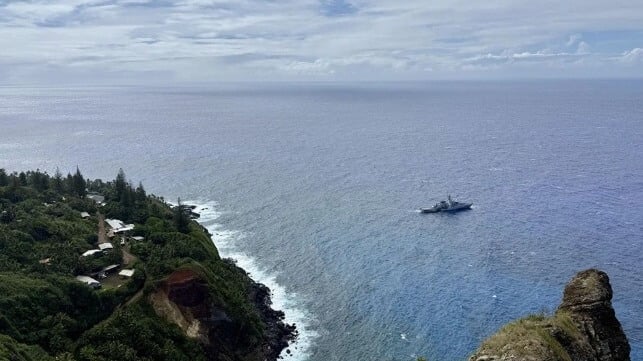
Royal Navy Pays a Visit to Pitcairn, the UK's Sole Pacific Territory

HMS Tamar off Pitcairn (Royal Navy)

Published Apr 17, 2026 8:56 PM by The Maritime Executive


Unlike the French, the United Kingdom has for the most part given up what used to be its empire, retaining only a ceremonial role in the governance of most its former colonies. However, the UK still has direct control of a small number of overseas territories, sufficiently spread around the world for US military planners to be able to usually find a small British-owned island somewhere close by should a crisis arise, and from which operations can be supported.

One such speck of red in the middle of nowhere is the island of Pitcairn, deep in the southern Pacific Ocean. Pitcairn is still inhabited by descendants of Royal Navy mutineers who deserted from HMS Bounty in 1789. But historical antagonisms appear to have been put aside by descendants of the mutineers during a visit in early April by the offshore patrol vessel HMS Tamar (P233).

HMS Tamar conducted fishery protection patrols across the Pitcairn 325nm-wide sea area, which includes outlying unpopulated Henderson Island, Oeno, Dulcie and Sandy Island. The embarked Diving & Threat Exploitation Group on board HMS Tamar also neutralized a large quantity of unstable ammonium nitrate on Pitcairn Island. With their disposal task completed, the embarked team is now available for mine clearance tasks elsewhere.

HMS Tamar is a River Class Batch 2 offshore patrol vessel built by BAE Systems on the Clyde in Scotland. The type has been sold to Brazil, Bahrain and Thailand, where armed with a 76mm gun it has been active in maritime disputes with Cambodia. Unlike some other vessels in the Royal Navy beset with maintenance issues, the River Class have proven to be remarkably reliable, to the extent that they can be double-crewed to increase their time at sea.

The principal criticism of the Batch 2 ships is that for very little extra money the hulls could have supported a hangar to have a helicopter permanently on board plus further weapons systems, including the 76 mm gun with which Thai ships are equipped. HMS Tamar and her sister ship HMS Spey (P224) are permanently based in the Indo-Pacific, and are home-ported at the UK Fleet Support Base in Singapore.


Sweden Busts Bulker for Washing Russian Coal Residue Into the Baltic

Courtesy Kustbevakeningen

Published Apr 12, 2026 8:10 PM by The Maritime Executive


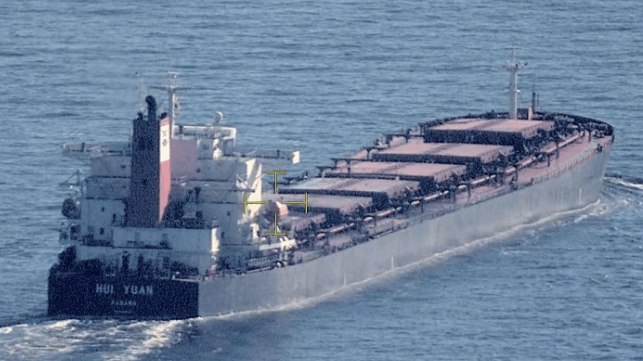
After years of tolerating under-regulated tonnage linked to Russian trade in the Baltic, NATO member nations have begun cracking down on traffic to and from the St. Petersburg region. That initiative has focused on irregularities aboard "shadow fleet" tankers, but all vessels capable of dragging anchor across a subsea cable are getting scrutiny. The latest boarding occurred Sunday morning, when Swedish authorities caught a Chinese-owned bulker in an apparent marine pollution violation. 

At about 0800 on Sunday morning, the Swedish Coast Guard patrol vessel KBV 003 interdicted the Panama-flagged bulker Hui Yuan at a position off Ystad, to the south of Sweden. Officials with the Kustbevakningen suspected that the ship had washed off coal residue into the water, which is forbidden in Sweden's Baltic waters. 

On questioning, the master of the vessel admitted that he "committed these crimes out of negligence," Swedish prosecutor Hakan Andersson told SVT. The ship posted a bond to cover the possibility of future fines, and she has been allowed to depart, as is customary. 

Hui Yuan is Panama-flagged and owned in Guangzhou. She loaded a cargo of coal at the Utramar terminal near Ust-Luga, Russia last week, and is now broadcasting her destination as Las Palmas, Spain. It is unclear whether she would intend to unload in Las Palmas, since the EU has banned the importation of Russian coal.

"The shipping industry should know that Swedish authorities are working close together to maintain order at sea. We are acting to increase maritime safety and protect the environment. If there is a suspicious vessel, we do intervene, based on the prevailing conditions," said Daniel Stenling, Deputy Head of the Swedish Coast Guard’s Operations Department.