
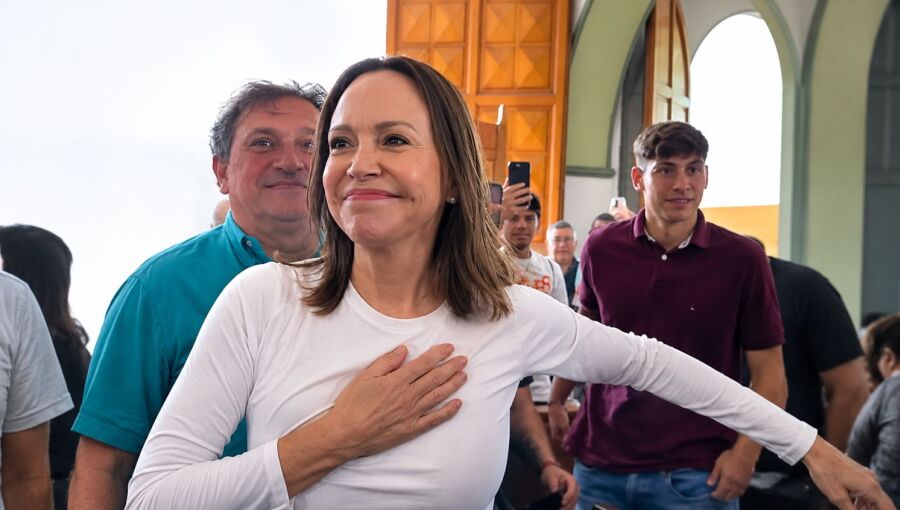
Venezuelan opposition leader María Corina Machado arrived back in her country on October 25, ending an exile that began last December and overcoming repeated obstacles to re-entry, as Washington and the interim government press ahead with a transition in which she has had little say.
“I am here. With you,” Machado, who won the 2025 Nobel Peace Prize, wrote on X, giving no further details. Her team said it would provide information on how she got back in the coming hours.
Former opposition presidential candidate Edmundo González Urrutia, whom Washington and other governments recognised as the winner of the disputed 2024 election, confirmed her arrival on X. “Venezuela! I am very excited to announce that our leader, my dear Maria Corina, is in Venezuelan territory,” he wrote.
“Today is a very important day for Venezuelans. Our sovereign voice returns with her to lead and guide this process!” added González Urrutia, who ran in Machado's place as the main opposition candidate and has lived in exile in Madrid since September 2024.
Photographs released by the opposition showed supporters welcoming Machado at the Church of Santa Rosa in Lara state. David Alandete, a journalist with Spanish newspaper ABC, said on X that she was due to appear at the Divina Pastora sanctuary in Barquisimeto.
Alandete said her return was the result of a diplomatic operation involving several countries, carried out with the knowledge of the United States. “Without Washington’s approval, this operation would not have been possible,” he wrote.
US President Donald Trump, however, said he had not been aware of her plans. “I don’t know anything about it, but I think she’s a very nice woman,” Trump told CNN. “She gave me her Nobel Prize, so how can I say anything else? And I hope she’s safe.”
Earlier this month, asked by Alandete at the White House whether he supported her intention to go home, Trump said “everything is going to turn out fine”.
Dinorah Figuera, the opposition’s lead negotiator in talks with the interim government, said the homecoming was made possible by the fall of former president Nicolás Maduro and the dialogue that followed. US Secretary of State Marco Rubio shared that view.
“The United States expects the freedoms of all sectors of Venezuelan politics to continue to be respected,” Rubio said. “Likewise, we expect all political actors to support these talks which represent the best chance Venezuela has had in thirty years to peacefully achieve not just a free and fair election but an enduring democracy.”
Machado left Venezuela in December 2025 after more than a year in hiding to avoid arrest. She had alleged fraud in the July 2024 election, in which the National Electoral Council proclaimed Maduro the winner without publishing a detailed breakdown of the vote.
She left the country secretly by boat at night for Curaçao and then flew to Oslo, but security constraints along the way prevented her from reaching the Nobel ceremony in time. Her daughter collected the prize in her place.
Her advisers say she made at least seven bids to return by air and sea. In late June, after twin earthquakes caused heavy damage, she tried to fly in to help with recovery work, but said authorities stopped her by shutting Venezuelan airspace.
She made three more unsuccessful bids on a single day in late September, when acting President Delcy Rodríguez was in New York for the UN General Assembly, her team said.
Rubio said on September 1 that the decision to return was hers to make, though Washington had voiced worries about it. “María Corina Machado, a Venezuelan citizen, has every right to enter her country whenever she wants to return,” he said.
Her arrival followed that of Omar González, one of her closest aides, who came home in late August after almost three years abroad and cast his return as a “prelude” to hers.
US forces captured Maduro in a brazen military operation on January 3. Shortly afterwards, Trump said Machado lacked the support and respect inside Venezuela to lead it, and Washington opted to work with Rodríguez, Maduro’s former vice president.
Machado handed Trump her Nobel medal at a White House lunch on January 15, after which he said he would like to involve her in the country’s future. The Norwegian Nobel Committee has said the laureate title cannot be transferred.
Rodríguez has largely complied with US requests, releasing hundreds of political prisoners and opening the door wider to American investment in the country’s oil and mineral wealth. The US Treasury removed her from its sanctions list on April 1.
On August 28, Trump announced a deal giving a US-backed operator rights to develop oilfields holding some 65bn barrels of proven reserves, an agreement the administration said would bring more than $100bn in investment. Machado objected in a video message, questioning the right of what she described as an “illegitimate regime” to sign the agreement.
At last month’s UN General Assembly, Rodríguez promised new elections and a full return to democracy, but her government has not set a date. Trump said on September 2 he did not think the country was “ready yet” for a vote.
Machado has called for a presidential vote within a year and has suggested she may run.

No comments:
Post a Comment