
Russia and Ukraine are both spending more than their budgets take in. But the war is testing their finances in different ways. Russia has a much larger economy, an oil export income stream worth billions of dollars (sanctions are not working) and a relatively small public-debt burden. Russia’s budget it coping – just. Ukraine’s position is a lot more precarious. It is trying to sustain the state and the war effort on a far smaller economy and without substantial outside help, its domestic resources simply cannot cover the bill.
The contrast is clearest when spending is measured against the size of each economy. The IMF expects Ukraine’s general-government expenditure to reach 77.9% of GDP in 2026, compared with 39.2% in Russia. Its projected Ukrainian deficit is UAH1.156 trillion ($25.7bn; 11.3% of GDP), after revenue including grants. Russia’s is RUB7.489 trillion ($93.0bn; 3.2% of GDP). These forecasts cover the whole general-government sector, including more than the central cash budgets examined below. [1]
Ukraine is financing a much larger state relative to its economy
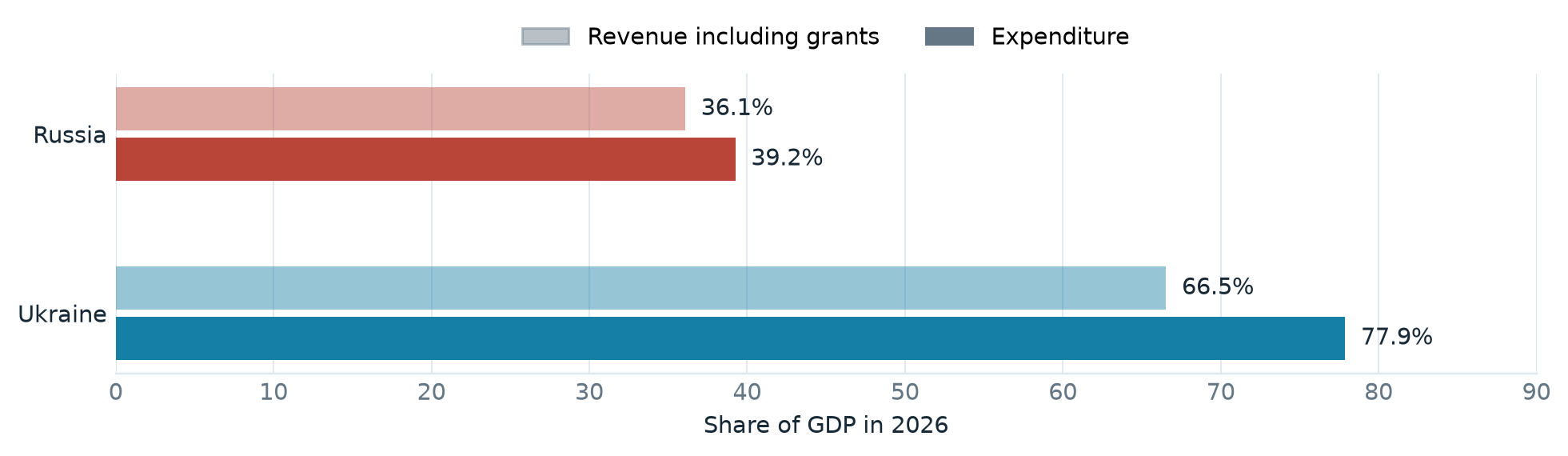
2026 IMF October forecasts. General government; revenue includes grants. These are annual projections, not nine-month cash results. Source [1].
Russia’s public-debt ratio is still far below Ukraine’s. That gives Moscow more room to absorb a deficit, but does not make borrowing cheap or remove the pressure from rising spending. Ukraine’s much larger fiscal burden makes predictable external support essential.
A shortfall or delay in support could force Kyiv to cut spending, run arrears or seek emergency financing. If something derails Ukraine’s support by partners it faces the risk of macroeconomic collapse like it did in April, until the €90bn EU loan package was approved. More recently, it is facing that danger again after Ukrainian President Volodymyr Zelenskiy said Ukraine had over spent in the first half of this year and the budget was short $28bn. Now he is asking for an additional €70bn to cover budget needs next year – and that money has yet to be committed as it is not care where the EU will find that additional cash. Ukraine’s resilience is entirely dependent on its partners’ willingness to pay up at a time when they are facing mounting economic and budget pressures of their own.
Russia has narrowed the gap but missed the original target
Russia’s federal budget collected RUB29.639 trillion ($368.0bn) and spent RUB34.825 trillion ($432.4bn) in January–September. The RUB5.186 trillion ($64.4bn) deficit (2.2% of GDP) is already almost double the assumption at the start of this year, but has narrowed since July thanks to a bump in oil prices.
Spending rose 14.5% year on year, outpacing revenue growth of 10%. Oil and gas income fell 17.2% to RUB5.471 trillion ($67.9bn), while non-oil and gas receipts (especially VAT) increased 18.8% to RUB24.168 trillion ($300.1bn). Domestic taxes helped offset weaker energy income, but could not cover the spending bill. [2, 3]
The nine-month deficit was 37% above the RUB3.786 trillion ($47.0bn) originally allowed for the whole year (1.6% of GDP). The ministry’s later full-year estimate of RUB7.345 trillion ($91.2bn; 3.2% of GDP) is twice that target. Better cash flow in August and September eased the pressure without restoring the original plan. [2, 3]
The cumulative deficit remains above the original annual target
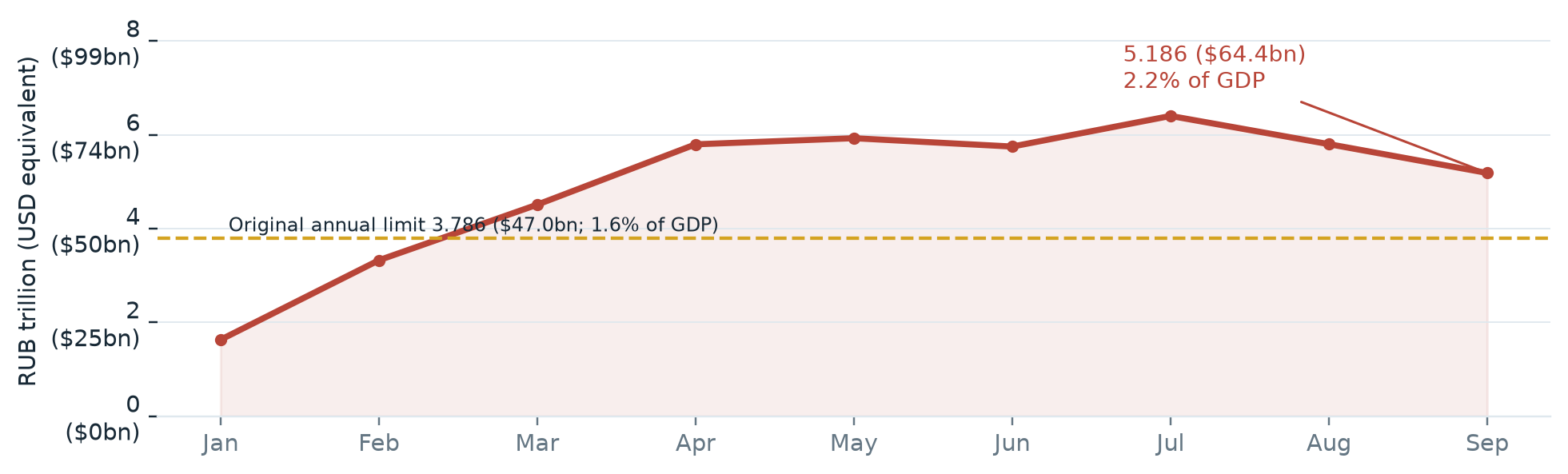
Federal cash budget, cumulative from January. A falling line means a smaller accumulated deficit, not a return to annual surplus. Source [2], as held in the statistics database.
Russia federal budget | 2026 original plan | Jan–Sep actual |
|---|---|---|
Revenue | about RUB40.3tn ($500.4bn) | RUB29.639tn ($368.0bn) |
Expenditure | about RUB44.1tn ($547.6bn) | RUB34.825tn ($432.4bn) |
Deficit | RUB3.786tn ($47.0bn) (1.6% of GDP) | RUB5.186tn ($64.4bn) (2.2% of GDP) |
Debt is the amount owed; debt service is the cost of paying it. The debt level is small, but the debt service costs is big – and becoming unsustainably big. The IMF puts Russia’s end-2026 general-government gross debt at RUB45.570 trillion ($565.8bn; 19.3% of GDP) where most developed countries, and Ukraine, have debt-to-GDP levels on the order of 100%. Russia still has room to borrow, but low debt does not guarantee cheap financing. [1]
Russia’s bond market is almost tapped out as its banks, the only source of liquidity, are demanding ever bigger yields to part with their cash. That is forcing Ministry of Finance (MinFin) to turn to taxpayers who are carrying more and more of the load.
Part of Russian President Vladimir Putin’s appeal to regular Russians is he slashed taxes immediately on taking office in 2000 and has left them almost untouched for more than two decades since. But no more. Taxes are quietly and delicately being raised to pay for the war. Corporate profit tax rose from 20% to 25% in 2025, alongside a broader introduction of progressive income taxes for the first time – although the bar for when these kick in has been set extremely high. A hike in standard VAT from 20% to 22% that went into effect in January 2026 was the first tax hike to hit the man in the street in the pocket. Higher receipts come at a cost to companies and households for the first time in a sign of the pressure MinFin is under. [9, 10]
VAT raised RUB13.467 trillion ($167.2bn) in the first nine months, about 45% of federal revenue. Moscow is increasingly testing how much its domestic tax base and financing system can bear and more increases will eat into Putin’s popularity. [3]
Ukraine has rewritten the budget around external support
Ukraine has a budgetary mountain to climb. Its original 2026 plan pencilled in UAH2.905 trillion ($64.5bn) of revenue against UAH4.824 trillion ($107.1bn) of expenditure and lending: planned outgoings about 66% higher than revenue. That is a funding gap the domestic economy cannot close on its own. [4]
Bankova has overspent this year spending more than it budgeted for on drones in the first half of the year. Zelenskiy called for an extra $28bn at an EU summit last month and has been haggling with the executive since as he wanted to pull forward the 2027 tranche from the €90bn EU loan to this year.
More recently, Zelenskiy has asked for an additional €70bn for 2027 on top of the €45bn that is the second half of the EU loan approved in April to cover the shortfall. So far no agreement has been reached leaving next year’s budget funding in doubt.
Ukraine needs at least an additional $50–55bn in external budget financing for 2027–2028, with access to further support dependent on meeting commitments to international partners, according to Vladyslav Rashkovan, Ukraine’s alternate executive director at the IMF.
The IMF estimates the uncovered requirement at $30–35bn in 2027 and about $20bn in 2028, UBN reports.
The European Union expects to cover approximately €46.7bn of Ukraine’s additional €70bn financing requirement for 2027 as Kyiv continues resisting Russia’s invasion, European Council President António Costa said. “We usually cover two-thirds of Ukraine’s financial needs,” Costa said.
The European Commission is preparing proposals, with a decision possible in November. If leaders fail to agree at the November 26–27 summit, discussions will move to their December meeting.
Other partners, including the UK, Canada and Norway, are expected to cover the remaining €23.3bn of the new requirement, but so far have not committed to pay anything.
Separately, the Commission is urging Nato countries to provide a further €70bn in bilateral military assistance, focused primarily on drone supplies. Options for financing civilian needs include a new loan funded through joint EU borrowing. Some member states, however, do not intend to participate in that mechanism. France, Austria, Slovakia, Hungary, Bulgaria and Chechia have all already opted out of participating in any fresh funding for Ukraine.
Financial instruments linked to frozen Russian assets could provide one source of funding, Rashkovan said. Ukraine’s 2027 budget envisages $52.5bn in nonmilitary financing, of which approximately $20bn has already been secured or confirmed by partners. On October 23, Zelenskiy signed three tax laws required for continued financing under IMF and EU programs that will provide part of this money.
The original budget identified UAH2.079 trillion ($46.1bn) of external-support needs. That is a financing requirement, not an additional spending line or a direct subtraction of the two headline totals. Refinancing, lending and other financing operations affect the arithmetic. [4]
The June amendment changed the picture. Planned revenue rose to nearly UAH5.196 trillion ($115.3bn) and defence and security resources to UAH4.367 trillion ($96.9bn). The ministry linked the revision to the EU support package and reduced the stated deficit target from 18.5% to 12.1% of GDP. Much of the improvement came from how external support was brought into the budget; it did not mean that Ukraine’s domestic tax base had suddenly doubled. [5]
The June amendment changed the scale of the Ukrainian plan
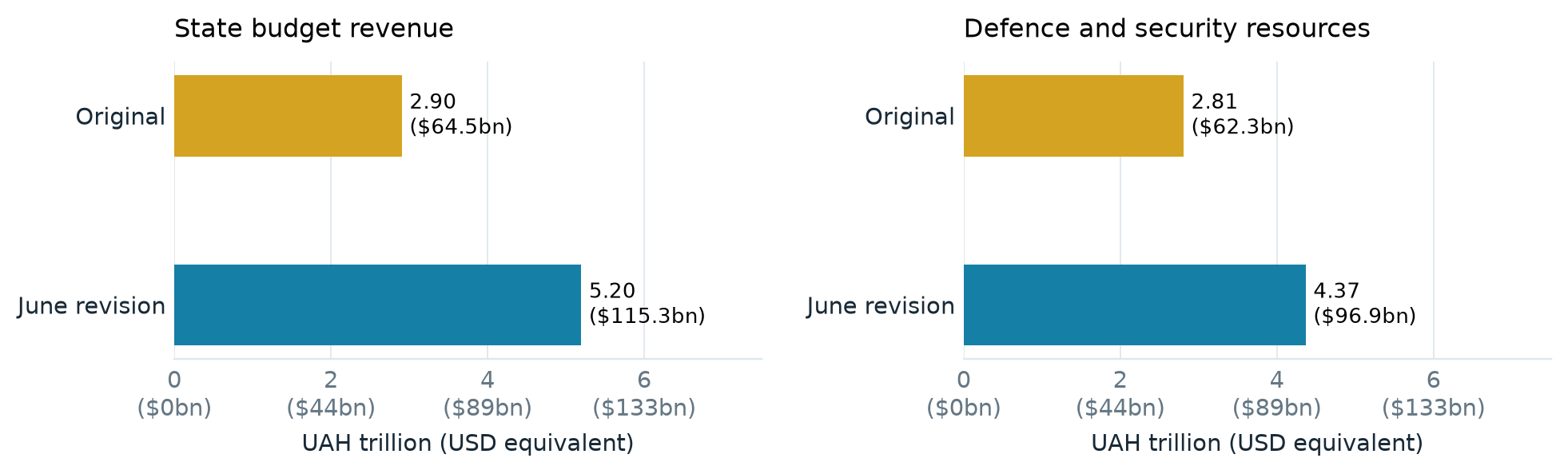
Published 2026 plans, not cash receipts or spending. The original defence and security envelope includes state guarantees. External-support classification affects revenue; the chart does not treat it as domestic taxation. Sources [4, 5].
Ukraine state budget | Original plan | June amendment |
|---|---|---|
Revenue | UAH2.905tn ($64.5bn) | nearly UAH5.196tn ($115.3bn) |
Expenditure and lending | UAH4.824tn ($107.1bn) | Not specified on the same basis in this release |
Defence and security resources | UAH2.807tn ($62.3bn) | UAH4.367tn ($96.9bn) |
The latest nine-month release reports UAH4.12 trillion ($91.5bn) of revenue and UAH4.78 trillion ($106.1bn) of cash expenditure across the state budget’s general and special funds. The rounded gap is UAH660bn ($14.7bn; roughly 6.5% of forecast annual GDP), before net lending, so it should not be labelled the certified deficit. Within the general fund alone, grants supplied UAH604bn ($13.4bn) of UAH2.49 trillion ($55.3bn) of revenue—about a quarter of receipts. [6]
The quarterly comparison needs a common yardstick
Each row below covers one quarter, rather than a running total from January. The Russian figures are calculated from cumulative ministry data; the Ukrainian figures come from NBU and Treasury quarterly tables. They compare central cash budgets. Ukraine’s revenue includes grants and its balance also reflects net lending. [2, 7]
Country and quarter | Revenue | Expenditure | Deficit and GDP share |
|---|---|---|---|
Russia Q1 | RUB8.315tn | RUB12.825tn | RUB4.510tn |
Russia Q2 | RUB10.327tn | RUB11.566tn | RUB1.239tn |
Ukraine Q1 | UAH1.019tn | UAH1.150tn | UAH130.2bn |
Ukraine Q2 | UAH1.508tn | UAH1.681tn | UAH172.9bn |
Values remain in each country’s own currency, followed by approximate dollar equivalents. Deficits are shown as positive shortfalls. The GDP percentages use the IMF’s forecast for the full 2026 year, not GDP produced within that quarter; they show the quarter’s contribution to an annual financing burden. Russia Q2 is June’s cumulative figure less March’s, using the current held vintage. Sources [1, 2, 7].
The war dominates Ukraine’s budget but civilian bills remain
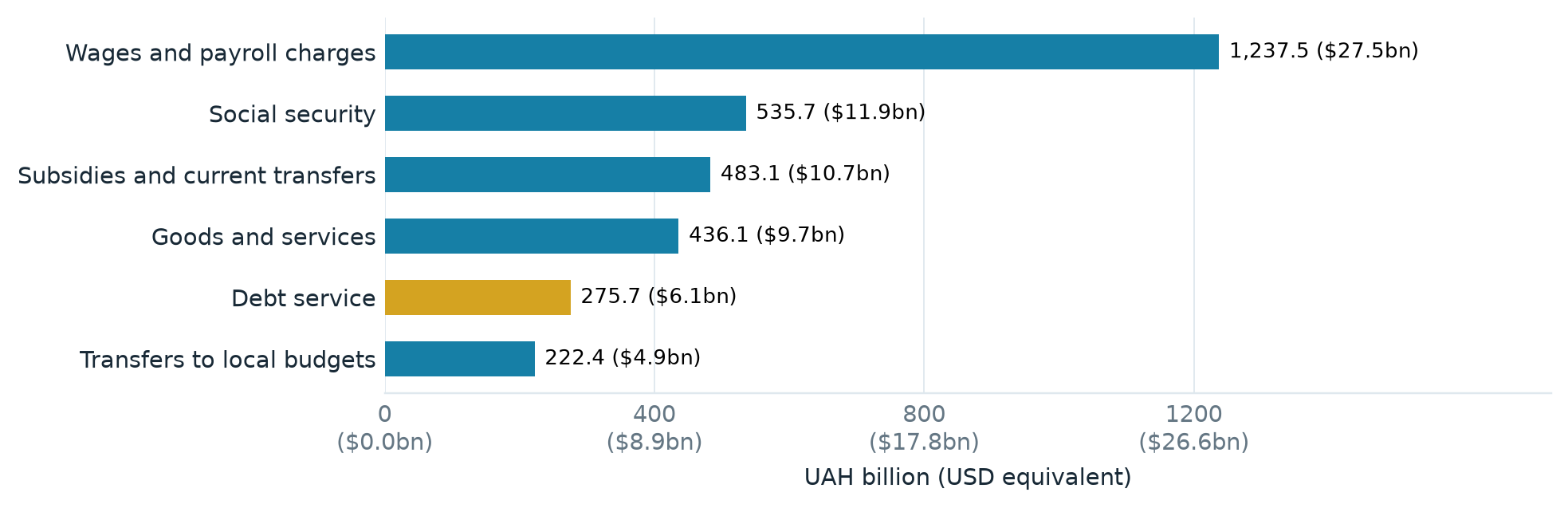
January–September 2026 general-fund spending by economic category. Dollar equivalents use the common display rates stated on page 1. A further UAH89.5bn ($2.0bn) of the rounded total falls outside these six groups. Source [8].
The later Treasury-based release puts Ukraine’s nine-month general-fund spending at UAH3.28 trillion ($72.8bn), including UAH2.01 trillion ($44.6bn) on defence and security—a published 61.2% of spending. Pay, social support and debt service must still be funded. Defence spending cuts across the economic categories in the chart: soldiers’ pay, for example, is also part of wages. Adding a separate defence bar to those categories would count some spending twice. [8]
The annual defence allocation and the nine-month general-fund result cover different baskets of money. The annual envelope includes items outside the general fund and, in the original plan, guarantees. The military levy also moved into the special fund in July. Comparing those totals directly would produce a misleading spending-completion rate. [5, 6]
The outlook depends on the financing behind the deficit
The IMF expects Russia’s general-government deficit to remain around 3.2% of GDP in both 2026 and 2027. Ukraine’s narrows from UAH1.156 trillion ($25.7bn; 11.3% of GDP) to UAH335.824bn ($7.5bn; 2.9% of GDP). But that forecast also assumes a sharp fall in spending, from 77.9% to 66.0% of GDP. It is a forecast path, not proof that the future war bill is funded. [1]
IMF forecast | RU 2026 | RU 2027 | UA 2026 | UA 2027 |
|---|---|---|---|---|
Revenue / GDP | 36.1% | 35.6% | 66.5% | 63.1% |
Expenditure / GDP | 39.2% | 38.8% | 77.9% | 66.0% |
Deficit | RUB7.489tn | RUB7.939tn | UAH1.156tn | UAH335.8bn |
Gross debt | RUB45.570tn | RUB55.123tn | UAH11.398tn | UAH12.741tn |
Ukraine carries a much heavier public debt burden
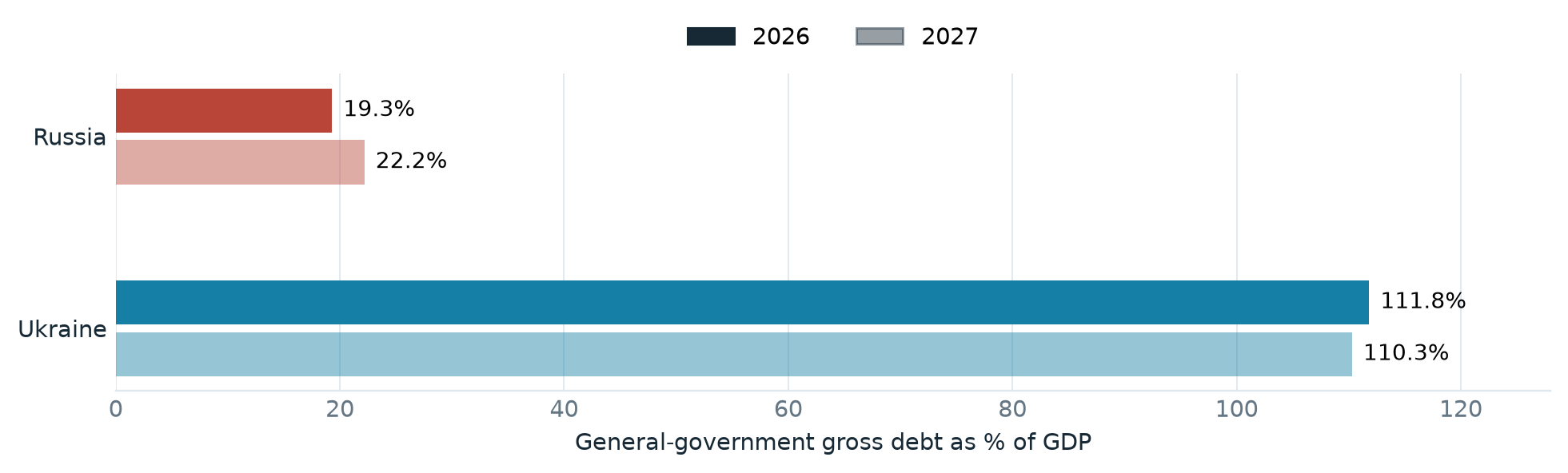
IMF October 2026 forecasts; general-government gross debt at year end. Debt ratios do not by themselves measure market access, repayment terms or liquidity. Source [1].
For Russia, the test is how much spending can be supported by recurring taxes, and how expensive it becomes to finance the rest. Russia’s leading corporates have been lobbying hard for the Central Bank of Russia (CBR) to cut interest rates faster as the burden of expensive debt service is crushing them. However, while inflation has been falling all year, the VAT hike in January has pushed it up again slightly in August and September, leading the regulator to leave rates on hold at 14% at the last monetary policy meeting. Those sky high rates are slowing the economy and so reducing the tax take. CBR governor Elvia Nabiullina is left in a very difficult position where she needs to boost growth, but can’t due to persistent inflation.
Less taxes will widen the deficit, with dwindling means of funding the gap. Russia is still far from crisis, but the pressure is increasing and the temptation to turn on the printing presses is growing as a last resort. A low debt-to-GDP ratio would provide badly needed wiggle room, but remains out of reach for now.
For Ukraine, the test is even starker: whether outside support arrives in the amount and at the time needed to pay for defence and keep civilian services running. A grant normally counts as revenue and reduces the reported deficit. A loan supplies financing and usually adds to debt. Military assistance delivered outside the budget may help the war effort without appearing in these cash accounts.
The two budgets expose different vulnerabilities. Russia is drawing more heavily on its taxpayers and domestic financing system. Ukraine is depending on the durability of its partners’ support. The most useful comparison is therefore the burden on each economy and the reliability of the money behind it—not the headline deficit in isolation.
Sources and comparison notes
Data cut off 25 October 2026. National cash execution, original and amended plans, and IMF general-government forecasts remain separate. Dollar figures are approximate display conversions, not estimates of historical dollar cash flows or future exchange rates.
[1] IMF October 2026 World Economic Outlook database
[2] Russian Ministry of Finance federal budget execution source
[3] IntelliNews 12 October 2026 Russia budget report
[4] Ukraine Ministry of Finance 3 December 2025 adopted budget
[5] Ukraine Ministry of Finance 10 June 2026 budget amendment
[6] Ukraine Ministry of Finance 5 October 2026 nine month execution
[7] NBU Treasury state budget quarterly workbook
[8] Ukraine Ministry of Finance 19 October 2026 expenditure report
[9] Russian Federal Tax Service 2025 tax changes
[10] Russian Federal Tax Service 2026 VAT changes
[11] Bank of Russia official rates effective 24 October 2026
[12] NBU official USD rate for 25 October 2026
How to read the figures
Budget scope. Russia’s federal cash budget is compared with Ukraine’s state cash budget, including general and special funds unless specified. General government is broader: it includes other public bodies and levels of government. IMF forecasts supply a common vintage for that broader comparison.
Timing and GDP. Quarterly figures are standalone flows. Russia’s quarters are calculated from the current cumulative series; Ukraine’s September all-funds figures are preliminary and rounded. The table’s quarterly deficit ratios use forecast annual 2026 GDP: RUB236.005 trillion ($2.93tn) for Russia and UAH10.193 trillion ($226.3bn) for Ukraine. They are not quarterly-deficit-to-quarterly-GDP ratios and are not annualised. Published ministry GDP ratios elsewhere use their own contemporaneous denominators.
External support and defence. Expenditure and lending is not expenditure alone. Defence and security resources are not the same as cash defence expenditure; the original Ukrainian envelope includes guarantees. The June amendment describes support under an EU loan instrument as part of revenue and grant-supported deficit reduction. That source treatment is retained; it should not be taken to mean every foreign loan is a grant.
Russian execution. Figures were checked against the previously ingressed official series and the contemporaneous IntelliNews archive. Original annual revenue and expenditure plans are rounded. Different release vintages can revise cumulative endpoints, so derived quarterly figures may differ from estimates printed at the time.
This article was prepared with the help of IntelliNews Lambda analytical tool, a beta version of an AI-assisted analysis tool that has access to IntelliNews’ two decades of daily granular reporting and makes use of sophisticated mathematical modelling to identify causal links in both reporting and statistics that gives more accurate and entirely objective analysis.
Military Spending In Russia’s Draft Federal Budget For 2027 To 2029 – Analysis
October 26, 2026
SIPRI
By Professor Julian Cooper
Key Takeaways:
Military spending stays high, though reclassification of combat compensation into National defence explains a chapter shift; actual 2026 outlays may already exceed the 2027 plan in real terms.
The 2028–29 figures are provisional projections, and the final budget law may differ from the draft.
On 30 September the Russian Ministry of Finance sent the draft three-year budget for 2027–29 to the State Duma, the lower house of the federal parliament, for approval. The draft, like all bills, will have three readings in the Duma. At the first, on 28 October, the main parameters of the budget will be approved, in particular total revenue and spending for each year. At the second reading, probably in mid-November, the Duma will consider proposed amendments and a number are likely to be approved, although the already agreed spending totals for each year will not change. The final reading, following soon afterwards, will approve the budget as a whole and send it to the upper house, the Federation Council, which usually agrees budgets with little discussion. The draft will then be sent to President Vladimir Putin, who will probably sign it into law in early December.
This backgrounder examines what the draft budget reveals about Russia’s military spending intentions in the next three years.
The economic forecast behind the budget
The draft 2027–29 budget is based on an economic forecast covering the period 2027–29 prepared by the Ministry of Economic Development (Minekon; see note below). Gross domestic product (GDP) is forecast to increase by 0.6 per cent in real terms this year, 1.4 per cent in 2027, 1.9 per cent in 2028 and 2.4 per cent in 2029. The annual average rate of inflation is expected to fall from 6.1 per cent this year to 5.0 per cent in 2027, then to 4.0 per cent in 2028–29.
Unemployment is forecast to remain at only 2.3 per cent throughout the period, but the rate of investment is expected to fall by 5.4 per cent this year, then to show very slight growth in 2027, increasing by 3.0 per cent in 2029. Overall, it is an understandably cautious forecast, but if realized should make it possible for the Central Bank to gradually reduce its key interest rate, which is currently at 14 per cent.
The draft budget would see Russia in deficit through to 2029: by 3.2 per cent of GDP this year, 2.2 per cent in 2027, and 1.9 per cent in both 2028 and 2029. Following a trend of recent times, revenues from oil and gas exports will remain at a modest level, accounting for only 18.4 per cent of total revenue this year and falling to under 16 per cent in 2029. However, with tax increases (mainly to value-added tax) and other measures, total budget revenues are set to increase significantly. This means that sanctions targeting earnings from oil and gas will have diminishing impact.
Military spending in the draft budget
In Russia, ‘military spending’ almost always refers to expenditure under the budget chapter ‘National defence’. However, some spending included in the standard SIPRI definition of military expenditure comes under other budget chapters, in particular ‘Social policy’ and ‘National security and law and order’. The table below shows total planned military spending in 2027–29, as reflected in the draft budget, alongside planned military spending in the budget law for 2026.

Note: Figures for 2026 are based on the budget law as adopted and have not been adjusted to reflect actual spending. Two budget lines within ‘Other military spending’ have to be partially or fully estimated: total spending on troops of the National Guard and total spending on the Federal Security Service (FSB) Border Service, the latter of which has not been revealed since 2021. Due to the author’s revision of these estimates, the figures for ‘Other military spending’ and ‘Total military spending’ in 2026 do not match those in previous SIPRI publications.
The evidence available to date suggests that total military spending in 2026 will be significantly larger than the budgeted total, perhaps reaching about 17 trillion roubles—in which case the military spending planned for 2027 could be less than this year’s spending in real terms.
One point worth noting is that for 2027 there has been a change in the source of funding of compensation for those injured in combat and for the families of troops killed in the combat with Ukraine. In the 2026 budget it was to be a classified component of spending under the ‘Social policy’ chapter, but this component is not present in the draft 2027 budget. This almost certainly accounts for the decline in military spending outside the ‘National defence’ chapter in the 2027 budget compared with that for 2026. Furthermore, it cannot be ruled out that this change was implemented during 2026, which would help to account for the scale of the increase in ‘National defence’ expenditure compared with the 2026 budget law.
A final point to emphasize is that the budgets for 2028 and 2029 do not in any way indicate future policy intentions; they are just projections and could change substantially when the budget for 2028 is drafted.
This brief analysis is based on the draft federal budget for 2027–29. Military spending in the final budget law could be different, as was the case with the 2026 budget, where ‘National defence’ spending in the budget law was lower than in the draft version. A longer, detailed, paper on Russian military spending will be published later in 2026 or early in 2027, after the new budget has been signed into law and more is known of budget implementation in the current year.
Note on the Ministry of Economic Development forecast
The economic forecast that the draft 2027–29 federal budget is based on is Основные макроэкономические параметры среднесрочного прогноза социально-экономического развития Российской Федерации до 2029 года, Базовый вариант [Key macroeconomic parameters of the medium-term forecast of socio-economic development of the Russian Federation to 2029, basic variant] from 26 September 2026.
About SIPRI
SIPRI is an independent international institute dedicated to research into conflict, armaments, arms control and disarmament. Established in 1966, SIPRI provides data, analysis and recommendations, based on open sources, to policymakers, researchers, media and the interested public. Based in Stockholm, SIPRI also has a presence in Beijing, and is regularly ranked among the most respected think tanks worldwide.
View all posts by SIPRI →

No comments:
Post a Comment