Chile clears Marimaca to start early copper mine works
The open pit would produce an average of 48,000 tonnes of refined copper cathode a year over its first decade.

Drilling on the Marimaca project site in Chile. Credit: Marimaca Copper.
Chile has cleared Marimaca Copper (TSX: MARI; ASX: MC2) to begin early construction work at its namesake copper project near Antofagasta, two days after a unit of Sprott (TSX, NYSE: SII) backed a proposed financing package for construction.
Chile’s National Geology and Mining Service granted the mining-method permit to Marimaca’s subsidiary, Compañía Minera Cielo Azul Limitada. It allows site preparation and bulk earthmoving at the Marimaca Oxide Deposit (MOD) site. Full-scale construction still requires board approval, according to Thursday’s company release.
Receipt of the permit “represents another derisking milestone for the MOD project,” BMO Capital Markets mining analyst Rene Cartier said Thursday in a note. “Marimaca is likely to receive additional sectorial permits in due course, though these are not viewed as critical path items.”
The permit builds on environmental approval granted in November 2025, “allowing for the commencement of the fully funded early works construction activities at the project,” said José Antonio Merino, Marimaca’s managing director in Chile.
13-year mine
The open pit, about 45 km from Antofagasta, would produce an average of 48,000 tonnes of refined copper cathode a year over its first decade. Marimaca put the upfront cost at C$834.7 million ($587 million) and the mine life at 13 years in its 2025 feasibility study.
Sprott Resource Lending Corp.’s investment committee backed a proposed funding package of up to $450 million Tuesday. It includes up to $425 million in senior secured debt and up to $25 million in equity under a non-binding term sheet. The first $100 million of the loan would become available after a construction decision, subject to final agreements, due diligence and other conditions, Marimaca said.
The oxide deposit has measured and indicated resources of 213.5 million tonnes grading 0.40% copper, containing about 853,800 tonnes of copper, according to an August 2025 estimate. It also holds inferred resources of 21.2 million tonnes at 0.29% copper for about 62,200 tonnes of the metal. The measured and indicated resources include proven and probable reserves of 178.6 million tonnes grading 0.42% copper.
Marimaca shares rose 2.4% to C$6.30 Thursday morning in Toronto, valuing the company at about C$854 million ($601 million). The shares have traded between C$5.53 and C$13.49 in the past 52 weeks.
$32 billion later and nothing to show for it: Codelco’s future hinges on private partners
Board chairman Bernardo Fontaine sounded the alarm as copper output fell despite massive capital spending over eight years.

Gabriela Mistral division. (Image courtesy of Codelco.)
Chile’s state-owned copper giant Codelco must forge extensive partnerships with private miners to reverse declining production after years of heavy investment, operational setbacks and management failures, board chairman Bernardo Fontaine warned Monday.
The world’s largest copper producer has struggled to recover from record-low output in 2022 and 2023, with project delays, fatal accidents and declining ore grades undermining its turnaround. An internal audit also uncovered 42,100 tonnes of inflated production figures, potentially requiring a $140-million accounting adjustment.
“The company holds a million hectares of mining concessions that remain unexploited, and it lacks both the management capacity and the capital to develop them,” Fontaine told Chilean broadcaster Radio Duna.
The warning raises questions about Codelco’s ability to sustain its position in the global copper market as the company grapples with rising costs, mounting debt and restrictions on private investment. Its difficulties also threaten Chile’s efforts to maintain copper supplies as demand for the metal grows.
Structural problems
Fontaine said Codelco invested $32 billion over the past eight years while annual copper production fell from 1.7 million tonnes to 1.2 million tonnes. Company reports also show its costs are 78% higher than those of comparable mining operations, he said.
The chairman blamed structural weaknesses in Codelco’s governance, arguing that successive administrations had failed to exercise adequate oversight of the state-owned miner.
“There is a structural problem here, linked to this mixture of a state service and a company,” Fontaine said. “The owner, which is the state, has never acted as an owner. For example, it allowed Codelco to take on debt.”
Fontaine, who requested an audit after taking office, said investigators identified three mechanisms used to artificially inflate reported production across several divisions.
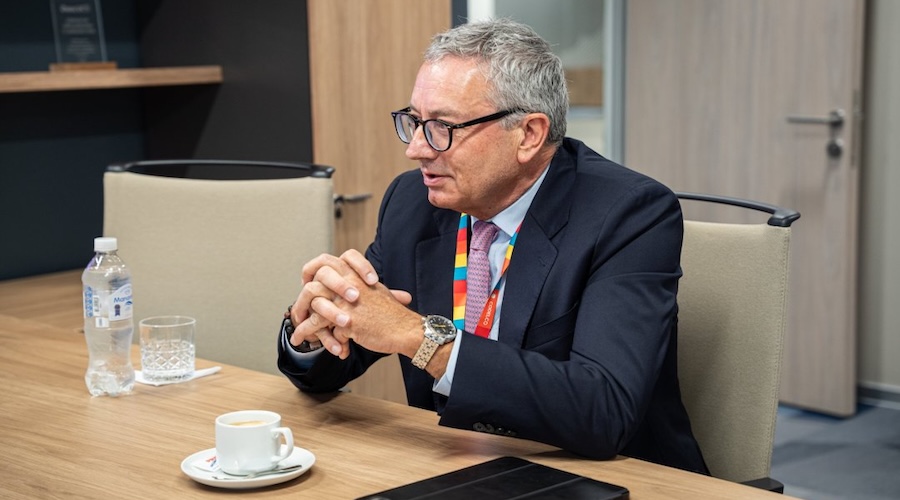
“Through three mechanisms, production at several divisions was falsely inflated,” he said. “Certain responsibilities were established, and a number of executives involved in the different ways of manipulating production left the company. We are continuing to investigate.”
The findings have prompted management changes and a reassessment of the company’s operating outlook.
Fontaine said previous production forecasts were excessively optimistic and failed to reflect Codelco’s operational capabilities.
“This company is not capable of producing what had previously been discussed,” he said. “All the projections were enormously optimistic, and Codelco is facing a crisis in its results and management.”
Private sector partnerships
Fontaine argued that developing Codelco’s vast portfolio of untapped mining concessions through joint ventures offers the most viable route to stabilizing output.
However, legislation governing state-owned enterprises imposes restrictions on such agreements, while lengthy and complex approval procedures discourage potential investors, he said.
Codelco has already established partnerships with international mining companies, including Rio Tinto (ASX, LON: RIO), BHP (ASX, LON: BHP) and Anglo American (LON: AAL) demonstrating the potential for collaboration despite those obstacles.
Fontaine said expanding that model would allow the miner to access outside capital and technical expertise without having to develop every project independently.
“That is the only way it can grow, or even maintain, its production levels in the future,” he said.
The new management team has adopted a more conservative outlook following the discovery of the reporting irregularities, with Fontaine setting an annual production objective of about 1.3 million tonnes.
“We will make every effort to achieve average annual production of around 1.3 million tonnes,” he said.

No comments:
Post a Comment