THE NEW AXIS OF STATE CAPITALIST IMPERIALISM
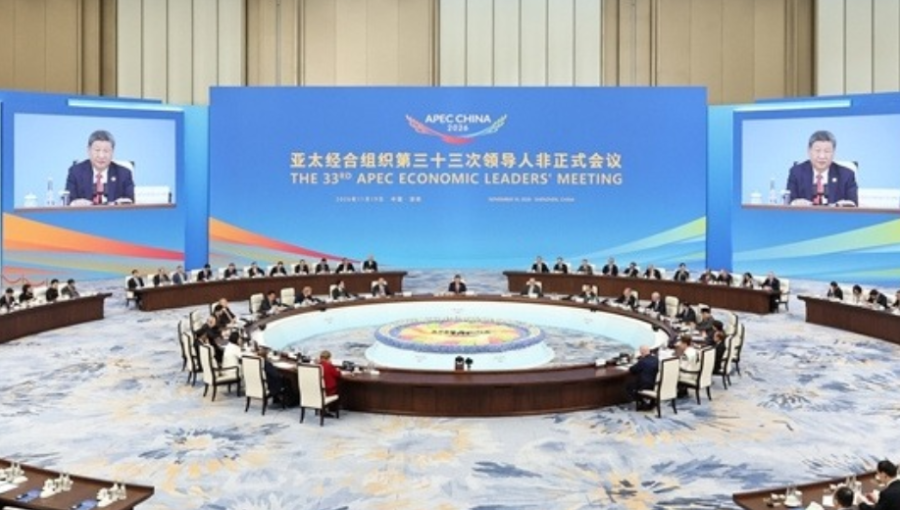
The four-point peace declaration agreed by Xi Jinping, Vladimir Putin and Donald Trump in Shenzhen on November 19 warns the International Criminal Court off but never mentions Ukraine.
Beyond the pledge to raise output of refined fuel that dominated first reports of the text, the declaration published by the Chinese foreign ministry commits the three permanent members of the UN Security Council to "reform the UN". It calls "respect for immunities of State officials" a matter "of paramount importance" and says the court "and other similar bodies must not abuse their jurisdiction".
Almost nothing in the text costs its signatories anything. None of the three countries is a party to the court, so a joint warning against its overreach binds no one, but it gives cover to the one leader at the table under indictment: judges in The Hague issued a warrant for Putin's arrest in March 2023 over the deportation of children from occupied Ukraine. The real gain for Moscow was the seat itself. Putin "took a baby step out from the diplomatic cold", Time wrote of the meeting.
The nuclear clause is older than the court. "A nuclear war cannot be won and must never be fought" was the formula Ronald Reagan and Mikhail Gorbachev agreed at Geneva in 1985, and the five nuclear-weapon states restated it in January 2022. The declaration sets no date for the promised dialogue on nuclear risk, no ceilings and no inspections, although New START expired in February and the three powers are building rather than cutting their arsenals.
Xi, as host, cast the meeting as a duty. "Positive interaction among major powers is not an optional question, but a compulsory one," he said, according to Time. Beijing had billed the summit as one of "groundbreaking significance", yet when German President Frank-Walter Steinmeier floated a Ukraine summit in Beijing on October 30, Xi's irritation showed, Steinmeier told ARD.
Trump told the table that the three were "uniquely positioned to discuss how to reduce the number of nuclear weapons on Earth", according to the Kremlin transcript, before turning to the Gulf: "We're not going to let Iran have a nuclear weapon." Iran does not appear in the text either.
Ukraine was the main subject of the 35-40 minutes Trump and Putin had spent alone earlier that day, a session Kremlin aide Yuri Ushakov called "of a preparatory nature" and which ended with no result announced. At his closing press conference Putin ruled out an energy truce and promised a response "far more painful than what the Kiev regime did to the bridge", after a Ukrainian strike on November 17 brought down a Crimean Bridge road span.
He also took on the Yalta analogy that had shadowed the summit. "At Yalta, no one carved up the world," Putin said. "At Yalta, the realities were acknowledged, and in today's conflicts, too, the realities will have to be accepted." In the same press conference he called the land Russia has seized in three Ukrainian regions "for now a security zone", not a subject for peace talks. Read side by side, the two lines amount to a demand that the occupation be accepted as permanent.
Ukrainian Foreign Minister Andrii Sybiha had warned on October 19 that a three-way summit without Kyiv would only "encourage Putin to continue this war", the Kyiv Independent reported. After Shenzhen he answered Putin on X: "Shenzhen is not the Yalta of Putin's dreams. Meanwhile, Russia has practically lost its bridge to the real Yalta in occupied Ukrainian Crimea."
Washington's reception was cooler than Trump's. Republican Senator John Curtis of Utah said he was "encouraged by the commitments resulting from the president's meetings in Asia, and especially the acknowledgment that a nuclear war should never be fought", but added that "Vladimir Putin and Xi Jinping are not our friends", in an email to the BBC. Jeanne Shaheen, the ranking Democrat on the Senate Foreign Relations Committee, told MS NOW the meeting was "a photo op that provided no deliverables, no benefits to the people of the United States". "I don't understand the president's admiration and cozying up to Vladimir Putin, who is a war criminal," she said.
Trump rated the summit "a 12 on a scale of 1 to 10", NBC News reported. On the evidence of the text, three nuclear powers agreed to keep international judges away from their officials and to pump more fuel. Peace in Ukraine was left to talks the declaration does not mention.
Trump, Xi, And Putin Make History, But No Breakthroughs: 4 Takeaways From The Trilateral Summit – Analysis
November 20, 2026
RFE RL
By Matthew Fulco
Analysts judge Putin the biggest winner for ending his post-2022 isolation and securing optics of great-power status, while Xi gained a well-choreographed display of Chinese leadership without committing to nuclear limits.
Trump achieved his modest goal of publicly pursuing nuclear dialogue, yet events such as Ukraine’s Crimean Bridge strikes and Iran’s renewed Gulf attacks highlighted that the three leaders cannot unilaterally settle conflicts without wider participation.
US President Donald Trump, Chinese leader Xi Jinping, and Russian President Vladimir Putin held a historic meeting on the sidelines of the Asia-Pacific Economic Cooperation (APEC) summit in Shenzhen that delivered modest wins for all three men but no game-changing accords.
The high-stakes summit on November 19 marked the first time the current heads of state of the three world’s largest nuclear powers have held a trilateral meeting without other leaders present, though Putin and Xi have met about 50 times.
While the summit was more style than substance, it still has important implications for the foreign policies of the United States, China, and Russia, highlighting their clout on the world stage as well as where their power falls short.
With that in mind, here are four takeaways about the summit from interviews RFE/RL conducted with academics and analysts.
Putin Gains The Most
Largely isolated internationally since Russia’s full-scale invasion of Ukraine in February 2022, Putin arrived at APEC with the lowest baseline for success of the three leaders. By simply attending the event — for the first time since 2017 — and directly discussing global security with Trump and Xi, Putin came in from the cold.
“Putin came away with a lot. He was the biggest winner at this meeting,” Elizabeth Wishnick, an expert on Chinese-Russian relations at the CNA Corporation, a US defense think tank in Virginia, told RFE/RL.
The Russian leader’s isolation “was tremendously reduced when it comes to optics, but maybe also in reality because of the joint ‘peace declaration’ after the meeting,” said Sari Arho Havren, an associate fellow at the Royal United Services Institute (RUSI), a British security research organization.
The joint declaration called for reducing nuclear risks and strengthening international stability but offered few concrete commitments.
Havren noted that the three countries challenged the legitimacy of the International Criminal Court (ICC), which issued an arrest warrant for Putin in March 2023 for alleged war crimes in Ukraine. According to the statement, the three leaders “recognized that the principle of state consent and respect for immunities of State officials are of paramount importance, and concurred that the International Criminal Court and other similar bodies must not abuse their jurisdiction.”
In the public portion of the meeting, Trump called the ICC “a rogue globalist organization.”
The statement further said that the US, China, and Russia plan “to increase the production and supply of refined petroleum products for the benefit of all nations,” effectively endorsing Moscow’s beleaguered oil sector.
Xi’s ‘Well-Choreographed’ Summit Pays Off For China
Compared to Putin, Xi Jinping had less to gain from the trilateral summit. China faces no comparable diplomatic or economic travails. Though tensions exist in ties with the United States, Xi has succeeded in defining the current trajectory of US-China relations with his “constructive strategic stability” bilateral relations framework.
Still, Xi had to prove that China could execute a high-stakes meeting on the sidelines of Asia’s top economic summit without overshadowing the main event.
The summit was “high-profile and well-choreographed. You can call it a success” for China, Yun Sun, director of the China Program at the Washington-based Stimson Center, told RFE/RL.
She noted that “it is not easy to negotiate a trilateral joint statement that all sides can agree on. But the tradeoff is that the results don’t cover much of the details of the issues here.”
“I think Xi Jinping very much got what he wanted, showing he’s in the driver seat for global affairs,” says Havren.
The Chinese leader said the meeting was “positive, constructive and fruitful,” according to China’s state-run Xinhua news agency.
Notably, Xi accommodated Trump’s interest in discussing nuclear disarmament without committing to specific action. With an estimated 620 warheads compared to the more than 5,000 that the US and Russia each have, Beijing believes its participation in disarmament talks would be premature and potentially detrimental to national security.
In the joint statement, Xi, Trump and Putin “reaffirmed that a nuclear war cannot be won and must never be fought,” which is boilerplate language the Chinese leader has used for years. Their pledge to “conduct a dialogue on reducing nuclear risks and preventing the proliferation of nuclear weapons,” meanwhile, is vague and noncommittal.
Trump Meets His Expectations
The US president set modest expectations ahead of the summit and met them, analysts say.
“President Trump wanted to be on record, with the world’s attention focused on him, that he is pursuing nuclear arms control with the two other major nuclear powers, and he achieved this,” Ross Darrell Feingold, a Taipei-based lawyer and political risk analyst, told RFE/RL.
Regarding the Iran war, which Trump said he wanted to discuss ahead of the summit, the three leaders’ joint statement did not name the conflict. Neither Putin nor Xi publicly mentioned the Iran war at APEC.
“China and Russia cannot, and will not, provide any help to Trump to end the conflict with Iran. Nor will they advocate for Iran to fight the US,” said Feingold. “The safe approach for China and Russia [which they continue to pursue] is to call for peace.”
Despite the lack of substantive diplomatic wins, Trump can still present the summit as a success, a former senior US Commerce Department official who worked on China issues told RFE/RL.
Granted anonymity to speak candidly, the person said that “Xi Jinping has succeeded in charming the heck out of President Trump. He even greeted Trump at the airport with a hug. That’s the kind of thing that Trump really cares about.”
Trump described Xi’s embrace as “a big win for us” and a sign of “great respect.”
Amicable relations with Trump are a welcome change for Xi after the turbulence the US-China relationship faced during the Biden and the first Trump presidencies. Facing less pressure from Washington has given Beijing more room to pursue strategic foreign policy objectives.
“Xi has to be pretty happy with the results, even if he knows this can’t last forever,” the official said.
Great-Power Diplomacy Has Its Limits
Ultimately, the trilateral summit may be remembered as much for what it did not achieve as the memorable optics, analysts say.
When Putin first mooted the summit last month, Ukraine and Europe expressed concern that the Russian leader would try to negotiate a peace settlement without their participation.
Yet that was never a realistic outcome given Beijing’s unwillingness to damage relations with Europe. “China still needs Europe [economically] and has been trying to portray itself as a neutral power,” said Havren. Refusing to put Ukraine on the agenda “was a strategic choice” for Beijing, she added.
It was not a coincidence that Ukraine launched drone and missile strikes on the Crimea Bridge — which collapsed a section of its road span — shortly before the APEC summit, said Wishnick.
“That sends a message that world leaders cannot end this conflict unless Ukraine and European leaders are involved,” she added.
Meanwhile, on November 18, Iran launched strikes on Gulf states. The drone and missile attacks on Bahrain and Kuwait were the first in roughly two months.
And North Korean leader Kim Jong-un, who has provided both arms and troops for Russia’s war in Ukraine, left APEC without meeting Trump. The US president had previously said that the two leaders might meet.
“The great powers have a lot of influence, but they can’t control the events on the ground,” said Wishnick. “The days of leaders sitting around a table and deciding the fate of the world are over. They’re going to have to engage more widely with other states for problems to be resolved.”
About RFE RL
RFE/RL journalists report the news in 21 countries where a free press is banned by the government or not fully established.
View all posts by RFE RL →
As the leaders of the United States, China and Russia held historic talks in the Chinese city of Shenzhen on Thursday, representatives of the European Union – the world's largest trading bloc – were conspicuously absent, despite the fact the discussions could have far-reaching consequences for Europe.
Issued on: 19/11/2026 - RFI

US President Donald Trump held separate meetings with Chinese President Xi Jinping and Russian President Vladimir Putin ahead of the unprecedented three-way summit, which took place on the sidelines of the Asia-Pacific Economic Cooperation (APEC) forum.
Their agenda included the wars in Ukraine and Iran, nuclear arms control and competition over artificial intelligence.
China described the gathering as being of "groundbreaking significance" for international stability. "We will be having discussions on the theme of promoting world peace," Xi said at the start of the trilateral meeting, which lasted around 90 minutes.
He stressed the three countries should "work together to address global challenges".
"We should learn from history," Xi said. "Adversity reveals true responsibility."
Major powers bear special responsibilities to promote stability in an increasingly interconnected world, he said.
Putin said the three powers "hold joint responsibility for maintaining international peace", while Trump declared they were "making history".
"Too often past leaders have avoided talking to nations with whom they had disagreements," the US president said. "We feel the opposite."
But for the European Union, which is not an APEC member, the summit exposed the struggle to secure a voice in global diplomacy, despite its considerable economic strength.
Diplomatic dilemmas
In 2025, EU trade with the rest of the world exceeded €8 trillion, representing almost 16 percent of global trade in goods and services – ahead of both the United States and China, according to EU figures.
Yet when it comes to resolving major security crises, Europe finds itself on the sidelines.
Nowhere is this more apparent than in Ukraine, where the EU has provided substantial financial and military support while struggling to influence diplomatic efforts to end the war.
Trump has repeatedly pursued direct negotiations with Moscow, while Russia has resisted European efforts to join peace discussions.
Meeting one on one with Putin ahead of Thursday's summit, Trump referred to the Russian president as "my friend".
He later said the two had had a "long discussion" on the conflict in Ukraine, and that Putin "and I hope the other side, would like to see an end to that war".
Any lasting settlement would have profound consequences for European security, sanctions policy and Ukraine's future relationship with the bloc.
Europe's economic relationship with Russia also gives it a significant stake in the outcome.
Before Moscow's full-scale invasion in February 2022, Russia supplied around 40 percent of EU natural gas imports and a quarter of its oil. Those energy sales generated approximately €100 billion for Moscow in 2021.
Europe has since dramatically reduced its dependence on Russian energy, turning increasingly towards the United States.
American producers have benefited considerably. The US is now the EU's largest oil supplier and has accounted for nearly two-thirds of its liquefied natural gas imports so far this year.
Any peace agreement that reopened European markets to Russian energy could therefore reshape commercial relationships on both sides of the Atlantic.
The war in Iran has exposed similar limitations.
European powers, including France, the United Kingdom and Germany, played a central role in negotiating the landmark 2015 agreement restricting Tehran's nuclear programme.
Almost nine months into the current conflict, however, European governments have largely been confined to diplomatic appeals.
The EU could potentially help protect shipping through the Strait of Hormuz or monitor a renewed nuclear agreement, but regional intermediaries such as Pakistan and Qatar have assumed more prominent diplomatic roles.
Speaking at Thursday's summit, Trump said the US, Russia and China were "uniquely positioned to discuss how to reduce the number of nuclear weapons on Earth and also to lessen the risk of those weapons being used", stressing their role in preventing nuclear proliferation in Iran and elsewhere.
"We're not going to let Iran have a nuclear weapon," he declared.
Calls for a more unified bloc
The EU has neither a unified foreign policy nor a military command. Its 27 members retain considerable authority over security and diplomacy, while many foreign-policy decisions require unanimity.
That makes responding quickly to international developments difficult, particularly when governments disagree over relations with Russia, China or the US.
Armed forces remain under national command, while collective defence continues to depend heavily on NATO and American military capabilities.
European governments increasingly acknowledge the need for change.
France, Germany and nine other EU members have recently called for reforms to accelerate foreign-policy decisions and reduce the ability of individual governments to block collective action.
Yet differences over Russia, competing national priorities and the growing influence of parties sceptical of deeper European integration complicate those ambitions.
For France, which has long championed European strategic autonomy, the Shenzhen summit offers another illustration of the case for a stronger, more independent European voice.
Paris argues that Europe must be capable of defending its interests without relying exclusively on Washington – an ambition given fresh urgency by Trump's increasingly transactional approach to international relations.
(with newswires)

No comments:
Post a Comment