Thursday, November 12, 2026

Rare earth price gap flags supply strains ahead of Trump-Xi meet


Image: Wikimedia Commons, under public domain licence

A global rush to secure strategic metals is taking on new urgency ahead of a possible meeting of the US and Chinese leaders this month, with rare-earth elements now trading outside China at enormous multiples of their domestic value.

Export curbs imposed by China – which dominates the supply chain for a host of critical minerals – are limiting the availability of products used in everything from aerospace and defense to semiconductors and magnets for electric vehicles. From the US to Japan, manufacturers are feeling the squeeze.

Washington has urged Beijing to make good on commitments agreed as part of a trade truce last year, with US Trade Representative Jamieson Greer using a recent video call with Chinese Vice Premier He Lifeng to emphasize the importance of China taking “concrete actions” to implement pledges on commodities including rare earths.

His comments – along with “serious concerns” raised by China on the same call – highlight the precarious nature of trade relations between the world’s two biggest economies. Presidents Donald Trump and Xi Jinping are expected to meet next week at an Asia-Pacific Economic Cooperation gathering in the Chinese city of Shenzhen.

The scarcity of some strategic minerals outside China is reflected in prices. Yttrium, used in electronics and turbines, is a staggering 125 times more expensive in Europe than in China, according to price reporting agency Argus Media. A ton of the metal costs about $1.15 million compared with just $9,144 in China, where supplies remain ample.

Dysprosium and terbium, used in powerful magnets essential for high-tech manufacturing, are 20 times and eight times costlier than in the domestic Chinese market, respectively. Overseas buyers of gallium can expect to pay 12 times more. Before the curbs, global prices were only marginally higher.

“I wouldn’t really call it a panic, but I think it is something that has been boiling up for the past 18 months,” said Chi Hin Ling, head of metals pricing for Asia at Argus. “People are now scrambling a bit for material.”

Limited alternatives

President Xi rolled out export controls on rare earths last year, adding to curbs already in place on other minor metals. The move proved especially powerful as Beijing accounts for the lion’s share of mining and processing, handing it enormous leverage.

Under the truce agreed in October 2025 – which is due to expire roughly two months from now – the US secured flows of critical minerals. But Greer, the trade representative, has repeatedly said that America isn’t getting rare earths at the expected volume and pace.

The Trump administration has led a global push to shore up non-Chinese supplies, lending its backing to domestic mining projects as well as developments in countries including Australia. But for many products, finding alternatives will take years given the timelines and investments required.

“Within the next year or two, really there is very limited ex-China supply which is going to be available,” said David Merriman, research director at Project Blue, a consultancy specializing in critical minerals. “We’re probably sat with quite a significant delta between Chinese domestic pricing and ex-China pricing for at least the next couple of years.”

Yttrium, with its massive disparity between domestic and export prices, is one of seven niche metals placed under Beijing’s export controls in April 2025, and has a range of critical uses in the semiconductor industry. In addition, it provides an essential, protective coating on the huge blades in gas-power and jet-engine turbines.

China’s total exports of yttrium oxide are running at about two-fifths of the average level for 2023-2024. Almost none has been exported to Japan this year, and shipments to the US are about 70% lower than before 2025.

“The challenge for manufacturers outside China isn’t simply what the material costs – it’s whether they can secure reliable supplies,” said Ramón Barúa, chief executive officer at Aclara Resources Inc., which is developing rare-earth projects in Chile and Brazil and recently added high-purity yttrium oxide to its downstream processing plans, alongside dysprosium and terbium.

There are virtually no other mined sources of yttrium outside China, with Australian producer Lynas Rare Earths Ltd. set to begin production at its growing Malaysian plant only from 2028.

Barúa said material currently available outside China was likely accumulated before the export restrictions were introduced. A key unknown is how much may still be sitting in stockpiles, possibly being held back by traders in anticipation of even higher prices.

Ling from Argus added that global stockpiles of critical minerals weren’t transparent. “We always think the market is quite thin,” he said. “Then, all of a sudden, someone will be like: ‘Oh hang on, actually I’ve got about 100 tons left in my warehouse – but I’m going to sell it to you for $1 million a ton.’”

 

Italian steelmakers halting production due to high energy costs, industry group says


Stock image.

Major Italian steelmakers have halted or are progressively shutting down production as surging electricity and gas prices make operations economically unsustainable, industry lobby Federacciai said on Tuesday.

The association said in a statement that high energy costs were undermining the competitiveness of Italian steelmakers compared with European rivals.

Federacciai, which did not name the companies halting operations, warned of repercussions for the entire industry.

It said Italy’s steel industry was among Europe’s most decarbonised but also among the hardest hit by high energy costs.

Low gas storage levels in Europe and disruptions caused by the Iran war pushed the benchmark Dutch front-month contract to a high of over €104 ($116.75) per megawatt-hour (MWh) last month.

Federacciai said it would seek a meeting with trade unions in the coming days to discuss the situation and its impact on the sector’s competitiveness.

The Italian government on Monday approved measures to curb the impact of rising gas prices on power bills for households and businesses, with critics saying they would only have a marginal impact.

($1 = 0.8908 euros)

(Writing by Francesca Piscioneri; Editing by Alvise Armellini and Joe Bavier)


China’s iron ore buying clout makes each deal a market event


BHP is China’s third-biggest iron ore supplier. (Image courtesy of BHP.)

State-backed iron ore buyer China Mineral Resources Group (CMRG) has had a good year, securing deals with two of its biggest suppliers that establish its dominance of a market worth north of $100 billion.

But success could present new challenges. The agreements struck with Australian mining giants BHP Group and Rio Tinto Group aren’t permanent. BHP’s will need resetting as early as next year. Smaller rival Fortescue Ltd. is still wrangling over terms. The negotiations themselves could now become a recurring price risk.

Introducing centralized iron ore purchasing for China’s sprawling steel industry minimizes the number of negotiations, but each one becomes much more important. Bargaining over pricing and which benchmarks to use, contract durations and settlement currency, are now confined to a single track of high-stakes talks.

“The risk now sits in discrete events: bans, easings and settlements that can move prices within a single session,” said David Cachot, iron ore analyst at Wood Mackenzie Ltd. “CMRG has introduced a greater degree of event-driven risk linked to negotiations, trade restrictions and procurement directives.”

CMRG was set up in 2022 to represent the world’s largest steel industry, which buys more than 70% of the world’s seaborne iron ore, converting it to about 1 billion tons of metal a year. Beijing had long complained about the profitability gap between the big miners and the mills that rely heavily on imported ore, particularly from Australia and Brazil. 

Pooling all that purchasing power has given CMRG much greater leverage in talks that were previously conducted between individual miners and steel companies, allowing it to challenge how prices are set and in what currency. 

Ultimately, the goal is lower costs for mills. The company has made a big effort to consolidate market data to improve its understanding of supply and demand. Last week, it unveiled artificial intelligence agents to track vessels and capture price differentials and inventory levels at ports.  

But the negotiations have been tense, creating uncertainty and volatility in a once predictable market. The months-long standoff with BHP saw unofficial restrictions on its ore that pushed up prices. Fortescue has taken a more combative approach, and with product curbs in place has warned its operations could be affected if talks stretch beyond the end of the year.

Rio Tinto reached its accord with less friction, agreeing on a longer contract that runs through May 2028. Meanwhile, Brazil’s Vale SA has managed to evade term deals for now, sticking with spot contracts due to its different product mix.

A Rio Tinto spokesperson said the company doesn’t comment on details of confidential commercial negotiations, but noted its “long and successful relationship with our customers in China.” BHP and Fortescue declined to comment. CMRG didn’t respond to a request for comment.

If the government extends CMRG’s remit, other commodities markets that depend on China might soon find themselves wrestling with an unfamiliar playbook. Flush from its success in iron ore, the company’s next target could be copper or another metal.

Longer agreements

The dispute with BHP showed that worries over possible disruptions can raise prices — particularly on futures markets that attract speculators — even before actual supply is materially affected. That’s arguably helped keep iron ore prices higher than they should be this year.

It means that both sides may have reason to favor longer agreements.

“Downstream participants value above all the predictability of raw material costs,” said Zhong Hong, a researcher at Citic Futures Co. “Multi-year frameworks support production planning, profit budgeting and long-term volume commitments, and reduce operational volatility stemming from sharp spikes and collapses in spot prices.”

And the balance of power could shift quickly between talks. CMRG has negotiated over the past year against a backdrop of weak Chinese steel demand, pressure on mill margins and new supply from Guinea’s Simandou project. In later rounds, those conditions might have changed.

“Pricing power is less permanent than it looks,” said Sushmita Vazirani, lead iron ore analyst at Kpler. “If the market tightens again, through supply disruptions or a demand recovery, leverage would swing back toward the miners.” 

“The structure has changed but the balance of power is still cyclical,” she said. 

(By Katharine Gemmell)


Ferrexpo halts production for third time after attacks on Ukraine power grid


Iron ore pellet producer Ferrexpo (LON: FXPO) said on Tuesday it has temporarily stopped production after fresh attacks on Ukrainian electricity infrastructure made power supply to the group’s operations unstable and insufficient to sustain output.

Shares of the Ukraine-focused miner fell over 7% in early trading in London.

This is Ferrexpo’s third production halt this year, as war risks and liquidity issues disrupt operations.

No Ferrexpo assets were damaged, the company said, adding that it can supply European customers from existing inventory.

Ferrexpo gave no timeline for when it expects to resume production, but said it would restart once operational conditions allow it to operate on a commercial basis.

The UK-listed firm had restarted one pellet line in September after securing a $100 million equity raise.

(Reporting by Anushka Chourasia in Bengaluru; Editing by Jochelle Mendonca)


Jindal, Arvedi bid for former Ilva steelworks


Stock image.

India’s Jindal and Italian steelmaker Arvedi Group have submitted binding bids for Italy’s largest steelworks, the special commissioners overseeing the company said on Monday, as the government seeks a buyer for the industrial group.

The commissioners will now assess whether the offers are complete and meet the tender requirements, according to a statement.

The business of Italy’s steel group Ilva, now Acciaierie d’Italia (AdI), centred on the vast Taranto plant in southern Italy, is currently run by government-appointed commissioners after years of financial and operational difficulties.

Prime Minister Giorgia Meloni’s government has been seeking a new owner to safeguard steel production and thousands of jobs at the site, which directly employs around 8,000 people. The Taranto site is Italy’s only integrated steelworks and is considered a key part of its manufacturing base.

A Supreme Court ruling last month ordering the shutdown of blast furnaces at the site on health and environmental grounds has complicated the sales process.

AdI also operates plants in the northern regions of Liguria and Piedmont, employing around another 1,500 people.

Arvedi’s bid envisages building a first electric arc furnace within two to three years, followed by a second, a person close to the matter said. Subject to local approval, the plan also includes a direct reduced iron plant using Arvedi’s proprietary technology It would allow steel to be produced from raw material within a 180-m (200 yards) production line, sharply reducing CO2 emissions compared with the previous process, according to that person.

Italy’s main metalworkers’ unions Fim, Fiom and Uilm said Arvedi’s offer was an important development but that it was too early to assess both bids impact on the group’s industrial strategy, production and jobs.

The unions urged the government to hold talks with them as soon as possible and disclose details of the offers, including planned investments, production plans for individual plants and employment guarantees. They also reiterated their demand for the state to retain a direct stake in the steelmaker.

Last week, Michael Flacks, chairman of US-based turnaround investor Flacks Group, told Reuters he would not bid for the Taranto steelworks without a government commitment of at least €1 billion ($1.1 billion) in financial support.

(Reporting by Giselda Vagnoni, editing by Giulia Segreti and Tomasz Janowski)


Mexico says crackdown on Asian steel shipments is paying off as US tariff talks advance


ArcelorMittal steel plant in Mexico. (Image courtesy of ArcelorMittal)

Mexico is working to ensure that no steel from China or other countries is rerouted through its territory into the United States under North America’s trade pact, a Mexican senior trade official said on Wednesday, as Mexico presses Washington for relief from tariffs on steel, aluminum and autos.

Luis Rosendo Gutierrez, Mexico’s deputy economy minister for foreign trade, told journalists the government had tightened traceability measures with industry and was guaranteeing that products were not reaching the United States by exploiting Mexico’s trade preferences.

Steel has become a politically sensitive issue for US-Mexico trade, with Washington determined to block Chinese goods and inputs from entering the US market through third countries.

“We want to guarantee – and we are guaranteeing – that there is no triangulation of steel or other products that reach the United States taking advantage of our trade agreement,” Gutierrez said.

Gutierrez said Mexico had canceled around 1,100 mill registrations, many in Asia, that authorities found did not exist, helping cut steel imports from Vietnam by 80% in some months.

He added that Mexico had reduced steel and aluminum imports from third countries including China, South Korea and India by about 30%, stemming some 13 billion pesos ($698.54 million) in imports.

Mexico’s priority, Gutierrez said, is to reduce the impact of US Section 232 tariffs on autos, steel and aluminum rather than focus on a broader review of the US-Mexico-Canada trade pact.

About 80% of Mexican exports to the United States already enter tariff-free, he added.

Gutierrez said US officials have welcomed proposals from Economy Minister Marcelo Ebrard, and that Mexico hoped for positive news in the coming weeks before year-end.

Analysts argue that Mexico is not a hub for steel “transshipment,” in which goods are routed through another country before reaching their final destination, typically to avoid tariffs.

Still, a report last month by Washington-based think tank the Center for Strategic and International Studies said certain goods may undergo significant processing in Mexico before being exported to the US, rather than simply passing through the country.

($1 = 18.6103 Mexican pesos)

(Reporting by Kylie Madry; Editing by Iñigo Alexander and Alistair Bell)


Ternium weighs more anti-dumping cases as steel snarls trade talks with US

Rolls of galvanized steel sheet inside the factory or warehouse. Stock image.

Latin American steelmaker Ternium is weighing more anti-dumping cases in Mexico to fight imports, especially from Asia, Chief Executive Maximo Vedoya told Reuters on Tuesday, as trade frictions over steel cloud broader talks with the United States.

Vedoya told Reuters Ternium would “very likely” pursue more anti-dumping cases after backing recent petitions in Mexico, where the company is trying to replace imports with local supply and ramp up a major new slab mill in Pesqueria just outside the industrial hub Monterrey, near the border with the US.

Ternium has been the petitioner in several Mexican cases against Asian steel shipments in the past few years.

Steel has become a central part of the US-Mexico trade agenda as the trilateral agreement with Canada is up for review.

Vedoya said the more important issue for North America was tightening rules of origin and easing the burden of US Section 232 tariffs, which apply to steel and aluminium, on regional trade.

Ternium has argued that Mexico and the United States face the same challenge from unfairly priced steel, though Vedoya said Ternium’s own direct exposure to US tariffs is now limited because it has sharply reduced exports from Mexico to the United States.

Instead, the company is focused on winning market share at home from imported flat steel, particularly from Asia.

Vedoya said the Pesqueria project, due to start production in February 2027, would take time to deliver its full payoff because sophisticated new products require certification and a lengthy ramp-up.

Ternium has told investors that the main benefits should become visible in 2028 and that using slab produced at Pesqueria rather than imported slab could add $50 to $100 per ton in margin.

Vedoya also said Ternium was focused on lifting performance at Brazilian steelmaker Usiminas (BVMF: USIM5), though he cautioned that its 2027 outlook would depend in part on conditions in Brazil. In February, Ternium and partner firms raised their controlling group stake in Usiminas to just under 93%, with some reports in August speculating that Ternium may buy the company outright.

“Improving productivity (at Usiminas) is the focus we have today,” Vedoya said. “There’s no other focus there.”

(Reporting by Kylie Madry; Editing by Aurora Ellis)


San Francisco Bay Area dominates mining tech startup funding worldwide


The San Francisco Bay Area dominates global mining technology investment, attracting $2.1 billion, or 35% of funding tracked in a study of 170 startups across 22 countries.

In this infographic, Alex Aguilar, global consultant in mining innovation, shows that 84 of the companies were founded since 2020. The Bay Area hosts 13 startups, compared with 10 in Santiago and nine in Perth, which together attracted just $92 million.

Five companies account for $2.8 billion in funding, led by KoBold Metals ($1.2 billion), Boston Metal ($485 million) and Mariana Minerals ($394 million).

Processing and refining attracted 38% of funding, or $2.2 billion, while mine-operations software accounted for the most startups (54) but received just 5%.

Mining giants lead investment activity. Rio Tinto has backed 23 startups, followed by BHP Ventures with 17.

Regional divide

Australia recorded 33 mining technology exits on $274 million in venture funding, compared with Canada’s 25 exits on $910 million and the US’s 13 on $3.5 billion.

Latin America hosts 29 startups but attracted just $59 million, roughly 1% of total funding, despite Chile and Peru producing 35% of the world’s copper.

(Credit: Alex Aguilar, Mining Tech Startup Landscape 2026.)


Nvidia turmoil tests metals demand boom

Nvidia CEO Jensen Huang delivers remarks as President Donald Trump looks on during an “Investing in America” event on April 30, 2025, at the White House. Credit: Official White House Photo by Joyce N. Boghosian.

Jensen Huang’s departure from Nvidia has put the leadership behind the artificial intelligence boom under scrutiny, exposing a risk for miners counting on new data centres and power projects to lift metals demand.

Huang resigned Thursday as Nvidia’s (Nasdaq: NVDA) CEO, president and director, with chief financial officer Colette Kress taking over on an interim basis. His departure followed reports of affairs that raised questions about corporate governance and US national security.

“This kind of situation would be damaging at any company but is exacerbated by just how strong the key person risk is perceived to be at Nvidia,” Russ Mould, investment director at UK-based AJ Bell with £126 billion ($167 billion) under administration, said by email before the resignation. “Huang is the man who led the business to become the poster child of the [artificial intelligence] story and for a time the largest company on earth.”

For miners, the exposure lies in the construction and financing behind that growth. A prolonged loss of confidence could delay buildings, electrical connections and power generation, pushing metal purchases into later years. The scale of any demand loss would depend on which projects are postponed or cancelled.

Confidence and spending

Nvidia shares fell as low as $148 (C$210) Thursday morning, about 30% below the $210 level seen last week, before recovering to trade 7.7% weaker on the day.

BMO Capital Markets cut its Nvidia share-price target by 29% to $240 from $340 and removed the company as its top pick in a note issued late Wednesday. It maintained its outperform rating.

“We remain bullish on [artificial intelligence]; however, the latest scandal is an overhang,” BMO semiconductor analyst Harsh Kumar wrote.

Kumar said a leadership transition could remove distractions, but wanted clarity on a successor before reassessing his position. His note preceded both Huang’s departure and Kress’s appointment.

BMO projected Nvidia revenue of $410.9 billion in the fiscal year ending January 2027 and $698.9 billion the following year, an increase of 70%. Those forecasts concern chip and related technology sales, not metal purchases, but show that a sharply lower share-price target can coexist with expectations for substantial business growth.

Watch the builders

The scale of existing spending helps explain why an immediate collapse in physical demand is far from certain. Microsoft (Nasdaq: MSFT) invested $45.2 billion, including finance leases, in the quarter ended Sept. 30. It expects calendar-year spending of about $170 billion and more than $50 billion in the December quarter, chief financial officer Amy Hood said on its Oct. 28 call.

Alphabet (Nasdaq: GOOGL) maintained its $195-billion to $205-billion spending forecast for 2026 and expects a significant increase in 2027, chief financial officer Anat Ashkenazi said on its earnings call the same day. Those forecasts predate Huang’s departure and could still be revised.

For miners, the composition of those budgets matters. About three-quarters of Microsoft’s quarterly spending went to shorter-lived assets, mainly processors, including higher memory and storage costs. Alphabet put about 65% of its technical infrastructure investment into servers and networking equipment and the rest into data centres, the companies said.

A dollar cut from a chip order cannot be translated directly into a proportional loss of copper demand. Moving workloads to another chip supplier could preserve much of the infrastructure requirement, although equipment designs and metal use would differ. The relevant changes would be fewer buildings, smaller electrical connections or delayed power projects.

More than AI

Copper has one of the clearest connections to the building boom because it carries electricity through power systems and data centres. But AI is only one part of the demand growth on which the mining industry is betting.

Global copper consumption could rise from 28 million tonnes in 2025 to 42 million in 2040, S&P Global forecast in its January study. AI, data centres and their associated power generation account for about 2 million tonnes of the increase; broader economic development and electrification remain the largest drivers.

Those figures suggest a sustained AI slowdown could weaken an important source of copper growth without removing the metal’s wider demand base. They are long-range projections, however, and cannot measure the effect of one executive’s departure on next year’s purchases.

Timing may prove more important than cancellation. Copper bought for a substation or cooling system is needed during construction. A delay can move that demand into another year even if the eventual computing capacity remains unchanged.

Different risks for other metals

Aluminium would also be exposed to a slower construction cycle. Data-centre development supports North American demand in electrical and other industrial applications, consultancy CRU said in an October presentation. The relevant test is whether planned buildings and electrical systems proceed, rather than Nvidia’s valuation alone.

Silver offers a warning against treating AI as the whole market. AI infrastructure supported consumption in 2025, yet total industrial silver demand fell 3% as solar manufacturers reduced silver use and adopted substitutes, the Silver Institute said in April, citing research by Metals Focus.

For uranium, the link runs through decisions to restart, expand or build nuclear reactors. Microsoft’s 20-year agreement supports Constellation Energy’s (Nasdaq: CEG) planned restart of the 835-megawatt Crane plant in Pennsylvania. Constellation currently targets 2027 for its return to service.

A restart creates fuel requirements that differ from a data-centre contract redirecting electricity from an existing reactor. A prolonged investment slowdown could make speculative new nuclear projects harder to finance, but would not by itself remove the needs of operating reactors.

China policy risk

Nvidia’s board opened an independent investigation on Nov. 8 into reports that Huang had been targeted by a foreign intelligence effort. The board said then that it had no reason to believe national security or company secrets had been compromised.

The controversy could also have consequences beyond Nvidia’s management. Eurasia Group president Ian Bremmer anticipated major US government investigations and questioned Huang’s argument that selling chips to China increases American influence in a Nov. 9 commentary. China already sees American chip supplies as vulnerable to political restrictions and is working to develop its own capabilities, he argued.

The metals implications would depend on the policy response. Restrictions that delay data centres would postpone purchases, while a shift to other chip suppliers or locations could preserve much of the demand.

Financing test

“Data centre investments have grown too large to be funded from company balance sheets alone,” the International Energy Agency said in an April assessment.

The IEA projected in April that global data-centre electricity use would roughly double from 485 terawatt-hours in 2025 to 950 in 2030. It also identified constraints in grids, energy equipment and chip supply. Huang’s departure adds another potential execution risk to a buildout already facing physical limits.

Nvidia’s Nov. 17 results offer the next scheduled test of orders, deliveries and management’s outlook. For metals producers, subsequent revisions to customer spending, construction schedules and power contracts would provide stronger evidence of a demand change than the first stock-market reaction.

Nvidia’s new chairman, Harvey Jones, said Thursday that the company expected its operations, customer commitments and product development to continue without interruption. BMO’s assessment before the resignation also left room for the buildout to proceed despite the leadership shock.

“A leadership transition is likely the appropriate course of action to remove distractions,” Kumar wrote before Huang’s departure.


Argentina could claim Chile’s South American lithium crown by 2035


The Pozuelos–Pastos Grandes (PPG) project is a JV between Lithium Argentina (33% interest) and Ganfeng Lithium (67%). (Image: Screenshot from courtesy of Lithium Argentina video.)

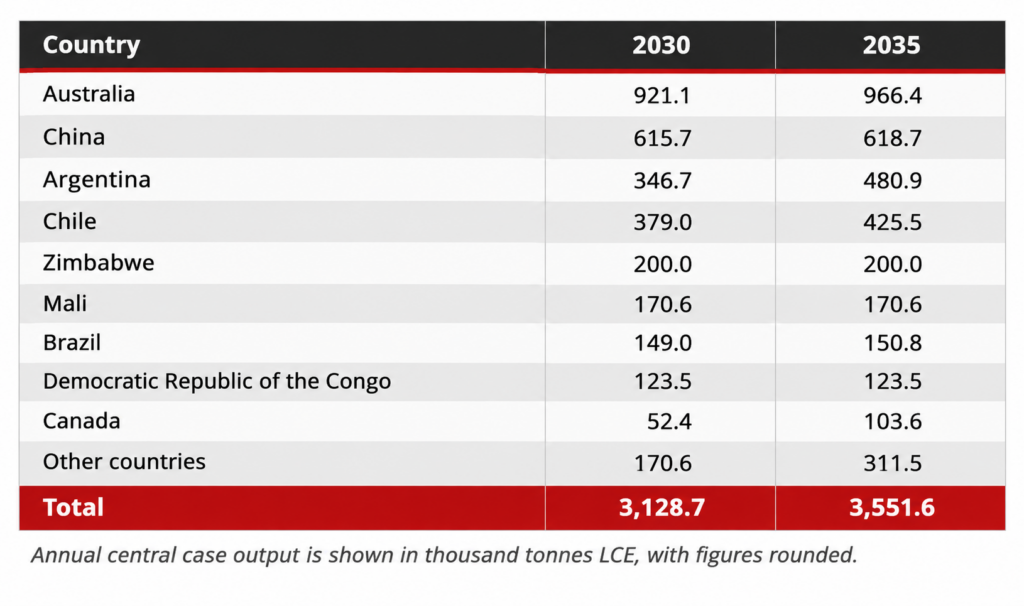
Argentina could overtake Chile as South America’s top lithium producer by 2035, even as global supply climbs to 3.55 million tonnes of lithium carbonate equivalent (LCE), a new study shows.

GEM Mining Consulting’s forecast puts Argentina’s output at 481,000 tonnes LCE by 2035, ahead of Chile’s 426,000 tonnes. Australia would remain the world’s largest producer at about 966,000 tonnes, followed by China at 619,000 tonnes.

The projections draw on 150 operating mines, expansions and development projects across 27 countries. They point to a changing competitive landscape as emerging producers gain ground on established suppliers, although financing constraints and construction delays could alter the rankings.

The findings also highlight the growing importance of project execution in securing future lithium supplies. For buyers and investors, the distinction between announced capacity and reliable commercial production could determine which suppliers can meet long-term commitments.

Conditional lead

Argentina’s projected advantage over Chile depends heavily on a single two-stage development, the Pozuelos–Pastos Grandes project, expected to contribute 90,000 tonnes LCE annually.

Without that project, Argentina’s expected output would fall to about 391,000 tonnes in 2035, leaving it behind its western neighbour.

Chile, meanwhile, is expected to increase production from about 361,000 tonnes in 2026 to 426,000 tonnes in 2035. Despite that growth, its share of modelled global supply would decline from roughly 18% to 12%.

The loss of market share reflects expanding production in competing jurisdictions, including Argentina, Mali, Brazil and Canada, rather than an outright contraction in Chilean output.

The study’s central scenario forecasts global lithium supply reaching 3.13 million tonnes LCE in 2030 before rising to 3.55 million tonnes five years later.

Supply risks

GEM’s alternative scenarios illustrate how project execution and operating performance could substantially alter the supply outlook.

Under a constrained development scenario with weaker operating results, global production would reach just 2.63 million tonnes LCE by 2035. Faster project delivery, by contrast, could lift output to 4.03 million tonnes.

The study also examined the consequences of a weaker lithium market. A scenario delaying new developments by two years and reducing production from existing operations by 10% beginning in 2027 would cut projected 2030 supply by approximately 529,000 tonnes, or 17%, compared with the central case.

Those differences underscore the risks of treating announced project capacity as guaranteed future supply, particularly when development schedules depend on financing and successful commissioning.

GEM recommends that lithium buyers and investors link contracted volumes to verifiable milestones, including secured financing, commissioning and sustained recovery performance.

The consultancy also advises companies to look beyond mine locations when diversifying supply chains, accounting for processing capacity and transportation routes.


India bans export of lithium-ion battery recycled material


Stock Image

The Indian government on Tuesday banned the export of lithium-ion battery black mass, a recycled battery material containing metals such as lithium, cobalt, nickel and manganese, by changing its export status from “free” to “prohibited” with immediate effect.

The amendment prohibits Indian recyclers from exporting lithium-ion battery black mass, encouraging domestic processing of critical battery materials and supporting India’s electric-vehicle supply-chain ambitions.

According to the notification from the Ministry of Commerce and Industry and the Department of Commerce, the export ban applies to lithium-ion battery black mass and associated battery waste that are unsorted and not containing lead, cadmium or mercury.

The notification comes days after the Indian cabinet approved an incentive policy worth 28.14 billion rupees ($300.2 million) to boost domestic processing of lithium and nickel, aimed at reducing reliance on supply chains dominated by China.


India is one of the world’s fastest-growing EV markets, with the government promoting local battery manufacturing and recycling as it targets EVs to account for 30% of new car sales and 80% of new two- and three-wheeler sales by 2030.

($1 = 93.7475 Indian rupees)

(Reporting by Saikeerthi in Bengaluru; Editing by Mrigank Dhaniwala)


Lithium Americas’ flagship Thacker Pass costs jump 31%


Counter-Current Decantation (CCD) thickener tanks at Thacker Pass. (Image courtesy of Lithium Americas.)

Lithium Americas (TSX, NYSE: LAC) has raised the estimated cost of the first phase of its flagship Thacker Pass lithium project in Nevada by 31% to $3.83 billion, citing rising labour, construction and logistics expenses.

The revised budget adds $895 million in capital costs and increases the project’s funding requirement by about $995 million, the company said Wednesday. Lithium Americas expects to cover the additional amount through company contributions and available reserves under a US Department of Energy (DOE) loan.

Investors reacted negatively to the news, sending Lithium Americas shares down almost 8% to C$2.48 apiece in early Toronto trading. The decline left the company with a market capitalization of nearly C$544 million ($382 million).

“Thacker Pass is on track to deliver America’s largest fully integrated source of domestic battery-quality lithium carbonate, and we are building it at pace,” CEO Jonathan Evans said in a statement. “Phase 1 is advancing toward peak construction activity by year end 2026, with mechanical completion targeted for late 2027.”

The cost increase underscores the challenges of building a domestic lithium supply chain in the US, where rising wages, skilled labour shortages and tariffs are adding pressure to major mining developments. Thacker Pass, a joint venture with US automaker General Motors (NYSE: GM), is expected to supply enough lithium for about 1 million electric vehicles annually.

Construction Pressures

Higher labour installation rates for piping, steel and equipment accounted for $245 million of the increase, while tariffs and logistics added approximately $100 million.

Lithium Americas now expects to spend between $1.7 billion and $2 billion on Phase 1 in 2026, compared with its previous forecast of $1.3 billion to $1.6 billion.

Despite the higher costs, the company continues to target commercial production in 2028, with Phase 1 designed to produce 40,000 tonnes of battery-grade lithium carbonate annually at full capacity.

The revised estimate puts greater pressure on construction productivity and cost controls as the project moves through its most labour-intensive stages. Further increases could strain available financing even if the company maintains its production schedule.

Funding Requirements

Lithium Americas expects to meet the additional funding requirement through contributions to the joint venture and available DOE loan reserves, reducing the need to seek entirely new financing.

The company held about $1.3 billion in cash and restricted cash as of Sept. 30, including approximately $360 million at the Thacker Pass joint venture.

The DOE-backed financing provides an important source of capital for the development, which is intended to strengthen US access to battery-grade lithium and reduce reliance on imported materials.