Friday, November 20, 2026

World Must Do More To Protect Children From War – Analysis


November 20, 2026

By Dr. Majid Rafizadeh


Key Takeaways:

UN World Children’s Day coincides with record verified grave violations against children in conflict, with the Secretary-General’s 2025 report documenting 38,558 violations affecting 24,174 children, the highest total in the mandate’s 30-year history.

In Yemen, renewed Houthi fighting has displaced hundreds of thousands, including an estimated 110,000 children, while UN data recorded 262 cases of child recruitment; in Sudan, drone strikes and blocked aid have left hundreds of thousands of young children facing severe acute malnutrition.

The author argues that existing international law and action plans are insufficient without full implementation, independent access, accountability for commanders, protected humanitarian space, and sustained funding so that children are no longer used as instruments of war.


As the world on Thursday observes UN World Children’s Day under the theme “My day. My rights. My future,” the reality for millions of children trapped in armed conflict is very different from this hopeful message. In many places, such as Sudan and Yemen, children are not merely bystanders to adult wars — they are the ones who suffer the deepest and most lasting harm.

Killed by drones and landmines, recruited as fighters, driven from their homes, starved by the blocking of aid and denied schooling and medical care, they carry problems and wounds that shape the rest of their lives.

These are not the unavoidable side effects of conflict. They are the predictable result of choices made by aggressive armed groups and governments and an international community that has too often failed to prioritize the protection of children.


The scale of the crisis is unprecedented. The latest Report of the UN Secretary-General on Children and Armed Conflict verified 38,558 grave violations against children in armed conflict in 2025, affecting 24,174 children — the highest number recorded since the Children and Armed Conflict mandate began 30 years earlier.

Killing and maiming accounted for the largest share, followed by denial of humanitarian access, the recruitment and use of children, and abduction. Explosive weapons caused about 70 percent of child casualties. These figures capture only verified cases; the true number is most likely higher.

The Houthis’ renewed aggression in Yemen this year illustrates how quickly progress can reverse. More than 12 million children there already require lifesaving assistance. The intensified fighting initiated by the Houthis in September displaced at least 300,000 people, including an estimated 110,000 children, in the opening weeks alone. Families have fled shelling around Taiz and other front lines only to confront overcrowded shelters, collapsing services and restricted humanitarian access.

Child recruitment remains especially grave. The UN verified 262 cases of recruitment and the use of children in Yemen in 2025 — 127 of which were attributed to the Houthis. Investigations have documented abductions of children as young as 11, ideological summer camps that channel youth into military pipelines and boys who left home on ordinary errands only to appear on the front lines.


Land mines and explosive remnants continue to kill and maim children gathering firewood or simply playing. Schools have been damaged or closed and health services disrupted. An entire generation is growing up without the basic security, nutrition, education and care that childhood demands.

Sudan presents an equally devastating picture. Between January and September, UNICEF recorded 410 children killed or injured, with about two-thirds of those casualties resulting from armed drone strikes.

Drones bring the war to places once considered relatively safe, destroying power stations that pump water, disrupting vaccine cold chains and forcing families to use unsafe water sources that spread disease.

Hunger has increased the damage. An estimated 825,000 Sudanese children under five are expected to suffer severe acute malnutrition in 2026 — the form that kills. Nearly 19.5 million people face high levels of acute food insecurity. Millions have been displaced. At least 8 million children are out of school in key regions. Health facilities have been destroyed or rendered nonfunctional.

The combination of drones, drought and blocked aid has created a lethal cycle from which children cannot escape on their own.

A protected childhood is not a luxury, it is the foundation of healthy individuals and stable societies. The early years shape brain architecture, emotional regulation and the capacity for trust and learning.

When children are recruited into fighting forces, they lose not only their present but also the skills and relationships needed for later civilian life. Survivors often face stigma, trauma and limited economic options, raising the risk of re-recruitment or further violence.

In addition, chronic malnutrition permanently impairs cognitive development. Displacement severs social networks and access to education. The long-term costs — mental health crises, lost productivity, intergenerational poverty and cycles of violence — fall on entire communities and impact future generations.


We know that international law is unambiguous: the recruitment and use of children under 15 in hostilities is a war crime. Broader obligations under the Convention on the Rights of the Child and the Additional Protocols to the Geneva Conventions require parties to conflict to protect children, facilitate humanitarian access and refrain from attacks on schools and hospitals.

Statements of concern are no longer sufficient. Concrete measures are required. Existing action plans must be fully implemented. The Houthis signed a UN action plan in 2022 to end child recruitment — they must immediately release children associated with their forces, cease new recruitment, allow independent age verification and grant the UN unimpeded access to detention and training sites. Accountability must be strengthened.

The UN Security Council should maintain and expand lists of parties that recruit or kill children and support mechanisms that document evidence for potential prosecutions. Targeted measures against commanders responsible for child recruitment and the use of explosive weapons in populated areas can raise the cost of violations.

Humanitarian space must be protected. Attacks on water systems, power infrastructure, schools and health facilities must be investigated and condemned without double standards.

Sustained and flexible funding for child protection, nutrition, education in emergencies and mine action is essential. Children’s specific needs and rights must be elevated in every peace process. Any settlement that ignores the harms done to them will plant the seeds of future instability.

In summary, children bear the most pain in any conflict. They are the ones who lose the most — their safety, their health, their education, their future — and they are the ones we have the clearest duty to protect. Childhood is the most formative period of human life; damage inflicted then echoes for decades. International organizations, governments and communities must therefore do everything in their power to shield children from the violence of adults.

Conflicts that place this intolerable burden on the youngest must be brought to an end. Children must not be used as instruments of war and instead be allowed to live as children.


This article was published at Arab News


About Dr. Majid Rafizadeh
Dr. Majid Rafizadeh is a Harvard-educated Iranian-American political scientist. X: @Dr_Rafizadeh
View all posts by Dr. Majid Rafizadeh →


Africa accounts for half of world's children living in conflict zones, NGO warns

Around 260 million children in Africa were living close to armed conflict in 2025 – amounting to two in five, a larger proportion than ever previously recorded, the charity Save the Children said in a report on Thursday. Worldwide, nearly one in four children lived near fighting.


Issued on: 19/11/2026 - RFI

Two in five children in Africa lived near armed conflict in 2025, Save the Children has said. AP - Gregorio Borgia

The number of children living in conflict zones in Africa rose by nearly 20 percent from 2024 to 2025, when the continent accounted for 44 percent of the global total.

Around one in eight lived in conflict zones in 2010, compared with around two in five in 2025 – roughly the same share as in the Middle East.

Meanwhile, the global count climbed from 378 million in 2015 to 589 million in 2025, the highest since records began in 1990. It covers children who lived within 50 kilometres of at least one conflict incident in their country that year.

“These record-high figures are a stark reminder that conflict is devastating the daily lives, education, health and future prospects of hundreds of millions of children,” said Gudrun Ostby, a research professor at the Peace Research Institute Oslo, which produced the report.


Abductions and sexual violence

The UN verified 38,967 grave violations against children in armed conflict in 2025, the second-highest annual total since monitoring began in 2005. More than half took place in the occupied Palestinian territory, the Democratic Republic of Congo (DRC) and Nigeria.

More than 14,000 children were killed or seriously injured and 5,128 were abducted. Attacks on schools and hospitals rose for a fifth year in a row, to 2,930.

Sexual violence against children is widely underreported, Save the Children said.

Around 86 percent of the cases verified in 2025 were in African conflict zones. From 2024 to 2025, cases rose from 358 to 592 in the DRC, and from 74 to 193 in Sudan.

In the eastern DRC, violence forced a 17-year-old girl and her family from their home. When they returned months later, armed men broke in, shot her brother dead and raped her.

“We had fled the war, but it came knocking at our door again,” the girl said in testimony published by Save the Children. The morning after the attack, neighbours helped her reach a health centre, where she received emergency medical care and ongoing psychological and social support.

Barriers to aid

Blocking aid was the fastest-growing violation tracked in the report, with verified incidents rising from 509 in 2015 to 8,322 in 2025 – nearly one an hour on average. More than 70 percent of the 2025 cases involved Palestinian children.

Denial of aid accounted for more than one in five verified violations that year, second in number only to the killing and maiming of children.

“We’re seeing aid weaponised, attacked and deliberately disrupted,” said Inger Ashing, chief executive of Save the Children International.

Warring parties should let humanitarian relief reach civilians safely and governments need to hold those responsible for violations against children to account, the NGO said.

(with newswires)

“The Nuremberg Women” By Natalie Livingstone – Book Review


"The Nuremberg Women: The Untold Story of the Eight Women Who Brought the Nazis to Justice," by Natalie Livingstone


November 19, 2026

By Neville Teller


With “The Nuremberg Women” Natalie Livingstone opens up for the first time a hitherto unexplored area in the modern historical record – the part played by some women in the prosecution of the Nazi leaders responsible for the war crimes, crimes against humanity and genocide committed during the Second World War. “The Nuremberg Women” addresses what has been a genuine gap in historical knowledge and understanding.

Newsreels, photographs and paintings of the Nuremberg trials, held between November 1945 and October 1946, show a courtroom filled with men – the eight judges, the prosecutors, defending counsel, the prisoners in the dock. Apart from the occasional witness, women were notable by their absence. Until Livingstone, no author has researched and pursued the idea that the trial was a human enterprise involving researchers, interpreters, journalists, artists, witnesses and survivors, many of them women.

Her book does more than tell the stories of eight remarkable women. It demonstrates how the conventional historical account can be incomplete, even when the principal events and personalities are well documented. Even for someone who already knows something about the Nuremberg trials the book is valuable, because it offers a different way of looking at a familiar historical episode.

Livingstone has selected eight women from the scores who were personally and directly involved in facilitating the Nuremberg trials and whose stories she could have pursued. They are:


Laura Knight, the British painter commissioned to record the courtroom proceedings. Her famous painting of the Nuremberg trial is the starting point for Livingstone’s investigation.

Harriet Zetterberg, the American lawyer and exceptionally capable member of the prosecution team who helped assemble important evidence against Nazi leaders.

Erika Mann, the German journalist. Daughter of novelist Thomas Mann, she was an outspoken anti-Nazi campaigner who had fled Germany. Her reporting provides a particularly revealing perspective on the defeated Nazi leadership.

Ursula von Kardorff – the German reporter whose dispatches raise difficult questions about the relationship between journalism, accommodation with Nazism and the selective remembrance of one’s own wartime activities.

Rebecca West – the celebrated British literary journalist, whose observations and reportage provide an important contemporary account of the proceedings and their wider significance.

Tatiana Stupnikova – the young Russian interpreter working for the Soviet delegation. Her experience illustrates the difficult position of those required to translate evidence of Nazi crimes while serving a Soviet regime with its own record of atrocities.


Marie-Claude Vaillant-Couturier – the French Resistance member and Auschwitz survivor, whose devastating testimony described the concentration camps and the systematic extermination of their victims.

Ingeborg Kálnoky – an Hungarian countess. She ran the house in which witnesses, concentration camp survivors and, remarkably, Nazi perpetrators were accommodated while awaiting their involvement in the proceedings.

Livingstone is interested not simply in what these women achieved at Nuremberg, but also in what happened to them before they became involved, and afterwards, when many found their professional achievements and public influence marginalized.

To select one of the eight at random – Erica Mann. She was one of the respected journalists covering the trials, but she had an astonishing and eventful life both before and after Nuremberg.

Born in 1905, she was the daughter of the renowned German author, Thomas Mann. Livingstone describes her childhood as “gilded”. The fact that her mother had Jewish connections induced the family to leave Germany when Hitler came to power in 1933. But Erica had already written and performed in an anti-Nazi cabaret.

Certain that the new Nazi regime would pursue her, she devised a way to change her nationality and arranged a “marriage of convenience” with an Englishman. The poet W H Auden was willing to cooperate. She came to England and married him, very nearly sight unseen, in June 1933. His lover, the gardener Peter Roger, was the witness. Five days later, the Reich Propaganda Minister, Joseph Goebbels, stripped her of her German citizenship. She and Auden remained friends throughout their lives.


During the 1940s, her parents moved to California. While there she had a brief relationship with a German conductor 30 years her senior. His name – Bruno Walter, the world-renowned maestro.

She returned to Europe to report the final months of the war. In September 1944 she met and fell in love with an American woman called Betty Knox. Betty had been one of the performing troupe known as “Wilson, Keppel and Betty”, very popular on the British variety stage. Betty left the group, bequeathing her role to her daughter, and became a journalist.

Livingstone tells us that during her time in Nuremberg Erica “wrote feverishly”. Shortly after the trials she became very ill, and was rushed to a hospital in Zurich where she was able to pay for her expensive medical treatment out of the Mann family funds, trapped in Germany during the war, but now released.

She recovered, but felt that the German people never came to terms with their Nazi past. In the final analysis she believed the world had sustained “defeat in victory”.

Livingstone devotes the same degree of consideration to the lives and careers of the other women she has selected, paying particular attention to their time spent in the preparation and conduct of the Nuremberg trials. The work of Tatiana Stupnikova, the only Russian women among the eight, is particularly interesting since it exposed the contradictions of the Soviet Union prosecuting Nazi crimes while concealing its own complicity in the Nazi-Soviet pact.

“The Nuremberg Women” is an original and outstanding work. With the trials as her central focus, Livingstone has placed the research-based biographies of eight remarkable women into the wider political and legal context of the times. It is highly recommended.


Follow the reviewer at: www.a-mid-east-journal.blogspot.com


About Neville Teller
Neville Teller's latest book is ""Trump and the Holy Land: 2016-2020". He has written about the Middle East for more than 30 years, has published five books on the subject, and blogs at"A Mid-East Journal". Born in London and a graduate of Oxford University, he is also a long-time dramatist, writer and abridger for BBC radio and for the UK audiobook industry. He was made an MBE in the Queen's Birthday Honours, 2006 "for services to broadcasting and to drama."
View all posts by Neville Teller →


In South Korea, women forced into prostitution on US military bases seek justice

Cover image: Focus
© Kim Han-geun, Pukyong institute for modern history
Issued on: 19/11/2026 
06:06 min

Tens of thousands of women were forced to work in South Korean state-sanctioned brothels used by American soldiers based in the country after the Korean War. They were raped, physically abused and forcibly confined. Now, after decades of silence, some of these women are speaking out.

The women accuse the US and South Korean governments of abuse and are demanding compensation for their ordeal. In May of this year, 117 of them – who are now mostly in their 70s – launched legal action that targets the US for the first time. Back in 2022, the South Korean Supreme Court ruled that the government had illegally operated the brothels for American servicemen.

FRANCE24's Chloé Borgnon, Constantin Simon, Aruna Popuri and Justin McCurry report.

Interview

French union leader warns strikes will continue without higher wages


French trade unions have promised to call more strikes and demonstrations, arguing that a government proposal to increase the minimum wage fails to address the social crisis that has spurred protests across the country. Sophie Binet, head of the CGT union, says even after six weeks of action, workers and students are more determined than ever to keep up the fight.


Issued on: 20/11/2026 - RFI

People attend a demonstration in Paris as part of a nationwide day of strikes and protests over wages, the cost of living and public services, 5 November 2026. 
© REUTERS - Sarah Meyssonnier

What began as student protests over conditions in French high schools have since been joined by workers in both the public and private sectors, as well as others angry over high cost of living, lack of investment in public services and stagnating salaries.

This comes as the government races to adopt a deficit-cutting budget ahead of a presidential election next year.

The CGT, one of France's biggest unions, is calling for another day of protest on Saturday. Its demands include the unfreezing of wages in the public sector, higher salaries across the board, more places in higher education and new teaching positions.

Speaking to RFI on Thursday, secretary-general Binet says the government must "make immediate, substantial announcements" if they hope to bring the protests to an end.

Sophie Binet, secretary-general of the CGT trade union, in RFI's studios on 19 November 2026. © RFI

RFI: This Saturday will mark the sixth major day of action since this movement began. Do you think it might go on for a long time yet?

Sophie Binet: Absolutely. What’s very clear is that none of the government’s manoeuvres have managed to take the air out of this movement. They’ve tried repression, they’ve tried banking on school holidays, they’ve tried sowing division among the unions, they’ve tried using the weather, and they’ve tried throwing up a smokescreen. None of it has worked.

What I want to say to the government is this: we know we’re running a marathon, and we have the stamina to go the distance. On Tuesday [when unions held their most recent nationwide public sector strike], we passed the 30-kilometre mark. In a marathon, the 30th kilometre is always the hardest – but once you’re past it, you’re sure to reach the finish line.

What I see is an unprecedented social mobilisation. In just two months, 11 national days of action have brought together 5 million people. What has taken place in France is truly massive – it’s an unprecedented start to this period of social unrest.

That said, there is of course some fatigue among the protesters.

RFI: On Tuesday, the turnout was 150,000 according to the police, and 500,000 according to the CGT. Government figures showed less than 3 percent of civil servants were on strike, compared to nearly 10 percent on 5 November. What do you make of this loss of momentum?

SB: It’s not so much a loss of momentum, it’s just that not everyone can turn up all the time. There are periods that are a bit quieter, and others that are more intense.

Quite simply, it’s a question of purchasing power. Going on strike is costly – it means losing income, which is expensive. People have clearly weighed the economic implications, but their determination remains unshaken, and the anger is very real. There must be a response to this mobilisation, otherwise it is set to become a drawn-out struggle.

Our goal is to get immediate answers. Contrary to what the government or [President] Emmanuel Macron might say, our focus is not on the ballot box six months from now – it is on the here and now. What will they tell us so that we can finally make a living from our work?

RFI: What can this government, which does not have a majority in parliament and is focused on making budget cuts, actually do?

SB: This government possesses the powers of a government and can make political choices. We must go and get the money where it really is – in the pockets of shareholders, the ultra-wealthy and large corporations – in order to provide fair compensation for workers and fund our public services.

RFI: The CGT has specifically criticised a planned increase in military spending. The draft 2027 budget allocates around €63 billion to defence, which is €6.5 billion more than in 2026. Why do you consider this to be too much?

SB: The problem is that the only public budget that is increasing is the military budget. And today, hospitals are being closed in order to build cannons. The problem arises when this happens at the expense of everything else. And right now, what we are seeing is that our public services are in a state of total disrepair. We experienced an unprecedented summer, with firefighters tasked with battling mega-fires while essentially armed with nothing more than teaspoons – simply because they lack the resources to do their jobs.

If there is one area that requires investment, it is public health, the state of our hospitals, along with adaptation to global warming and education. When millions of young people tell us that they lack the means to pursue their studies under decent conditions, that is a red alert. It means our country is no longer preparing for its own future.

RFI: What about the war in Ukraine? There is clearly an aggressor and a victim of aggression. Should we abandon Ukraine simply because we can no longer afford it?

SB: No, that is not what we are saying. What we are saying is that the money should be taken from where it currently lies – in the pockets of large corporations and the ultra-wealthy. Among the many things the government could very easily do, it could re-examine the €211 billion in annual subsidies granted to businesses – subsidies provided without any conditions or requirements in return.

Included in that €211 billion is what is known as the "tonnage tax" – a system of tax exemptions that benefits shipowners. It costs us between €3 billion and €5 billion a year, even though these shipowners have never made such high profits. Why don’t we, for instance, abolish this tax?

Within that €211 billion, there are €8 billion in tax credits for businesses pursuing research and development – a setup that clearly creates windfall effects. Dozens upon dozens of reports have pointed this out. Why don’t we reallocate funds from this tax credit to finance our universities and research institutions instead?

RFI: Are things worse in France than elsewhere?

SB: Yes, it is worse in France than elsewhere. When you look at international comparisons, France is the European country that has increased its minimum wage the least. We started from a high level. After all, we still recall the general image of France – a country of social rights, a country with higher wages, a country that had a minimum wage back when the majority of European nations did not.

And now, the French minimum wage lags far behind the German minimum wage, even though the Germans used to be behind us and didn't even have a minimum wage. In terms of wages, France has fallen behind at the European level.

This is a result of Emmanuel Macron’s supply-and-demand policy, which has effectively compressed wages. Furthermore – again due to this approach – taxes on the wealthiest individuals and the largest corporations have been cut by €60 billion annually. That is €60 billion less for our public services.

‘Generational rage’ drives young Europeans to fight to be heard

RFI: In your view, is a convergence of struggles across Europe possible?

SB: We know that what is happening in France is giving others ideas – in Greece, Italy, Portugal, Spain and Germany.

But first, it is worth noting that this so-called "Gen Z" movement did not start in France. It began in countries of the Global South, such as India, Bangladesh, Nepal, Morocco and others. What we are seeing in France may well be the first instance of this movement breaking out in a Western nation. In other words, we didn't invent anything. It is simply a wave that has reached our shores.

What I find very interesting is that this is a wave coming from the South. It therefore shatters all preconceived notions about North-South power dynamics in our countries, and it highlights the demographic shifts currently at play.

A distinctive feature of Europe is that young people are becoming a minority within our ageing society, one that renders them invisible – the first time this has ever happened in our history. We need proactive public policies focused on young people, because they are our future.

This article has been adapted from an interview in French by RFI's Arnaud Pontus and lightly edited for clarity.
Europe's youth set to join mass cost of living protests in 25 countries

Youth protests are set to take place in more than 25 countries in Europe on Friday and over the weekend, coalition organisers said, as demostrators seek to increase pressure on governments over issues including soaring housing costs and deteriorating learning conditions with a show of cross-border solidarity.


Issued on: 20/11/2026 
By: FRANCE 24


Students march during a demonstration calling for better school conditions in Paris on November 17, 2026. © Aurelien Morissard, AP

Protesters across Europe are set to take to the streets on Friday in a show of cross-border solidarity, joining coordinated demonstrations against the rising cost of living, militarisation and other causes, in a bid to increase pressure on their governments.

After weeks of protests in several European nations, unions and activists from France, Britain, Belgium, Spain, Italy, Portugal and Greece want to raise the stakes by holding simultaneous rallies on Friday and over the upcoming weekend.

While local grievances have fuelled the fire, the movements that have brought hundreds of thousands onto the streets are linked by shared continent-wide concerns, including soaring housing costs, deteriorating learning conditions, stagnant pay and increased military spending.

The demonstrations come as Russia's invasion of Ukraine approaches its fifth year and ahead of a series of key elections in Spain, France, Italy and Greece.

A youth-led coalition said young people in more than 25 countries were expected to join the protests.

"It's a really important event in giving a platform to the youth voice throughout the country and expressing our need for systemic and immediate change for our futures," said Zennor Tyndale-Biscoe, a 17-year-old student who planned to demonstrate in Truro in southwest England.

"We believe strongly in the youth voice and the effect it will have on an adult world," Tyndale-Biscoe said, also citing the French youth protests.


'Radical transformation'

The youth-led coalition urged a "radical transformation of the system we live in" and encouraged young people to protest against militarisation and social injustice.

"Fight for our future, not their wars!" said the coalition of more than 50 youth- and student-led groups.

Among the organisers are also France's Yellow Vests, a movement that rattled President Emmanuel Macron with street protests in 2018 and 2019.

The unions and housing rights activists put forward six broad demands ranging from a guaranteed right to housing for everyone to taxing the rich and ending rearmament policies.

While the European Union seeks to rearm in the face of the Russian threat, the protest organisers say funds allocated to rearmament should be spent on education, youth policies and housing.

In Germany, fears of a possible reintroduction of military service have led many young people to join the protests.

"While seemingly unlimited amounts of money are being poured into the military and the infrastructure supporting the military, the welfare state is being dismantled," said Hannes Kramer, a German student protester.


'Call for change'

While organisers say that hundreds of protests and strikes are expected to take place in countries including Portugal, Croatia and Switzerland, the scale of the mobilisation remains difficult to predict.

In France, the calls to protest coincide with the eighth anniversary of the Yellow Vest movement, which began as a campaign against rising fuel taxes before evolving into a broader protest over the cost of living.

In Italy, the demonstrations will coincide with a general strike set to affect transport, schools and hospitals, with the CGIL trade union dubbing the protests "the country's call for change".

In Spain, the protests fall on the anniversary of the death of dictator Francisco Franco, with youth demonstrations expected at midday and anti-fascist rallies planned for the evening.

In Germany, the collective "GenZ regelt" ("Gen Z has got this") says it expects 15,000 people to join protests in Berlin, alongside actions in dozens of other cities.

The protests in European countries were inspired by French students who began blocking their high schools in mid-September to demand better learning conditions.

The school movement fuelled a nationwide campaign against soaring prices, inadequate public services and police brutality. Several young people have lost eyesight or hands to police weapons in the protests and thousands have complained about the severe effects of tear gas.

It has encouraged similar student actions in countries including Belgium, Italy and Spain, where the French word "blocus" (blockade) has become a popular hashtag.

"We are seeing youth movements emerge across the world at the same time," said French historian Sylvain Boulouque.

"What unites almost all of these demonstrations is distrust of law enforcement and political authorities."

(FRANCE 24 with AFP)


\


Youth protests return as thousands to march in German cities


20.11.2026,

Photo: Matthias Rosenkranz/dpa

Thousands of young people are expected to demonstrate again on Friday in many German cities, following a call from the group Gen Z Takes Charge, almost three weeks after the first major youth protests.

The group, Gen Z regelt in German, is demanding money for schools, addiction support and psychotherapy, affordable living, opposition to conscription and consistent action climate change.

Separately, the Federal Pupils' Conference is organizing its own demonstration at the Brandenburg Gate in Berlin on Friday afternoon. According to police, 5,000 people have registered for it.

The pupils' conference is keeping its distance from the organizers of Gen Z Takes Charge. It said that it is focusing on demands for better education, including school renovation, school social work, relief for teachers and the inclusion of climate action in curricula.

The Federal Parents' Council, trade unions and environmental associations are supporting it.

Young people don't feel taken seriously

Gen Z Takes Charge co-organizer Akram Selo called on Germany's leadership to meet the young people's demands.

"Talks won’t make us stop demonstrating," he told RBB-Inforadio in comments aired on Friday.

"Essentially, our demands should be addressed, and we should be given assurances. That is what needs to happen, not empty promises."

"So far, we feel that we aren’t being taken seriously at all," said Selo. "The way we’re being treated suggests that the aim is to sideline our demands and discriminate against us by focusing on other trivial matters."

Protest also against conscription checks

The alliance "School strike against conscription" is also holding its own actions. It is demanding an immediate halt to conscription checks for the German Armed Forces, or Bundeswehr.

The various protests by different groups begin in the morning and run until late afternoon.

At the protests organized by Gen Z Takes Charge on October 31, tens of thousands took to the streets across Germany, largely peacefully. That evening, rioting broke out in several cities, including Frankfurt.

At that time, Gen Z Takes Charge said it had more than 180,000 registrations for actions nationwide, far more than it has now.

France raises bird flu alert to highest level as infections spread across Europe

France is raising its avian flu alert to the highest level from Friday, bringing new restrictions on poultry movements as authorities seek to contain the spread of the virus. The decision comes amid a rise in infections among wild birds across Europe, particularly along migration routes crossing France.


Issued on: 19/11/2026 - RFI

France has raised its avian influenza alert to the highest level, introducing tighter restrictions on poultry farms. © GAIZKA IROZ / AFP

France will raise its bird flu risk level from "moderate" to "high" on Friday, triggering tougher preventative measures aimed at protecting poultry farms from the highly contagious virus.

The decision, announced in a decree published in the Official Journal on Thursday, places mainland France on the highest of three alert levels for highly pathogenic avian influenza (HPAI).

The new restrictions include a ban on poultry movements and tighter requirements for keeping farmed birds separated from wild birds, which are considered a major source of transmission.

The Agriculture Ministry said the decision followed the confirmation of outbreaks in backyard poultry flocks in mainland France, alongside growing evidence that the virus is circulating among migrating wild birds.

It cited the spread of the infection along migration routes crossing France, with confirmed cases among wild birds on French territory raising concerns that the disease could reach commercial poultry operations.

The move marks a rapid escalation in the country's alert status. France had maintained a "negligible" risk level since June before raising it to "moderate" in early November.

Vaccination advantage

The decision comes as European authorities report a resurgence of bird flu infections, particularly among wild birds travelling along major migration corridors.

French officials have warned of an increase in confirmed cases in several neighbouring countries.

Avian influenza is a highly contagious viral disease that primarily affects birds. The most dangerous strains can spread rapidly through poultry flocks, often forcing farmers to slaughter large numbers of animals to prevent further transmission.

France has already recorded several outbreaks this year.

In early September, a case was detected at a duck farm in the western department of Maine-et-Loire which led to the culling of around 7,600 birds.


Despite the renewed threat, France enters the latest bird flu season with an advantage – a vaccination programme which experts credit with helping to keep major outbreaks under control over the past two years.

Since October 2023, vaccination against avian influenza has been compulsory on French farms raising more than 250 ducks.

France remains the only European Union country to have introduced such a mandatory programme on this scale.

The strategy was adopted following repeated bird flu crises that devastated poultry production, particularly in southwestern France, where duck farming is central to the production of foie gras.

Experts say the vaccination campaign has played an important role in reducing the scale of outbreaks, although it cannot entirely eliminate the risk of infection.

France has also adjusted its biosecurity rules to allow farmers greater flexibility when the country is placed on high alert. Since October 2023, certain free-range poultry have been permitted limited outdoor access under strictly controlled conditions, rather than being kept permanently indoors.

Laying hens, for example, may be allowed into restricted outdoor runs, while vaccinated ducks can use specially adapted areas designed to minimise contact with wild birds.

The return to the highest alert level means poultry farmers must now reinforce biosecurity measures to prevent contact with infected wild birds.

(with newswires)


Bangladesh rocked by bomb blitz as Hasina vows to return

Bangladesh rocked by bomb blitz as Hasina vows to return
Crude bombs, arson at Muhammad Yunus's family home and attacks on Grameen Bank mark Hasina's (above) Awami League's biggest show of strength since the 2024 uprising. / PentagonFacebook
By IntelliNews - Chennai Bureau November 19, 2026

Crude bombs exploded in Dhaka before dawn on November 19 as Bangladesh's banned Awami League called a nationwide shutdown to demand the return of exiled former prime minister Sheikh Hasina.

At least four people were wounded, police and witnesses told the Indian news agency PTI. Hours earlier, fire tore through part of the ancestral home of Muhammad Yunus, the Nobel laureate who ran the interim government after Hasina's fall, in the Panchlaish area of Chattogram. Local residents suspected petrol bombs. Panchlaish police chief Mozammel Haque told The Business Standard that the initial assessment was that the fire had been started "using a flammable substance such as kerosene or octane". The room had been unused for about 15 years. Police are investigating.

Yunus's Grameen Bank has become a target in its own right. At least 51 of its branches and offices have been hit by arson or attempted arson since November 10, the bank said, Reuters reported.

The shutdown is the Awami League's biggest show of strength since the July 2024 uprising that drove Hasina into exile in India. Barred from politics and kept off February's ballot, the party can still paralyse districts, and incumbent Prime Minister Tarique Rahman's Bangladesh Nationalist Party (BNP) government, nine months into office, now has a law-and-order crisis stacked on top of an economic one. Hasina, 79, has said she will come home in December at "any cost".

Gopalganj in revolt

The violence has been fiercest in Gopalganj, Hasina's home district. After police detained party activists in Tungipara, her birthplace, on the evening of November 17, a crowd stormed the town's police station and set it alight. Nine police vehicles and 15 motorcycles were burned and weapons were looted, Prothom Alo reported, citing police. The house of the local BNP MP, SM Jilani, was torched the same night, according to The Daily Star.

Police fired tear gas and rubber bullets at Hasina supporters in Gopalganj on November 10, and more than 100 crude bombs went off near the Padma Bridge toll plaza during an overnight blockade. Over the past 10 days police have recorded bomb blasts and vehicle arson in at least 28 of the country's 64 districts, Reuters reported, citing local media.

Two local BNP leaders were killed in Narail when Awami League activists attacked a BNP march, police said, while a BNP leader and a transport worker died in Faridpur and Pirojpur, PTI reported.

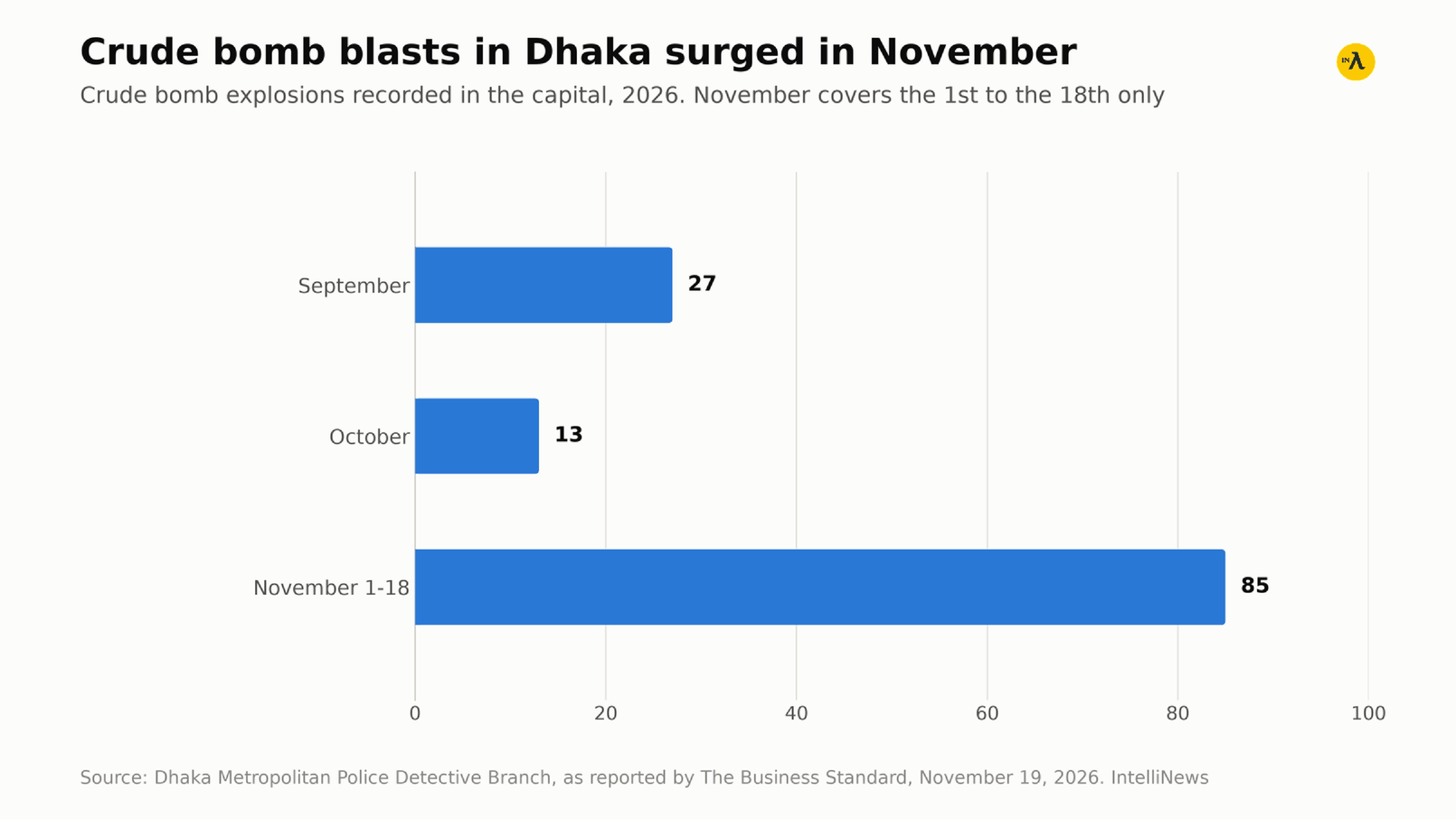
The capital recorded 85 crude bomb explosions in the first 18 days of November, against 13 in all of October and 27 in September, Detective Branch Additional Commissioner Shafiqul Islam told The Business Standard.

Crude bomb explosions recorded in Dhaka, 2026; November covers the 1st to the 18th. Source: Dhaka Metropolitan Police Detective Branch, as reported by The Business Standard, November 19, 2026. IntelliNews

The state pushes back

Dhaka police arrested 565 people in 24 hours before the shutdown, 71 of them Awami League or Chhatra League members, the Dhaka Metropolitan Police said, bdnews24 reported. Nurul Islam Nahid, education minister in Hasina's cabinet, was detained at his Dhaka home around midnight. Thousands of Border Guard Bangladesh troops have been sent to sensitive districts, including Gopalganj, and Home Minister Salahuddin Ahmed has promised to prosecute those responsible using audio and video evidence.

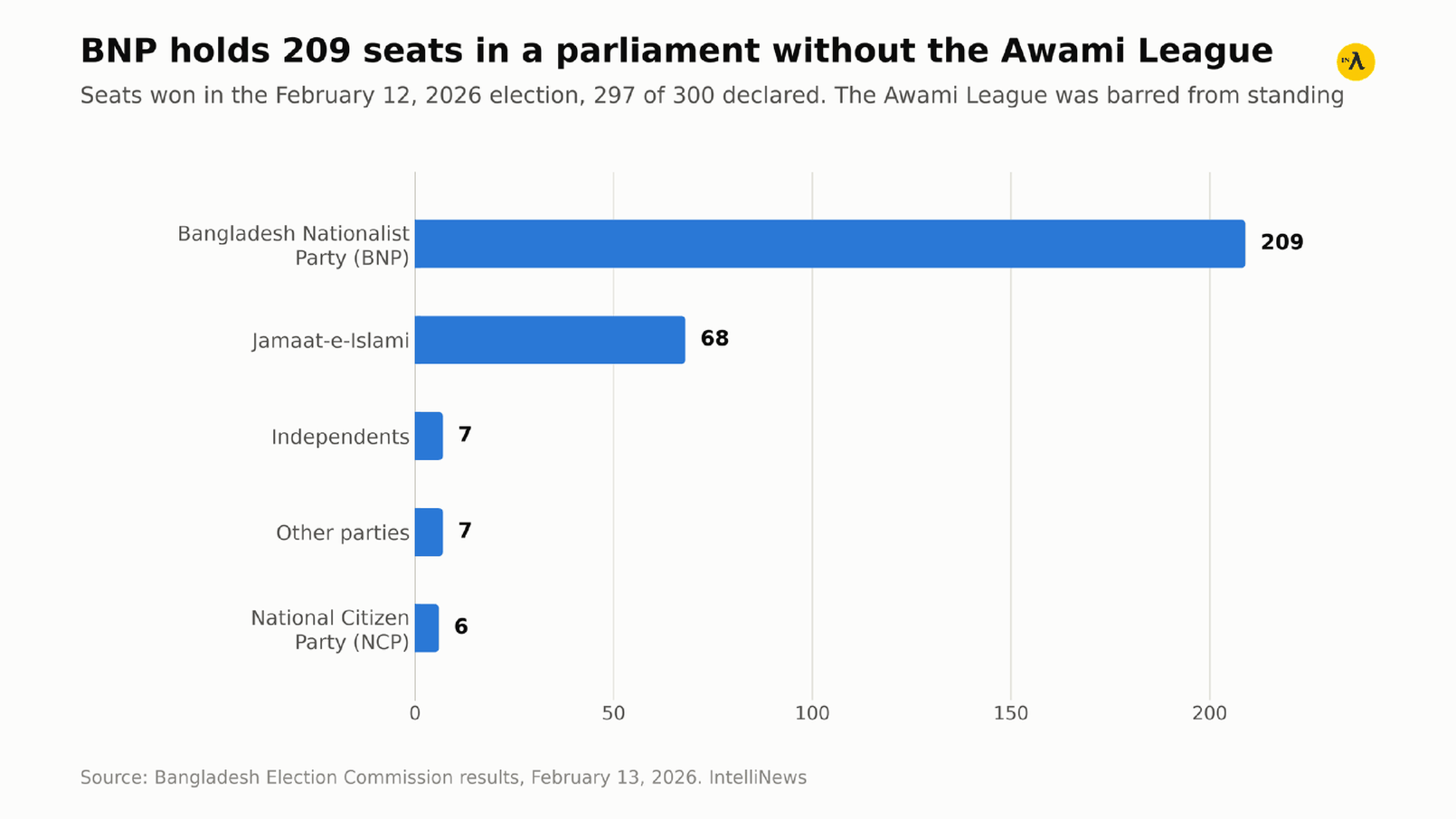
"Let us once again unite in the spirit of 2024, when we drove the autocratic forces out of this country, and ensure that those forces are decisively defeated," he told parliament, according to PTI. He ordered BNP lawmakers back to their constituencies and told them not to rely on the administration alone but to work with grassroots activists, The Daily Star reported. The BNP has the numbers in parliament: it took 209 of the 297 seats declared in February, and formed the government with Jamaat-e-Islami, on 68 seats, as the main opposition, according to the Election Commission's results.

Seats won in Bangladesh's February 12, 2026 election, 297 of 300 declared. Source: Bangladesh Election Commission results, February 13, 2026. IntelliNews

Prices give the protest a second engine

Most of the Awami League's eight demands concern the party itself: lifting its ban, abolishing the International Crimes Tribunal, quashing verdicts and freeing jailed members, according to a statement on its Telegram channel reported by India Today. Two reach further, calling for controls on the prices of essentials and the reopening of closed factories.

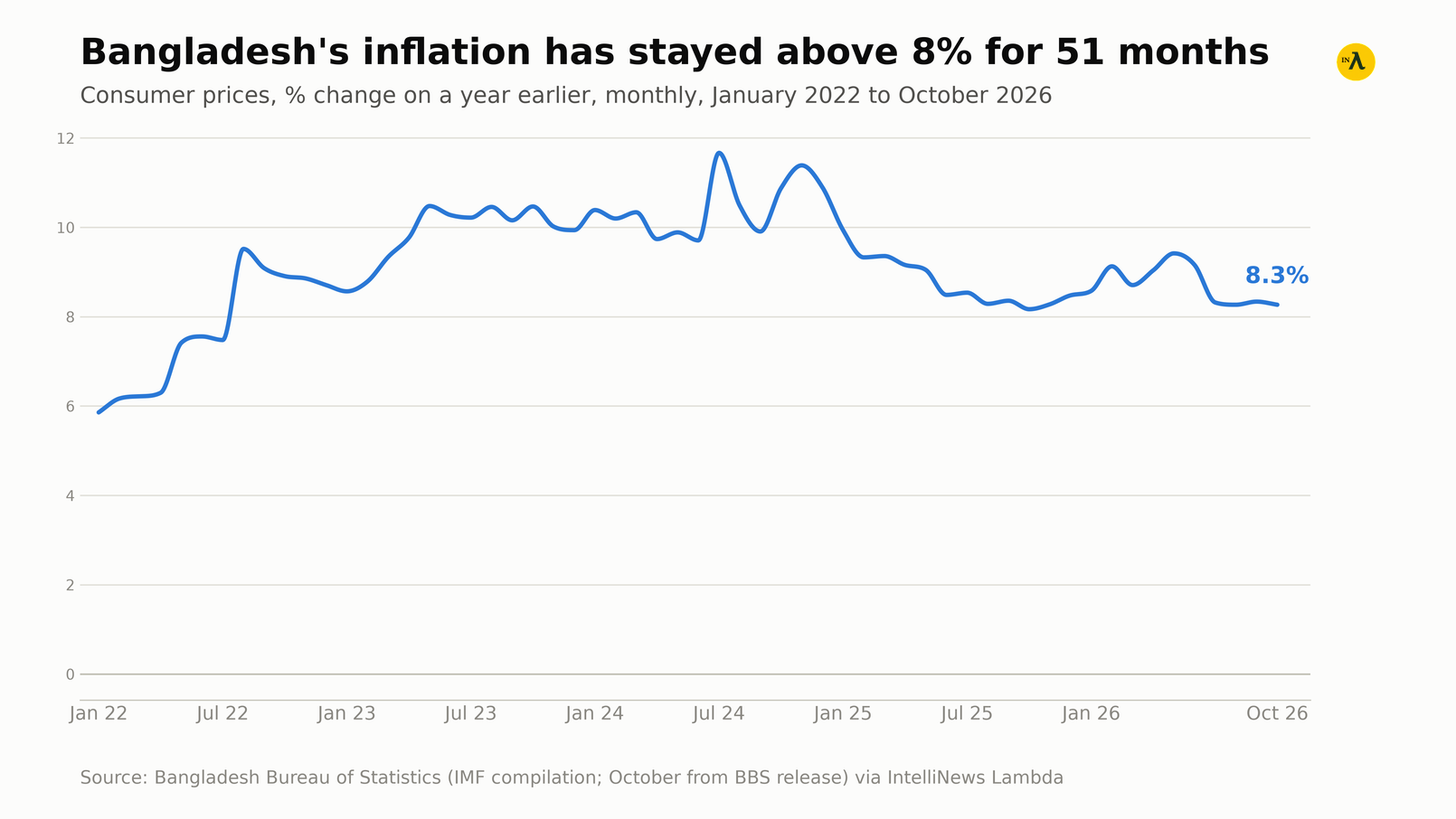
Those land on real grievances. Consumer price inflation eased only to 8.27% in October, from 8.34% in September, the Bangladesh Bureau of Statistics said, and it has not fallen below 8% since August 2022. Wages rose 7.63% over the same 12 months, so pay is still losing ground. Garment workers in Gazipur, Savar and Ashulia have been blocking highways for weeks as a wage board weighs a new minimum.

Consumer price inflation, % y/y, January 2022 to October 2026. Source: Bangladesh Bureau of Statistics (IMF compilation; October from BBS release) via IntelliNews Lambda

The next test is Hasina herself. She was sentenced to death in absentia on November 17, 2025, for the crackdown on the 2024 uprising, a verdict whose anniversary the shutdown was timed to follow. Dhaka has refused her a passport and wants India to extradite her. With her December deadline weeks away, both sides are counting on the street, and each round so far has been more violent than the last.

This article was produced with the help of the IntelliNews Lambda analytical tool


Taiwan's firefighters are dying while waiting for reinforcements

Taiwan's firefighters are dying while waiting for reinforcements
Taiwan reforms its fire service after firefighters die, then lets delivery slide. South Korea shows what a real hiring drive looks like. / Ozzie Stern - UnsplashFacebook
By Mark Buckton in New Taipei November 19, 2026

Taiwan's firefighters run the island's ambulances, free people stuck in lifts and remove hornet nests, yet a decade of deaths on duty has still not given them enough colleagues.

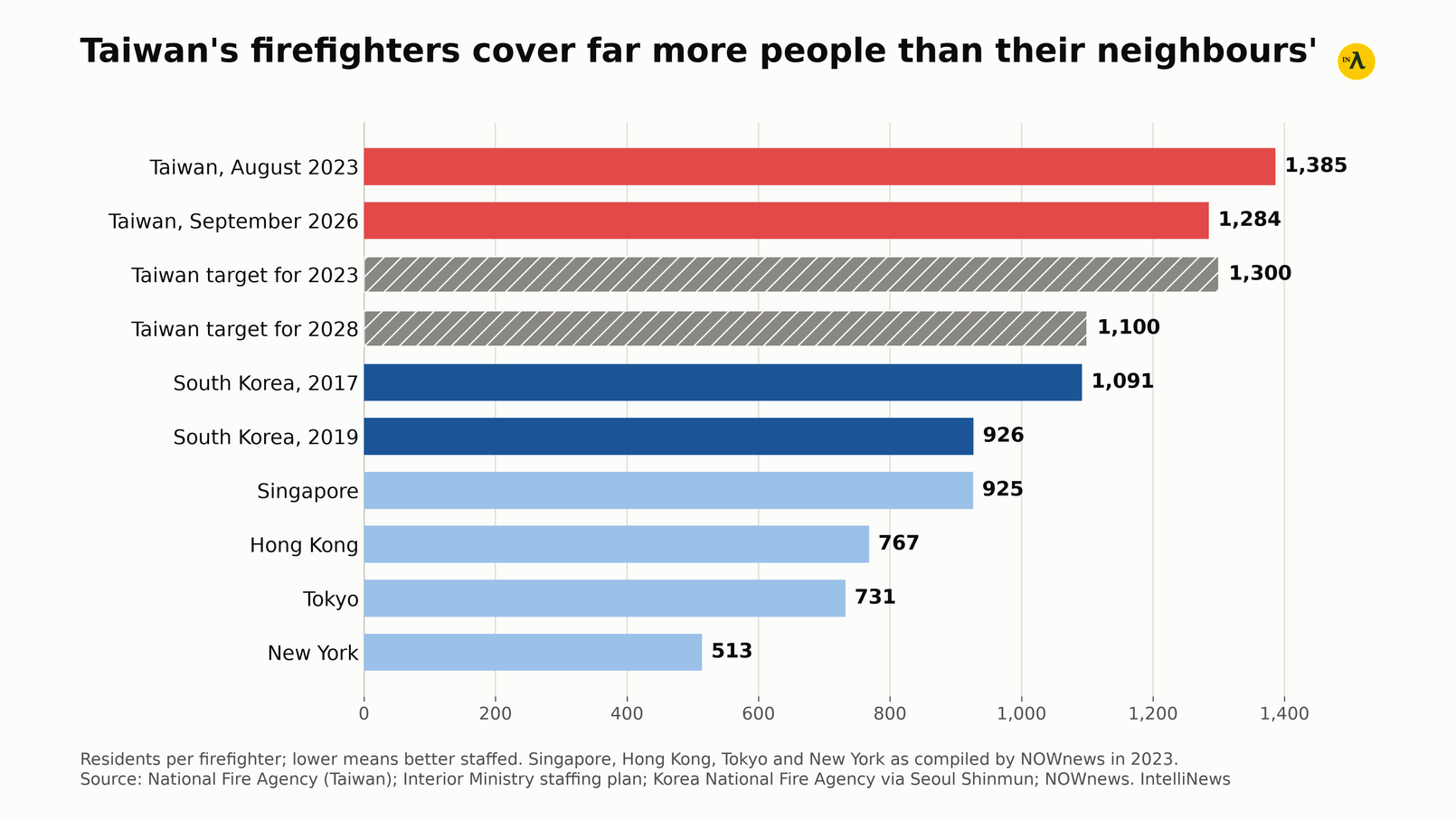
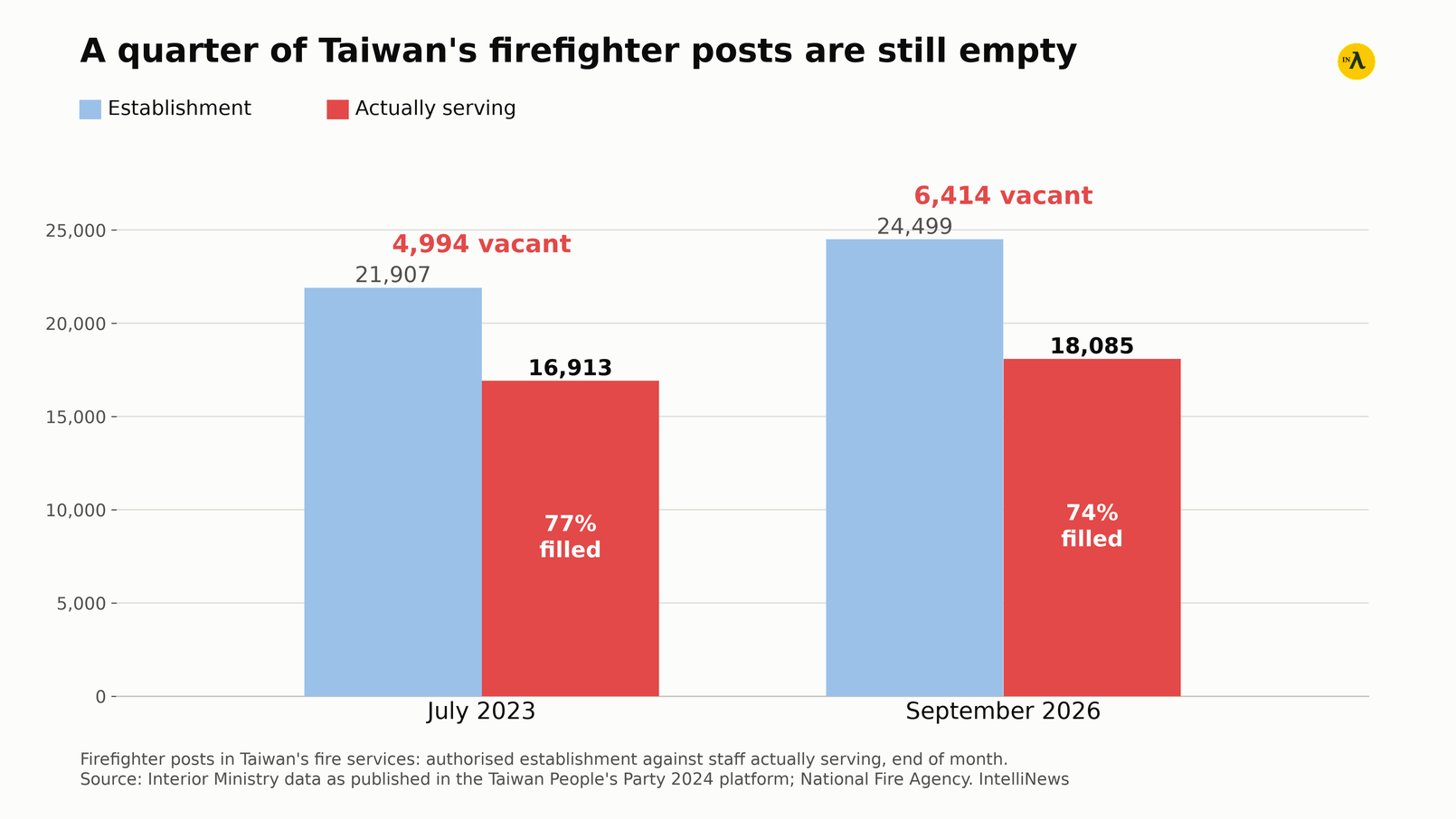
At the end of September Taiwan's fire services had 18,085 firefighters against an establishment of 24,499 posts, according to the National Fire Agency's manpower overview. Each firefighter covers 1,284 residents. That clears the target of one per 1,300 that the government set for 2023, three years late, but leaves the island nation well short of the one per 1,100 it promised for 2028.

The fire service shows a wider Taiwanese habit: a tragedy brings a headline reform, then the slower work of keeping staff and protecting the front line fades once the funerals are over. South Korea faced a similar gap in 2017 and, after two deadly fires, hired its way out of it.

Residents per firefighter in Taiwan, its targets and comparators. Source: National Fire Agency (Taiwan); Interior Ministry staffing plan; Korea National Fire Agency via Seoul Shinmun; NOWnews. IntelliNews Lambda

Ambulance crews and snake catchers

Taiwan borrowed its system from Japan, where municipal fire departments run almost all 119 ambulances and also deal with wasp nests and locked-out residents. South Korea works the same way, as do Hong Kong, Macau and Singapore, while neighbouring China leaves ambulances to health authorities.

The law gives Taiwan's firefighters three core duties: fire prevention, rescue and emergency medical care. Catching snakes, rescuing cats and retrieving dropped keys eats into their training and rest, Lan Yu-chieh of a firefighters' labour rights association told a legislative hearing in December 2017, according to TVBS.

A decade of funerals

The modern argument began on January 20, 2015, when six firefighters aged 21 to 29 died as a burning bowling alley collapsed in Taoyuan's Xinwu district. Yu Tsung-han of the National Association for Firefighters' Rights said at the time that 212 of Taiwan's 550 brigades, or 40%, had fewer than six people available for duty each day.

At that hearing campaigner Chang Ya-chun said 14,000 firefighters were doing the work of 28,000, and legislator Chiang Yung-chang said Taiwan had lost on average one firefighter a year since 2007. Deputy fire chief Hsieh Ching-hsu promised about 2,700 recruits by 2019 and 3,000 every five years after that.

The Interior Ministry's staffing plan duly set targets of one firefighter per 1,300 residents by 2023 and one per 1,100 by 2028. By July 2022 Kaohsiung stood at one per 1,779 and was the only one of Taiwan's 22 cities and counties with fewer firefighters than in 2019, the New Power Party said, according to NOWnews. Its caucus convener, Chiu Hsien-chih, said 32 firefighters had died on duty since 2013 and that the cap on overtime pay had risen by TWD2,000 ($61) in 22 years.

On September 22, 2023, a fire and explosions at a golf-ball factory in Pingtung killed 10 people, four of them firefighters. That year's fire service exam needed 955 recruits and drew 1,910 candidates, but only 25.6% passed the first stage, NOWnews reported.

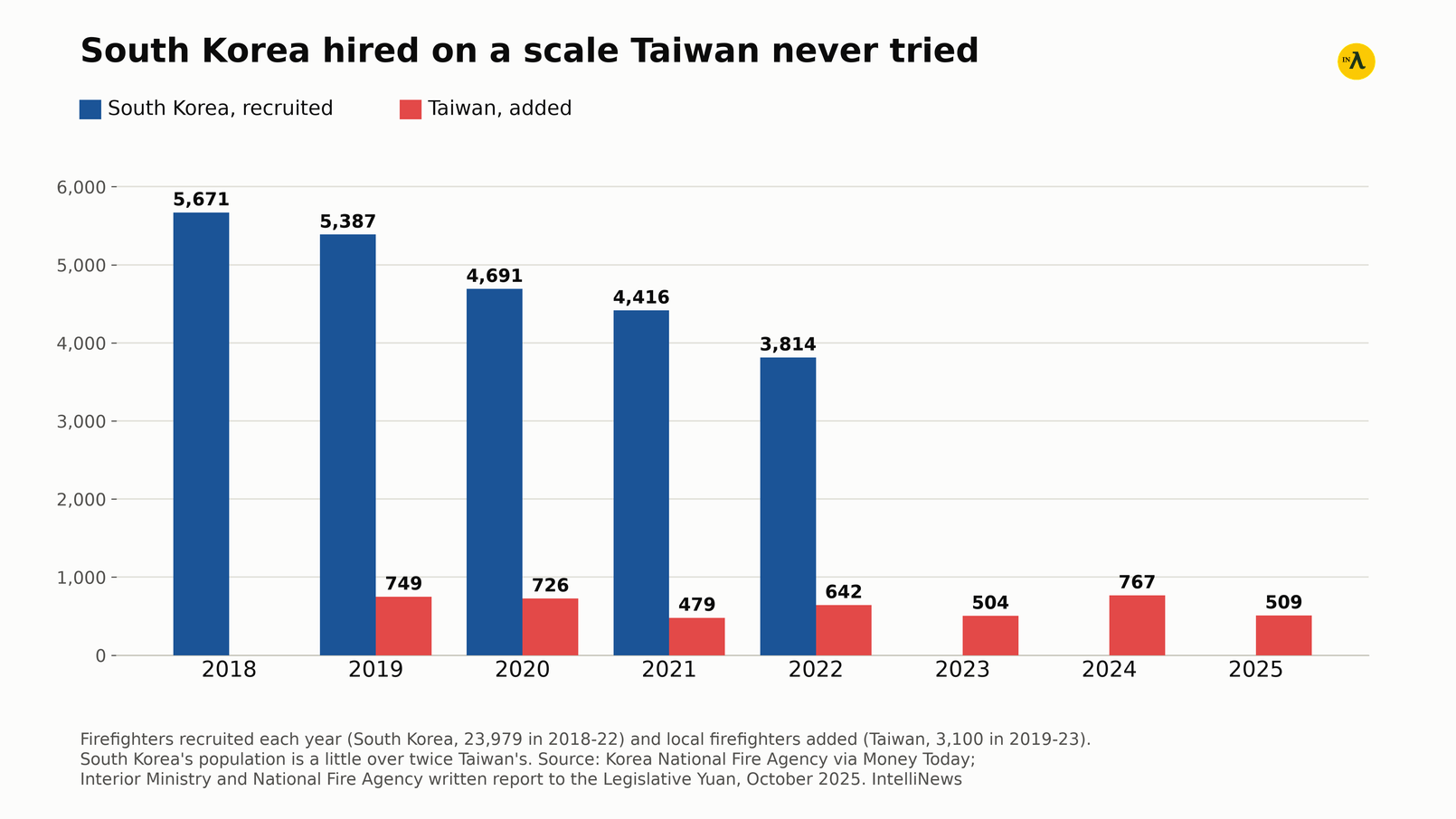
Local fire services added 3,100 firefighters in 2019–2023, meeting the plan, followed by 767 in 2024 and 509 in 2025, the Interior Ministry told the Legislative Yuan in a written report last year. Counted net of retirements and resignations, the five-year gain was only a little over 2,000, NOWnews calculated.

Two firefighters died on May 26, 2024, at a 28-storey block in Hsinchu, where the city's ladder trucks reach only 15 floors and residents were lifted out by a borrowed crane, Taiwan News reported, exposing equipment as well as staffing gaps. In New Taipei, the most populous city in the country, 2,576 firefighters were serving in August and the city plans 584 more posts over the five years to 2031, the Commercial Times reported.

Taiwan's firefighter establishment against staff actually serving. Source: Interior Ministry data as published in the Taiwan People's Party 2024 platform; National Fire Agency. IntelliNews Lambda

Interior Ministry data for July 2023, cited in the Taiwan People's Party's 2024 presidential platform, showed 16,913 firefighters serving against 21,907 posts, 77% filled. Today the figure is 74%: posts have been added faster than people.

How Seoul did it

Japan's fire departments are at only 77.4% of the staffing that national guidelines require, according to Fire and Disaster Management Agency briefing material posted by Aomori prefecture in the north of the country. Yet with 168,898 fire staff in April 2024, according to the agency's white paper, it was far better covered than Taiwan, at one firefighter per 820 people in a 2017 comparison by the Korea Herald.

South Korea fixed its problem. Moon Jae-in pledged 20,000 extra firefighters by 2022, and fires at a Jecheon sports centre in December 2017 and a Miryang hospital a month later, which killed more than 70 people, forced the pace. The country recruited 5,671 firefighters in 2018 and 23,979 over five years, the National Fire Agency said, according to Money Today. Residents per firefighter fell from 1,091 in 2017 to 926 in 2019, Seoul Shinmun reported, and in April 2020 firefighters became national civil servants. Scaled to population, that drive was more than three times the size of Taiwan's.

Firefighters recruited in South Korea and added in Taiwan each year. Source: Korea National Fire Agency via Money Today; Interior Ministry and National Fire Agency report to the Legislative Yuan. IntelliNews Lambda

Hiring has not ended deadly fires in Korea, however: 14 workers died at a car parts plant in Daejeon in March. The fight has moved on to money. Gyeonggi governor Choo Mi-ae complained on August 8 that her province bears most of the more than KRW1.5 trillion ($1.1bn) cost of its roughly 11,000 firefighters, although they are national employees, OhmyNews reported.

Funerals, then reform

Taiwan's social services follow the same script as its fire service. The 2016 killing of a four-year-old known as "Little Light Bulb" in Taipei and the 2023 death of one-year-old Kai Kai after abuse by nannies each brought promises of new safety nets, then complaints that delivery fell short.

On paper the fire agency has now hit its hiring target. In practice the ratio goal arrived three years late and a quarter of posts are still empty. A firefighter quoted by Global Views Monthly after the Pingtung fire put the cycle simply: with no news and no deaths, nobody pays attention. Until the next funeral.

This article was produced with the help of the IntelliNews Lambda analytical tool