Showing posts sorted by relevance for query ALLENDE CHILE 9/11. Sort by date Show all posts

Wednesday, December 29, 2021

Leftist Presidential Candidate’s Landslide Promises Clean Sweep of Pinochet’s Fascist Legacy

 Facebook

Ever since the 9-11 attack on the US, people here had this mantra that 9-11 “changed everything.” It’s a gross overstatement of course. The country has been moving steadily into becoming a “national security” state since President Harry Truman launched it with the creation of the CIA and the National Security Agency. Since then, like a ratchet, we’ve had a gradually metastasizing police state and ever more intrusive central government, with both political parties supporting more military spending, more wars, more domestic spying, more militarized policing, and more attacks on media independence.

Now we have a shining example of what needs to be done, in a country that had its own 9-11, but has finally turned things around.

Chile, in fact, was the scene of a far more brutal and deadly 9-11 event that occurred on September 11, 1973, when the country’s military, under the direction of a fascist military leader named Augusto Pinochet, in a coup backed if not orchestrated by the US under President Richard Nixon and his then National Security Advisor Henry Kissinger, overthrew the democratically elected and hugely popular Marxist President Salvador Allende Gossens, murdering him in the presidential palace and launching a reign of terror that saw thousands of Allende supporters murdered or disappeared.

Pinochet tore up the country’s constitution and imposed a fascist replacement document that has been in place long after his death, limiting the country’s ability to recover its freedoms.

That all ended this past weekend, as Chileans turned out in large numbers in a dramatic run-off election between a hard-right open admirer of Pinochet named Antonio Kast and a 35-year old leftist and veteran of a decade of protest actions against the government, Gabriel Boric, who has vowed to wipe away the almost half-century legacy of the country’s own 9-11 horror.

Unlike recent elections of leftist leaders in countries like Bolivia, Ecuador and Peru, which have been so close that it’s difficult for the new left leaders to make changes, Boric’s win in Chile was decisive. After coming in a close second with 25% of the vote in a crowded presidential field that included various left candidates and some centrists during the initial election, behind Kast, who got 28% of the vote, with 99% of the ballots counted in the Sunday run-off voting by the end of the day Monday, Boric had won 56% of the vote to Kast’s 44% — a 12% margin of victory.

While the solid left didn’t win an outright majority in the country’s bicameral Congressional election which took place in November, it appears that between leftist, “soft” leftist and indigenous deputies in the 155-member lower house and in the 40-seat senate, Boric should be able to pass most of the measures he is proposing to bring the country out of its decades of repressive darkness. In a good demonstration of what may be expected from the new Congress with which Boric, who assume the Presidency on March 11, passed a law establishing marriage equality for same sex individuals — a big step for such a conservative mostly Catholic country.

Meanwhile, a second body, an constitutional assembly established two years ago to write and approve a whole new truly democratic Constitution for the country, has a strong left majority.

This is all worth cheering about.

Under Pinochet, who led the country from 1973 through 1990, besides enduring a brutal military/police repression, Chile became a laboratory for right wing economic experiments by a gang of acolytes of capitalist economic theorist Milton Friedman, a University of Chicago professor and Economics Nobel Prize winner who claimed that unregulated capitalism was essential for democracy. Chileans paid the price for these ludicrous ideological experiments with soaring income and wealth disparity, deepening poverty, collapsing education, privation of all kinds of services including by foreign private investors, and even the privatization of the country’s social security system.

Boric has vowed to reverse all these disasters.

Chile is showing the way. It can be done, if the people will it to be so!

We in the US, especially on the left, need to study what the left in Chile has accomplished, and of course to support their struggle to clean away the toxic sludge of decades of fascist rule and rules.

We need also to be alert to efforts by our own government and its nefarious imperial agencies from the CIA to the Pentagon, the Drug Enforcement Agency, State Department, Alliance for Progress and National Endowment for Democracy to undermine progressive governments like Chile’s. The history of US subversion of left governments in Latin American goes back centuries and is alive and well in Washington.

Dave Lindorff is a founding member of ThisCantBeHappening!, an online newspaper collective, and is a contributor to Hopeless: Barack Obama and the Politics of Illusion (AK Press).

Sunday, September 10, 2023


50 years later, wounds of Pinochet regime are still raw

By AFP
PublishedSeptember 9, 2023

Patricia Herrera visits the basement of the Chilean presidential palace where she was tortured 50 years ago - 
AFP GABRIEL BOUYS

Magdalena ADVIS

In the basement of the presidential palace in Chile’s capital, Patricia Herrera was detained and tortured for months before being sent into exile. It was early in a military dictatorship that would kill or cause the disappearance of thousands of people.

Fifty years after the US-backed coup that snuffed out Chile’s democracy, the wounds from all that suffering are still raw.

– Torment –

As she returned from class at the university, Herrera was detained by officers in plain clothes because she was “a woman and a socialist.” She was 19.

Herrera was taken, blindfolded, to the basement of La Moneda, as the presidential palace is called. It was then also known as “El Hoyo,” or the pit, as it was one of the first detention and torture centers set up by General Augusto Pinochet’s new regime after the ouster of Socialist president Salvador Allende on September 11, 1973.


“From the very first night we got there, there was sexual humiliation. At first I thought it was just the guard who was overdoing it with me. I did not think it was an established thing that women had to suffer sexual, in addition to political, violence,” said Herrera, now 68 and a historian.

Herrera was held for 14 months at the palace and in two other buildings in Santiago that were converted into torture centers by the Pinochet regime. She was then sent into an exile that would last 15 years, first in France and then in Cuba.

Two commissions created to study the dictatorship concluded that at least 38,254 people were tortured under the Pinochet regime, which lasted until 1990.

The basement in the presidential palace where Herrera was held was also known as Cuartel, or barracks, N°1 and is now used as office space. People taken there blindfolded could identify it because of its curved wall.

On August 30 of this year, the current president, Gabriel Boric, had a plaque installed in the basement space to mark the horrors endured by around 30 people who were held there.

“We want to put up a marker for everyone to see,” Herrera said, “that here, in the political heart of the nation, there was a torture center.”


Allende committed suicide rather than be captured.


– Disappearance –

Agents of the dictatorship killed 1,747 people, and detained and made another 1,469 disappear, according to an official government tally.

While 307 of the disappeared have since been identified, the other 1,162 remain missing. Fifty years later, their families still wonder where they are.

In 1974, when Pinochet’s police detained a man named Luis Mahuida — a 23-year-old university student active in leftist politics and the father of two young daughters — they also brought an abrupt end to the childhood of his sister Marialina Gonzalez, who was then nine years old.

Their mother, Elsa Esquivel, spent all her time looking for her son; it was a full-time occupation. Marialina Gonzalez looked after her brother’s daughters, who were three and 11 months old when he vanished. “I stopped playing with dolls. My nieces were dolls for me,” said Gonzalez.

She never finished her education. She went to hundreds of places asking for her brother. Gonzalez even staged a hunger strike and recalls being arrested several times while taking part in protest marches in honor of missing people.

She regrets the childhood she never had. “I was not capable of saying: ‘Stop, let me be. I want to go out dancing. I want to have friends.’ I kept quiet,” she said.

Now 59, she dedicates herself to caring for her elderly mother and expects to carry suffering with her into her own old age. “There is no closure just because my brother is still missing. There will be no closure.”


– Exile –

The dictatorship triggered the biggest migratory movement in Chilean history. Just over 200,000 people went into exile, according to the non-governmental Chilean Human Rights Commission.

Employees of the Allende government, union leaders, workers, students and farmers left the country, taking their families with them. Sweden, Mexico, Argentina, France and Venezuela were the main recipient countries.

Most of the exiles were able to return home starting September 1, 1988, when the regime issued a decree allowing them back, a year and a half before the dictatorship ended.

A communist activist named Shaira Sepulveda was tortured in secret prisons called Villa Grimaldi and Cuatro Alamos. After her release she left in 1976 for France, along with her husband at that time. She left relatives and friends in Santiago.

“My family was here, my sister, my parents. But what really hurt was having to go to a country where you are a nobody,” Sepulveda recalls.

She returned to Chile 17 years later with two children, but again her family was broken apart. The eldest child could not adapt to life in Chile and returned to Europe.

“I am an old woman, so my grandchildren there will barely know me,” said Sepulveda, who is 74.


Pinochet: Images of a dictatorship

Emilia Rojas-Sasse
13 hours ago13 hours ago

Fifty years after the military coup in Chile, historians describe why Augusto Pinochet's coup had such a huge impact in Europe. A major factor was the power of images.


https://p.dw.com/p/4VwHv


Media coverage of the 1973 coup, including this picture of General Augusto Pinochet, was seen around the world
Image: AFP/epa/dpa/picture-alliance

Everyone knows the image of Che Guevara, his steely gaze directed confidently into the distance. In the counterculture of the 1960s, the "Comandante" emerged as a symbol of the idealistic revolutionary and long remained an icon of youth culture.

The photo of Augusto Pinochet, on the other hand, embodies the dictator par excellence. The general who violently overthrew Salvador Allende's government in Chile on September 11, 1973, was commonly regarded as the ultimate evil. But why, compared to other Latin American dictators, Pinochet in particular?

Coup caught on camera (& TV)


While the coup d'etat in Chile shocked the world, the 1964 coup in Brazil went relatively under the radar.

The spotlight on the Chile coup was due in large part to the widespread media presence in the country, noted Caroline Moine, professor of political and cultural history at the University of Versailles Saint-Quentin-en-Yvelines in France.

"This coup d'etat did not take place in the middle of the night and in secret, but in front of running cameras," she told DW of the events of 1973. "There were many journalists there, so the images flickered quickly across the screens, even abroad."

This was probably in the interests of the putschists, she said.

"The military wanted people to see what had happened. They wanted to impress not only their opponents, but also their supporters inside and outside the country," she said.

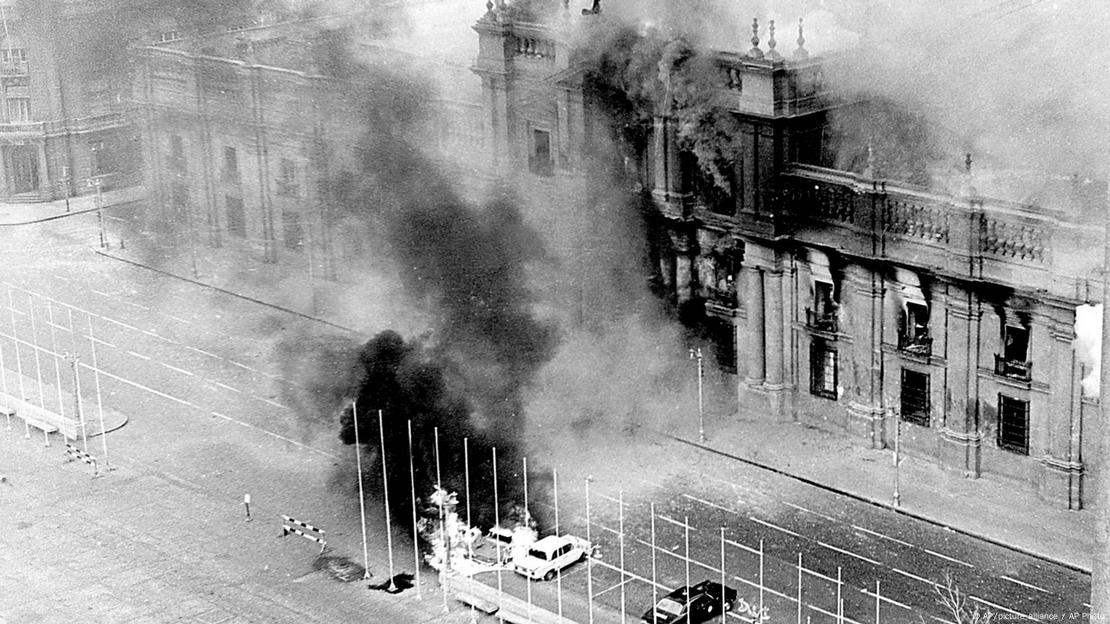
Through media coverage, the scenes were burned into the collective memory. The images of the bombing of the presidential palace, La Moneda, went around the world — as did the photo of the usurper Pinochet in uniform, with dark glasses and an expressionless face, sitting in front of his men.

The government palace in Santiago de Chile was attacked in 1973, and seen on TV
Image: AP/picture alliance / AP Photo

For Joan del Alcazar, professor of contemporary history at the University of Valencia, the image of this dictator was projected in stark contrast to overthrown president, doctor Salvador Allende.

"The figure of a friendly, empathetic doctor, an undeniably attractive man, contrasts with the odious image of an unpleasant, authoritarian, despotic and, moreover, criminal military man," he told DW.
Allende a fallen symbolic figure of left-wing intellectuals

When viewed against the backdrop of the Cold War, events in Chile transcended national borders.

"In West Germany and in Europe, Allende was an important symbolic figure because he represented the democratic path to socialism; he was a very strong symbolic figure for many left-wing intellectuals," said Lasse Lassen, a historian and researcher at the University of Würzburg.

"When he was overthrown, especially in such a brutal way — with the bombing of the government palace and his suicide — he became a shining beacon for the left in Western Europe. And Pinochet embodied the image of the enemy."
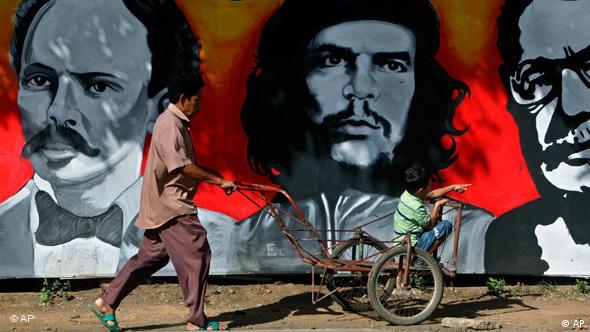
Legends of socialist struggle — Ernesto 'Che' Guevara, center, Chilean late President Salvador Allende, right, and Cuban independence hero Jose Marti, left — have been remembered in art
Image: AP

At the time in Europe, the left was divided, said Caroline Moine.

"There were attempts, for example in France and Italy, to unite communist and socialist forces" in the same way as the Unidad Popular, an electoral alliance of leftist Chilean parties led by Allende.

"The coup put an end to that project and destroyed those hopes," she said. Nevertheless, the communist party in particular, but also the socialist party in Chile, very quickly launched a major international campaign after Pinochet's coup.

This not only stylized Pinochet as the embodiment of evil, but also glorified the ousted president.

"Allende was the one who wanted to defend democracy in Chile and died for it. In Europe, too, the idea of heroes who are willing to die for their ideas is highly emotionally charged," said the French historian.
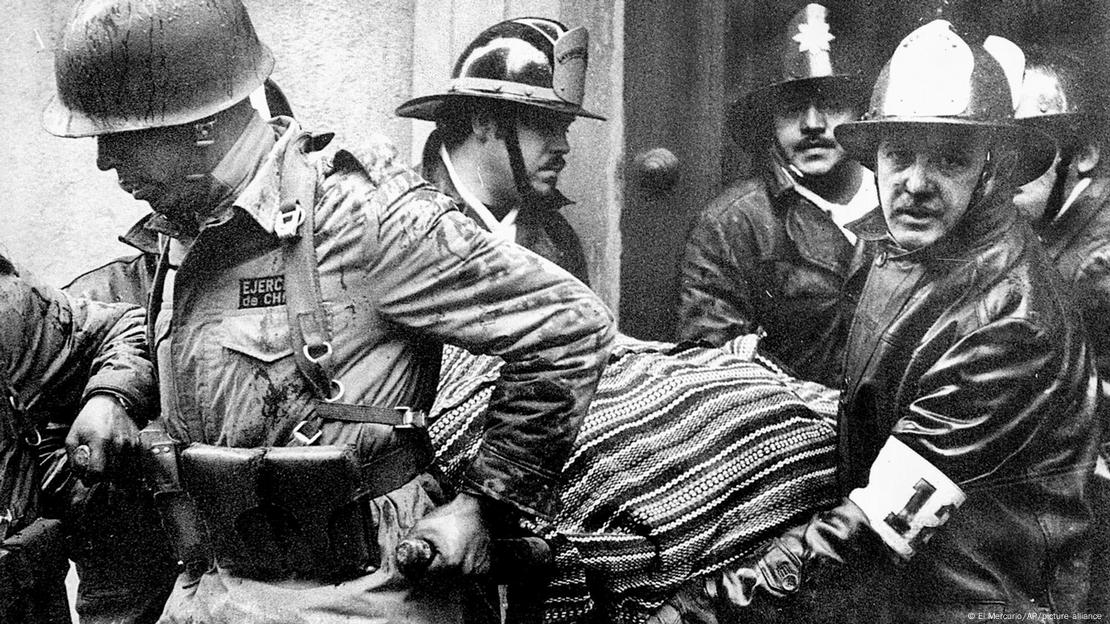
The body of Salvador Allende was carried away after his death on September 11, 1973, along with hope for a democratic Chile
Image: El Mercurio/AP/picture alliance

Yet, she added, the various parties within the Unidad Popular were not always so united.

"It was always said that the UP was a victim of the dictatorship; there was never any public talk of internal tensions. There was a kind of myth."
Brutal repression shocked the world

The extreme brutality on the part of the coup plotters in Chile shocked more than just members of the political left.

Similar repression was being imposed by other dictatorships in the region, including in Argentina, Paraguay and Uruguay during the so-called Operation Condor camapaigns.

"[Nonetheless] this military coup stands out for its cruelty, its extreme viciousness," said Joan del Alcazar.

Historian Lassen believes knowledge of human rights abuses in Chile and simultaneous Cold War tensions in the West contributed to the coup in Chile being particularly present in people's minds.

Ultimately, however, "neither Franco nor Pinochet were condemned as Hitler was, not even in their own country," he added. "It's a complex process."


This article was originally written in Spanish.

Artists After the Escape: Chile's coup, dictatorship and the path to democracy

DW
13 images


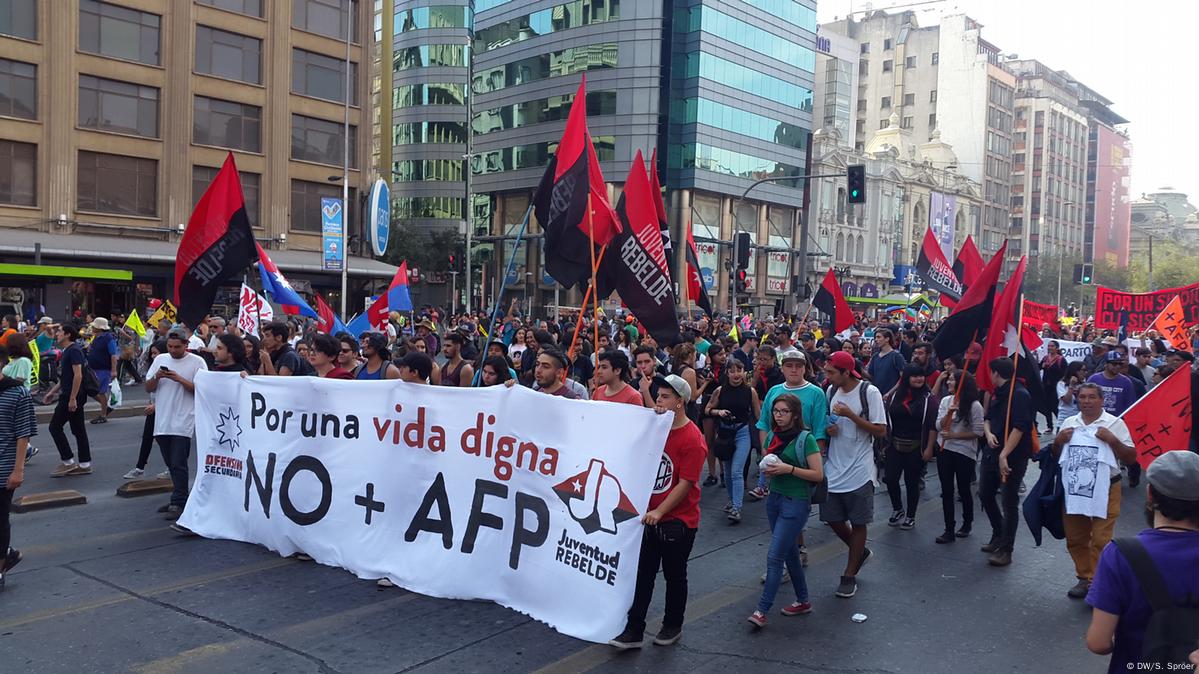
September 11, 1973 changed the lives of many Chileans forever. A coup against President Allende brought Augusto Pinochet to power. Sixteen years later, a spectacular campaign toppled the dictator.Image: DW/S. Spröer


Chile's September 11


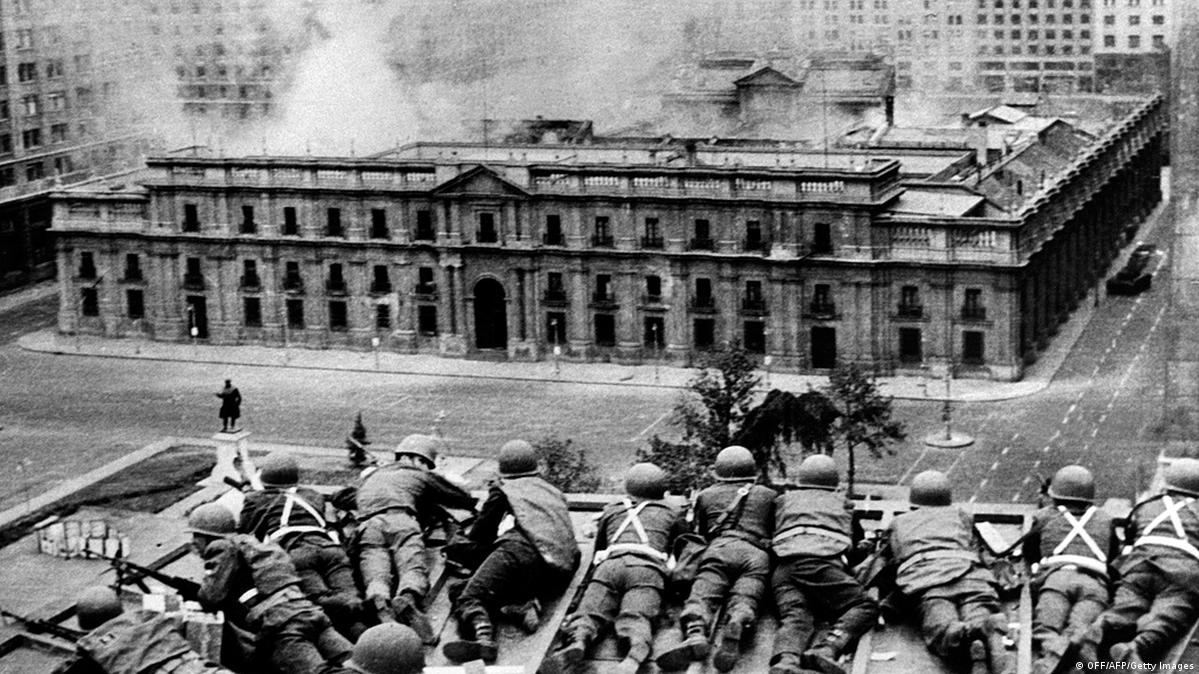
September 11, 1973, changed the lives of many Chileans forever. General Augusto Pinochet, commander in chief of the Chilean army, overthrew the incumbent socialist president, Salvador Allende. The military bombarded the presidential palace "La Moneda" in the capital Santiago, arrested government supporters, leftists and Pinochet opponents.
OFF/AFP/Getty Images


Salvador Allende, a people's president

The socialist president had only been in office for three years before the coup. After having nationalized companies and dispossessed great land owners, his government faced massive opposition. The US didn't approve of the socialist leader in South America either. With the help of the CIA, Washington boycotted Allende's economic policies and incited Chile's media against the government.
Image: picture-alliance/dp

Chile begins probing 'disappearances' during Pinochet regime

August 31, 2023

A process has begun to try and determine what happened to those who disappeared during dictator Augusto Pinochet's brutal regime 50 years ago.

Relatives of victims at a march commemorating the victims of Augusto Pinochet's regime
Image: Martin Bernetti/AFP

Chile's government launched a program on Wednesday which seeks to determine what happened to more than 1,000 people during Augusto Pinochet's dictatorship 50 years ago.

"Justice has taken too long," President Gabriel Boric said as he announced the government project at the presidential palace.

"The only way to build a future that is more free and respectful of life and human dignity is to know the whole truth," he said.


A legacy of abuse


Pinochet seized power in a bloody coup backed by the US on September 11, 1973 and would remain in power until 1990.

During his dictatorship, some 40,175 people were executed, detained and disappeared, or tortured as political prisoners, according to Chile's Ministry of Justice.

Government reports show 1,469 people were victims of forced disappearances, of whom 1,092 were secretly detained and 377 were executed.

Their remains were never returned to families.

Pinochet died in 2006 at the age of 91, and was never convicted for his role in the crimes. Many have been pushing the government for more answers and accountability.


Project to uncover truth, a government first

Until now, the circumstances of those who were declared missing has not been looked into, the weight only carried by bereaved loved ones.

The project, officially known as Truth and Justice, will have a dedicated budget and staff, with investigators tasked with reconstructing the victims' final days.

Earlier this week, the US State Department declassified briefings presented to Richard Nixon, the US president at the time, on September 8 and September 11.

The reports show how we was briefed on Chile's impending coup which was part of the wave of military dictatorships in the region in the 1970s.

In Argentina, Brazil and Uruguay, families have also pushed for more information on those who were declared missing during military regimes.

rm/kb (Reuters,

Child victims are the forgotten voices of Chile during the Pinochet dictatorship from 1973 to 1990


Eliana Rodríguez holds a photograph of herself with her daughter Yelena Monroy at home in La Serena, Chile, Friday, Sept. 1, 2023. The photograph was taken one year after they were released from a detention center where Rodriguez and her two young daughters were imprisoned for over a year during the dictatorship of Gen. Augusto Pinochet, who was brought to power in Chile after a military coup in September 1973.
 (AP Photo/Esteban Felix)

Yelena Monroy poses for portrait by photos of detainees who disappeared during the dictatorship Gen. Augusto Pinochet in La Serena, Chile, Friday, Sept. 1, 2023. Monroy was 3-years-old when she was imprisoned for more than a year along with her younger sister Natacha and her mother Eliana Rodriguez, a socialist activist persecuted by the regime Pinochet, who was brought to power in Chile after a military coup in September 1973. (AP Photo/Esteban Felix)


BY EVA VERGARA
 September 8, 2023

SANTIAGO, Chile (AP) — Yelena Monroy was 3 years old when she was imprisoned for more than a year along with her younger sister and her mother, a socialist activist targeted by the regime of Gen. Augusto Pinochet after he came to power in Chile in a military coup in September 1973.

“We were scared, we were crying,” recalled Monroy, now a 53-year-old commercial engineer and one of more than 1,000 children and adolescents who were detained in the name of fighting communism and leftist guerrillas during Chile’s military dictatorship from 1973 to 1990.

Eliana Rodriguez adjusts her glasses as her daughter Yelena Monroy searches through a photo album at Rodriguez’s home in La Serena, Chile, Friday, Sept. 1, 2023. Rodriguez and her two young daughters were imprisoned during the dictatorship of Gen. Augusto Pinochet, who was brought to power in Chile after a military coup in September 1973. (AP Photo/Esteban Felix)

Photographed through a plastic window, an entrance leads to the center of “El Buen Pastor,” or The Good Shepherd, originally built to hold detained, female minors and run by Catholic nuns, that was turned into a detention center for political prisoners during the dictatorship of Gen. Augusto Pinochet, in La Serena, Chile, Friday, Sept. 1, 2023. Yelena Monroy was incarcerated here for more than a year when she was only three-years-old with her mother Eliana Rodriguez and younger sister Natacha. (AP Photo/Esteban Felix)

Yelena Monroy shows a 1973 photograph of her mother Eliana Rodriguez, bottom left, sitting with other political prisoners during the dictatorship of Gen. Augusto Pinochet at “El Buen Pastor” or The Good Shepherd detention center, originally built to hold detained, female minors and run by Catholic nuns that was turned into a detention center for political prisoners during Gen. Augusto Pinochet’s dictatorship, in La Serena, Chile, Friday, Sept. 1, 2023. Monroy was incarcerated here with her mother and younger sister for more than a year. The 1973 photo is from a visit by the International Red Cross to verify detainees’ condition. (AP Photo/Esteban Felix)

When Pinochet installed himself as leader, the age of majority in Chile was set at 21 years. But being a minor was no protection from the dictatorship’s crackdown. Children were detained, tortured, killed, and even used as decoys to apprehend their parents.

The trauma of that period has made many of the young victims of the military regime reluctant to speak out, and the process of prosecuting that era’s crimes and making reparations generally has made no distinction among victims based on age. So, the child victims of the Pinochet era have not had much visibility, though minors represent nearly 10% of the deaths attributed to the regime.

OTHER NEWS

Chile president defends democracy 50 years after coup ushered in brutal military dictatorship

The Catholic Church defended human rights during Chile’s dictatorship. An archive tells the story

Movie Review: Pinochet as a vampire in surreal, frightening ‘El Conde’

“We don’t classify them by age, because they all suffered,” Gaby Rivera, president of Chile’s Association of Relatives of the Detained-Disappeared, told The Associated Press.

However, the National Commission on Political Imprisonment and Torture figures show that the Pinochet regime detained 1,132 minors under the age of 18. Of these 88 were under 13 and 102 were arrested along with their parents — or were born in prison.

Some 307 children under the age of 18 were killed during that period, according to human rights groups’ reviews of documentation from the National Truth and Reconciliation Commission. About 3,200 people overall were killed during the dictatorship, or went missing and are believed dead.

Chile’s National Stadium, in the country’s capital, became the largest detention center of the military government. That is where they arrested — and beat — Roberto Vásquez Llantén, when he was 17, for being an active militant of the Revolutionary Left Movement.

Roberto Vásquez Llantén, 67, poses for a portrait on the stairs that leads to a tunnel at the National Stadium where he was held during the dictatorship in Santiago, Chile, Saturday, Sept. 2, 2023. (AP Photo/Esteban Felix)

View of the women´s dressing room of the National Stadium, which was used as a prison and place of torture during the coup orchestrated by Gen. Augusto Pinochet, Santiago, Chile, Saturday, Sept. 2, 2023. (AP Photo/Esteban Felix)

He had been in hiding since the start of the coup, but was arrested on Jan. 15, 1974. Vásquez Llantén, who is 67 today, spent a year in the Chacabuco Prison Camp in the Atacama desert along with 16 other minors. There was no electricity or hot water, he recalled. There were antipersonnel mines outside the barbed-wire to keep prisoners in line, while guards kept watch from towers.

If minors had political significance, they were detained just like adults. But they also were used as lures to trap and detain their parents.

The Fernández Montenegro sisters were imprisoned in February 1974 when they were teenagers.

Viviana, 14, and Morelia, 17, were accused of being guerrillas in the Chilean port of Valparaíso where they lived, some 120 kilometers (75 miles) northwest of the capital. Their mother was arrested and released after 24 hours. The whole family, with the exception of the father, were active communists.

The sisters were first held together in the Silva Palma Navy Barracks, on one of the many inhabited hills of Valparaíso.

“I was in a cell, wearing a hoodie, while some guys put electricity cables on my fingers, yelling and screaming profanities and threats,” demanding to know where the weapons were, Viviana Fernández recounted.

“The only thing I did was cry and cry ... I felt very afraid, very afraid,” she said.

Fernández, who is 64 today, and Yelena Monroy are members of the Association of Former Minors Victims of Political Imprisonment and Torture, created nine years ago in part to raise awareness about the fate of children and adolescents under the dictatorship.

Fernández, who is the spokesperson, says the organization has about 100 members, but she thinks there are many more, and that many are still afraid to talk about what happened to them during those years.

Many other minors of that time did not survive to tell their story.


Cecilia Aguilar is reflected in the mirror at home where a photo of her with her then 6-year-old sister Alicia stands in Santiago, Chile, Wednesday, Sept. 6, 2023. Her sister was assassinated on Sept. 18, 1973, the day their portrait was taken, by soldiers who arrived shooting into a public square in the Yungay neighborhood where they played during Gen. Augusto Pinochet’s dictatorship. Cecilia said she was saved because she ran, but later was found by a soldier who applied “the escape law,” telling her to run as he counted to 30. “If I catch you, I’ll shoot you and kill you,” she recalled him saying. (AP Photo/Esteban Felix)

Cecilia Aguilar holds a photo of herself with her then 6-year-old sister Alicia in Santiago, Chile, Wednesday, Sept. 6, 2023. Cecilia’s sister was assassinated on Sept. 18, 1973, the day their portrait was taken, by soldiers who arrived shooting into a public square in the Yungay neighborhood where they played, during Gen. Augusto Pinochet’s dictatorship. Cecilia said she was saved because she ran, but later was found by a soldier who applied “the escape law,” telling her to run as he counted to 30. “If I catch you, I’ll shoot you and kill you,” she recalled him saying. (AP Photo/Esteban Felix)

José Gregorio Saavedra González, a militant of the Revolutionary Left Movement, was executed at the age of 18 by soldiers in Calama, in the north of the country, together with 25 other political prisoners on Oct. 19, 1973. He was one of the disappeared who years later were located — and identified.

“They gave us a little bit of a finger in a small box, and a little bit of what I imagine was a small tooth,” recalls his sister, Ángela Saavedra, who is 81.

Monroy and Fernández fault the Chilean government for not fully acknowledging past violations of children’s human rights.

“We have been totally forgotten by the state, it is very much in debt,” Fernández said.

Yorka Salinas poses for a portrait wearing photos of her 18-year-old brother Isidro Salina and mother Margarita Martin, both who were murdered in 1986, that reads in Spanish “I don’t forget. I demand justice,” in Santiago, Chile, Wednesday, Sept. 6, 2023. The National Commission for Truth and Reconciliation consider her brother, mother and aunt María Martin to have been executed by the Carabineros national police, and consider their deaths violations of human rights under the responsibility of state agents during Gen. Augusto Pinochet’s dictatorship. (AP Photo/Esteban Felix)
___

Follow AP’s coverage of Latin America and the Caribbean at https://apnews.com/hub/latin-america


Saturday, December 20, 2025

Kast: Chile’s “democratic route” back to Pinochetism

Saturday 20 December 2025, by Karina Nohales, Pablo Abufom


On Sunday 14 December, the far-right politician José Antonio Kast won by a wide margin (58.2%) in the presidential run-off against the incumbent government candidate and member of the Partido Comunista de Chile (Communist Party of Chile), Jeannette Jara (41.8%).


The result falls within what the main polling organisations had anticipated—particularly CADEM, whose survey of 29 November projected the final outcome with notable precision—but it also confirms a broader political trend that has been visible since the government coalition primary in June. As was noted at the time: ’The challenge for Jeannette Jara’s candidacy is immense on several levels. The first and most significant is transforming the 825,835 votes from the primary into the 7 million that will be needed to win in the presidential run-off, which for the first time since 2012 will be held with compulsory voting, a modality that, according to all trends, has favoured the right.’

Following the first round of the presidential election, as we noted: ’the election results of Sunday 16 November clearly demonstrate the magnitude of the right-wing victory. In the presidential election, the right-wing bloc garnered 50.3% of the vote, distributed among José Antonio Kast (23.9%, Partido Republicano), Johannes Kaiser [1] (13.9%, Partido Nacional Libertario), and Evelyn Matthei (12.5%, Chile Vamos).’

With turnout of 85% of the electoral roll, Jeannette Jara increased her vote between the first and second rounds by approximately 1.7 million votes. However, this growth proved clearly insufficient against Kast’s advance, who added more than 4 million new voters and won in every single region of the country, without exception.

Analysis of the vote distribution by gender and age allows for a more precise understanding of this dynamic. Kast achieved his best results amongst male voters across all age groups, but he also recorded particularly strong performance amongst women aged between 35 and 54. Jara, by contrast, won the female vote amongst those under 35 and those over 54, representing a more fragmented and socially localised base of support.
Who is José Antonio Kast?

José Antonio Kast is not an outsider. He was a member for more than two decades of the Unión Demócrata Independiente (Independent Democratic Union, UDI) [2], the historic party of Pinochetism, served as a deputy for sixteen consecutive years (2002–2018), and has stood as a presidential candidate on three occasions.

In 2016, Kast resigned from the UDI, arguing that the party had abandoned its founding project—ultraconservative in moral terms, Catholic in cultural terms, and neoliberal in economic terms—in favour of a strategy of mass appeal and discursive moderation. Shortly afterwards, in 2017, he launched his own presidential platform, Acción Republicana, which in 2019 formally constituted itself as a political party under the name Partido Republicano (Republican Party), his current political vehicle. [3]

Consistent with this trajectory, in 2020 Kast was one of the signatories of the so-called Madrid Charter [4], an initiative promoted by the international far right with the explicit objective of halting ’the advance of communism’ in Latin America.

Kast is the youngest of ten children born to the German émigré couple Kast-Rist. His father, Michael Kast, was a soldier in the armed forces of Nazi Germany (Wehrmacht) and was affiliated with the Nationalsozialistische Deutsche Arbeiterpartei (Nazi Party).

Both his parents and several of his siblings developed business activities in the agricultural sector of Chile’s central zone. There are, moreover, documented journalistic and judicial investigations linking members of the Kast family to criminal activities of the Central Nacional de Informaciones (CNI) [5] during the Pinochet dictatorship, including their participation in civilian patrols alongside the regime’s repressive forces and in operations associated with serious human rights violations, including enforced disappearances.

José Antonio’s eldest brother, Miguel Kast—an economist trained at the University of Chicago [6]—held key positions during the dictatorship: he served as Minister of Labour and subsequently as President of the Central Bank. In his role as minister of the Oficina de Planificación Nacional (ODEPLAN, National Planning Office) between 1978 and 1980, Miguel Kast Rist was one of the principal promoters of the statistical category of ’extreme poverty’, which guided the targeting of social spending towards the most impoverished sectors. This definition institutionalised a policy of minimal social expenditure, oriented towards mere survival, fully consistent with the structural adjustment programme and dismantling of the social state promoted by the dictatorship.

Of ultra-Catholic family background and political formation, Kast identifies himself as a faithful disciple of the principal civilian ideologue of the Chilean dictatorship and founder of the UDI, the late senator Jaime Guzmán [7]. In keeping with this doctrinal framework, Guzmán held an extreme position on abortion: ’The mother must have the child even if it turns out abnormal, she did not want it, it is the product of a rape, or even if having it would result in her death.’

As a deputy, Kast systematically opposed the expansion of civil and sexual rights. He voted against marriage between same-sex couples and against anti-discrimination legislation, actively campaigned against comprehensive sexuality education, rejected the free dispensation of the morning-after pill, and defended the repeal of existing legislation permitting abortion in three circumstances [8].

This orientation was also reflected in his policy proposals. During his second presidential candidacy, Kast proposed the elimination of the Ministerio de la Mujer y la Equidad de Género (Ministry for Women and Gender Equality), its replacement with a Ministry of the Family, and the restriction of certain social benefits—particularly relevant for impoverished women—exclusively to married women.

In 2017, during his first presidential bid, his wife, Pía Adriasola, recounted in an interview that, upon expressing her desire to postpone a pregnancy before having their third child—the couple have nine—she consulted a doctor who prescribed oral contraceptives. Upon informing Kast of this decision, according to her own testimony, he reacted with the phrase ’Are you mad? That’s not allowed’ and subsequently took her to see a priest, who told her that the use of such pills was forbidden.

In August of that same year, José Antonio Kast was proclaimed candidate by associations of retired military personnel and by organisations of relatives of those convicted of crimes against humanity. At an event held at the Teatro Caupolicán, he declared: ’My name is José Antonio Kast, and I do proudly defend the work of the military government, I do believe that many military personnel and members of the Armed Forces are being persecuted, and I do commit, if I become President, to protecting the Armed Forces’, pledging to pardon ’all those who are unjustly or inhumanely imprisoned.’

Amongst those convicted is Miguel Krassnoff Martchenko, a brigadier in the Army at the time of the 1973 coup d’état [9], subsequently an agent of the Dirección de Inteligencia Nacional (DINA) [10]—the dictatorship’s secret police—and sentenced to more than 1,060 years in prison in twenty-seven cases of kidnapping, torture, and enforced disappearance. Kast, who has visited Krassnoff in prison, was repeatedly asked during this latest presidential campaign whether he maintained his intention to pardon him. He consistently refused to answer.

All of the above allows us to characterise José Antonio Kast as an explicit and consistent defender of the work of the Pinochet dictatorship, not only in terms of a symbolic vindication of the anti-communist feat of the past, but as a conscious attempt to recover the Pinochetist programmatic framework to confront the multiple crises currently traversing Chilean society. His proposal combines a heavy hand to restore ’the rule of law’, deregulation and commodification of social services to ’improve conditions for investment and job creation’, and a conception of society founded on the centrality of the family, the preferential right to private property, individual entrepreneurship, and patriarchal control over women and children.
What to expect from the next government?

In 2023—following the defeat of the constituent process that emerged from the social uprising [11]—a second attempt at constitutional reform took place. This new process was, in practically every sense, the antithesis of the previous one. The body called the Consejo Constitucional (Constitutional Council) was composed of fifty councillors, of whom twenty-two belonged to the Partido Republicano, a force which also presided over the body.

The constitutional proposal that emerged from this body, crafted in the image of the Republican ideology, consisted of a sort of return to the original text of the Pinochetist Constitution of 1980, stripped of the reforms introduced during the democratic period. The project was rejected in the plebiscite of December 2023 with 55.7% of the vote. With that result, the constitutional cycle opened in 2019 came to a close. However, the process allowed for testing the degree of dogmatism of the Republican project and brought to prominence several political figures who, with high probability, will play a significant role in the coming four years of government. [12]

On the evening of Sunday, in his first speech as president-elect, Kast opted for a moderate tone. He declared his respect for democracy, for political opponents, and for pluralism, expressed an apparent commitment to consensus-building, and acknowledged the contribution of the presidents who preceded him. At times, he seemed to be appropriating the so-called ’politics of agreements’ that characterised post-dictatorial governance: a framework sustained by a centre-left that had accepted the social market economy and by a right that had progressively attempted to distance itself from the explicit legacy of Pinochetism in order to manage the democratic transition.

However, this conciliatory rhetoric contrasts markedly with the first programmatic definitions from his team. The plan announced for the first three months of government aligns with the Kast known during the campaign and is structured around four central axes: tax counter-reform, deregulation, an offensive against labour, and fiscal adjustment.

In tax matters, Kast proposes reversing the reform implemented during the second government of Michelle Bachelet, through tax reductions for medium and large enterprises and the elimination of tax on the individual profits of business owners. This represents an orientation that reinforces the regressivity of the tax system and consolidates a transfer of income towards higher-income sectors.

In regulatory matters, Kast’s programme aims to dismantle existing limits on the power of capital, with particular emphasis on the deregulation of environmental protection frameworks and the relaxation of restrictions on the property development business. This is an agenda long promoted by big business, which in recent years has popularised the neologism ’permisología’ [13] to delegitimise environmental impact assessment processes applied to projects with potential negative effects on assets protected by current legislation.

On the axis of the attack on labour, the central objective consists of reducing the inspection and sanctioning capacities against anti-union and anti-worker practices, through the weakening of the Dirección del Trabajo (Labour Directorate). To this is added the explicit intention to limit the application of the 40-hour law, approved during the current government, reversing even the limited advance that this legislation represented for placing the question of vital time at the centre of the labour movement’s struggle.

Finally, regarding the reduction of public spending, the proposal has been deliberately attention-grabbing: a cut of 6 billion dollars (approximately EUR 5.7 billion). The magnitude of this figure rapidly generated suspicions and demands for clarification. In response, one of the campaign spokespersons was explicit in justifying the refusal to detail the adjustments: ’Obviously, we’re not going to say which ones because they’d paralyse us the next day. If you say "I’m ending programme X", we’re going to have the streets on fire.’

Beyond this cynical frankness, the first announced measures are reduced to vague formulations: promises to limit so-called ’political expenditures’, increase the efficiency of public spending, strengthen the powers of the Contraloría General de la República (Comptroller General) to audit municipal spending, and dismiss civil servants categorised as ’political operatives’. Taken together, this represents an adjustment agenda whose concrete content remains deliberately opaque, but whose foreseeable effects fall upon public employment, social policies, and the regulatory capacities of the state.
The first day: protocolar and international Kast

On Monday 15 December, on his first day as president-elect, Kast visited the Palacio de La Moneda and held meetings with the teams of the parties that supported his candidacy. Nothing out of the ordinary in institutional terms.

The most significant political signals of the day came, however, from the international sphere. Kast received explicit congratulations from central figures of the so-called ’fascist international’: Javier Milei [14], Donald Trump, and Benjamin Netanyahu openly celebrated his electoral victory and presented him as an ally in the offensive against Latin American socialism. The Wall Street Journal expressed itself in the same register, interpreting Kast’s triumph as part of a ’bad democratic season for socialism in Latin America’, suggesting that the wave of ’leftist violence’ and economic stagnation was entering retreat.

Everything indicates that Kast will become one of the pieces in the realignment of the Latin American right in power, with at least two consequences that function as warning signs. First, an unqualified adherence to the new orientation of United States foreign policy, the so-called ’Trump corollary to the Monroe Doctrine’, whose immediate objective is regime change in Venezuela and the appropriation of its energy resources. Second, the beginning of a process of re-normalisation of relations with Israel, even at the cost of endangering Chile’s historic commitment to the right of the Palestinian people to self-determination. This commitment has recently been expressed in Chile’s participation in the case brought by South Africa against Israel before the International Court of Justice for genocide, as well as in the suspension of certain instances of diplomatic and military cooperation with the occupying state.

In the dissonant concert of the global far right, each country contributes its own tradition and specific form of legitimation. In Chile, everything indicates that this form is Pinochetism. There the far right finds its glorified past, its most successful governing experiences from the perspective of the ruling classes, and the strategic memory—economic, military, and cultural—that allows it to take root in the new global scenario. [15]
What does Kast’s triumph mean in Chile’s historical trajectory?

The government of José Antonio Kast will be the first democratic government of Pinochetism. With his victory, the aspiration long held by the founders of the Unión Demócrata Independiente, the party created by Jaime Guzmán together with Miguel Kast and other central cadres of the authoritarian Catholicism of the dictatorship, is realised for the first time. Kast embodies the return of this project, now updated by the experience of the international reactionary wave and by the new sensibilities of a younger, ideologically cohesive, and politically uninhibited far right.

It is worth paying attention to the role that historic UDI cadres play in the formation of the cabinet and ministerial teams. Just as a still inexperienced Frente Amplio [16] once turned to Concertación cadres to sustain the functioning of the state apparatus, it is likely that a relatively young Partido Republicano will need to rely on its old comrades: former ministers of the dictatorship and of Piñerismo [17], bearers of key experience for governing under conditions of social conflict and conservative restoration.

But Kast’s triumph does not express only the electoral victory of Pinochetism. In this election, anti-communism also prevailed as the articulating axis of political common sense. There is no doubt that the centre of the campaign revolved around fear of violence, unemployment, and the rising cost of living—phenomena systematically attributed to crime, drug trafficking, corruption, and migration. The decisive question is why these anxieties managed to be politically organised around Kast and against Jeannette Jara.

We argue that the backbone unifying these fears was a simple and persistent idea: that, regardless of any disturbing aspect of Kast, ’communism is worse’ and that a communist government would inevitably lead to more misery. The ideological glue binding these induced fears was the threat—non-existent in real terms—of a government headed by a communist, mechanically associated with Venezuela, Cuba, the Unidad Popular [18], or the Soviet Union. In this way, criticisms that were in many cases reasonable—of governmental management and of the everyday difficulties facing broad social sectors—were subsumed under a profoundly irrational argument: anti-communism as a living inheritance of the dictatorship, forged in the context of the Cold War and still effective in the Chilean popular imagination.

In the weeks following the defeat, retrospective analyses and the distribution of blame will abound. Once this initial phase has settled, the Chilean left will find itself obliged to start over. The tactical adjustments attempted in recent years will no longer suffice. The scenario is highly complex and could become even more contradictory if an increase in investment in the copper industry is confirmed, driven by greater global demand, opening a potential supercycle favourable to the incoming government. At the same time, the absence of elections for at least three years gives Kast significant room to impose his agenda as the central axis of national politics.

In this context, the immediate challenges for the working class in Chile will concentrate on two closely linked fronts: resistance to the regressive reforms of the new government and the capacity to articulate a social opposition that does not remain subordinated to the same progressive leadership that presided over what now appear as four lost years in the struggle against the advance of the far right. The cycle that is opening demands something more than partial defences: it demands a strategic recomposition of the Chilean left commensurate with the new historical moment.

16 December 2025

Translated by Adam Novak for ESSF from Jacobin America Latina.

P.S.


If you like this article or have found it useful, please consider donating towards the work of International Viewpoint. Simply follow this link: Donate then enter an amount of your choice. One-off donations are very welcome. But regular donations by standing order are also vital to our continuing functioning. See the last paragraph of this article for our bank account details and take out a standing order. Thanks.

Attached documentskast-chile-s-democratic-route-back-to-pinochetism_a9320.pdf (PDF - 936.8 KiB)
Extraction PDF [->article9320]

Footnotes


[1] Johannes Kaiser is a far-right politician and leader of the Partido Nacional Libertario (National Libertarian Party), known for his libertarian and ultra-conservative positions.


[2] The UDI is a right-wing political party founded in 1983 by Jaime Guzmán during the Pinochet dictatorship. It was the principal civilian political vehicle of Pinochetism during the democratic transition.


[3] On the 2021 presidential election and the rise of Kast, see Dave Kellaway, "Fascist wins first round of presidential elections in Chile", Europe Solidaire Sans Frontières, November 2021. Available at: http://www.europe-solidaire.org/spip.php?article60270


[4] The Madrid Charter was a declaration signed in 2020 by representatives of far-right parties from Europe and Latin America, including Spain’s Vox party, convened to oppose what they termed the ’advance of communism’ in the Ibero-American sphere.


[5] The CNI was the secret police agency of the Pinochet dictatorship, created in 1977 to replace the DINA. It was responsible for political repression, including torture, disappearances, and extrajudicial killings until its dissolution in 1990.


[6] The ’Chicago Boys’ were a group of Chilean economists who studied at the University of Chicago under Milton Friedman and Arnold Harberger. They played a central role in designing and implementing the neoliberal economic policies of the Pinochet dictatorship.


[7] Jaime Guzmán (1946–1991) was a lawyer and politician who served as the chief ideologue of the Pinochet regime. He was the principal author of the 1980 Constitution and founded the UDI. He was assassinated by the Frente Patriótico Manuel Rodríguez in 1991.


[8] Chile’s 2017 law decriminalised abortion in three specific circumstances: when the mother’s life is at risk, when the foetus is unviable, and when the pregnancy is the result of rape.


[9] On 11 September 1973, the Chilean armed forces, led by General Augusto Pinochet, overthrew the democratically elected government of Salvador Allende. The coup inaugurated seventeen years of military dictatorship characterised by systematic human rights violations. See Oscar Mendoza, "Chile 1973 — The Original 9/11", Europe Solidaire Sans Frontières, September 2023. Available at: https://www.europe-solidaire.org/spip.php?article67743


[10] The DINA was the secret police of the Pinochet dictatorship from 1973 to 1977, responsible for the systematic persecution, torture, disappearance, and murder of political opponents both within Chile and abroad.


[11] In October 2019, Chile experienced the largest social uprising since the return to democracy, triggered by a metro fare increase but rapidly expanding into a broad rejection of the neoliberal model inherited from the dictatorship. See "¡Fuera Piñera! — Revolt in Chile", Europe Solidaire Sans Frontières, 2019. Available at: http://www.europe-solidaire.org/spip.php?article53004


[12] On the constitutional process and the stakes of the second round, see Soumya Sahin, "Chile’s Presidential Election: A Political Future Oscillating Between Fear and Promise", Europe Solidaire Sans Frontières, November 2024. Available at: https://europe-solidaire.org/spip.php?article77064


[13] A portmanteau of ’permiso’ (permit) and ’ología’ (study/process of), used pejoratively by business interests to criticise environmental and planning regulations as excessive bureaucracy.


[14] Javier Milei is the far-right libertarian President of Argentina, elected in November 2023, known for his radical free-market positions and alliance with international far-right movements.


[15] On the historical significance of Pinochetism, see "Remembering September 11, 1973: the US‑backed Pinochet coup in Chile", Europe Solidaire Sans Frontières, September 2023. Available at: https://europe-solidaire.org/spip.php?article67698


[16] The Frente Amplio (Broad Front) is a coalition of left-wing parties formed in 2017, which supported Gabriel Boric’s successful presidential bid in 2021.


[17] Sebastián Piñera served two terms as Chile’s president (2010–2014 and 2018–2022), representing the traditional right-wing coalition.


[18] The Unidad Popular (Popular Unity) was the coalition of left-wing parties that supported Salvador Allende’s government (1970–1973).

Chile
From progressive decline to reactionary advance in Chile
After the 1973 Coup in Chile
The coup in Chile
The Chile Coup and after
The rising class consciousness of the proletariat and the problem of power

Karina Nohales
Karina Nohales is a lawyer, member of the Chilean Committee of Women Workers and Trade Unionists and the Internationalist Committee/March 8 Feminist Collective. She is in the editorial collective of Jacobin América Latina

Pablo Abufom
Pablo Abufom is Editor of Posiciones, Revista de Debate Estratégico, founding member of Centro Social and Librería Proyección and part of the editorial collective of Revista Jacobín.

Monday, July 04, 2022

Abolish the CIA

 Facebook

Richard Helms in the White House Cabinet Room, March 27, 1968. Photo: White House.

Just about every lousy U.S. foreign policy escapade from the 1950s to the late ‘70s traces back to the CIA. From the catastrophic1953 coup of Iranian president Mohammad Mossadegh, the 1954 regime change of Guatemalan president Jacobo Arbenz for daring to step on United Fruit’s toes, the Bay of Pigs fiasco, the many, some of them quite ridiculous, attempts to assassinate Fidel Castro, South Vietnamese leader Ngo Dinh Diem’s demise, a possible right-wing Cuban link to the JFK assassination, the murder of Chilean general Rene Schneider and the overthrow of Chilean president Salvador Allende, the Watergate break-in and much, much more – the CIA’s fingerprints were all over these crimes. It got so bad that two high-level, echt-centrist government officials called for scrapping the CIA: senator Patrick Moynihan in 1995 and president Harry Truman in 1963. They were right.

A new book proves it. Jefferson Morley’s Scorpion’s Dance, the President, the Spymaster and Watergatedetails decades of CIA funny-business, and there was loads of it. Indeed, if you ever wonder how the world got to be such a mess and who’s responsible, read this book. And there’s no reason to believe the nonsense has stopped or that somehow, despite the Taliban, the CIA is just quietly minding its own business and watering its poppy fields in Afghanistan.

No. The CIA trained terrorists throughout the greater Middle East and Nazis in Ukraine. They’re still at it, though their adventures on Russia’s border make for by far the most deadly possible disaster in a history riddled with them, for the simple reason that the Russia caper could go nuclear at any time. From the way they’ve behaved, it’s almost as if that’s what the CIA wants. If Biden can control the agency and avert nuclear winter and radioactive global mass death, I’ll be very impressed.

Morley’s book focuses on the relationship between president Richard Nixon and CIA director Richard Helms. Their somewhat uncomfortable, edgy teamwork led to debacles domestic and foreign. With Nixon’s approval, Helms illegally spied on the antiwar movement. Meanwhile the CIA-assisted the murder of General Schneider – because he supported a civilian transfer of power and would not undo Allende’s legitimate presidency, something which profoundly affronted the testy pride of Nixon and his advisor Henry Kissinger – encouraged fascist killers to go after Allende himself. It signaled that the U.S. not only would not stop their excesses, but also supported them.

 And Chile did not even threaten any vital American interest. It was of international insignificance to Washington. But Morley observes: “Chile mattered as Cold War theater.” And the U.S. stole the show. The anti-Allende coup provided a stellar performance of how Nixon and Helms deployed the CIA to the ruin of freedom, fairness, democracy and decency. It ushered in decades of overt fascism under Pinochet. But U.S. elites considered this worth it. Managing the public perception that Washington was winning the cold war remained paramount, and the gaudier the exhibition, the better.

This was and remains typical. Washington believes it must be seen as winning and its enemies as utterly depraved. “There is no disputing that the idea of staging a spectacular crime,” Morley writes, “and blaming it on Cuba as a way of overthrowing Castro was in circulation at the highest levels of the Pentagon and CIA in mid-1963.” Sound familiar? Substitute Russia for Cuba and Putin for Castro and you’ll see little has changed in 50 years. The CIA owns a very skimpy playbook, peppered almost exclusively with failed strategies, but this failure never seems to stop the agency from repeating the same idiocy, hoping for a different result – Einstein’s definition of insanity. And by that rule, Helms was one of the craziest of all. “Helms, like Nixon, favored action. Communism, they believed, had to be resisted everywhere.” Even with the manifest fiasco of Vietnam, Helms and Nixon still doubled-down on the strategy. Now, communism in the twenty-first century may be in retreat, but the fanatical, paranoid sense of a threat to America saturates Washington’s upper echelons. That combined with other governmental maladies is toxic.

“One of the chief legacies of Nixon and Helms was cynicism,” Morley writes, and later of the American people: “In the absence of a credible explanation of Kennedy’s death, mistrust of government exploded and conspiratorial thinking was legitimized.” And who’s to say it wasn’t legitimate? The CIA, the mafia, the anti-Castro Cubans all hated Kennedy, and their skullduggery all intertwined. Indeed, Robert Kennedy assumed some such lethal combo killed his brother, but Morley notes, he could not act on it until he became president. He very conveniently didn’t. And the JFK assassination was swept under the rug. As Morley writes of French president Charles De Gaulle: “Not long after Dallas, he predicted that American officialdom would shy from investigating the enigmatic crime of Dallas. ‘They don’t want to know,’ De Gaulle said. ‘They don’t want to find out. They won’t allow themselves to find out.’”

The late 1970s Frank Church congressional committee investigation of CIA and FBI abuses marked the zenith of government efforts to drag these shadowy criminal enterprises into the light. It’s been steeply downhill and a plunge into darkness ever since. After 9/11 came the insane war on terror, when things got much worse. With carte blanche from the George “Mission Accomplished” Bush administration, the CIA tortured innocent people at black sites all over the world. These pointless and gruesome atrocities were never prosecuted. In fact, Barak “I’m Good at Killing People,” Obama deliberately swept them under the rug and matters only deteriorated during his reign. But they plummeted to rock bottom under Joe “Russian Regime Change” Biden: Thanks to CIA and U.S. special forces in Ukraine, humanity gets to peer over the abyss at nuclear annihilation.

According to the New York Times June 25, “some CIA personnel have continued to operate in [Ukraine] secretly, mostly in the capital, Kyiv, directing much of the vast amounts of intelligence the United States is sharing with Ukrainian forces.” Because the Russians, of course, know this, it is a recipe for nuclear Armageddon. If the CIA pulls that off, that will be its worst atrocity yet, far, incomparably worse than its possible involvement in Kennedy’s assassination.

Biden proclaims he wants to avoid World War III, but his actions tell a different story. This is something for which he will pay at the polls in 2022 and 2024, but that is cold comfort. We could all be dead by then on account of his nuclear brinksmanship. “As usual it appears that the administration wants to have it both ways: assure the American people that it is being ‘restrained’ and that we are not ‘at war’ with the Russians, but doing everything but planting a U.S. soldier and flag inside Ukraine,” wrote Kelley Vlahos in the June 27 Responsible Statecraft. The Quincy Institute’s “George Beebe…wonders if Washington even knows how far it is going here.” It probably doesn’t and thus plays an iniquitously cavalier game with the fate of humanity. Who’s rolling the dice in that game? The CIA of course, just the sort of amoral gang dedicated to its own perpetuation regardless of cost that you don’t want anywhere near the borders of a nuclear-armed nation.

This is the agency Helms bequeathed us: Violent, criminal, secretive, lawless, it is an agglomeration of murderers and torturers who rampage across the globe with impunity. Former CIA director Mike Pompeo boasted of the agency that “We lied, we cheated, we stole.” Those, unfortunately, are merely the agency’s misdemeanors. It’s the felonies that should worry you. The CIA not only collaborates with Nazis, it trains them. And it does so right under the nose of a country deeply, tectonically offended by Nazism and, it happens, armed with more nuclear warheads than the U.S. So currently, the CIA flirts with the ultimate genocide, the extinction of the human species. It is an instrument of evil incarnate. Dissolve it.

Eve Ottenberg is a novelist and journalist. Her latest book is Hope Deferred. She can be reached at her website.