Palestine
The “Day After” in Gaza
Thursday 14 August 2025, by Gilbert Achcar
Benjamin Netanyahu’s recent statements, made in an interview with Fox News last Thursday and in two press conferences on Sunday, have caused a major uproar. He has been condemned by most Western governments, including the German government (a remarkable rarity), all of whom blame him for announcing his intention to complete control of the Gaza Strip by occupying the remaining populated built-up areas, from Gaza City to Deir al-Balah. Hypocritical cries of condemnation have risen, warning Netanyahu that this project will lead to massive displacement and a large number of deaths, as if the genocide and displacement perpetrated by the Zionist army over the past 22 months, and supported during several months by the same Western governments that are blaming Netanyahu today, were not already worse than what he is promising now.
The Israeli prime minister was certainly surprised by the wide condemnation of his statements, prompting him to make numerous media appearances to clarify what he perceived as a misunderstanding. Ironically, announcements he initially made to reassure Arab and Western governments have provoked a storm in his face, whereas he had intended them as a declaration of his intention to pave the way for a settlement. His ultraright Zionist partners in government realized this well and denounced his position, threatening to dissolve the coalition and provoke new parliamentary elections. This time, Bezalel Smotrich himself – who refused to follow the example of his friend Itamar Ben-Gvir when the latter withdrew temporarily from the government at the beginning of this year in protest against the truce that went into effect in the Gaza Strip on the eve of Donald Trump’s return to the White House – declared last Sunday that he had “lost faith that the prime minister is able and wants to lead the IDF to a decisive victory”. He added, “From my perspective we can stop everything and let the people decide”.
What, then, is new in Netanyahu’s recent announcements? It is certainly not the declaration of his intention to complete the occupation of the Gaza Strip and displace its population, a process that has been underway for more than 22 months in full view of everyone. It is rather his clear statement, for the first time since the beginning of the genocidal war, that he does not intend to permanently occupy the Gaza Strip in its entirety and annex it to Israel. Instead, he emphasized that his goal is to complete full control over the Strip as a prelude to ending the war on the basis of disarming Hamas and turning Gaza into a demilitarized zone in which Gazans are subject to a provisional, non-Israeli “civilian” authority willing to coexist in peace with Israel, provided it is neither Hamas nor the Ramallah-based Palestinian Authority (PA). This would involve Israel retaining security control over the Strip, including the permanent deployment of its armed forces along strategic axes and in select areas, while “Arab forces” would be responsible for maintaining security in populated areas under the interim Palestinian authority.
The truth is that this scenario is certainly more in line with the wishes of the Arab states and most Western states than the scenario preferred by the ultraright Zionist movement, which is to displace most of the Gazans from most of the Gaza Strip and annex it, as happened in the 1948 Nakba with most of the Palestinian territories between the river and the sea. The “day after” scenario that is supported by the Arab states and most Western governments, was recently described in the declaration issued by countries that met at the United Nations headquarters in New York at the end of last month, at the invitation of France and the Saudi kingdom. This declaration, which was endorsed by the Arab League and the European Union, in addition to several individual Arab and European states, including Egypt, Qatar, Jordan, Britain, Italy, Spain, and Turkey, as well as a few countries from other parts of the world, praised the efforts of “Egypt, Qatar, and the United States” to find a settlement that would end the ongoing war, along conditions that include the stipulation that “Hamas must end its rule in Gaza and hand over its weapons to the Palestinian Authority”.
Al-Quds Al-Arabi’s correspondent reported what follows about the talks scheduled to be held on the day this article is written: “The [Egyptian-Qatari] proposal that the Hamas delegation is supposed to discuss in Cairo includes freezing the resistance’s weapons, Hamas’s complete relinquishment of control over the Gaza Strip, and its release of all Israeli detainees in a single batch, in exchange for a complete end to the war and the commencement of reconstruction in the Gaza Strip. It also includes the formation of an Arab-Palestinian committee to assume control and govern the Gaza Strip until a full-fledged Palestinian administration, with Palestinian security personnel, is qualified to fulfil this role.” (Tamer Hendawi, Al-Quds Al-Arabi, 12 August 2025).
The main disagreement between the Euro-Arab project and what Netanyahu announced is that the project stipulates the withdrawal of the Israeli army from the entire Gaza Strip and the transfer of its control to the Ramallah PA. While the distance between the two approaches – Euro-Arab and Israeli – may seem long, Netanyahu’s recent statements have in fact narrowed it. In doing so, he is paving the way for a compromise that Washington will seek to impose on everyone, one that will certainly respond to the new conditions set by Netanyahu more than to the conditions set out in the New York Declaration (see “Trump, Netanyahu, and the Reordering of the Middle East”, Al-Quds Al-Arabi, 8 July 2025). In doing so, Netanyahu is also paving the way for imposing his vision on his ultraright allies, once again invoking US pressure.
Translated from the Arabic original published in Al-Quds al-Arabi on 12 August 2025 for the author’s blog.
Attached documentsthe-day-after-in-gaza_a9125.pdf (PDF - 909.3 KiB)
Extraction PDF [->article9125]
Gilbert Achcar grew up in Lebanon. He is currently Professor of Development Studies and International Relations at the School of Oriental and African Studies (SOAS) in London. A regular and historical contributor to the press of the Fourth International, his books include The Clash of Barbarisms. The Making of the New World Disorder (2006), The Arabs and the Holocaust: The Arab-Israeli War of Narratives (2012), The People Want: A Radical Exploration of the Arab Uprising (2022). His most recent books are The New Cold War: The United States, Russia and China, from Kosovo to Ukraine (2023) and the collection of articles Israel’s War on Gaza (2023). His next book, Gaza, A Genocide Foretold, will come out in 2025. He is a member of AntiCapitalist Resistance in Britain.
International Viewpoint is published under the responsibility of the Bureau of the Fourth International. Signed articles do not necessarily reflect editorial policy. Articles can be reprinted with acknowledgement, and a live link if possible.
by Jonathan Cook
[First published by Middle East Eye]
If you thought Western capitals were finally losing patience with Israel’s engineering of a famine in Gaza nearly two years into the genocide, you may be disappointed.
As ever, events have moved on – even if the extreme hunger and malnourishment of the two million people of Gaza have not abated.
Western leaders are now expressing “outrage”, as the media call it, at Israeli Prime Minister Benjamin Netanyahu’s plan to “take full control” of Gaza and “occupy” it. At some point in the future, Israel is apparently ready to hand the enclave over to outside forces unconnected to the Palestinian people.
The Israeli cabinet agreed last Friday on the first step: a takeover of Gaza City, where hundreds of thousands of Palestinians are huddled in the ruins, being starved to death. The city will be encircled, systematically depopulated and destroyed, with survivors presumably herded southwards to a “humanitarian city” – Israel’s new term for a concentration camp – where they will be penned up, awaiting death or expulsion.
At the weekend, foreign ministers from the UK, Germany, Italy, Australia, and other Western nations issued a joint statement decrying the move, warning it would “aggravate the catastrophic humanitarian situation, endanger the lives of the hostages, and further risk the mass displacement of civilians”.
Germany, Israel’s most fervent backer in Europe and its second-biggest arms supplier, is apparently so dismayed that it has vowed to “suspend” – that is, delay – weapons shipments that have helped Israel to murder and maim hundreds of thousands of Palestinians over the past 22 months.
Netanyahu is not likely to be too perturbed. Doubtless, Washington will step in and pick up any slack for its main client state in the oil-rich Middle East.
Meanwhile, Netanyahu has once again shifted the West’s all-too-belated focus on the indisputable proof of Israel’s ongoing genocidal actions – evidenced by Gaza’s skeletal children – to an entirely different story.
Now, the front pages are all about the Israeli prime minister’s strategy in launching another “ground operation”, how much pushback he is getting from his military commanders, what the implications will be for the Israelis still held captive in the enclave, whether the Israeli army is now overstretched, and whether Hamas can ever be “defeated” and the enclave “demilitarised”.
We are returning once again to logistical analyses of the genocide – analyses whose premises ignore the genocide itself. Might that not be integral to Netanyahu’s strategy?
Life and death
It ought to be shocking that Germany has been provoked into stopping its arming of Israel – assuming it follows through – not because of months of images of Gaza’s skin-and-bones children that echo those from Auschwitz, but only because Israel has declared that it wants to “take control” of Gaza.
It should be noted, of course, that Israel never stopped controlling Gaza and the rest of the Palestinian territories – in contravention of the fundamentals of international law, as the International Court of Justice ruled last year. Israel has had absolute control over the lives and deaths of Gaza’s people every day – bar one – since its occupation of the tiny coastal enclave many decades ago.
On 7 October 2023, thousands of Palestinian fighters briefly broke out of the besieged prison camp they and their families had endured after Israel momentarily dropped its guard.
Gaza has long been a prison that the Israeli military has illegally controlled by land, sea, and air, determining who could enter and leave. It kept Gaza’s economy throttled, and put the enclave’s population “on a diet” that saw rocketing malnourishment among its children long before the current starvation campaign.
Trapped behind a highly militarised fence since the early 1990s, unable to access their own coastal waters, and with Israeli drones constantly surveilling them and raining down death from the air, the people of Gaza viewed it more as a modernised concentration camp.
But Germany and the rest of the West were fine supporting all that. They have continued selling Israel arms, providing it with special trading status, and offering diplomatic cover.
Only as Israel carries through to a logical conclusion its settler-colonial agenda of replacing the native Palestinian people with Jews, is it apparently time for the West to vent its rhetorical “outrage”.
Two-state trickery
Why the pushback now? In part, it is because Netanyahu is pulling the rug out from under their cherished, decades-long pretext for supporting Israel’s ever-greater criminality: the fabled two-state solution. Israel conspired in that trickery with the signing of the Oslo Accords in the mid-1990s.
The goal was never the realisation of a two-state solution. Rather, Oslo created a “diplomatic horizon” for “final status issues” – which, like the physical horizon, always remained equally distant, however much ostensible movement there was on the ground.
Lisa Nandy, Britain’s culture secretary, peddled precisely this same deceit last week as she extolled the virtues of the two-state solution. She told Sky News: “Our message to the Palestinian people is very, very clear: There is hope on the horizon.”
Every Palestinian understood her real message, which could be paraphrased as: “We’ve lied to you about a Palestinian state for decades, and we’ve allowed a genocide to unfold before the world’s eyes for the past two years. But hey, trust us this time. We’re on your side.”
In truth, the promise of Palestinian statehood was always treated by the West as little more than a threat – and one directed at Palestinian leaders. Palestinian officials must be more obedient, quieter. They had to first prove their willingness to police Israel’s occupation on Israel’s behalf by repressing their own people.
Hamas, of course, failed that test in Gaza. But Mahmoud Abbas, head of the Palestinian Authority (PA) in the occupied West Bank, bent over backwards to reassure his examiners, casting as “sacred” his lightly armed security forces’ so-called “cooperation” with Israel. In reality, they are there to do its dirty work.
Nonetheless, despite the PA’s endless good behaviour, Israel has continued to expel ordinary Palestinians from their land, then steal that land, which was supposed to form the basis of a Palestinian state, and hand it over to extremist Jewish settlers backed by the Israeli army.
Former US President Barack Obama briefly and feebly tried to halt what the West misleadingly calls Jewish “settlement expansion” – in reality, the ethnic cleansing of Palestinians – but rolled over at the first sign of intransigence from Netanyahu.
Israel has stepped up the process of ethnic cleansing in the occupied West Bank even more aggressively over the past two years, while global attention has been on Gaza – with the Israeli newspaper Haaretz warning this week that settlers have been given “free rein”.
A small window into the impunity granted to settlers as they wage their campaign of violence to depopulate Palestinian communities was highlighted at the weekend, when B’Tselem released footage of a Palestinian activist, Awdah Hathaleen, inadvertently filming his own killing.
Extremist settler Yinon Levi was released on grounds of self-defence, even though the video shows him singling out Hathaleen from afar, taking aim, and shooting.
Alibi gone
It is noticeable that, having stopped making reference to Palestinian statehood for many years, Western leaders have revived their interest only now, as Israel is making a two-state solution unrealisable.
That was graphically illustrated by footage broadcast this month by ITV. Shot from an aid plane, it showed the wholesale destruction of Gaza – its homes, schools, hospitals, universities, bakeries, shops, mosques, and churches gone.
Gaza is in ruins. Its reconstruction will take decades. Occupied East Jerusalem and its holy sites were long ago seized and Judaised by Israel, with Western assent.
Suddenly, Western capitals are noticing that the last remnants of the proposed Palestinian state are about to be swallowed whole by Israel, too. Germany recently warned Israel that it must not take “any further steps toward annexing the West Bank”.
US President Donald Trump is on his own path. But this is the moment when other major Western powers – led by France, Britain, and Canada – have started threatening to recognise a Palestinian state, even as Israel has obliterated the possibility of such a state.
Australia announced it would join them this week after its foreign minister, a few days earlier, said the quiet part out loud, warning: “There is a risk there will be no Palestine left to recognise if the international community doesn’t move to create that pathway to a two-state solution.”
That is something they dare not countenance, because with it goes their alibi for supporting all these years the apartheid state of Israel, now deep into the final stages of a genocide in Gaza.
That was why British Prime Minister Keir Starmer desperately switched tack recently. Instead of dangling recognition of Palestinian statehood as a carrot encouraging Palestinians to be more obedient – British policy for decades – he wielded it as a threat, and a largely hollow one, against Israel.
He would recognise a Palestinian state if Israel refused to agree to a ceasefire in Gaza and proceeded with the West Bank’s annexation. In other words, Starmer backed recognising a state of Palestine, after Israel had gone ahead with its complete erasure.
Extracting concessions
Still, France and Britain’s recognition threat is not simply too late. It serves two other purposes.
Firstly, it provides a new alibi for inaction. There are plenty of far more effective ways for the West to halt Israel’s genocide. Western capitals could embargo arms sales, stop intelligence sharing, impose economic sanctions, sever ties with Israeli institutions, expel Israeli ambassadors, and downgrade diplomatic relations. They are choosing to do none of those things.
And secondly, recognition is designed to extract from the Palestinians “concessions” that will make them even more vulnerable to Israeli violence.
According to France’s foreign affairs minister, Jean-Noel Barrot: “Recognising a State of Palestine today means standing with the Palestinians who have chosen non-violence, who have renounced terrorism, and are prepared to recognise Israel.”
In other words, in the West’s view, the “good Palestinians” are those who recognise and lay down before the state committing genocide against them.
Western leaders have long envisioned a Palestinian state only on condition that it is demilitarised. Recognition this time is premised on Hamas agreeing to disarm and its departure from Gaza, leaving Abbas to take on the enclave and presumably continue the “sacred” mission of “cooperating” with a genocidal Israeli army.
As part of the price for recognition, all 22 members of the Arab League publicly condemned Hamas and demanded its removal from Gaza.
Boot on Gaza’s neck
How does all of this fit with Netanyahu’s “ground offensive”? Israel isn’t “taking over” Gaza, as he claims. Its boot has been on the enclave’s neck for decades.
While Western capitals contemplate a two-state solution, Israel is preparing a final mass ethnic cleansing campaign in Gaza.
Starmer’s government, for one, knew this was coming. Flight data shows that the UK has been constantly operating surveillance missions over Gaza on Israel’s behalf from the Royal Air Force base Akrotiri on Cyprus. Downing Street has been following the enclave’s erasure step by step.
Netanyahu plans to encircle, besiege, and bomb the last remaining populated areas in northern and central Gaza, and drive Palestinians towards a giant holding pen – misnamed a “humanitarian city” – alongside the enclave’s short border with Egypt. Israel will then probably employ the same contractors it has been using elsewhere in Gaza to go street to street to bulldoze or blow up any surviving buildings.
The next stage, given the trajectory of the last two years, is not difficult to predict. Locked up in their dystopian “humanitarian city”, the people of Gaza will continue to be starved and bombed whenever Israel claims it has identified a Hamas fighter in their midst, until Egypt or other Arab states can be persuaded to take them in, as a further “humanitarian” gesture.
Then, the only matter to be settled will be what happens to the real estate: build some version of Trump’s gleaming “Riviera” scheme, or construct another tawdry patchwork of Jewish settlements of the kind envisioned by Netanyahu’s openly fascist allies, Bezalel Smotrich and Itamar Ben Gvir.
There is a well-established template to be drawn on, one that was used in 1948 during Israel’s violent creation. Palestinians were driven from their cities and villages, in what was then called Palestine, across the borders into neighbouring states. The new state of Israel, backed by Western powers, then set about methodically destroying every home in those hundreds of villages.
Over subsequent years, they were landscaped either with forests or exclusive Jewish communities, often engaged in farming, to make Palestinian return impossible and stifle any memory of Israel’s crimes. Generations of Western politicians, intellectuals, and cultural figures have celebrated all of this.
Former British Prime Minister Boris Johnson and former Austrian President Heinz Fischer are among those who went to Israel in their youth to work on these farming communities. Most came back as emissaries for a Jewish state built on the ruins of a Palestinian homeland.
An emptied Gaza can be similarly re-landscaped. But it is much harder to imagine that this time the world will forget or forgive the crimes committed by Israel, or those who enabled them.
A Shield of Lies: Netanyahu’s Battle Against the World
It was a sign of someone desperate that his message has failed to take wing and make its way to better lands. With the strategy of Israeli Prime Minister Benjamin Netanyahu in the Gaza Strip sundered and falling over, leaving only a thick butcher’s bill (over 60,000 deaths for starters), extraordinary suffering and humanitarian catastrophe, he thought it wise to confront foreign press outlets on a late Sunday in the hope that the tide might turn away from his exemplary viciousness. There had been, he moaned like a wounded starlet, a “global campaign of lies” about Israel’s war in Gaza. In doing so, he merely inflated the arguments against him with boisterous credit and almost irrefutable plausibility.
The conference, which gave “an opportunity to puncture the lies and tell the truth,” involved the following points: Hamas still has thousands of fighters in Gaza; it vowed to repeat what it had done on October 7, 2023; it continued to expound the goal of wishing to destroy Israel even as it subjugated Gazans, stole their precious food, and shot those seeking to move to safe zones, the latter term being itself a monstrosity in the context of this conflict. Paternally, Netanyahu, as the punishing father figure, thought he had deciphered the true desire of those in Gaza, which presumably would not have entailed the killing of Palestinians by the tens of thousands and starving the rest. Everything could be blamed on a militant organisation he had done so much to praise as a countering force against Fatah in the West Bank. As things stood now, Gazans seemed to be suffering from a highly developed sense of Stockholm syndrome, “begging us, and they’re begging the world: ‘Free us, Free us, and free Gaza from Hamas’.”
With a solid body of mendacity to work with, Netanyahu proceeded to build an edifice of fantasy few others outside Israel could contend with: that the same Israeli forces who starve, kill, and maim the civilian populace of the Strip have no wish to impose an occupation but “free it from Hamas terrorists. The war can end tomorrow if Gaza, or rather if Hamas, lays down its arms and releases all the remaining hostages.” Israeli policy was not one of starving the Palestinians into famine, wrecks, skeletal ruin, and physiological malfunction. That hideous criminal pursuit fell to Hamas, apparently responsible for the violent looting of aid trucks and the deliberate creation of “a shortage of supply.” Fantastically, Netanyahu blamed the United Nations for refusing “to distribute the thousands of trucks that we let into Gaza through the Kerem Shalom crossing,” a delightful complaint given his government’s overt hatred for a body he always wished to be rid of from the occupied territories. The synapses in Netanyahu-Land seemed frailer than ever, if not altogether snapped.
He then belted out the now-familiar five-point vision of the Strip once Hamas is defeated. This elusive “day after” includes the following objectives: the disarming of Hamas, the freeing of all hostages, the demilitarising of the Gaza Strip, granting Israel “overriding security control”, the creation of a non-Israeli administration that will not “educate its children for terror, doesn’t pay terrorists and doesn’t launch terrorist attacks against Israel.” Unlike other proposals advanced by France, the UK, and Canada, the Palestinian Authority is also excluded from the arrangements, since no Palestinian politician is worth the Israeli PM’s time. Netanyahu’s idea of a politically viable Palestinian is one manacled to the security regime of other powers.
The stage for the next slaughter is set, namely, the dismantling of “the two remaining Hamas strongholds in Gaza City and the Central Camps. Contrary to false claims, this is the best way to end the war, and the best way to end it speedily.” Netanyahu feigns a humanitarian streak in stating that the civilian population will be allowed to “leave the combat areas to designated safe zones.” The process of ethnic cleansing, or simply cleansing of the population, is to continue.
Oblivious to Netanyahu’s fortified wall of prejudice is the fact that much of the groundwork for precisely those outcomes he hopes to avoid has already been laid. Whether it be Hamas or any other militant organisation, the notion of pacifist subordinate figures content with their status in any territory where Israel has the last word on everything is absurdly unrealistic.
Doing everything to make his case even less convincing, Netanyahu then told Israeli journalists after seeing the foreign scribblers off that he had never halted all humanitarian aid to Gaza. Even the patriotic Times of Israel found this a bit rich, noting that “his government had enacted that policy earlier this year.” The paper went on to quote the announcement from the premier’s office on March 2: “Prime Minister Netanyahu has decided that, as of this morning, all entry of goods and supplies into the Gaza Strip will cease.”
Netanyahu also refused to accept the proposition that Gaza’s population was starving. Shortages in supply, yes; starvation, no. “If we had wanted starvation, if that had been our policy, 2 million Gazans wouldn’t be living today after 20 months.” The same could be said about the supreme crime of all: “if we wanted to commit genocide, it would have taken exactly one afternoon.” A wise head might have told him that few who commit genocide or engineer circumstances of mass murder ever make the intention that obvious.
Open Letter to Israel Foreign Minister Sa’ar
The great threat to Israel’s survival is not the Arab nations, the Palestinians, or Iran, but the policies of Israel’s extremist government.
Reprinted from CommonDreams.
H.E. Gideon Sa’ar
Foreign Minister
Government of Israel
August 9, 2025
Dear Mr. Minister,
I write to you following your speech at the United Nations Security Council on August 5. I attended the session but did not have the chance to speak with you following the session. I want to share my reflections on your speech.
In your speech you failed to recognize why almost the entire world, including many Jews such as myself, are aghast at your government’s behavior. In the view of most of the world, with which I concur, Israel is engaged in mass murder and starvation; you would not have known it from your speech. You failed to acknowledge that Israel has caused the deaths to date of some 18,500 Palestinian children, whose names were recently listed by The Washington Post. You blamed all the mass murder of civilians by Israeli forces on Hamas, even as the world watches video clips every day of Israeli forces killing starving civilians in cold blood as they approach food distribution points. You lamented the starvation of 20 hostages but failed to mention Israel’s starvation of 2 million Palestinians. You failed to mention that your own prime minister worked actively over the years to fund Hamas, as The Times of Israel has documented.
Whether your oversights are the result of obtuseness or prevarication, they would be a tragedy for Israel alone were it not for the fact that you attempted to rope me and millions of other Jews into your government’s crimes against humanity. You declared at the U.N. session that Israel is “The sovereign state of the Jewish people.” This is false. Israel is the sovereign state of its citizens. I am a Jew, and a citizen of the United States. Israel is not my state and never will be.
Your language about Jews in your speech betrayed the gulf between us. You referred to Judaism as a nationality. This is indeed the Zionist construct, but it runs counter to 2,000 years of Jewish belief and Jewish life. It is an idea that I and millions of other Jews reject. Judaism for me and for countless others outside of Israel is a life of ethics, culture, tradition, law, and belief that has nothing to do with nationality. For 2,000 years, Jews lived in all parts of the world in countless nations.
The great Rabbinic sages of the Babylonian Talmud in fact explicitly proscribed a mass return of the Jewish people to Jerusalem, telling the Jewish people to live in their own homelands (Ketubot 111a). Sadly, the Zionists undertook massive campaigns including financial subsidies and scare tactics to induce Jewish communities to leave their own homelands, languages, local cultures, and relations with their fellow inhabitants to draw them to Israel. I have traveled throughout the world visiting nearly empty synagogues and vacated Jewish communities, with only a few elderly Jews remaining, and where these few remaining Jews insisted that their communities once lived in peace and harmony with the non-Jewish majorities. Zionism has weakened or put an end to countless vibrant communities of our co-religionists around the world.
Reprinted from CommonDreams.
H.E. Gideon Sa’ar
Foreign Minister
Government of Israel
August 9, 2025
Dear Mr. Minister,
I write to you following your speech at the United Nations Security Council on August 5. I attended the session but did not have the chance to speak with you following the session. I want to share my reflections on your speech.
In your speech you failed to recognize why almost the entire world, including many Jews such as myself, are aghast at your government’s behavior. In the view of most of the world, with which I concur, Israel is engaged in mass murder and starvation; you would not have known it from your speech. You failed to acknowledge that Israel has caused the deaths to date of some 18,500 Palestinian children, whose names were recently listed by The Washington Post. You blamed all the mass murder of civilians by Israeli forces on Hamas, even as the world watches video clips every day of Israeli forces killing starving civilians in cold blood as they approach food distribution points. You lamented the starvation of 20 hostages but failed to mention Israel’s starvation of 2 million Palestinians. You failed to mention that your own prime minister worked actively over the years to fund Hamas, as The Times of Israel has documented.
Whether your oversights are the result of obtuseness or prevarication, they would be a tragedy for Israel alone were it not for the fact that you attempted to rope me and millions of other Jews into your government’s crimes against humanity. You declared at the U.N. session that Israel is “The sovereign state of the Jewish people.” This is false. Israel is the sovereign state of its citizens. I am a Jew, and a citizen of the United States. Israel is not my state and never will be.
Your language about Jews in your speech betrayed the gulf between us. You referred to Judaism as a nationality. This is indeed the Zionist construct, but it runs counter to 2,000 years of Jewish belief and Jewish life. It is an idea that I and millions of other Jews reject. Judaism for me and for countless others outside of Israel is a life of ethics, culture, tradition, law, and belief that has nothing to do with nationality. For 2,000 years, Jews lived in all parts of the world in countless nations.
The great Rabbinic sages of the Babylonian Talmud in fact explicitly proscribed a mass return of the Jewish people to Jerusalem, telling the Jewish people to live in their own homelands (Ketubot 111a). Sadly, the Zionists undertook massive campaigns including financial subsidies and scare tactics to induce Jewish communities to leave their own homelands, languages, local cultures, and relations with their fellow inhabitants to draw them to Israel. I have traveled throughout the world visiting nearly empty synagogues and vacated Jewish communities, with only a few elderly Jews remaining, and where these few remaining Jews insisted that their communities once lived in peace and harmony with the non-Jewish majorities. Zionism has weakened or put an end to countless vibrant communities of our co-religionists around the world.
No Excuse for Refusing Palestinians their State a Moment Longer
When it comes to recognising Palestinian statehood, the UK and US seem unable to grasp what their solemn obligations are. Fortunately, UN Resolution 37/43 of December 1982 is there to help.
It comprehensively reaffirms previous resolutions and treaties on the universal right to self-determination and the speedy granting of independence to colonial countries and peoples to provide an effective guarantee that human rights may be observed. And note the words “speedy granting”. Palestinians have been kept waiting for over 100 years for an effective guarantee of their human rights.
37/43 considers that denying the Palestinian people their inalienable rights to self-determination, sovereignty, independence, and return to Palestine, and the repeated acts of aggression by Israel against the peoples of the region, constitute a serious threat to international peace and security. In general:
It calls on all States to implement fully and faithfully the resolutions of the United Nations regarding the exercise of the right to self-determination and independence by peoples under colonial and foreign domination.
It reaffirms the legitimacy of the struggle of peoples for independence, territorial integrity, national unity, and liberation from colonial and foreign domination and foreign occupation by all available means, including armed struggle.
It strongly condemns the continued violations of the human rights of people still under colonial and foreign domination and alien subjugation.
It strongly condemns those Governments that do not recognize the right to self-determination and independence of all peoples still under colonial and foreign domination and alien subjugation, notably the Palestinian people.
It strongly condemns the expansionist activities of Israel in the Middle East and the continual bombing of Palestinian civilians, which constitute a serious obstacle to the realization of the self-determination and independence of the Palestinian people.
It urges all States, competent organizations of the United Nations system, specialized agencies, and other international organizations to extend their support to the Palestinian people in the struggle to regain their right to self-determination and independence in accordance with the Charter of the United Nations.
It demands the immediate and unconditional release of all persons detained or imprisoned as a result of their struggle for self-determination and independence, full respect for their fundamental individual rights and the observance of article 5 of the Universal Declaration of Human Rights which says: “No-one shall be subjected to torture or to cruel, inhuman or degrading treatment or punishment.” Also Article 19 under which “everyone has the right to freedom of opinion and expression; this right includes freedom to hold opinions without interference and to seek, receive and impart information and ideas through any media and regardless of frontiers”.
It urges all States, specialized agencies, and competent organizations of the United Nations system to do their utmost to ensure the full implementation of the Declaration on the Granting of Independence to Colonial Countries and Peoples and to intensify their efforts to support peoples under colonial, foreign, and racist domination in their just struggle for self-determination and independence.
Can the UN be relied on?
Let’s remind ourselves about the Purposes of the United Nations:
To maintain international peace and security, and to that end: to take effective collective measures for the prevention and removal of threats to the peace, and for the suppression of acts of aggression or other breaches of the peace, and to bring about by peaceful means, and in conformity with the principles of justice and international law, adjustment or settlement of international disputes or situations which might lead to a breach of the peace;
To develop friendly relations among nations based on respect for the principle of equal rights and self-determination of peoples, and to take other appropriate measures to strengthen universal peace.
And what does the UN Charter expect of its Member States in a situation like Israel’s genocide in Gaza and escalation of its decades-long brutal and illegal occupation of the West Bank, including East Jerusalem?
The Charter’s stated aims are “to save succeeding generations from the scourge of war…. and to reaffirm faith in fundamental human rights, in the dignity and worth of the human person, in the equal rights of men and women and of nations large and small, and to establish conditions under which justice and respect for the obligations arising from treaties and other sources of international law can be maintained, and to promote social progress and better standards of life in larger freedom”. Sounds good.
And the Charter’s numerous Articles explain the dos and don’ts. Here are some:
- A Member of the United Nations which has persistently violated the Principles contained in the Charter may be expelled from the Organization by the General Assembly upon the recommendation of the Security Council.
- All Members shall refrain in their international relations from the threat or use of force against the territorial integrity or political independence of any state, or in any other manner inconsistent with the Purposes of the United Nations.
- All Members shall give the United Nations every assistance in any action it takes in accordance with the present Charter, and shall refrain from giving assistance to any state against which the United Nations is taking preventive or enforcement action.
- The Members of the United Nations agree to accept and carry out the decisions of the Security Council.
- The parties to any dispute, the continuance of which is likely to endanger the maintenance of international peace and security, shall, first of all, seek a solution by negotiation, enquiry, mediation, conciliation, arbitration, judicial settlement, resort to regional agencies or arrangements, or other peaceful means of their own choice. The Security Council shall, when it deems necessary, call upon the parties to settle their dispute by such means.
- Should the Security Council consider that measures taken so far are inadequate, it may take such action by air, sea, or land forces as may be necessary to maintain or restore international peace and security. Such action may include demonstrations, blockades, and other operations by air, sea, or land forces of Members of the United Nations.
- All Members of the United Nations, in order to contribute to the maintenance of international peace and security, undertake to make available to the Security Council, on its call and in accordance with a special agreement or agreements, armed forces, assistance, and facilities, including rights of passage, necessary for the purpose of maintaining international peace and security.
- In order to enable the United Nations to take urgent military measures, Members shall hold immediately available national air-force contingents for combined international enforcement action.
- The Members of the United Nations shall join in affording mutual assistance in carrying out the measures decided upon by the Security Council.
- In the event of a conflict between the obligations of the Members of the United Nations under the present Charter and their obligations under any other international agreement, their obligations under the present Charter shall prevail.
What of the International Court of Justice (ICJ)?
This is the principal judicial organ of the United Nations, and its function forms an integral part of the Charter. All Members of the United Nations are thus parties to the Statute of the ICJ, although some (such as China, India, Russia, and the US) reject the ICJ’s jurisdiction, which undermines the whole idea of universal accountability.
Each Member of the United Nations undertakes to comply with the decision of the International Court of Justice in any case to which it is a party. If any party to a case fails to perform the obligations incumbent upon it under a judgment rendered by the Court, the other party may have recourse to the Security Council, which may, if it thinks necessary, make recommendations or decide upon measures to be taken to give effect to the judgment.
A state which is not a Member of the United Nations may become a party to the Statute of the International Court of Justice on conditions to be determined in each case by the General Assembly upon the recommendation of the Security Council.
The UN seems to have all angles covered and the necessary machinery to deal with the world’s evils. So what can possibly go wrong?
Lots. And some say it was designed to fail.
The likes of Starmer, Lammy, Trump, and Vance appear ignorant of the obligations their countries signed up to. Even when enlightened, they don’t care. And if one or two leading nations (the ‘Permanent’ Members on the Security Council) aren’t aligned with the UN’s high ideals, its somewhat ludicrous procedural rules can frustrate the UN’s purpose and render the world’s champion of rights and justice powerless to act, which is what we are witnessing now.
‘There’s a broad majority of the European people who understand that the EU has the power to stop the genocide’
First published at The Left Berlin.
Inês Colaço: Hi Catarina, thank you for talking to us. Let’s start by telling our readers about yourself and your background.
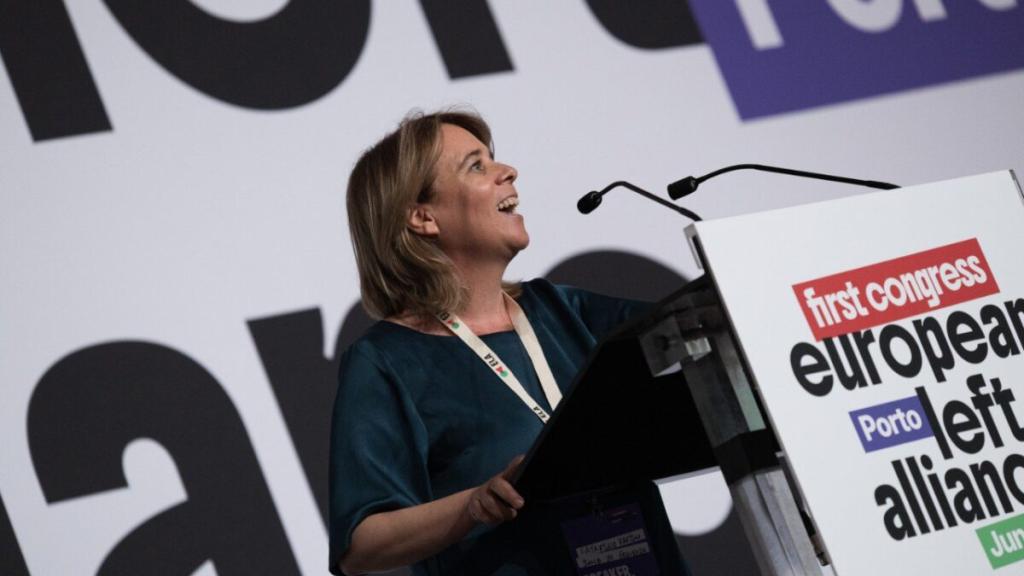
Catarina Martins: Hi, very pleased to talk to you. I was the national coordinator of Bloco de Esquerda (Left Bloc) for about 11 years — from 2012 to 2023 — and I was also a Portuguese Member of Parliament from 2009 to 2023. My professional background is in theatre — I directed for theatre, and I was also an actress. I started to work with Bloco because I was an activist for precarious workers in the culture sector, but also for culture itself — for its presence in our democracy and in our lives. I’ve also done some work with poverty and with people who were excluded from everything — that’s where I met most people from Bloco. I was elected as an independent candidate, and later, I decided to officially join Bloco de Esquerda. After I left the party’s leadership in 2023, we had a discussion and felt that I should run for the European Parliament. I was elected an MEP (Member of European Parliament) in 2024.
People are often quite distant from European parliamentary politics. Can you briefly explain what the difference between a European political party (or Europarty) and a European political group is? What distinguishes them in terms of their purpose and how they act?
This is very important because I’ve read all sorts of things — that we are splitting from The Left, which is our parliamentary group. This is not the case. In the European Parliament, there are parliamentary groups; the one Bloco de Esquerda inserted itself into was called GUE/NGL (European United Left/Nordic Green Left). It’s now called The Left, but it’s stayed the same since the beginning. We are very happy there. This parliamentary group has different lefts, but we work together, despite not agreeing on everything. We are a confederal group, meaning we don’t all vote the same way on everything, but we have common principles. I don’t think the left can afford to not work together.
Within GUE/NGL, there were always different groups — parties that were in a European party, parties that weren’t; and we also had subgroups, like the Nordics — so it’s a group of different lefts. It has two parties from Portugal: Bloco de Esquerda and the Portuguese Communist Party. Within the European Union, for some parliamentary groups, their party and their parliamentary group are the same, which isn’t the case for others. For us, it was never the same. So what we formed was not a new parliamentary group, but a new European party.
You are one of the co-chairs, alongside Malin Björk, of the European Left Alliance for the People and the Planet — ELA for short — that was founded in August 2024, after the last European elections. What is ELA?
In 2018, Bloco de Esquerda formed a political platform with Podemos and La France insoumise, called Now the People (NTP), because we didn’t feel represented by the European party we were in. In NTP, we have always considered that struggles for workers’ rights, for an alternative to capitalism, for public services, for the public control of infrastructure and so on, have to be done at the same time, and with a clear environmental agenda. We don’t feel that this is a contradiction — in fact, we feel that one agenda makes the other stronger, alongside a feminist and antiracist agenda. When we fight capitalism, we fight patriarchy and we fight racism and colonialism. For these parties, it was always important to have political platforms with this kind of approach, and we didn’t have that in the European Left. At first, we tried for the European Left to be the house for everyone, to make it so that Podemos and La France insoumise and the Nordics could feel welcomed, but that was not possible — the European Left was never interested in that path. So, over time, we started to work on that platform (NTP), and ELA is the result of that long political process.
Why is it the case that it wasn’t possible to accommodate Podemos and La France insoumise? One possible comment is that this is splitting the left more.
We are not splitting, because we are in the same parliamentary group. We are creating a new way to articulate our struggles. The European Left always had an approach of trying to have common political declarations, even when the national circumstances did not allow for it. What we need to understand is that the left forces in Europe don’t always need to have the same propositions. Sometimes, what a national circumstance or a geographical one demands is different. I’m happy that Podemos is an ELA founder, but EH Bildu is also a member. We are proving that we can have different parties, even when they “compete” in the same elections, so to speak.
We needed a practical element of articulating struggles and learning. I believe that ELA has a concrete, practical approach to how we can learn from each other. Our discussions are a lot about the kinds of tools we can use and what campaigns can bring us together, rather than debates. While debates are interesting and the left should have them, we cannot let them paralyse us. Sometimes we felt that the European Left was quite paralysed by that and lacked this practical approach. For us, a European party should mainly make us articulate concrete steps, learn from each other, be a tool for common struggles and help each other, rather than a space that tries to define the political path of each national party. We need to have the tools to think together, which is why we decided to create a think tank. A European party is not a national party; it should not do the same as a national party does.
Another difference is that ELA only allows parties with seats in a national parliament or with elected European deputies to be members. That is different from the European Left, whose membership is open to any left parties, even if they don’t stand in elections, as well as individuals. Is there a reason why ELA chose this membership framework?
It’s important that the parties that are in ELA are parties that want to dispute elections, and that have a responsibility towards how they present themselves to the people. We don’t want to risk becoming a very closed field of thought that doesn’t enter into dialogue with the people. If one party loses representation, it doesn’t have to leave ELA — we have a buffer, so they are still a part and have all their rights. However, for the kind of party we are creating, the responsibility of disputing social relevance and political relevance in the institutions was important.
ELA held its first Congress last month, in Porto, on 13 and 14 June, under the motto “for a stronger left against the far right”. What are your highlights from that? What were the major decisions and orientations adopted?
We know that the far right is quite organised and articulated — also because they have funding from oligarchs. We should also be well articulated, and learn from each other how best to campaign andto use all the tools at our disposal. Part of the decisions we took was to have a working programme that allows us to have precisely that kind of change of ideas on a very concrete level.
The other thing we decided on was to create a think tank because we also need that kind of reflection; it’s also to collect data, to conduct more research. Not only to debate the big questions that the left has today, but also to know more about what is going on, and what the debates happening in each country are, because we are in a situation where the far right determines the terms of the debate, and we need to change that. That is our main goal with ELA: to change the political agenda. We cannot always be discussing the far-right agenda; we need to have a cultural battle, to make debates on left terms. Collecting data is an important part of it.
We have also decided on our first campaign together, which will be to collect one million signatures for a European Citizens’ Initiative (ECI), which states that the European Union cannot have any commercial or association agreements with a country that violates international law. That means we want sanctions on Israel, and we want the end of the association agreement. I think it’s important that we do this because while the EU is evaluating the association agreement with Israel, it doesn’t mean anything—the agreement should not exist in the first place, because Israel has never complied with international law. That the agreement persists when we have a genocide is something we cannot understand, so this is taking the voice of the people to the institutions. At the same time, it’s a concrete way for the parties to work together and put all those practical tools and learnings to use on the ground.
That is very important. In the last year and a half, we have witnessed massive mobilisation all over the world, condemning Israel’s government actions, including people in Europe pressuring their governments and demanding an end to their complicity. However, we failed to stop the genocide. It seems that governments no longer seem to care about public support, or they don’t need public support to continue doing what they’ve been doing. So what can we do?
That is why we have chosen this. The parties of ELA, despite having different positions on some decisions, all agree that it’s only natural that the European Union has sanctions on Russia, because Russia invaded Ukraine. So how can we explain that we have an association agreement with Israel? It’s not acceptable. Different international studies show that public opinion reflects widespread shock at what is going on, and wants to end the genocide and wants sanctions to Israel. Something central in our programme and the Congress was the idea: “from the streets to the Parliament”. That’s what we do, that’s what the left needs to do. This European Citizens’ Initiative is that: we want the voices of the streets in the European institutions. We are convinced that there’s a broad majority of the European people who understand that the EU, being one of the major partners of Israel, actually has the power to stop the genocide, if it imposes sanctions.
On ELA’s political platform, feminism is one of the main pillars. We have seen feminism being misused and even co-opted for neoliberal gains in different areas. One example would be Annalena Baerbock, Germany’s Foreign Minister, who is associated with a so-called feminist foreign policy, while defending Israel’s killings of Palestinian civilians. What does it mean to have a left, feminist european programme?
For us, fighting capitalism comes along with fighting patriarchy, we need to do it together. Feminism is key in fighting the far right because it has to do with equality, with respect for everyone, and with carework. Feminism is crucial in imagining other futures: imagining an alternative world from this neoliberal world, from its hatred and war. Feminism is not only about individual rights; it’s about forging an alternate society.
In terms of popular participation, Italy recently had a referendum, which included a question on easing citizenship requirements for migrants; however, it failed since only 30% of eligible people voted, and a third of them voted against making citizenship more accessible. How do we build support and solidarity with migrant workers when citizens seem so happy to sacrifice them?
We have never produced as much as we produce now, and in the last 25 years, we have had a huge change in our technological competence. However, in this century, innovation is not social progress — on the contrary. For many years, innovation marginally served the workers, even if it was not well distributed. But now, it’s against the workers. People feel that their lives are getting worse, there are impossible rhythms of work, impossible working hours, the wages are not enough, and the new generations don’t think their lives can get better. That creates a lot of resentment, and the neoliberals and the far-right know how to use that resentment. In fact, it was not the far-right that started it, it was neoliberalism, and the far-right grows because of neoliberalism, and gives people a simple explanation: your salary is low because there’s an immigrant that is willing to work for a low salary, you don’t have a home because immigrants get available homes, and other things like that, which are not true. The left needs to be able to put the conversation in other terms and determine the debate in new ways, explaining that it’s not the immigrants who are taking jobs, but rather that we have never had as much inequality in the world as we have today. And we need to learn to say this in different ways. That’s why we want ELA to articulate concrete ways to do things.
At the same time, we need new ways of organising workers, that immigrant workers can be a part of. There’s a part of the left that sometimes seems to go along with the right-wing criticism of the left, saying that defending immigrants, or being antiracist, or being feminist, doesn’t help our struggle with workers. Is there any place or any activity where we can have workers’ struggles without women or without migrants? No, it’s impossible. We need other ways for people to feel represented, and that’s the work of the left, but not only of the left parties — this is also the work of the unions. We need to integrate migrant workers into the workers’ rights struggles in Europe. We have good examples of that, and we already know how to do it in some sectors. But it’s still too little, we need to do it better, and we need to do it all over.
The far right is growing in European countries. In some cases, the left is struggling, on one side, to keep parliamentary representation, and on the other, grassroots mobilisation; sometimes both. How can we regain ground?
We need both. We cannot give up on the institutions. We can say that the democracies that we have are quite limited — and they are — and they are not the democracies that we would stand for. But not using what we have is a silly mistake. When we see how fast Orbán dismantled the democratic rules in Hungary, when we see what Trump is doing, can we really leave the institutions up to them? I don’t think so. They are a tool and we need them. Of course, we also need to have grassroots movements, and we shouldn’t see them as opposites. We need to be everywhere. We are in a new, dangerous moment in our history, not only European but internationally, with fascism on the rise. Faced with that, the answer can’t be to be scared and run, but to foster the resistance. Grassroots movements don’t have to be instrumentalised for institutional activity, the same way that our institutional activity cannot be determined only by what the movements are saying at each time.
The left, being anticapitalist and progressive is under attack, because we represent everything that is under attack right now. Wanting an alternative to capitalism makes us the target for neoliberals, for the centre, for the far right. Stating that everyone is equal and that everyone needs to be free — at a point in time where fascism is on the rise, when you see how non-white, LGBTQIA+ people, and women are being targeted — the present moment is really important. We know that this anti-conservative and progressive agenda is key in fighting fascism. That is what mobilises people. I see the younger generation — where there’s a real polarisation — but we also have so many young people who understand this, and that gives us hope.
How can people get involved with ELA?
ELA is a party of parties, but we are trying to have initiatives and be open to discussions. We will have a youth camp in Poland at the beginning of September. In our Congress in Porto, it wasn’t only parties participating: we opened it up to social movements and to people from outside Europe. That gives us hope and energy. Lots of things can be created from that. So, for anyone interested, you are welcome to our initiatives.

No comments:
Post a Comment