Wall Street is Killing the US Housing Market

Photo by Robb Miller
There are few things more important than our homes. Alongside providing our shelter, homes are where we make memories with friends and family — where bonds are formed and strengthened.
Unfortunately, the right to a home in America is under threat. Rents have skyrocketed, homelessness is rising, and home ownership is increasingly unattainable for most Americans.
There are multiple causes, but one culprit stands out: classic Wall Street greed. Massive private equity corporations and hedge funds are buying up homes by the thousands — houses, apartment buildings, and mobile home parks alike — and then jacking up rents.
This trend accelerated after the 2008 financial crisis, when investment firms snatched up homes in foreclosure and began renting them to the growing number of people locked out of ownership.
The result? An epidemic of corporate slumlords.
According to a recent study, nearly a fifth of all homes sold in the first quarter of 2024 were purchased by investment firms — including over a quarter of low-priced homes that might have been affordable to working people.
With their vast wealth, these companies are able to easily outbid real people, often paying a premium to buy properties before they even hit the market. This reduces supply — and encourages developers to sell at higher prices that only Wall Street can afford. Once a firm owns a property, they rent it out at an inflated, algorithm-fixed
Take Blackstone. The trillion dollar private equity giant owns over 300,000 U.S. residential units, making it the largest corporate landlord in the world. The company has hiked rents in its properties by as much as 64 percent over just two years. While Blackstone’s tenants often can’t make rent, CEO Stephen Schwarzman now enjoys a net worth north of $50 billion.
I’ve seen the impacts of Wall Street’s assault on our homes firsthand.
According to a Georgia State study, my hometown of Atlanta has the highest concentration of Wall Street-owned single family homes in the country. In the past 15 years, mega-corporations have purchased over 70,000 homes in Atlanta, accounting for over 30 percent of all single family rental properties in the city. In some districts, as much as 99.6 percent of the market is owned by corporate investors!
As a result, longtime residents have been pushed out, housing costs have soared, and inequality has multiplied. For me and many of my friends, the idea of owning a home in the city we grew up in feels less realistic every day — an unfortunate truth across countless towns and cities in America.
As a fundamental need, housing should be a right for all people and families — not an investment commodity for the ultra-rich. In the short term, rent control and increased tenant protections could ease people’s pain in this corporate-controlled housing market.
In the longer term, there’s an alternative that would allow us all to have the homes we deserve: social housing.
Social housing refers to housing developed by non-corporate entities like non-profits or local, state, or federal governments. Social housing is permanently and truly affordable, controlled democratically by its community, and never resold for profit. There are a variety of models, but they all share one key component: they exist outside the for-profit housing market.
Cities and states can take the lead in developing their own social housing, like what’s happening in Seattle after a citizen-driven referendum. There, a tax on rich corporations will fund a city-owned social housing developer — a great model for cities across the country.
Trump Wants to Take Your Social Security to Give Even More Money to Wall Street

Photograph by Nathaniel St. Clair
Scott Bessent, Donald Trump’s Treasury Secretary, let the cat out of the bag when he said that their new “Trump Accounts” are intended as a backdoor way to privatize Social Security. Their idea is to get people to put money in these accounts beyond the $1,000 the government will give each newborn, so that they will be able to phase out or scrap Social Security. Your “Trump Account” will serve as a replacement.
This has been a longstanding dream among Republicans. They have hated Social Security ever since Franklin Roosevelt created it in 1935 and taxes started to be collected two years later. Now they think Donald Trump has finally given them the weapon needed for the program’s destruction.
Their hatred is understandable. Social Security is an incredibly successful government program that does exactly what it was designed to do. It provides workers with a core retirement income that ensures people will not be in poverty in their old age. It also provides insurance against disability, as well as providing benefits to children and surviving spouses of workers who die young.
It does this with a minimum of fraud and abuse, as Elon Musk and his DOGE team inadvertently showed earlier this year when their clown show came up empty-handed. It also is incredibly efficient. The administrative costs of the retirement program are just 0.4 percent of the benefits paid out. By comparison, a private sector pension system would cost more than 40 times as much.
For all of these reasons, Social Security is hugely popular: Polls regularly show approval ratings of more than 80 percent, with Republicans liking the program just as much as Democrats.
It is easy to see why Republican politicians want to destroy it. After all, if the government can do a great job running a retirement program, maybe it can also provide healthcare insurance, and who knows, maybe even pay for our kids to go to college. Republicans hate good examples of government functioning smoothly.
They also hate the fact that the program is so efficient. The money the public saves from an efficient Social Security system could instead be trillions of dollars in fees to Wall Street and the financial industry. This is why privatizing Social Security is a longstanding dream for Donald Trump and his crew.
No, Social Security Is Not in Financial Trouble
In assessing the case for privatization, it is first important to knock down the big lie that Social Security is going broke. It is true the system is projected to face a shortfall in eight years, but there are three important points to be made about this projection.
First, even if it proves exactly right, the program will still be able to pay close to 80 percent of benefits. No one wants to see benefits cut by 20 percent, but we should be clear: It will always be possible to pay the vast majority of benefits under any plausible scenario.
The second point is that one of the main reasons the program is projected to face a shortfall is that we have redistributed so much income upward to Donald Trump and his rich friends. There is an income cap on Social Security withholdings — which means that earnings above that amount ($176,100 in 2025) are not subject to the Social Security tax. In 1982 — the last time there were major changes to the Social Security system — only 10 percent of wage income escaped taxation by being over the cap Currently, close to 20 percent of wage income escapes taxation as a result of being above the cap
There has also been a redistribution from wages to profits. Since only wage income — and not dividends and capital gains — are subject to the tax, this redistribution has further hurt the program’s finances. For politicians to scream that Social Security can’t pay your retirement benefits after they engineered the redistribution away from workers is true Republican hypocrisy.
This brings us to the last point: the decision to not pay full benefits would be a political one, not an economic one. If we actually do have a 20 percent reduction in benefits in 2033 it will be because the politicians in Washington decided to cut our benefits.
The government has the money to pay full benefits if the president and Congress will let it. The program will be taking just as much in tax revenue (relative to the size of the economy) in 2033 and later years as it did before. And the amount we pay in benefits relative to the economy also changes little. The only change in 2033 is that the program runs out of the government bonds it had purchased when the baby boomers were all working and the program had a huge surplus.
There was a logic to have Social Security exclusively funded by the payroll tax, but now that the Republicans’ war on workers has made that less feasible, there is no reason for us to say, “Okay, you killed our wages, you might as well take away our Social Security benefits too.” Instead, Congress can just decide to make up the gap in the program from general revenue. This would be an accounting change with no economic significance whatsoever.
The Privatization Trap: Wasteful and Expensive
Suppose instead, we decide to go the Trump-Bessent route and have private accounts replace Social Security. Presumably, this would first be hitting workers 60 and 70 years out, after they have accumulated enough money in their “Trump Accounts” to replace Social Security.
While there are many reasons this arrangement would be far inferior to the insurance provided by Social Security, it would also be a massive source of waste in the economy. Paying extra money to Wall Street to do something that could be accomplished far more cheaply by the government is the same thing as throwing money in the toilet — although in this case the toilet is the money managers on Wall Street.
We can get some idea of what sort of money we are looking at by looking at current benefits and costs. At present, the average benefit for a retired worker is roughly $2,000 a month, or $24,000 a year. Life expectancy at 65 is around 80, so the average person will collect benefits for 15 years.
In a private account, a person would need roughly $300,000 to pay out $24,000 a year for 15 years. Since people don’t know exactly how long they will live, they would need to buy an annuity which would guarantee them that this $24,000 would be paid out as long as they live. Insurers charge a fee of at least 10 percent for issuing annuities, which means a worker would need to accumulate $333,000 to pay an insurance company for an annuity of $24,000 a year.
On top of this, the annual cost of 401(k) type accounts in the private sector are over 1.0 percent annually. If the average dollar has been in a worker’s account for 20 years (some money will have been in the account for 45 years, some for just a few years), then these fees will amount to more than 20 percent of the final accumulation. In this case they would be $66,000.
Adding the cost of the annuity and the cost of maintaining a Trump Account through a working lifetime, we get that this worker would be paying $99,000 to Wall Street for the retirement income generated by the account.
We can easily calculate the comparison cost for getting Social Security benefits. It comes to 0.4 percent of the benefit paid out, or $96 a year in this case. If we assume the worker collects their benefits for 15 years, the total cost is $1,440.
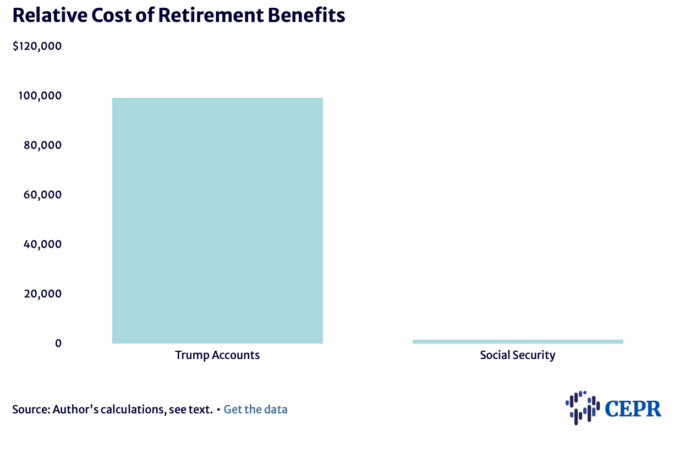
So there you have it. We can go with Donald Trump and Scott Bessent and give $99,000 to Wall Street or we can keep the Social Security system we’ve had for almost 90 years and pay out $1,440 in administrative fees. That doesn’t seem like a tough choice.
This first ran on Dean Baker’s Beat the Press blog.

No comments:
Post a Comment