.jpg)
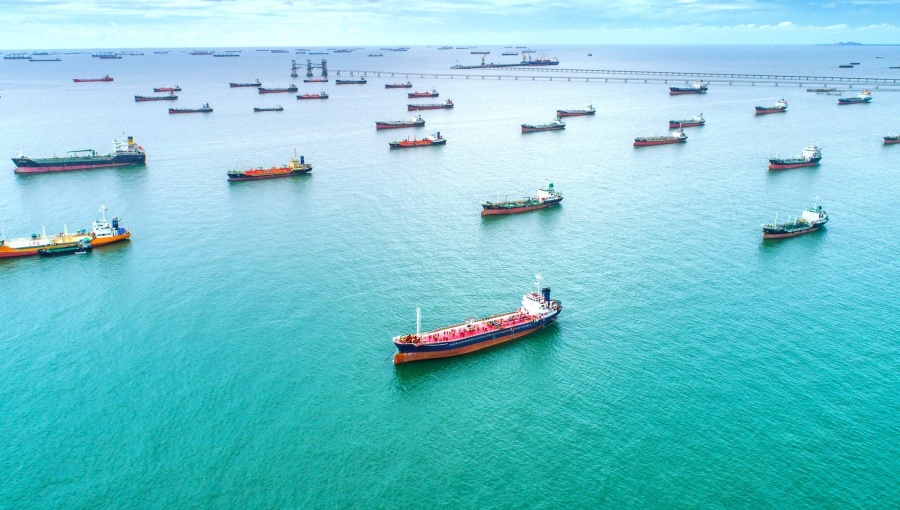
Oil prices surged to over $100 per barrel in early trading on March 9, as the Iranian blockade of the Strait of Hormuz for nearly a week now has led to production shut-ins across the Gulf as storage space for unexported oil runs out.
Brent was trading at over $108 per barrel as of 06:30 GMT, up from the early $90s at the close of trading on March 6 and the early $70s prior to the US and Israel launch of strikes against Iran on February 28.
As NewsBase warned, Gulf producers are now having to shut down wells because of limited oil storage capacity and limited alternative oil export routes to Hormuz, which typically handles 20mn barrels per day (bpd) of oil flow – equivalent to around a fifth of global supply.
Tehran claims it is only restricting passage through Hormuz for Western nations and Israel rather than completely closing the maritime chokepoint. But many other oil tankers are reluctant to pass through the Strait because of the risk of Iranian strikes – intentional or accidental. Iranian forces already targeted two tankers in the early days of the war.
Iraq has cut production from its southern fields that export via Hormuz by 70% to only 1.3mn bpd, Reuters reported on March 8, after the country’s storage facilities reached maximum capacity. Its exports also fell sharply to 800,000 bpd, from 3.33mn bpd in February, according to the news agency.
Kuwait and the UAE were next to announce production cuts over the weekend, with even larger producers like Saudi Arabia expected to take similar steps if the crisis is not resolved soon.
JPMorgan estimated on March 2 that onshore crude storage capacity across Gulf producers amounts to roughly 343mn barrels, equivalent to around 22 days of output that could become stranded if exports are unable to leave the region. In addition, about 60 empty tankers currently in the Gulf could provide temporary floating storage capacity of roughly 50mn barrels
“The market is shifting from pricing pure geopolitical risk to grappling with tangible operational disruption,” Natasha Kaneva, head of global commodities research at JPMorgan, told clients on March 6.
The bank estimates that production cuts could surpass 4mn bpd by the end of this week if Hormuz remains closed. The oil price surge may therefore have only just begun.
“Every additional day of disruption adds pressure, and in that scenario there is effectively no ceiling to prices in the short term,” Stefano Grasso, senior portfolio manager at Singapore-based fund 8VantEdge, told Bloomberg.
Depending on how it lasts, this may prove to be the biggest disruption in oil markets in history. In comparison to the 20mn bpd of exports affected by the Hormuz blockade, the Iranian Revolution of 1978 only disrupted 5.6mn bpd of supply, while the Yom Kipper war of 1973 hit 4.4mn bpd of exports, the 1990 Iraq-Kuwait war 4.3mn bpd and the Iran-Iraq war of 1980 some 4.0mn bpd.
As noted, the alternative export routes for Saudi Arabia and other producers is limited. As NewsBase has reported, Saudi Arabia possesses the greatest logistical flexibility. Its primary contingency relies on the East-West pipeline, which has around 2mn bpd of spare capacity to deliver oil to the Red Sea. But that would still leave 4mn bpd of Saudi exports trapped.
Other major producers face significantly shorter timelines. Kuwait lacks any bypass infrastructure, meaning all its exports must transit Hormuz. With limited storage headroom, Wood Mackenzie estimates the country has roughly two weeks of cover before it must slash production. Southern Iraq is similarly exposed; its 3.5mn bpd of exports are entirely dependent on the strait, with storage cover measured in “days, not weeks,” according to Araman.
The UAE maintains partial flexibility through the Abu Dhabi oil pipeline, which can move 1.8mn bpd to Fujairah, a terminal located outside the strait. Nevertheless, with total exports exceeding 3.4mn bpd, a substantial volume remains bottlenecked. Araman wrote that ADNOC’s Fujairah storage provides a buffer of roughly two to three weeks, after which Murban crude output must adjust.
The $100-per-barrel oil price is perceived as a psychologically significant threshold that when surpassed, could trigger problems for the global economy as well as inflationary pressure. Depending on the duration of Hormuz’s closure, the crisis could erase completely the surplus of global oil supply this year that was anticipated prior to the war. In February, the International Energy Agency (IEA) predicted that global oil production would rise by 2.4mn bpd in 2026, while demand would only grow by 850,000-930,000 bpd, creating a surplus of 1.47-1.55mn bpd.
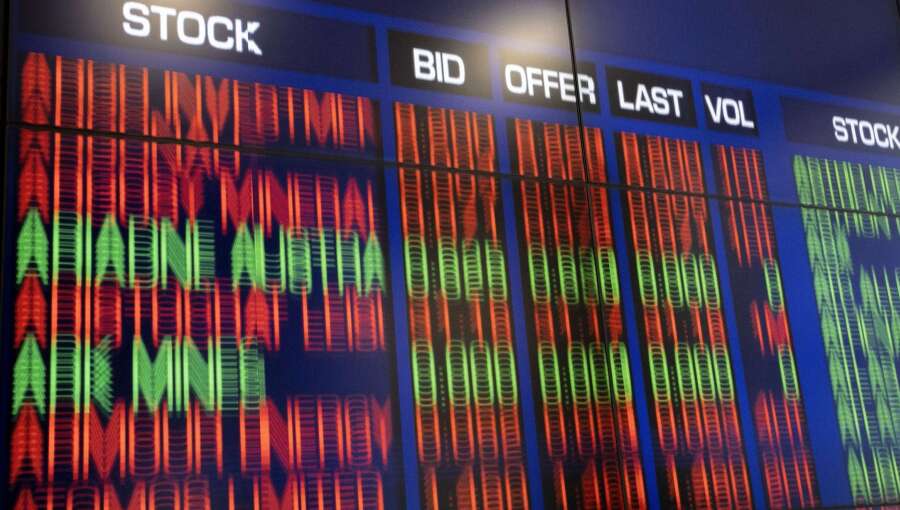
Equity markets across Asia fell sharply at the week’s opening on March 9, with indices in Japan and South Korea leading regional losses following a steep rise in global oil prices, The Business Times reports.
Singapore’s benchmark Straits Times Index (STI) also opened 1.9% lower at 4,755.91 points. On the island, declining stocks heavily outnumbered gainers, with 249 losers versus 37 advancers, after around 166.9mn securities worth approximately $175.3mn were traded.
In addition, banking stocks in Singapore were among the hardest hit in early trading. Shares of DBS Bank fell 1.6%, declining by about $0.67 to $40.24. Meanwhile, OCBC Bank dropped 1.9%, slipping roughly $0.30 to $15.18, while United Overseas Bank (UOB) lost a full 2.3%, decreasing by $0.61 to $26.19.
The sell-off across Singapore and the region came about as crude oil prices surged above the $100 per barrel mark with West Texas Intermediate rising 20.8% to $109.78 per barrel, while Brent crude climbed 16.3% to hit $101.38 per barrel.
Energy-related stocks - as a result - were among the few gainers in early trading. Rex International jumped 13.3%, rising by about $0.018 to $0.154, while Geo Energy Resources also increased 5.4%, gaining roughly $0.019 to $0.365.
In Southeast Asia, Malaysia’s FTSE Bursa Malaysia KLCI was also down 2% as of 9:30 am local time, despite a research note released on March 6 by BMI ranking Malaysia as having the fifth-lowest risk score among 24 emerging markets in terms of potential exposure to the economic fallout from the US–Israel–Iran conflict.
The assessment evaluated factors such as trade disruption linked to the effectively closed Strait of Hormuz, terms of trade, external balances, as well as fiscal and monetary policy resilience.
The report also noted that energy-exporting countries such as Malaysia, seen as up and coming in the region, could benefit from elevated gas prices. In contrast, dedicated energy importers like the Philippines and South Korea may face pressure on their currencies and increased strain on their balance of payments as oil prices remain elevated.
War In Iran Shocks Markets, Costs U.S. Taxpayers $1 Billion A Day
By Brett Rowland
(The Center Square) – The escalating war in Iran has already rattled global markets and driven oil prices to their highest levels since April 2024. If the conflict persists, the strain on the global economy deepens and the burden on U.S. taxpayers grows.
With U.S. military operations costing more than a billion dollars each day, experts warn that a prolonged war could require a significant increase in defense spending, further affecting the federal budget.
The U.S. and Israel launched attacks on Iran on Feb. 28 after nuclear talks with Islamic Republic failed to produce a deal. President Donald Trump and Secretary of War Pete Hegseth have laid out four military objectives: Destroying Iran’s missile capabilities, neutralizing its navy, preventing the development of nuclear weapons, and ensuring the regime can’t direct terrorism beyond its borders.
Both Trump and Hegseth said the conflict is at the beginning. It’s unclear how long the war could continue, but Trump said it could be several weeks. On Friday, Trump said he would accept nothing less than Iran’s unconditional surrender.
U.S. gas prices surged to an average of $3.45 on Sunday, according to AAA, a $0.47 increase over the week. That’s the sharpest weekly rise since March 2022, when prices jumped $0.60 after Russia invaded Ukraine.
Since the Iran conflict began, oil prices have soared from around $65 to over $90 a barrel as of Friday.
Desmond Lachman, senior fellow at the American Enterprise Institute, said the economic hits could become more severe as the war continues.
He predicted gas prices could climb even higher, potentially exceeding $3.50 or even $3.75 per gallon.
“That has an impact on inflation and could also slow the economy. So it’s quite a big deal,” he said.
Shipping traffic through the critical Strait of Hormuz is nearly at a standstill, according to the Joint Maritime Information Center, an international group that tracks commercial shipping safety. The waterway usually handles about 20% of the world’s crude oil and natural gas shipments.
On average, about 138 vessels pass through the strait each day. That dropped to four earlier this week.
“This represents a near-total temporary pause in routine commercial traffic,” JMIC noted. “While no formal legal closure of the Strait has been universally acknowledged, the reduction stems from a combination of security threats, insurance constraints, operational uncertainty, and effective disruptions rather than a declared blockade.”
Lachman said the Strait of Hormuz is one problem, but Iran is also attacking oil and gas infrastructure, reducing supply.
“They are going after oil refineries and pipelines so there’ll be pressure on the United States to end the war,” he told The Center Square. “What’s happening right now is that those Gulf states are able to intercept the drones that the Iranians are sending, but the Iranians have got more drones than these states have got interceptors.”
Additional disruptions could send oil prices above $100 a barrel, Lachman said.
Goldman Sachs Research economists Jessica Rindels and Pierfrancesco Mei estimated that higher oil prices could hamper the U.S. economy and push up consumer prices. Higher oil prices reduce disposable income, which in turn limits spending, they noted.
“History suggests that oil price spikes driven by geopolitical shocks can be short-lived if markets gain confidence that supply disruptions will be temporary,” they wrote in a report.
How long the war with Iran will last and how far it might spread throughout the Middle East remain unclear, Lachman said.
“The trouble is, nobody really knows how long it will continue,” he told The Center Square.
United Nations Secretary-General António Guterres said Friday that the “situation could spiral beyond anyone’s control.”
“All the unlawful attacks in the Middle East and beyond are causing tremendous suffering and harm to civilians throughout the region – and pose a grave risk to the global economy, particularly to the most vulnerable people,” he said. “It is time to stop the fighting and get to serious diplomatic negotiations. The stakes could not be higher.”
In addition to the global economy, a long and costly war in Iran could hit U.S. taxpayers, Lachman said.
“This is costing over a billion dollars a day,” he told The Center Square. “So if this drags on, the U.S. is going to need a big increase in its defense budget, which can push interest rates up. You’ve just got to hope that this is a very short war; otherwise, there will be serious consequences.”
Trump is already looking to boost military spending. Trump previously proposed a $1.5 trillion budget for the Department of War, a 60% increase over existing levels.
On Friday, the nation’s largest defense contractors agreed to “quadruple Production of the ‘Exquisite Class’ Weaponry,” the president said in a social media post.
Rising US fuel prices risk sparking domestic wildfire for Trump
By AFP
March 6, 2026
In California and across the United States, gas prices are on the rise as the Middle East war begins to affect pocketbooks - Copyright AFP/File Frederic J. BROWN
Sean Robinson, a 54-year-old schoolteacher in the US capital Washington, did not realize how high gas prices had gotten until he arrived at the pump on Friday.
“That is a sizeable jump,” he told AFP, pointing to a neon sign showing $3.27 for a gallon of regular gasoline.
Robinson is among US consumers feeling the sting of a cost surge sparked by the US-Israel war on Iran, which sent oil prices soaring as Tehran effectively blocked the Strait of Hormuz after being attacked.
But the price hike comes at a politically sensitive time for President Donald Trump as midterm elections approach, hitting voters hard.
Expensive gasoline could also prompt the independent central bank to put the brakes on the world’s largest economy as it battles stubborn inflation.
Since last week, US average domestic fuel prices have risen 11 percent, according to the AAA’s fuel price gauge.
It is the kind of move that Robinson said will have him cutting down on all but the essentials.
“It just determines what I’m going to do on a day-to-day basis,” he said. “Pretty much start thinking about (watching) Netflix, staying in the house instead of burning gas.”
Others at the gas station agreed.
“It impacts all areas of life,” said Toloria Washington, 39. “We are in a state of survival mode.”
– ‘It’s the basics’ –
Washington, who works in finance, said fuel expenses are non-negotiable for her. With prices rising at the pump, she had to make cuts elsewhere.
That, she said, is a problem for people already battered by years of high prices post-pandemic.
“That’s the key thing, it’s tapping into everybody’s basics,” she added. “It’s the basics. Daily survival of food, water, housing.”
US inflation hit a peak of 9.1 percent during the pandemic. While it has cooled since then, analysts warn of risks of another pick-up.
“Inflation showed signs of accelerating prior to the jump in energy prices,” said KPMG chief economist Diane Swonk.
“That has left consumers in a sour mood,” she added.
Swonk warned that rising fuel prices added “insult to injury” for low-income Americans, who are already seeing higher healthcare costs and a tightening of welfare benefits under Trump.
Trump, who has bragged about oil prices falling during his term, sought to address the political fallout on Friday, telling CNN he expected prices to come down quickly.
His Republican party holds only a slim majority in both the House and Senate.
With midterm elections due in November, he will be hoping that voters do not let tightening household budgets weaken his political position.
– Fed’s ‘dueling mandate’ –
Trump could see further complications if inflation from gasoline price hikes pushes the Fed to respond by keeping interest rates at a higher level.
The central bank has a dual mandate of maintaining stable prices and maximum employment, but has one main tool to do so — adjusting interest rates.
Raising them generally cools economic activity and reduces inflation while lowering them can spur activity, boosting the weakening employment market.
The prospect of more inflation due to oil prices raises the specter of what some analysts call a nightmare scenario.
“This could not come at a worse time for the Federal Reserve,” said KPMG’s Swonk. “It now has a dueling mandate with the risk that inflation not only lingers but accelerates.”
Fed policymakers remain cautious.
Addressing higher domestic energy prices on Friday, Federal Reserve governor Christopher Waller told Bloomberg TV he considered them “unlikely to cause sustained inflation.”
But this is scant consolation for many Americans hit by even a temporary bout of price increases.
“One thing after another, it’s chaos, you know, every day,” said Lucas Tamaren, 32, at a gas pump in Los Angeles.
“Living in America feels unpredictable and chaotic and it’s hard.”
Robinson, the schoolteacher, said he will be watching gas prices every day now. He expects price pressures will be reflected at the voting booth in November.
“The more you pay higher gas, higher groceries (costs),” he said, voters will “start to see” that the middle class is shrinking.

No comments:
Post a Comment