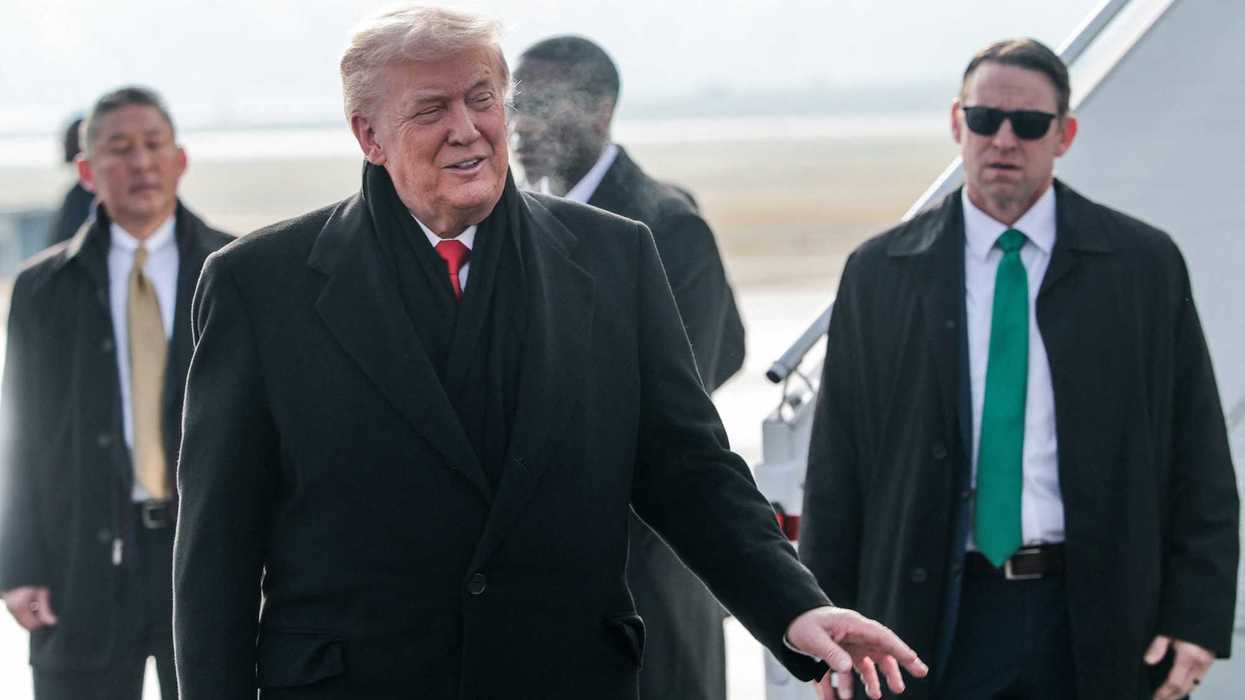
U.S. President Donald Trump at Zurich International Airport in Switzerland, January 21, 2026. REUTERS/Jonathan Ernst
April 19, 2026
ALTERNET
President Donald Trump’s belligerent rhetoric toward America’s allies may please his domestic political base, but it is harming America’s international standing — perhaps permanently.
“Trump, for so many people, epitomizes the ugly American — somebody who is bumptious and vulgar and ignorant about foreign cultures,” former Time Magazine editor Rick Stengel said in a recent podcast appearance on The Bulwark with former Daily Beast editor-in-chief John Avlon. “So I think people sort of have come to the end of their patience with America.”
Avlon replied to Stengel by noting that polls found presidents like Bill Clinton and Barack Obama, who engaged in positive diplomatic relationships with other countries, were far more popular than the bellicose Trump. Indeed, Stengel noted that America’s foreign standing has “plummeted” during Trump’s two terms.
“It always seemed absurd to me when Trumpists would say that we need to be respected on the world stage, when you could see in the data that America was not respected — was held in worse regard when Trump was president, even than Chinese president-for-life Xi,” Avlon told Stengel. “So I wonder now with Iran, though — we seem to have crossed a Rubicon, because it was a war of choice, because our allies are not with us. And tell me about the downstream effect of that as you see it.”
Stengel added that, even though Joe Biden tried to reverse the damage to America’s reputation caused by Trump’s first term, America’s allies were not convinced that Biden would remain in power long enough to keep those policies in place. Trump’s reelection in 2024 confirmed their fears.
“This seesaw in presidential politics is something that people don't really understand,” Stengel told Avlon. “And then this Iran thing — by the way, what was probably most popular about Trump on the world stage was his sort of isolationism: that this isn't about America invading foreign countries and this world of endless wars, that America would retrench globally in terms of militaries but increase their presence globally in terms of trade and globalization. In some ways, it's the exact opposite. The alliances are also part of this idea of soft power, because — and I hate that phrase we used to use — we're not the world's policemen. We weren't the world's policemen, but we were the kind of foundation of the global world order, that people could trust America to abide by the rule of law, to be a pretty fairly honest broker. Not to say we wouldn't do bad things, but that is completely out the window.”
He concluded, “And the kind of ‘America First’ which has now actually caused it to get into a war is something that makes us much more isolated and much less popular, to an extraordinary extent.”
In February the New York Times reported that Trump’s imperialist rhetoric toward Denmark about acquiring Greenland and his conquest of Venezuela had convinced America’s European allies to decouple their most valuable financial and digital assets from American corporations. His tariffs have similarly prompted talk among Europeans of a permanent “divorce” from the US, with a senior European official telling Politico that “there is a shift in U.S. policy and in many ways it is permanent. Waiting it out is not a solution. What needs to be done is an orderly and coordinated movement to a new reality.”

No comments:
Post a Comment