Harriet Tumbled: Now I Know Why Brits Love and Fear for Their NHS
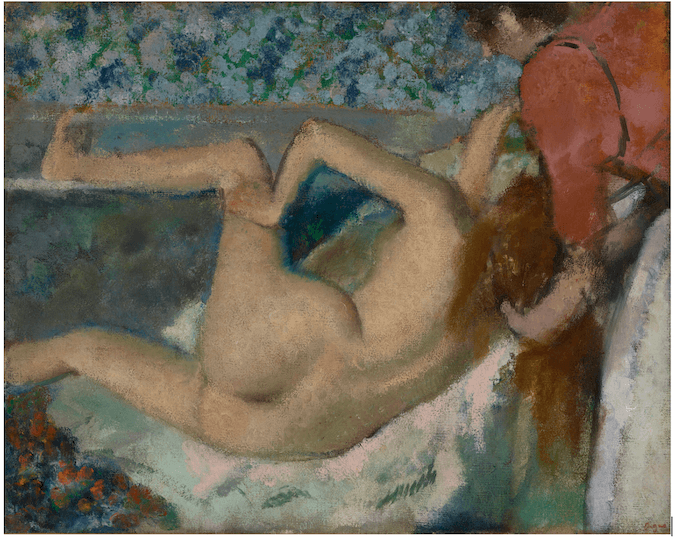
Edgar Degas, After the Bath, c. 1895. Los Angeles: J. Paul Getty Museum (Public Domain).
The fall
The Twineham Ward of Princess Royal Hospital, Haywards Heath, Sussex, U.K., consists of six bays of patients to the left, multiple offices to the right and a long corridor in between. But to call it a corridor isn’t quite right; it’s more like a spine because it’s the nerve center where senior nurses direct junior nurses and aids, doctors review patient records, and visitors enter and leave. It’s also a rehab space where elderly patients with frames (“walkers” in American dialect) shuffle up and down, exercising repaired or replaced hips. I was there because my wife, Harriet – at 60 the baby of the ward – tumbled when stepping out of a bathtub in a Brighton hotel room that had a nice view of the English Channel.
After hearing her scream, I opened the bathroom door and saw Harriet in a pile in front of the tub, naked except for a towel around her middle. I thought of Degas’ painting of a woman with one leg propped on the rim of a bathtub and the rest of her naked body below. “Did you fall?” I stupidly asked. “Are you hurt?” She replied through gritted teeth with a cliché of her own: “I think I’m ok.” I knew she wasn’t. Refusing to believe she’d seriously hurt herself, Harriet scuttled across the bathroom floor like T.S. Eliot’s crab, then across the carpet and somehow up on the bed. I dialed 999, the U.K. emergency services number. That’s when I discovered a major flaw of the National Health Service, established in 1948 by Aneurin Bevan, Minister of Health under Labor Prime Minister Clement Attlee – ambulance wait times. My conversation with the dispatcher was roughly as follows:
“My wife has had an accident and we need an ambulance.”
“May I speak to her?”
“Sure, here she is.”
“Is there any bone protruding through the skin?”
“No.”
“Were you unconscious at any time after your fall? Can you stand up or walk?”
“No and no.”
“Ok, we’ll send an ambulance for you.”
I came back on the line: “About how long will that be?”
“Our average wait time is between one and four hours, but the latter is an outlier. We’ll send one as soon as we can.”
Two hours ticked by. I called again and had roughly the same exchange. At three hours, 20 min, Harriet grimaced, moaned, then screamed in agony and began shaking uncontrollably. I knew what shock looked like, so I bundled her up in blankets, encouraged her to breathe slowly and deeply and called another NHS dispatcher:
“No, my wife cannot speak to you because she’s in too much pain. She’s going into shock. You must raise the level of urgency to one or two and send somebody at once.” In the hour since my previous call, Gemini AI (my new buddy) told me that every ambulance summons, save imminent death, rates an “urgency level” of three or four from the NHS. My words had the desired effect.
“I’ll send an ambulance right away.”
45 minutes later, help arrived in the form of two diminutive, bespectacled, white men, 40ish, with working-class accents and calm demeanor. They finished each other’s sentences like Rosenkrantz and Guildenstern – but were kind and competent. They quickly gave Harriet laughing gas (nitrous oxide) to reduce the pain while checking her vitals. Then they hoisted her onto their gurney and took her down the elevator, past hotel reception, and into a night that smelled like the sea. In a minute, we were swallowed by the waiting ambulance. That’s when I deployed the second set of magic words, I learned that night, courtesy of Gemini:
“Harriet has a probable neck of femur fracture, and I want her taken to the nearest hospital with fast-track treatment.”
“Let me call…” one said…
“Princess Royal Hospital in Hayward’s Heath” the other continued, “and see if she is eligible for that program.”
She was. So that’s where they drove, carefully but at speed.
The National Health Service, neo-liberalized
Almost from the beginning, the NHS has been treated like a piggy bank. Three years after its founding, the Labour government, wanting money to pay for British participation in the U.S. war against North Korea, cut funding for the NHS. Bevin quit his post to protest charges for dental work, eyeglasses, and prescription drugs. (These costs remain in effect.) More cuts were mandated by the Guillebaud Committee report in 1953, but it wasn’t until the Margaret Thatcher years (1979-90) that the NHS was looted, albeit surreptitiously.
Like her American friend, President Ronald Reagan, the U.K. Prime Minister believed that the invisible hand of the marketplace could better direct the allocation of resources than any elected parliament, council or parish. In her laissez-faire utopia, the heads of businesses, and especially large corporations, would comprise a clerisy that supplanted leaders in education, religion, science, politics, and the arts. Universities, hospitals, and even museums would be privatized and rationalized, that is, made subservient to market discipline. Labor unions, especially, were viewed by Thatcher with suspicion or worse. They must be enfeebled for profits to grow and investment to occur. Indeed, any accommodation to workers’ wants or public needs distorts the iron logic of supply and demand. In the U.S. “Reaganomics” followed the same course and had similarly dire outcomes for health and safety, income inequality, and national infrastructure.
In 1982, Thatcher and her chancellor, Geoffrey Howe, clandestinely proposed abolishing the NHS in favor of compulsory enrollment in private insurance. Opposition by ministers prevented the rollout of the program, but not before leaks fueled a press and public firestorm. In response, Thatcher claimed, duplicitously, “the NHS is safe with me.” Thatcher and her team’s subsequent assault on the NHS proceeded along two tracks. The first entailed splitting off long-term care from acute care, and the second introduced competition among hospitals for scarce resources, along with cuts to local councils under the rubric of “fiscal discipline”.
When elderly or disabled patients were discharged from hospitals, under the new system, they could no longer move seamlessly and without charge to long-term care homes or rehabilitation facilities. Nor could they be assured of free, at-home visiting nurse services. Instead, they had to pay for most after-care themselves, or if they could not afford to (after liquidating their assets, including homes), line up for subsidized care financed by their local Councils. The cunning of it was to present the change as a progressive reform that would liberate patients from large and dehumanizing care homes and direct them to better, smaller facilities close to or within their own communities. The formula was the same as that used by neo-liberal advocates for the de-institutionalization of the mentally ill in the U.S., beginning in the late 1960s. (That’s been a major factor in the American homelessness crisis.)
When Westminster began starving local Councils for cash beginning in 1980 – what Thatcher called “fiscal discipline” — care services began to be rationed and their quality diminished. The same market logic now began to govern all parts of the NHS, not simply long-term care and rehabilitation. Hospitals were made to compete for funds, leading to perverse incentives and poorer patient outcomes. Everything – from food preparation to nursing – was opened to competitive tenders. Further cuts (or rises below the level of inflation) under successive coalition and Tory regimes from 2010 to 2024 made matters worse.
“Austerity” has become a dirty word in the U.K., but the new Labour government under Keir Starmer and Health and Social Care Secretary Wes Streeting has done little to address the healthcare crisis that helped elect them. They have boosted grants to local councils by some £800 million, but that’s not enough even to cover minimum wage increases and mandated higher National Insurance Contributions. In 2028, an independent commission is due to issue a report on the establishment of a National Care Service with low cost to patients and high standards of service. The idea was first proposed by Labor PM Gordon Brown in 2009.
Meanwhile, privatization of healthcare continues apace, further undermining the strength of the NHS. When wealthy patients seek treatment in the private sector, the NHS is left caring for older, poorer and sicker patients. And since the NHS pays hospitals based on the average price of a treatment or procedure, sicker patients needing more expensive care are a financial strain. In addition, low NHS salaries and difficult workloads have enabled the private sector to siphon off some of the best young doctors and nurses, leaving staffing shortages that again reduce the quality of care and increase waiting times for medical services. The queue for elective procedures can be years long. In addition, with fewer hospital beds available, hospitals must slow their emergency room intakes – thus the long wait for ambulances, as my wife and I discovered last week!
Saving the NHS will require the current Labour government, or any successor, to resist creeping privatization and undertake much more significant investments than have been considered so far. Paying for them will require some combination of the following: imposing new wealth, corporate and estate taxes, forgoing nuclear modernization, and resisting other large defense expenditures. At the moment, the Green Party is the most likely vehicle for delivering those changes. But the Labor Party, which created nationalized care in the U.K. and is currently struggling in the polls, may yet recognize that rebuilding the National Health Service is its best hope of electoral salvation.
Back in the ward – first the good news
My wife’s care at Princess Royal Hospital, thanks to the “fast track” service, was excellent. Once Harriet arrived at the hospital – about 10 p.m. on a Tuesday night – she was quickly taken into a quiet area with just one or two other patients nearby, several nurses, and a presiding Urgent Care physician. She was given strong painkillers (blessed Morpheus!), rushed to x-ray, and prepped for surgery, scheduled for 9 a.m. the next morning. The procedure, called Open Reduction and Internal Fixation, took about 3 hours and entailed inserting a titanium rod in her femur and fixing the broken section to it with a series of screws. I waited in a quiet, glass-walled hallway near Twineham. At noon sharp, I heard the “whoosh/bump–whoosh/bump” of a gurney wheeled across linoleum tiles, and saw Harriet, doped up but happy, on her way to the ward. I took her hand and accompanied her.
The next four days were blessedly uneventful. Harriet experienced the expected pain and other minor symptoms, but was out of bed walking slowly two days after surgery. On day four, we informed doctors and physiotherapists that we would be leaving on day six at the latest. They said they would have to evaluate, but we said no, we’d be out on Sunday, come what may.
We had no cause for complaint. The nurses couldn’t have been kinder or more attentive. The surgeons were a bit grandiose – that comes with the territory – but not so much that they wouldn’t answer questions. The attending physicians were competent, concerned and engaging – and almost always available. The ward itself was incommodious – six patients in a bay the size of an average American living room, with translucent windows on one side only. Beds were separated by curtained partitions kept open except when intimate ministrations were performed by nurses or doctors. Harriet didn’t mind the lack of privacy; in fact, there were spells of garrulousness that reminded us of scenes from Dennis Potter’s BBC series The Singing Detective(1986). But that wasn’t enough to keep us in the ward, if Harriet could possibly manage to get out.
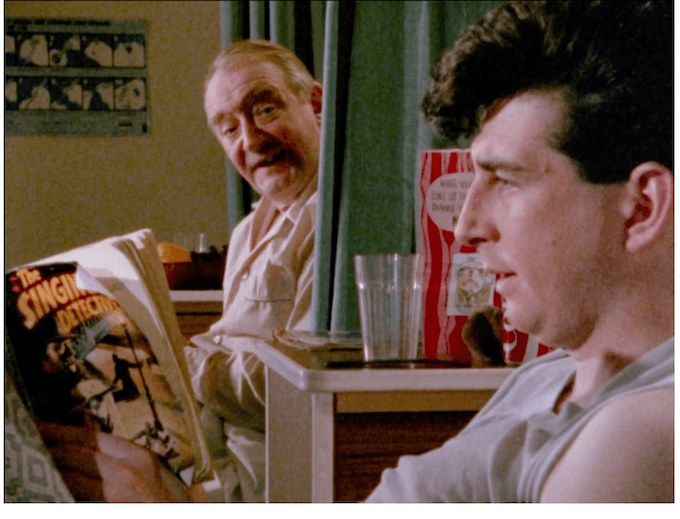
David Ryall and Gerald Horan in The Singing Detective, written by Dennis Potter and directed by Jon Amiel, BBC production, 1986. Screenshot.
And now the bad news
Far more often than gay, the atmosphere in Harriet’s bay and the other five I saw was grim despite the best efforts of staff and doctors. The other five women in Harriet’s section were in their 80s or older and had no place to go because of NHS and government failure to provide adequate social care. The woman to Harriet’s right had been in the hospital for six weeks, after four in a different hospital. Her fracture was healed, but there was no place for her to go and no chance for extended home care. Now she suffered from multiple, hospital-caused maladies, including bed sores and could barely raise her head above her sheets. She told Harriet that her two children lived far away and couldn’t look after her. She was well looked after at Princess Royal and expected to die there, perhaps soon.
Directly across from Harriet was a woman in her late 80s (at least) with rosy cheeks and rheumy eyes. She spent much of her time crying. The nurses would come and ask her why, but she could not answer. One male nurse managed to get her to smile by putting his face close to hers and allowing her to explore it with her fingers. But a few hours later, she began quietly whimpering. She probably suffered some degree of dementia, but there was as yet no available placement for her either.
In the opposite corner, closest to the window, was a handsome woman in her early 80s who spoke with composure and clarity. She said she had been in the ward for 4 weeks, and was well healed from hip replacement surgery, but her local Council and NHS had not yet been able to set up the twice-a-week, at-home support she needed. They offered instead to send her to a nursing home 50 miles away, but that was too far from her daughter, and besides, she didn’t want to live in such a place. She hardly got out of bed in the five days we saw her, jeopardizing her recovery. We shared some crisps one day – the lowly potato chip is much prized in hospital wards — and she told me how much she wanted to leave but simply couldn’t figure out how. She knew she was growing weaker and more depressed each day.
Dr. Raju Dey, a well-credentialed geriatric orthopedist, was frequently in attendance while we were at Princess Royal Hospital. He’s a young, dashing man with a sweep of jet-black hair that drapes over his forehead. He’s also patient, thoughtful and committed to his profession. I asked him about the long-term patients in his ward. “They’re the majority of patients here,” he said. “We do the best we can for them, but a hospital ward like this is no place for long-term rehabilitation. Many have been here for months but can’t find a social care placement.” I asked him about the cost of it all: “The average cost per patient per day in this specialized facility is over £1,000…” I finished his sentence, having recently looked up the figures, “whereas the most luxurious care home in London or elsewhere is about £400. A less fancy place is half that.” We couldn’t understand how a government led by intelligent people couldn’t figure out a way to shift resources from one sector to another – never mind raising new money – to improve patients’ well-being and extend their lives. It’s nothing less than madness, but it will continue until there is enough public demand for it to stop. The best Harriet and I could do was get out of there fast and tell about the experience.

No comments:
Post a Comment