David Carrier
April 10, 2026
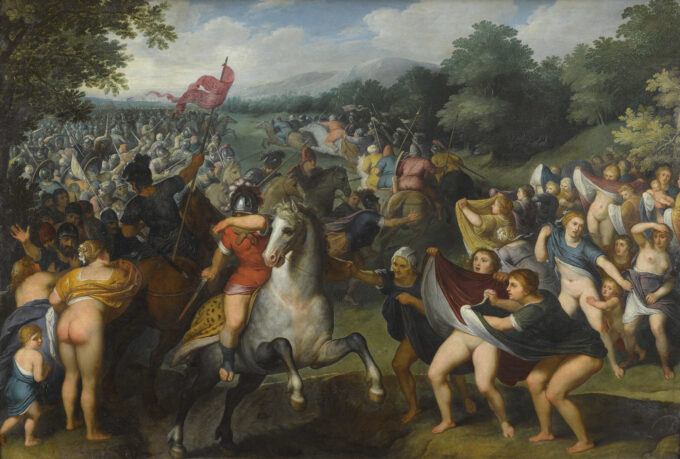
The Persian Women by Flemish artist Otto van Veen, created between approximately 1597 and 1599.
Viewing a pictorial scene that you didn’t think possible is a startling, often revealing experience. You ask yourself, should you believe your eyes. Maybe, you conclude, you are having a hallucination. A few years ago, in Venice, I went to review an exhibition, “Corpi Moderni: The Making of the Body in Renaissance Venice” at the Academy. And there I found Otto van Veen’s large history painting, Persian Women (1597–99), which shows a group of young women raising their skirts to show their naked bottoms to the men, who are terrified. Had I found this picture in a show of contemporary artworks, I would not have blinked. Our artists love to deal in erotic shock. But in a pre-modern art world where Nicolas Poussin (1594-1665) defined the ideals of decorum in his history paintings, Persian Women was surprising indeed. What, indeed, would he have made of this picture. And while any well trained old master had the skill required to paint this picture, the subject seems in that culture unimaginable. That’s why the picture looks surprising. We can readily imagine some minor follower of the modernist Surrealist Paul Delvaux painting this fantasy scene. But how surprising to learn that it’s a late seventeenth-century work.
In our visual culture, which is permeated by psychoanalytic thinking, everyone can easily explain the Freudian implications of this picture. Whatever you think about Sigmund Freud, even if you haven’t read Three Essays on Sexuality, you cannot help knowing in a general way about his accounts of gender. And, I hasten to add, nowadays also to know also at least in a vague way the many feminist critiques of his analysis. That means that it’s impossible nowadays not to look at Persian Women without a certain self-conscious irony. That the man in the foreground and his horse appear to be shocked by the genitals of the women, what are we to made of that? The people I asked said that the picture was funny, as if the artist was oddly naive.
It can be revealing to discover what artists choose not to do, for that reveals the implicit rules of their art world. Often, Venetians hung carpets from their window. Venetians admired Islamic textiles, and as a great trading culture with Muslims, they had ready access to these artifacts, which were often collected. The Venetians used these precious rugs without concern for their role in Islamic culture. And so a painter who loved color would naturally take an interest in them. Indeed, Lorenzo Lotto sometimes depicted carpets in his altarpieces, rugs dubbed ‘Lottos’ in his honor. St Antoninus giving Alms (1542) shows a splendid carpet in the center. And so, these Islamic carpets were often depicted in their paintings of domestic interiors. But the Venetian artists were not inspired to model their own paintings on these carpets. Not until the time of Henri Matisse, when Western art had evolved dramatically, did European artists do that. Jorge Luis Borges’ short story “Averroes’s Search” (1947) imagines an Arab translator of Aristotle who puzzles over that writer’s description of the theater. In a culture without theaters, that analysis seems incomprehensible. And yet, Borges observes with fine irony, the Muslim children are play-acting games which, had the translator only observed, would resolve his puzzles. We are very familiar with political protest paintings, with subjects that were never found in Venetian old regime paintings. In old regime Venice, painting had to serve the political goals of the state. Just as it would be hard to translate Aristotle’s Poetics in a society without theater performances, so it’s difficult to imagine history painting playing with Freudian concepts of gender in a pre-modern culture.
One additional bit of information may change how you see Persian Women. In fact, this artist, Otto van Veen, was not especially imaginative. Not when we learn that, like most old master history paintings, his images were based upon classical literature. And this painting is based upon a text from Plutarch. By frightening the men, the women inspire them to fight. Like Poussin, van Veen thus was a literary history painter. Only he chose an odd, relatively unfamiliar text. Now, of course, after Surrealism, Persian Women look different. But it would never had occurred to any Venetian artist to paint such a Surrealist scene. No more than gay Venetians would have marched to protest their lack of rights. Or Venetian feminists would have demanded a female doge. There were no movements for Venetian Jews or Muslims seeking political rights. Such ideas, so familiar nowadays, were simply over the horizon. And although there were some Black people, most of them slaves, in Venice, as we can see in Titian’s Diana surprised by Actaeon and in Tiepolo’s frescoes, there was no movement to liberate them. The Venetian Republic had moral problems, but no significant art was devoted to criticizing its institutions. Van Veen, I should add, was a very minor artist.
Imagine that in 1550 some unusually imaginative pupil of Titian was called upon to make an artwork that would, so it is demanded, ‘catch the public’s eye’. And she was given a church in which to display her work. Knowing the recent paintings by her master, and recalling the great earlier works by Giorgione and the Bellinis, this young woman faces a very demanding situation. What can she do to rival Tempest or one of the ‘sacred conversations’ of Giovanni Bellini? Inspired, she boldly breaks the church’s delicate floor tiling and labels the piles of rubble The Consequences of Sin.
In fact, there is a real Venetian work just like this, but it’s recent. In 1993, at the Biennale, Hans Haacke’s Germania trashed the floor of the German pavilion, leaving it smashed to pieces. And he included a photograph of Adolf Hitler meeting Benito Mussolini in 1934, at an earlier iteration of that institution. Look it up online! Haacke drew on a long tradition of politically critical installation art. But in Titian’s era such a gesture would be thought the act of a madman. Philip II, an historian of Venetian painting, remarks, was a patron of discernment, who was prepared to support his chosen painter (Titian) “even into the strange pictorial explorations of his old age.” But not this far! The Consequences of Sin would have been incomprehensible in 1550.
Note:
On carpets in Venetian art see Patricia Fortini Brown, Private Lives in Renaissance Venice: Art, Architecture, and the Family (2004), 59-67
A more general analysis of carpets in paintings appears in Joseph Masheck, The Carpet Paradigm ( 2010).
The source of examples like The Consequences of Sin is Arthur Danto’s aesthetics.
David Carrier is a philosopher who writes art criticism. His Aesthetic Theory, Abstract Art and Lawrence Carroll (Bloomsbury) and with Joachim Pissarro, Aesthetics of the Margins/ The Margins of Aesthetics: Wild Art Explained (Penn State University Press) were published in 2018. He is writing a book about the historic center of Naples, and with Pissarro he conducted a sequence of interviews with museum directors for Brooklyn Rail. He is a regular contributor to Hyperallergic.
April 10, 2026
The Persian Women by Flemish artist Otto van Veen, created between approximately 1597 and 1599.
Viewing a pictorial scene that you didn’t think possible is a startling, often revealing experience. You ask yourself, should you believe your eyes. Maybe, you conclude, you are having a hallucination. A few years ago, in Venice, I went to review an exhibition, “Corpi Moderni: The Making of the Body in Renaissance Venice” at the Academy. And there I found Otto van Veen’s large history painting, Persian Women (1597–99), which shows a group of young women raising their skirts to show their naked bottoms to the men, who are terrified. Had I found this picture in a show of contemporary artworks, I would not have blinked. Our artists love to deal in erotic shock. But in a pre-modern art world where Nicolas Poussin (1594-1665) defined the ideals of decorum in his history paintings, Persian Women was surprising indeed. What, indeed, would he have made of this picture. And while any well trained old master had the skill required to paint this picture, the subject seems in that culture unimaginable. That’s why the picture looks surprising. We can readily imagine some minor follower of the modernist Surrealist Paul Delvaux painting this fantasy scene. But how surprising to learn that it’s a late seventeenth-century work.
In our visual culture, which is permeated by psychoanalytic thinking, everyone can easily explain the Freudian implications of this picture. Whatever you think about Sigmund Freud, even if you haven’t read Three Essays on Sexuality, you cannot help knowing in a general way about his accounts of gender. And, I hasten to add, nowadays also to know also at least in a vague way the many feminist critiques of his analysis. That means that it’s impossible nowadays not to look at Persian Women without a certain self-conscious irony. That the man in the foreground and his horse appear to be shocked by the genitals of the women, what are we to made of that? The people I asked said that the picture was funny, as if the artist was oddly naive.
It can be revealing to discover what artists choose not to do, for that reveals the implicit rules of their art world. Often, Venetians hung carpets from their window. Venetians admired Islamic textiles, and as a great trading culture with Muslims, they had ready access to these artifacts, which were often collected. The Venetians used these precious rugs without concern for their role in Islamic culture. And so a painter who loved color would naturally take an interest in them. Indeed, Lorenzo Lotto sometimes depicted carpets in his altarpieces, rugs dubbed ‘Lottos’ in his honor. St Antoninus giving Alms (1542) shows a splendid carpet in the center. And so, these Islamic carpets were often depicted in their paintings of domestic interiors. But the Venetian artists were not inspired to model their own paintings on these carpets. Not until the time of Henri Matisse, when Western art had evolved dramatically, did European artists do that. Jorge Luis Borges’ short story “Averroes’s Search” (1947) imagines an Arab translator of Aristotle who puzzles over that writer’s description of the theater. In a culture without theaters, that analysis seems incomprehensible. And yet, Borges observes with fine irony, the Muslim children are play-acting games which, had the translator only observed, would resolve his puzzles. We are very familiar with political protest paintings, with subjects that were never found in Venetian old regime paintings. In old regime Venice, painting had to serve the political goals of the state. Just as it would be hard to translate Aristotle’s Poetics in a society without theater performances, so it’s difficult to imagine history painting playing with Freudian concepts of gender in a pre-modern culture.
One additional bit of information may change how you see Persian Women. In fact, this artist, Otto van Veen, was not especially imaginative. Not when we learn that, like most old master history paintings, his images were based upon classical literature. And this painting is based upon a text from Plutarch. By frightening the men, the women inspire them to fight. Like Poussin, van Veen thus was a literary history painter. Only he chose an odd, relatively unfamiliar text. Now, of course, after Surrealism, Persian Women look different. But it would never had occurred to any Venetian artist to paint such a Surrealist scene. No more than gay Venetians would have marched to protest their lack of rights. Or Venetian feminists would have demanded a female doge. There were no movements for Venetian Jews or Muslims seeking political rights. Such ideas, so familiar nowadays, were simply over the horizon. And although there were some Black people, most of them slaves, in Venice, as we can see in Titian’s Diana surprised by Actaeon and in Tiepolo’s frescoes, there was no movement to liberate them. The Venetian Republic had moral problems, but no significant art was devoted to criticizing its institutions. Van Veen, I should add, was a very minor artist.
Imagine that in 1550 some unusually imaginative pupil of Titian was called upon to make an artwork that would, so it is demanded, ‘catch the public’s eye’. And she was given a church in which to display her work. Knowing the recent paintings by her master, and recalling the great earlier works by Giorgione and the Bellinis, this young woman faces a very demanding situation. What can she do to rival Tempest or one of the ‘sacred conversations’ of Giovanni Bellini? Inspired, she boldly breaks the church’s delicate floor tiling and labels the piles of rubble The Consequences of Sin.
In fact, there is a real Venetian work just like this, but it’s recent. In 1993, at the Biennale, Hans Haacke’s Germania trashed the floor of the German pavilion, leaving it smashed to pieces. And he included a photograph of Adolf Hitler meeting Benito Mussolini in 1934, at an earlier iteration of that institution. Look it up online! Haacke drew on a long tradition of politically critical installation art. But in Titian’s era such a gesture would be thought the act of a madman. Philip II, an historian of Venetian painting, remarks, was a patron of discernment, who was prepared to support his chosen painter (Titian) “even into the strange pictorial explorations of his old age.” But not this far! The Consequences of Sin would have been incomprehensible in 1550.
Note:
On carpets in Venetian art see Patricia Fortini Brown, Private Lives in Renaissance Venice: Art, Architecture, and the Family (2004), 59-67
A more general analysis of carpets in paintings appears in Joseph Masheck, The Carpet Paradigm ( 2010).
The source of examples like The Consequences of Sin is Arthur Danto’s aesthetics.
David Carrier is a philosopher who writes art criticism. His Aesthetic Theory, Abstract Art and Lawrence Carroll (Bloomsbury) and with Joachim Pissarro, Aesthetics of the Margins/ The Margins of Aesthetics: Wild Art Explained (Penn State University Press) were published in 2018. He is writing a book about the historic center of Naples, and with Pissarro he conducted a sequence of interviews with museum directors for Brooklyn Rail. He is a regular contributor to Hyperallergic.

No comments:
Post a Comment