Report: Russia Faces Logistical Nightmare in Redirecting Yamal LNG to Asia
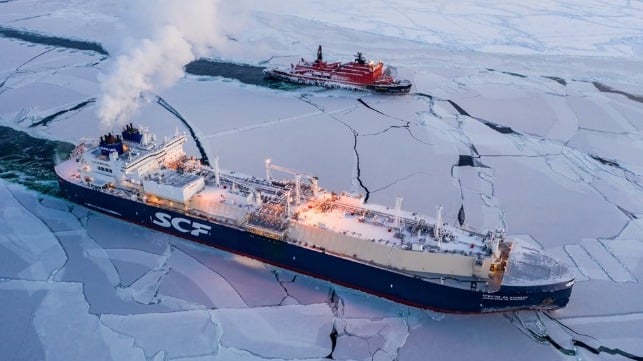
With Russia’s Yamal LNG exports rebounding amidst the war in the Middle East, new research reveals that a logistics challenge is likely to impact the project as early as 2027. While most of the Yamal shipments are currently heading to ports in Europe, Moscow has announced a pivot to the Asian market. In January, the European Union also approved a ban of Russian LNG imports to the bloc from January 2027. These shifts will add pressure to Russia’s existing transport fleet for Yamal LNG, according to Norway’s Center for High North Logistics (CHNL) - unless energy shortages from the ongoing Arabian Gulf conflict force Europe to change course.
The operational Russian LNG fleet includes 14 Arc7, 6 Arc4 and 5 non-ice-class LNG carriers. The researchers calculated the capability of the fleet to serve the Asian market when redirecting of shipments begins from 2027. Notably, the estimates do not account for maintenance, weather delays, port congestion and structuring transshipment cycles.
“If all flows are redirected to Asia, the fleet will be able to complete approximately 120-130 voyages per year. This is more than two times lower than the export volumes of 2024-2025,” projected CHNL.
The reduction is explained in part by the longer distances to Asia. In addition, Yamal LNG depends highly on Arc4 and non-ice-class vessels for transshipment operations, significantly limiting navigation options in the winter months. Again, shorter European routes ensure higher turnover for the relatively small transport fleet.
For Yamal LNG to retain its market edge, CHNL said that the project’s logistics scheme will require adjustments. This includes expansion of the ice-class tonnage, which Russia is struggling to build due to massive sanctions on its shipbuilding sector. Since 2023, Russia has only managed to complete two Arc7 vessels, which are part of the five partially built hulls originally supplied by South Korea.
Other options to resolve the impending logistical bottleneck include increasing transshipment capacity for a long voyage around Europe to reach Asia. Data from Eikland Energy shows that Russian gas producer Novatek would need to charter 25-35 additional tankers from 2027 to effectively redirect LNG to Asia using the Suez Canal or Cape of Good Hope route during the winter season. This would help Yamal LNG maintain its current export levels of 18 million tons per year.
Europe remains the largest customer of Yamal LNG, with France and Belgium being the primary destination. Out of 270 shipments from the port of Sabetta in 2025, 88 were destined to France, followed by 57 to Belgium and another 50 to China. The three countries together absorbed more than two-thirds of the total annual shipments.
This dynamic has changed with the ongoing war in the Middle East. In February, 100% of all Yamal LNG exports went to Europe, according to data by the campaign group Urgewald. All 21 shipments made in February, equivalent to 1.5 million tons of LNG, were destined to EU ports. Zero shipments went to China or Asia, down from four cargoes during the same period last year.
Lone Russian Corvette Flies the St. Andrew’s Flag in the Med
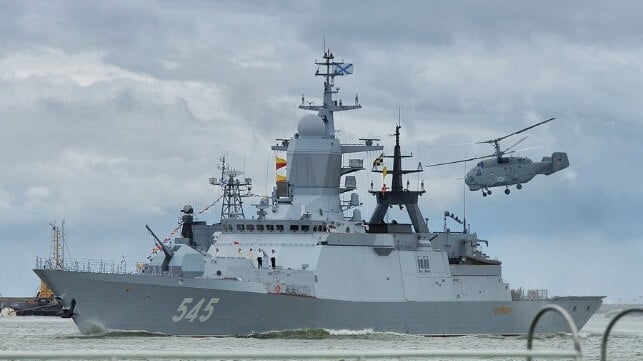
At a time of active conflict involving both Lebanon and Israel, and when the French Navy has deployed at full strength to prevent further attacks on the British Sovereign Base Area in Cyprus, the strength of the Mediterranean Flotilla has sunk to a single ship flying the St. Andrew’s Flag of the Russian Navy.
On March 31, the Improved Kilo (Project 636.6) class submarine RFS Krasnodar (B-265) and its shadowing tug Altay (IMO 4622404) passed westwards back through the Strait of Gibraltar, having transited the English Channel on entry in mid-December last year. In its three month stint in the Mediterranean, Krasnodar first made a port call in Algiers, and passed back through Algiers with the Altay on its return journey.
On the basis of NATO anti-submarine patrol paths tracking the submarine, the Krasnodar appears to have spent most of its time in the central Mediterranean, where in December the dark fleet Omani-flagged tanker Qendil (IMO 9310525) was attacked, as was the Russian-flagged LNG carrier Arctic Metagaz (IMO 9243148) later on March 3. A Kilo-class submarine is not well suited to helping deter or react to such attacks.
The Krasnodar has conducted previous patrols in the Mediterranean. Although now based in the Baltic, the boat was formerly assigned to the Black Sea Fleet – and in effect may still therefore be nominally assigned to the Mediterranean Flotilla.
The sole Russian naval vessel remaining in the Mediterranean is the Steregushchiy-class corvette RFS Stoykiy (F545), last identified off Tartus at the end of March, but seen west of Cyprus and alongside in Tartus earlier in the month. The Stoykiy has had an eventful patrol, passing through the English Channel in late November, circumnavigating Africa, participating in Exercise Mosi-26 in Cape Town in early January, then making a port call in the Seychelles. It was next scheduled to exercise with the Chinese and Iranian navies in Exercise Maritime Security Belt 2026 off Bandar Abbas.
Clearly aware something was afoot, the Chinese 48th Flotilla did not turn up, and the Stoykiy stayed only one night on February 18, conducting a very brief exercise with the Iranian Navy as it left the next day - a gesture which was clearly much appreciated by the Iranians. Most of the Iranian vessels participating in this short passage exercise were sunk days later as the Stoykiy was beating a retreat through the Red Sea to Tartus.
The Russian Navy, contrary to predictions, appears to have retained some restricted visiting rights in Tartus, and the Russian airfield at Khmeimim further up the Syrian coast remains active. The Russians appear not to have sought a new facility, with the port of Tobruk in Libya considered a strong candidate. Instead, the Russians are leveraging their long-term training presence to make more frequent port calls in Algiers. Algiers is some distance away from the technical support which might be available at the Algerian naval base of Mers el Kebir, where a Russian team help maintain Algeria’s six Kilo-class submarine
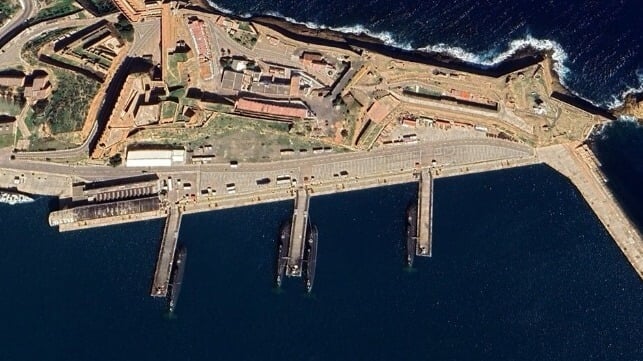
Algerian Navy Kilo Class submarines alongside at their base in Mers al Kebir, March 2025 (Google Earth/Airbus)

No comments:
Post a Comment