¡Cuba Sî, Bloqueo No!

Nine years later, in 2017, I went with Pastors again to Cuba, and again loved being there amidst the warmth and vitality of the Cuban people. I also renewed my commitment to speaking out and working against the criminal blockade.
Then in February of this year, Trump and Marco Rubio imposed a deadly fuel blockade, and I decided to go to Cuba again. This time I joined the CODEPINK contingent of the Nuestra América convoy that was quickly being organized as an international humanitarian aid effort. We went there in late March with 6300 pounds of urgently needed medical supplies for just a weekend. It was a quick visit, but it was full of solidarity and love. We in CODEPINK were 170 strong, but in the entire convoy there were some 700 people arriving from 33 countries to bring material assistance and to say to Cubans, “No estan solos!”
This time there I did a lot of walking around Havana, precisely because the acute fuel shortage caused by the US meant there wasn’t much in the way of other transportation, like busses or those beautiful vintage cars serving as taxis. In fact, the streets were markedly empty of the hustle and bustle I witnessed in my previous trips. Walking along the Malecon was kind of a solitary and sad experience compared to the fun and vitality I remembered.
Indeed, the more I saw and heard about the stark realities of this current fuel blockade, the sadder I felt. Blackouts in the nighttime shrouded the city in an eerie atmosphere. There were stories about people suffering for lack of food and medical supplies. People were cooking with wood in the parks. There was garbage in the streets because there was no fuel for garbage trucks. Hospital generators were almost out of fuel.
Moreover, the people I met while walking around the streets looked tired and drawn. Instead of the engaging and lively exchanges I recalled from the past, I found myself handing out pesos and dollars to many who were desperate for help. It was the least I could do, being the privileged well-fed person from the very empire that was causing their pain.
To be sure, some Cubans we met blamed their own government for mismanagement that contributed to this crisis. But they also fully understood, from 66 years of enduring the US blockade, that their government is under the gun and has been for most, if not all, of their lives. Cubans are well educated and are very willing to express their opinions. What we are led to believe about the repression of free speech there appears to be mostly a handy tool for US propaganda about the supposed evils of a socialist state.
We are constantly told that socialism has failed the people there, with no mention of the asphyxiating trauma the US-led global capitalist system has inflicted upon it ever since the success of the revolution in 1959. There is no mention of how the US has consistently violated Cuba’s sovereignty in our relentless efforts at regime change through sanctions, terror attacks out of Miami, assassination attempts, immigration policies, demonization of the leadership, funding of opposition groups, and control of the media narrative.
This all begs the question: Why has the US been so adamant in its hostility to Cuba? Is it an ideological thing, where we can’t get over the cold war mentality of us versus them? Is it the national electoral calculus that caters to the Cuban exiles in Miami who fled the island after the revolution and who harbor such a hatred for the government there? Or is it something else?
Many of us have believed it is the threat of a good example. Despite the squeeze the blockade has put on it, the Cuban government has provided basic food, housing, education, and medical care for all of its people. Its civil defense system has been astonishingly good at protecting lives during the recurring hurricanes that wreak havoc on the island. And most of all, Cuba has come to epitomize global humanitarian solidarity by providing tuition-free medical school and sending doctors all over the world, especially during times of crisis.
While not at all perfect, the Cuban government is a far cry from the western individualistic capitalist model. It is a government that focuses on the common good, prioritizing its people, not profits. It exports doctors, not weapons and wars. It defies imperialism, rather than submit to it.
What if others were to adopt this kind worldview and government, as we saw in the so-called Latin American “pink tide” with Venezuela, Nicaragua, Bolivia and others turning away from US-imposed colonization? This is the “threat” to the empire. Sovereign countries who opt out of domination by the US empire.
Cuba has paid a heavy price for its resistance throughout these years of blockade. Much has been made of Cuban resilience, and there is a great deal of truth to this. Cubans have been innovative, resourceful, and undefeated. But we also must not romanticize this spirit of resistance and endurance. Resilience fatigue is a real thing and at this point people are truly worn down. It’s not like they have chosen to be resilient, it’s more like they have no other choice, given the circumstances. And it’s a choice they shouldn’t have to face. As one person on the delegation put it, “No one should have to be resilient to get to tomorrow.”
The Nuestra América convoy to Cuba was a grassroots step in the right direction to show the Cuban people that they are not alone and that people-to-people connections can bypass governments to sustain lives and keep hope alive. More convoys and aid efforts are already being planned and carried out, some by CODEPINK and some by many of those who participated in this delegation.
And now there is a heightened international awareness – and conscience – about what is happening to Cuba. This has manifested in the recent arrival of a Russian oil tanker in Cuba and the shipping of thousands of tons of food and solar panels from China. Hopefully, other countries will also soon defy the US blockade and come to Cuba’s side in this hour of need. Mexico and Canada appear to be doing so. For countries to step up like this would not only be just, but would also be a fitting repayment to Cuba for its many years of international solidarity.
Meanwhile, anyone can legally travel to Cuba, with the purpose of providing support for the Cuban people or going as an educational trip. It may come as a surprise to some that Cuba is not the scary place it is painted to be, but a welcoming and enjoyable one. And the mere going would be an act of solidarity. Go if you are so moved – Cuba needs our dollars.
Finally, once we can see what Cuba is like and what our country is doing to it, how can we not do all in our power to get rid of the deadly US blockade? That is what our role should be. Not to find fault with the imperfections of Cuba, but to get the US boot off its neck.
On this trip, our delegation chanted over and over, ¡Cuba Sî, bloqueo no! Yes to Cuba, no to the blockade. That’s the message we all need to carry in our hearts and actions.
How U.S. Sanctions Are Fueling Hunger in Cuba
April 6, 2026
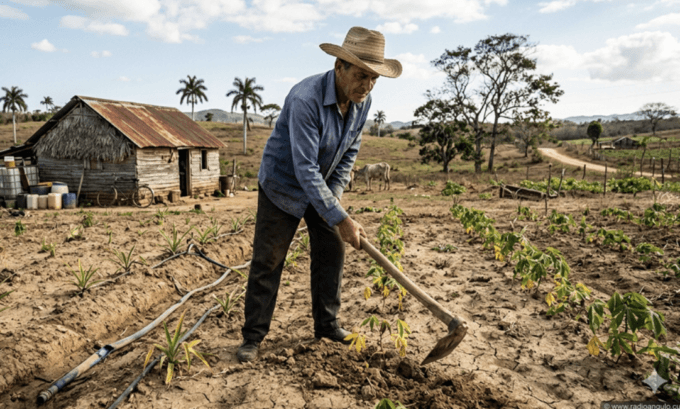
Image by Radio Angulo.
In Cuba today, food is rotting in the fields while families go hungry.
On a recent trip to the eastern part of the island, I spoke with farmers who are watching their livelihoods slip away—not because they lack skill or dedication, but because they lack fuel, parts, and basic inputs. One farmer described fields ready to harvest but no diesel to bring the crops in. Others showed broken machinery they have no way to repair. Even those who have turned to animal traction are having problems with feed.These are not isolated stories; they reflect a system under siege.
The U.S. fuel embargo, together with tightened sanctions under Trump, is strangling Cuba’s agricultural system from seed to table—making it harder and harder for Cubans to feed themselves.
Cuban farmers have already been operating under severe constraints imposed by U.S. sanctions—struggling to obtain spare parts to repair tractors, access fertilizers and pesticides, or secure basic inputs like seeds. Machinery breaks down and sits idle for months because parts can’t be imported or paid for through normal banking channels.
Add to that Hurricane Melissa, which struck Cuba in October 2025, flooding fertile farmland and destroying crops. Climate change is wreaking havoc on agriculture, bringing stronger storms, longer droughts, erratic rainfall, and rising temperatures.
Into this already fragile system comes the fuel crisis, compounding every existing problem. Even the farm equipment that can be repaired can’t be used because there is no diesel to run it. Irrigation systems go dry, planting is delayed or scaled back, and harvests are lost.
At the same time, there is not enough fuel to transport fresh produce from rural farms to urban markets. Trucks sit idle. Distribution chains break down. Food that could nourish communities never makes it to the people who need it most.
Processing food becomes impossible. Tomatoes—one of Cuba’s most abundant seasonal crops—are a painful example. Without reliable electricity, processing factories cannot operate. Mountains of ripe tomatoes, waiting to be turned into paste or sauce, are left to spoil.
Cuban farmers are certainly resilient. Across the island, they have been experimenting with agroecology, animal traction, local inputs, and cooperative models. They are finding creative ways to grow food with fewer resources. But resilience has limits.No amount of ingenuity can substitute for fuel that doesn’t arrive, machinery that can’t be repaired, or markets that can’t be reached.
This is not just an agricultural crisis—it is a humanitarian one.
On various trips to Cuba delivering humanitarian aid, I met women across the island who are desperate to find enough food to feed their children. They spend hours in lines, piecing together meals from whatever they can find, and constantly worrying about what to put on the kitchen table tomorrow. Their struggle mirrors what is happening in the countryside: a breakdown that is squeezing both producers and consumers at once.
Families stand in long lines for basic staples. Protein is scarce. Fresh fruits and vegetables—when available—are often priced beyond the reach of ordinary people. State salaries—often the equivalent of $15 to $30 a month—have been completely overtaken by soaring food prices driven by scarcity and inflation. A few pounds of tomatoes, a carton of eggs, or a bottle of cooking oil can consume a week’s wages. Pensioners and families living on fixed incomes are hit the hardest, forced to stretch rations, skip meals, or rely on remittances from relatives abroad—if they are lucky enough to have them.
The government has set up soup kitchens—the Sistema de Atención a la Familia (Family Care System)—to support the most vulnerable. But at the one we visited in Holguín, portions had grown smaller and less varied, and staff were forced to scavenge for wood to cook with due to gas shortages and unreliable electricity.
Rep. María Elvira Salazar, a leading voice in Congress for tightening sanctions, has openly acknowledged that the suffering of mothers and children is a price worth paying for regime change. Perhaps she should consult with Cubans on the island—not just those in Miami—about whether this is a price worth paying.
Trump’s major proponent of squeezing Cuba is Secretary of State Marco Rubio. Rubio argues that this pressure is necessary to force regime change and a flowering of private enterprise. But across the island, small-scale farmers and cooperatives already operate as private entrepreneurs, growing food, managing their own production, and selling to local markets–most of which have been privatized. Yet instead of supporting this sector, U.S. sanctions are crippling it. The very people the U.S. claims to champion are being strangled by the same policies that claim to promote them.
If the goal is to support the Cuban people, this policy is an utter failure. And for those unmoved by humanitarian concerns, think about an unstoppable wave of mass migration that may well be unleashed. In recent years, over a million Cubans—roughly one in ten—have migrated in search of a better life, most of them heading to the United States. While Trump has now closed the borders, the crisis risks fueling a new wave of desperate Cubans.
The solution is not complicated.
Lift the blockade. Allow Cuba to import fuel without threats of sanctioning the countries that provide it. Stop punishing farmers for trying to grow food—and the Cuban people simply trying to feed their families.
Cuba is Not Alone!
Cuba Will Not Yield!
An interview with Adrián Heredia, Second Secretary of the Cuban Embassy, Washington, D.C.
April 6, 2026
I met Adrián Heredia, the Second Secretary of the Cuban Embassy in Washington, D.C. at the Cuba Under Siege conference on March 14th in New York City. Adrián had recently assumed his role at the Cuban Embassy in January 2026, shortly before Trump issued his libelous Executive Order of January 29th which labeled Cuba a national security threat and instituted a total blockade on oil to Cuba. Since then, Adrián and his colleagues at the Embassy have been working continuously to break through the mountain of lies propagated by the edict.
Given the pressing need to combat disinformation and disseminate the perspectives and responses of the Cuban government, we discussed the possibility of an interview that could be published in CounterPunch, a journal that has consistently supported the Cuban revolution and given voice to Cuban diplomatic leaders such as Ricardo Alarcón. We offer this interview to enhance understanding and strengthen solidarity.
DB: Thank you for taking the time to clarify the perspective of the Cuban government on the escalating attacks against Cuba since January 29th. To begin with, what is your position at the Embassy and why do you think it’s important for you as part of the Embassy to do this interview now?
AH: I currently serve as Second Secretary at the Embassy of Cuba in Washington, D.C. I hold a Bachelor’s degree in International Relations and as part of my Embassy position I am responsible for academic affairs, where I work to promote dialogue and cooperation with universities, research institutions, and academic organizations across the United States.
Given my role, I am closely engaged with spaces where informed discussion and critical thinking are essential. That is precisely why I believe it is important to speak at this moment. The current state of bilateral relations—and its very real consequences for the Cuban people—makes it necessary that perspectives grounded in our reality are heard and understood.
I sincerely appreciate the opportunity to contribute to this conversation and to share our views with a broader audience.
DB: What are the main ways in which the U.S. has intensified its actions against Cuba since the beginning of 2026?
AH: Since the beginning of 2026, the United States has significantly escalated its campaign of political and economic pressure against Cuba. This has included not only hostile rhetoric but also concrete actions aimed at isolating our country and penalizing those who engage with us.
A clear example is the Executive Order of January 29, 2026, which designates Cuba as a so-called national security threat. This politically motivated decision serves as a pretext to intensify sanctions and expand coercive measures.
One of the most damaging aspects has been the direct pressure exerted on third countries to cut off fuel supplies to Cuba. As a result, our country has faced severe disruptions in fuel imports, with immediate and profound consequences for the daily lives of our people. From my perspective, this amounts to a form of collective punishment, intended not only to hinder development, but to make it increasingly difficult to sustain essential and everyday services for the population.
DB: What do you think are the primary reasons for this escalation?
AH: This policy is not new—it represents the continuation of a strategy that has been in place for more than six decades. Its underlying logic was clearly articulated from the outset: to generate economic hardship, foster dissatisfaction, and ultimately force political change in Cuba. This is evident with total clarity in the Lester Mallory Memorandum, drafted on April 6, 1960. What we are witnessing today is a more aggressive and more harmful application of that same approach.
Let us be clear: this policy is not directed solely at the Cuban government—it is designed to impact the Cuban people as a whole. It deliberately seeks to create shortages, hardship, and suffering as a means of political pressure. Its effects are felt across all sectors of society—women and men, children and the elderly alike—without distinction.
At the same time, the justification for this escalation lacks credibility. Cuba does not pose any threat to the United States. On the contrary, it has consistently acted as a responsible and cooperative partner on issues such as drug trafficking, migration, and global health. The Cuban people have even extended solidarity to the United States in times of crisis. The reality is that this policy cannot be explained by legitimate security concerns—it is, fundamentally, a political choice.
DB: What is the impact of the total blockade on oil on Cuban life, and how are Cubans coping?
AH: The impact is severe and undeniable. Fuel is not a luxury—it is essential for the functioning of society. Shortages affect electricity generation, transportation, food supply chains, and the healthcare system. Hospitals are forced to operate under extremely difficult conditions, postponing procedures and prioritizing only the most urgent cases. Thousands of patients, including children, are waiting for surgeries. This directly affects the ability to provide quality medical services. Infant mortality rates may inevitably be impacted, as even with prioritization, many medical procedures simply cannot be performed without electricity. Vaccination programs are delayed—not due to a lack of vaccines, but because fuel shortages hinder their distribution.
Patients undergoing life-saving treatments, such as cancer therapy or dialysis, are also affected. These outcomes are not accidental—they are the predictable consequences of a policy designed to exert maximum pressure on a civilian population.
DB: What has been the impact of the sanctions that Marco Rubio announced in February 2025 against countries contracting with Cuba’s renowned international medical brigades?
AH: The primary victims of these actions are the millions of people around the world who previously relied on adequate medical care made possible through Cuban medical cooperation who now often have no viable alternative. Cuba will continue to uphold its commitment to international solidarity and to providing assistance wherever it is needed, as demonstrated in our historic efforts such as the fight against Ebola in Africa and our response to COVID-19 in many parts of the world.
Our relationship with the peoples of the world goes beyond this cooperation and cannot be easily dismantled through political measures of this nature, which do not prioritize the well- being of those affected. I am confident that these bonds of solidarity and friendship will endure.
DB: What was the significance of the Nuestra América Convoy where over 600 people from around the globe converged in Havana on March 21st to bring humanitarian aid and express their heartfelt solidarity with Cuba?
AH: Such initiatives send a very clear message: Cuba is not alone. They reflect a growing international rejection of policies that seek to punish an entire people. They also demonstrate increasing global awareness that the situation facing Cuba is unjust and must be addressed by the international community.
At a time when misinformation is widespread, these acts of solidarity help bring greater truth, visibility, and balance to the public discourse.
DB: What are the most important ways for people in the U.S. to show solidarity with Cuba at this time?
AH: We do not believe it is our place to tell the people of the United States what they should do. However, we can affirm that acts of solidarity, in any form, are deeply valued by the Cuban People. There is a long-standing history of solidarity between the peoples of Cuba and the United States. That tradition continues today, and every voice advocating for a more just and rational policy contributes meaningfully.
DB: How should we respond to those in the U.S. who think that “it’s all over for Cuba?”
AH: That narrative has been repeated many times over the decades—and it has consistently been proven wrong. Cuba has faced sustained pressure, yet it has not relinquished its sovereignty or its social project. The current situation is challenging, but it is not unprecedented.
The Cuban people have demonstrated resilience, dignity, and a strong sense of national identity. Measures are being taken every day to confront these challenges and protect the most vulnerable.
Cuba will not yield! It will continue to defend its independence and its vision of a more just society, regardless of external pressure—even from a country as powerful as the United States.
Adrián Heredia is the Second Secretary with the Cuban Embassy in Washington, D.C. He joined the Ministry of Foreign Affairs of the Republic of Cuba in 2016 as a Political Analyst in the U.S. Division, where he focused on bilateral relations and policy analysis. In 2026, he was promoted to Second Secretary and received his first permanent overseas posting at the Cuban Embassy in the United States, where he is currently in charge of academic affairs.
End the Blockade on Cuba

This past weekend, I traveled to Cuba with the Nuestra América Convoy alongside a delegation of Cuban Americans to deliver aid and stand in solidarity with our fellow Cubans as a US-driven fuel blockade pushes the island deeper into crisis.
We brought critical medical supplies to Hospital Hermanos Ameijeiras, one of Cuba’s most important hospitals, where doctors and nurses continue to perform miracles with dwindling resources. We delivered food directly to families in Parque Maceo, where shortages have made even basic necessities difficult to secure. And we partnered with Cuban LGBTQ organizers to distribute aid.
These moments of connection and care are what stay with you. But so does the reality that makes them necessary.
During our trip, we experienced the island plunged into darkness following a collapse of the power grid. Our friends and families were left without light, without refrigeration, without any reprieve from the heat. The silence that followed was striking. It forced a confrontation with the scale of the crisis that no statistic or headline can fully capture.
This is what scarcity looks like, in its lived form.
It is easy, from the outside, to reduce Cuba’s situation to politics as usual — to flatten it into a debate about ideology or governance. But on the ground, the picture is far more human and far more complex. We spoke with Cubans of all political perspectives. Many were candid, even critical, about their government. Those conversations were nuanced and often deeply personal.
But there was also a shared throughline: a fierce commitment to sovereignty and independence. Regardless of political differences, there was a broad understanding that the current crisis is caused in large part by external pressure imposed by the United States. Cubans want the ability to determine their own future, without being strangled in the process.
That perspective is often missing from conversations in the United States.
As Cuban Americans, we occupy a unique and sometimes uncomfortable position in this dynamic. Many of us were raised in communities where returning to Cuba is still seen as taboo, even as betrayal. That stigma, rooted in decades of pain and displacement, continues to shape how we relate to the island and to each other.
But it is precisely because of that history that this moment demands something different from us.
We are told that US policy toward Cuba reflects the will of Cuban Americans. That claim is repeated so often that it is treated as fact. But it obscures a more complicated reality. There are millions of Cuban Americans in this country — and we are not monolithic. Increasingly, many of us are rejecting the idea that policies of isolation and economic pressure speak for us.
On this trip, that contradiction became impossible to ignore.
The crisis in Cuba is not simply about a lack of fuel, though that alone is devastating. It is about everything that follows. When fuel is scarce, transportation slows or stops. Food cannot be distributed efficiently. Hospitals struggle to maintain operations. Garbage goes uncollected. The effects compound, touching every aspect of daily life.
What might look like dysfunction from afar is often, on closer inspection, the result of material constraints.
And yet even in the midst of these challenges, there is something profoundly moving about what persists. Cuba’s social fabric remains strong. There is a deep sense of collective responsibility, a commitment to care that shows up in small but meaningful ways — neighbors sharing food, communities organizing support, artists and activists creating spaces of joy in the face of hardship.
This is the Cuba that is often overlooked: not a caricature, not a talking point, but a living, breathing society grappling with immense challenges while holding onto its humanity.
None of this means ignoring Cuba’s internal problems. Like any country, Cuba faces serious political and economic issues. Those debates belong to Cubans themselves, and they are already happening. But what is too often excluded from US discourse is the role that American policy plays in shaping the conditions under which those debates unfold.
A policy that restricts access to fuel, limits imports, and punishes economic engagement does not create the conditions for openness or reform. It creates scarcity. It creates hardship. It narrows the space in which people can imagine and build alternatives.
If the goal is a better future for Cuba, this approach is not just ineffective — it is counterproductive.
We have seen glimpses of another path before. Periods of limited engagement between the United States and Cuba, however incomplete, led to increased economic activity, greater exchange, and a sense of possibility on the island. Those moments suggest that a different relationship is not only possible, but beneficial.
What is lacking is the political will to pursue it.
We left this trip with deep sadness at the situation in Cuba. It is impossible not to, after witnessing the daily realities that so many are navigating. But we also left with a renewed sense of purpose.
The policies contributing to this crisis are not inevitable. They are choices. And as Americans — especially as Cuban Americans — we have a responsibility to challenge them.
That begins with telling the truth, even when it complicates familiar narratives. It means rejecting the idea that cruelty and deprivation are acceptable tools of foreign policy. And it means insisting on a vision of US-Cuba relations grounded in dialogue, respect, and mutual prosperity.
For too long, the loudest voices shaping this policy have not represented the full spectrum of our community. That is beginning to change.
More and more of us are speaking out, organizing, and saying clearly: this is not in our name.
Cuba’s future should be determined by Cubans. Our role is not to dictate that future but to remove the barriers that prevent it from unfolding on its own terms.


No comments:
Post a Comment