Secrets and Shortcuts: The US Uranium Enrichment Rush
The United States keeps going to war over uranium enrichment. We started a war in Iraq over it after Secretary of State Condoleezza Rice said, “We don’t want the smoking gun to be a mushroom cloud,” which later proved to be false. We bombed Iran’s enrichment facilities in June 2025, with Trump declaring he had “completely and totally obliterated” them. Eight months later, we started another war with Iran over enrichment, even though the International Atomic Energy Agency (IAEA) found no evidence of a structured nuclear weapons program. Now, Trump is considering sending special forces into Iran to physically seize the enriched uranium — except nobody knows exactly where it is.
Now the US is actively pursuing its own domestic uranium enrichment after decades of dependence on foreign suppliers, including Russia, which, after it invaded Ukraine, the Biden administration cut off. The US currently has only one operating commercial enrichment facility, which cannot begin to supply the “nuclear renaissance” the Trump administration is promoting. Five companies are simultaneously seeking NRC licenses, backed by $2.7 billion in DOE contracts, under a regulatory framework being dismantled in real time — gutting environmental review, eliminating radiation safety standards, and compressing public participation timelines to get them built fast.
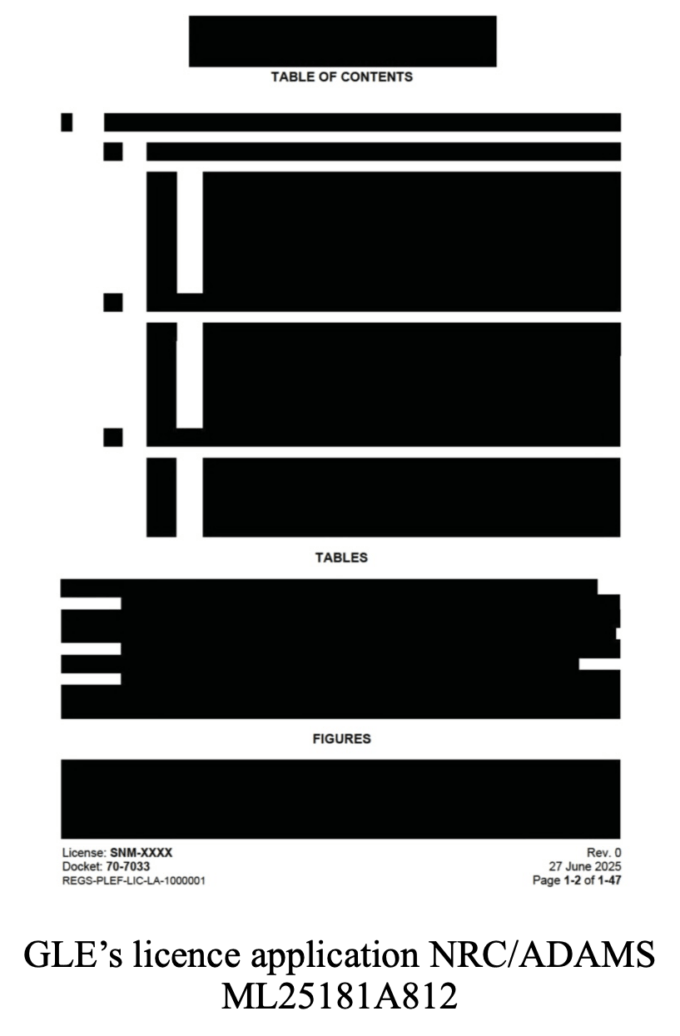
The first to apply is Global Laser Enrichment LLC — a Delaware shell company majority-owned by Silex Systems Limited of Australia and Cameco Corporation of Canada — and their application is shrouded in secrecy and regulatory shortcuts. The license application looks like a redacted Epstein file: 274 pages of black bars.
Why the Big Secrecy?
The problem with enrichment is proliferation. Natural uranium consists of two isotopes — uranium-238 and uranium-235 (U-235), the fissile isotope you need for both nuclear reactors and nuclear bombs. In its natural state, uranium contains only 0.7% U-235, so it must be enriched artificially.
Nuclear fuel for a nuclear power plant needs uranium enriched to about 5% U-235. A nuclear bomb needs it at 90% or above. Same basic process, same basic equipment — just keep enriching. Iran had enriched to 60% according to the IAEA before the June 2025 strikes — well past reactor fuel and closing in on weapons grade. That’s proliferation. North Korea had a proliferation problem the Clinton administration was successfully negotiating — until Bush came in, put North Korea on the “axis of evil,” and within months they turned off their IAEA monitoring cameras and expelled inspectors, testing their first nuclear bomb four years later.
On March 27, 2026, the NRC published a draft Environmental Impact Statement (EIS) for a proposed $1.76 billion uranium enrichment facility in Paducah, Kentucky — next to the former Paducah Gaseous Diffusion Plant (PGDP), a Cold War uranium enrichment site that operated from 1952 to 2013 and left behind a Superfund cleanup still running today. The federal government sold GLE over 200,000 metric tons of publicly owned depleted uranium to process from the PGDP — but the price is secret.
The secrecy traces to a single act. In June 2001, the Secretary of Energy classified the SILEX laser enrichment technology under the Atomic Energy Act of 1954. The entire public record of that decision is five sentences in the Federal Register — no technical justification, no public comment period, no congressional notification, no appeal process. The Federation of American Scientists called it “constitutionally questionable.” It has never been legally challenged. The PLEF would be licensed to enrich to a maximum of 6% U-235 — reactor fuel grade. The irony is that independent peer-reviewed research suggests SILEX cannot be efficiently cascaded to weapons grade, making the classification that drives all this secrecy scientifically questionable as well.
What’s in the EIS?
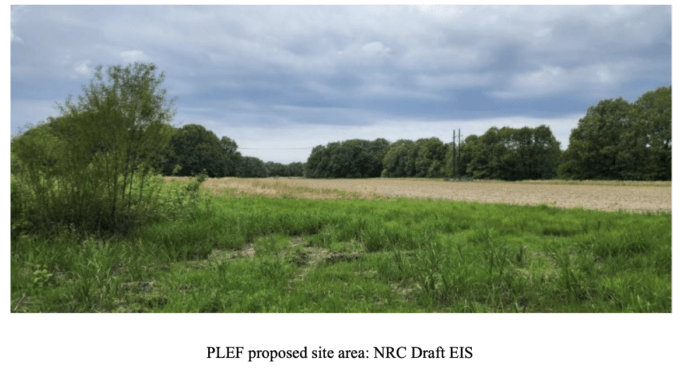
GLE proposes to build a $1.76 billion laser enrichment facility on 322 acres of former public wildlife land — until eighteen months ago part of the West Kentucky Wildlife Management Area, managed for hunting, fishing, and horseback riding, and home to bald eagles, golden eagles, monarch butterflies, and eastern box turtles. The site contains 38 wetlands, 20 streams, and 6 ponds — all of which would be destroyed to build the facility. GLE proposes to discharge 60,000 gallons of wastewater per day, some of it radioactive, into Little Bayou Creek, which flows to the Ohio River — drinking water for five million people downstream. Fish consumption in Little Bayou Creek is already not supported due to PCB contamination from the adjacent Cold War plant.
The facility would take in depleted uranium hexafluoride — the tails left over from Cold War enrichment — re-enrich it, and produce more uranium hexafluoride waste. Over 40 years the PLEF would generate 290,574 metric tons of new radioactive waste with nowhere to go. The EIS waste table lists the largest waste stream — 18,161 tons per year — with three words in the disposal column: “subject to availability.” The EIS also declines to quantify what fraction of the DOE stockpile contains reprocessed uranium — known as RepU — material that passed through a reactor and carries transuranic contaminants, including neptunium-237 and plutonium, with half-lives of thousands to millions of years. RepU cannot go to a standard low-level waste site and may require disposal at WIPP in New Mexico, which was never designed for it. GLE’s website says the PLEF will “reduce the legacy environmental footprint” of the former Paducah plant. Re-enriching depleted uranium hexafluoride produces more uranium hexafluoride. The chemical form never changes, and the volume increases. That’s not cleanup. That’s more radioactive waste with nowhere to go.
What We Don’t Know: Safety
The comment period for the EIS closes May 11, but the government’s Safety Evaluation Report (SER) – which is normally completed alongside the EIS -won’t be completed until January 2027. GLE received special NRC permission to submit the environmental and safety portions of its application separately, meaning the public must comment on the facility’s EIS without ever seeing the safety analysis. The safety analysis submitted with the license application is classified. The emergency plan is withheld as a corporate trade secret on the grounds that releasing it would, in the sworn, notarized words of GLE’s licensing manager Tim Knowles, “reduce or foreclose the availability of profit opportunities.” The Integrated Safety Analysis Summary — which NRC regulations require to be placed on the public docket — has been removed from the federal docket entirely. Not redacted. Removed. (NRC ADAMS accession ML25179A002 not publicly available) In case of emergency, the EIS says the facility relies on local volunteer fire departments – departments with no legal right to read the emergency plan for the facility in their jurisdiction.
Meanwhile, Kentucky approved nearly $100 million in public incentives to bring this facility to Paducah — some of it under a nondisclosure agreement so complete that the McCracken County judge told public radio he legally cannot tell you how much his county committed or what the terms are. The undisclosed county portion alone is nearly twice McCracken County’s entire annual operating budget.
The Regulatory Shortcut
For the EIS, the NRC borrowed conclusions from NUREG-2249, a draft Generic Environmental Impact Statement written for nuclear reactors — not enrichment facilities — that was published in September 2024, never finalized, and never applied to any proceeding before this one. Using this unfinished reactor document, the NRC pre-answered 34 environmental questions for the PLEF, declaring them all SMALL without site-specific analysis — including water use in the region, sedimentation impacts on aquatic species, and contaminated stormwater from outdoor uranium cylinder storage pads. SILEX laser enrichment appears nowhere in NUREG-2249. These 34 conclusions can still be challenged before May 11. Once NUREG-2249 is finalized, that window closes permanently.
What You Can Do
The most impactful comments challenge the application of NUREG-2249 — a draft reactor document — to pre-answer 34 environmental questions for a laser enrichment facility without legal authority; the waste disposal analysis for which no confirmed to put 290,574 metric tons of new radioactive waste; and the requirement to comment on facility safety before the Safety Evaluation Report exists.
Submit comments on the PLEF draft EIS by May 11, 2026 at: https://www.regulations.gov/

No comments:
Post a Comment