It’s possible that I shall make an ass of myself. But in that case one can always get out of it with a little dialectic. I have, of course, so worded my proposition as to be right either way (K.Marx, Letter to F.Engels on the Indian Mutiny)
Friday, April 03, 2026
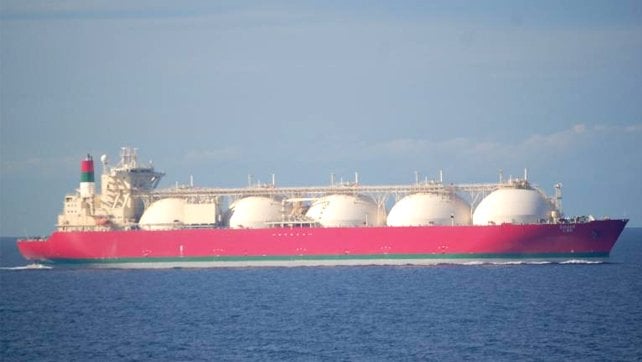
First LNG Carrier Among Three Omani Ships Breaking Out Through Hormuz
Sohar LNG was one of three Omani vessels heading out of the Persian Gulf through the Strait of Hormuz (VesselFinder)
Three vessels, including the first LNG carrier in a month, were spotted making their way along the northern coast of Oman on Thursday, April 2, in an apparent breakout from the Persian Gulf. It appears Iran decided to look the other way as reports surfaced that Oman and Iran are in discussions for a protocol to manage the Strait of Hormuz.
The analysts at TankerTrackers.com had posted on Wednesday, “To our best knowledge, not a single LNG tanker departed via the Strait of Hormuz during March 2026.” They calculated that, “During entire March 2026, only 84 tankers have departed the Middle East region via the Strait of Hormuz. That's less than 3 tankers a day.”
The Sohar LNG (72,000 dwt) was spotted via its AIS signal underway on Thursday. The vessel, built in 2001 and currently registered in Panama, has been owned by Asyad Shipping since 2005. The AIS signals, which were confirmed by TankerTrackers.com with satellite images, showed the LNG carrier between two Omani crude oil tankers. All three were displaying a message that they were Omani ships as they made the transit.
The tanker Dhalkut (299,997 dwt) registered in the Marshall Islands, was at the head of the effective convoy of ships and, in its last AIS transmission, was rounding the Omani peninsula. Bringing up the rear was the tanker Habrut (319,439 dwt) also under the Marshall Island flag.
There was a difference of opinion if the three ships were laden. Bloomberg wrote in the morning that the Sohar LNG was apparently not loaded. TankerTrackers.com, however, wrote that it was laden with Emirati LNG and that the two crude tankers were carrying Saudi and Emirati crude.
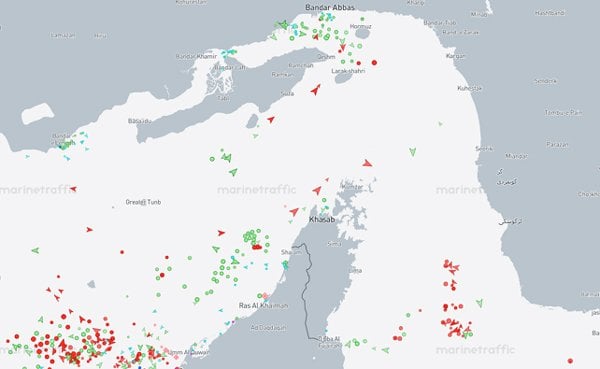
Three tankers are hugging the Omani coast while all the other vessels are in the Iranian channel near Larak Island (Marine Traffic)
It was noted that they were taking a very unusual route outside the normal shipping lane. Several other ships appeared in Iran’s newly established route around Larak Island, with the normal center of the Strait of Hormuz still empty.
In a possible explanation, the Iranian state news agency IRNA reported that Iran and Oman were drafting a “protocol” to facilitate and ensure safe passage through the Strait. They wrote that the Strait “should be supervised and coordinated.” They said the purpose would be to monitor transits through the Strait of Hormuz.
There was no mention of the Iranian toll system requiring ships to pay for their safe passage. Reports are that the Iranians are requiring payments in Chinese currency or cryptocurrency.
It comes as the list of countries reported to send shipping through the Strait of Hormuz continues to grow. The Philippines Foreign Ministry reported on Thursday that it had concluded talks with Iran. It said that Iran had agreed to allow the passage of Philippine-flagged vessels and ensure the safety of Filipino seafarers. The country said it would be permitted to receive oil coming through the Strait. It is critical as the country depends on Saudi Arabia for its fuel imports.
Safeen Prestige Reportedly Sank in the Strait of Hormuz
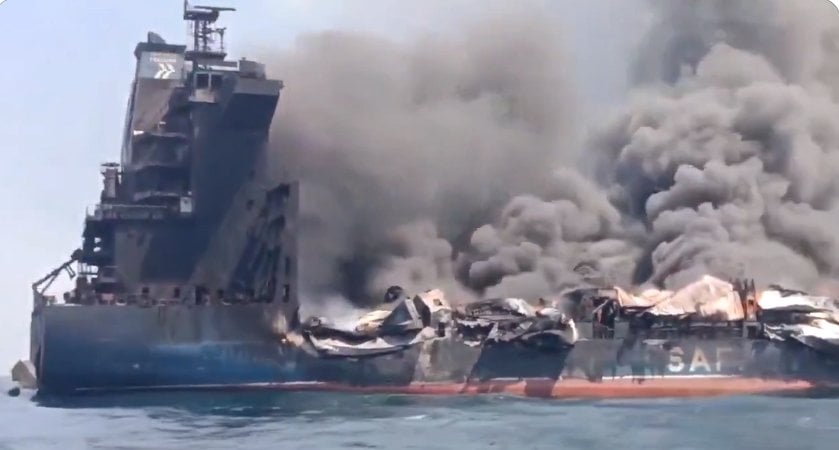
Safeen Prestige was seen on fire in a video posted no social media
The UAE-managed containership Safeen Prestige is reported to have finally succumbed to the fire that engulfed the vessel after it was attacked by the Iranians. A month after the ship was first reported to have been struck, NAVEREA IX issued a maritime warning reporting the sinking of the vessel, which would make it the first ship confirmed to have sunk due to the hostilities with Iran.
The position is reported to be near the northernmost tip of Oman’s Musandam Peninsula. An exact timing for the sinking was not reported, but the alert was issued on April 1. It says the vessel went down in a position with a depth of approximately 120 meters (nearly 400 feet). They place the sinking approximately 6.5 nautical miles northeast of Ras Madrakah, Oman.
The report warns that some of the container debris may be floating in the area, and there is a report of an oil slick.
The ship was one of the early casualties of the war when it was struck by at least one Iranian missile on March 4. At the time, it was reported to have been about 2 nautical miles north of Oman when it was attempting to transit the Strait of Hormuz. The first reports said there was a fire in the engine room and the crew abandoned the ship.
Built in 2013 in China, the ship was 23,425 dwt with a capacity of 1,740 TEU, including 345 reefer plugs. AD Ports Group acquired the vessel in May 2022, although according to databases, it was sold in 2024 to an Egyptian company and was operating under charter.
Abu Dhabi Ports launched its service in the Gulf as Safeen Feeders in 2020. It was linking Abu Dhabi to ports serving the UAE, the broader Gulf region, and the Indian Sub-Continent. The service was expanded in 2022 to include a route between the UAE and Red Sea with calls in Saudi Arabia and Sudan,
Videos had surfaced recently showing the vessel engulfed in a fire from end to end. A satellite picture released by the NGO United Against Nuclear Iran (UANI) on March 18 showed smoke coming from a vessel that it identified as the Safeen Prestige. That raised speculation that the vessel had been struck a second time by the Iranians.
Two days after the ship was abandoned, AD Ports sent a rescue tug on March 6 as part of a salvage effort. The tug was also hit by an Iranian projectile, killing and injuring the crew aboard the tug.
Reuters released a tally of all the reported incidents in the Persian Gulf that showed a total of 22 maritime incidents since the start of the bombing campaign on February 28. It included ships that were struck and damaged, as well as ships that reported debris from the efforts to intercept the incoming projectiles.
UN Security Council Expected to Vote Down Use-of-Force Request for Hormuz
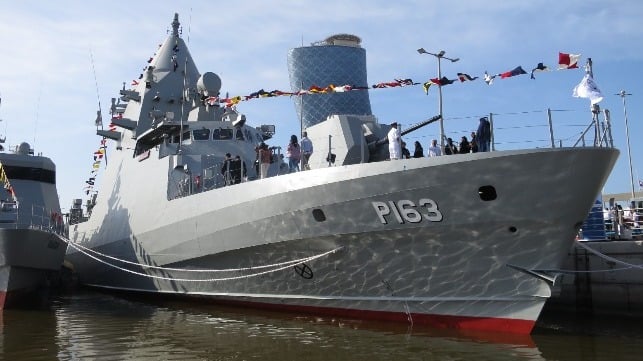
An Emirati patrol boat on display, 2025 (MZtourist / CC BY 4.0)
Three of the permanent members of the UN Security Council have signaled that they do not support a motion to authorize use of force to reopen the Strait of Hormuz, according to the New York Times. Russia and China were widely expected to oppose the measure, given their diplomatic ties to Tehran; they are reportedly joined by France, which has publicly opposed a military solution.
The proposed UN Security Counsel resolution is spearheaded by Iran's neighbors in the Gulf, and it has been the subject of intense but quiet negotiations for weeks. The latest version viewed by the Times would permit any UN member state to use all necessary means to secure transit rights through the Strait of Hormuz and to deter any further attempts to close the waterway.
The language is expected to come up for a formal vote on Friday. Any of the five permanent UNSC members could block it with a veto; with three in opposition, its odds of passage are limited.
Iran's leadership has suggested that it has no plans to give up control of the strait, which it has turned into a tollway channel administered by the Islamic Revolutionary Guard Corps. Within weeks of the U.S.-Israeli attack on February 28, the IRGC took control of the strait and set up an administrative structure for its management. Per Bloomberg, it has a fee schedule; payment arrangements; vessel vetting procedures; security escorts; and exceptions for friendly nations. China, Pakistan and India have already arranged to use the transit lane for limited numbers of vessel transits, and some commercial shipowners are believed to be making their own arrangements with the IRGC as well.
Ending this new status quo by force would be "unrealistic," French President Emanuel Macron said on Thursday. "It would take an inordinate amount of time and would expose anyone crossing the strait to coastal threats from the Revolutionary Guards," he said. In addition to cruise missiles, ballistic missiles, drone boats, suicide drones and attack boats, the IRGC has access to a stockpile of mines for forcing the strait's closure.
France and dozens of other stakeholders are pursuing a purely diplomatic track. On Thursday, a coalition of 40 countries joined in a virtual meeting hosted by the UK to discuss "diplomatic and economic tools" to support the "safe and sustained" opening of the strait. Participants included the UAE, Italy, the Netherlands, and the EU, represented by top diplomat Kaja Kallas; the United States did not participate. The coalition's objective is "restoring safe, toll-free freedom of navigation" in the strait by diplomatic means.
The need to increase traffic through the waterway is getting acute for energy-importing nations. Brent physical cargoes for prompt delivery hit $141 per barrel on Thursday, and European diesel futures surged to $200 per barrel. The EU is preparing for all possibilities to adapt to a "long-lasting" energy shock with high fuel prices for a "very long time," European Union energy commissioner Dan Jorgensen told the FT this week. In lower-income nations in Asia, like Sri Lanka, fuel rationing and shortages are becoming part of the landscape.
For its part, Iran said Thursday that it is working out a plan with Oman on a long-term proposal to "monitor" the Strait of Hormuz, which would "facilitate and ensure safe passage and provide better services to ships passing through this route." Energy markets were not reassured: Brent front-month futures jumped back up eight percent overnight, returning to $109 per barrel.
Just reports of mines are often sufficient to disrupt maritime traffic. Even if ship owners, crews and insurers weren’t aware of the missile threat in the Strait of Hormuz, news reporting of sea mines in the narrow waters would likely be enough to stop commercial traffic that Iran didn’t direct through safe passages.
That goes for even the US Navy, too. A single, inexpensive mine can threaten a multi-billion-dollar warship, and no navy, regardless of technological superiority, can afford to ignore that.
Mine warfare doesn’t need to sink ships to succeed. It works by imposing unacceptable risk. So maritime access through the strait can be shaped less by firepower and more by caution, uncertainty, and slow responses of mine countermeasures forces. For this effect to endure, Iran will require the means to sustain it. To understand what comes next, we need to understand Iran’s mine warfare capability.
The country is assessed to have had a pre-war stock of 5,000 to 6,000 sea mines, though US and Israeli forces have destroyed some. Mines are classified by their positioning in the water (drifting on the surface, sitting on the bottom, or floating on or just under the surface while tethered to the bottom) and by how their charges are set off (by contact with a ship or detecting its proximity through some influence – sound, pressure, magnetism or a combination of these). Iran’s inventory includes ground influence, tethered contact, tethered influence and drifting mines.
Sea mines offer distinct advantages as a maritime weapon. They require little training or specialist support. They are easy to deploy: they can be placed in the water from civilian boats, small craft or submarines. And unlike many other naval weapons, they can be laid without direct combat interaction with an adversary, remaining dormant until activated by a passing vessel. These characteristics make mines some of the most cost-effective weapons available to a weaker and outmatched force.
Given the right conditions, they are difficult to counter. Their presence can complicate the tactical picture by restricting or denying access to naval forces and commercial shipping until countermeasures operations can be undertaken to ensure safe passage.
Mine countermeasures are methodical, resource-intensive processes. Recent efforts to modernize them have focused on keeping mine hunters and their crews outside the minefield by shifting detection and clearance to autonomous and uncrewed systems.
Advances in precision sonar have significantly improved the ability to detect and classify mine-like contacts, often at scale and from vessels operating well away from the mined area. However, while detection has increasingly moved to stand-off systems, the processes of identification and neutralization are still somewhat tied to the mine hunters.
This creates a growing operational challenge. In confined and heavily trafficked waterways such as the Strait of Hormuz, conservative assumptions about safe stand-off distances can keep mine hunters tens of kilometers from suspected minefields. Autonomous vehicles may be able to search large areas, but confirming and neutralizing individual contacts still requires fairly close-in action, often with remotely operated systems working at the limits of range, endurance and control.
The result is that clearance timelines can expand from days to weeks to even months, particularly when the extent of the mine threat is unknown. As these clearance timelines extend, the burden of protecting mine countermeasures forces from attack also grows. Warships must provide this protection.
Iran has threatened to expand sea mine operations throughout the Gulf if its coast or islands are attacked. As the war progresses, mining could extend into the Red Sea and Bab el Mandeb Strait through Iran’s proxies, the Houthi militants of Yemen.
The Houthis have used sea mines before. In 2017 they laid hundreds off the Yemeni coast to deter maritime operations by Saudi-led forces during the Yemeni conflict. Houthi participation in the current war is already expanding, with recent strikes against Israel.
If Iran’s objective is to increase disorder for its adversaries, it is likely to start laying sea mines throughout the Gulf. In this confined area, shipping density is high, and most approaches to ports and harbours are vulnerable to mining (or just declaration of mining). These include the waterways serving Bahrain, Iraq, Kuwait, Qatar, Saudi Arabia and the United Arab Emirates. Oman, too, could be targeted.
Shipping lanes in and out of those countries’ ports and harbors are well known to Iranian war planners. Shallow waters of these approaches are well suited to Iran’s influence ground mines, including the Maham-2, which is cylindrical, has an explosive capacity of 350 kg and can operate as deep as 50 meters, and the Maham-7 which is conical, contains 150 kg of explosive and can operate at 35 meters.
In deeper areas of the Gulf, Iran’s tethered mines would be effective. These can be tied to sea bottoms as deep as 100 meters. They would likely be used within established shipping lanes, anchorages and other high-traffic areas.
Iran could also deploy floating mines, which are set adrift and will move with currents and wind. Floating mines are inherently uncontrolled and pose a hazard to all shipping, including vessels from the nation that lays them.
Iran has several options available for deploying sea mines, including the use of hundreds, if not thousands, of boats. Submarines can also do the job, and Iran’s Ghadir-class midget submarines are particularly well suited to minelaying, because they can operate in water as shallow as 30 metres.
Tethered mines would most likely be deployed from boats in waters deeper than 40 meters, while ground influence mines could be laid either by midget submarines or surface craft in shallow water approaches to ports and harbours.
Floating mines could be deployed from small surface vessels or even from the shore. Once in the water, they will be carried by currents, increasing risk to friendly and neutral shipping, with their eventual location often unpredictable.
Iran has a history of employing sea mines across the Gulf region, most notably during the Tanker War campaign in 1984 to 1988, part of the Iran–Iraq War. In 1987, the tanker SS?Bridgeton struck an Iranian contact mine even as it was part of a convoy escorted by the US Navy. In 1988, a mine damaged the frigate USS Samuel B Roberts; repairs cost about US$90?million.
The month of US and Israeli attacks on Iran that began on February 28 has greatly degraded Iran’s military capability, but the country can still sow minefields throughout the Gulf and get the Houthis to sow them in the Red Sea. As the war continues, the likelihood of Iran again resorting to sea mines increases by the day. Whether it has already crossed a strategic threshold at a large scale remains unclear. What is clear, however, is that Iran has the capability to use mines to achieve a strategic effect.
Andy Perry is a retired Royal Australian Navy mine warfare specialist with more than 30 years of experience. He works as a maritime geospatial specialist supporting mine warfare operations.
This article appears courtesy of The Strategist and may be found in its original form here.
The opinions expressed herein are the author's and not necessarily those of The Maritime Executive.
Proposals to End Gulf Conflict Could Preserve Iranian Control of Hormuz
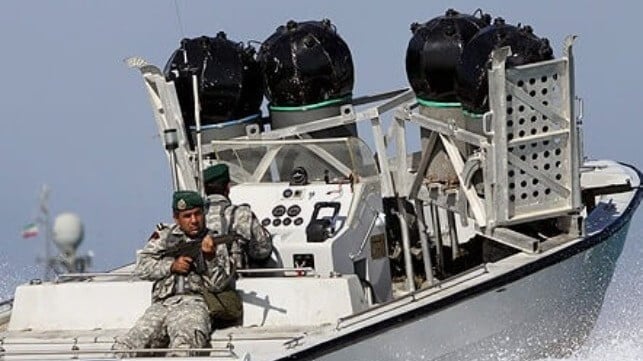
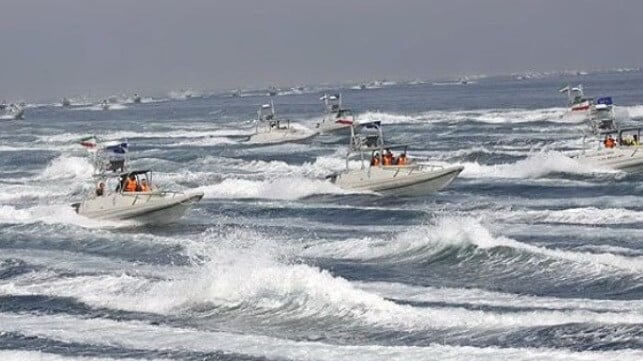
Iranian IRGC attack boats in the Strait of Hormuz, prior to the war and the U.S. effort to destroy Iran's boat flotilla (Mehr file image)
On Tuesday, shortly after President Donald Trump proposed leaving the Strait of Hormuz as a matter for other nations to address, China and Pakistan released a peace proposal that would provide for "normal passage" - without calling for a withdrawal of Iranian administration of the strategic waterway. Both China and Pakistan have already reached initial deals with Tehran for safe transit of their vessels, acknowledging de facto Iranian supervision, and both proposals align with an extended period of Iranian control over the strait.
Officials have told the Wall Street Journal that Trump is open to ending U.S. involvement in the conflict without first taking action to remove Iran's newfound control over Hormuz. In comments Tuesday, the president appeared to confirm that the strait was not an active policy concern for his administration.
"When we leave the strait will automatically open," President Trump claimed in a conversation with the New York Post. "I don’t think about it, to be honest."
Iran has given no indication that it will give up authority over the waterway voluntarily. It has declared sovereignty over the strait, and it demands international recognition of its claim as a condition for a ceasefire. Its parliament has passed a bill formalizing regulations for administering the strait; it has partially mined the waterway to deter transits outside of an Iranian-controlled lane; and it has set up a "tollbooth" between the islands of Qeshm and Larak, reportedly charging up to $2 million per passage for safe transit rights. AIS data confirms that nearly all of the visible traffic through the strait is using this tolling arrangement and submitting to Iranian instructions.
In a social media message Monday morning, Trump suggested that future access to the strait would be up to the nations most dependent upon it, not the U.S. military. "Build up some delayed courage, go to the strait, and just take it," the president wrote. "Go get your own oil!"
The president's comments could be tactical: he has previously signaled the opposite of his intentions in military affairs, and he has moved troops into theater for a potential ground offensive, multiple analysts observed. But if Trump does pull out with Iran still in control of the waterway, foreign nations' least risky option to "get their own oil" would be to negotiate with Tehran and pay transit fees, just like at the Panama Canal and the Suez Canal. Most of the Gulf region's energy customers have no major disputes with Iran: almost all of the oil passing Hormuz goes to Asian buyers. Less than ten percent is purchased by European buyers, who have access to other alternatives and little physical exposure to Gulf oil terminals.
China is by far the most dependent upon oil shipped through the strait, and buys about four out of ten barrels passing through it (including almost all Iranian barrels). Chinese shipping interests have already reached an agreement with "relevant parties" for limited use of the waterway, Chinese foreign ministry spokeswoman Mao Ning said Tuesday - a tacit acceptance of a new status quo of Iranian control.
"An Iranian regime that retains control over the Strait of Hormuz, gets paid for passage and chooses which nations can access the Persian Gulf will use this vital leverage . . . to pressure America’s European and Asian allies to lift sanctions, will coerce Gulf states, and will turn from a weakened regional pariah to the Middle East’s foremost power," warned the Wall Street Journal's senior foreign correspondent, Yaroslav Trofimov.
Iran's Gulf neighbors would be disadvantaged by Iranian control of the strait, and the UAE is reportedly concerned enough that it is urging a coalition effort to forcibly reopen the waterway. It is hoping to convince the Trump administration to lead such an operation, and has lobbied European and Asian powers as well, according to the Wall Street Journal.
Ukraine Pitches its Own Solution to the Strait of Hormuz Shutdown
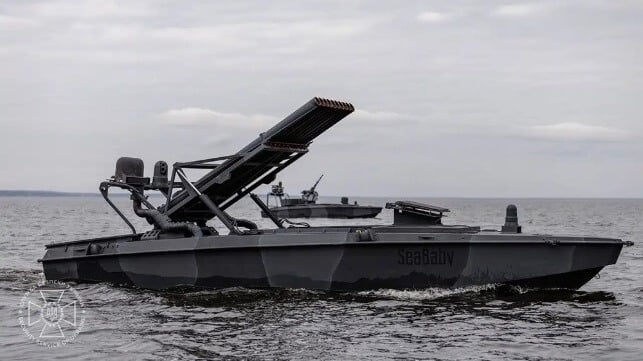
Up-gunned "Sea Baby" drones operated by Ukraine's defense intelligence service (Courtesy SBU)
The Ukrainian government is offering to lend Gulf states its experience in reopening contested sea lanes, President Volodymyr Zelensky told reporters on Monday. Ukraine has a battle-tested system that protects its own Black Sea shipping corridor from Russian-spec surface warfare threats, comparable to the lower end of the threat spectrum currently found in the Strait of Hormuz, and it is willing to export its knowledge to clients in the GCC.
"There is an energy crisis. They know they can rely on our expertise in this area, and we discussed it in detail," Zelensky told reporters in a group chat following his return from talks in Qatar and the UAE last week. "We shared our experience with the Black Sea corridor and how it operates. They understand that our armed forces have been highly effective in unblocking the Black Sea corridor."
The closure of the Strait of Hormuz is tough to crack, and after 30 days of conflict, the U.S. has not been able to do so (nor does it expect to have an escorted-traffic scheme soon). Iran has deposited a small number of naval mines in the strait, and can target passing merchant ships with drone boats, manned gunboats and missiles to enforce its control. Since it can range the entirety of the narrow waterway with multiple classes of weaponry, the Strait of Hormuz is closed - except for traffic that Iran itself administers using a "tollbooth" passage between Qeshm and Larak Islands.
Ukraine has a sealane-defense solution that it has developed over the past four years of conflict with Russia, and the proof is in the results. Ukraine's ports receive about 200 vessel calls per month, with low casualty rates and accessible (subsidized) war risk insurance.
The Ukrainian solution is a layered air defense system to defeat airborne drones, combined with Ukraine's well-known drone-boat patrols to drive off the Russian Navy's surface fleet. Ihor Fedirko, CEO of Ukraine’s Council of Defence Industry, told Politico that "Ukraine has a ready-made ecosystem, fully systemic solution for protecting marine areas." Unlike manned escort vessels, which are in short supply and are politically difficult to lose, drone boats like those operated by Ukraine are attritable.
Iran also uses another, harder-to-defeat form of attack which is not seen in Ukraine. Iranian antiship ballistic missiles require missile defense technology to shoot down; for this threat, the GCC states possess American-made Patriot batteries and PAC-3 interceptors (if these assets can be spared from other areas).
Zelensky has proposed a trade to exchange Ukraine's air defense and sea-lane defense expertise for a supply of those same PAC-3 interceptors, which are in short supply and are desperately needed by Kyiv. They are valued at about $4 million each, and production is limited to about 60 units per month.


No comments:
Post a Comment