“Such corporate impunity would twist the knife of the climate crisis that is already directly harming people across the country,” said one campaigner.
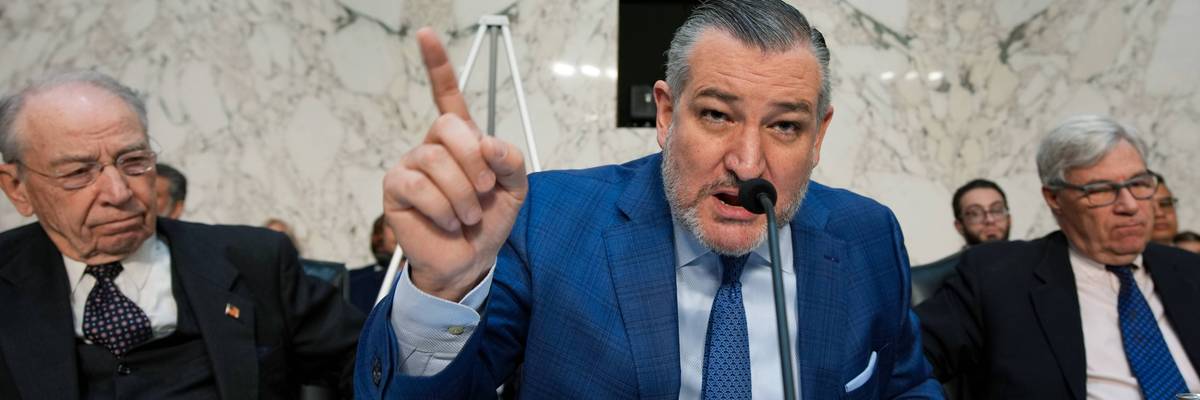
US Sen. Ted Cruz (R-Texas) speaks during a March 24, 2026 Senate Judiciary Committee hearing in Washington, DC.
(Photo by Andrew Harnik/Getty Images)
Apr 17, 2026
COMMON DREAMS
Green groups warned Friday that Big Oil-backed Republican legislation would give fossil fuel companies immunity from laws or lawsuits aimed at holding them accountable for their role in causing the climate emergency.
On Thursday, Sen. Ted Cruz (R-Texas) introduced a bill co-sponsored by Sens. Ted Budd (R-NC), Tom Cotton (R-Ark.), and Mike Lee (R-Utah) that, if passed, would “prohibit liability against those engaged in the mining, extraction, production, refinement, transportation, distribution, marketing, manufacture, or sale of energy for damages or injunctive or other relief from the use of their products, and for other purposes.”
Congresswoman Harriet Hageman (R-Wyo.) on Friday introduced the House version of the legislation, dubbed the Stop Climate Shakedowns Act of 2026, “to protect American energy from leftist legal crusades punishing lawful activity,” as her office put it.
If passed, the legislation would ban retroactive climate liability lawsuits, dismiss any such litigation pending upon the law’s enactment, void all state energy penalty laws, and affirm that the federal government maintains exclusive authority and jurisdiction over the regulation of greenhouse gas emissions and other interstate environmental standards.
Other Republican-controlled states including Tennesseee and Utah have recently passed such legislation, and others—including Iowa, Louisiana, and Oklahoma—have introduced similar bills.
“This blatant championing of some of the world’s largest polluters shows how far certain elected officials will go to undermine democratic policymaking and deny people and communities access to justice,” Kathy Mulvey, climate accountability campaign director at the Union of Concerned Scientists, said Friday.
“No company should be above the law, especially those that planned, funded, and continue to engage in a coordinated decadeslong campaign to protect their profits by deceiving the public and blocking climate action,” Mulvey continued.
“Such corporate impunity would twist the knife of the climate crisis that is already directly harming people across the country,” she added. “Congress must not capitulate to wealthy special interests. Communities deserve the right to hold polluters accountable for the deadly and costly harms they are causing.”
Former Democratic Washington Gov. Jay Inslee said in a statement that “every elected official who cares about the interests of their constituents more than those of corporate polluters should oppose this disgraceful proposal.”
“Juries are a fundamental bastion of democracy, and it’s beyond dangerous to allow powerful and wealthy corporations to shield themselves from ever having to face jurors’ judgment,” he added.
The Center for Climate Integrity said the bill “would put Big Oil above the law.”
“Big Oil companies have raked in massive profits at the pump while lying to the American people about the catastrophic harm of their products, and now they want to deny Americans their rightful day in court and stick taxpayers with the bill for the mess they made,” Center for Climate Integrity president Richard Wiles said Friday. “If fossil fuel companies have done nothing wrong, why do they need immunity?”
While these and other climate advocates denounced the bill, their congressional sponsors—and those lawmakers’ fossil fuel industry campaign donors—applauded its introduction.
“Energy security is national security, and we will not self-sabotage our critical industries with a cascade of costly lawsuits and extreme penalties that jeopardize American drilling,” Hageman said in a statement. “America’s energy producers should be protected from the dangerous legal precedent that would be set by the retroactive punishment of lawful activity.”
American Fuel & Petrochemical Manufacturers president and CEO Chet Thompson and American Petroleum Institute president and CEO Mike Sommers said in a joint statement, “We thank Sen. Cruz and Rep. Hageman for introducing legislation to stop a growing patchwork of state laws and lawsuits that threaten American energy and risk raising costs for consumers.”
“These efforts to retroactively penalize companies for lawfully meeting consumer demand are misguided and counterproductive,” the lobbyists added. “Congress should act decisively to reaffirm federal authority over national energy policy and end this activist-driven state overreach.”
Eleven states—California, Connecticut, Delaware, Hawaii, Maine, Massachusetts, Michigan, Minnesota, New Jersey, Rhode Island, and Vermont—along with the District of Columbia and dozens of city, county, and tribal governments have ongoing lawsuits seeking to hold fossil fuel companies accountable for lying to the public about their products’ role in causing and worsening climate change.
On Friday, the right-wing US Supreme Court unanimously issued an important procedural ruling that certain environmental damage lawsuits—in this case, one challenging Chevron’s destruction of coastal wetlands in Louisiana—can be moved from state to generally friendlier federal courts. This, after a jury in Plaquemines Parish ordered Chevron and two other companies to pay $744 million in damages for harming coastal wetlands, a verdict that was appealed.
The US Supreme Court’s decision came as its justices prepare to hear Suncor Energy Inc. v. County Commissioners of Boulder County, a case in which the plaintiffs—three Suncor entities and ExxonMobil—are seeking to relocate a climate damages lawsuit from Colorado to federal court.
Big Oil-backed efforts to relocate cases to friendlier forums come amid wins for climate defenders, most notably Held v. Montana, a historic 2024 state court ruling in favor of youth-led plaintiffs based on the Montana Constitution’s right to “a clean and healthful environment.”

The second Trump administration has been an unrelenting assault on democracy.
Basic democratic rights are disappearing. Unarmed people have been executed in the streets and smeared as “terrorists” by the government. Entire families are being kidnapped and denied basic rights in inhumane detention centers. And journalists are being arrested for doing their jobs.
Against this backdrop, working for climate justice might seem like a distraction.
But a clear-headed look at how we ended up in this grim situation in the first place shows that the movement for climate justice, far from being a distraction, is an essential part of the fight to defend and deepen democracy.
The Trump administration has received major political backing from fossil fuel oligarchs—in response, in fact, to Trump’s open solicitation to trade favors for their support. The government has subsequently followed an energy and environmental policy agenda that benefits the industry.
The administration has expanded the industry’s access to resources at home through leases and permits for drilling in public lands and waters. It has attacked Venezuela, kidnapped its president, and is attempting to open up the country’s oil reserves to US corporations.
And of course it launched an unprovoked war on Iran, sending the price of oil skyrocketing—and leading to genocidal threats from the president against Iran unless the country reopens the Strait of Hormuz, through which Gulf oil passes.
Meanwhile at home, the Trump administration has weakened environmental standards, including mercury pollution standards for power plants. By attacking motor vehicle fuel economy standards, it has effectively grown the captive market for the industry’s products. And it has abused the federal permitting process to try to kill the fossil fuel industry’s main competitors, wind and solar energy.
This is not merely a case of an administration that supports the fossil fuel industry and also happens to be authoritarian. The industry directly supports and benefits from an authoritarian government that curtails democratic rights and silences dissent. It also benefits from a government that upholds white supremacy and enforces racial hierarchy.
Several years ago, a report I worked on for the Institute for Policy Studies documented how the fossil fuel industry has used its money and influence to push for state-level legislation to criminalize protest against fossil fuel infrastructure projects. These so-called “critical infrastructure laws” are now on the books in 19 states. The industry has also used strategic lawsuits against public participation (SLAPPs) to intimidate and silence critics.
This is a predictable response of a powerful, politically connected industry that is under assault on two fronts.
First, competition from cheap, widely available wind and solar energy poses a serious economic threat to the industry. Renewable energy is cheaper than fossil fuels in most of the world, and new generation capacity is dominated by renewables.
Simultaneously, the industry faces serious political and reputational threats. Growing numbers of people worldwide are experiencing extreme heat, wildfires, storms, floods, and toxic air and water pollution attributable to the industry’s activities. Many of them are connecting the dots, and refusing to be passive victims of a powerful industry and its political backers.
Social movements against particular fossil fuel projects, or against the industry more broadly, have multiplied on every continent. What’s more, they are already winning. The industry faces restrictions in several political jurisdictions, and likely recognizes that it could even be expropriated in the not so distant future.
Faced with these twin crises, the fossil fuel industry is increasingly resorting to relying on the repressive apparatus of state violence to crush dissenting voices and maintain its dominance.
The industry has also historically benefited from a racially and economically unequal society. The lack of political power of Indigenous, Black, and other racially marginalized communities, and of poor communities of every race, has enabled the industry to locate polluting infrastructure in these communities, treating them as sacrifice zones. This has let the industry avoid the protracted zoning and legal battles they would have to contend with if they tried to locate their infrastructure in more privileged communities, greatly reducing the cost and lead time for their projects.
In recent years, the growing strength of the environmental justice movement has threatened the ability of the industry to continue to reap the benefits of racial and economic stratification. It is therefore no surprise that the industry is supporting an openly white supremacist political agenda that seeks to bring old racial hierarchies back and eliminate the very concept of environmental justice.
In sum, the far-right agenda in the US is deeply intertwined with the political and economic objectives of the fossil fuel industry that is at the root of climate change. We cannot defeat authoritarianism without breaking the stranglehold of the fossil fuel industry on our economy and our political system.
Finally, it is worth pointing out that these observations are mainly based on US politics, but are applicable to many parts of the world. Fossil fueled fascism has become a global phenomenon, and our resistance to the fossil fuel industry must be similarly global in scale.

No comments:
Post a Comment