Sunday, February 16, 2020

Trump says the person who invented the wheel 5,500 years ago should be 'protected'
Throughout the years Donald Trump has displayed that he clearly doesn't have the greatest knowledge of history or time.

For instance, he once claimed that airports existed in 1776 and that the Soviet Union decided to become Russia "because of Afghanistan."

Now, he is talking about how some of the world's greatest inventors should be protected like the person who "invented the wheel."

We can't actually be sure who Donald Trump is referring to here but maybe he knows who invented the wheel as historians believe that it first started to appear in ancient Mesopotamian cultures around 3,500 BC.

Speaking to CNBC's Joe Kernan at the World Economic Forum in Davos, Trump was about the recent financial successes of the eccentric entrepreneur and Space X owner, Elon Musk, whose Tesla car company is now worth more than Ford and GM.

The president said:

We have to give him credit. I spoke to him very recently.

He's also doing the rockets. He likes rockets, and he does good at rockets too, by the way.

I was worried about him because he's one of our great geniuses.

Trump then goes off on a strange eulogy about 'geniuses' who should be protected like Thomas Edison (died 1931) and the person who invented the wheel (presumably died some millennia before Christ).

We have to protect Thomas Edison—we have to protect all of these people that came up with originally the light bulb, and the wheel, and all of these things, and he’s one of our very smart people

We want to cherish those people. That’s very important. He’s done a very good job.

We're not quite sure what Trump is on about here and why he's so keen to protect people that are long dead and it's safe to say that Twitter was equally baffled, with some claiming that he thinks an American invented the wheel.  

Two burglars tried to rob gay bookshop but got distracted drinking a bottle of prosecco

Sirena Bergman in news

Stop everything you're doing: we've found the heist of the century.

Two burglars who were presumably unable to find a good bank to rob decided to break into Gay's The Word instead - the first LGBTQ+ bookshop ever to open in the UK. Because independent bookshops are famously a goldmine, obvs.

Anyway as we all know, nothing will foil a great laid plan like free booze. After ransacking the shop, the burglars happened upon a bottle of tequila which was leftover from a staff member's birthday. They did what we would all do: forgot what they were actually there for and lived their best lives. In other words, they got absolutely trollied.

Clearly not ones to cut a night of drinking short, they then moved onto the kitchen, where they found a bottle of prosecco, and decided that would do nicely.

Unbeknownst to them, a member of the public had heard the windows being smashed and called the police, who were closing in on the criminal masterminds while they were drinking away.

And that's where they were found. 

Staff member Uli Lenart told The Guardian:

As I went through the shop afterwards, I found an empty bottle of tequila, and an open bottle of prosecco on the kitchen table downstairs. They seemed to have been boozing up mid-burglary, which probably wasn’t the most prudent thing to do.

Ocean's Eleven eat your heart out.

The burglars were presumably looking for cash, but only found a box where customers donated their change for LGBTQ+ youth charity Mosaic. In a delightful twist though, people have been coming together to help the bookshop get through this difficult time.

Lenart explained:

Customers turning up with bunches of flowers, people dropping off bottles of prosecco, publishers sending us free books and boxes of chocolates. We’ve felt really held and supported, and we’ve found that deeply touching.

The two men were sentenced, one receiving six months in jail and the other 16 weeks (suspended for 12 months). This seems somewhat lenient... but then again they will have to live with the knowledge that they screwed up their plan by getting drunk (relatable) and perhaps that's punishment enough?


---30---

UPDATED
‘It fills us with rage’: Mexican activists protest femicide at presidential palace

Demonstration stemmed from outrage over killing of Ingrid Escamilla and publication of photos of her mutilated corpse


Staff and agencies in Mexico City

Fri 14 Feb 2020

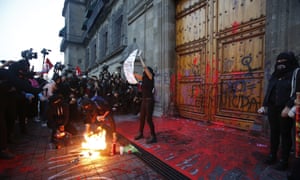
A masked female protester stands with a sign at the entrance to the national palace in Mexico City on 14 February. An average of 10 women are killed a day in Mexico. Photograph: Ginnette Riquelme/AP

Dozens of activists gathered outside Mexico’s presidential palace on Friday to protest against violence against women, chanting “Not one murder more” and splashing one of its large, ornate doors with blood-red paint and the words “femicide state”.


'Why did she have to die?' Mexico's war on women claims young artist Read more
The heated Valentine’s Day demonstration, led by women, stemmed from outrage in recent days over the killing of 25-year-old Ingrid Escamilla in Mexico City and the publication of graphic photos of her mutilated corpse in newspapers.

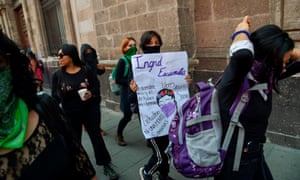
One protester spray-painted “Ingrid” in tall pink letters on another palace door in tribute. Many participants noted that her death was only the latest example in a wave of brutal murders of women, or femicides.

An average of 10 women are killed a day in Mexico, and last year marked a new overall homicide record, official data shows   

 A woman holds a sign for Ingrid Escamilla as women demonstrate outside the national palace in Mexico City on Friday. Photograph: Rodrigo Arangua/AFP via Getty Images

“It’s not just Ingrid. There are thousands of femicides,” said Lilia Florencio Guerrero, whose daughter was violently killed in 2017. “It fills us with anger and rage.”


She called on Mexico’s president, Andrés Manuel López Obrador, who was inside the palace as t


he protests continued, to do more to stop the violence.

Others graffitied slogans including “They are killing us” on the building’s walls and ejected bright flames from cans of flammable spray-paint.

Inside the stately palace, López Obrador said such killings were hate crimes and an act of brutal machismo.

“I’m not burying my head in the sand … The government I represent will always take care of ensuring the safety of women,” he said, without detailing new plans.

But early this week, he showed little patience for those who questioned him about the government’s commitment to fighting violence against women.

“This issue has been manipulated a lot in the media,” López Obrador said Monday, adding: “I don’t want the issue just to be women’s killings.”
A masked female protester sprays fire at the entrance to the national palace in Mexico City on Friday. Photograph: Ginnette Riquelme/AP

On Friday, the protesters also admonished the newspapers that published photos of Escamilla’s corpse, chanting: “The press is complicit.”

Mexico's 'glitter revolution' targets violence against women Read more

La Prensa, a newspaper that ran the gruesome image on its cover, defended its record of reporting on crime and murder, subjects it said the government prefers to keep quiet. The paper also said it was open to discussion on adjusting its standards beyond legal requirements.

“We understand today that it hasn’t been sufficient, and we’ve entered a process of deeper review,” the paper said in a front-page statement on Friday.

Newspaper Pásala had filled nearly its entire tabloid cover with the photo, under the Valentine’s Day-themed headline: “It was cupid’s fault.” The cover sparked anger not only at the gory display, but also the jocular tone over a crime for which Escamilla’s domestic partner has been arrested.

Woman’s Grisly Murder in Mexico Puts AMLO on the Defensive

Lorena Rios

Bloomberg•February 14, 2020

(Bloomberg) -- Demonstrators in Mexico City, outraged by the horrific murder of a 25-year-old woman, on Friday sprayed graffiti on the presidential palace and disrupted President Andres Manuel Lopez Obrador’s daily press conference.

Even in a nation accustomed to rampant homicides and frequent violence against women, the case of Ingrid Escamilla was particularly shocking. Pictures of her dismembered body were leaked on social media, causing widespread revulsion, anger and despair.

The shouts from protesters outside the palace could be heard as reporters questioned the president about measures to reduce killings. A crowd of about 100, most of them women, spray painted slogans on the ornate building that dates to the 16th century. Some splashed red paint on its doors.

One chant: “We are not dying. They are killing us.”

Lopez Obrador has enjoyed widespread popularity as he implements a leftist agenda to take on Mexico’s traditional power brokers. But many see stemming the nation’s epidemic violence as his biggest test. Drug gangs kill with impunity, leaving their enemies’ defiled corpses displayed as warnings. Murders of female workers have been a plague in border regions, with many disappearances uninvestigated.

In 2019, Lopez Obrador’s first year in office, killings overall reached a record. The pace of women being killed more than doubled in the past five years, while the overall homicide rate is up 35% in the period, Attorney General Alejandro Gertz said this week.

Gertz and the president known as AMLO have been fielding criticism by feminist groups that say they are trying to downplay violence against women as a special phenomenon.

Irene Tello Arista, director of an organization called Zero Impunity, which ranks the jobs prosecutors perform around the country, said Friday that AMLO also has failed to make the crucial distinction.

“He needs to know that when it comes to public policy, he can’t do that,” she said. “They are different phenomena.”

Marches against gender violence have grown frequent in the nation’s capital amid reports of rape and sexual harassment on campuses, including the main public university of Mexico, and as cases of brutal killings of women have emerged.

The death of Escamilla has galvanized opponents. The victim was murdered in an apartment complex in Mexico City this past weekend, according to news reports. Her 46-year-old partner confessed to the killing in a video taken after his arrest, according to national media. News outlets reported that he admitting stabbing her after an argument. She made a violence complaint against him in 2019 that she later dropped, according to El Universal newspaper.

Pictures of Escamilla’s mutilated body were leaked and widely circulated, causing outrage on social media. Hashtags such as #JusticeForIngrid began circulating and led to Mexico City Mayor Claudia Sheinbaum calling for “maximum punishment.”

On Friday morning, questions in the press briefing quickly turned to what the president known as AMLO plans to do to reverse the trend.

Lopez Obrador has tried to respond to rising concern about gender violence, but has also grown defensive at being questioned over the matter. “We’re doing things every day to guarantee peace and tranquility. I’m not sticking my head in the sand, I’m not evading my responsibility,” he said.

After several questions from reporters Lopez Obrador reeled off 10 declarations, including “it’s cowardice to hurt a woman,” and, “women need to be respected,” and, “the government I represent will always be working to guarantee, always, the security of women.”

He didn’t commit to specific actions to protect women, such as creating a special prosecutor to investigate the killings.

(Adds comment from an activist in eighth paragraph. Earlier version was corrected to remove references to victim’s profession and day of death.)


Mexican demonstrators splash presidential palace red in protest over murder of women

29 PHOTOS
By Daina Beth Solomon and Josue Gonzalez,
Reuters•February 14, 2020


Mexican demonstrators splash presidential palace red in protest over murder of women
People take part in a protest against gender-based violence in downtown of Mexico City


MEXICO CITY (Reuters) - Demonstrators daubed the words "femicide state" in blood-red on Mexico's presidential palace on Friday, before marching in heavy rain to the offices of newspaper La Prensa to protest against the recent publication of a gruesome image of a murder victim.

The Valentine's Day demonstration, led by women, was sparked by the killing of 25-year-old Ingrid Escamilla in Mexico City and the publication of graphic photos of her mutilated corpse in newspapers.

The protesters, numbering at least 200 and comprised mostly of women, burned vehicles belonging to La Prensa and briefly clashed with security forces who prevented them from entering the newspaper's offices.

Chanting "not one more murder" and carrying signs saying "we demand responsible journalism," "Ingrid we are all you" and "sexism kills," the demonstrators demanded justice.

An average of 10 women a day are killed in Mexico. Last year marked a new overall homicide record, official data shows.

The United Nations Entity for Gender Equality and the Empowerment of Women, also known as UN Women, said on Twitter that it condemned the killing of Escamilla.

"We demand comprehensive actions to eliminate violence against women and girls. We demand full access to justice and non-revictimization for all. Ingrid is not an isolated case," UN Women said.

Lilia Florencio Guerrero, whose daughter was violently killed in 2017, called on President Andres Manuel Lopez Obrador, who was inside the palace during the protests, to do more to stop violence

"It's not just Ingrid. There are thousands of femicides," said Guerrero. "It fills us with anger and rage."

One protester spray-painted "INGRID" in big pink letters on a door of the presidential palace. Many participants noted that Escamilla's was only the latest in a wave of brutal murders of women.

Others protesters painted slogans including "they are killing us" on the building's walls and fired bright flames from cans of flammable spray-paint.

Inside the stately palace, where Lopez Obrador lives with his family, the president attempted to reassure the activists during his morning news conference.

"I'm not burying my head in the sand ... The government I represent will always take care of ensuring the safety of women," he said, without giving details of new plans.

Protesters also admonished the newspapers that published photos of Escamilla's corpse, chanting, "The press is complicit."

La Prensa, which ran the image on its cover, defended its record of reporting on crime and murder, subjects that it said the government prefers to keep quiet. The paper said it was open to discussion on adjusting its standards beyond legal requirements.

"We understand today that it hasn't been sufficient, and we've entered a process of deeper review," the paper said in a front-page statement on Friday.

A 22-year-old student dressed in black, with a mask covering her face and carrying a can of spray paint, said the protests after Escamilla's death seemed to have had an affect.

La Prensa, she said, had caved to "pressure from feminists."

Another newspaper, Pasala, had filled nearly its entire tabloid cover with the photo of Escamilla's corpse, under the Valentine's Day-themed headline: "It was cupid's fault." The cover sparked anger not only at the gory display, but also the jocular tone over a crime for which Escamilla's domestic partner has been arrested.

Pasala editors did not respond to requests for comment.

(Reporting by Daina Beth Solomon and Josue Gonzalez; Writing by Anthony Esposito; Editing by David Gregorio and Leslie Adler)


Angry protests in Mexico after woman's gruesome killing

MARÍA VERZA,
Associated Press•February 14, 2020


Mexican Activists Protest After Gruesome Killing of Woman, Publication of 'Horrific' Crime Scene Photos

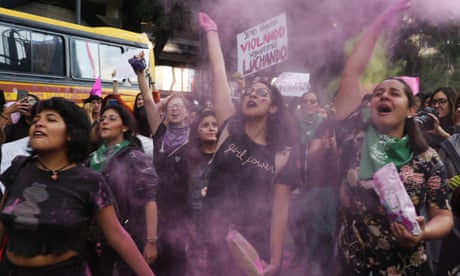
MEXICO CITY (AP) — Angry demonstrations broke out in Mexico City on Friday as hundreds of women protested the gruesome slaying and mutilation of a young woman, a case that has come to personify outrage over the rising incidence of gender-related killings, or femicides.

In the morning, dozens of protesters spray-painted slogans such as “We won't be silenced” on the facade and doorway of the capital's National Palace as President Andrés Manuel López Obrador was holding his daily news conference inside.

Hours later hundreds marched to the offices of a media outlet that published grisly images of the crime scene, and a newspaper truck outside was partially set ablaze. Some spray-painted the plastic shields of riot officers as the crowd chanted “Not one more murdered!” and “Justice!” Police unleashed pepper spray.

As a cool rain fell in the evening, those remaining left and walked down the central Reforma boulevard, where some bus stop windows were shattered and signs vandalized.

About 10 women are slain each day across Mexico just because they are women, the government and activists say. Last year there were 3,825 in all, which was up 7% from 2018, according to federal figures.

Not only have attacks on women become more frequent, they have become more grisly. In September, a young female musician in the southern state of Oaxaca was burned with acid by two men who testified they had been hired by a former politician and businessman who allegedly had an affair with her.

But the killing last weekend of Ingrid Escamilla, a young Mexico City resident who was allegedly murdered by a boyfriend, has horrified Mexicans for its brutality.

The man, who has been arrested and purportedly confessed to killing Escamilla with a knife, mutilated her body and flushed part of her corpse into the sewer.

Indignation grew after some local media published horrific photos of the skinned corpse, apparently leaked by city police officers.

The protesters read a statement Friday saying “it enrages us how Ingrid was killed, and how the media put her body on display.”

“It enrages us that the public judges us, saying 'this isn't the right way to express your rage,'" the statement continued. “We are not mad, we are furious.”

In the past, women's protests in Mexico City had been criticized for spray-painting historical monuments and trashing city infrastructure, but the damage Friday was minor, and criticism almost non-existent.

Instead, officials condemned media outlets for publishing the photos and said they were investigating police who may have taken the photos with their cellphones at the crime scene.

The Interior Department said in a statement it “condemns the publication and distribution of such material, given that it re-victimizes people and promotes sensationalism and morbid curiosity. It is an attack on the dignity, privacy and identity of the victims and their families.”

The president said Friday morning in the colonial-era palace as the protesters were outside that such killings were hate crimes and “an act of brutal machismo.”

But early this week, López Obrador showed little patience for those who questioned him about the government's commitment to fighting violence against women.

“This issue has been manipulated a lot in the media,” the president said Monday, adding that “I don't want the issue just to be women's killings.


SEE  https://plawiuk.blogspot.com/search?q=FEMICIDE

Canada Rocked By Anti-Pipeline Protests

Nick Cunningham
Oilprice.com February 15, 2020

Protests continue to swell over the Coastal Gaslink Pipeline, a long-distance pipeline carrying natural gas from Alberta to the Pacific Coast.

The pipeline’s route would travel more than 400 miles to the coast at Kitimat, British Columbia, where it intends to deliver gas to a massive LNG export project, under construction by a joint venture led by Royal Dutch Shell.

The $6.2 billion Coastal Gaslink pipeline, which is being built by TC Energy, runs through territory of the Wet’suwet’en Nation. Some First Nations chiefs support the pipeline, but others do not. Those opposed have demanded a halt to construction.

The Royal Canadian Mounted Police (RCMP) began arresting indigenous peoples on their territory earlier this month. “Forcing indigenous peoples off their own territory is in complete and disgusting violation of the United Nations Declaration on the Right of Indigenous Peoples,” Grand Chief Stewart Phillip of the Union of BC Indian Chiefs said in early February.

Solidarity protests have sprung up across the country, multiplying and raising pressure on TC Energy. They have blocked roads, ports and railways. The protests have also disrupted the legislative session in British Columbia.

Canadian National Railway said on Thursday that it was “forced to initiate a disciplined and progressive shutdown of its operations in Eastern Canada” due to the protests, CN said in a statement. “While the illegal blockades have come to an end in Manitoba and may be ending imminently in British Columbia, the orders of the court in Ontario have yet to be enforced and continue to be ignored.”

Canada’s oil industry has shipped increasing volumes of oil by rail, due to pipeline constraints. It’s unclear if the rail outage will impact oil flows. CN Rail said that it expects to ship 250,000 bpd by the end of the first quarter, an increase from 180,000 bpd in September.

The shutdown also comes a week after a derailment and explosion of an oil train, merely the latest in a string of disasters. The most recent derailment also caused disruptions as the rail industry was forced to reduce speeds.

“After six days of protest, hundreds of trains hauling everything from fresh produce to chlorine for municipal water purification were parked on the tracks, which are filling rapidly,” the Globe and Mail wrote on Wednesday. The CEO of Cenovus Energy Alex Pourbaix denounced the protestors. “Shutting down the country’s ports, shutting down highways, whatever; this is really ridiculous behavior,” he said.

Related: Shale Gas Drillers Are Facing A Perfect Storm

For his part, TC Energy’s CEO Russ Girling said he was “extremely disappointed” that “enforcement was required.”

But the heavy-handed crackdown on protestors and First Nations has only enflamed criticism of the RCMP, arguably contributing to the explosion of protest. The Canadian Association of Journalists issued a press release on February 8 stating that the RCMP had been blocking journalists from reporting on the protests. “All week the RCMP have been unnecessarily threatening reporters who are simply trying to perform their democratic duties,” CAJ president Karyn Pugliese said in a statement. “Yesterday the RCMP promised to respect media rights, but today they continue to abuse their powers and blatantly disregard the law in a way that is previously unheard of in Canada and unthinkable in a democratic country.”

“We remind B.C. RCMP that Canada is not a police state,” the association said on Twitter.

In December, The Guardian reported that RCMP “were prepared to shoot” indigenous people protesting the pipeline, and according to documents, they were ready to use lethal force.

Prime Minister Justin Trudeau has supported the project, but has also tried to stay above the fray, arguing that the conflict is a provincial matter. His support for the Trans Mountain Expansion pipeline is also relevant context – the oil industry has long criticized Trudeau for his insufficient support of the Alberta oil industry, but some environmentalists see him as a hypocrite, giving lofty speeches about climate change, but also pushing long-distance pipelines.

Trudeau has been unable to thread the needle on the Trans Mountain Expansion, angering both sides even as he supports the project. But his strategy this time, to stay out of it, looks increasingly untenable.
---30---


WISHFUL THINKING
U.S. Says It Has Thwarted $6 Billion Russia-Germany Gas Pipeline
 
February 15, 2020

(Bloomberg) -- President Donald Trump’s top energy official said he’s confident that Russia won’t be able to complete the Nord Stream 2 gas pipeline in the Baltic Sea -- and signaled that the U.S. will press forward with its opposition to the project.

Asked about Russian efforts to circumvent U.S. sanctions on the pipeline by completing it on its own, U.S. Energy Secretary Dan Brouillette said “they can’t” -- and dismissed claims that project owner Gazprom PJSC will face only a short delay.

“It’s going to be a very long delay, because Russia doesn’t have the technology,” Brouillette said in an interview at the Munich Security Conference on Saturday. “If they develop it, we’ll see what they do. But I don’t think it’s as easy as saying, well, we’re almost there, we’re just going to finish it.”

The pipeline, which would pump as much as 55 billion cubic meters of natural gas annually from fields in Siberia directly to Germany, has become a focus for geopolitical tensions across the Atlantic. Trump has assailed Germany for giving “billions” to Russia for gas while it benefits from U.S. protection.

Nord Stream 2’s owners had invested 5.8 billion euros ($6.3 billion) in the project by May 2019, according to company documents.

Why World Frets About Russia’s Nord Stream 2 Pipeline: QuickTake

U.S. sanctions in December forced Switzerland’s Allseas Group SA, which was laying the sub-sea pipes, to abandon work, throwing the project into disarray. The U.S. has said Europe should cut its reliance on Russia for gas and instead buy cargoes of the fuel in its liquid form from the U.S.

“It’s distressing to Americans that, you know, Germany in particular and others in Europe would rely upon the Russians to such a great degree,” Brouillette said, adding that he is unaware of additional sanctions should Russia move to defy the U.S.

Even as he spoke, signs emerged that Gazprom’s attempts at completion may be underway. A Russian pipe-laying vessel, the Akademik Cherskiy, left the port where it had been stationed in Nakhodka on Russia’s Pacific coast last Sunday. Russian Energy Minister Alexander Novak last year mentioned that vessel as an option to complete the pipeline in Denmark’s waters. The vessel is now expected to arrive in Singapore on Feb. 22, according to ship-tracking data on Bloomberg.

While Gazprom has said it’s looking at options to complete the pipeline, it hasn’t given any details on where it will find the ship to do the work. One of the pipeline’s financial backers, Austrian gas and oil company OMV AG, has predicted that the Russians will follow through.

“From my point of view, they will find a solution,” Rainer Seele, OMV’s chief executive officer, told Bloomberg on Saturday.

The pipeline was just weeks away from completion, with 94% already constructed, when U.S. sanctions halted work. There’s a small section in Denmark’s waters that needs to be finished. Before the halt, Nord Stream 2 hoped to finish construction by the end of 2019 or in the first few months of this year. That would allow gas deliveries in time to supply Europe by winter 2020-2021.

Besides OMV, Nord Stream 2’s other European backers are Royal Dutch Shell Plc, Uniper SE, Engie SA and Wintershall AG.

--With assistance from Anna Shiryaevskaya.
Amazon Axes Delivery Partners in U.S.; Hundreds of Jobs Cut

OUTSOURCING CREATES A SUPPLY CHAIN ECOLOGY AKA GIG ECONOMY
CUTS ARE THE SAME LOSS OF JOBS


Spencer Soper and Matt Day February 14, 2020


(Bloomberg) -- Amazon.com Inc. is severing ties with small delivery firms around the country -- putting at least 1,300 drivers out of work -- in an effort to eliminate partners that aren’t meeting its standards.

Bear Down Logistics, an Illinois company that rapidly expanded over the past two years, is shuttering operations in five states and letting go of about 400 drivers. Delivery Force, an Amazon delivery partner in Washington state, is cutting 272 drivers in Seattle and other cities. Kansas-based RCX Logistics, an Amazon delivery partner with operations in Texas, Alabama and Florida, will eliminate the jobs of more than 600 employees after losing its Amazon contract. Around the country, logistics firms are notifying state officials about facility closures and job cuts, signs that Amazon is culling the herd.

The action underscores the challenges of outsourcing deliveries to new, untested companies instead of traditional partners such as United Parcel Service Inc. and FedEx Corp. It also serves as a warning to Amazon delivery partners that the company is an exacting client willing to cut them off.

Bear Down Logistics notified Ohio, Virginia, Minnesota and Illinois that it would close facilities in those states in April, resulting in the loss of almost 280 jobs. Another Bear Down facility near Grand Rapids, Michigan, will also close in April, according to documents reviewed by Bloomberg. About 120 drivers work at the Michigan facility, said a person familiar with the matter who spoke on condition of anonymity due to company policies about speaking with the media. The company also has Amazon delivery operations in Wisconsin, the status of which was not immediately clear.

“We have a responsibility to our customers and the communities where we operate to ensure these partners meet our high standards for things like safety and working conditions,” an Amazon spokeswoman said in an email. “Occasionally we need to end a relationship with a partner and when this happens we are committed to helping the impacted employees find opportunities with other delivery service partners or to learn more about the thousands of available roles at Amazon delivery stations and fulfillment centers.”

Bear Down Logistics, Delivery Force and RCX Logistics didn’t immediately respond to requests for comment.

Amazon in 2018 launched a program encouraging aspiring entrepreneurs to lease vans, hire drivers and build their own businesses delivering packages to its customers. More than 800 such businesses have sprouted around the country with 75,000 drivers, helping Amazon increase delivery capacity. Amazon also has greater negotiating leverage over each small operator than it does with larger delivery partners like UPS, FedEx and the U.S. Postal Service.

Drivers working for Amazon delivery partners typically earn less than their counterparts working at larger delivery companies like UPS, which helps Amazon lower costs. One driver working for Bear Down Logistics in Michigan said he earned about $15 an hour delivering Amazon packages, while UPS paid seasonal drivers doing the same work in that area about $20 an hour.

A big challenge for Amazon is balancing safety with its efforts to deliver things quickly at the lowest possible cost. ProPublica in December revealed internal Amazon documents showing it prioritized speed over safety in its delivery network, which followed other investigations exposing the injuries and deaths that accompanied Amazon’s quick expansion of its delivery program.

The Bear Down experience also shows how hard it is to make a go of such businesses. When Amazon courted entrepreneurs, it touted the prospects of earning $300,000 a year with as little as $10,000 in up front costs, significantly less than most franchise businesses that can cost more than $100,000 to launch.

(Updated with job cuts in Florida, Texas and Alabama in the second paragraph.)

©2020 Bloomberg L.P.


THE GIG ECONOMY IS JUST ANOTHER NAME FOR OUTSOURCING

US manufacturing jobs are not in demand any longer: Farmgirl Flowers CEO on moving jobs to Ecuador

Last year, Farmgirl Flowers had a hiring problem.

The e-commerce flower delivery startup struggled to find people to fill open positions at its flagship distribution center in San Francisco.

“We had at least 30% of our positions open all of last year,” Christina Stembel, founder and CEO of Farmgirl Flowers, told Yahoo Finance in a Breakouts series interview. “We had no less than 40 positions open the entire year trying to find people, especially in San Francisco.”

Farmgirl Flowers, a bootstrapped startup with more than 160 employees, delivers between 6,000 to 8,000 bouquets across 48 states in a typical week and brought in more than $30 million in revenue last year.

For a company that depends on shipping a highly perishable product to customers across the country, the lack of staffing was palpable.

“It’s a universal problem in the United States right now,” Stembel said. “Manufacturing jobs are not the ones that are in demand any longer, and so trying to find people that want to work at these types of jobs is very challenging.”
‘We found a different way’

Stembel’s struggle underscores a broader trend of weakening in the domestic manufacturing sector, an area where output has slumped and employment growth has been lackluster. Manufacturing jobs rose by a net 46,000 in 2019, including three months of declines in payrolls, according to the Labor Department. That was down sharply from the 264,000 manufacturing jobs added in 2018.

And that came as the broader U.S. labor market continued to tighten, with the unemployment rate shrinking to a 50-year low of 3.5% at the end of last year and further putting pressure on employers to find qualified labor.

Stembel’s eventual solution was to look south of the border.

Earlier this year, Stembel announced she would be launching Farmgirl South, a distribution center in Latacunga, Ecuador, where workers would take on similar roles of fulfillment, packaging, cutting and preparing flowers as employees at Farmgirl’s flagship San Francisco center. The company works with farm partners in Ecuador to manage workers, which now number around 40.

The decision helped ensure Farmgirl Flowers would be able to meet increasing customer demand with timely shipping, as well as help provide work in a country where the unemployment rate has held stubbornly high relative to that of the U.S.

“I was in Ecuador on a trip last summer, and it was a sourcing trip for growing flowers,” Stembel said. “And I was just amazed at how many people [were unemployed].”

[Read more: How Farmgirl Flowers took off – without VC]


Farmgirl Flowers recently opened a distribution center in Ecuador.
 (Courtesy of Farmgirl Flowers)More

Ecuador’s unemployment rate was 4.9% in the fourth quarter of 2019, up from 4.8% in the prior year period, according to official data from country’s national statistics agency. The underemployment rate was even higher, coming in at 17.0% during the final three months of last year.

Visiting Ecuador, Stembel said she remembered seeing lines of workers waiting outside factories, hoping they could get even a few hours worth of work.

Farmgirl Flowers, first founded in 2010, had already begun sourcing flowers from South America several years ago. Stembel had struggled to find enough local farmers willing to sell to her start-up, trouncing her initial plans to source from U.S. farmers alone.

To adequately meet customer demand, Stembel said Farmgirl Flowers will eventually need some eight distribution centers, including those in San Francisco and Ecuador. In March, the company is planning to open another distribution center stateside, this time in Miami.

But in the meantime, deepening Farmgirl Flowers’ roots in South America made sense, Stembel said.

“We also were at a stage, where we were at a crossroads of being like, are we going to just stay this size? Because we can’t grow, or are we going to find a different way? And so we found a different way,” Stembel said.

---30---

The 19 companies with CEOs paid over 1,000x more than the median employee


Ethan Wolff-Mann Senior Writer Yahoo Finance February 12, 2020


Incredible Health CEO: ‘Our demand for healthcare as a country keeps going up and we don’t have enough workers in the system’

The message that has helped propel Bernie Sanders to the front-runner position of the Democratic primaries (at least for now) has been one that calls out inequality and a growing divide between the rich and the poor.

A new report from Jefferies equity research shows exactly how big the divide has become — and highlights the roles of companies by looking at the metric of CEO pay compared with median employee pay.

“CEO compensation is going to be a focus area for U.S. politicians,” Jefferies noted, and highlighted 50 companies with the highest disclosed CEO-to-median-worker pay ratio for 2018 and 2019. Of those, 10 of them showed a crater-size difference, with the CEOs going home with 1,000 times the median worker or more in total compensation. The average, according to Jefferies is 250 times, but federal data from 2018 showed it was even more — 287 times.

View photos

A worker prepares drinks during a media preview at Starbucks Reserve Roastery on November 12, 2019 in Chicago. (Photo by Scott Olson/Getty Images)More

Here they are:

Gap (GPS) - 3,566 times ($20 million total compensation)

Align Technology (ALGN) - 3,168 times ($41.8 million total compensation)

Aptiv (APTV) - 2,609 times ($14.1 million total compensation)

ManpowerGroup (MAN) - 2,508 times ($15.9 million total compensation)

McDonald’s (MCD) - 2,124 times ($15.9 million total compensation)

VF (VFC) - 1,767 times ($17.8 million total compensation)

Linde (LIN) - 1,629 times ($66.1 million total compensation)

TJX (TJX) - 1,596 times ($18.8 million total compensation)

Discovery A (DISCA) - 1,511 times ($129.5 million total compensation)

Walt Disney (DIS) - 1,424 times ($65.6 million total compensation)

Hanesbrands (HBI) - 1,392 times ($8.8 million total compensation)

Western Digital (WDC) - 1,279 times ($12.9 million total compensation)

Ross Stores (ROST) - 1,222 times ($12.2 million total compensation)

Yum! Brands (YUM) - 1,191 times ($14.0 million total compensation)

Norwegian Cruise (NCLH) - 1,124 times ($22.6 million total compensation)

T-Mobile US (TMUS) - 1,116 times ($66.5 million total compensation)

Walmart (WMT) - 1,076 times ($23.6 million total compensation)

Starbucks (SBUX) - 1,049 times ($13.4 million total compensation)

Coca-Cola (KO) - 1,016 times ($16.7 million total compensation)

Jefferies notes that companies with high CEO-to-median-employee pay ratio are “being viewed as promoting inequality.” Furthermore, companies that engage in a lot of stock buybacks, high leverage, and a low effective tax rate are also prime targets for politicians’ ire.

Many of the companies on this list are in the service or retail industries with a large portion of employees who earn wages far closer to the minimum wage, driving the median number down.

View photos

Source: JefferiesMore

According to the Economic Policy Institute, CEO compensation has grown 940% since 1978 while a typical worker’s compensation has only risen 12%.

Broadly, Jefferies reports that the top 1% of earners in the U.S. accounts for 20% of the nation’s income, whereas the bottom 50% accounts for just 13%. Furthermore, the share of total income going to the top 1% is the highest it’s been since the 1930s.

The report calls out these companies for high CEO compensation, but notes that the recent information on the causes of inequality shifted some of the commonly believed blame from globalization to technology, noting the irony that “without technology, everyone would be worse off.”

According to Jefferies, “the debate should come back to institutions and politics, and how we develop a system that redistributes the benefits of both rising globalization and technology in a much fairer way.”


Pro-Trump parents suggest locking down children's bank accounts to stop them donating to Sanders

Picture: Ethan Miller/Getty Images/MIKE SEGAR/Reuters

A pro-Trump activist is urging parents to lock their children's bank accounts to prevent them from donating to Bernie Sanders' campaign to become president. 

Amy Kremer is a conservative activist who has links to the Tea Party movement and is the chair of Women for America First (a Trump-supporting organisation) and the co-founder for Women for Trump.

With the 2020 election just over the horizon, she is already in campaign mode and clearly doesn't want the president to face Bernie Sanders in the race. 

In a tweet that she posted on Friday, Kremer called on parents to 'lock down' their children's bank accounts over fears that they might respond to one of Sanders' requests for a small donation of money.

According to her, Sanders has been emailing the younger offspring of Trump supporters, asking for just $2.70 towards his campaign, which is obviously an unthinkable atrocity, especially after her best friend caught her son committing such an act against the POTUS.

Kremer then shared another screenshot of an email sent by the Sanders team on Friday asking for the same amount of money 'in the name of fairness.'

As you can imagine, this tweet has backfired on Kremer, with many people explaining to her that this is exactly why younger voters are turning to candidates like Sanders, with many adding that they have chosen to increase their donations to Sanders after seeing her tweet. 


Believe it or not, the Deepwater Horizon oil spill was even worse than previously thought

Chris Graythen / Getty Images  SURFACE SLICK

By Emily Pontecorvo on Feb 14, 2020

After the Deepwater Horizon explosion in the spring of 2010, oil poured into the Gulf of Mexico for nearly three months straight, resulting in the worst offshore oil spill in U.S. history. More than 200 million gallons of light crude flowed into the sea, devastating marine life and fisheries.

Ten years later, scientists are still uncovering new facets of the disaster and its aftermath. A study published Wednesday from researchers at the University of Miami found that fisheries closed by federal and state agencies after the spill only accounted for about 70 percent of the actual extent of the toxicity that emanated from the drilling platform. The closures were based on satellite images of so-called surface slick — the visible oil on the surface of the water. This metric was ultimately not sensitive enough to capture lower concentrations of oil that nevertheless were still harmful to animals.

“It’s a pretty interesting finding, and it shows that the surface slick is not a sufficient indicator of the real footprint of where the damage is occurring,” said Cameron Ainsworth, a fisheries oceanographer at the University of South Florida who was not involved in the study but has collaborated with its authors on related research.

Igal Berenshtein, a postdoctoral fellow at the University of Miami and lead author of the new study, said he originally set out to look at the effect of fishery closures on communities in the Gulf. One of the first things he did was run a model that his advisor, Claire Paris-Limouzy, developed that mapped where oil would have travelled after the spill, based on the specific conditions in the Gulf at the time. When he compared that map to the fishery closures, the results were intriguing: The model showed that oil likely traveled well beyond the bounds of the fishery closures.

When Berenshtein pored over past studies, the literature confirmed that oil had in fact been detected as far as the waters off the west coast of Florida, the Florida Keys, and Texas. That led to the question: Was the oil that spread beyond the fishery closures in high enough concentrations to be toxic to plant and animal life? And if so, what was the line between the toxic oil that satellites could detect, and the “invisible” but still toxic oil that they couldn’t?

One of the reasons for the discrepancy is the way that “toxicity” was being measured by fishery managers. “Until recently, the estimated satellite detection threshold was roughly equal to the estimated level of concern,” the paper’s authors write. But recent studies have found that organisms can be harmed at much lower concentrations due to a phenomenon called photo-induced toxicity.

After the spill, as oil floated around in the Gulf, it was exposed to ultraviolet radiation from the sun. When UV light interacts with the hydrocarbons in oil, it can produce new chemical compounds that can be more dangerous than the oil itself — especially to fish larvae and other young creatures. When the authors took this effect into account, they found that the oil concentration capable of killing many Gulf species is lower than what satellites can detect.

While satellite captures will remain essential for these kinds of calculations, according to Berenshtein, the study presents an additional framework that emergency managers can use to measure and account for the oil that’s “invisible” to satellites but still toxic to marine life. Accurate assessments of offshore drilling risk — and the effectiveness of emergency action after deadly spills — may benefit from the added precision this method can provide.