It’s possible that I shall make an ass of myself. But in that case one can always get out of it with a little dialectic. I have, of course, so worded my proposition as to be right either way (K.Marx, Letter to F.Engels on the Indian Mutiny)
Thursday, February 20, 2020
Indigenous Peoples Report Racism Surge as Wet'suwet'en Rail Blockades Grow
A Cree woman from Winnipeg went viral after posting atearful video detailing racism she experienced last week.
DEMONSTRATORS MARCH IN SUPPORT OF WET'SUWET'EN AS A STANDOFF BETWEEN THE NATION'S HEREDITARY CHIEFS AND THE COASTAL GASLINK PIPELINE PROJECT CONTINUES. PHOTO BY TIJANA MARTIN/THE CANADIAN PRESS
Violet Baptiste, a Cree woman living in Winnipeg, says she was waiting for her bus after work when a group of white people—who she said were issuing racist commentary about the nearby Wet’suwet’en rally—ambushed her and started hurling racist, anti-Indigenous insults.
Baptiste said that a pro-Wet’suwet’en rally, which took place on February 10, inspired the vitriol, because it forced several bus routes to change course, delaying commuters. Baptiste stood at her transit stop while others started venting about the Wet’suwet’en supporters.
The City of Winnipeg did not confirm whether bus routes were delayed on February 10.
“People got upset and mad about them, so the insults started,” Baptiste told VICE. “It was like ‘These damn Native people, why don’t they get jobs?’”
Baptiste said she’s a visibly Indigenous woman, so she didn’t want to stand in the middle of a racist diatribe. She ended up challenging the group: “I said, ‘You don’t know that they don’t have jobs.’”
The group then started verbally attacking Baptiste, she says. First at the bus stop, then on the bus. She said they repeated racist stereotypes about Indigenous peoples and even uttered “Fucking Natives” in front of her.
Baptiste said she was troubled by the fact that no one stood up to her attackers during the assault, and everytime she tried to stand up for herself, three or four people would gang up on her.
“I’m a strong woman, but having a group of white people abuse me for 15, 20 minutes on a bus, telling me everything that is wrong with Native people, isn’t right,” Baptiste said through tears, in her video. “It is so god damn hurtful.” https://www.facebook.com/Violet2586/videos/10156696288611571/
Baptiste didn’t report her situation to police or public transit officials because she “didn’t want to get anyone fired.”
Ta’Kaiya Blaney, a 19-year-old Wet’suwet’en supporter and advocate, has been mobilizing in Victoria for nearly two weeks. She said she’s noticed heightened racism taking place away from protest sites—and people are scared.
“False and misleading and inaccurate depictions expose us to white supremacists and threaten our safety,” Blaney told VICE on Friday.
Indigenous activists say they’re staying strong despite a steady stream of racism.
Brielle Beardy-Linklater, 25, has been organizing rallies in Winnipeg. She said she’s concerned about the onslaught of anti-Indigenous prejudice accompanying pro-Wet’suwet’en rallies.
“We’re targeted,” Beardy-Linklater told VICE. “Anytime Indigenous communities stand up...people jump on the bandwagon and tell us to ‘get over it.’ We’re treated as such inconveniences.”
According to Beardy-Linklater, social media has made ongoing racism particularly difficult to avoid. She made her Instagram private as a means of disengaging with internet trolls and always avoids the comment sections under Indigenous-related news.
The 25-year old said she’s not surprised to hear Baptiste’s story.
“It is disheartening,” Beardy-Linklater said. “If that doesn't tell you about the racism that Indigenous people are experiencing, then I don’t know. That was a clear cry for help and a call for an end to racism.”
Beardy-Linklater said Indigenous youth who mobilize in support of Wet’suwet’en fear for their safety, but will continue to organize and express solidarity.
“We’re using our voices and taking to the streets because this needs to end,” Beardy-Linklater said. “That’s what I want to focus on: the joining of communities, people coming together by taking up space through ceremony and in a peaceful way.”
According to Baptiste, non-Indigenous Canadians need to challenge their racist friends and loved ones.
“I carry a pair of earphones now, so I don’t have to hear the racism,” Baptiste said. “This kind of taunting can’t happen anymore.”
Stats Can has been conducting its National Cannabis Survey, an online questionnaire, since February 2018 in an effort to collect data on Canadians’ cannabis habits before and after legalization. While the data has limitations—it’s based on self-reported surveys and answers haven’t been verified—it does paint a pretty chill post-legalization picture.
One of the government’s stated goals of legalizing weed was keeping it out of the hands of kids. Those who were opposed to legalization, meanwhile, claimed that ending prohibition would make it easier for minors to get their hands on weed—one MP went as far as saying weed is just as deadly as fentanyl for children. But according to Stats Canada, the rate of cannabis consumption for 15-17 year olds fell from 19.8 percent in 2018 to 10.4 percent in 2019.
Overall, cannabis consumption is up slightly from 15 percent to nearly 17 percent, with 5.1 million Canadians 15 and older reporting using weed in 2019. The Atlantic provinces were the highest with Nova Scotia reporting about 26 percent of residents consuming cannabis, followed by Newfoundland (21 percent) and New Brunswick (20 percent.) In Quebec, which has some of the strictest weed laws on the books (growing and most edibles are banned there), only about 12 percent of residents reported consuming weed.
Unsurprisingly, a lot more people reported getting some or all of their weed from a legal source in 2019; before legalization, the only way to get legal weed in Canada was to become a medical patient. The report said an estimated 29.4 percent of cannabis users reported obtaining all of the cannabis they consumed from a legal source in 2019—up from 10.7 percent pre-legalization. Some people reported getting their weed from multiple sources, with 52 percent reporting getting at least some of their weed legally in 2019.
However, there were other categories such as “from a friend” or “unspecified” which could mean a legal or illegal source.
Driving was another big concern, with the federal government making sweeping changes to impaired driving laws in order to crack down on an anticipated increase in driving high. But, according to Stats Canada, the percentage of survey respondents who said they drove within two hours of consuming weed remained the same—13.2 percent.
Surveys were conducted each quarter, with around 5,600 respondents each time.
---30---
What do people really find attractive in chess problems? by Azlan Iqbal
2/10/2020 – Chess compositions have been around for over a thousand years, and composers aim to tap not only the practical but also the aesthetic sense of solvers. Recently AZLAN IQBAL has investigated the potential of fully-computer-generated chess problems, and here he presents some conclusions about what passes the threshold of beauty.
Beauty is in the eye of the beholder
Perhaps the earliest recorded chess problems were by al-‘Adli who was reputedly the author of the first book about chess (or rather, an earlier but still recognizable form of the game) and lived in the 9th century CE. He is also said to have played it in the presence of one named, al-Mutawakkil, and therefore was not likely just or even primarily a composer of problems [1]. In the 21st century, however, composing original chess problems is no longer something that only humans can do autonomously. Chesthetica, a program I developed, has been doing so for years now with no end in sight. It composes, quite literally, like a machine. Also, it does not use any kind of machine learning but a totally different approach I call the ‘Digital Synaptic Neural Substrate’ or DSNS, for short. There is, in fact, no ‘learning’ going on at all despite having the word ‘neural’ in it (related books on the subject can be found here).
The feedback I have received over the years about these compositions from the general chess-playing community has been largely positive. However, among master or even grandmaster composers, less so. This is despite some of Chesthetica’s compositions being intriguing enough for publication in a chess problem magazine [2]. Perhaps the first ever to publish compositions composed entirely and autonomously by a computer program.
Personally, I lack the necessary experience (and frankly interest or inclination) to be able to appreciate all the intricacies of traditional chess problems, which apparently put them on a ‘higher aesthetic level’ than anything Chesthetica has produced so far. I suppose the same could be said for other artificial intelligence (AI) systems — even with far more resources behind them — that generate things like paintings and music. The best human painters and musicians are still ‘better’. Perhaps they always will be as far as humans are concerned.
Regardless, in this article I wanted to share with readers what the general global chess community, not just master players and composers, apparently find appealing when it comes to chess problems. For that purpose, I exported the ‘post data’ from the Chesthetica Facebook page between May 26th and November 21st 2019 (Facebook only allows up to the last 180 days). This showed various statistics regarding all the chess problems published there within that period. Pundits may prefer to just call them constructs, a type of chess problem, since the expression of themes (in particular) is not a critical component. I had been ‘sharing’ these problems composed by Chesthetica to a selection of large chess problem/puzzle communities that are also on Facebook. Each post there can potentially ‘reach’ tens of thousands of people. None of these posts were ever ‘boosted’ by me, by the way (e.g. with money to Facebook or requested assistance from anyone).
Since every few weeks Chesthetica composes far too many problems for any one person to go through in detail individually, for the purpose of online publication (and with the help of more filtering tools I have programmed into Chesthetica), I am able to choose some and reject others based on certain criteria. The process undoubtedly means I would have rejected some problems that others would likely have found appealing and this cannot be helped. To be fair, some problems are also just ‘bad’, ‘weak’, too weird or make no sense in my view and rejected for those reasons too. The information of primary interest to me in the exported data was what Facebook calls ‘lifetime engaged users’ which they define as, “the number of unique people who engaged in certain ways with your page post, for example by commenting on, liking, sharing, or clicking upon particular elements of the post.”
For the given period mentioned earlier there were 87 posts that included mates in 3, 4, 5, and study-like constructs. Even the main line of the solution was selected by Chesthetica. After ranking them in terms of ‘lifetime engaged users’, I could contrast the top 5 compositions by Chesthetica versus the bottom 5 which presumably reflects what most people like (and dislike) about these compositions.
Here they are(with the Chesthetica version number that produced them)
It should be noted that aesthetics is a significant but not the only aspect that attracts people to chess problems. My experience working in this area for over a decade (with chess as the primary domain of investigation) suggests that, rather obviously, different people tend to like different things. Even so, there are still clearly ‘bad’ compositions and clearly ‘good’ ones that most of us (i.e. with a working knowledge of the game or better) would generally agree on if we are not told in advance what to look for. Perhaps in a thousand years some of Chesthetica’s compositions would also have survived and be marvelled upon, if not for their aesthetics then maybe due to the fact that a computer program ‘back then’ could compose original chess problems autonomously at all.
Having said all that, do you, dear reader, agree with the ranking of a sampling of the general global chess community as shown above or would you arrange the compositions in a different order?
References Sezgin, F. (Editor) (1986). Book on Chess (Kitāb al-Shatranj): Selected Texts from al-‘Adli, Abū Bakr al-Sūlī and Others; Series C, Volume 34, Institute for the History of Arabic-Islamic Science at the Johann Wolfgang Goethe University, Frankfurt am Main (Reproduced from MS 560, Lala Ismail Collection, Sūleymaniye Library, Istanbul). Enemark, B. (2015). Computer-genererede Problemer, Problemskak, Denmark, Vol. 4, No. 31, July, pp. 1, 3-6. ISSN 1903-0169.
Azlan IqbalDr. Azlan Iqbal has a Ph.D. in artificial intelligence from the University of Malaya and is a senior lecturer at Universiti Tenaga Nasional, Malaysia, where he has worked since 2002. His research interests include computational aesthetics and computational creativity in games. He is a regular contributor at ChessBase News.
When French historians of ancient Greece conquered the world
Australians continue to study the celebrated funeral oration attributed to Pericles at school and at university. Often the French are surprised to learn this. For them, Australia is simply a distant land with fierce bushfires and very strange animals. Yet studying ancient Greece in Australia dates back to the arrival of Europeans two centuries ago.
The first colonial leaders of my country feared that their civilization would be lost. Europe was very far away and most of their fellow colonists were convicted criminals. Consequently they saw it as an urgent task to inculcate everyone in the core values of the European Enlightenment. These leaders saw studying ancient Greece at school as an important way to achieve this.
The French are no less surprised to learn that an Australian has come to France to research ancient Greece. They understand why Australian philosophers might come here. It is a matter of national pride that “French theory” conquered the Anglophone world in the 1980s. But few French realize that among students of ancient Greece “the Paris School” was just as influential.
The leading figures of this Paris-based circle of ancient historians were Jean-Pierre Vernant and Pierre Vidal-Naquet. Reading their books as well as those of younger circle-members completely changed our lives. It turned me and other Australian students of ancient Greece into the cultural historians that we are today.
The book of “the Paris School” that had the greatest impact on us was “The Invention of Athens” by Nicole Loraux. Before its publication, in 1981, historians had accorded little importance to the funeral oration. For them, the oration of Pericles and the other annual speeches in honor of the war dead consisted only of cliches.
Loraux proved them wrong by showing the central role that this genre played in the maintenance of Athenian self-identity. “The Invention of Athens” demonstrated that each staging of a funeral speech helped the Athenians to maintain the same “imaginary” over two centuries.
Thus, according to this genre, Athenians were almost always victorious because they were more courageous than the other Greeks. In fighting for the safety or liberty of others, they waged only just wars.
“The Invention of Athens” was a remarkable achievement. It was striking that Loraux even studied the funeral oration at all. This genre endorsed a rampant cultural militarism: It claimed that war brought only benefits and minimized its human costs.
This was at odds with the strong anti-militarism on the French left during the 1970s. In studying the funeral oration, Loraux was absolutely going against the tide.
It is just as remarkable that she did this without the tools that we take for granted. Today the studies of social memory and oral tradition are well established. This was not the case when Loraux wrote her first book.
Indeed, the only tool that she was able to use was French and Italian Marxism of the 1970s. Anyone who has tried to understand Louis Althusser knows that this tool is not so useful.
“The Invention of Athens” was also remarkably different from the other works of “the Paris School.” At this time Vernant and Vidal-Naquet were researching the basic structures of Greek thought. What Loraux discovered was much more complicated: a complex narrative of self-identity and a series of discursive practices that maintained it.
In spite of its huge impact, “The Invention of Athens” was far from a complete work. In particular it did not compare the funeral oration with the other literary genres that Athenian democracy had produced.
Consequently Loraux did not prove three audacious claims. Her first claim was that “the imaginary” that one can observe in the funeral oration had made a big impact on political debates about war.
Loraux no less audaciously claimed that Athenian democracy did not have the capacity to invent its own core values. Consequently the Athenians were condemned to use traditional aristocratic values. Loraux felt that she had found the evidence for this in the funeral oration.
Her third audacious claim was that plays and oratory generally copied the pro-war message of the funeral oration. This would mean that democratic Athens lacked the strong critique of militarism that is quite common in present-day democracies.
The project that I am directing in France aims to complete “The Invention of Athens” by undertaking this comparison between all the literary genres of Athenian democracy.
Already this project is confirming Loraux’s first claim. It is true that Athenian politicians often argued for a war in terms of the state’s self-interest. But their speeches just as often drew on the same self-identity as the funeral oration.
Clearly idealism too played an important role in Athenian foreign affairs.
Yet this comparison refutes Loraux’s second audacious claim. A military speech is rarely a good opportunity for describing democracy.
By contrast, in their political debates, Athenian leaders were very good at justifying core democratic values. By comparing autocracy and democracy, the tragedians did this even better.
My project in France is affirming no less Loraux’s final audacious claim. Admittedly Athenian comedies argued that making love was preferable to war, while tragedies indirectly referred to its heavy costs.
Yet drama still generally depicted war as a very good thing and the wars that the Athenians had waged as always just. Athenian politicians conceded even less: They simply followed the funeral oration in talking up war’s benefits.
Certainly studying ancient Greece remains an important way to learn about many of Europe’s core values. Nevertheless, the funeral oration of Pericles or any other Athenian speech for that matter is no lesson in peace.
From their somber history of the last two centuries, Europeans have learnt that peace rests on peaceful norms, shared identities and conciliatory public discourses.
This lesson is no less important than those from ancient Greece.
David M. Pritchard is a research fellow at the Institute for Advanced Study of the University of Lyon, where he is co-convening a workshop on the funeral oration and Nicole Loraux on February 19. He is also the author of “Athenian Democracy at War” (Cambridge University Press 2019) and associate professor of Greek history at the University of Queensland in Australia.
Gridlock in Athens as transport staff strike over pension reforms
Traffic was gridlocked in parts of Athens on Tuesday as transport workers joined a strike over planned pension reforms, while thousands marched peacefully through the city center demanding the draft law be scrapped.
With the subway, trains and public buses at a standstill, many commuters were forced to drive to work, leaving major traffic arteries into the sprawling city of almost four million blocked. Passenger ships remained docked at ports.
The one-day stoppage was convened by public sectors unions who are concerned the reforms will mean more cuts to pensions that have been progressively whittled away since Greece took its first financial bailout in 2010.
Marchers rallied outside parliament later on Tuesday, a day before a scheduled debate on the bill submitted by the conservative government that took office in July.
“It’s been chop job after chop job in the last [few] years. We are striking because we want pensions we can live on,” said Dimitris Volis, a steward at a coastal ferry company in Piraeus, the port that serves Athens. Greece, which needed three international bailouts between 2010 and 2015, has cut state pensions several times in recent years to make the system viable.
The draft now pending legislative approval creates a digital social security registry and delinks pensions from earnings, introducing more flexibility for the self-employed over contributions.
Unions say the reforms are a thinly-disguised attempt by the governing conservatives to privatize pension funds, and accuse Greek politicians of reneging on a promise to rescind all bailout-mandated cuts.
“I’ve been working since I was 17, and they [the state] are telling me I won’t get a pension until 67. Will I endure this until then?” said Nectaria, 48, a single mother who works as a cleaner in a hospital.
Others had little sympathy for the strikers. “A strike has never accomplished anything,” said pensioner Dimitris Polychroniadis, angry that he had to pay for a taxi instead of taking public transport.
Greeks staged repeated strikes against austerity cuts during the debt crisis that erupted in late 2009. The country emerged from its third international bailout in 2018.
[Reuters] Online
Downtown Athens and Thessaloniki gridlocked by marches and transport strikes NEWS 18.02.2020 TAGS:Strike, Protest, Transport
Downtown Athens and Thessaloniki were turning into a motorist’s nightmare on Tuesday, as unions gathered at central public squares and public transport workers joined a nationwide general strike in protest at social security reforms being implemented by the center-right government.
In the capital, protesters from the ADEDY civil servants’ union and communist-affiliated PAME, among other groups, were gathering at central points to march onto Syntagma Square in front of Parliament, where the contentious legislation will be voted on by lawmakers.
Traffic jams were reported on Kifissos, Katehaki, Mesogeion, Kifissias, Alexandras and Vassilissis Sofias avenues, as well as on the northbound stretch of Syngrou Avenue. Roads to and from the port of Piraeus were also experiencing problems.
To help motorists, police have lifted the usual restrictions on cars in the city center and are allowing them to use bus lanes.
In Thessaloniki, too, streets in the city center were being closed to make way for a protest march, with food delivery workers holding a motorcycle rally on Egnatia and Agia Sofias streets before joining the main gathering of unions at Aristotelous Square.
The strike has left hundreds of thousands of commuters stranded as bus and trolley bus drivers have walked off the job in both cities, along with workers on Athens’ metro, ISAP electric railway and tram.
Out-of-town commuters, meanwhile, were in for a nasty surprise when workers on the suburban railway made an unannounced move to join the industrial action on Tuesday morning, despite assurances by operator Trainose on Monday that service would proceed as usual on both the suburban and national rail network.
Trainose CEO Filippos Tsailidis condemned the “sudden” decision by the workers to strike, saying in comments to Skai radio on Tuesday morning that the company will “do who it has to do,” without elaborating.
The head of the POS rail workers’ union, Panos Paraskevopoulos, however, told the Athens-Macedonian News Agency that Trainose had been informed of the decision to strike last week.
---30---
Robots, clocks and computers: How Ancient Greeks got there first
ATHENS (Reuters) - A humanoid figure dressed as a maid holds a jug in its right hand and, as hidden gears click and whirr, lifts it and pours wine into a cup a bystander has placed into the palm of its left.
The automatic servant of Philon from the 3rd century BC, is seen at Kotsanas Museum of Ancient Greek Technology in Athens, Greece February 13, 2020. Picture taken February 13, 2020. REUTERS/Costas Baltas
The robot is a recreation of the automatic servant of Philon, designed more than 2,200 years ago by a Greek engineer and operating though a complex mechanism of springs, weights and air pressure that also allowed it to dilute the alcohol with water.
It is the focal point of an exhibition of more than 100 inventions that highlight the vast extent of Ancient Greece’s technological legacy and also features an analogue computer, an alarm clock and automatic fire doors.
“By just opening up the hood of a modern car, you will see bolts and nuts, screws, automatic pilots. All of these were just some of the inventions (pioneered)... by the ancient Greeks that were the building blocks of complex technology,” said exhibition director Panagiotis Kotsanas.
The exhibits are explained with audio-visual material and detailed diagrams, and many are interactive.
The automatic doors of Heron of Alexandria were considered a miracle of the gods. Installed in a temple, they opened when a fire burned on its altar, to the awe of those spectating.
Viewed as a precursor of the computer, the 2,000-year-old Antikythera mechanism forecast astronomical and calendar events using gears and dials.
The philosopher Plato’s alarm clock used a hydraulic system of ceramic jugs filled with water to ‘ring’ with a chirping sound at the desired time.
Other recreations include Polybolos, a repeating catapult capable of launching arrows in succession, examples of cryptography to send coded messages in times of war, and the Pyoulkos, a syringe used for injections and to remove pus.
The exhibition is on permanent display at the Kotsanas Museum of Ancient Greek Technology in central Athens.
Exhibition director Panagiotis Kotsonis uses the replica of an ancient weapon at the Kotsanas Museum of Ancient Greek Technology in Athens.
Greek Orthodox Archdiocese takes part in UN event on homelessness
The Greek Orthodox Archdiocese of America took part in the United Nations’ 58th session of the Commission for Social Development held earlier this month in New York focusing on affordable housing and social protection systems to address homelessness.
Meanwhile, the archdiocese’s department of inter-Orthodox, Ecumenical and interfaith relations held a side event on the so-called Housing First policy, which focuses on getting people into housing, regardless of mental illness or substance abuse problems that can be treated once accommodation has been secured.
The policy, which has been adopted in many countries around the globe, was said to be founded by Dr. Sam Tsemberis, a Greek-Canadian-American in New York.
IT IS WHAT WE DO IN CITIES IN ALBERTA The event, titled “Building a Housing First approach and implementing inclusive best practices,” was co-sponsored by the permanent mission of Finland to the UN and UNANIMA International.
It is estimated that more than 1.6 billion people worldwide live in substandard housing. Of those, at least 150 million have no home at all.
Greek President Prokopis Pavlopoulos (right) welcomes mountaineer Christina Flampouri at his office in Athens on Monday, where he presented her with a medal for her achievements. Flampouri is the first Greek woman to conquer the Seven Summits, the highest peaks on the world’s seven continents. She completed the feat in January, after climbing Antarctica’s Mount Vinson.
[Panagiotis Tzamaros/InTime News]
Many American chess enthusiasts regard FM Alisa Melekhina as one of the strongest female players in the United States. Melekhina has participated in eight different U.S. Women's Championships and has represented the country abroad in two different Women's World Team Championships.
While the 28-year-old has achieved a myriad of accomplishments in the chess world, she has been extremely successful off the board as well. While she was at the peak of her chess career, she was pursuing a J.D. (Doctor of Law) at the University of Pennsylvania Law School. Today, Melekhina works as an attorney for a large corporate law firm practicing white-collar, commercial, and intellectual property litigation.
Melekhina most recently played in the US Women's Championship in 2016, one of her eight appearances in the event. Photo: Spectrum Studios
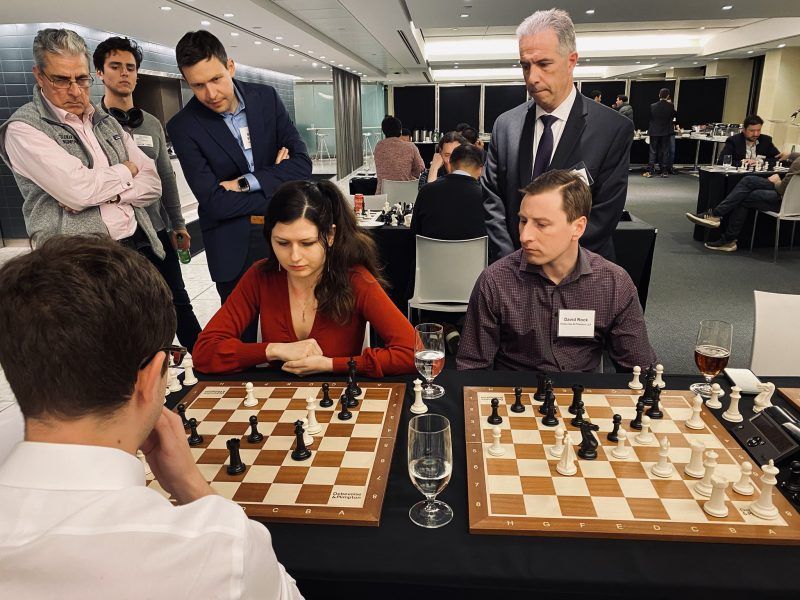
Currently, Melekhina runs the New York City Corporate Chess League (NYCCL), a corporate chess league which she founded, featuring teams from esteemed companies like Google, Goldman Sachs, Deutsche Bank, and Debevoise & Plimpton LLP. The NYCCL finished its second season last November and features a healthy mix of titled and untitled players.
Chess.com: Can you tell us about what made you choose a career as an attorney? Did chess play a role in influencing your decision?
Alisa Melekhina: Law seemed like the natural career option when considering my varied interests. When I was young, I was always intellectually curious and enjoyed puzzle-solving and detective stories. During my high school years, I focused more on science but renewed my interest in writing and logic upon studying philosophy. From there, law was the natural progression given that it draws on essential skills for analytical thinking and persuasive reasoning.
Unsurprisingly, these are also skills prevalent in chess. The skill of planning and anticipating an adversary’s response especially overlap in both fields. Thus, I do credit chess as influencing my decision. On a practical level, at the time I was considering law school, I was also intrigued by the various intellectual property issues present in chess (for example, copyrights over games or player images) and was excited to study this field in law. How did balancing chess and your academic career help you grow (in both pursuits)? Did you have any setbacks along the way? I went straight to law school after graduating with my bachelor’s degree in philosophy (summa cum laude) in two years in 2011. I graduated from Penn Law in 2014. Indeed, during this time I was very active in chess and achieved several chess career highlights. Those who were aware of my academic pursuits might have underestimated how seriously I could still compete in chess. However, that inspired me even more because I thought I had to “prove myself” in being able to succeed in both fields
However, my chess play was very volatile during this time, and I had as many “downs” as “ups.” It is easy to blame the setbacks on lack of time. Yet, I found that time was not the culprit. It was the lack of prioritization on my part and seeking “escapes” in one field when the other wasn’t going well. For example, if I had a lamentable tournament, I would bury myself in my law casebooks the next day and forget about the tournament (at the exclusion of taking the time to analyze and learn from my games). Conversely, if I had a setback with law applications, I would refocus on chess and enter an all-consuming, long tournament. This created a toxic cycle.
To exit, I ultimately had to decide what I wanted to prioritize, and importantly, why. I explored this dilemma in one of my debut articles for the United States Chess Federation's Chess Life Online (“Legal Moves: Melekhina on Chess & Law School”) in 2014, which turned out to resonate with many readers and has inspired my subsequent chess journalism.
Looking back, do you think chess has helped your professional growth? How might it help others who have a career outside of law? Chess 100 percent contributed to my professional growth. Coming from an immigrant family and being a first-generation lawyer, I was coming into the corporate world with a blank slate. Especially for a field that depends as much on networking as it does on academic excellence, I had limited resources to consult and had to figure out everything —from law school admissions to internships, to the job application process — on my own.
Chess 100 percent contributed to my professional growth.
—Alisa Melekhina
I credit chess for the strategic and planning skills required to navigate this process. All job candidates have different strengths, and chess equipped me with a unique skill set that helped put me at least on a level playing field with colleagues much older and with more distinguished pedigrees than I had.
In 2017, you wrote and published your book, which discusses why you believe chess helps navigate the modern workplace. What inspired you to write this book? The book is a collection of my thoughts and introspection on the connections between chess and other competitive fields. Its incipiency was my early writings on chess.
The book adopts a meta-perspective on the motivations behind chess, the mindset required to succeed—whatever that means, a concept also discussed—and what we can glean from those lessons as applied to the external world.
In your book, you write:
"Rather than reacting to every obstacle or dashed expectation, incorporate the event into your overall plan. Real-life setbacks like rejections, broken promises, and unfair disadvantages will happen. Rethink the meaning behind the emotional triggers and how your reaction will further your purpose. Manage emotions by recognizing their place, but do not allow them to control your moves."
Can you give an example of how managing your emotions and decision-making process at the board has translated into your day-to-day responsibilities as an attorney? The day-to-day of an attorney includes —if not already working on meeting a tight deadline—requests for immediate responses from clients or senior team members. When first assimilating to such a demanding work environment, the intuitive reaction is to crank out a hurried response. Chess, on the other hand, teaches you to stay calm in the face of pressure and competing demands.
I’d like to think that chess reinforces a default setting where I’ll first contemplate the best way to approach a demanding situation from all angles of substance and timing, rather than making an impulsive reaction.
Your experience as both a top chess player and a successful attorney is unique in that both fields are traditionally dominated by men. What advice would you offer young women looking to follow in your footsteps? What were some obstacles you had to overcome to get to where you are now? Indeed, the chess and law fields share many parallels concerning overall female participation and retention in more senior roles. Similar to scholastic levels in chess, the starting law school and firm associate classes tend to be evenly split among men and women. When considering ascension into senior roles such as partnership, however, the numbers begin to dwindle. Last I checked the stats, the number of female equity partners at law firms was less than 20 percent. In chess, I believe women comprise about less than three percent of all national masters and less than two percent of grandmasters worldwide.
Because I grew up playing in mixed open tournaments since the age of seven, when I regularly won against men eight to 10 times my age, I was never even cognizant of gender disparities until I got older. Chess is an opportunity to resolve all battles over the board, regardless of age, gender, or background. It is an excellent tool for instilling confidence, in all kids, to level with adults, precisely because the moves speak for themselves.
In corporate settings, on the other hand, information is not as transparent as a recording of chess moves. Implicit biases based on gender and youth are significantly more difficult to overcome because the “results” are not as definitive and there is no inherent “rating” that you can rely on as an indication of your strength.
Chess is an opportunity to resolve all battles over the board, regardless of age, gender, or background.
—Alisa Melekhina
Chess reinforces self-reliance, and likewise in the real world, you have to be your number one biggest advocate. Regardless of the setting, don’t ever be shy about speaking up to either offer your opinions or else vouch for yourself. (Because if you don’t, it’s not likely that someone else will).
What inspired you to run the New York City Corporate Chess League? What does the league's popularity say about how these companies view chess as an asset for potential incoming talent? I am very pleased with the success of the NYCCL to date. It initially formed as the natural next step in finding a common forum for myself and my friends—all longtime chess players who found themselves at major NYC financial/business institutions. We all came across other chess enthusiasts at our respective companies but needed a formal outlet to share our common interest.
As you mentioned and as I discussed recently on the Ladies Knight podcast with WGM Jennifer Shahade, the NYCCL facilitates play among corporate professionals of all skill and seniority levels. It’s not that the league led to its popularity; rather, the league came to be because of the existing popularity of chess among various players at these large institutions.
The New York City Corporate Chess League features teams from companies like Google, Goldman Sachs, Deutsche Bank, and Debevoise & Plimpton LLP. Photo: Alisa Melekhina, NYCCL.
Because of how large the participating banks and companies are, it is impossible for a particular person to know everyone within the company. The league offers a medium for reaching out to chess players in any role within the company in order to represent the company as a collective team. Thus, the NYCCL arose primarily as a way to harness and organize that existing shared interest. For example, it created a sustained network among otherwise decentralized information.
I am most proud that the league accomplishes the goal by providing a forum for chess players of all skill and seniority levels to compete. It’s a way to look past the traditional corporate hierarchies and bring people together within companies and among the external teams. The common factor is that chess is highly respected, and a setting such as the NYCCL helps elevate the status of chess as a mainstay in corporate culture. Our goal is for this sentiment to spread, which would then organically inform staffing or hiring considerations down the line.
For novice players interested in learning chess to boost their professional development, what advice would you offer? Does one have to become master-strength to grow? The goals in learning chess differ depending on whether you decide to play to be competitive, as a scholastic extra-curricular, or as a working professional. In the latter category, the greatest takeaways that chess can offer, in my opinion, are skills enhancing sustained focus, patience, and organization.
Melekhina is still an active representative of the chess community and has written about chess in the New York Times, Los Angeles Times, and The Wall Street Journal. (Photo: Austin Fuller)
It is certainly not necessary to be master-level to appreciate these aspects. However, it is important to keep in mind that progressing in chess requires more than just playing online. I meet many working professionals whose experience in chess is limited to playing quick, online games. That will only take you so far, and in fact, will become detrimental to your overall growth because it will reinforce bad habits. If you are considering playing chess on an adequate level to compete among colleagues, you have to be prepared to budget in time for studying in addition to playing. It doesn’t have to be a major time commitment so long as when you do focus on chess, you are focusing on the right things.
Of all the games you've played, which is your favorite?
I’m most proud of my win over Alexander Shabalov because I figured out a new move order over the board, and had numerous successes with this line of the Alapin opening later in my chess career:
Algorithm blocks human rights investigator from entering US Eyal Weizman was heading stateside for an exhibition by Forensic Architecture, his investigative group
Eyal Weizman, the director of London-based investigative group Forensic Architecture, was first informed by email that his visa waiver had been revoked. No reason was given for the revocation. The next day, he went to apply for a visa at the US Embassy in London, where an officer told him that he couldn’t travel to the country because an algorithm had identified a security threat.
“He said he did not know what had triggered the algorithm but suggested that it could be something I was involved in, people I am or was in contact with, places to which I had traveled (had I recently been in Syria, Iran, Iraq, Yemen, or Somalia or met their nationals?), hotels at which I stayed, or a certain pattern of relations among these things,” Weizman explained in a statement sent to the Architect’s Newspaper.
Weizman, who holds both British and Israeli passports, was also asked if he knew anyone who may have triggered the algorithm — ostensibly to help the Department of Homeland Security investigate his case. He refused to answer the questions. Algorithmic justice
Weizman had been planning to travel to the US for the opening of Forensic Architecture’s first major survey exhibition in the country, which was being held at Miami’s Museum of Art and Design (MOAD).
On display will be investigations into Chicago Police killings, CIA drone strikes in Pakistan, and the use of VR to compel witness testimony, among other work by the Goldsmiths, University of London-based research group.
Weizman had visited the US dozens of times before his visa was revoked. The political sensitivity of his work has led to suspicions that this may be another case of “ideological exclusion,” a policy that closes the door to foreigners whose views the government dislikes.
Weizman told the New York Times that the use of algorithms to measure “relations between actions and movement, between people and places” needed to be examined. However, it’ll be difficult to find out what was the impact (if any) of the algorithm that led him to be blocked from entering the US, as the government refuses to discuss individual visa cases.
You’re here because you want to learn more about artificial intelligence. So do we. So this summer, we’re bringing Neural to TNW Conference 2020, where we will host a vibrant program dedicated exclusively to AI. With keynotes by experts from companies like Spotify and RSA, our Neural track will take a deep dive into new innovations, ethical problems, and how AI can transform businesses. Get your early bird ticket and check out the full Neural track.