Tuesday, September 27, 2022

The Global Water Crisis Could Crush The Energy Industry

  • Water is growing more scarce due to climate change.

  • Water scarcity could derail the green energy boom, and even hinder fossil fuel production.

  • With rising concerns over water scarcity, mainly due to climate change, there are fears that the big transition to renewable energy will be hindered even further.

For years, the energy sector, and almost every other sector, has taken water for granted, viewing it as an abundant resource. But as we move into a new era of renewable energy, the vast amounts of water required to power green energy operations may not be so easy to find. And it’s not just renewables that are under threat from water scarcity, as it also hinders fossil fuel production and threatens food security. 

In recent months, we have seen extreme droughts across Europe and the U.S., which are finally making people realise the significance of water security. Stefano Venier, CEO of the Italian energy infrastructure company Snam, highlights the huge impact recent droughts have had on both food security and energy production. Labelled as ‘Europe’s worst drought in 500 years’, the low water levels have restricted shipping capabilities, as well as drying up soil and reducing summer crop yields

Venier explains, “For a long time, water was considered [as being] for free, as something that is fully available in any quantity.” He went on to say, “Now, we are discovering that with climate change … water can become scarce.” And so, “we have to regain the perception of importance, and the value [that] … the water has, also, with respect to … energy production… we have discovered that without water, enough water, we cannot produce the energy we need, or we can’t ship the fuels for filling the power plants,” he added.

The drought has already raised concerns for nuclear power plant operators that rely on water from rivers to cool their nuclear reactors. EDF typically uses water from the Rhone and Garonne but rising water temperatures mean that nuclear power output could be reduced during hot periods. The falling water levels have also hindered traditional energy operations such as coal output, according to several European energy firms.

But the issue of water scarcity is perhaps most detrimental to hydropower projects. In the U.S., several hydropower operations are located along rivers with falling water levels, with a higher risk of water scarcity by 2050. Montana, Nevada, Texas, Arizona, California, Arkansas and Oklahoma are the most affected states. A recent study published in the Journal Water found that 61 percent of all global hydropower dams will be in basins with very high or extreme risk for droughts, floods or both. In addition, one in five hydropower dams will be in high flood risk areas, an increase from one in 25 today. 

World Wildlife Fund’s Global Freshwater Lead Scientist Jeff Opperman explains, “Hydropower projects must deal with a range of hydrological risks–ranging from too little water to too much–and these risks are projected to increase in many regions due to climate change.” “Already, we’ve seen regions, such as the southwestern US, southern Africa, and Brazil, where hydropower generation has declined due to falling water levels,” he adds. 

And it’s not just the U.S. that is facing these challenges. In August, Norway threatened to limit its power exports due to low reservoir levels. The country, which relies on hydropower for around 90 percent of its electricity production, increased regulations on power production to prevent hydroelectric reservoir levels from running out of water. This news came just days after the world’s longest under-sea power cable began transferring hydroelectric energy from Norway to the UK. 

Norway’s Minister of Petroleum and Energy Terje Aasland explained, “We need a management mechanism or security mechanism that safeguards national security of supply so that we do not run out of water in our reservoirs.” He added, “We are now introducing a system where, when we come to a situation where the magazine capacity is below what is normal for the time of year and down to a critically low level, there will be a restriction on exports.” 

These kinds of restrictions could become commonplace if these severe weather events, and related water scarcity, continue to take place. Europe’s recent heatwave far exceeded the expectations of climate experts, with several countries reaching record highs which led to wildfires in areas that had never previously experienced such events, showing the reality of the effects of climate change. 

As well as the detrimental effect water scarcity has on energy output, it also has a hugely negative impact on food production. With several areas of the world seeing poorer harvests year on year, as temperatures soar and water scarcity becomes a challenge, many countries are worried about their food production levels. And the water-food-energy nexus is raising concerns over the impact of the two other factors on the energy sector. We’re already seeing this nexus work the other way, with increasing gas prices causing fertiliser shortages, which have exacerbated the impact of water shortages on agricultural yields further. 

With rising concerns over water scarcity, mainly due to climate change, there are fears that the big transition to renewable energy will be hindered even further. However, even traditional fossil fuel production cannot escape from the effects of water scarcity, and the water-food-energy nexus may further exacerbate the situation, meaning that plans to mitigate this scarcity must be quickly established to avoid a major energy crisis. 

By Felicity Bradstock for Oilprice.com

SEX POSITIVE IN A STALINIST COUNTRY
'I'll keep being myself': Newly crowned Miss Hong Kong Denice Lam doesn't fret being called 'nymphomaniac'


SEPTEMBER 27, 2022
ByKHOO YI-HANG

Denice Lam, daughter of 1980s Hong Kong acting legend Wilson Lam, will keep being true to herself.
Instagram/Denice Lam

Her sex life laid bare, recent Miss Hong Kong winner Denice Lam isn't worried about letting the world know about the sexual encounters she's had in the past.

Denice, 27, was declared the winner of the Miss Hong Kong 2022 beauty pageant last Sunday (Sept 25) but her fame has brought her unsavoury remarks labelling her as a "nymphomaniac".More from AsiaOneRead the condensed version of this story, and other top stories with NewsLite.

This is following her candid interview on talk show Abracadabra, where she described at length the more intimate moments of her sex life.

Said Denice during the show: "[Scorpio men] are not just handsome and tall, but they also have many moves and can last long.

"If you want to have a relationship with Scorpio men, it requires a lot of physical stamina. He will flip you around — I was light-headed and sweating profusely."

Adding that she's had five sexual partners, she also recalled an incident where a Pisces man lasted for around three seconds.

Read AlsoDaughter of 1980s Hong Kong heart-throb Wilson Lam crowned winner of Miss Hong Kong 2022


The man purportedly hugged her from behind and started rubbing on her before stating that he was done.

Her blunt anecdotes resulted in netizens flaring up and insulting her, even referring to her as a "nymphomaniac".

According to multiple media reports, Denice has responded to this uproar: "In this era, we don't need to be so secretive; relations between men and women are very common."

She added that previously, when she had one foot in the door of showbiz and was looking for opportunities to perform, she didn't expect to have such a big response.

"This has been a valuable lesson, but even so, I'll keep being myself in the future. As long as one is of a virtuous mind, it shouldn't matter what others say."

https://en.wikipedia.org/wiki/Sex-positive_movement

Sex-positivity is "an attitude towards human sexuality that regards all consensual sexual activities as fundamentally healthy and pleasurable, encouraging ...

https://www.ursu.ca/2021/07/28/what-is-sex-positivity

Jul 28, 2021 ... The term sex positivity was first coined in the 1920's by Wilhelm Reich who was a student of Sigmund Freud. Reich shared that sex wasn't as ...

https://www.esquire.com/uk/life/a36554013/fighting-for-the-female-orgasm-wilhelm-reich

May 28, 2021 ... His anti-authoritarian orgasm theory, which stressed the importance of open relationships and sexual freedom with women's economic and bodily ...

https://www.theguardian.com/books/2011/jul/08/wilhelm-reich-free-love-orgasmatron

Jul 8, 2011 ... Reich was a sexual evangelist who held that satisfactory orgasm made the difference between sickness and health. It was the panacea for all ills ...

https://theanarchistlibrary.org/library/marie-louise-berneri-wilhelm-reich-and-the-sexual-revolution

“To the individual with a genital structure, sexuality is a pleasurable experience and nothing but that; work is joyous vital activity and achievement. To the ...

https://www.fkawdw.nl/en/review/image/out_of_the_box_wilhelm_reich_and_the_future_of_sex

For Reich, this wasn't merely a physical process, but a political one. In his 1927 study The Function of the Orgasm, he theorized that the orgasm had healing ...

http://www.williamapercy.com/wiki/images/Negpos.pdf

SEX NEGATIVE, SEX. POSITIVE. This polarity owes its inception. toWilhelmReich(1897-1957),whosought ... the exaltation of "sex positivism" per-.

https://www.refinery29.com/en-us/2013/11/57345/sex-positive-meaning

Nov 17, 2013 ... Essentially, way back in the 1920s, Wilhelm Reich, a psychoanalyst and student of Sigmund Freud spread the word that sex wasn't the terrible ...

Why Some Plants SQUIRT and Others EXPLODE! 
(Biophysicist Reacts) 💥🌱
Sep 26, 2022
CNET

Plant expert Dwight Whitaker guides us through an assortment of exploding plant species known as "touch-me-nots", with expert commentary on the evolution of plants and their abilities to spread their seeds far and wide in a unique way.


Incredible Electric Plane Crosses A Major Milestone

Rahul Srinivas - Yesterday 

In 2022, it is common to spot people going about their daily lives using electric vehicles. These vehicles typically range from buses and cars to battery-powered scooters and motorcycles. Given that electric vehicles have already proven their viability as excellent replacements for internal combustion engine vehicles, it was only a matter of time before someone thought of coming up with electric planes, as well. One of the primary reasons for the growing interest in electric planes is concerns over the environmental effects of the aviation industry, which as of 2018 accounted for 2.4% of all fossil fuel-derived CO2 emissions (via NIH).


Person near Eviation Alice prototype© Mathieu Lewis-rolland/Getty Images


With the number of people traveling by air expected to rise exponentially in the decades to come, developing an alternate, cleaner form of air travel is becoming vital. Interestingly, the concept of a battery-powered aircraft isn't entirely new, with the earliest records of such an aircraft concept dating back to the late 1880s. However, the major impediment to the development of such a plane was the battery, which simply could not hold the energy needed to power a reasonably long flight. The development of lithium-ion batteries in the '70s and '80s did solve this problem to some extent.

With significant investments from established players in the aviation industry, the development of electric planes is undoubtedly happening at a heightened pace these days. One of the companies working to develop an electric plane is Eviation, which recently completed a major milestone in the development of an all-electric aircraft called the Eviation Alice.

Eviation Alice: Everything You Need To Know


Eviation CEO and plane© Mathieu Lewis-rolland/Getty Images

Designed for commercial use, the Eviation Alice is a small 57-foot-long all-electric aircraft focused on ultra short-haul flights. The aircraft was in the news after it passed a major test called the high-speed taxi rotation test. The next stage in the development of Alice is its first test fight, which is also expected to happen soon. The Eviation Alice team is targeting a range of 440 nautical miles (506 miles), according to the company's website, though a small disclaimer notes such a range would be without payloads and in ideal conditions.

The model can carry up to nine passengers and their luggage with reasonable comfort, and other cabin designs (such as for cargo) have also been teased by the company. The plane can also accommodate two pilots. What makes the Eviation Alice different from most of its peers is its rather slick design, which mimics the looks of a traditional aircraft.
Like electric cars, the Eviation Alice comes powered by a massive array of lithium-ion batteries located at the belly of the plane. These batteries weigh up to 8,000 pounds and take up a significant amount of weight and space. To keep the weight of the aircraft down, Eviation used carbon composite materials to build it and fly-by-wire technology for controlling the aircraft, according to PopSci. Despite the seemingly advanced stage of development, the fact remains that Eviation Alice is still a couple of years away from its first commercial flight, though the first test flight is likely to happen later this year.

Are electric air taxis ready for takeoff? Maybe sooner than you think

Manufacturers ramp up test flights ahead of commercial

 transport of goods and passengers

A prototype of an electric vertical takeoff and landing aircraft or eVTOLs by Airspace Experience Technologies. (Shawn Benjamin/CBC News)
Imagine you're about to order an Uber to the airport, but there's terrible traffic. Instead, you click "air taxi" on your smartphone, and walk a few blocks to a parking garage. You head up to the roof, where an aircraft that looks like a giant drone picks you up.

Within minutes, it drops you and a handful of other passengers at the airport to catch your flight.

That's the potential of eVTOLs, or electric vertical takeoff and landing aircraft  — and the aviation industry says it won't be long before they take to the skies commercially.

These battery-powered aircraft will move cargo and passengers between the city, the suburbs, and airports, says Jon Rimanelli, CEO of Airspace Experience Technologies.

His Detroit-based company is one of dozens building eVTOLs, technology that's getting more attention as cutting greenhouse gas emissions from burning fossil fuels becomes a global priority.

The eVTOL by Archer Aviation called Maker completing a test flight in December 2021. (Archer Aviation)

"Traffic is a big problem, right? It's not only taking up our time and anxiety, it's creating carbon emissions … it's hurting our environment," he says. "We have to do something different."

Air taxis still have a limited range because of their battery capacity, but some can cover a distance of about 250 kilometres. They generally take off and land anywhere a helicopter can, so they don't need a runway, and many are pilot-optional and can be flown remotely. They also make little noise as they travel. 

Rimanelli hopes it won't take much to win over the public.

"Once people see the utility of it, once they have a chance to experience it because it's super quiet…. It's just a tremendous difference between commercial grade helicopters that we all know today."

Rimanelli predicts some eVTOLs will first be used for deliveries, before they actually transport passengers. His prototype, which was on display at this year's Detroit Auto Show, is designed with a pod that can carry goods or people.

"We're more flexible. We can plug and play different containers to do different jobs, whether it's medical evacuation, cargo or passenger mobility," he says.

Making big bets

The aviation industry is betting millions of dollars air taxis will play a big role in the future of transportation.

Over the past few months, U.S. carrier United Airlines ordered 200 air taxis from Eve Air Mobility and another 100 from Archer Aviation. American Airlines had an agreement for 250 from Vertical Aerospace. Last year, Canadian helicopter operator Helijet inked a deal with Blade Air Mobility. The partnership gives Blade the rights to Helijet's routes and infrastructure, and Helijet access to Blade's air taxis.

Wisk Aero's all-electric, pilotless Cora eVTOL is backed by Boeing. (Wisk Aero)

Automakers are also showing interest in the eVTOL space, which has significant overlaps with electric vehicles. They are already pouring money into developing EV batteries. Hyundai, GM and Volkswagen are all working on developing their own air taxi prototypes. Automakers can offer air taxi-makers manufacturing expertise as well. Daimler has partnered with Volocopter, while Joby Aviation counts Toyota as a major investor.

Analysts say the opportunity is there: consulting firm McKinsey predicts that by 2030, air taxis could be a multi-billion dollar market. But costs will need to come down for broader adoption; some eVTOLS still cost upwards of $1 million.

Competition is stiff among hundreds of startups and not every company will survive. Just this week, Kittyhawk, an air taxi-maker backed by Google co-founder and billionaire Larry Page, announced on Twitter that it would be winding down its business.

New regulations on the drawing board

While the technology is rapidly maturing, there's still much work to be done on the regulatory side.

"There's going to have to be some form of air traffic control and pilot certifications and operational requirements," says Nigel Waterhouse, an aerospace consultant.

Regulators around the world are evaluating the new machines. With plans to fly at low altitudes in urban areas, there are significant safety concerns. Officials in the European Union recently published what they called the world's first rules for the operation of air taxis. The U.S. Federal Aviation Administration is working on certification for several eVTOL companies, some hoping to have paying customers as soon as 2024.

Volocopter aims to fly electric air taxis in Singapore by 2024. (Volocopter)

Waterhouse says it may be slow-going. "These companies that are developing these aircraft are quite ahead of the curve and the FAA is trying to catch up, but they are trying to be more flexible in applying the rules," he says.

Meanwhile, Transport Canada told CBC News that while it doesn't currently have standards, it will "review and update its regulatory framework as necessary to ensure that its high safety standard is maintained."

Manufacturers like Rimanelli insist their designs are safer compared to helicopters.

"Because it's electric, it's a simple machine," he says. "Fewer failure modes, fewer parts. So that's one of the key benefits to a system like this, it's inherently more reliable."

But it's not just regulators that need convincing, Waterhouse says. "It's going to be an exercise for the operators to sell the idea to the public and to make them feel safe in these aircraft... So that may be a fairly steep curve."

If you build it, they will come

Cities and suburbs will also need infrastructure to support air taxis, if this new type of mobility is to take off. Some startups are tackling that challenge with plans to build terminals called vertiports. Vertiports would offer air taxis a place to take off and land, and charge their batteries.

VPorts, a Montreal-based startup, plans to build and operate a network of vertiports for air taxis. (VPorts)

Montreal-based VPorts hopes to build and operate a network of 1,500 vertiports for commercial cargo transportation over the next two decades, starting with a corridor between Canada and the U.S., says CEO Fethi Chebil. "Cargo is a very important business and we believe that by having this corridor we will reduce the cost of ... the transport of goods between the two countries by 10 per cent," says Chebil.

Chebil says eVTOL test flights are planned for the corridor next year. When asked about the timelines for passenger transportation, he says the technology has to evolve but "when you and me fly in a couple of years, we can fly safely. You'll be surprised."

With files from Shawn Benjamin

Hurricane Fiona has destroyed much, but the Sable Island horses survive

The island's wild horses have survived 200 years of Atlantic hurricanes by sheltering in groups beside sand dunes

Author of the article: Tristin Hopper
Publishing date:Sep 26, 2022
Wild horses run on the grasslands of Sable Island. 
PHOTO BY JENNIFER NICHOLSON/HANDOUT

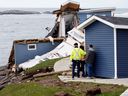
Hurricane Fiona has flattened scores of homes and killed at least one person, but there is a spot of good news amid all the destruction: The famed wild horses of Sable Island appear to have weathered the storm without incident.

Sable Island is a 44 km-long, crescent-shaped sandbar located about 300 kms east of Halifax. The island is most famous for a population of around 500 wild horses that are believed to be the descendants of mounts that escaped in the 18th century.

On Saturday morning, as Atlantic Canadians took stock of homes and villages smashed to timbers by the storm, the Sable Island horses emerged from hiding and were soon back to grazing and whinnying on beaches now strewn with debris.

“By late morning (Saturday), horses had emerged from sheltered areas and were grazing, grooming, and engaged in their usual activities,” read a weekend update by the Sable Island Institute, a non-profit devoted to the conservation of the isolated island.

Storms are nothing new to Sable Island, as evidenced by the more than 350 historic shipwrecks peppering its small coastline.

The island is devoid of the usual landforms that can cushion the impact of a severe storm. There is no bedrock of any kind; Sable Island is exclusively composed of sand and the occasional pebble of gravel. The island’s sole tree is a deformed pine planted as part of a failed 1950s experiment.

Due to its isolated location, the island is vulnerable to extreme weather coming from any direction, and is known to vary wildly in size and shape thanks to wave erosion and the near-constant removal of sand due to high winds.

Despite this, the Sable Island horses have successfully weathered more than 200 years of Atlantic hurricane seasons. Their typical strategy is to gather tightly together between large dunes, the youngest and most vulnerable horses to the centre, with the strongest adults to the outside.

A band of wild horses rest at the edge of a Sable Island pond. 
PHOTO BY HANDOUT

Adding to the horses’ ability to hunker down is that they’re well known as capable diggers; the Sable Island horses are often known to obtain freshwater by scratching out shallow wells.

“The horses are pretty used to storms, they find shelter from the wind and blowing sand in the lee of dunes — there are plenty of hollows and high dune slopes in inland areas, and depending on the wind direction, the horses also huddle on the beach at the base of the dunes,” wrote the Sable Island Institute.

During the worst of Hurricane Fiona, wave heights near the island were reaching as high as 30 metres. However, the Institute reported that the island’s large, sloping beaches were able to tame the worst of the waves and prevent them from swamping the “areas inland and between dunes” where the horses would have been sheltering.

Which isn’t to say that prior storms haven’t been devastating to the Sable Island horses. One 1905 report wrote of horses succumbing to starvation after high winds destroyed much of the island’s wild grasses.

Sable Island is nominally uninhabited by humans. In large part because of its isolation and exposure to severe weather, Sable Island has only ever been fit for rescue stations and the occasional military outpost.

A group of young male horses drink at a freshwater pond on Sable Island.
 PHOTO BY ZOE LUCAS/HANDOUT

Nevertheless, four people remained on Sable Island throughout the storm: Three Parks Canada staff members and one researcher took shelter in the low cluster of buildings forming Sable Island Station.

Although the four spent much of Friday and Saturday cut off from the outside world, by Saturday afternoon they were able to re-establish an internet connection via Starlink satellites.

“Everyone is fine, but there is a lot of wind damage and debris around the station to clean up, as well as some erosion that will prevent vehicles from checking the beaches for a while,” reported the Sable Island Institute.

While the Sable Island horses did not find themselves among the casualties of Hurricane Fiona, the storm did destroy a number of celebrated natural landmarks in addition to the destruction it wrought on human settlements.

Teacup Rock, a much-photographed P.E.I. rock formation, was toppled over by the storm. As was the Shubenacadie Tree, a beloved 300-year-old Nova Scotia oak that was clearly visible to motorists driving between Halifax and Truro.

Prince Edward Island’s famous Tea Cup Rock didn’t survive Hurricane Fiona.
 PHOTO BY GETTY IMAGES


Not again: Why another federal election may be on the horizon in Canada

Thomas Klassen, Professor, 
School of Public Policy and Administration, York University, Canada
THE CONVERSATION
 - 9h ago

The recent selection of Pierre Poilievre as Conservative leader and Justin Trudeau’s announcement that he will lead the Liberals into the next federal election has started a chain of events that will play out over the next 12 months.


Prime Minister Justin Trudeau and Conservative leader Pierre Poilievre greet each other as they gather in the House of Commons to pay tribute to Queen Elizabeth in Ottawa on Sept. 15, 2022.© THE CANADIAN PRESS/Sean Kilpatrick

After that Canadians can expect another federal election.

During the past century, no minority government has lasted three years; most far less. Trudeau’s current minority isn’t likely to break any longevity record.

The confidence-and-supply agreement negotiated earlier this year between the Liberals and NDP was aimed at ensuring the Liberal minority governs to 2025. But the agreement isn’t binding, and it will probably falter sooner rather than later. Both parties will want their independence or else Poilievre will depict them as interchangeable.

The Conservatives will need a year to develop a new policy platform and adjust to their new leader. The result will likely be a more centrist party than the one that elected Poilievre. That’s because the party has to get votes from those who rejected it in 2021 if it hopes to form the next government.
Avoiding austerity measures

The new Conservative platform will likely entail a smaller, and smarter, hand for the state, but probably won’t contain slash-and-burn proposals. No party in recent federal elections has advocated austerity measures.

Similarly, provincial election campaigns, such as in Ontario earlier this year and currently in Québec, show that parties of all stripes are unwilling to run on a platform that explicitly reduces benefits, or even makes realistic proposals for a balanced budget in the short term.


François Legault, head of the Coalition Avenir Québec, greets supporters after casting his ballot in L'Assomption, Que. ahead of the provincial election on Oct. 3.© THE CANADIAN PRESS/Graham Hughes

Trudeau’s Liberals will probably shift to the right over the next year, seeking to occupy as much of the political spectrum as possible by squeezing the NDP on the left and the Conservatives on the right. The party will work hard to demonstrate to voters that it is a sound steward of economic prosperity.

Both parties will prioritize urban voters in Toronto, Montréal and Vancouver. Election after election has shown that as long as most ridings in these cities vote Liberal, the party cannot be denied power, either as a majority or minority.

An early move by Conservatives to shore up support in voter-rich Ontario is the hiring of the executive director of Ontario’s Progressive Conservative party, Mike Crase, as the new executive director of the federal Conservatives.
Weak, rudderless?

Once a year is up, the current minority government may totter on its last legs. That’s because if the Liberals shift to the right, the NDP will have less reason to support the minority government. And Trudeau will likely be loath to be portrayed by Poilievre as being in bed with the NDP. It will be easy for the Conservatives to paint Trudeau as weak, rudderless and only in power due to the NDP.

Once 2023 rolls around, Trudeau will probably be eager to battle the still inexperienced Poilievre. At the same time, the new leader of the opposition will likely savour the opportunity to take on a prime minister seeking a fourth mandate.


Conservative Sen. Patrick Brazeau and Justin Trudeau, then Liberal leader, fight in a charity boxing match in March 2012 in Ottawa. Trudeau stopped Brazeau in the third round.© THE CANADIAN PRESS/Fred Chartrand

Neither will have any reason to prefer waiting another two years before seeking a mandate from voters. Like boxers who spar as long as they can, they will be keen to strike a knockout punch as soon as the opportunity arises.

The Conservatives and the Liberals will both paint the election as a referendum between stark opposites, even if their election platforms probably won’t be very dissimilar.

With higher interest rates and soaring inflation, all parties will position themselves as guardians of the well-being of the middle class and working Canadians. It is via this guardianship that the parties will seek to differentiate themselves and appeal to specific groups of voters.

In calling another election the Liberals, as the incumbents, would control the exact timing. Of the past five elections, four were held in September or October. Elections during these months permit campaigning during pleasant late summer and early fall weather and don’t interfere with the summer plans of voters. Late spring elections are also common for the same reasons.
The unknowns

Of course, in political life there’s always uncertainty. Like his father did, Trudeau might go for a walk in the snow this winter and conclude that 15 years as MP, 10 years as Liberal leader and nearly eight as prime minister is enough.


Foreign Affairs Minister Mélanie Joly addresses the United Nations General Assembly in New York.© (AP Photo/Julia Nikhinson)

If so, Trudeau might delay the next election as long as possible to provide time for a successor, such as Chrystia Freeland or Mélanie Joly, to assume the party’s leadership.

Or a scandal might threaten one of the party leaders.

Less likely, but not entirely improbable, is a splintering of the Conservative party along ideological lines. A natural disaster or international events could also change the calculus and delay the next election.

Nonetheless, an election in the fall of 2023 or spring of 2024 is probably what Canadians can expect — or dread.

This article is republished from The Conversation, a nonprofit news site dedicated to sharing ideas from academic experts.


Read more:
What the spectre of Alberta separatism means for Canada
ICYMI
Former Particle Physicist Absolutely Annihilates the Field of Particle Physics

Maggie Harrison - Futurism


According to former particle physicist Sabine Hossenfelder, the state of the field of particle physics is misguided and wasteful


Shots Fired

If you have trouble keeping up with the latest particle physics, we don't blame you. The buzzy field has exploded in recent years, with a vast string of highly experimental studies — and a lot of highly inconclusive literature — spawning as a result. You'd be forgiven for assuming that if this much time, money, and effort and is going into one particular realm of study, it must be worth it. Right?

According to former particle physicist Sabine Hossenfelder, the answer, sadly, is wrong.

"It has become common among physicists to invent new particles for which there is no evidence, publish papers about them, write more papers about these particles' properties, and demand the hypothesis be experimentally tested," Hossenfelder, who now works as an astrophysicist, argued in an excoriating essay for The Guardian. "It is wasting time and money."

Big Grain Time

Hossenfelder's case rests on several criticisms of the field, the first being social. Basically, she says, everyone is following the leader. If your peers are receiving grants in the name of far-flung, conceptual, unproven particles, why would anyone opt out? Science isn't cheap, and going against the grain is by nature a far more difficult sell.

But that issue aside, the astrophysicist believes there to be a deeper problem with the race for particle discovery: that particle physicists have "misconstrued" Karl Popper's philosophy of falsifiability, incorrectly interpreting it to mean, as she writes, that "any falsifiable idea is also good science."

In other words, many of her peers have used falsifiability to justify a heft chunk of dead end research, rather than using it as a guideline. And this, in her opinion, has led to the use and study of misinterpreted-and-or-probably-not-real particles as convenient plugs for statistical holes in a number of other theories. A troubling observation, given that, if true, it would mean that a lot of research out there is being held up by nonexistent glue.

"I believe there are breakthroughs waiting to be made in the foundations of physics; the world needs technological advances more than ever before," the astrophysicist explains, "now is not the time to idle around inventing particles, arguing that even a blind chicken sometimes finds a grain."

"It saddens me," she added, "to see that the field has become a factory for useless academic papers."

READ MORE: No one in physics dares say so, but the race to invent new particles is pointless [The Guardian]

More on particle physics: Cern Scientists Annoyed That People Think They're Ripping a Hole in Reality

The post Former Particle Physicist Absolutely Annihilates the Field of Particle Physics appeared first on Futurism.


Our Entire Galaxy Is Rippling and the Reason Why Is Wild

Maggie Harrison - 
Futurism


You can't see or feel it, but our Milky Way galaxy is actually... rippling, like a galactic pond that's been hit by a cosmic stone. Here's why

Ripple Effect


You can't see or feel it, but the Milky Way where our solar system lives is rippling, scientists say, like a pond that's been disrupted by a stone. Except in this case, as Live Science explains, that pond is our home galaxy, and the rock — our neighboring Sagittarius dwarf galaxy — is the size of 400 million Suns.

Eep! Fascinating, if it doesn't trigger an existential crisis.

But fear not, the rippling can't hurt you — and actually, according to a new study published in the journal of the Royal Astronomical Society, there's a lot that this ancient wobbling can teach us about our galaxy's oft-chaotic history.

Galaxy Messed


Importantly, the galactic rock-to-pond collision at hand happened eons ago. Anything that astronomers are seeing now is the result of age-old cosmic impacts. But that being said, if we can't actually see or feel the residual rippling, how do we know it's there?

To examine the cosmic wobble, the international team of researchers used data from the European Space Agency's Gaia space observatory to study the movements of over 20 million Milky Way stars, tracking and comparing their positions. Through a process of "galactic seismology," they modeled the ripples as well as the likely time of the Sagittarius collision in question, which they believe took place hundreds of millions of years ago.

"We can see that these stars wobble and move up and down at different speeds," co-author Paul McMillan, an astronomer at Sweden's Lund University, explained in a translated statement.

Crash Into Me


While previous studies have concluded that our galaxy indeed is rippling, this one, as Live Science explains, is the first to show that the ripples move all the way through its furthest reaches — a sign that at the time, our comparatively small neighbor was actually much bigger than it is today.

This research also corroborates the hypothesis that the Milky Way and Sagittarius galaxies have actually crashed into each other not once, but multiple times, throughout the history of our universe. And ultimately, it offers a new, fascinating glimpse into the beginnings of our home galaxy and its neighbors — and in studying collisions past, we can hopefully understand the ones likely to happen in the future.

READ MORE: The Milky Way is 'rippling' like a pond, and scientists may finally know why [Live Science]
New Webb Telescope image reveals an eerie portrait of a familiar galaxy


Kiona Smith -  Inverse

Webb’s mid-infrared instrument reveals a stunning spiral galaxy in a whole new light, showing what’s going on behind an already-gorgeous Hubble Space Telescope photo.


In the wavelengths of light our eyes can see, IC 5332 is the perfect image of a spiral galaxy. 29 million light years away, it’s a bit larger than the Milky Way (about 66,000 light years wide) and almost exactly face-on toward Earth, offering us a perfect view.

Hubble captured a dazzling image of the galaxy’s glowing arms of stars, swirling outward from a blazing center, with dark bands in between. It’s classic. But viewed in infrared light, through the James Webb Space Telescope’s Mid-Infrared Instrument, the galaxy looks completely different — as if we’ve wandered into the Upside Down from Stranger Things.

The overall spiral shape is still there, but the familiar swirling bands of bright stars and dark dust become a strange, intricate web of glowing matter, with distant galaxies showing through the gaps. Even the stars themselves look different; some of the stars that shine brightest in the familiar Hubble image are missing in the infrared version, replaced by different ones.

Related video: Webb Telescope captures details of Phantom Galaxy and its 100 billion stars
Duration 0:32 View on Watch


James Webb Space Telescope captures stunning images of the Tarantula Nebula


The James Webb Space Telescope Provides ‘Breathtaking’ New Views of the Orion Nebula

It’s a gorgeous — and slightly disconcerting — example of how the physics of light can reveal some things and hide others.

Those dark bands of dust between the bright, starry spiral arms look dark to us because the dust scatters and blocks shorter wavelengths of light, including visible and ultraviolet. But longer wavelengths of infrared light can shine right through the dust, making those dark bands transparent — and revealing a whole new structure behind the familiar swirling bands.


That’s also why Webb and Hubble see a different set of stars in IC 5332. Some stars shine brighter in particular wavelengths. Young, massive stars tend to blaze with high-energy ultraviolet light, for instance, while smaller or older stars are usually brighter in infrared. By viewing the same galaxy through both telescopes, astronomers can see them all instead of just one set or the other.

Both Hubble and Webb can see the shortest infrared wavelengths — what’s called “near-infrared” because its wavelengths are “next door” to visible light on the electromagnetic spectrum. But to give us this Stranger Things-esque view of IC 5332, Webb needed to capture slightly longer wavelengths of light, in what’s called the “mid-infrared” part of the spectrum. That’s something Hubble can’t do, because the older space telescope just isn’t cool enough — literally. If Hubble tried to view the universe in mid-infrared light, it would mostly see the heat from its own mirrors, rather than the glow of distant cosmic objects.

Webb can take mid-infrared images of galaxies like IC 5332 because its Mid-Infrared Instrument, MIRI, has its own cooling system that keeps the instrument at -266°C (-447°F). That’s just 7°C (45°F) above absolute zero, at which there’s no heat – no energy – at all. All of Webb’s other instruments run at a comparatively balmy -233°C (-387°F).

In other words, Webb — like Stranger Things’ Mind Flayer — likes it cold.