Thursday, November 21, 2024

Gang violence leaves at least 150 dead in Haiti's capital this week, UN says

The death toll from gang violence in Haiti this year rose to over 4,500 after 150 people were killed in the capital of Port-au-Prince over the past week, United Nations human rights chief Volker Turk said on Wednesday. Amid rampant violence and persistent political instability, Turk said the latest "upsurge" in violence is a "harbinger of worse to come"
.


Issued on: 20/11/2024 - 
By:  NEWS WIRES
Video by:  Matthew-Mary Caruchet

Soaring violence in Port-au-Prince since last week has left at least 150 people dead, bringing the number of deaths in Haiti this year to over 4,500, the United Nations said Wednesday.

"The latest upsurge in violence in Haiti's capital is a harbinger of worse to come," UN rights chief Volker Turk warned in a statement.

"The gang violence must be promptly halted. Haiti must not be allowed to descend further into chaos."

Violence has intensified dramatically in Port-au-Prince since November 11, as a coalition of gangs pushes for full control of the Haitian capital.


Well-armed gangs control some 80 percent of the city, routinely targeting civilians despite a Kenyan-led international force that has been deployed to help the outgunned police restore some government order.

"At least 150 people have been killed, 92 injured and about 20,000 forced to flee their homes over the past week," Turk's statement said.

In addition, "Port-au-Prince's estimated four million people are practically being held hostage as gangs now control all the main roads in and out of the capital".

Monica Juma, Kenya's presidential national security advisor, said on Wednesday that her nation backs calls from Haiti for the United Nations to consider turning the current international security mission into a formal UN peacekeeping mission.

Juma told a UN Security Council meeting on Wednesday that Kenya, believed a formal peacekeeping mission could bring more resources to confront an escalating gang conflict.

The current mission has deployed just a fraction of troops pledged by a handful of countries and less than $100 million in its dedicated fund.

The Haitian capital has seen renewed fighting in the last week from Viv Ansanm, an alliance of gangs that in February helped oust former prime minister Ariel Henry.

03:16© AFP


Turk said that at least 55 percent of the deaths from simultaneous and apparently coordinated attacks in the capital resulted from exchanges of fire between gang members and police.

He also highlighted reports of a rise in mob lynchings.

Authorities said Tuesday that police and civilian self-defence groups had killed 28 gang members in Port-au-Prince after an overnight operation as the government seeks to regain some control.

Last year, in a gruesome chapter of the vigilante reprisals, a dozen alleged gang members were stoned and burned alive by residents in Port-au-Prince.

The UN rights office said the latest violence brought "the verified casualty toll of the gang violence so far this year to a shocking 4,544 dead and 2,060 injured".

The real toll, it stressed, "is likely higher still".

In addition, an estimated 700,000 people are now internally displaced across the country, half of them children, it said.

Turk warned that "the endless gang violence and widespread insecurity are deepening the dire humanitarian crisis in the country, including the impacts of severe food and water shortages and the spread of infectious diseases".

This was happening "at a time when the health system is already on the brink of collapse", he said, adding that "threats and attacks on humanitarian workers are also deeply worrying".

"Gang violence must not prevail over the institutions of the State," he said, demanding "concrete steps ... to protect the population and to restore effective rule of law".

(AFP)


HAITI, LE ZOMBIE AND UNITED FRUIT COMPANY 

SEE MY GOTHIC CAPITALISM
Feb 15, 2005 — The development of capitalism in the 18th and 19th Centuries saw not only bourgeois revolutions but the revolt of slaves and the most successful ...

Full text of "The Horror Of Accumulation And The Commodification ...

https://archive.org › stream › The+Horror+of+Accumul...

Karl Marx GOTHIC CAPITALI$M The Horror of Accumulation & The Commodification of Humanity Gothic Capitalism The Horror of Accumulation and the 

 WHITE BRO KULTURKAMPF 

Want to understand why Trump won the election? Look at pop culture.


How entertainment, from Morgan Wallen to Twisters, predicted the MAGA pivot.


by Kyndall Cunningham
Updated Nov 15, 2024

Singers Post Malone and Morgan Wallen performing at the 57th Annual CMA Music Awards on November 8, 2023
 Frank Micelotta/Disney via Getty Images

Earlier this year, conservatives on social media claimed an unlikely new icon. It wasn’t a podcaster with questionable views or a libertarian businessman selling a course or any particular ideology. It was actress Sydney Sweeney, Euphoria star and the recent lead of the rom-com Anyone but You.

Following her Saturday Night Live hosting gig in March, two conservative outlets published columns heralding Sweeney as a return to conventional beauty standards of the ’90s and early 2000s — or as, Bridget Phetasy for the Spectator put it, “the giggling blonde with an amazing rack.” Both pieces postulate that, by wearing low-cut dresses and playing up her sexuality, Sweeney was inviting men to gawk at her, therefore raising a middle finger to “woke culture” and the Me Too movement.

Sweeney hasn’t publicly aligned herself with the right in any way. (Her family’s politics, though, were the subject of controversy in 2022, which may have something to do with the right’s eager embrace of her.) Rather, her ascension as a throwback-y, hyper-feminine sex symbol has given conservatives the rare mainstream Gen Z figure on whom to project their values. For those paying close attention, the past year was rife with springboards for the conservative message.

In the hindsight following Trump’s reelection, it seems the zeitgeist of 2024 was a foreshadowing of his return to office and something forecasters might have considered a little more seriously. “Bro country” singers became the artists de jour, going head-to-head with female pop singers on the charts and, in many cases, outperforming them. The buzziest new reality shows were about Dallas Cowboys cheerleaders and Mormon TikTokers. Conservative films from smaller distributors, like the biopic Reagan and Daily Wire documentary Am I Racist?, made millions at the box office. Nominally apolitical podcasters and streamers, from Joe Rogan to the Nelk Boys, hosted presidential candidates and took on an increasingly political valence.

It’s a sharp turn from the liberal-coded pop culture of the Obama years and the sort of trends that took off in response to Trump’s first presidency — comic-book movies with a progressive edge like Wonder Woman and Black Panther, social commentary films like Get Out and Promising Young Woman, not to mention the explosion of drag culture.

Joel Penney, an associate professor at Montclair State University, says the overall conservative feel of pop culture at the moment is, in many ways, a response to the Me Too movement and the notion by its detractors that “masculinity is in crisis.” At the same time that we’re seeing Sweeney receive praise for representing “traditional” femininity, the All-American straight white “bro” is getting renewed cultural attention.

“There’s been a lot of this trying to restore these strong male role models in pop culture, whether it’s Tom Cruise in the Top Gun remake or these ‘bro’ podcasters and country singers,” Penney says.

2024 was all about the straight white bro

We can see this happening most visibly in mainstream music. It’s not just that country music — a Southern genre with a past and present of conservative politics — has emerged in the mainstream over the past two years — with much controversy. It’s that this class of musicians — Morgan Wallen, Zach Bryan, Jelly Roll, Luke Combs, Shaboozey, and the newly rustic Post Malone — are glaringly male. Shaboozey’s unprecedented achievements in an overwhelmingly white genre add a refreshing element to this conversation. BeyoncĂ© also released a successful country album this year featuring Shaboozey and an array of Black female country artists. Cowboy Carter’s lead single, “Texas Hold ’Em,” topped the Billboard Hot 100 for two weeks, a shorter amount of time than Morgan Wallen, Post Malone, and Shaboozey’s No.1 songs this year. Nor was she recognized by the country establishment, getting completely shut out of the Country Music Association awards. Overall, it seems like country fans and the average young person, who’s listening to more country music these days, are still more eager to hear dudes croon about beer.

Outside of the charts, these country singers have also become mainstream personalities and subjects of celebrity gossip. In the span of roughly a year, Bryan went from a little-known alternative country crooner posting YouTube videos to a celebrity whose personal relationships are being analyzed by TikTok users and explained in the pages of People. Jelly Roll and his wife, influencer and popular podcast host Bunnie XO, have also become a recognizable celebrity couple, while Wallen’s dating life and public antics have become Page Six fodder.


Singer Zach Bryan and influencer Bri LaPaglia a.k.a. Brianna Chickenfry at the 66th Annual Grammy Awards held at Crypto.com Arena on February 4, 2024, in Los Angeles. Gilbert Flores/Billboard via Getty Images

Elsewhere in pop culture, figures seemingly designated for a more male, conservative audience have gone mainstream. First, there was the viral video of a woman from Tennessee being asked about oral sex outside of a bar — a very bro-y Girls Gone Wild-inspired genre that’s emerged on TikTok — and offering a memorable onomatopoeia. There’s also the viral Florida-based father-and-son duo A.J. and Big Justice, who do food reviews at Costco. With the exception of Big Justice’s sister and mother — who’s literally referred to as the “Mother of Big Justice” in videos — this expanded universe of “Costco Guys” is made of white men and boys from Florida and New Jersey rating foods in a cartoonishly macho manner.


They’re not explicitly expressing MAGA as a value, but they’re trafficking in spaces that have been less visible in recent years: rural and suburban enclaves, featuring white, heterosexual, male, and even “bro-y” talent that was out of vogue in recent history.

One can assume that the current MAGA-coded fabric of mainstream culture correlates with a generation of young people who identify as more conservative than their parents, although Penney says the relationship between pop culture and politics is a two-way street. While the media can reflect growing opinions and interests of the moment, it can also be used to shape it.

“Pop culture doesn’t just emerge out of nowhere,” says Penney, who wrote the book Pop Culture, Politics, and the News. “We’re seeing attempts to shape the culture that are increasingly coming from the conservative media ecosystem.”

Conservatives carved out a space for themselves at the movies

In March, Ben Shapiro’s media company the Daily Wire released its first theatrical movie, the “satirical” documentary Am I Racist?, which earned $4.5 million its opening weekend. Currently, it’s the highest-grossing documentary of the year along with a handful of other conservative nonfiction films including the Catholic documentary Jesus Thirsts: The Story of the Eucharist, the Dinesh D’Souza-directed Vindicating Trump, and the creationist movie The Ark and the Darkness all making the top 10 list.

2024 saw other movies from conservative studios and right-wing producers make notable financial gains. Despite overwhelmingly negative reviews, the Ronald Reagan biopic, Reagan, starring Dennis Quaid, broke into the top 5 at the box office when it premiered in August, doing particularly well with older, white, and Southern audiences. Over the summer, the Christian media company Angel Studios also released the pro-adoption movie Sound of Hope: The Story of Possum Trout, marketed by Daily Wire+. While it made significantly less money than its 2023 predecessor Sound of Freedom, which had a vocal fan base of QAnon supporters, its nearly $12 million worldwide earnings are still a massive accomplishment for a small Christian film with no movie stars.

While the performance of these movies has not bred the same immediate concern of something like Sound of Freedom, it does provide a potential incentive for major studios to start courting a movie-going crowd that’s felt alienated by mainstream Hollywood.


Actors Glen Powell and Daisy Edgar-Jones in the 2024 film Twisters. Universal Pictures, Warner Bros. Pictures, and Amblin Entertainment

Warner Bros has yet to produce its own Sound of Freedom, but we’ve seen hints that Hollywood is interested in movies that at least appeal to white, Southern, and conservative audiences. American nostalgia bait came to the fore in the summer blockbuster Twisters. The Oklahoma-set film with a star-studded, country-infused soundtrack did particularly well in Southern cities and theater chains in middle America, outperforming initial estimations. While it’s probably most accurate to describe the film as decidedly apolitical with some patriotic markers, it does see the white, blond savior (played by Glen Powell) emasculate the movie’s other male main character, Latino storm chaser Javi (Anthony Ramos). Powell happened to produce another piece of Americana, Blue Angels, a look at the US Navy’s flight demo squadron, and the fourth highest-grossing documentary of 2024. He also co-starred with Sweeney in Anyone but You, a film released at the end of 2023 that crossed the $200 million mark in early 2024.

Penney says corporations will try new strategies and pander to different audiences, as they’ve done with Marvel and Disney’s diversity pushes in recent years, based on what they think will benefit them financially. They’re not really thinking about political impact.

“That was very much the reality of capitalism at work,” Penney says. “[Disney] was trying new strategies, not because they were really, truly convinced that they were going to save the world through expanding diversity, but they were getting a sense that that’s what the audience wanted. It was a response to Me Too and Black Lives Matter and things that actually resonated with our culture to a degree.”

This pendulum swing from the sort of diversity-focused art that dominated pop culture during the Obama years to what we’re seeing now is hardly unprecedented. Specifically in music, country’s popularity as a genre has historically corresponded with a push in right-wing politics, from the jingoist anthems following 9/11 to “Okie From Muskogee” during the Nixon years. Pop culture has also seen movies with conservative and/or religious themes, from American Sniper and The Passion of the Christ, break the box office. If this current moment tells us anything, it’s that we’re stuck in an ouroboros of shifting political values and corporate interests.

Suffice to say, it’s not a question of whether we’ve been here before but whether we’re paying attention to what these signals all mean. With an honest look at our media landscape, were the results of the election truly that surprising?


Kyndall Cunningham is a culture writer interested in reality TV, movies, pop music, Black media, and celebrity culture. Previously, she wrote for the Daily Beast and contributed to several publications, including Vulture, W Magazine, and Bitch Media.

GOP WETDREAM

Could Trump actually get rid of the Department of Education?

Getting rid of the agency would cause a lot of harm and wouldn’t really change school curriculum.


by Ellen Ioanes
 Nov 20, 2024,

President-elect Donald Trump’s plans for the Department of Education will likely become clearer during Linda McMahon’s confirmation hearings. 
Scott Olson/Getty Images

part of Trump 2.0, explained
see all


While campaigning, President-elect Donald Trump repeatedly threatened to dismantle the US Department of Education (DOE), on the basis that the federal education apparatus is “indoctrinating young people with inappropriate racial, sexual, and political material.”

“One thing I’ll be doing very early in the administration is closing up the Department of Education in Washington, DC, and sending all education and education work it needs back to the states,” Trump said in a 2023 video outlining his education policy goals. “We want them to run the education of our children because they’ll do a much better job of it. You can’t do worse.”

Trump on Tuesday nominated his former Small Business Administration head (and former wrestling executive) Linda McMahon to be the education secretary. Closing the DOE wouldn’t be easy, but it isn’t impossible — and even if the department remains open, there are certainly ways Trump and McMahon could radically change education in the United States. Here’s what’s possible.

Can Trump actually close the DOE?

Technically, yes.

However, “It would take an act of Congress to take it out,” Don Kettl, professor emeritus and former dean of the School of Public Policy at the University of Maryland, told Vox. “It would take an act of Congress to radically restructure it. And so the question is whether or not there’d be appetite on the Hill for abolishing the department.”

That’s not such an easy prospect, even though the Republicans look set to take narrow control of the Senate and the House. That’s because abolishing the department “would require 60 votes unless the Republicans abolish the filibuster,” Jal Mehta, professor of education at the Harvard Graduate School of Education, told Vo

Without the filibuster rule, legislation would need a simple majority to pass, but senators have been hesitant to get rid of it in recent years. With the filibuster in place, Republicans would need some Democratic senators to join their efforts to kill the department. The likelihood of Democratic senators supporting such a move is almost nonexistent.

That means the push to unwind the department is probably largely symbolic. And that is the best-case scenario, Jon Valant, director of the Brookings Institution’s Brown Center on Education Policy, told Vox. According to Valant, dismantling it would simultaneously damage the US education system while also failing to accomplish Trump’s stated goals.

Closing the department “would wreak havoc across the country,” Valant said. “It would cause terrible pain. It would cause terrible pain in parts of the country represented by congressional Republicans too.”

Much of that pain would likely fall on the country’s most vulnerable students: poor students, students in rural areas, and students with disabilities. That’s because the department’s civil rights powers help it to support state education systems in providing specialized resources to those students.

Furthermore, much of what Trump and MAGA activists claim the agency is responsible for — like teaching critical race theory and LGBTQ “ideology” — isn’t actually the purview of the DOE; things like curriculum and teacher choice are already the domain of state departments of education. And only about 10 percent of federal public education funding flows to state boards of education, according to Valant. The rest comes primarily from tax sources, so states and local school districts are already controlling much of the funding structure of their specific public education systems.

“I find it a little bewildering that the US Department of Education has become such a lightning rod here, in part because I don’t know how many people have any idea what the department actually does,” Valant said.


Even without literally shutting the doors to the federal agency, there could be ways a Trump administration could hollow the DOE and do significant damage, Valant and Kettl said.

The administration could require the agency to cut the roles of agency employees, particularly those who ideologically disagree with the administration. It could also appoint officials with limited (or no) education expertise, hampering the department’s day-to-day work.

Trump officials could also attempt changes to the department’s higher education practices. The department is one of several state and nongovernmental institutions involved in college accreditation, for example — and House Majority Leader Steve Scalise (R-LA) has threatened to weaponize the accreditation process against universities he believes to be too “woke.”

Finally, Trump could use the department’s leadership role to affect policy indirectly: “There’s power that comes from just communicating to states what you would like to see” being taught in schools, Valant said. “And there are a lot of state leaders around the country who seem ready to follow that lead.”

Trump’s plans for the department will likely become clearer during McMahon’s confirmation hearings. She has been an advocate for the school choice movement, and posted praise for the hands-on education gained through apprenticeships shortly before her nomination was made public.

Update, November 20, 11:45 am ET: This story was originally published on November 13 and has been updated to reflect Linda McMahon’s nomination for education secretary.


Ellen Ioanes
 covers breaking and general assignment news as the weekend reporter at Vox. She previously worked at Business Insider covering the military and global conflicts.

The stunning success of vaccines in America, in one chart

America, before and after vaccines.


by Dylan Scott
VOX
Nov 19, 2024

A teenage boy is vaccinated against smallpox in New York in March 1938.
Harry Chamberlain/FPG/Hulton Archive/Getty Images

Measles, mumps, and polio are supposed to be diseases of the past. In the early to mid-20th century, scientists developed vaccines that effectively eliminated the risk of anyone getting sick or dying from illnesses that had killed millions over millennia of human history.


Vaccines, alongside sanitized water and antibiotics, have marked the epoch of modern medicine. The US was at the cutting edge of eliminating these diseases, which helped propel life expectancy and economic growth in the postwar era. Montana native Maurice Hilleman, the so-called father of modern vaccines, developed flu shots, hepatitis shots, and the measles, mumps, and rubella (MMR) vaccine in the 1950s and ’60s, which became virtually universally adopted among Americans.
Smallpox, the most common form of which has a 30 percent fatality rate, has been eradicated. Mitch McConnell, Republican titan of the Senate, may be the last major public figure still afflicted by a childhood case of polio, less than a century after it paralyzed a sitting American president. Measles likely infected millions of people annually in the US in the 1800s, although precise estimates from the era are hard to come by. In the early 1900s, thousands of people died from the disease every year. It was still infecting more than half a million and killing hundreds per year on average in the 1950s and ’60s, before the vaccine debuted. Diphtheria, a deadly respiratory infection, killed more than 1,800 people annually between 1936 and 1945 as the vaccine against it was still being rolled out. It has not killed anybody in the United States in decades.

The vaccines that made this possible are among the most important achievements in human history. And yet many Americans appear to be losing faith in them, a worrying trend that could accelerate if President-elect Donald Trump succeeds in handing control of the top US health agency into the hands of Robert F. Kennedy Jr., the country’s foremost vaccine denier.

Kennedy has spent much of his public career pushing the thoroughly debunked theory of a link between autism and childhood vaccines. He has supported an anti-vaccine group in Samoa, where measles vaccination rates have since fallen off; a 2019 outbreak killed 83 people just a few months after Kennedy visited the island and met with anti-vaccine advocates. He has likewise cast doubt on the safety and efficacy of the Covid vaccines, a position that helped nudge the lifelong Democrat toward Trump. After Kennedy dropped his own presidential campaign this year, he became Trump’s most influential health adviser and last week was nominated by the president-elect to lead the Department of Health and Human Services (HHS).

The day after Trump’s election, Kennedy insisted he would not “take away anybody’s vaccines.” Instead, he said, he planned to compile vaccine safety information so that people could make their own decisions. But vaccine safety has been extensively studied — and the negative effects Kennedy claims remain undetected. (Others in Trump’s orbit have stated that Kennedy will nevertheless use whatever information he finds to try to pull vaccines from the market.)

Experts fear that his appointment will validate his anti-vaccine attitudes — and exacerbate the public’s growing ambivalence toward these vital public health measures.

As long-accepted, lifesaving public health measures increasingly become politically polarized, routine vaccination rates are rapidly declining in much of the US. In the 2019–2020 school year, three states had less than 90 percent of K–12 students vaccinated against measles, mumps, and rubella. By the 2023–2024 school year, 14 states had fallen below that threshold. The number of states with more than 95 percent of schoolchildren vaccinated — the preferred level of coverage to prevent outbreaks — dropped from 20 to 11 during that same period.

It is no surprise then that the number of US measles cases more than quadrupled from 2023 to 2024. Nobody has died of measles in the US since 2015, but if vaccination rates continue to decline, this highly contagious disease (one person can infect more than a dozen other people) will spread with increasing ease, which raises the risk that American kids could die.

We know how to prevent that. We’ve had remarkably safe, effective shots for decades. We just need to keep using them.


Dylan Scott is a senior correspondent and editor for Vox’s Future Perfect, covering global health. He has reported on health policy for more than 10 years, writing for Governing magazine, Talking Points Memo, and STAT before joining Vox in 2017.
Big Oil Tax Could Boost Global Loss and Damage Fund by 2000%

"The damages resulting from the industry’s operations are disproportionately borne by people who did not cause the crisis," said one campaigner.


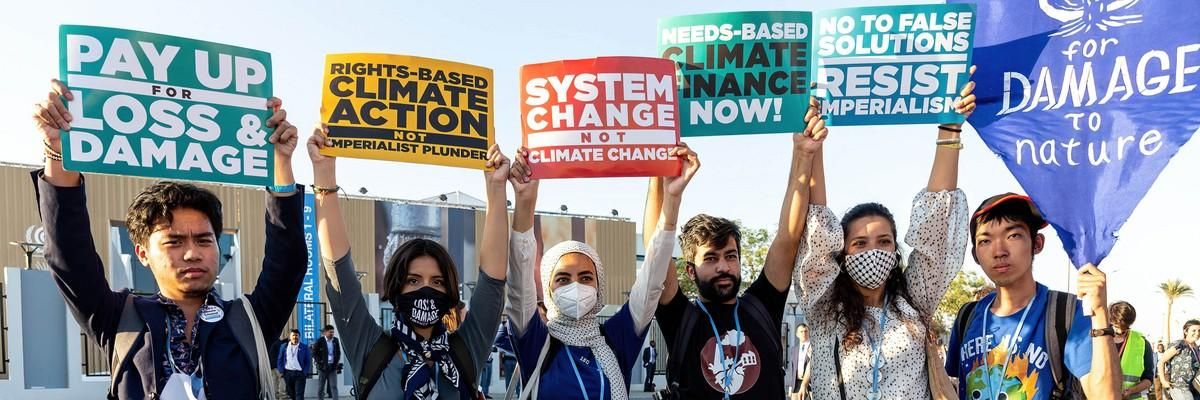
Activists protest for loss and damage reparations outside the United Nations Climate Change Conference (COP27) in Sharm el-Sheikh, Egypt on November 11, 2022.
(Photo: Dominika Zarzycka/SOPA Images/LightRocket via Getty Images)

Eloise Goldsmith
Nov 18, 2024
COMMON DREAMS

A modest tax on the world's seven largest oil and gas companies could generate hundreds of billions of dollars by the end of the decade to assist poor and vulnerable communities with the impact of the climate crisis, according to a new analysis out Monday from the groups Greenpeace International and Stamp Out Poverty.

The groups found that a tax on fossil fuel extraction, which would increase each year, combined with additional taxes on excess profits would grow the UN's Fund for Responding to Loss and Damage by more than 2,000%.

The loss and damage fund was created two years ago during the COP27 summit in Egypt with the aim of helping vulnerable countries confront the risings costs of climate disasters. Last year, a group of nations that included the United States made their first financial pledges to the fund—though the size of the U.S. pledge was panned as "paltry" by climate justice advocates. As one of the world's largest fossil fuel emitters, the initial pledge of $17.5 million was miniscule relative to the hundreds of billions in fossil fuel subsidies the U.S. government handed out in 2022.

Total commitments to the loss and damage fund currently hover at around $720 million, according toThe New York Times.

This year, at COP29 in Baku, Azerbaijan, boosting the money in the fund is top of mind for a number of UN leaders.

"The $700 million is obviously insufficient," Jorge Moreira da Silva, the executive director of the United Nations Office for Project Services, toldthe Times.

"In an era of climate extremes, loss & damage finance is a must. And we must get serious about the level of finance required. At #COP29, I urged governments to deliver. In the name of justice," U.N. Sectary-General AntĂłnio Guterres wrote on X as the summit kicked off last week.

The joint analysis—which focused on world's largest publicly traded oil and gas companies, a group that includes ExxonMobil, Shell, Chevron, TotalEnergies, BP, Equinor, and Eni—illustrates how major polluters could be tapped to support the fund.

Stamp Out Poverty researchers have "found that home government collection of volume-based [climate damages tax] is feasible, with many countries already collecting volume-based revenue from oil and gas producers," according to the report.

The briefing notes that the Climate Damages Tax "would be a fee on the extraction of each tonne of coal, barrel of oil or cubic metre of gas, calculated at a consistent rate based on how much CO2e [carbon dioxide equivalent] is embedded within the fossil fuel."

To illustrate the impact of this tax, Greenpeace and Stamp Out Poverty looked at the estimated costs associated with multiple extreme weather events in 2024 alongside the hypothetical tax revenue.

Hurricane Beryl, which impacted multiple Caribbean islands, Mexico and the U.S. Gulf Coast, caused at least $6.6 billion in estimated damages and losses, according to the report. Meanwhile, imposing a hypothetical Climate Damages Tax on the 2023 carbon emissions from ExxonMobil alone would raise enough money to cover nearly half of that price tag.

ExxonMobil made $38.6 billion in adjusted earnings for 2023, so levying a tax of $5 per tonne of CO2e in 2023 would yield $3.19 billion. Over the first year, the combined revenue from all seven companies would be over $15 billion. As the levy was increased over the two following years, that annual figure would grow to over $37 billion. The analysis, according to its authors "contributes to the growing civil society call for long term tax on fossil fuel extraction."

The report comes on the heels of two weeks of worldwide protests by Greenpeace activists and allies, during which some demonstrators confronted fossil fuel executives about their role in fueling climate disaster and demanded that they "pay for the climate damage they cause."


Did Brazil's G20 summit deliver on its promises?


Nik Martin
DW

Ever-present wars and trade tensions dominated the agenda, but G20 leaders, meeting in Rio, did agree to boost climate funding, tackle poverty and work toward a new tax on the ultra-rich.


Brazilian President Luiz Inacio Lula da Silva seemed satisfied with the final communique he got from G20 leaders
 Eraldo Peres/AP Photo/picture alliance

The world's many geopolitical crises and Donald Trump's imminent return to the White House overshadowed this week's G20 summit in Rio de Janeiro, Brazil, with leaders using a more neutral tone to describe the conflicts in Ukraine, Gaza and Lebanon in their final joint communique.

Unlike the 2022 summit in Bali, which explicitly condemned Russia's"aggression" against Ukraine, and last year's summit in New Delhi, India, which called on G20 members to shun the use of force, Brazil's G20 declaration avoided direct blame.

Instead, it vaguely referred to the "suffering" caused by the conflict — a likely compromise to achieve consensus from G20 members, especially those aligned with Moscow.

While the summit was underway, Ukraine used — for the first time — longer-range US missiles against Russian territory, prompting Moscow to revise the Kremlin's nuclear doctrine, setting out new conditions for how nuclear weapons would be used. This escalation caused consternation among G20 leaders.

Creon Butler, director of the global economy and finance program at the London-based Chatham House think tank, said the communique had already been agreed by the working groups. "After the latest barrage of missiles, some European countries wanted to reopen the text for more specific criticism of Russia, but the Brazilian presidency didn't want to do so," he told DW.
Major geopolitical issues divide G20 leaders

The final communique hardly mentioned Israel, which has been criticized for its tactics against the Iran-backed Hamas and Hezbollah in the conflicts in Gaza and Lebanon. G20 leaders did, however, reaffirm the urgent need to boost humanitarian aid to the region, called for cease-fires and emphasized support for a two-state solution between Israel and the Palestinians.

Argentine President Javier Milei, known for his libertarian views and skepticism toward multilateral organizations, even signed the final communique. However, he later issued a statement, saying he did not support several points in the declaration.

"Milei signed the document. I would call that a victory," Tomas Marques, a research fellow at GIGA Institute for Latin American Studies in Hamburg, Germany, told DW, referring to the president's previous criticism of the G20.

Marques also said the Rio summit had achieved some "good results," considering the forum's limits and the numerous conflicts and economic issues that dominated the talks.

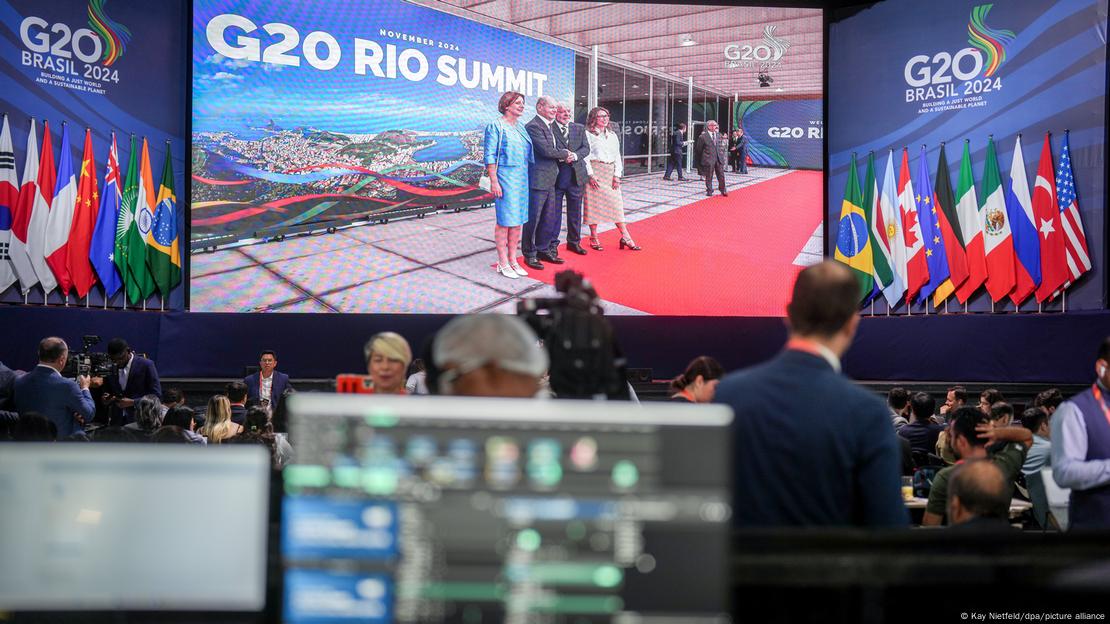
After Brazil's presidency, South Africa will take the lead and host the 2025 G20 summitImage: Kay Nietfeld/dpa/picture alliance


Lula pushes tax, climate and poverty relief

And while G20 host, Brazilian President Luiz Inacio Lula da Silva, will have partially fulfilled his promise to bridge the gap between the West and the so-called Global South over the most pressing issues, his real achievement comes from agreements on topics pushed under Brazil's G20 presidency.

A cause close to Lula's heart is the Global Alliance Against Hunger and Poverty, an initiative launched in Rio on Monday to help lift incomes and food availability in the world. In the final communique, the G20 leaders emphasized their commitment to eradicating poverty and hunger, calling for new funding pledges and for other countries not yet participating to join the global effort.

"The fact that it [poverty and hunger relief] got such strong support is an indication that at the moment, there is a kind of consensus that groups like the G20 need to tackle this issue," Butler said.
As Trump awaits, climate funding gets Biden's backing

Rio may have been the last chance for US President Joe Biden to back policies that Trump is more hostile to, like climate change and the proposed tax on billionaires. Biden told the gathering that developing countries need "enough firepower and access to capital" to protect their nations from the effects of climate change.

The G20 leaders recognized the need for trillions of dollars in climate finance for low-income countries, but failed to mention the need to transition away from fossil fuels. While the last point may have been welcomed by Trump, the US president-elect is set to wind down US financing of climate initiatives, which could now be an excuse for other countries to follow suit, citing their many domestic challenges.

"Because of the economic stress that advanced economies are under and the debt taken on during the pandemic, the likelihood of a step change in amounts of international public finance for climate action is pretty unlikely," said Butler.

New tax on ultra-rich moves forward

Lula continued the push for a new tax on the world's wealthiest people, who French economist Gabriel Zucman estimates pay an effective tax rate of just 0.3% of their wealth. The proposed levy could raise up to $250 billion (€237 billion) annually from the nearly 2,800 billionaires globally. Their combined fortune is some $13.5 trillion, according to the Forbes World's Billionaires List.

Advocates for the wealth tax have said the funds raised could be used to tackle growing global inequalities and climate projects, especially among heavily indebted low-income countries. And while the final communique said G20 would "seek to engage cooperatively to ensure that ultra-high-net-worth individuals are effectively taxed," the leaders didn't create a binding agreement on implementing a global wealth tax.

"Although the final G20 communique is purely political, it could now be a useful tool to help advocate for the wealth tax to pressure governments that are against the proposal — like Germany, the United States, the United Kingdom, and Canada," GIGA's Marques argued.

However, with tax affairs being fiercely guarded at the national level, concerns about hurting economic growth, and administrative costs, Butler was doubtful that any binding agreement on a billionaire tax would be forthcoming.

"Even within a very aligned group of countries like the EU, it is difficult to get common approaches to taxation. So I'm skeptical that it can be done globally, and even more skeptical for when Trump returns to office," he said.

Edited by: Uwe Hessler
G20 Leaders Reach 'Landmark Commitment' for Global Tax on Ultrarich


"Now is the time to turn words into action and launch an inclusive international negotiation, extending beyond G20 countries, on the reform of the taxation of the superrich," said economist Gabriel Zucman.


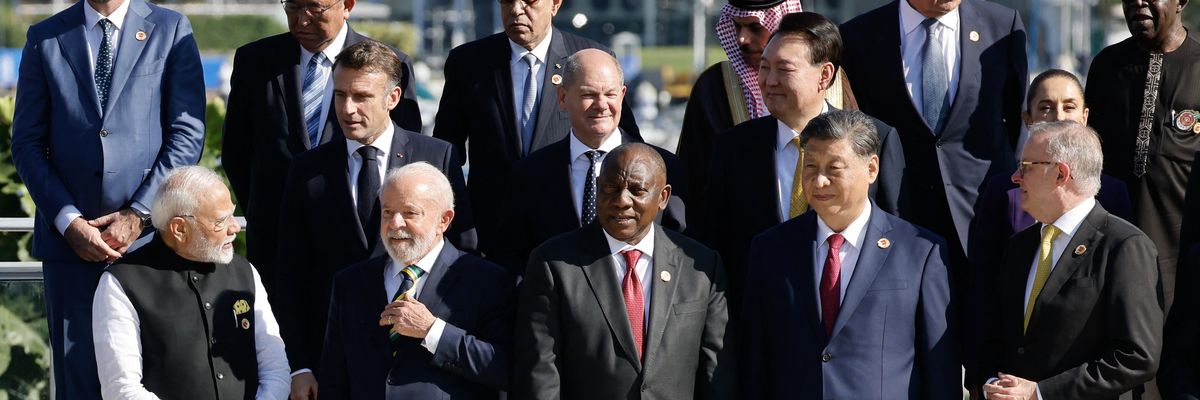
India's prime minister, Narendra Modi, speaks with Brazilian President Luiz Inacio Lula da Silva as G20 leaders gather at their annual summit in Rio de Janeiro on November 18, 2024.
(Photo: Ludovic Marin/AFP via Getty Images)

Julia Conley
Nov 19, 2024

Acknowledging that "the era of the billionaire" is still in full swing across the globe, economic justice advocates on Tuesday applauded a "landmark commitment" by G20 leaders at the group's annual summit in Rio de Janeiro, where delegates agreed to cooperate on efforts to ensure the richest households in the world are taxed fairly.

The final communiqué out of the G20 Summit includes a commitment from 19 countries, the European Union, and the African Union, to "engage cooperatively to ensure that ultra-high-net-worth individuals are effectively taxed."


"Cooperation could involve exchanging best practices, encouraging debates around tax principles, and devising anti-avoidance mechanisms, including addressing potentially harmful tax practices," reads the communiqué. "We look forward to continuing to discuss these issues in the G20 and other relevant forums, counting on the technical inputs of relevant international organizations, academia, and experts."

The final text was brokered by Brazilian President Luiz Inácio Lula da Silva, commonly known as Lula, and the E.U. Tax Observatory noted that Argentina's right-wing president, Javier Milei, "failed to convince other G20 countries to block the communiqué."

The meeting took place less than a year after economist Gabriel Zucman, director of the E.U. Tax Observatory, published a report titledA Blueprint for a Coordinated Minimum Effective Taxation Standard for Ultra-High-Net-Worth Individuals, which informed G20 finance discussions leading up to the summit.


"A minimum tax on billionaires equal to 2% of their wealth would raise $200-$250 billion per year globally from about 3,000 taxpayers; extending the tax to centimillionaires would add $100-$140 billion," said Zucman, a leading expert on tax avoidance and reducing inequality, in the report.

Billionaires' effective tax rate is currently equivalent to 0.3% of their wealth, requiring them to pay a far lower rate than middle-class taxpayers.

Zucman hailed the agreement out of the summit in Rio de Janeiro as a "historic decision" and said concrete action by the world's governments must follow.

"Now is the time to turn words into action and launch an inclusive international negotiation, extending beyond G20 countries, on the reform of the taxation of the superrich," said Zucman.

Along with Milei, the Biden administration pushed back this year as the G20 weighed Zucman's tax proposal. Treasury Secretary Janet Yellen toldThe Wall Street Journal in May that the "notion of some common global arrangement for taxing billionaires with proceeds redistributed in some way—we're not supportive of a process to try to achieve that. That's something we can't sign on to."

As Common Dreamsreported Tuesday, the U.S. is one of eight countries that are contributing to an international loss of $492 billion in taxes each year as multinational corporations and ultrawealthy individuals underpay. The eight countries—which also include Australia, Canada, Israel, Japan, New Zealand, South Korea, and the U.K.—oppose a United Nations tax convention.


Jenny Ricks, general secretary of the Fight Inequality Alliance, said that particularly with U.S. President-elect Donald Trump set to take office in January, "we live in the era of the billionaire."

"We need to move to the era of the 99%," said Ricks. "This shift won't come easily. The U.S. elections have shown how the superrich can use their wealth and power to influence policies and shape the outcomes of elections. Leaders like Trump in the U.S. and Javier Milei in Argentina are actively working to derail international cooperation, while politicians around the world fail to oppose the vested interests that continue to benefit from such unequal societies."

"We will fight harder than ever before to transform the rhetoric on taxing the rich into a global reality," she added. "We need more equal societies in which the richest no longer hold all the power and wealth, with devastating consequences. We need to redistribute the wealth of the superrich to fund vital public services and the response to climate change. Such a transformation is essential to creating the alternative we seek to today's broken system."

Viviana Santiago, executive director of Oxfam Brazil, applauded Lula's government and the G20 leaders for responding "to people's demands worldwide to tackle extreme inequality, hunger, and climate breakdown, and particularly for rallying action on taxing the superrich."

"G20 governments deserve praise for their groundbreaking commitment to cooperate on taxing the world's superrich. But we won't rest until this delivers real change for people and planet," said Santiago, adding that governments now ostensibly supporting a tax on billionaires' wealth should also "be championing a $5 trillion climate finance goal at COP29," the U.N. summit set to wrap up in Baku, Azerbaijan this week.

"How can they argue that climate justice is unaffordable with a deal to raise trillions of dollars by taxing the superrich on the table?" she asked.

Quentin Parrinello, policy director at the E.U. Tax Observatory, asserted that negotiations on the tax proposal "must now extend to a much more inclusive space than the G20."

"Such reforms don't happen overnight, but time is pressing," said Parrinello. "This agenda is even more important today, with the risk of geopolitical fragmentation and looming wealth concentration fueling inequality and undermining democracy."


Low-Wage Workers to Democratic Leaders: Fight for Us or Face 'Consequences'


"Democrats must act now to protect workers and show that they are fighting for the people who need them most," said one economic justice leader.


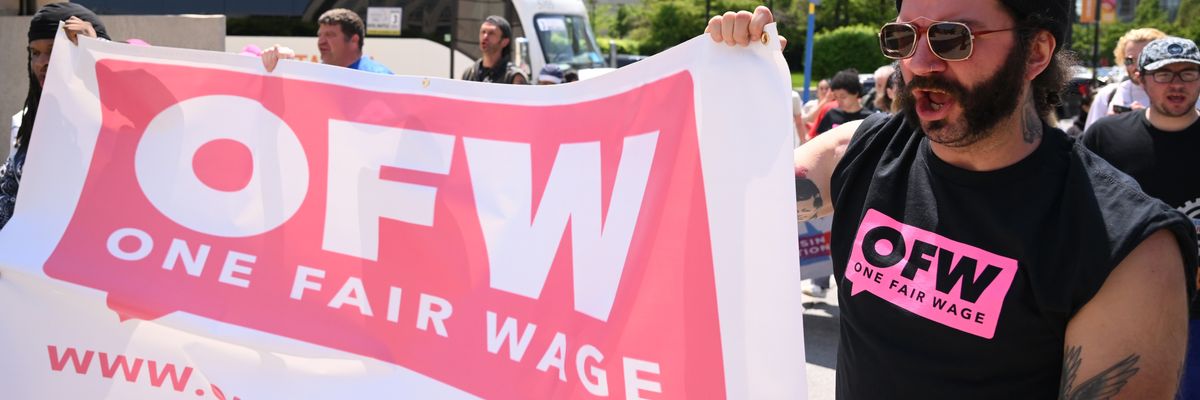
Protesters march during a rally for fair labor practices on May 22, 2023 in Chicago.
(Photo: Daniel Boczarski/Getty Images for One Fair Wage)

Julia Conley
Nov 19, 2024
COMMON DREAMS


With Democratic leaders grappling with how to move forward following this month's devastating electoral losses and governors in the party moving to resist President-elect Donald Trump's policies, low-wage workers are planning on Wednesday to send a clear message to several Democrat-led statehouses: Prioritize workers and fair wages, or "face the consequences."

The national economic justice group One Fair Wage, which works closely with restaurant industry and other service workers, is organizing direct actions in Detroit, New York, and Springfield, Illinois, demanding that Democratic leaders in blue states "act decisively" to protect working people from Trump's anti-regulation, pro-corporate agenda.

The group said tipped service workers, advocates, and labor leaders will take part in the actions, in which participants will deliver an open letter calling for the passage of legislation to raise the minimum wage and eliminate subminimum wages.

"Workers in blue states are raising their voices because they cannot afford to wait any longer," said Saru Jayaraman, co-founder and president of One Fair Wage. "With a cost-of-living crisis squeezing families and an anti-worker Trump administration on the horizon, Democratic leaders must act boldly to protect workers and provide economic security. If they fail to prioritize wages and worker protections, they risk losing the trust—and the votes—of the very people they need to win."

The actions come after preliminary demographic data from the election showed working-class voters from a variety of racial backgrounds swung toward Trump. Two-thirds of Trump voters said they had to cut back on groceries because of high prices, according to a New York Times/Siena College survey, compared to only a third of people who supported Vice President Kamala Harris. Latino-majority counties shifted toward the Republican former president by 13 percentage points, and Black-majority counties did the same by about three points.

"Last week's electoral results made one thing clear: Voters overwhelmingly prioritize wages and affordability."

"Last week's electoral results made one thing clear: Voters overwhelmingly prioritize wages and affordability," said Jayaraman.

The actions were planned amid reports that U.S. Ambassador to Japan Rahm Emanuel, a key adviser to former President Barack Obama, is among those considering a run for chair of the Democratic National Committee—a plan that one former adviser to Sen. Bernie Sanders (I-Vt.) said seemed aimed at ensuring "the Democratic Party continues to lose working-class voters." Other possible contendersinclude former Maryland Gov. Martin O'Malley and, reportedly, progressive Wisconsin Democratic Party Chair Ben Wikler.

One Fair Wage said that following Democratic losses across the country, and with Republicans set to take control of the White House and both chambers of Congress in January, Democratic leaders at the state level must "act boldly on behalf of working families."

In Michigan, workers will call on Gov. Gretchen Whitmer to uphold the state Supreme Court's decision to raise the minimum wage and eliminate subminimum wages for tipped workers.

At the Illinois state Capitol, advocates plan to push for statewide legislation to extend fair wages for all workers, building on Chicago's minimum wage reforms.

In New York, One Fair Wage will lead the call for Gov. Kathy Hochul to "safeguard tipped and immigrant workers from the looming anti-worker policies of the incoming Trump administration."

The workers and supporters will deliver their demands to state lawmakers as well as hold "solidarity turkey giveaways for struggling families let down by elected officials."

Since the election, some Democratic governors have pledged to resist Trump's far-right agenda. California Gov. Gavin Newsom called a special legislative session aimed at "Trump-proofing" the state by finalizing climate measures and protecting reproductive and other kinds of healthcare. Govs. JB Pritzker of Illinois and Jared Polis of Colorado announced a coalition that will resist Trump's deportation plan and reinforce key state institutions.

The governors' plans have not specifically mentioned efforts to protect workers from Trump's policies. The president-elect attempted to pass regulations that would make tips the property of employers during his last term, and the National Restaurant Association has pledged to revive such efforts in the next four years.

"There's a glaring omission in these efforts: low-wage and tipped workers," Angelo Greco, a political strategist working with One Fair Wage, told Common Dreams. "When Democrats say they will fight for the most vulnerable, who exactly does that include if not the people earning the lowest wages and facing the greatest economic instability?"


"Tipped workers—many of whom are women, people of color, and immigrants—continue to be paid below the minimum wage in a system rooted in the legacy of slavery," Greco added. "They face Trump's imminent rollback of Biden-era workplace protections, and now restaurant workers are on the front lines of his anti-labor rampage. If governors truly want to protect workers, they must include tipped workers in their efforts."

Jayaraman called on Democrats to "act now to protect workers and show that they are fighting for the people who need them most. Ignoring these demands will lead to alienated voters and further political losses."


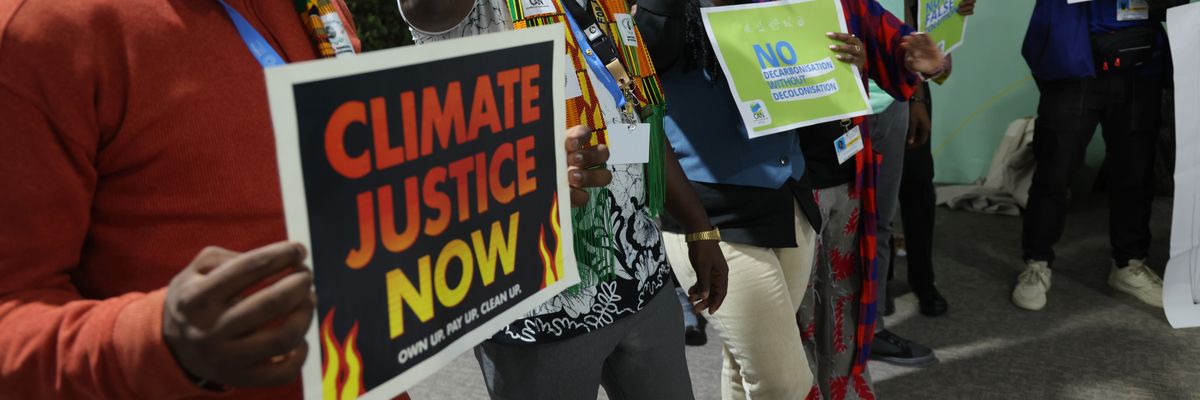
Climate Change Gives Us the Chance to Truly Decolonize; Will We Take It?


If we are to safeguard our very existence, climate change will challenge us to rethink, review, and reinvent the very notion of civilization and modernity.


Activists demanding financing for renewable energy projects in Africa demonstrate on day seven of the UNFCCC COP29 Climate Conference on November 18, 2024 in Baku, Azerbaijan.   SURPRISED THEY AIN'T IN JAIL
(Photo: Sean Gallup/Getty Images)

Mbong Akiy Fokwa Tsafack
Nov 20, 2024
Common Dreams

As delegates enter the final days of negotiations in Baku, Azerbaijan for the 29th seating of the Conference of the Parties—COP29—one thing is certain: These discussions happen under circumstances far different from the early 1990s. At that time, it was an absolute novelty that climate activists were highlighting the consequences of a Euro-North American notion of modernity and civilization rooted in extraction and overconsumption. Today, delegates meet within the framework of a global recognition that colonialism exacerbated climate change and that decolonisation is critical in reversing its effects on humankind.

In its 2022 report, the Intergovernmental Panel on Climate Change made a clear connection between climate change and colonialism, stating that colonialism not only caused climate change but continues to exacerbate the impact of the climate crisis on the most vulnerable around the world. This acknowledgement sent a strong message to the global community and fired up the debate around the need to decolonize our mindsets, economic systems, and definition of modernity and civilization if we are to adequately deal with the climate crisis.

Climate change has inadvertently exposed the inferiority of modern civilization, characterized by a neocolonial economic model rooted in extraction, exploitation, and destruction of nature

2024 has given humanity a foretaste of the apocalypse that awaits us all if we do not rethink our approach to development and make true commitments toward staying below 1.5°C and attaining net-zero carbon dioxide emissions globally by 2050.

With record-high temperatures in several parts of the world this year, the reality of climate change has dawned on even the hardest denialists. Climate change is a lived experience for billions around the world, as floods continue to ravage cities, droughts threaten villages and communities, and wildfires scorch through lives and livelihoods.
Can We Afford to Continue With Business as Usual?

Science tells us we must immediately halt all new investment in fossil fuels. Many countries are making significant strides in the right direction—the U.K. recently announced that it was closing the last of its coal plants following Portugal, Greece, and many others making the switch away from the most polluting fossil fuel. Despite these gains, threats still loom. Trumpism and its “drill baby drill” narrative might have left climate activists feeling despondent, while news reports expose unsettling conversations between the COP29 chair and fossil fuel corporations. The fact of the matter is that no one can truly deny that the world is facing one of its greatest challenges yet and human-made climate change is at the center of it all.

There’s no room for fossil fuels, even though capitalist greed, individualism, and desire for profits over people and the rest of nature still drive the fossil fuel industry. But this industry is well aware of the devastation it has and continues to cause humanity.

COP28 gave a glimpse of hope with terminology to transition away from fossil fuels. COP29 must be more audacious in calling for a full phase out of fossil fuels if we are to reverse the harms of the last 100 years.

Climate Change as a Gift


Unlike many other human-made disasters facing the world—wars, conflicts, economic crises, and political rivalries—climate change has no borders or boundaries. It affects the wealthy and the less privileged, even if the wealthy can adapt better to its damages. The heatwaves, droughts, and the ferocity of the wildfires which science directly link to human activity have cast a dark cloud on the credibility of the Western civilization that has driven global systems in the last 100 years.

this reality calls on every one of us who is confronted with climate change to challenge the Euro-North American notion of a good life, of well-being, of development, of wealth, that has driven us to a climate apocalypse.

Climate change has inadvertently exposed the inferiority of modern civilization, characterised by a neocolonial economic model rooted in extraction, exploitation, and destruction of nature. A civilization that has destroyed the Earth, polarised society, driven individualism and greed, and left our very existence hanging on a thread if we do not act fast to reverse the speed at which the Earth is heating.

Beyond the horrors and misery bestowed on us by extreme weather events, collapsing food systems, and negative health impacts, there may also be a gift in climate change. If we are to safeguard our very existence, climate change will challenge us to rethink, review, and reinvent the very notion of civilization and modernity.

The Imperative of Decolonial Thinking and Decolonisation


Climate talks today should prioritize the need for a decolonial mindset, focusing on an alternative economic model rooted in our relationship with nature, our relationship with self, with each other, and rethinking growth and development.

Wisdom guarded by Indigenous African communities, and other Indigenous communities around the world, shows that it is possible to live great lives, build great empires and kingdoms, while maintaining peace with nature.

Whether world leaders commit to what must be done at COP29 is yet to be seen. However, the reality of a world ravaged by extreme weather events is indisputable. And this reality calls on every one of us who is confronted with climate change to challenge the Euro-North American notion of a good life, of well-being, of development, of wealth, that has driven us to a climate apocalypse.

Whether we like it or not, we will not save ourselves unless we treat the tragedy of climate change as a gift that compels us to do things differently and ultimately to live better lives.


Our work is licensed under Creative Commons (CC BY-NC-ND 3.0). Feel free to republish and share widely.


Mbong Akiy Fokwa Tsafack is a Pan-African, climate and decolonization activist and executive chairperson of Umoya MwaAfrika.
Full Bio >