Monday, January 20, 2025

7 illegal miners killed by army in southern Ghana

Incident happened at Anglo Gold Ashanti mines in Obuasi town of West African country, says Ghana army

LOCAL PEOPLE DOING ARTISANAL MINING


Ilayda Cakirtekin |20.01.2025 - 


ISTANBUL

Ghanaian troops killed at least seven illegal miners in a shootout over the weekend, according to the military.

The incident happened at Anglo Gold Ashanti mines in southern Obuasi town, the West African nation's military said in a statement late Sunday.

Around 60 illegal miners breached the mines and intruded at Cote D’or Ramp to enter the Deep Decline of the mines, it said.

The miners, carrying weapons such as locally manufactured rifles, pump action guns, gas cylinders, knives, heavy-duty industrial bolt cutters, axes, and machetes fired on the soldiers who tried to stop them, the military said, adding that acting in self-defense, the soldiers killed seven miners and seriously injured one of them.

One of the soldiers was also injured.

The troops also retrieved six pump action BB cartridges.

The Ghana Armed Forces “wishes to urge all illegal miners to stay away from mining concessions and also desist from engaging troops in shootouts since the consequences of such actions could be fatal,” the statement said.
South African police hunt gang leader of illegal mine where dozens died

Reuters | January 20, 2025 | 4:49 am Africa Gold

Stock image.

South African police are hunting a gang leader from Lesotho believed to have controlled operations at an illegal gold mine where 78 bodies were recovered last week after months of police siege.


“Tiger” is believed to have surfaced from the deep mine in Stilfontein while it was under police surveillance and escaped with the help of officials, the South African Police Service said on Monday.

“Extensive investigations and tracing operations are under way to find those officials who aided his escape between shaft 11 and the Stilfontein police holding cells,” their statement said.

Police were widely condemned for the months-long operation, in which they cut off food and water in an attempt to force the miners out and arrest them.

Finance Minister Enoch Godongwana said the state should not be held responsible for the deaths.


“You have got people who voluntarily entered mines and did some illegal activities and in the process died inside those mines. To then come back and say the state is going to take the blame for that, in my view, is misplaced,” he told Reuters at the World Economic Forum’s annual meeting in Davos, Switzerland.

The standoff culminated in a state-sponsored rescue last week in which 246 survivors were retrieved from the mine, many emaciated and weak from hunger.

Police have cited miners who said there had been food underground, but that the gang leaders had kept it for themselves.

Thousands of people are believed to be mining gold illegally in abandoned industrial mines in South Africa. Some spend months at a time underground.

The operations are thought to be run by Lesotho-based gangs, and police say some of the workers are illegal immigrants recruited from neighbouring countries without knowing what they have come to do.

Miners named “Tiger” as a leader of operations, the police statement said.

“He is also being accused by some illegal miners … (of) being allegedly responsible for some deaths, assault and torture that is alleged to have taken place according to videos in police possession,” it said. “He is also alleged to have hoarded and kept food away from other illegal miners.”

(Reporting by Nellie Peyton;Additional reporting by Brad Haynes in Davos and Sfundo Parakozov in Johannesburg;Editing by Alexander Winning, Bernadette Baum and Kevin Liffey)
PAKISTAN/BALOCHISTAN

Canada's Barrick Reko Diq project to generate $74 billion over 37 years — Bristow


Cecilia Jamasmie | January 20, 2025 | 

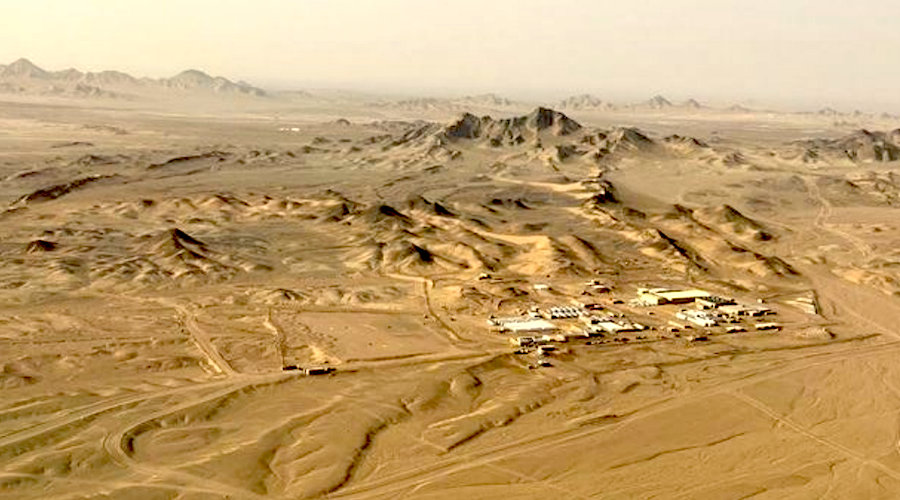
Barrick Gold’s 50% Reko Diq copper-gold project in Pakistan. 
(Image: Barrick’s presentation.)

Barrick Gold (NYSE: GOLD) (TSX: ABX) said on Monday its 50%-owned Reko Diq copper and gold project in Pakistan is projected to generate approximately $74 billion in free cash flow over the next 37 years, based on consensus long-term prices.


Speaking to local media, chief executive Mark Bristow said an initial estimated capital expenditure of $5.5 billion will be allocated to develop the first phase of the mine. During this phase, Reko Diq, in which by the governments of Pakistan and the province of Balochistan have a combined 50% stake, is expected to produce 200,000 tonnes of copper concentrate and 250,000 ounces of gold annually.

In an interview with Pakistani digital media outlet Dawn News, Bristow confirmed that the starter mine is scheduled for completion by 2029. A second phase, requiring an additional investment of $3.5 billion, is projected to double production, he added.

Reko Diq is a critical component of Barrick’s strategy to expand its footprint in copper, a metal central to the global energy transition. The project is located in the Chagai mountain range, part of the Tethyan Magmatic Arc, known for its rich copper-gold deposits.

Barrick has long maintained that Reko Diq is one of the world’s largest undeveloped copper-gold prospects. It also boasts a high copper grade of 0.53%, meaning that for every tonne of ore mined, about five kilograms of copper can be extracted. Once the expansion is complete, the mine is expected to process over 90 million tonnes of ore annually.

The mine is estimated to have reserves lasting 37 years, but Bristow said that through upgrades and expansions it could potentially be mined for more than 50 years.

The project has gauged interest from global investors, , including Saudi Arabia’s Manara Minerals, a joint venture between state-controlled miner Ma’aden and the $925 billion Public Investment Fund (PIF).

Executives from Manara visited Pakistan last year for talks about buying a stake in the project. Pakistani Petroleum Minister Musadik Malik said last week talks were progressing and that he expected an investment from Manara to come “in the next two quarters.”

Bristow has said that Barrick would support any decision made by the Pakistani government in collaboration with the Saudis, but the company will not dilute its equity in the project.


Brisbane's First Big-Ship Passenger Terminal Draws In Cruise Lines

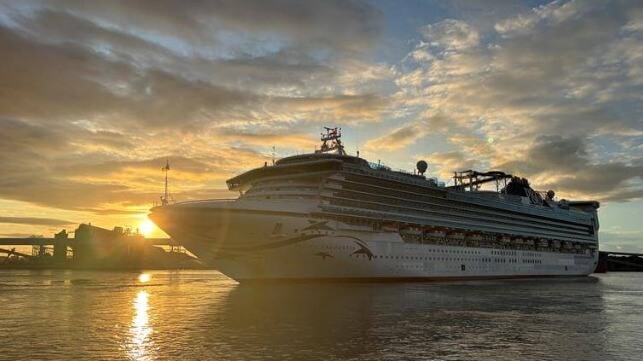
Pacific Encounter calls at Brisbane International Cruise Terminal (Port of Brisbane)

Published Jan 19, 2025 10:32 PM by The Maritime Executive


The Port of Brisbane, Australia is celebrating its decision to invest in a real cruise terminal after passenger movements at the Brisbane International Cruise Terminal (BICT) crossed the two million mark, a development that comes just two and half years after its opening.

BICT, which was constructed at a cost of US$110 million, achieved the two-millionth-passenger milestone on Saturday after P&O Cruises Australia’s Pacific Encounter called at the port. 

The call could be the last that the 2,600-vessel makes at its Brisbane homeport under the Pacific Encounter name. This is because the ship is set to be rebranded into Carnival Encounter after Carnival Corporation announced it was ending the P&O Cruises Australia brand in March 2025.

“Carnival’s long-term partnership with the world-class BICT has helped in the success of Queensland’s growing cruise industry. As Carnival Cruise Line prepares for an exciting expansion in March, when Pacific Encounter joins the CCL fleet as Carnival Encounter, we can’t wait to continue to deliver our guests unforgettable holidays from Brisbane, all year round,” said Peter Little, Carnival Corporation Country Manager.

The hitting of the two million passenger mark is a significant achievement for BICT, which was opened in June 2022 and is touted as a strategic asset in Queensland’s cruise tourism industry. The decision to build the terminal was approved in 2017, with construction completed in 2020. Its commercial opening was delayed due to the Covid-19 pandemic.

Prior to its construction, cruise ships longer than 270 meters had to call at the Port of Brisbane’s cargo terminals. This caused most cruise lines to bypass the city altogether, taking with them significant economic benefits. It is estimated that every time a vessel calls in Brisbane, it contributes around US$620,000 to the economy. Over the next decade, cruising is projected to contribute around US$700 million to the Queensland economy. During the 2024/25 season alone, the port expects to welcome over 150 cruise calls from 13 different cruise lines.

“Achieving two million passenger movements through our world-class terminal highlights the integral role of BICT to Queensland’s cruise tourism industry,” said Neil Stephens, Port of Brisbane CEO.  


US Navy Replaces Two Cyber School Commanders in Two Months

THIRD TIME LUCKY?!

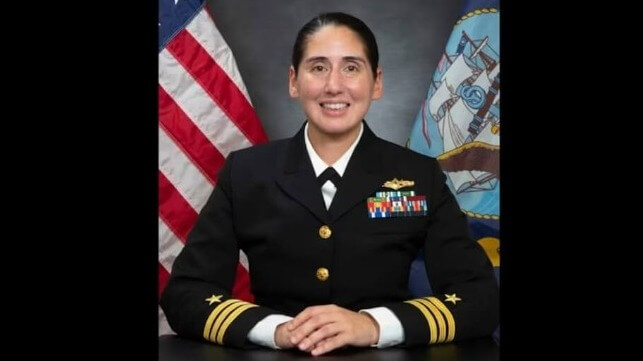
Cmdr. Sarah M. Quemada (USN file image)

Published Jan 19, 2025 11:15 PM by The Maritime Executive


The U.S. Navy has removed the commander of its East Coast information warfare training center, which prepares cyber and cryptography specialists for deployment. The announcement came just months after the replacement of the head of the equivalent center on the West Coast.  

Cmdr. Sarah M. Quemada, the commanding officer of Naval Information Warfare Training Group Norfolk, has been relieved "due to a loss of confidence in her ability to command," the explanation that the U.S. Navy usually provides in personnel actions. 

Quemada had commanded the Norfolk training group since 2023, and she has now been reassigned temporarily, as is standard. Rear Adm. Brian A. Harding, commander of Naval Information Warfighting Development Center, has appointed Capt. Steve McIntyre to take over the Norfolk unit on a temporary basis. 

Cmdr. Quemada is from Washington State, and she enlisted in 2005. After training as an information systems technician, she completed Officer Candidate School and commissioned as an ensign in 2007. A cryptologist by training, she deployed to Afghanistan to provide intelligence support for Joint Special Operations "village stability" missions. Afloat, she served aboard USS McFaul, and later held senior roles with an amphibious ready group and a carrier strike group. 

In November, the Navy relieved the commander of Naval Information Warfare Training Group San Diego, Cmdr. Cayanne McFarlane. "The Navy maintains the highest standards for commanding officers and holds them accountable when those standards are not met," the Navy said after McFarlane's removal. 

Navy Information Warfare's training command has a broad remit: it prepares personnel in afloat and ashore commands to work in electronic warfare, cryptography, cyber operations, intelligence, operational security, communications, space operations, and meteorology and oceanography. It has centers in Norfolk, San Diego and Gulfport, Mississippi. 


CRIMINAL CAPITALI$M

Fraud Charges Against Singaporean Oil Trader Dropped After His Death

ZenRock was a high-profile oil trading firm and tanker charterer (file image)

Published Jan 19, 2025 7:46 PM by The Maritime Executive


The founder of a Singaporean oil trading firm that collapsed amidst a financial crime scandal has died, his attorneys told a court earlier this month. 

Xie Chun, an experienced oil trader who founded ZenRock Commodities, was accused of fraud in connection with his company's collapse. His firm failed and was placed under judicial management in May 2020, and at the time it had about $600 million in debt. Its problems came to light at about the same time as the notorious implosion of Hin Leong Trading, the family-run bunker shipping and brokering firm that allegedly cheated several major banks out of billions of dollars.  

In 2022, Xin was charged with forgery, breach of trust and cheating valued at more than $100 million. Along with his operations executive Zhang Taiming, he faced a second case of alleged forgery that targeted Bank of China for $54 million in fraudulent loans in early 2020, just as the pandemic began. The two executives also allegedly defrauded Credit Agricole out of $17 million.  

Earlier this month, upon application from Xie's attorneys, a Singaporean criminal court abated (withdrew) all charges against Xie due to his death. The circumstances of his passing were not detailed. 

Zhang's trial remains pending, and proceedings begin on February 7. 


Report: U.S. is Convinced That Eagle S Cable Incident Was Accidental

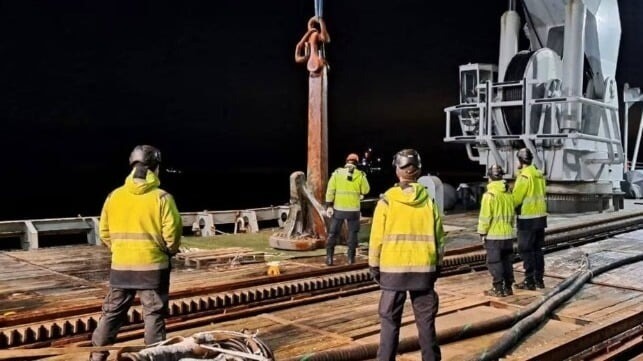
Eagle S's lost port anchor, retrieved and lowered to the deck of a Swedish salvage ship (Finnish Border Guard)

Published Jan 19, 2025 8:35 PM by The Maritime Executive


Since late December, the Russia-linked tanker Eagle S has been under arrest in Finland on suspicion of rupturing five subsea cables by dragging her anchor for 50 miles. The Christmas Day incident was the latest in a series of three suspected sabotage attacks on the Baltic seabed, all involving vessels headed to or from Russia. According to The Washington Post, senior intelligence officials in the U.S. and the EU have become convinced that these repeat incidents were all accidents caused by inexperienced crewmembers, and had nothing to do with Russian "hybrid" warfare efforts. 

The Post's report was received with skepticism by some in Finland. Pekka Toveri, former head of Finland's military intelligence agency, told the paper that the accidental-damage theory was "total B.S."

"The most important thing in any hybrid operation is deniability," Toveri said, explaining how the incidents might have an accidental appearance. He pointed to the ships' anomalous movements and the well-funded, decadal Russian intelligence effort to map out NATO's seabed infrastructure vulnerabilities. 

Finnish National Bureau of Investigation inspector Sami Liimatainen, who is involved in the ongoing inquiry aboard Eagle S, gave a dismissive reply when asked about the Post's accidental-damage explanation. "I'm not even going to comment on that, I'll leave the information from foreign newspapers at their own value. The Finnish National Police is investigating the crime," Liimatainen told YLE. "Crimes are being investigated and solved. Nothing has changed."

Eagle S's lost port anchor was recovered from the bottom of the Baltic at the end of a 50-mile drag track, at the location where the ship was intercepted by Finnish forces. In order to start the drag track by accident, the Eagle S would have to lower and then secure her port anchor accidentally mid-voyage, without the crew's knowledge, and without the anchor running away. Then, over the course of a 50-mile transit, the crew would have to overlook the effects of the port anchor dragging on the bottom at 6-10 knots. 

Sweden warns of Russian, Chinese and Iranian hybrid warfare

Sweden - which was affected by two of the subsea cable damage incidents - has publicly acknowledged an ongoing state of hybrid warfare with Russia, characterized in part by covert threats in the subsea domain. 

"Hybrid warfare is not a kinder form of war. The aim is to harm or weaken us and our society - and NATO - through actions that are deniable and more difficult to derive and respond to. This can be done through measures that sabotage and destroy important societal functions, make decision-making more difficult or damage trust in the country's authorities and leadership," said Swedish Commander-in-Chief Michael Claesson. 

Claesson's ministry singled out Russia, China and Iran as active antagonists in this shadow conflict, and said that sabotage attacks (including targets in the power grid and telecommunication system) are among their methods. These attacks are planned by intelligence agencies, but are often carried out by hired hands in order to maintain deniability, the ministry said. 

"Sweden is not at war. But there is no peace either," said Swedish Prime Minister Ulf Kristersson. "True peace requires freedom and the absence of serious conflicts between countries. But we and our neighbors are exposed to hybrid attacks, carried out not with robots and soldiers, but with computers, money, disinformation and the risk of sabotage."


Yemen's Houthi Rebels Agree to Lift Red Sea Blockade

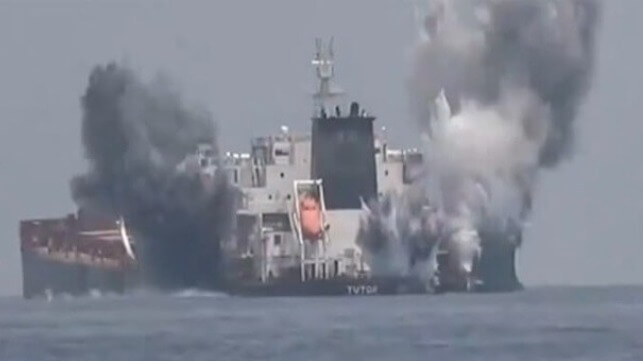
Houthi fighters sabotage the disabled bulker Tutor, sending it to the bottom, 2024 (Houthi Military Media)

Published Jan 19, 2025 11:46 PM by The Maritime Executive


On Sunday, Yemen's Houthi rebels  announced plans to phase down their campaign against shipping in the Red Sea, beginning with a cessation of hostilities against "non-Israeli" vessels. 

The group's "Humanitarian Operations Coordination Center" issued a statement on Sunday reporting that the group is lifting its yearlong blockade on shipping in the Red Sea, following implementation of the ceasefire between Israel and Hamas in Gaza last week. The first phase was a prisoner exchange between Israeli forces and Hamas; this took place successfully on Sunday with a trade of 90 Palestinian suspects for three Israeli hostages.

The center said that going forward, it would not attack most categories of ships, including ships bound for Israel; American or British ships; vessels partly owned by Israeli interests; or vessels operated by Israeli interests but owned by other nationalities. The Houthis still plan to attack vessels that are wholly Israeli-owned or are Israeli-flagged, at least until all phases of the ceasefire agreement are implemented. These fully-Israeli vessels are "prohibited from transiting the Red Sea, Bab-el-Mandeb, the Gulf of Aden, the Arabian Sea and the Indian Ocean at present," the HOCC said.  

In a warning, the group said that it could resume hostilities against commercial shipping if U.S. and UK forces strike Yemen again. If that occurs, the group warned, it could resume its attacks on specifically American and British shipping. 

On Friday, Houthi leader Malik Al-Houthi suggested that the group's "naval operations have reached a decisive result and a real victory" in the announcement of the ceasefire, but warned that the group's activities could resume if fighting returns to Gaza. "At any stage in which the Israeli enemy returns to aggression and escalation, we will be ready to support [Hezbollah]," said Al-Houthi. 

The group's decision to back away from further anti-ship missile and drone strikes had been anticipated by many in the shipping industry. Dimitris Maniatis, CEO of Marisks, told Reuters that the Houthis' capabilities have been significantly reduced by Israeli and American airstrikes over the past month, leaving the group eager for "a pretext to announce a ceasefire" and end their campaign. Multiple other sources told Reuters that shipping interests are already eyeing a return to the Red Sea route, though blue-chip carriers have emphasized that they still plan to wait and see how the situation stabilizes. 

Whether or not their assurances for Western shipping stay in place, Houthi forces have appeared to select vessel targets that do not align with their criteria in the past, and have occasionally attacked ships tied to their own foreign sponsors. 

The fate of the hijacked car carrier Galaxy Leader and her stranded crew remain uncertain. The ro/ro has been detained at anchor off northwestern Yemen for more than a year. 

On the same day as the HOCC's announcement, Houthi leaders claimed an eighth attempt to target the carrier USS Harry S. Truman in the Red Sea. As with previous claims of Houthi attacks on aircraft carriers, U.S. Central Command has not commented. 


Gaza Ceasefire Raises Hopes of Renewed Security in the Red Sea

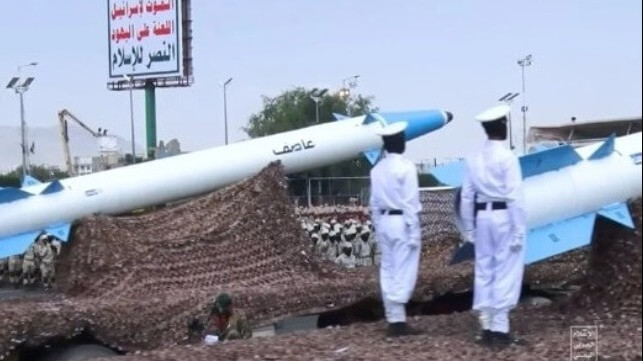
Houthi missiles on display at a parade, 2024 (Houthi Military Media)

Published Jan 16, 2025 10:07 PM by The Maritime Executive


On Thursday, Israeli Prime Minister Benjamin Netanyahu announced that an agreement for a ceasefire and hostage exchange had been reached with terrorist group Hamas, setting conditions for the end of hostilities in Gaza - though an unspecified last-minute issue has delayed an Israeli cabinet vote to finalize the deal. If approved, it appears to satisfy most of the demands of Yemen's Houthi rebels, who have attacked shipping in the Red Sea for more than a year in protest of Israeli operations in Gaza. 

In a response to Netanyahu's announcement early Friday, Houthi leader Malik Al-Houthi cast the ceasefire as a loss for Israel and America. He suggested that the group's "naval operations have reached a decisive result and a real victory," and contributed to a "failure" for Israel in the Gaza Strip. He cautioned that the group would monitor the situation for the next three days as the deal takes effect; notably, Al-Houthi did not pledge a halt to attacks on shipping, and he left open the possibility of renewed strikes. "At any stage in which the Israeli enemy returns to aggression and escalation, we will be ready to support [Hezbollah]," said Al-Houthi. 

Shipping and security analysts have given mixed predictions about the group's intentions going forward. Dimitris Maniatis, CEO of Marisks, told Reuters that the Houthis' capabilities have been significantly reduced by Israeli and American airstrikes over the past month, leaving the group eager for "a pretext to announce a ceasefire" and end their campaign. Multiple other sources told Reuters that shipping interests are already eyeing a return to the Red Sea route after a year of disruption, so long as sky-high war risk insurance rates come down. 

Others are less sure, especially since Houthi fighters have reportedly developed a revenue stream from their campaign. A UN panel on Yemen investigated their operations and spoke with regional shipbrokers and service providers; the panel heard multiple accounts that the group was extorting shipowners out of hundreds of thousands of dollars for each safe transit past Yemen, and estimated that the Houthis are earning about $2 billion per year from "security" fees. While the exact amount of the fee is debated, "there's clearly some deal-cutting," U.S. special envoy for Yemen Tim Lenderking told The Economist - and those deals may create a business incentive for Houthi fighters to continue launching attacks. 

Blue-chip carriers have signaled that they do not plan a quick return to the route. Maersk has predicted that the Red Sea will stay shut down for global container liners "well into 2025," and a spokesperson told Reuters on Thursday that it is "still too early to speculate about timing." Hapag-Lloyd concurred, saying that the "agreement has only just been reached."  

Others will be unaffected. The Russia-linked "shadow fleet" tankers that ferry Russian oil to buyers in India and China have consistently used the Suez-Red Sea route, without interruption, and will likely continue to do so after an eventual cessation of Houthi hostilities. Chinese shipping interests have also benefitted from a public nonaggression pact, and many continue to use the route.


Yemeni Houthis to Limit Red Sea Attacks to

 Israeli-Linked Ships


By Charles Kennedy - Jan 20, 2025


The Houthis have announced a limited halt to attacks on ships in the Red Sea, but major shipping companies remain cautious.

Shipping giants are concerned about the long-term security situation in the region and are closely monitoring developments.

The prolonged conflict and attacks had forced many ships to reroute, disrupting supply chains and increasing shipping costs.


Following the Israel-Gaza ceasefire, the Iran-aligned Houthis will limit attacks in the Red Sea to vessels linked with Israel, the Humanitarian Operations Coordination Center, through which the Houthis communicate with merchant shipping, has said.

“We affirm that, in the event of any aggression against the Republic of Yemen by the United States of America, the United Kingdom, or the usurping Israeli entity, the sanctions will be reinstated against the aggressor,” the center said in an email sent to shipping industry officials dated on January 19 and quoted by Reuters on Monday.

The Houthis will only target ships that are wholly or partially owned by Israeli individuals or entities, as well as Israel-flagged ships, the Houthis said, announcing a partial halt to the attacks in the Red Sea that have disrupted commercial shipping in the past year.

However, global shipping giants do not expect a quick return to Red Sea traffic.

“We will continue monitoring the situation in the Middle East closely and will return to the Red Sea and sailing through Bab el Mandeb when it is safe to do so,” A.P. Moller-Maersk A/S told Bloomberg in an emailed statement on Friday.

Last week, Israel and Hamas reached a Gaza ceasefire and hostage release deal following 15 months of war. During most of these months, the Houthis attacked commercial vessels passing through the Bab el Mandeb Strait and the Red Sea.

These attacks forced the global container and tanker shippers to re-route their journeys between Europe and Asia via the longer route around the southern tip of Africa.

The longer voyages via Africa have increased travel times, delayed goods delivery, disrupted supply chains, and raised shipping costs.

Apart from Maersk, another shipping giant, Hapag-Lloyd, also expects no imminent return to the Red Sea shipping lane.

“The agreement has only just been reached. We will closely analyze the latest developments and their impact on the security situation in the Red Sea,” a spokesperson for Hapag-Lloyd told Reuters on Thursday.


By Charles Kennedy for Oilprice.com


Controversy Swirls Around Argentina's Giant Waterway Privatization Plan

Government tender for dredging on the Paraguay-Paraná shipping route slammed by businesses as unfair, while environmentalists fear damage to wetlands

Port
Confluence of the Parana and Paraguay Rivers northeast of Corrientes, Argentina (NASA)

Published Jan 19, 2025 8:24 PM by Dialogue Earth


[By Jorgelina Hiba]

The waterway formed by the Paraguay and Paraná rivers is one of the world’s longest and most biodiverse river corridors, extending more than 3,400 kilometres from its source in southern Brazil, through Paraguay, and into Argentina to reach the Río de la Plata estuary.

For Argentina, it is also a vital route through which most of the country’s foreign trade flows. The country’s section of this natural channel – also known as Hidrovía, after the company that held its dredging and signalling concession from the mid-1990s until 2021 – enables around 80% of its exports, mainly of agro-industrial origin, to reach the rest of the world.

But the waterway is currently in the midst of a contentious process to privatise its management and enable works along its route, launched by the administration of President Javier Milei. In November, it opened a call for tender for a concessionaire to undertake a 30-year contract for the waterway’s “modernisation, expansion, operation and maintenance”, in a process that will be open until the end of February, and that has so far seen interest registered by European and Chinese companies.

However, the call for tender has generated fierce opposition from several interested business entities, who claim the government is favouring a single company: Belgian dredging firm Jan De Nul, which, as a joint partner in Hidrovía, held the concession until 2021, after which management returned to state administration.

Additionally, some aspects of the call for tender, namely works to widen and deepen channels along the Paraná, have come under fire from environmental organisations, who have warned about the possible environmental impacts of such works. They say that further dredging of the river could damage the surrounding wetland ecosystem that provides many ecosystemic benefits, ranging from water purification to climate change mitigation, while worsening the unprecedented water deficits it has been experiencing for the last five years.

More works, more depth

Since the end of 2021, the management of the most intensively navigated stretch of the Paraná has been without a concessionaire. Through the current call for tender, the government is looking for an operator to provide works and technology to expand the operational capacity of waterway navigation and boost the competitiveness of the Argentine economy.

To this end, the tender documents require the winning company to “modernise” the waterway not only by increasing its depth, but also through providing radars and satellite systems to track ships, new signalling equipment, and stronger control measures to combat drug trafficking – an activity that expanded dramatically along the route in the past decade.

For years, the main entities in the agricultural export sector – ports and grain exporters – have been insisting on the need for dredging to deepen the waterway to enable the passage of larger ships, improve the logistics of the shipping lines that transport grains, and increase the flow of raw material exports.

Gustavo Idígoras, president of the Argentine Edible Oil Association and Grain Export Centre (CIARA/CEC), noted that the route “is the only highway to connect with the world, not only for exports – more than 85% of sales go through the waterway – but also for imports, 90% of which enter through the Río de la Plata.”

Idígoras describes the current state of the waterway as dated: “It is as if the world had evolved towards five- or six-way highways, while here we are left with a one-way route.” Cargo ships, he explained, have become larger, with draughts of at least 44 feet, yet the navigation channel does not exceed 34 or 36 feet at its deepest points. This “generates a lot of inefficiencies” and means Argentina loses out on some cargo business to neighbouring Brazil, he added.

In 2020, a group of Argentine private-sector entities put together a feasibility study explaining the works that would be needed to expand the operational capacity of the navigation channel. The study noted that, in the section that spanning the province of Santa Fe to the ocean, the waterway has a maximum depth ranging between 25 and 34 feet. It proposed maintaining the current 27-foot depth in the more northerly section near the confluence of the Paraguay and Paraná rivers, but increasing depths from the current 36 feet to 42 feet in the lower reaches of the Paraná, closer to the Río de la Plata and where the larger ports and greater capacity needs are located.

A disputed process

The tender involves major infrastructure works and a significant business deal. “We are talking about the largest project on the planet: more than 1,000 kilometres from Confluencia to the ocean, with an estimated turnover of between USD 10-12 billion over 30 years,” said Alfredo Sesé, technical secretary of the Transport and Infrastructure Commission at the Rosario Stock Exchange (BCR).

The conditions required in the tender documents have sparked criticism from several large operators in the sector, who see a business supposedly tailormade for former concessionaire Jan De Nul.

Two global dredging giants, Belgium’s Dredging International (DEME) and Denmark’s Rohde Nielsen, have publicly complained, filing an administrative appeal for the tender to be suspended on the grounds that it is an “illegitimately steered” call.

In the appeal made by DEME, the company notes: “A tender document has been approved that grants unbeatable competitive advantages to the current dredger, that could discourage and even make unviable the presentation of new bids by new operators.” The government has made limited public comment on the tender, though the National Agency for Ports and Navigation has described the concession’s specifications as “very demanding” by design. “None of those who are qualified to participate will be left out,” a spokesperson told Infobae. Jan De Nul has issued no public response to these accusations.

Certain stipulations in the call for tender have also generated interest and questions among observers. The Argentine government has said that companies “controlled, directly or indirectly, by sovereign states or state bodies” cannot apply – something that would exclude China’s Shanghai Dredging Co, which had expressed interest in participating.

The exclusion occurs against a backdrop of the Milei government’s frequently tense relations with China, a relationship that, according to specialists such as Agustina Marchetti, a PhD researcher at the University of Rosario, is a demonstration of its “oscillating” foreign policy, between “ideological principles, which deplore communism, and the pragmatism of doing business”.

She added: “Milei repeated many times that he was not going to align himself with communists, although he may later give in to pragmatism and the need to negotiate with China.”

Although this clause “indirectly affects the relationship”, it does not overshadow the need to continue trading with China and strengthen the commercial relationship, Marchetti argued. “China is a relevant actor, although the relationship is marked by this duality, or double standard, that appears throughout.”

For Idígoras, the presence of such a clause should be seen as a sovereign condition for Argentina, and not one specifically targeting certain countries, as it “leaves out the US Army, a Chinese company and surely a European company as well”. He added: “It is the same as the contracts that exist in Europe or the United States, and it is still a sovereign decision.”

Idígoras says the key concern is securing “a solid and good contract”.

Juan Venesia, head of the Institute for Regional Development and director of the infrastructure programme at the National University of Rosario, described the current bidding process as being carried out quickly and without proper planning, creating a “high degree of precariousness and lack of foresight”.

He said: “Many issues that have been requested for years do not appear, such as a control body and spaces for participation from the provinces. It was done in a handful of weeks, for something that takes a long time.” Venesia claimed that this “takes away the seriousness of the tender”.

Socio-environmental impacts

In the midst of the political tensions, environmental organisations have been warning about the effects that the dredging and increased river traffic could have. The Fundación Humedales (Wetlands Foundation) has called for environmental impact studies to be conducted, as well as an evaluation of the costs of this megaproject over the last 30 years. “It is urgent to project what the impacts would be in the framework of a new concession that will increase the dredging depth of the canal,” said Nadia Boscarol, the national coordinator of the NGO’s Blue Corridor programme.

She noted that the entire river system is going through an “unprecedented” water crisis associated with its productive uses. The drought has been described as one not seen in over a century, with flow rates of the river falling due to scarce rainfall. Land use change is said to have worsened the impacts.

According to the Argentinean Association of Environmental Lawyers, there is little information on the socio-environmental impacts of works of this magnitude. “Studies show how dredging and signalling equipment have impacted the ecosystem,” said Rafael Colombo, one of the group’s founders. “This generates a lot of uncertainty when it comes to making public policy decisions.”

Cows roaming in a wetland area of the Paraná Delta. Experts say the Paraná River is going through an “unprecedented crisis”, and that the continual dredging could impact the surrounding wetland ecosystem (Image: Fundación Humedales)

For Colombo, the Paraná “is going through an unprecedented crisis” that is not being given due attention. “It seems that the only solution they can think of to guarantee navigability 365 days a year is to continue dredging,” he added.

Luis Espínola, an expert in freshwater fish ecology at the National Institute of Limnology, said that there is a lack of information on the impacts that the waterway has had to date. “It is difficult to discern the [waterway’s] effect on the ecosystem because there are no previous studies that allow us to compare. There are some studies, but they have been more literature reviews than anything else,” he noted.

Espínola is one of the authors of a 2021 report warning about potential impacts of the works on the waterway. The report states that impacts on biodiversity include erosion of riverbanks, alterations in water composition and increased mortality of fish eggs and larvae due to turbines and wave effects. It also highlights the waste generated by ships, as well as possible spills and other pollution generated by ports and large vessels.

For biologist Nadia Boscarol of Fundación Humedales, it is a “very complex” task to determine the impacts of the works. “The river is very dynamic, and it is difficult to discern which changes are natural and which are the effect of dredging,” she noted. “But in a time of extreme weather events, the water will tend to flow faster with a greater depth, generating more erosion. That’s the main danger.”

The Argentine government is due to make public the offers received for the tender on 12 February. Despite accusations of favouritism, legal actions launched against the tender, and moves to restructure the state agency in control of the waterway, the administration still aims to have the new concession holder confirmed by April.

Jorgelina Hiba is freelance environmental reporter from Argentina.

This article appears courtesy of Dialogue Earth and may be found in its original form here

The opinions expressed herein are the author's and not necessarily those of The Maritime Executive.


After More Than a Month, Russian Flotilla Remains Stalled off Tartus

Tartus
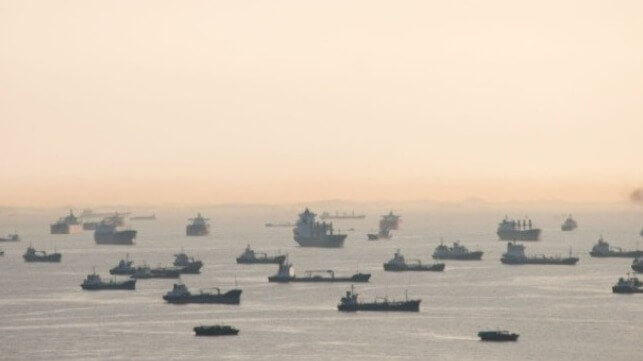
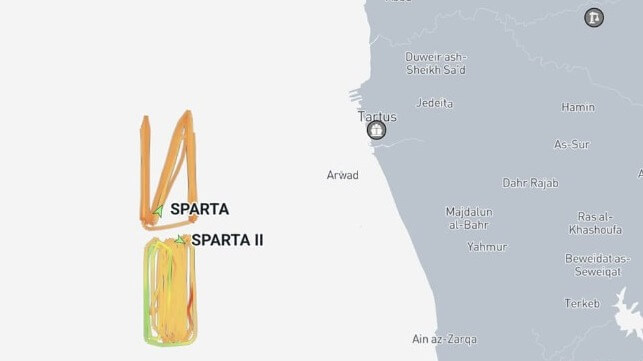
Sparta and Sparta II in holding patterns off Tartus, January 19 (MarineTraffic)

Published Jan 19, 2025 5:43 PM by The Maritime Executive


Commercial maritime traffic at the Syrian port of Tartus is picking up again under the new management of Hay'at Tahrir al-Sham (HTS), which overthrew the government of longtime dictator Bashar al-Assad in December However, Russian military cargo ships remain stalled off Tartus' harbor, where the Russian Navy has maintained a base since the days of the Cold War. 

HTS would have reasons to restrict Russian access. Russia helped the Assad government fight HTS (and other rebel groups) for 13 years, and the Russian Air Force has long been accused of indiscriminate bombing of rebel-held civilian areas. In the final days of the regime, the Russian government helped Assad to flee into exile ahead of HTS' final advance, ensuring that he would not face trial for alleged war crimes. 

HTS has so far refrained from reprisal attacks against  Russian forces, but the Russian military has pulled back to two key bases on the coast - the Hmeimem airbase and the Tartus naval base - in preparation for an apparent evacuation. Frequent cargo aircraft flights in and out of Hmeimem suggest that high-value equipment is already being extracted from that location. 

A large assortment of vehicles from the Russian operation in Syria were pulled back to the base at Tartus in the closing days of the war, but are all still stacked in storage yards at the pier. Open-source intelligence estimates suggest that laid end-to-end, this collection of mobile equipment would tail back over a kilometer of roadway; several of the trucks appear to be components of the S-400 system, a high-quality air defense radar and missile launcher system that costs an estimated $500 million to produce. The S-400 is in high demand in the Ukraine conflict. 

The Russian Navy's Mediterranean Flotilla - which called Tartus home for decades - fled during the rebel takeover, and it remains at sea after more than a month. Satellite imaging and AIS show that two well-known military cargo ships, Sparta and Sparta II, are still staged offshore despite weeks of rumored negotiations over access. 

Imaging obtained by analyst MT Anderson shows that three merchant ships have pulled in opposite the Russian section of the harbor, suggesting signs of renewed commercial activity - but the military piers on the Russian side remain devoid of traffic. The timeline for the flotilla's presence off Tartus is not indefinite, and the ships will eventually require fueling, provisioning and spare parts. Unconfirmed rumors of breakdowns have already been reported, and the flotilla's last known submarine left the Mediterranean earlier this month.