Microplastics Make Up Majority of US National Park Trash, Waste Audit Finds
“Even in landscapes that appeared untouched,” volunteers found “thousands of plastic pellets and fragments that pose a clear threat to the environment, wildlife, and human health,” said a 5 Gyres Institute spokesperson.
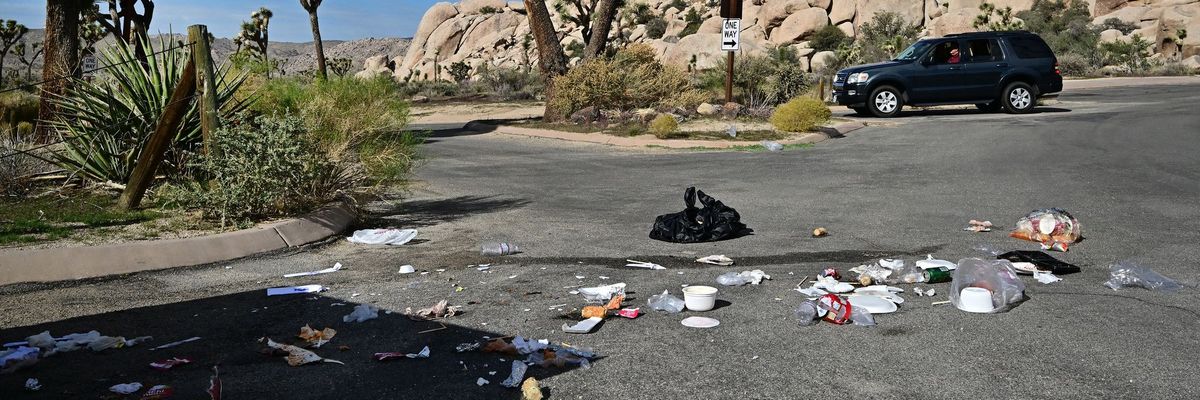
Trash is seen strewn along the road at Joshua Tree National Park in California, on October 10, 2025, on the 10th day of the federal government shutdown.
(Photo by Frederic J. Brown/AFP)
Stephen Prager
Dec 04, 2025
COMMON DREAMS
More than half the trash polluting America’s national parks and federal lands contains hazardous microplastics, according to a waste audit published Thursday.
As part of its annual “TrashBlitz” effort to document the scale of plastic pollution in national parks and federal lands across the US, volunteers with the 5 Gyres Institute collected nearly 24,000 pieces of garbage at 59 federally protected locations.
In each of the four years the group has done the audit, they’ve found that plastic has made up the vast majority of trash in the sites.
They found that, again this year, plastic made up 85% of the waste they logged, with 25% of it single-use plastics like bottle caps, food wrappers, bags, and cups.
But for the first time, they also broke down the plastics category to account for microplastics, the small fragments that can lodge permanently in the human body and cause numerous harmful health effects.
As a Stanford University report from January 2025 explained:
In the past year alone, headlines have sounded the alarm about particles in tea bags, seafood, meat, and bottled water. Scientists have estimated that adults ingest the equivalent of one credit card per week in microplastics. Studies in animals and human cells suggest microplastics exposure could be linked to cancer, heart attacks, reproductive problems, and a host of other harms.
Microplastics come in two main forms: pre-production plastic pellets, sometimes known as “nurdles,” which are melted down to make other products; and fragments of larger plastic items that break down over time.
The volunteers found that microplastic pellets and fragments made up more than half the trash they found over the course of their survey.
“Even in landscapes that appeared untouched, a closer look at trails, riverbeds, and coastlines revealed thousands of plastic pellets and fragments that pose a clear threat to the environment, wildlife, and human health,” said Nick Kemble, programs manager at the 5 Gyres Institute.
Most of the microplastics they found came in the form of pellets, which the group’s report notes often “spill in transit from boats and trains, entering waterways that carry them further into the environment or deposit them on shorelines.”
The surveyors identified the Altria Group—a leading manufacturer of cigarettes—PepsiCo, Anheuser-Busch InBev, the Coca-Cola Company, and Mars as the top corporate polluters whose names appeared on branded trash.
But the vast majority of microplastic waste discovered was unbranded. According to the Coastal & Estuarine Research Federation, petrochemical companies such as Dow, ExxonMobil, Shell, and Formosa are among the leading manufacturers of pellets found strewn across America’s bodies of water.
The 5 Gyres report notes that “at the federal level in the United States, there is no comprehensive regulatory framework that specifically holds these polluters accountable, resulting in widespread pollution that threatens ecosystems and wildlife.”
The group called on Congress to pass the Reducing Waste in National Parks Act, introduced in 2023 by Sen. Jeff Merkley (D-Ore.), which would reduce the sale of single-use plastics in national parks. It also advocated for the Plastic Pellet Free Waters Act, introduced last year by Rep. Mike Levin (D-Calif.) and then-Rep. Mary Peltola (D-Alaska), which would prohibit the discharge of pre-production plastic pellets into waterways, storm drains, and sewers.
“It’s time that our elected officials act on the warnings we’ve raised for years—single-use plastics and microplastics pose an immediate threat to our environment and public health,” said Paulita Bennett-Martin, senior strategist of policy initiatives at 5 Gyres. “TrashBlitz volunteers uncovered thousands of microplastics in our nation’s most protected spaces, and we’re urging decisive action that addresses this issue at the source.”
Microplastics filter inspired by fish
Researchers at the University of Bonn want to make wastewater cleaner
University of Bonn
image:
of this anchovy, plankton particles are captured by the gill arch system.
view moreCredit: Photo: Jens Hamann
Wastewater from washing machines is considered a major source of microplastics – tiny plastic particles that are suspected of harming human and animal health. Researchers at the University of Bonn now have developed a filter to curb this problem. Their filter was inspired by the gill arch system in fish. In initial tests, the now patent-pending filter was able to remove over 99 percent of plastic fibers from washing machine wastewater. The results now have been published in the journal npj Emerging Contaminants.
Wastewater from a washing machine in a four-person household produces up to 500 grams of microplastics each year, mainly caused by textile abrasion. The household appliances are thus one of the most important sources of the tiny particles. Microplastics currently make their way directly into the sewage sludge of wastewater treatment plants. As this sludge is often used as fertilizer, the fibers ultimately end up on the fields.
Many manufacturers have thus been searching for ways to remove microplastics from washing water to prevent them from entering the environment. “The filter systems available so far, however, have various disadvantages,” explains Dr. Leandra Hamann from the Institute for Organismic Biology at the University of Bonn. “Some of them quickly become clogged, others do not offer adequate filtration.”
Looking inside the mouths of fish
The scientist, alongside her doctoral supervisor Dr. Alexander Blanke and colleagues, has thus turned to the animal kingdom in her search for possible solutions. The team focused on fish that can be considered true masters of filter technology – and have evolved this filtration over hundreds of millions of years.
Some fish feed by means of filtration; these include, for example, mackerel, sardines, and anchovies. They swim through the water with their mouths open and sift out the plankton with their gill arch system. “We took a closer look at the construction of this system and used it as the model for developing a filter that can be used in washing machines,” says Blanke, who is a member of the transdisciplinary research areas “Life & Health” and “Sustainable Futures” at the University of Bonn.
During their evolution these fish have developed a technique similar to cross-flow filtration. Their gill arch system is shaped like a funnel that is widest at the fish’s mouth and tapers towards their gullet. The walls of the funnel are shaped by the branchial arches. These feature comb-like structures, the arches, which are themselves covered in small teeth. This creates a kind of mesh that is stretched by the branchial arches.
Self-cleaning: plankton rolls towards the gullet
“During food intake, the water flows through the permeable funnel wall, is filtered, and the particle-free water is then released back into the environment via the gills,” explains Blanke. “However, the plankton is too big for this; it is held back by the natural sieve structure. Thanks to the funnel shape, it then rolls towards the gullet, where it is collected until the fish swallows, which empties and cleans the system.”
This principle prevents the filter from being blocked – instead of hitting the filter head-on, the fibers roll along it towards the gullet. The process is also highly effective, as it removes almost all of the plankton from the water. Both are aspects that a microplastic filter must also be able to deliver. The researchers thus replicated the gill arch system. In doing so, they varied both the mesh size of the sieve structure and the opening angle of the funnel.
Filter achieves high efficiency
“We have thus found a combination of parameters that enable our filter to separate more than 99 percent of the microplastics out of the water but not become blocked,” says Hamann. To achieve this, the team used not only experiments but also computer simulations. The filter modelled on nature does not contain any elaborate mechanics and should thus be very inexpensive to manufacture.
The microplastics that it filters out of the washing water collect in the filter outlet and are then suctioned away several times a minute. According to the researcher, who has now moved to the University of Alberta in Edmonton, Canada, they could then, for example, be pressed in the machine to remove the remaining water. The plastic pellet created in this manner could then be removed every few dozen washes and disposed of with general waste.
The team from the University of Bonn and the Fraunhofer Institute for Environmental, Safety, and Energy Technology UMSICHT has already applied for a patent for its development in Germany; EU-wide patenting is currently underway. The researchers now hope that manufacturers will further develop the filter and integrate it into future generations of washing machines. This would stem the spread of microplastics from textiles, at least to some extent. And that is also necessary: analyses indicate that the particles may cause serious damage to health. They have already been found in breast milk and in the placenta – and even in the brain.
Participating institutions and funding:
In addition to the University of Bonn, the Fraunhofer Institute for Environmental, Safety, and Energy Technology UMSICHT was also involved in the study. The work was supported with funding from the Federal Ministry of Research, Technology and Space (BMFTR) and the European Research Council (ERC). The protection and marketing of the invention is supported by the Transfer Center enaCom at the University of Bonn in close cooperation with PROvendis GmbH, a service provider of the NRW university network for knowledge and technology transfer “innovation2business.nrw.”
Publication: Leandra Hamann et. al. (2025): A self-cleaning, bio-inspired high retention filter for a major entry path of microplastics; npj Emerging Contaminants; DOI: https://doi.org/10.1038/s44454-025-00020-2
the gill rakers are covered with denticles forming a mesh structure that catches the particles.
Credit
Photo: Leandra Hamann
imitates the gill arch system of the fish. The filter housing enables periodic cleaning and installation in washing machines.
Credit
Illustration: Christian Reuß/Leandra Hamann
front Dr. Leandra Hamann, right Dr. Alexander Blanke, center material researcher Christian Reuß, left biologist Dr. Hendrik Herzog.
Credit
Photo: Peter Rühr/Uni Bonn
Method of Research
Experimental study
Subject of Research
Animals
Article Title
A self-cleaning, bio-inspired high retention filter for a major entry path of microplastics
Article Publication Date
5-Dec-2025

No comments:
Post a Comment