US, Congo eye minerals pact amid peace deal with Rwanda
The Democratic Republic of Congo aims to sign a minerals and infrastructure partnership with the Trump administration on Thursday as part of a series of deals targeted at ending a long-running conflict in the eastern part of the resource-rich African nation.

President Donald Trump is scheduled to meet with the presidents of Congo and Rwanda in Washington on Thursday to oversee the signature of a peace accord between the two countries.
The three-decade-long conflict is one of several that Trump has claimed to end as part of his global dealmaking, despite ongoing fighting between the Congolese army and Rwanda-backed fighters.
The central African nations will also sign an economic agreement, while the US and the Congo are expected to ink their own partnership.
Through the deal with the US, “the DRC will become a continental energy hub, a kind of logistical, strategic hub, but also an indispensable player in the critical mineral supply chains,” Tina Salama, a spokesperson for Congolese President Felix Tshisekedi, told reporters in Washington on Wednesday.
The US has been targeting Congo’s minerals to secure key inputs for technology, energy and defense and as a way of diminishing China’s dominance over the trade.
Congo is the biggest nation by landmass in sub-Saharan Africa and rich in strategic metals including cobalt, copper, tantalum, lithium and gold.
The deal with the US will support local mineral production and job creation, and offer US companies the chance to invest in resource, energy and infrastructure projects, Salama said.
This will include the development of a $1.8 billion connection to Angola’s Lobito railway corridor to the Atlantic Ocean and the Grand Inga dam, which would be the biggest hydropower plant in the world, she said.
But the investments will only move forward if Rwanda stops supporting rebel groups in Congo’s east, Salama said.
Rwanda-backed M23 rebels have occupied the region’s two biggest cities since early this year. In recent days, M23 has clashed with the Congolese army in South Kivu province.
“It’s a proof that Rwanda doesn’t want peace,” Congolese government spokesman Patrick Muyaya said alongside Salama in Washington. “Peace for us means withdrawal of Rwandan troops.”
Rwanda denies supporting the M23 and says its troops have only been taking “defensive measures” to secure its borders, in particular against a rebel group with ties to the perpetrators of the 1994 Rwandan genocide against Tutsis.
Congo has agreed to “neutralize” the group, known as the FDLR, as part of the US-backed peace agreement.
“It’s up to the DRC to show how much and how quickly they want peace,” Rwandan government spokesperson Yolande Makolo told Bloomberg Wednesday.
“Achieving peace is tied to the DRC ending all state support to the FDLR as well as other forces hostile to Rwanda, which will allow us to relax our defensive measures, but this hasn’t happened yet,” she said.
(By Michael J. Kavanagh)
Rwanda's Kagame and Tshisekedi of the DRC sign peace deal at the White House
Rwandan President Paul Kagame and DR Congo's President Felix Tshisekedi signed a peace accord in the presence of US President Donald Trump at the White House on Thursday aimed at ending the conflict between their countries. Meanwhile, fighting in eastern DR Congo continues amid a rapid advance by Rwanda-backed M23 rebels.
Issued on: 04/12/2025
By: FRANCE 24
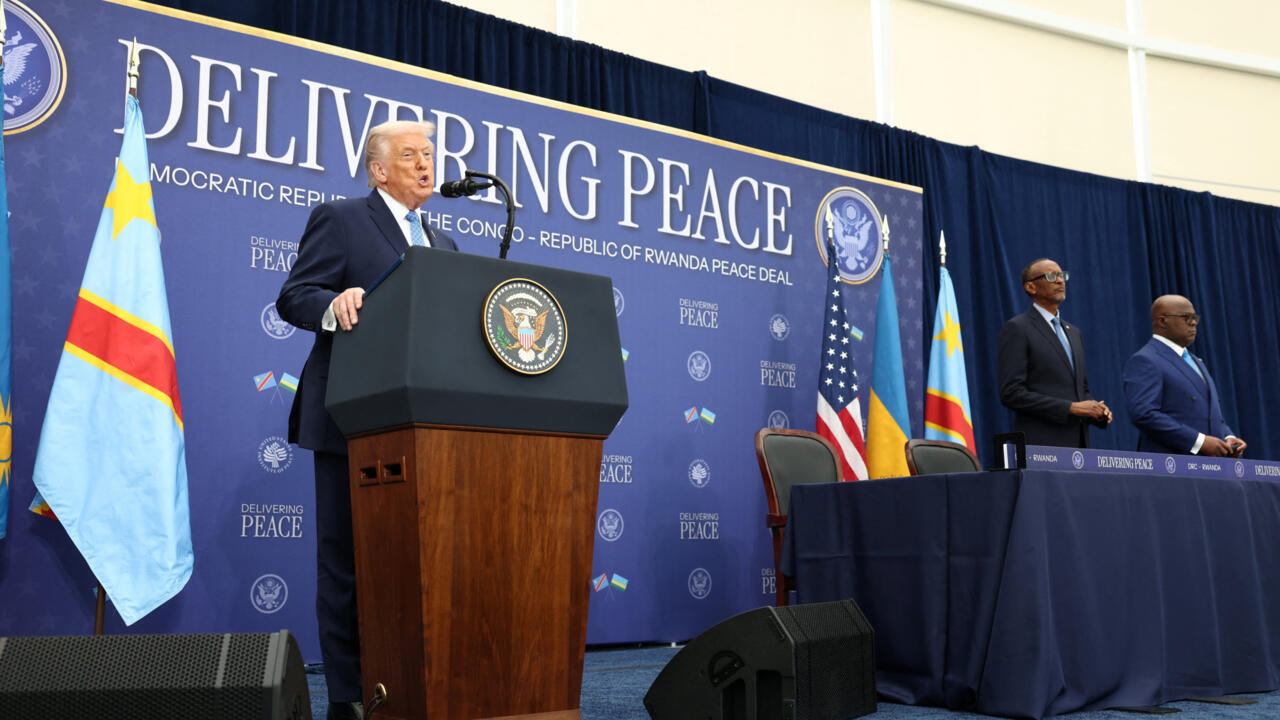
US President Donald Trump and the leaders of Rwanda and the Democratic Republic of Congo signed a peace deal Thursday, even as fresh violence raised questions about the accord to end one of Africa's longest wars.
Trump said the United States was also signing deals on critical minerals with the two countries as he hosted Paul Kagame, the longtime president of Rwanda, and Congolese President Felix Tshisekedi in Washington.
"I think it's going to be a great miracle," Trump said after the signing – held in a peace institute which his administration has just renamed after him.
Speaking of the two leaders, he added: "They spent a lot of time killing each other, and now they are going to spend a lot of time hugging, holding hands and taking advantage of the United States of America economically, like every other country does."
But the African leaders both took a more cautious tone, as fighting raged in eastern DRC, where the M23 armed group – which the UN says is backed by Rwanda – has been gaining ground in recent weeks against Kinshasa's forces.
"There will be ups and downs on the road ahead, there is no doubt about it," said Kagame, whose allies have taken a decisive edge on the ground against his country's turbulent neighbour.
The DRC's Tshisekedi called it the "beginning of a new path, a demanding path."
'There isn't peace in Eastern Congo': Fighting rages between M23 and Congolese army
05:08
'A lot of money'
Trump has boasted that the eastern DRC conflict, where hundreds of thousands of people have died over several decades, is among eight wars he has ended since he returned to office in January.
The US president has made no secret of his desire to win the Nobel Peace Prize.
Trump said the agreement will pave the way for the United States to gain access to critical minerals in both countries. The violence-torn eastern DRC, in particular, has reserves of many of the key ingredients in modern technologies, such as electric cars.
It is the latest in a series of deals in which the billionaire Republican has negotiated a stake for US firms to extract rare earth minerals, including in Ukraine.
"We're going take out some of the rare earth," Trump said. "And everybody's going to make a lot of money."
The signing comes more than five months after the countries' foreign ministers also met Trump and announced another deal to end the conflict.
The long-simmering conflict exploded in late January as the M23 captured the major cities of Goma and Bukavu.
After the June agreement, the M23 – which denies links to Rwanda – and the Kinshasa government pledged a ceasefire following mediation by US partner Qatar, but both sides have since accused the other of violations.
'Many dead'
Violence continued on the ground even on the day of the signing.
An AFP journalist at the scene heard weapon fire ring out on the outskirts of Kamanyola, an M23-controlled town in South Kivu province near the borders with Rwanda and Burundi.
"Many houses have been bombed, and there are many dead," said Rene Chubaka Kalembire, an administrative official in Kaziba, a town also under M23 control, on the eve of the signing.
After several days of clashes around Kaziba, fighter jets bombarded the town again on Thursday morning, a local civil society representative who requested anonymity told AFP.
Explosions could also be heard coming from the Bugarama border post in Rwanda across the border in neighbouring Burundi, with Rwandan police temporarily shutting the frontier post on Thursday.
AFP was unable to obtain a verifiable toll from the fighting from independent sources.
Local sources reported a massive build-up of M23 reinforcements, accompanied by armoured cars, in the high plateau of South Kivu.
Passage through the mountainous region would allow its troops to encircle Uvira, the last major town in South Kivu to evade the M23's capture.
The Trump-brokered deal meanwhile comes as both countries are in talks with his administration on its priority of taking in migrants amid the president's sweeping deportation drive.
(FRANCE 24 with AFP)

No comments:
Post a Comment