Davie Defense Expands in U.S. Market with Acquisition of Gulf Copper
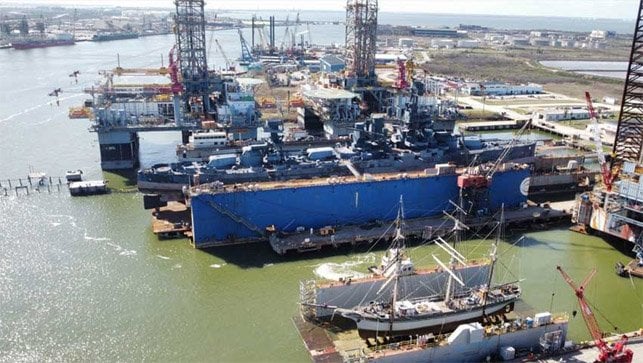
The newly minted Davie Defense, a division of Inocea Group and aligned with Canadian shipbuilder Davie, completed its acquisition of Gulf Copper & Manufacturing Corporation's shipbuilding assets in Galveston and Port Arthur, Texas. The deal was first announced in June, with the launch of Davie Defense announced in September, as the group looks to leverage its expertise to gain a foothold in U.S. defense shipbuilding and specifically the Polar Icebreaker programs.
Gulf Cooper has been operating for 75 years along the U.S. Gulf Coast and reports it has two dry docks in each of the locations and 4,000 feet of dock in Galveston and 1,000 feet in Port Arthur. It has been focused of late on ship repair, offshore services, and marine infrastructure. It serves the oil and gas, marine transport, petrochemical, and government sectors. Davie highlights that the yard recently expanded scope on the Flight III Arleigh Burke–class destroyer units. It has approximately 350 employees currently.
The group reports that Gulf Copper will continue to operate as a leading repair and fabrication center, backed by its experienced management team and workforce, who will remain in place. Kai Skvarla, CEO of Davie Defense, will assume the role of CEO of Gulf Copper, with current CEO Steve Hale staying on in an advisory role to ensure a smooth transition.
"Closing this acquisition is a defining moment in our Group's journey,” said James Davies, Co-Founder, Inocea Group, a privately held British marine industrial group with operations spanning the United States, Canada, and Finland. “We are now truly transatlantic, and we are proud to welcome the Gulf Copper team as part of our U.S. presence.”
The company is seeking to leverage the expertise of Davie Group in Canada, which is one of the builders for Canada’s new large Polar icebreakers. In addition, Davie acquired Helsinki Shipyard in Finland as well as other assets. In September, it outlined its plans to invest in Gulf Cooper to create what it called an "icebreaker factory." Davie had said once it secures contacts that it plans to invest $1 billion to upgrade and expand capacity in Galveston and Port Arthur. The project it said could generate approximately 4,000 American jobs, with 2,000 directly at Gulf Copper.
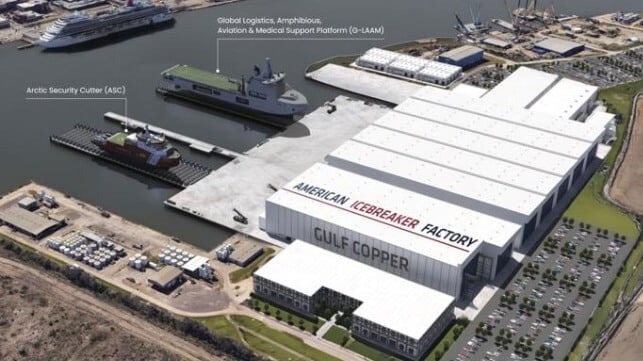
Rendering of the proposed "icebreaker factory" at Gulf & Cooper's yard (Davie Defense)
Polar icebreakers are becoming increasingly significant in the planning of both the United States and Canada. On October 9, the presidents of the U.S. and Finland signed a Memorandum of Understanding on icebreaker construction that was a follow-up to the trilateral initiative first announced in July 2024 between the U.S., Canada, and Finland to advance shipbuilding and Arctic defense collaboration under the Icebreaker Collaboration Effort (ICE Pact).
As a principal industrial partner in the ICE Pact, Davie Defense says it looks forward to the upcoming contracting process and to working with the U.S. Coast Guard to determine how best to advance the Arctic Security Cutter (ASC) project in America. Davie Defense is in negotiations to deliver five ASCs.
The ASC is based on a fourth-generation polar icebreaker design from Helsinki Shipyard, which is billed as the world's premier icebreaker builder. The Finnish yard has delivered approximately half of the world fleet and all the polar icebreakers built in Finland over the past 25 years.
The October memorandum between the U.S. and Finland calls for the construction of a total of up to 11 icebreakers using Finnish designs and expertise. The value of the deal was reported at approximately $6.1 billion, with media reports saying four of the vessels will be built in Finland, and in a second phase, Davie’s U.S. yard and Bollinger would build the additional vessels using the Finnish designs and expertise.
Davie follows other major shipbuilders that are positioning for the anticipated expanded U.S. shipbuilding proposed by the Trump administration. Austal has moved to increase its facilities, while South Korea’s Hanwha Ocean purchased the Philly Shipyard. HD Hyundai is also reported to be exploring possible U.S. acquisitions while also forming partnerships in the U.S. It is all part of the highly anticipated revival of the American shipbuilding industry.
Saronic Invests $300M to Expand Louisiana Shipyard to Accelerate ASVs

A U.S. defense tech startup specializing in autonomous ships is pushing to enhance its competitiveness in the fast-growing market with a $300 million investment to expand its production facility. Texas-based Saronic Technologies wants to deliver autonomous ships at speed and scale with the massive investment to expand its Franklin, Louisiana, shipyard.
The firm, which began operations in April this year with the ambitions of redefining the building of unmanned surface vehicles, reports that the expanded facility will enable it to increase the production of autonomous surface vessels (ASVs) while significantly growing its workforce. The expansion project will add more than 300,000 square feet of new production capacity and create 1,500 new jobs.
The new facility, which is expected to strengthen the Gulf Coast’s role in the future of U.S. maritime innovation, is slated for completion by the end of 2026, with expanded operations coming online a year later. The project will encompass the construction of three new slips, warehouse expansion, and the development of a dedicated production line for large-vessel assembly, namely Marauder, the firm’s 180-foot autonomous ship.
Saronic is currently constructing two Marauder vessels at the Franklin facility, having progressed from initial design to full vessel development in just six months. At 150 feet, Marauder is a large ASV that has a payload capacity of up to 40 metric tonnes and can travel up to 3,500 nautical miles or loiter for more than 30 days. The vessel is designed to support a range of missions for the U.S. Navy, its allies, and commercial customers. The firm expects that construction of the first vessel will be complete by the end of the year.
In recent months, Saronic has managed to improve the vessel’s design to 180 feet, enhancing its payload capacity and operational range. The updated vessel is capable of hosting up to four 40-foot or eight 20-foot containers, providing unmatched modularity for logistics, payload delivery, and sustained operations at sea. The new design comes with a cruise speed of 12 knots and a top speed of 25 knots, a 150-metric-ton payload capacity, and a range of up to 5,400 nautical miles.
The firm, which earlier this year acquired Louisiana-based shipbuilder Gulf Craft to accelerate its growth into autonomous shipbuilding, contends the expanded facility is critical to its growth ambitions. In the coming years, it plans to create about 1,500 new jobs ranging from welding to fabrication, engineering, and systems integration.
“Our expanded shipyard will enable us to deliver autonomous ships at unprecedented speed and scale. Together with our next-generation Port Alpha shipyard, we’re establishing the modern blueprint for American shipbuilding, an integrated ecosystem that connects autonomy innovation with large-scale production capacity to strengthen and sustain America’s maritime leadership for generations to come,” said Dino Mavrookas, Saronic Co-founder and CEO.
The Franklin facility is expected to complement Saronic’s plans for Port Alpha, which the company has touted as the largest and most advanced shipyard in the U.S., designed to produce large autonomous ships at speed and scale.
Samsung Sets Agreements with NASSCO and Conrad to Enter U.S. Shipbuilding
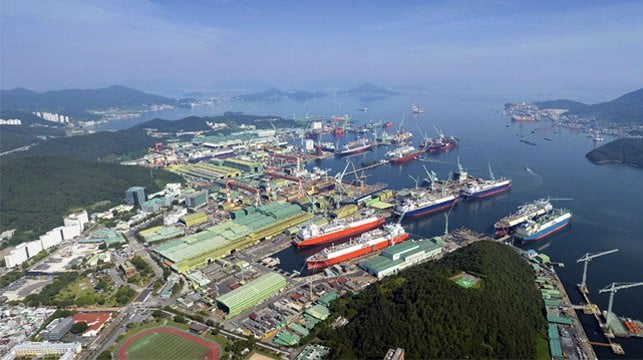
South Korea’s Samsung Heavy Industries announced two key partnerships with leading U.S. shipbuilders, as it follows competitors HD Hyundai and Hanwha Ocean into the U.S. shipbuilding market. The South Koreans look to the emerging opportunities in the U.S. under the anticipated efforts to revitalize the segment and the Make American Shipbuilding Great Again program.
Samsung Heavy Industries is one of South Korea’s largest shipbuilders, known for its work in developing the liquified natural gas carrier segment, ranging from LNG carriers to floating LNG production units. It has a long heritage in the oil and gas sector as well as containerships, and is actively pursuing the development of new technologies for shipping and shipbuilding. The company highlights a current orderbook which includes 120 commercial ships and three FLNG units.
A tri-party Memorandum of Agreement was announced on December 3 involving SHI with General Dynamics NASSCO and its long-term partner DSEC Co. The companies said they plan to “join forces to collaborate on their industry-leading ship design and manufacturing automation and technology” for the U.S. market.
The companies point to the opportunities for naval and government shipbuilding as well as commercial shipping. They cite the U.S. Navy’s Next Generation Logistics Ships as one of the areas where they can share common experience.
"This partnership brings together three extraordinary companies with a track record of success and over 160 years of combined shipbuilding and design experience," said Dave Carver, president of General Dynamics NASSCO.
General Dynamics NASSCO highlights its work as a designer and builder, having delivered over 150 vessels since the 1950s. It is currently building the U.S. Navy's 20-ship class of John Lewis (T-AO 205) Fleet Oilers and is designing the U.S. Navy's future Submarine Tender (AS-X) class. Recent commercial programs include ConRo ships, containerships, and medium range (MR) tankers, all designed with DSEC and other South Korean partners.
DSEC Co. highlights that it provides a complete range of shipbuilding and marine engineering services, including ship design, material procurement, quality management, shipyard operations and development consulting, logistics support, and eco retrofit solutions. With over three decades of experience, DSEC notes it has worked extensively on U.S.-built ship designs and material packages throughout the U.S., supporting a wide variety of commercial, naval, and government ship programs.
"Through this tri-party collaboration, SHI is committed to leveraging its technological expertise, skilled workforce and production infrastructure to enhance the capabilities of the U.S. shipbuilding industries," said Joonyun Kang, director of SHI.
Today, December 4, SHI followed the first agreement, announcing it has also signed a Memorandum of Understanding with Conrad Shipyard. The MOU formalizes a collaborative framework to jointly explore opportunities in the rapidly expanding U.S. LNG bunkering market.
“Through this collaboration, we expect to enter the U.S. LNG bunkering market while also contributing to the revitalization of the U.S. shipbuilding industry,” said an SHI representative.
Conrad and SHI will work together to evaluate and pursue technical, commercial, and market-based initiatives that support the design, construction, and deployment of LNG bunkering vessels tailored for U.S. regulatory and operational requirements. The MOU is intended to combine SHI’s global expertise in advanced LNG technologies with Conrad’s proven LNG shipbuilding capabilities and domestic market access.
South Korea committed to making a $150 billion investment in U.S. shipbuilding during the U.S. trade negotiations and gave the program the catchphrase of “Make American Shipbuilding Great Again” (MASGA). Hanwha Ocean was first into the market, announcing the acquisition and planned investment to revitalize the Philly Shipyard. HD Hyundai Heavy Industries has said it is also looking at possibly U.S. acquisitions, while the company in October signed an agreement with HII (Huntington Ingalls Industries), which they said is designed to further expand cooperation in shipbuilding and repair, as they target the U.S. Navy and commercial shipping. Hyundai also announced a new partnership with Edison Chouest Offshore that calls for jointly building containerships.

No comments:
Post a Comment