Philippine Navy Launches Second Malvar Class Frigate
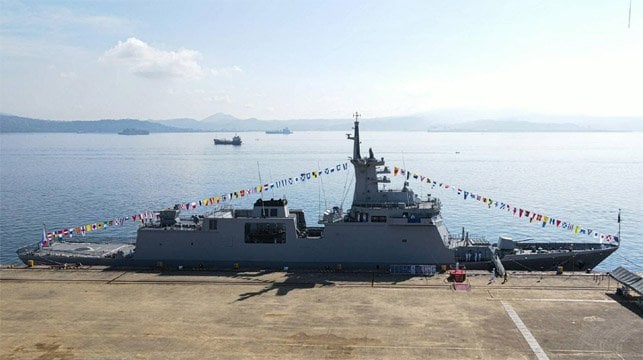
The Philippine Navy has officially commissioned its second Miguel Malvar Class frigate, BRP Diego Silang (FFG07), into active service, in a ceremony at Subic Bay with the commander of the Philippines Navy Vice Admiral Jose Ma Ambrosio Q Ezpeleta present. It comes at a critical time as the Philippines looks to enhance its capabilities as it continues to confront Chinese aggression in the region.
BRP Diego Silang is a multi-role warship capable of conducting anti-surface, anti-air, anti-submarine, and electronic warfare missions. In comparison to BRP Jose Rizal (FF-150) and BRP Antonio Luna (FF-151) of the Jose Rizal Class, which they will supplement, it features a longer hull, larger displacement, and enhanced communication and electronic warfare support measures. These features will give the two new frigates wider capability at longer range, reaching out beyond the exclusive economic zone (EEZ).
The ship was built by HD Hyundai Heavy Industries shipyard in Ulsan, South Korea, and completed in March. The first commanding officer of the BRP Diego Silang is Captain John Percie Alcos.
At 115 meters (388 feet) in length, the frigate is 3,200 tons displacement and has an operating speed of 25 knots. Her sister ship, BRP Miguel Malvar, was commissioned in May. They are also an important calling card for HD Hyundai, which is actively seeking to expand its role in naval shipbuilding. Hyundai is currently also building six offshore patrol vessels for the Philippine Navy, two of which are now completed and undergoing sea trials in South Korea.
The Philippines also has an aspiration to order two more Malvar Class frigates as part of its expansion of capabilities. Two 124-meter landing dock platforms are also currently being constructed by Indonesian shipbuilder PT PA, with all the additions to the fleet forming part of the Horizon 2 modernization program approved by Philippine President Rodrigo Duterte in June 2018, and costing approximately $5 billion. The net effect of this program will be to give the Philippine Navy a much greater ability to sustain its outposts in the disputed areas of the South China Sea, which face daily bullying and harassment by Chinese naval, coastguard, and paramilitary fishing vessels.
Launching the ship, Philippine Undersecretary for Acquisition and Resource Management Salvador Melchor B. Mison, Jr. diplomatically emphasized that the program to enhance the capability of the Philippine Navy was ongoing, and needed to strengthen maritime domain awareness, enhance deterrence, and improve the Philippines' ability to uphold the rule of law

No comments:
Post a Comment