Tuesday, January 21, 2025

REST IN POWER
'Horrifically symbolic': US Feminists mourn the death of women's rights icon Cecile Richards

Sarah K. Burris
January 20, 2025 
RAW STORY

Cecile Richards, former President of Planned Parenthood Federation of America and Planned Parenthood Action Fund, speaking at a women's roundtable at Hillary for Minnesota Headquarters in St Paul, MN (Photo by Lorie Shaull/Flickr)

On the eve of Donald Trump's second presidency, longtime women's rights activist Cecile Richards passed away after a fight with brain cancer.

Richards was the daughter of with former Texas governor Ann Richards, a powerhouse in Democratic politics who ended her time as governor mocking the intellect of George W. Bush. She and Cecile Richards then became a kind of double threat in the fight for women's rights. Richards took over Planned Parenthood in 2006 and battled the "war on women."

In a post from her family on social media, they remembered Richard saying about the impending Trump presidency: “It’s not hard to imagine future generations one day asking: ‘When there was so much at stake for our country, what did you do?’ The only acceptable answer is: ‘Everything we could.'"


It was a comment that moved MSNBC host Alecia Menendez, and she cited the quote on BlueSky, saying, "Rest well."

"She was an amazing woman. This was taken at the DNC in Chicago this year. Cecile fought for women’s rights. Hard. Millions of women benefited from her courage and determination. Cecile Richards made her mom proud. RIP," said former Sen. Claire McCaskill (D-MO) on BlueSky.

MSNBC host Joy Reid similarly expressed her heartbreak, "So sad to hear that Cecile Richards has passed at just 67 years old. She was a fighter and a stalwart for the rights of women, just like her mom. Thankfully she lived to see a president affirm the #equalrightsamendment as the 28th Amendment."

"Cecile Richards dying on the day of Trump's inauguration feels horrifically symbolic," said features editor and writer Alisha Grauso.

"Oh my God. Cecile Richards was from Waco, Texas. My hometown. She’s with her mother Ann, now. You fought for your state and your country. May her memory be a blessing," said Texas criminal defense attorney Sara Spector.

Texan Matthew Dowd recalled his longtime friendship with Richards, saying, "oh dang, so sad news. my good friend Cecile Richards has passed away. Have known her since 1986, and helped her in 1990 to elect her mom as Governor of Texas. The last governor of Texas who cared about all Texans. RIP Cecile. We will miss you."

"Cecile Richard’s was a warrior for women’s rights, but also incredibly kind and generous with her mentorship and advice. As a former Texan, I revered Cecile and her mother, Ann Richards, and getting to know Cecile was the honor of a lifetime," said Shannon Watts of Mom's Demand Action.

"I am so deeply saddened by the news of our dear friend, @CecileRichards , passing. She was a light, a champion, a force for good. As her family says below - to honor her legacy and life, let’s do everything we can in this moment to create the just world that everyone deserves. Rest in power dear friend," former Texas state senator and feminist Wendy Davis said.

"As if today wasn’t bad enough, the passing of Cecile Richards, former Planned Parenthood leader, is beyond tragic for all women in US. Her powerful voice for women’s freedom has been silenced. Rest in power, dear friend," said former Congresswoman Jackie Speier on X.

Cecile Richards, Reproductive Rights Champion Who Led Planned Parenthood, Dies at 67

"To honor her legacy and life, let's do everything we can in this moment to create the just world that everyone deserves," said former Texas lawmaker Wendy Davis.
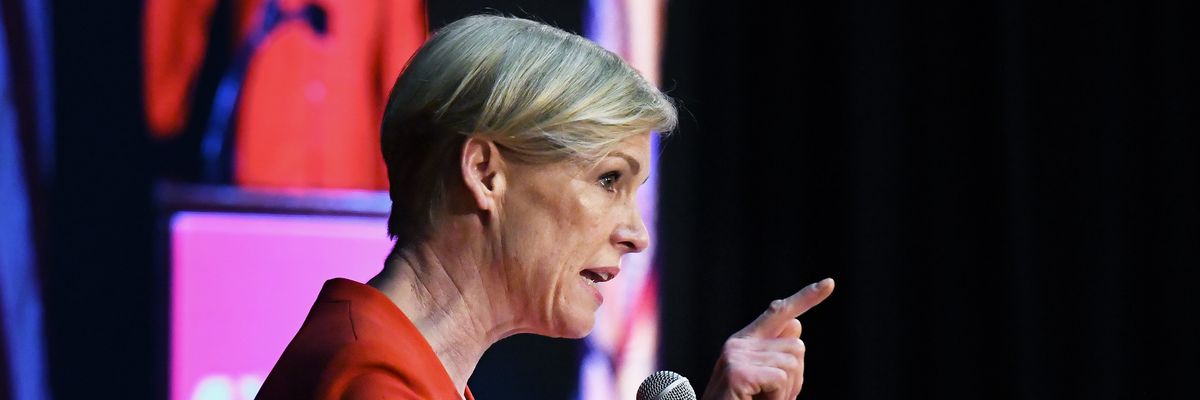


Cecile Richards, president of Planned Parenthood Action Fund, speaks to New York State Planned Parenthood advocates during a rally at the Empire State Plaza Convention Center on March 13, 2018 in Albany, New York.
(Photo: John Carl D'Annibale /Albany Times Union via Getty Images)

Julia Conley
Jan 20, 2025
COMMON DREAMS

Cecile Richards, the former president of Planned Parenthood and longtime champion of women's rights and other progressive causes, died on Monday at the age of 67. The cause was an aggressive brain cancer that had been diagnosed in 2023.

Richards' husband and three children confirmed her death in a statement posted on social media.

Richards, the daughter of forner Democratic Texas Gov. Ann Richards, had an early introduction to progressive politics. At 16 she worked on a campaign to elect Sarah Waddington, the lawyer who argued in favor of abortion rights before the U.S. Supreme Court in Roe v. Wade, and in college she helped push Brown University to divest from companies that supported apartheid in South Africa.

After years of labor organizing work, Richards became the president of Planned Parenthood Federation of America. She sat at the helm of the organization for 12 years, leading it as it became more vocal in electoral politics and fought state-level battles against abortion restrictions.

She was the national face of the organization and spoke frequently on its behalf at political events and galas, but also stood shoulder-to-shoulder with abortion rights supporters at pivotal moments in the fight against right-wing efforts to attack reproductive justice.

In 2013, after then-Texas state Sen. Wendy Davis (D-10) made national headlines by spending 13 hours filibustering an omnibus bill that contained a host of anti-abortion measures, Richards rallied supporters in the state Capitol to yell loud enough to halt the Senate debate over the legislation—a move that Republican lawmakers later blamed for the bill's failure.

"That was vital," Dave Cortez of Occupy Austin toldThe Texas Tribune. "Her support really helped put it all together."

Davis called Richards "a light, a champion, a force for good" on Monday.


Calling her death "a heartbreaking loss," Rep. Pramila Jayapal (D-Wash.) said the former Planned Parenthood leader "spent her life on the front lines, fighting for women's rights throughout this country."

After leaving Planned Parenthood in 2018, Richards co-founded the progressive political mobilization group Supermajority and toured the nation speaking out against President Donald Trump's nomination of U.S. Supreme Court Justice Brett Kavanaugh.

She also cofounded the chatbot Charley, which connects people seeking abortion care with reproductive health organizations, and Abortion in America, a project that publishes the personal stories of people who have obtained abortions since the Supreme Court overturned Roe in 2022.

"The only thing people respond to and remember are stories," Richards told The New York Times last October. "We have to figure out: How do you catch the attention of people that, even if they could find the article, don't have 20 minutes to read it?"

Richards' death was announced just hours before Trump, who has bragged about his role in overturning Roe and mocked the family of one woman who died after being unable to receive standard care under Georgia's abortion ban, was to be sworn in for his second term in office.

"As if today wasn't bad enough, the passing of Cecile Richards, former Planned Parenthood leader, is beyond tragic for all women in U.S," said former Rep. Jackie Speier (D-Calif.). "Her powerful voice for women's freedom has been silenced. Rest in power, dear friend."

Sen. Richard Blumenthal (D-Conn.) said Richards "modeled guts and grit in public service, showing courage and fortitude beyond words as a champion of women's reproductive freedom."


In their statement, Richards' family asked that supporters who wish to honor her listen to "some New Orleans jazz, gather with friends and family over a good meal, and remember something she said a lot over the last year: It's not hard to imagine future generations one day asking, 'When there was so much at stake for our country, what did you do?'"

"The only acceptable answer is: Everything we could."

France urged to exonerate women convicted under old abortion laws

As France commemorates 50 years since the law decriminalising abortion came into effect, prominent figures in politics and the arts are urging the government to exonerate women convicted for abortions before 1975.


Issued on: 17/01/2025 - RFI
A woman returns to Paris in March 1974 after taking a bus to Amsterdam for an abortion, a year before France legalised the procedure. AFP - -


“We, activists, researchers, elected officials, demand the rehabilitation of women unjustly convicted of abortion,” they wrote in a petition published on the Libération website.

The law, first debated by MPs in 1974, was championed by health minister Simone Veil and adopted for a trial period of five years before being made permanent in 1979.

Abortion had been criminalised in France since the 1800s, with convictions rising dramatically under the Vichy regime during World War II. Between 1940 and 1943, it was punishable by death.

Even in 1946, French courts ruled on 5,151 cases of clandestine abortions, the petition states.

"We cannot forget those who suffered, those who died as a result of clandestine abortion and even more, those who were condemned by unfair laws," the group wrote.

Restoring dignity

Notable signatories include Nobel Prize-winning author Annie Ernaux, Fondation des Femmes (Women's Foundation) president Anne-Cécile Mailfert, and actresses Laure Calamy and Anna Mouglalis.

“It is about restoring their dignity, but also giving them a worthy place in the history of women and their rights,” the petition says.

The group proposes creating an independent commission to oversee the recognition and compensation of women convicted of abortion under previous laws. Compensation could be material or symbolic.

The petition cites a recent precedent: a bill passed by the National Assembly on 6 March 2024, which recognised and sought to repair harm caused by discriminatory laws against homosexuals between 1942 and 1982.

The signatories argue that exonerating women convicted of abortion would be a "strong political gesture" in line with recent moves to enshrine abortion rights in the constitution, which was approved in March 2024.

(with AFP)


France's Veil abortion law leaves positive but fragile legacy, 50 years on


France on Friday marks 50 years since the law decriminalising abortion came into effect. Since then, the law has undergone numerous updates to reflect changes in society and was even enshrined in the Constitution in March 2024. But despite these advances, advocates warn that access to abortion remains fragile in practice.


Issued on: 17/01/2025 - RFI

Emmanuel Macron speaks during a ceremony to seal the right to abortion in the French constitution, on International Women's Day, 8 March, 2024.
 © Gonzalo Fuentes / Reuters

By:Ollia Horton with RFI


The law to decriminalise abortion was proposed by then-health minister Simone Veil in November 1974. She was one of only nine female MPs at the time and faced enormous pressure – and abuse – during the 25-hour parliamentary debate.

"I never imagined the hatred that I would unleash," Veil later said, recalling how some lawmakers likened abortion to the Holocaust – of which Veil was a survivor, having been deported to the Auschwitz-Birkenau and Bergen-Belsen concentration camps.

After concessions on adding a conscience clause for doctors who refused to perform the procedure, the bill was adopted with 284 votes for and 189 against.

It was enacted after approval by the Senate on 17 January, 1975, becoming what was known as the Veil Act. It was initially adopted for a period of five years, then prolonged indefinitely in 1979.

France marks 50 years since journey to decriminalise abortion began

There were originally two sets of circumstances under which abortion was accepted by the law – the first for an elective abortion due to a woman’s "distress" and the second for medical reasons.

Veil herself said that abortion should only be carried out as an exception, hence the inclusion of a seven-day waiting period and a "psycho-social" interview among the conditions for a termination, both of which have fallen by the wayside in recent years.

French Health Minister Simone Veil opening the debate on decriminalising abortion at the National Assembly, 26 November 1974. © Bodini/AP


An evolving law


Fifty years on, the legacy of the Veil Act continues to mark French society. The technical aspects of the law have significantly evolved over time, with six major modifications between 1979 and 2024, when it was enshrined in the French constitution.

In 1975, elective abortion was initially authorised up to the 10th week of pregnancy. This limit was extended to 12 weeks in 2001 and to 14 weeks in 2022.

In 1975, terminations had to be performed surgically by a physician in a hospital. Under today’s legal framework, they can be performed in a range of settings, by both physicians and midwives, using various methods.

France set to make history by enshrining abortion rights in constitution

One of the biggest changes in the last 50 years is access to medical abortions, those in which medications are used rather than surgery, which accounted for four out of five abortions in 2023, according to a November report by the National Institute for Demographic Studies (INED). The figure for surgical abortions went down to one in five the same year.

Initially administered in hospitals, these drugs also became available in physicians’ offices, clinics and sexual health centres in the 2000s. Since the Covid-19 pandemic, women seeking medical abortions can also access health practitioners remotely.
Increase in abortions

France is among the European Union countries with the highest abortion rate. In 2023, in France as a whole (including its overseas departments) there were 17 elective abortions (16 in mainland France) per 1,000 women aged 15-49, according to the INED report.

It also shows that France has seen an increase in abortions. Stable at around 220,000 per year for the last three decades, the figure began rising sharply in the early 2020s, reaching 241,700 in 2023.

The report's authors suggest that the increase in elective abortions may be "in response to greater social and economic insecurity and increasing uncertainty about the future".

Despite the legal and logistical advances in the law, access to abortion remains fragile in practice and unequal across the country.

Why changing the constitution doesn't guarantee access to abortion in France

Planning Familial ("Family Planning"), an advocacy group, found in a survey commissioned by polling group the IFOP Institute in July 2024, that 27 percent of women who sought an abortion over the last five years had been faced with a refusal.

Some of these refusals may have been linked to the “conscience clause” which has been part of the law from the outset. It states that a medical practitioner has the right to refuse to carry out an abortion, but must immediately refer the patient to a service that can perform the procedure.

Furthermore, the survey found that 31 percent of women who terminated their pregnancy before its eighth week said they were given no choice of method – medical or surgical – even if the right to this choice is inscribed in the law.

Planning Familial also reported that 130 abortion centres have been closed over the last 15 years in France, and others are under threat.
Geographical discrepencies

A Senate report from October 2024 also pointed to geographical discrepancies when it came to accessing abortion.

In France's overseas departments and regions the rate reaches close to double that of mainland France. However, it was these same departments – including Guyana, Guadeloupe and Réunion Island – where women found it difficult to access health centres due to distance and lack of transport.

Rural areas in France were also subject to similar difficulties, as well as long waiting times and under-equipped regional health facilities.

The Senate report stated that the number of medical staff willing to carry out abortions was not sufficient and that this was perhaps due to a lack of training, poorly updated information campaigns and in some cases, too much red tape.
Stigma

Both the Senate report and Planning Familial survey also pointed to the need to counter the stigma associated with abortion, which stemmed from aggressive disinformation campaigns and activism online.

In its July survey, Planning Familial found that 41 percent of women who recently had an abortion stated that they felt "the right to abortion was taboo", and 63 percent feared being judged by those around them or by health professionals.

Meanwhile, 37 percent said they felt pressure over their choice to have an abortion, either from their entourage or society at large.

This concern was also highlighted in a 2024 report from the La Fondation des Femmes (Women’s Foundation), which pointed to a change in public opinion following the June 2022 ruling of the Supreme Court of the United States, which rolled back the Roe vs Wade decision that had guaranteed abortion rights on a federal level.

Should France guarantee supply of abortion drugs by producing its own?

According to the Fondation, this gave anti-abortion groups in France a sense of legitimacy in carrying out "attacks against the premises and organisations fighting for reproductive rights" and campaigns such as putting anti-abortion stickers on hire bikes in Paris.

Planning Familial said that while 85 percent of people questioned in the IFOP poll said they are very strongly attached to the right to abortion, 89 percent of people were aware that obstacles persist in France.

The recent addition of abortion rights to the constitution does not seem sufficient to reassure people moving forward, the group said. "The fear of a possible challenge to the right to abortion in France is present, and particularly among women who have already had an abortion – 51 percent compared to 30 percent of the general public."

Monday, January 20, 2025

Young Chinese turn to AI pets for emotional relief


By AFP
January 20, 2025

Zhang Yachun playing with her AI-powered robot named Aluo and pet duck Nana at her home in Beijing - Copyright AFP Adek BERRY


Mary Yang, with Emily Wang in Nanjing

At a shopping mall in Beijing, Zhang Yachun murmurs quietly to her closest confidant, a fluffy AI-powered robot whose soothing chirps remind her that she is not alone.

Zhang, 19, has long battled anxiety over school and work, and has struggled to form deep friendships with other people.

But since buying a BooBoo, a “smart pet” that uses artificial intelligence to interact with humans, she says life has become easier.

“I feel like I now have someone to share the happy times with,” Zhang told AFP in the apartment she shares with her parents and a real pet duck.

Across China, a growing number of people are turning to AI to combat social isolation as the technology becomes more mature and widely accepted.

Wriggly, furry and resembling a guinea pig, BooBoo is produced by Hangzhou Genmoor Technology and retails for up to 1,400 yuan ($190).

Developed with children’s social needs in mind, it has sold about 1,000 units since May, according to the company’s product manager Adam Duan.

On an outing this month, Zhang ferried her companion, which she named “Aluo”, in a cross-body carrier, whispering to the rugby ball-sized creature as it nodded and squeaked.

At a pet shop, she pressed the beige bundle up against the window to admire a ginger cat before buying Aluo a tiny winter coat designed for a dog.

She said the robot plays the same role as human friends, adding: “(It) makes you feel you are someone who is needed.”


– Robot boom –


The global market for “social robots” like BooBoo is expected to grow by a factor of seven to $42.5 billion by 2033, according to consulting firm IMARC Group, with Asia already dominating the sector.

For Guo Zichen, 33, a smart pet could help when he is unable to play with his child.

“Right now, family members are spending less time with the children”, Guo said as he examined a robotic dog on sale at the flagship store of tech company Weilan in the eastern city of Nanjing.

“Buying one for my kid can help them with studying and other things,” he mused.

Weilan’s AI dog, called “BabyAlpha”, sells for between 8,000 ($1090) and 26,000 yuan ($3,500), and the company says 70 percent of buyers are families with young children.

But Guo said he was sceptical the electronic pup could bring as much joy as an actual canine.

“The biggest difference is that dogs have souls, while (BabyAlpha) looks different in an indescribable way”, he said.

“On the whole, you feel like it’s not the same as the real thing.”

– Shifting society –

While the 1990s introduced electronic pets to the world like Japan’s digital Tamagotchis and American-made Furbies that could mimic speech, computerised companions are becoming more functional with AI.

A growing number of AI products in China cater to people’s emotional needs, from conversational chatbots to lifelike avatars of the deceased.

Social shifts like the impact of the government’s decades-long one-child policy are helping drive market growth, according to experts.

People born in the policy’s early years are now in their 40s and facing an economy burdened with soaring home prices, higher living costs and increased work stress, stretching their ability to focus on their own children.

That, in turn, “leaves little room for personal interactions, prompting people to seek alternative ways to meet their emotional needs”, said Wu Haiyan, a professor specialising in AI and psychology at the University of Macau.

AI companions provide cognitive stimulation, “enhancing the well-being of… individuals who may otherwise feel isolated”, Wu said.

In some cases, she added, people show more trust in AI than humans.

– Same on the inside –

Zhang’s father Peng said he understood his daughter’s bond with Aluo.

“When we were young, we didn’t lack friends. We had loads as soon as we stepped out of the door”, the 51-year-old told AFP.

“Now, children in cities seem to be under a lot more pressure, so they may lack friends.”

Zhang, an only child, said she has become more willing to share her worries with her parents since she bought Aluo.

Opening up about her troubles at school has meant that “there aren’t as many things piled up in my heart”, she said.

People of her generation often struggle to communicate face to face, Zhang said, adding that “they might be afraid” to express who they are.

“But what they feel inside has not changed”, she added, cradling Aluo in her lap.
TODAY IS MLK DAY IN U$A

As Billionaires Consolidate Power, We Need to Recommit to MLK’s Radical Vision

MLK was assassinated on the cusp of a strike wave in a time of counterrevolution. We need his “revolution in values.”

January 20, 2025
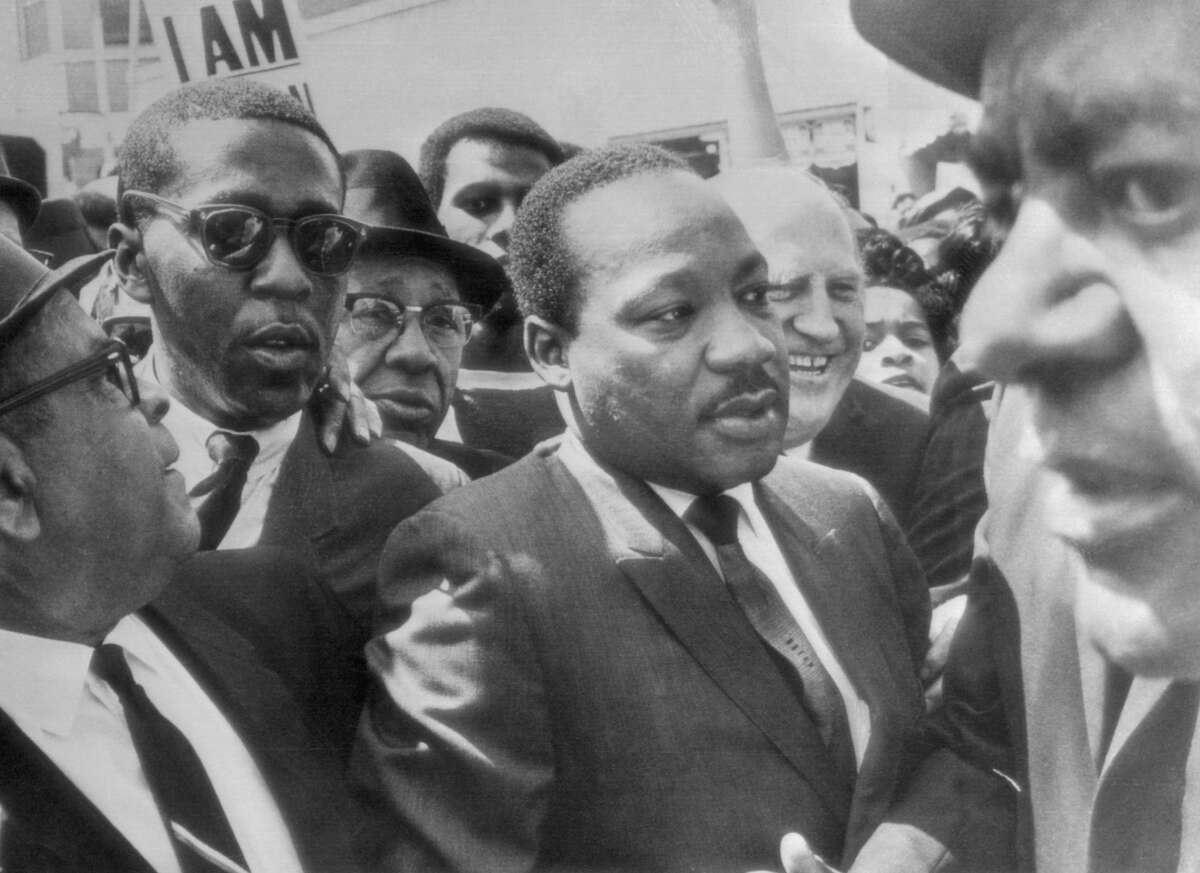
Dr. Martin Luther King is surrounded by leaders of the sanitation strike in Memphis, Tennessee, as he arrives to lead a march in support of the striking workers on March 28, 1968.
Bettmann via Getty Images

Less than a month before his assassination, Martin Luther King Jr. addressed a crowd of 10,000 striking sanitation workers and their supporters in Memphis, Tennessee. “One day our society will come to respect the sanitation worker if it is to survive,” he said, “for the person who picks up our garbage … is as significant as the physician, for if he doesn’t do his job, diseases are rampant. All labor has dignity.”

King delivered this message at Mason Temple on March 18, 1968, as Black sanitation workers in the city were waging a historic strike for safer working conditions. His speech also focused on one of the central themes that consumed his political work in the last two years of his life: the moral and political need for the United States to divest itself from fighting wars and reinvest in ending poverty, or the U.S. would surely, he declared, go “to hell.”

When King delivered this speech advocating for workers to overturn segregation and build power to pursue economic justice, the U.S. was on the cusp of a strike wave. In less than a month, King would be struck down by an assassin’s bullet while standing on the balcony of the Lorraine Motel. According to the Bureau of Labor Statistics, there were more than 26,000 strikes involving more than 10 million workers between 1969 and 1973. These strikes gave birth to new radical labor organizations like the Dodge Revolutionary Union Movement, League of Revolutionary Black Workers and the Black Workers Congress that articulated transformative visions aimed at disrupting what King called the “giant triplets” — racism, militarism and materialism, or capitalism.

However, this new wave of strikes and labor actions took place at a time of growing counterrevolution. Richard Nixon won the 1968 election on an anti-civil rights “law and order” campaign. Law enforcement throughout the U.S. engaged in violent repression of the Black liberation movement and the New Left. These efforts featured COINTELPRO’s attempts to extinguish the Black Panther Party, which arrived in the form of raids, shootouts, jailings and assassinations of activists like Fred Hampton. By the end of the 1970s, state repression; economic turbulence, in the form of stagflation, energy shocks, recession and deindustrialization; and organized labor’s failure to win labor law reform had frozen workers’ aspirations to achieve power. As Gil Scott Heron said, “It was winter in America.”

We are living in a similar moment. Five years after the largest racial justice uprising in the U.S., we live in a counterrevolutionary moment. Most Democrats and Republicans are in agreement about lavishly funding the police; celebrations of “essential” workers during the pandemic did not translate into material gains; white nationalists have launched ideological and political attacks on critical race theory, diversity, equity and inclusion programs, and on the teaching of Black history; and politicians are targeting trans people and immigrants in their bid to secure and maintain power. Colleges and universities have led the crackdown effort on Palestinians, Arabs, Muslims, and anyone else protesting apartheid and genocide in Gaza. Billionaire authoritarians and media organizations appease the incoming Trump administration in advance. Corporations seek to foist generative AI onto everyone, which threatens to displace workers. The Trump administration seeks to enact policies such as broad tariffs and cutting welfare benefits like SNAP that will disproportionately hurt working-class people. Lastly, the new administration’s promises to enact mass deportations of Global South migrants are reminiscent of the anti-immigrant programs of the 1930s and the 1950s.

Despite these major setbacks, one progressive political force is poised to lead us through this winter season — workers and labor unions. Of course, union density is at its lowest since the 1970s. Nor has organized labor organized a strike wave on the level of the 1970s. But labor unions have experienced a sort of upsurge in the last ten years. Fast food, restaurant, hotel and coffeehouse workers launched the “Fight for 15” movement with the demand of a $15/hour wage and union recognition. The Fight for 15 movement represents one of the contemporary labor movement’s most notable successes, as it has won wage increases in hundreds of U.S. cities and changed public discourse.

Thousands of educators have engaged in labor actions as well. More than 100,000 teachers participated in the “Red for Ed” strike wave in 2018-2019. These actions took root in mostly “red” states like Oklahoma, Arizona and West Virginia. Facing increased precarity, stagnant wages and benefits, and losing control over shared governance, tens of thousands of college and university faculty, graduate assistants and staff have responded by unionizing and striking. According to a report in Inside Higher Ed, nearly 36,000 graduate students won union representation in 2022 and 2023. Three faculty unions at Rutgers University struck for the first time over salaries, graduate student funding and job security for adjuncts and won. Members of University of Michigan’s Graduate Employees Organization responded to the 2020 uprisings for Black lives with an “abolitionist strike” to transform the way the university approached public safety. Members have also struck for improved trans health care.


We can start with King’s declaration that “all labor has dignity” and then move toward his argument for a “revolution in values” that centers human rights and the environment.

Flight attendants, led by AFA-CWA international president Sara Nelson, have positioned themselves at the fore of fighting for improved working conditions for themselves and all workers, especially amid the COVID-19 pandemic. American Airlines flight attendants won pay increases after threatening to strike last year. Hundreds of Starbucks and Amazon workers have recently engaged in inspirational unionization drives. The Writers Guild of America and the Screen Actors Guild-American Federation of Television and Radio Artists (SAG-AFTRA) went on strike to protect their labor from AI and win revenues from streaming. The Teamsters union, representing UPS workers, won wage gains for all of the company’s workers in 2023. The United Auto Workers (UAW) won an extraordinary contract that included increases in wages, retirement benefits and other benefits for all of its workers, in its strike against the Big Three automakers in 2023. Rather than all workers going on strike simultaneously, the UAW utilized a different tactic, a “stand up strike,” where the union would decide which plants to idle, hoping employers could not recalibrate production to blunt the stoppages. Last year, the labor movement scored a major victory. The UAW successfully unionized Ultium Cell workers and a Volkswagen plant in Tennessee, establishing a potential organizing beachhead in the South. This effort took place in a year where tens of thousands of workers at Boeing, Starbucks, Amazon and U.S. ports engaged in labor actions.

Organized labor has also advocated against another one of King’s “giant triplets” — militarism. The UAW used its power to weigh in on the genocide that Israel is inflicting on Gaza when Shawn Fain called for a ceasefire. Rank-and-file members of the UAW also demanded that Fain and the leadership divest from Israel. Members from several unions including the Association of Flight Attendants, Service Employees International Union and the United Electrical Workers also called for the end of the genocide and the defunding of U.S. military aid to Israel. It would be powerful if workers in shipping and the defense industry joined to support Palestinian liberation in the wake of the recently announced ceasefire agreement.

Lastly, more Americans recognize the importance of labor unions in fighting for their rights as workers. According to a September 2024 Gallup poll, labor unions are polling their highest approval rating since 1965. And as winter in America comes and more Americans grow skeptical of political institutions, tech companies, health insurance firms, and other corporations, organized labor is the best force to lead this struggle.

Workers and organized labor can provide a more expansive vision of democracy that does not just emphasize voting. What would it mean for workers to provide a real countervailing force against authoritarians and capitalists? And what would it mean for them to determine their fates in their workplaces at a time when costs and expenses remain high, when employers continue to steal wages, and at a time when generative AI threatens to degrade human labor?

But, to confront billionaire authoritarians, economic inequality and fascism, we need to build power. King articulated a similar point in his March 18, 1968, speech, saying:

We can all get more together than we can apart; we can get more organized together than we can apart. And this is the way we gain power. Power is the ability to achieve purpose, power is the ability to affect change, and we need power. What is power? Walter Reuther said once that ‘power is the ability of a labor union like UAW to make the most powerful corporation in the world—General Motors—say yes when it wants to say no.’ That’s power.

Racial justice protesters, educators, workers for Starbucks and Amazon, port workers, and other laborers have demonstrated the necessity of utilizing the disruptive power of collective action. The UAW’s use of stand up strikes is another example of using disruption strategically.

Unions and worker organizations are needed the most at this moment as economic inequality is increasing and as billionaire authoritarians continue their quest to consolidate power over the private and public sectors. We need a radical independent labor movement to bring in those disaffected with capitalism, the legal system and electoral politics. Of course, not all labor unions fit within this category, but workers and unions in the U.S. boast a tradition of advocating for various issues important to a broad swath of workers including workplace democracy, socialized health care, racial justice, immigrant rights and disinvestment from militarism. This tradition of solidarity is a good place to deepen contemporary workers’ political consciousness. Unions and workers’ organizations can be the institutions that welcome all of us into radical politics without fear of making mistakes. We can start with King’s declaration that “all labor has dignity” and then move toward his argument for a “revolution in values” that centers human rights and the environment..

This article is licensed under Creative Commons (CC BY-NC-ND 4.0), and you are free to share and republish under the terms of the license.

Austin C. McCoy  is a scholar of African American history, labor and social movements. Follow him on Bluesky.


MLK’s Legacy Is One of Class Struggle. To Fight Trump, We Must Carry His Torch.

Project 2025 aims to recreate the state-sanctioned discrimination and inequality that our ancestors fought to end.
January 19, 2025

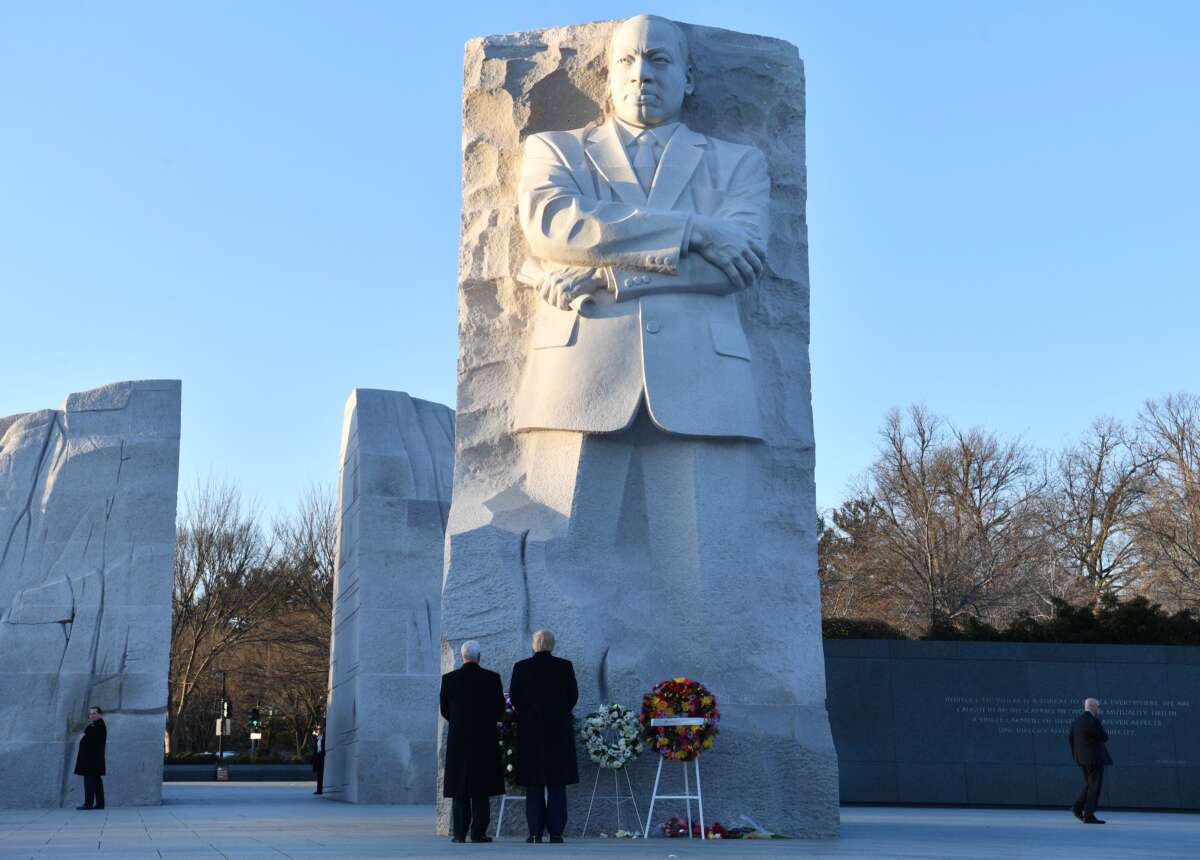
President Donald Trump and Vice President Mike Pence look on at the Martin Luther King Jr. memorial on MLK day in Washington, D.C., on January 20, 2025.
NICHOLAS KAMM /AFP via Getty Images


This Martin Luther King Jr. Day, Donald Trump will be sworn into office. Working in concert, Trump, the Republican-led House and Senate, and the right-wing Supreme Court threaten to dismantle King’s legacy. If they do, the most vulnerable people in the United States, Black folks in particular, will be attacked. The blueprint for this assault is Project 2025.

The symbolism of Trump being inaugurated on MLK Jr. Day is chilling. Is King’s legacy dead? How can we be observing MLK Day by handing power to a politician who ran a blatantly racist campaign to beat the first Black woman to have run as a major party’s presidential nominee? Has the goal of transforming the United States from a white ethno-state into a multiracial democracy been vanquished? If so, does that leave us plunging headlong into a permanent Republican oligarchy?

King’s life and martyrdom have been split in two. The dominant one is the “I Have a Dream” King. He appears on Apple ads. He is the apostle for nonviolent direct action to end racial segregation

The lesser known King, the one repressed from official celebration, is the 1968 radical, who was an anti-poverty and antiwar democratic socialist.

We need that legacy of King to build a working class, progressive supermajority that can fight the cruel agenda of Project 2025.

Related Story

Martin Luther King Jr. Warned That the Poor Pay for War With Their Lives
King warned us that the real enemy is war itself.
By Nicholas Powers , Truthout January 20, 2020


Dismantling the Trap

On Inauguration Day, Trump will place his hand on the Bible and be sworn into office. The ceremony will take place on the West Front of the U.S. Capitol as jubilant Republicans plan to cut, cut, cut the federal budget. They want to cut poor people from social services, the sick from health care and undocumented workers from the country with Immigration and Customs Enforcement (ICE) raids. They come armed with a plan: Project 2025, a 900-plus page tome of conservative policy crafted by the Heritage Foundation. When you look at it closely, you see more than budget cuts, it is a plan to institutionalize conservatism. It is state-sponsored, widespread suffering.

In contrast to Trump’s swearing in to office, just two miles away at the Lincoln Memorial, King gave the “I Have a Dream” speech in the 1963 March on Washington. Nearby is the Reflecting Pool, where after King’s murder in 1968, the Poor People’s Campaign built Resurrection City, a protest camp to make visible the multiracial poor. In downtown D.C. sits a massive statue of King called The Stone of Hope, engraved with his speeches. D.C. is filled with the King’s history; the man’s life was dedicated to expanding the circle of citizenship.

Trump’s inauguration on MLK Jr. Day highlights the clash of two opposing visions. MAGA wants to rebuild walls of racism, patriarchy and classism — even ending birthright citizenship. The left has fought to enlarge the circle of citizenship and include people of color, women, workers and LGBTQ folks. But the right has the White House, Senate, House and Supreme Court.

“I like one big beautiful bill,” Trump recently bragged at a news conference. His reconciliation bill, scheduled for April, can pass the Senate with a simple majority. It is the first step to Project 2025. And it’s a whopper. First up is the renewal of Trump’s Tax Cuts and Jobs Act: basically tax cuts for the rich to the tune of $4 trillion. Think about it. The government will have $4 trillion less to fund services. Next are additional funds for ICE to brutally deport undocumented workers. What is obscene is that Republicans plan to plug the hole left by those tax cuts with $5 trillion in budget cuts.


Working in concert, Trump, the Republican-led House and Senate, and the right-wing Supreme Court threaten to dismantle King’s legacy.

And the cuts are sure to keep coming. Trump’s blueprint is Project 2025, which aims to take a chainsaw to programs that help the poor. Medicaid will be cut and the spending left to states. Project 2025 calls the U.S. Department of Agriculture a “welfare agency” and plans to cut SNAP (food stamps) and school meal programs. Project 2025 aims to dismantle the Department of Education and end federal aid to low-income schools. On housing, it calls for an end to the Housing Trust Fund, a federal grant to states to alleviate chronic homelessness. Project 2025’s plan for the Department of Justice is to shift its focus to prosecuting officials, colleges and private businesses that promote social justice. To cap it off, Project 2025 plans to remove any federal workers that get in the way of Trump’s agenda by using executive order Schedule F, which makes tens of thousands of them replaceable with Trump loyalists.

Project 2025 is an attack on workers, on the racially marginalized, on LGBTQ people and the poor. It will cause mass suffering and death. How? The U.S. has 304 million citizens. The Poor People’s Campaign calculates 140 million are poor and working poor, and 47 million go hungry, including 14 million children. At the bottom of this cruel class oppression are 771,800 unhoused people. All of this kills. The Journal of the American Medical Association cited poverty as the fourth-leading cause of death in the U.S. each year as 183,000 people die from poverty-related causes. And nearly 45,000 die because they have no health insurance.

Project 2025 is an assault on vulnerable people. Trump and the Republicans are threatening to push the hungry deeper into hunger. They will make the sick sicker — and many, if you follow the math, inevitably will die. Project 2025 is racist because poverty in the United States is racialized; 21 percent of Indigenous people are poor, along with 17 percent of Black people and 16 percent of Latinos.

Project 2025 is also a trap. Republican budget cuts and extremist policies will compell people to protest them. Marches will roll like waves and hit the wall of police and draconian laws that Trump builds around his government. Anger will spike in the streets. When a window is broken or a police car is torched, the trap is sprung. Trump says he is eager to send in riot police or the military. He has already given a wink to far right groups like the Proud Boys that like to break bones.

This is why we have to turn to King again. His radical legacy is a blueprint to avoid the trap and defeat Project 2025.
A Tale of Two Kings

In April 1963, an incarcerated King wrote the “Letter from Birmingham Jail” to push back against white moderates who feared conflict. He wrote, “I am not afraid of the word ‘tension.’ I have earnestly opposed violent tension, but there is a type of constructive, nonviolent tension which is necessary for growth … we must create the kind of tension in society that will help men rise from the dark depths of racism to the majestic heights of understanding and brotherhood.”

In May 1963, his ideas came to life. King created tension not only from nonviolent direct action, but also from contrasting widely accepted values against less accepted ones: in this case, the universal value of children’s innocence versus white supremacy. Firefighters in Birmingham, Alabama, shot high-powered fire hoses at children. Police let dogs loose to tear at their clothes and skin. White supremacist and Commissioner of Public Safety Bull Connor ordered the assault on the 1963 Children’s Crusade in Birmingham, in which thousands of Black children walked downtown to protest segregation. They were arrested and thrown in jail where they sang freedom songs. Reporters filmed it. The world saw the news and was shocked. A moribund civil rights movement was reenergized.

We can learn from King how to maneuver from a position of weakness. The civil rights movement faced hostile officials that used violence to suppress protests. We face similar threats under Trump and the Republican trifecta. King faced a hostile public raised on anti-Black racism. We likewise now face a public turned against “wokeness.” King faced interlocking laws from legal segregation, redlining and a racist criminal legal system. We face Project 2025, which seeks to recreate, to a degree, the state-sanctioned discrimination that our ancestors fought to end.


Project 2025 is a plan to institutionalize conservatism. It is state-sponsored, widespread suffering.

Project 2025 and the second Trump administration will surely set the stage for more protests. Again, images of families torn apart by government officials may soon spark rage. News of increased poverty and hunger will likely direct disgust at Trump and the GOP. Protests and lawsuits might hamper the Trump administration temporarily, but it is not enough. We must go beyond political trench warfare and build a progressive supermajority.

Here is where we shift from the “I Have a Dream” King to the later, more radical King. He realized the integration of Black people was just the first step; next was to integrate the poor and working class as well. Which is why, in 1966, he told his staff that the U.S. must “move toward a democratic socialism.”

Integration did not mean marginalized people transform themselves to fit into the U.S. mainstream. No, for King it meant that everyone has a place at the table. Capitalism must be replaced with democratic socialism, in which people are integrated by a government that answers their needs for food, housing and jobs with dignity. That’s why in 1968, King marched in Memphis with striking sanitation workers and told them in a sermon, “Whenever you are engaged in work that is at the service of humanity it has dignity and work. You are reminding the nation that it is a crime for people to live in this rich nation and receive starvation wages.”
Mine Eyes Have Seen the Glory

We must now pick up the baton from the radical King of 1968. His legacy pulls the rug from under even the most powerful and violent regimes. King’s political adherents used his tactic of contrasting widely accepted values (in sociology known as “consensus values”) to less accepted ones. The goal is to make clear that most Americans already were progressive.

Rev. Jesse Jackson thundered in his climatic 1988 Democratic Convention speech, “What’s the moral challenge of our day? We have public accommodations. We have the right to vote. We have open housing. What’s the fundamental challenge of our day? It is to end economic violence.” He evoked a powerful image: “Most poor people are not lazy. They are not Black. They are not Brown. They are mostly white and female and young. But whether white, Black or Brown, a hungry baby’s belly turned inside out is the same color — color it pain; color it hurt; color it agony.”

In 2016, Anderson Cooper asked Sen. Bernie Sanders about his spirituality. Sanders said, “I believe as a human being that the pain one person feels, if we have children who are hungry, if we have elderly people who can’t afford their prescription drugs, that impacts you and that impacts me. My spirituality is that we are all in this together.”

Jackson and Sanders use King’s strategy of turning class warfare into a spiritual struggle between good and evil. Since class cuts across race and gender, it becomes a powerful leverage to topple a corrupt Trump administration the way that King toppled a corrupt Southern white supremacy — and to go further and build a supermajority. The Democratic Party’s liberal politics will fail unless there is a call for economic justice.

We are in a two-front struggle. The Congressional Black Caucus, the NAACP and the ACLU are preparing to fight Trump in the courts and at the ballot box. Yet the neoliberal Democratic Party is exhausted. Now the left has a historic chance to follow King’s footsteps and mobilize the poor and workers. To say clearly that integration means recognizing the working class — the janitors, mass transit drivers, nurses and undocumented day laborers — who make life possible.

For King, the Memphis strike wasn’t just a class conflict; it was a spiritual struggle to redeem humanity. We are not fully realized until we accept responsibility for the relationships we are in with others. That’s why King marched with the sanitation workers.

All around you is the world our forebears in the civil rights movement created for us. Harriet Tubman and Frederick Douglass are here. Ella Baker and Fannie Lou Hamer. And Martin Luther King Jr. They’re still here, marching in spirit. They’re still leading us

This article is licensed under Creative Commons (CC BY-NC-ND 4.0), and you are free to share and republish under the terms of the license.


Nicholas Powers is the author of Thirst, a political vampire novel; The Ground Below Zero: 9/11 to Burning Man, New Orleans to Darfur, Haiti to Occupy Wall Street; and most recently, Black Psychedelic Revolution. He has been writing for Truthout since 2011. His article, “Killing the Future: The Theft of Black Life” in the Truthout anthology Who Do You Serve, Who Do You Protect? coalesces his years of reporting on police brutality.


'There is still hope for a brighter tomorrow': Read MLK Jr.'s Nobel Prize acceptance speech


(Creative Commons)
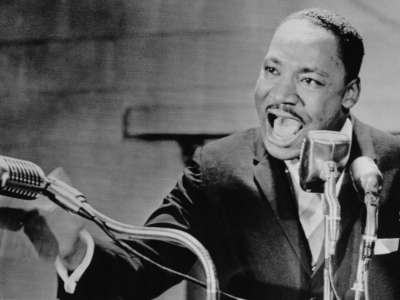
Dr. Martin Luther King Jr. at the University of Minnesota on April 27, 1967
.January 20, 2025


Your Majesty, Your Royal Highness, Mr. President, Excellencies, Ladies and Gentlemen:

I accept the Nobel Prize for Peace at a moment when 22 million Negroes of the United States of America are engaged in a creative battle to end the long night of racial injustice. I accept this award on behalf of a Civil Rights Movement which is moving with determination and a majestic scorn for risk and danger to establish a reign of freedom and a rule of justice. I am mindful that only yesterday in Birmingham, Alabama, our children, crying out for brotherhood, were answered with fire hoses, snarling dogs and even death. I am mindful that only yesterday in Philadelphia, Mississippi, young people seeking to secure the right to vote were brutalized and murdered. And only yesterday more than 40 houses of worship in the state of Mississippi alone were bombed or burned because they offered a sanctuary to those who would not accept segregation. I am mindful that debilitating and grinding poverty afflicts my people and chains them to the lowest rung of the economic ladder.

Therefore, I must ask why this prize is awarded to a movement which is beleaguered and committed to unrelenting struggle; to a movement which has not won the very peace and brotherhood which is the essence of the Nobel Prize.

After contemplation, I conclude that this award which I receive on behalf of that movement is a profound recognition that nonviolence is the answer to the crucial political and moral question of our time — the need for man to overcome oppression and violence without resorting to violence and oppression. Civilization and violence are antithetical concepts. Negroes of the United States, following the people of India, have demonstrated that nonviolence is not sterile passivity, but a powerful moral force which makes for social transformation. Sooner or later all the people of the world will have to discover a way to live together in peace, and thereby transform this pending cosmic elegy into a creative psalm of brotherhood. If this is to be achieved, man must evolve for all human conflict a method which rejects revenge, aggression and retaliation. The foundation of such a method is love.

The tortuous road which has led from Montgomery, Alabama to Oslo bears witness to this truth. This is a road over which millions of Negroes are travelling to find a new sense of dignity. This same road has opened for all Americans a new era of progress and hope. It has led to a new Civil Rights Bill, and it will, I am convinced, be widened and lengthened into a super highway of justice as Negro and white men in increasing numbers create alliances to overcome their common problems.

I accept this award today with an abiding faith in America and an audacious faith in the future of mankind. I refuse to accept despair as the final response to the ambiguities of history. I refuse to accept the idea that the “isness” of man’s present nature makes him morally incapable of reaching up for the eternal “oughtness” that forever confronts him. I refuse to accept the idea that man is mere flotsam and jetsam in the river of life, unable to influence the unfolding events which surround him. I refuse to accept the view that mankind is so tragically bound to the starless midnight of racism and war that the bright daybreak of peace and brotherhood can never become a reality.

I refuse to accept the cynical notion that nation after nation must spiral down a militaristic stairway into the hell of thermonuclear destruction. I believe that unarmed truth and unconditional love will have the final word in reality. This is why right temporarily defeated is stronger than evil triumphant. I believe that even amid today’s mortar bursts and whining bullets, there is still hope for a brighter tomorrow. I believe that wounded justice, lying prostrate on the blood-flowing streets of our nations, can be lifted from this dust of shame to reign supreme among the children of men. I have the audacity to believe that peoples everywhere can have three meals a day for their bodies, education and culture for their minds, and dignity, equality and freedom for their spirits. I believe that what self-centered men have torn down men other-centered can build up. I still believe that one day mankind will bow before the altars of God and be crowned triumphant over war and bloodshed, and nonviolent redemptive good will proclaim the rule of the land. “And the lion and the lamb shall lie down together and every man shall sit under his own vine and fig tree and none shall be afraid.” I still believe that we shall overcome!

This faith can give us courage to face the uncertainties of the future. It will give our tired feet new strength as we continue our forward stride toward the city of freedom. When our days become dreary with low-hovering clouds and our nights become darker than a thousand midnights, we will know that we are living in the creative turmoil of a genuine civilization struggling to be born.

Today I come to Oslo as a trustee, inspired and with renewed dedication to humanity. I accept this prize on behalf of all men who love peace and brotherhood. I say I come as a trustee, for in the depths of my heart I am aware that this prize is much more than an honor to me personally.

Every time I take a flight, I am always mindful of the many people who make a successful journey possible — the known pilots and the unknown ground crew.

So you honor the dedicated pilots of our struggle who have sat at the controls as the freedom movement soared into orbit. You honor, once again, Chief Lutuli of South Africa, whose struggles with and for his people, are still met with the most brutal expression of man’s inhumanity to man. You honor the ground crew without whose labor and sacrifices the jet flights to freedom could never have left the earth. Most of these people will never make the headline and their names will not appear in Who’s Who. Yet when years have rolled past and when the blazing light of truth is focused on this marvellous age in which we live – men and women will know and children will be taught that we have a finer land, a better people, a more noble civilization – because these humble children of God were willing to suffer for righteousness’ sake.


I think Alfred Nobel would know what I mean when I say that I accept this award in the spirit of a curator of some precious heirloom which he holds in trust for its true owners – all those to whom beauty is truth and truth beauty – and in whose eyes the beauty of genuine brotherhood and peace is more precious than diamonds or silver or gold.
Kushner rolls out 'slew of' Middle East deals as Trump returns to White House

FOR SALE: GAZA BEACH FRONT PROPERTY


Jared Kushner in Tel Aviv on August 31, 2020 (Wikimedia Commons)


ALTERNET
January 20, 2025

Although Ivanka Trump and her husband Jared Kushner served as senior advisers in Donald Trump's first administration, neither has expressed interest in direct participation in his second.

Ivanka Trump, during a recent appearance on the "Skinny Confidential" vodcast, stressed that her "role" in her father's second administration will be strictly "supportive." Reportedly, both Kushner and Ivanka Trump plan to concentrate on their own business activities rather than politics in the months ahead.

According to Bloomberg News reporter Adveith Nair, Kushner "unveiled a slew of deals" in the "days leading up to Donald Trump’s swearing in."

Nair, in an article published on Inauguration Day 2025, explains, "Just over a month ago, Jared Kushner disclosed that his Affinity Partners had raised an additional $1.5 billion from the Qatar Investment Authority and Abu Dhabi-based asset manager Lunate. Last week, Bloomberg News reported that the firm got the approval to double its stake in one of Israel’s top financial firms and is partnering with Emirati billionaire Mohamed Alabbar on a luxury development in the Serbian capital: Trump Hotel Belgrade."

Nair notes that after serving the first Trump Administration, Kushner "set up Affinity, which now counts the Saudi Public Investment Fund, the QIA and Lunate as its three largest limited partners."

Kushner, according to Nair, is working with Eric Trump — Donald Trump's son and executive vice president of the Trump Organization — on the Trump Hotel Belgrade deal.

Kushner told Bloomberg News, "I thought the tower would make a tremendous Trump Tower, so I spoke to Eric about it, and he was very excited. So we’ll be bringing them in as our hotel partner.”

READ MORE: 'I hate politics': Ivanka Trump to avoid Washington’s 'darkness' during dad’s second term

Read Bloomberg News' full article at this link (subscription required).
SPACE/COSMOS

Trump vows astronauts will plant US flag on Mars as Elon Musk goes wild at inauguration

GET TO THE MOON FIRST

David Edwards
January 20, 2025
RAW STORY

C-SPAN/screen grab

President Donald Trump vowed that U.S. astronauts would plant the American flag on Mars during his next administratio

During his inaugural address on Monday, Trump insisted that going to Mars was part of the "manifest destiny" of the United States.

"Above all, my message to Americans today is that it is time for us to once again act with courage, vigor, and the vitality of history's greatest civilization," he opined. "Together, we will end the chronic disease epidemic and keep our children safe, healthy, and disease-free."

"The United States will once again consider itself a growing nation, one that increases our wealth, expands our territory, builds our cities, raises our expectations, and carries our flag into new and beautiful horizons," he continued.

"And we will pursue our manifest destiny into the stars, launching American astronauts to plant the stars and stripes on the planet Mars."

As Trump spoke, billionaire SpaceX owner Elon Musk could be seen applauding nearby.

In 2011, Musk pledged to put humans on Mars by 2021. That promise never materialized.

Watch the video below or at this link.


Why is one half of Mars so different to the other?

The Conversation
January 20, 2025 


A map showing the ‘Martian dichotomy’: the southern highlands are in yellows and oranges, the northern lowlands in blues and greens. NASA / JPL / USGS

Mars is home to perhaps the greatest mystery of the Solar System: the so-called Martian dichotomy, which has baffled scientists since it was discovered in the 1970s.

The southern highlands of Mars (which cover about two-thirds of the planet’s surface) rise as much as five or six kilometres higher than the northern lowlands. Nowhere else in the Solar System do we see such a large, sharp contrast at this scale.

What caused this dramatic difference? Scientists have been split on whether it resulted from external factors – such as a collision with a huge, moon-sized asteroid – or internal ones, such as the flow of heat through the planet’s molten interior.

In new research published in Geophysical Research Letters, we analyzed marsquakes detected by NASA’s Insight lander, located near the border separating the two sides of the dichotomy. Studying how the marsquake vibrations travel revealed evidence that the origin of the Martian dichotomy lies deep inside the red planet.
The Martian dichotomy

Altitude isn’t the only difference between the two sides of the Martian dichotomy.


The southern highlands are pocked with craters and streaked with frozen flows of volcanic lava. In contrast, the surface of the northern lowlands is smooth and flat, almost free of visible scars and other significant features.

From geophysical and astronomical measurements, we also know the crust of Mars is significantly thicker beneath the southern highlands. What’s more, the southern rocks are magnetized (suggesting they date to an ancient era when Mars had a global magnetic field), while those of the northern lowlands are not.

The Martian dichotomy was discovered in the 1970s, when images from the Viking probes showed a difference in height and in density of impact craters.


The Viking missions of the 1970s revealed a more detailed view of the Martian surface. NASA / USGS

The surface density of craters (the number of craters per unit area) can be used to calculate the age of surface rocks – the older the surface, the more craters. So the southern highlands appear to be older than the northern lowlands.


Scientists also believe there was once a vast ocean of liquid water on Mars, likely in the same region as the northern lowlands.

There is a lot of debate about this because the existence or absence of sediments, landforms, and certain minerals that form when the land is covered by an ocean are used as the primary evidence for and against. The existence of liquid water is a prerequisite for life, so it is not difficult to understand the interest of the scientific community and space agencies in this problem.

Outer space or inner forces?


The origin of the Martian dichotomy has been a long-standing puzzle in planetary science. What kind of gradual or violent natural process, phenomenon, cosmic force, or catastrophe in the early phase of Mars (given the age of the rocks on the surface) could offer an answer to this question?

Two main hypotheses have emerged.

First is the so-called endogenic hypothesis. This argues that the difference in heat transfer through the rising of warmer and sinking of cooler material inside the Martian mantle led to a visible dichotomy on its surface.

Second is the exogenic hypothesis, according to which the cause of the dichotomy comes from space. This would mean the catastrophic impact of either a single moon-sized body or several smaller bodies, reshaping the planet’s surface.
Marsquakes

On Earth, we can use data from hundreds and even thousands of seismometers to triangulate the location of an earthquake.

On Mars, we only have data from a single instrument on the Insight lander. To find the location of a marsquake, we have to rely on measuring the difference in arrival time between different kinds of vibrations (called P and S waves).

This lets us calculate the distance to the marsquake. We can also determine the direction to the quake by looking at the movement of particles on the ground.


The Insight lander carried a seismograph to measure marsquakes and other vibrations. NASA / JPL-Caltech


Once we had made a system for pinpointing marsquakes from Insight data, we checked it against known events such as meteoroid impacts spotted by satellite cameras. We found our methods reliably pointed to a cluster of marsquakes in the Terra Cimmeria region in the southern highlands.

Next we studied how S waves lost energy as they travelled through the rock of the southern highlands. We also made similar calculations for earlier observed quakes in the Cerberus Fossae region of the northern lowlands.

Comparing these two showed that the waves lost energy more quickly in the southern highlands. The most likely explanation is that the rock beneath the southern highlands is hotter than in the north.

What quakes tell us about the dichotomy


This temperature difference between the two halves of the dichotomy supports the idea that the split was caused by internal forces on Mars, not some external impact.

The full explanation of why is quite complex. To simplify, scientists have made models of how the dichotomy could have formed based on an initial unevenness in the crust of Mars way back in time.

At one point, Mars had moving tectonic plates like Earth does. The movement of these plates and the molten rock beneath them could have created something like the dichotomy – which was then frozen in place when the tectonic plates stopped moving to form what scientists call a “stagnant lid” on the planet’s molten interior.

These events may have then enabled patterns of convection in the molten rock that can explain the dichotomy we see today, with upwelling beneath the southern highlands and downwelling beneath the northern lowlands.

Our marsquake evidence for a temperature difference across the dichotomy is consistent with these models.

To conclusively answer the question of what caused the Martian dichotomy, we will need more marsquake data, as well as detailed models of how Mars formed and comparisons with Earth and other planets. However, our study reveals an important new piece of the puzzle.

Hrvoje Tkalčić, Professor, Head of Geophysics, Director of Warramunga Array, Australian National University and Weijia Sun, Professor of Geophysics, Key Laboratory of Earth and Planetary Physics, Institute of Geology and Geophysics, Chinese Academy of Sciences

This article is republished from The Conversation under a Creative Commons license. Read the original article.
It's time for liberals to abandon MSNBC's 'sweet little lies'

John Stoehr
January 20, 2025 
ALTERNET

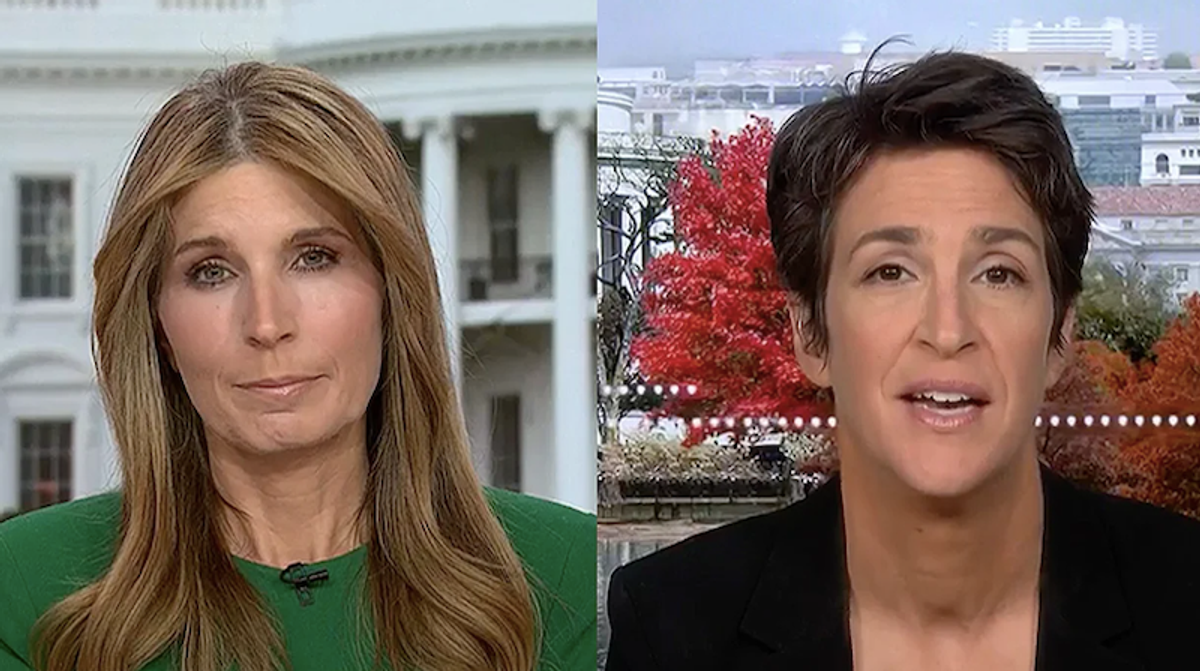
MSNBC hosts Nicolle Wallace (left) and Rachel Maddow (right) 
(Photo: MSNBC video screen capture

At this point, I think it needs to be said that there’s a feeling among liberals and Democrats, and I would suggest especially affluent white liberals and Democrats, that liberal democracy isn’t really dead.

I would say there’s a deep sense of denial among these folks. They tell themselves that the dearly departed is much too dear to be truly departed. I would say there’s also a good deal of magical thinking in this denial, as if the criminals who shot their beloved will come to justice, and once they do, their beloved will rise again, good as new.

I think this needs to be said because liberals and Democrats keep telling themselves that democracy itself depends on the integrity of democratic institutions and democratic norms, and that without them, the country will manifest the founding fathers’ fear of despotism.

I think this needs to be said because the founding fathers’ fear of despotism is about to be made manifest, and that’s because the institutions and democratic norms that liberals and Democrats keep telling themselves that they hold so dear have failed absolutely.

It’s like the dead are not really dead.

Denial is natural, as is the impulse to seek comfort, and MSNBC and other outlets that are attuned to the tastes of privileged liberals are ready to capitalize on that impulse. I’m generalizing here, perhaps grossly, but even so, the tenor seems to be one of patronizing solace, as if to say: Don’t worry, the evil that’s coming won’t be too evil, and anyway, the evil that does come will be remedied by the next election.

MSNBC will offer these sweet little lies, because they know their audience, which is to say, they know that lots of liberals, especially privileged liberals, want to be told sweet little lies. These customers will demand to be treated like children, because their greatest fear is not the death of liberal democracy – it poses little danger to them and ,anyway, they can deny it – but instead feeling bad about themselves.

That’s why, in the coming weeks and months, we will see on MSNBC and other places a preponderance of political coverage that’s about the breathtaking hypocrisy of Donald Trump and the GOP, about broken promises and about how any minute now, the American people are going to figure it all out. We will see this because their audiences want to see this and they want to see this, because seeing it will prove they are better than the Republicans, which, in the end, means they win.

This may seem like victory without fighting.

In reality, it’s decadence and moral decay.

Look, I’m sorry, but lots of liberals are soft. I don’t mean reasonable. I don’t mean complicated, practical or willing to compromise. I mean soft. I mean lots of liberals are motivated by self-regard, group-esteem and pleasure-seeking more than duty, sacrifice and the common good.

We saw it last summer. After Joe Biden’s poor debate performance, the Democratic Party stabbed in the back the best and most accomplished president of our lifetimes. Liberals could have rallied to push their man through to the finish, but chose instead to second-guess themselves.

We saw it again after the Democratic National Convention. It “was a joyful, inclusive reminder of what politics is supposed to feel like,” wrote MSNBC’s Jen Psaki as if fun were a required emotion in war by other means. I still don’t understand all the attention that was paid to “voter enthusiasm.” If liberals were not motivated by Donald Trump’s evil, I thought, nothing would motivate them. Turns out, I was right.

And we’re seeing it now. Many congressional Democrats seem to have lost the will to fight. They are not pursuing any changes to a horribly punitive new immigration law. Others are dressing up cowardice in the garb of “the people’s will.” Others still keep yak-yak-yakking about norms and institutions, as if they have not been totally corrupted. All that talk of higher-order things is looking more and more like appeasement, and that’s because, in the end, politics isn’t the point.

The point is feeling good about ourselves.

Lots of liberals are soft.

Liberals should recognize the stone-cold truth – that liberal democracy is dead. We had a chance to save it. We lost. It’s gone.

We are now entering a period in which fairness will be defined not by equity and justice but by who gets to do what to whom. Instead of being the instruments of liberty, the institutions of democracy will be the instruments of oppression. And there will likely be a new consensus in which it’s agreed: the in-group’s rights trump the out-group's freedom.

Kamala Harris campaigned on a message of “we’re not going back.”

But we are.

The country is going back to a time in American history in which democracy was not only illiberal but sometimes tyrannical. The next election won’t stop that, because the problem isn’t only Trump and the Republicans. It’s a mainstream liberalism that’s so mired in decadence and moral decay that it can’t or won’t acknowledge the war against it. It prefers fun and sweet little lies to the difficulty of political combat.

Soft liberalism had its day.

Time for the hard kind.


LEFT WING SOCIALIST DEMOCRACY


Office metronome: Does listening to music make you a more productive worker?


By Dr. Tim Sandle
January 19, 2025
DIGITAL JOURNAL

Tim Sandle wearing headphones. Image by © Tim Sandle

Many workplaces have the radio or Spotify on during the day but how do people feel about music playing while they work? A poll from the company Kickresume reveals employees’ thoughts and opinions about music in the workplace, across different industries and career levels.

To arrive at the findings, Kickresume surveyed 1,625 respondents from around the world about their music preferences at work.

It was found that 69 percent of respondents say music boosts their productivity, focus and motivation, whilst 2 percent say it’s a distraction they avoid, and 1 percent say it kills their productivity.

The most popular genre to listen to while working is ambient/lofi music – with 14 percent of respondents favoring this. This is followed by rap, in second place. Time to dust down those Brian Eno albums?

The main findings are:Music is a productivity booster for nearly 70 percent of respondents
11 percent of workers have had arguments at work over music
Most workers listen to music for 1-3 hours a day at 43 percent
The most unpopular music genre in the office is metal/punk
Spotify is the most popular streaming platform
Most workplaces, 45 percent, have no strict rules regarding music

Expanding on the findings, Peter Duris, CEO and Co-Founder at Kickresume, has told Digital Journal: “Our survey revealed that nearly 70 percent of people use music to boost focus and motivation while working. Whether it’s music with lyrics or instrumentals, people across industries and career levels seem to find it helpful to have some kind of music playing during the day.”

Duris adds: “Music certainly plays an important role in work environments, but it’s always good to be considerate of your coworkers. About 11 percent of people reported conflicts over music at work, with volume being the most common issue. The good news is that most problems can be avoided by following workplace music etiquette. Keeping the music at a reasonable volume, or checking in with your team to make sure everyone’s happy with the vibe, can go a long way.”

11 percent of workers have experienced conflict due to music in the office

Although music is overall a positive tool for productivity and concentration – Kickresume found that it was a cause of conflict for 11 percent of respondents. Of those, 27 percent claimed there were disputes about the volume of music in the office, and another 21 percent said there was conflict over the repetition of certain songs. A further 20 percent said the music did not suit the workplace.

43 percent of workers listen to music at work for just 1-3 hours per day

The survey found that most people surveyed listen to music for 1-3 hours during the workday. 28 percent listen to music for 4-7 hours, and 12 percent listen for more than 7 hours. On the flip side, 12 percent of respondents listen to music at work for less than an hour a day, and 5 percent reported never listening to music.

Additionally, it was found that workers in the healthcare and pharmaceuticals industry, and those who work in manufacturing and engineering listened to music the least amount of time (less than an hour).

Spotify is the streaming platform of choice

Fifty percent of respondents use Spotify as their preferred platform. Only 2 percent listen to music from the radio and another 2 percent from physical media. This means modern streaming platforms like Spotify have swiftly taken over.

Following Spotify is Youtube Music at 22 percent, and Apple Music at 17 percent, again highlighting the preference of flexible music streaming services over traditional physical media and radio.

45 percent of workplaces have no strict rules regarding music

The majority of workplaces have relaxed rules when it comes to music. 45 percent of workplaces have no strict rules, but encourage employees to be respectful and considerate of those around them.

Moreover, 39 percent of workplaces allow their employees to listen to music – but through headphones only. Whereas 7 percent of workplaces do not permit music with explicit lyrics, and 2 percent allow instrumental music only.

Whether listening to music at work helps to boost most people’s productivity, focus, and motivation is a separate issue.