It’s possible that I shall make an ass of myself. But in that case one can always get out of it with a little dialectic. I have, of course, so worded my proposition as to be right either way (K.Marx, Letter to F.Engels on the Indian Mutiny)
Friday, January 24, 2025
Iranian Filmmaker Mohammad Rasoulof’s Film Nominated for Oscar
January 24, 2025
The director reached Europe last yaer after being sentenced to eight years in prison, flogging, and property confiscation by the Islamic Republic
The film, submitted by Germany, follows an investigative judge in Tehran's Revolutionary Court amid the 2022 protests The director reached Europe last yaer after being sentenced to eight years in prison, flogging, and property confiscation by the Islamic Republic
The film, submitted by Germany, follows an investigative judge in Tehran's Revolutionary Court amid the 2022 protests
The director reached Europe last yaer after being sentenced to eight years in prison, flogging, and property confiscation by the Islamic Republic
Iranian director Mohammad Rasoulof’s film "The Seed of the Sacred Fig" has been nominated for Best International Feature Film at the 97th Academy Awards.
The film, submitted by Germany, follows an investigative judge in Tehran's Revolutionary Court amid the 2022 protests.
Filmed secretly and including real demonstration footage, the movie explores themes of distrust and political tension.
Rasoulof previously won the Special Jury Prize at the 77th Cannes Film Festival.
The director reached Europe last yaer after being sentenced to eight years in prison, flogging, and property confiscation by the Islamic Republic.
Rasoulof’s lawyer, Babak Paknia, explained that the charges stemmed from the director's films and his involvement in a letter urging authorities to stop violence during protests over a deadly building collapse in 2022.
"I arrived in Europe a few days ago after a long and complicated journey," Rasoulof said after leaving Iran.
Another Iranian project, the animated short "In the Shadow of the Cypress" by Shirin Sohani and Hossein Molayemi, is nominated for Best Animated Short Film.
The 97th Academy Awards ceremony will take place on March 2 in Hollywood.
Stay or Go? The Dilemma of Türkiye's Syrian Refugees
For many Syrian refugees living in Türkiye, the idea of going home raises many worrying questions. (AFP)
24 January 2025
AD ـ 25 Rajab 1446 AH
More than 50,000 Syrian refugees have left Türkiye to return home since Bashar al-Assad's ouster. But for many others living in the country, the thought raises a host of worrying questions.
In Altindag, a northeastern suburb of Ankara home to many Syrians, Radigue Muhrabi, who has a newborn and two other children, said she could not quite envisage going back to Syria "where everything is so uncertain".
"My husband used to work with my father at his shoe shop in Aleppo but it was totally destroyed. We don't know anything about work opportunities nor schools for the kids," she said.
After the civil war began in 2011, Syria's second city was badly scarred by fighting between the opposition and Russian-backed regime forces.
Even so, daily life in Türkiye has not been easy for the Syrian refugees who have faced discrimination, political threats of expulsion and even physical attacks.
In August 2021, an angry mob smashed up shops and cars thought to belong to Syrians in Altindag as anti-migrant sentiment boiled over at a time of deepening economic insecurity in Türkiye.
Basil Ahmed, a 37-year-old motorcycle mechanic, recalled the terror his two young children experienced when the mob smashed the windows of their home.
Even so, he said he was not thinking of going straight back.
- 'Not the same Syria' -
"We have nothing in Aleppo. Here, despite the difficulties, we have a life," he said.
"My children were born here, they don't know Syria."
As the Assad regime brutally cracked down on the population, millions fled in fear, explained Murat Erdogan, a university professor who specializes in migration.
"Now he's gone, many are willing to return but the Syria they left is not the same place," he told AFP.
"Nobody can predict what the new Syrian government will be like, how they will enforce their authority, what Israel will do nor how the clashes (with Kurdish fighters) near the Turkish border will develop," he said.
"The lack of security is a major drawback."
On top of that is the massive infrastructure damage caused by more than 13 years of civil war, with very limited electricity supplies, a ruined public health service and problems with finding housing.
At the SGDD-ASAM, a local association offering workshops and advice to migrants, 16-year-old Rahseh Mahruz was preparing to go back to Aleppo with her parents.
But she knew she would not find the music lessons there that she has enjoyed in Ankara.
- 'No emotional ties to Syria' -
"All my memories, the things I normally do are here. There's nothing there, not even electricity or internet. I don't want to go but my family has decided we will," she said.
Of the 2.9 million Syrians in Türkiye, 1.7 million are under 18 and have few emotional links to their homeland, said the association's director Ibrahim Vurgun Kavlak.
"Most of these youngsters don't have strong emotional, psychological or social ties with Syria. Their idea of Syria is based on what their families have told them," he explained.
And there may even be problems with the language barrier, said professor Erdogan.
"Around 816,000 Syrian children are currently studying in Turkish schools. They have been taught in Turkish for years and some of them don't even know Arabic," he said.
During a visit to Türkiye earlier this week, EU crisis commissioner Hadja Lahbib told AFP she shared "the sense of uncertainty felt by the refugees".
"The situation is unstable, it's changing and nobody knows which direction it will go in," she said.
"I've come with 235 million euros ($245 million) worth of aid for refugees in Syria and in the surrounding countries like Türkiye and Jordan, to meet them and see what worries them and how to respond to that," she said.
If there ends up being a huge wave of Syrians heading home, it will likely have an unsettling impact on certain sectors of Türkiye's workforce.
Although they are often paid low wages, commonly under the table, their absence would leave a gaping hole, notably in the textile and construction industries.
For Erdogan, the economic shock of such a shift could ultimately be beneficial for Türkiye, forcing it to move away from the exploitation of cheap labor.
"We cannot continue a development model based on exploitation," he said.
Turkish media: PKK leader Öcalan may urge disarmament in February
2025-01-24
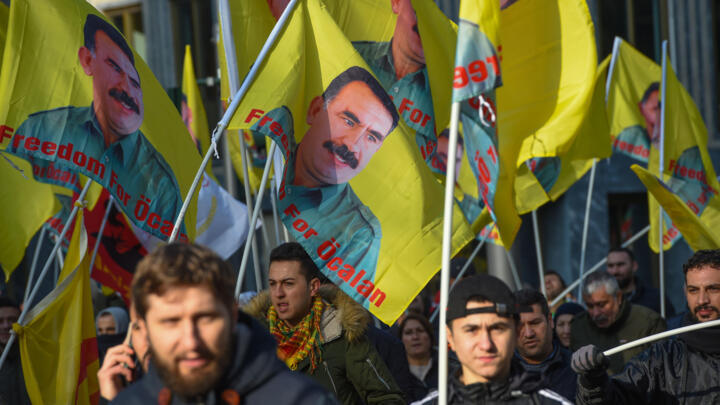
Shafaq News/ Turkish media reported that Abdullah Öcalan, the imprisoned leader of the Kurdistan Workers' Party (PKK), labeled as a terrorist organization by Turkiye, US, and EU, is expected to call on his party and its supporters to disarm by mid-February.
According to the Turkish newspaper Zaman, discussions during recent meetings with Öcalan in İmralı Prison touched on details of talks between the ruling Justice and Development Party (AKP), the Nationalist Movement Party (MHP), and the Republican People's Party (CHP), as well as reservations expressed by other political factions.
The Kurdish People's Democracy and Equality Party (DEM) issued a statement on Thursday regarding two meetings its delegation held with Öcalan. The statement, widely circulated in Turkish media, confirmed that Öcalan had been briefed on the delegation's discussions with Turkish political parties following their first meeting.
The DEM statement noted, “The meeting provided Öcalan with critical information. After completing preparations for this process, necessary announcements will be made to the public. The party delegation will continue its efforts and communication, updating the public as developments arise. This process aims to promote coexistence in freedom, and we anticipate meaningful contributions from all sectors of society to achieve this goal.”
The second meeting between Öcalan and the DEM delegation reportedly lasted four hours. Their first meeting, held on December 28, 2024, lasted three hours, after which the delegation briefed political leaders on Öcalan's stance.
Turkish media has speculated that Öcalan could issue an official call for disarmament in mid-February. The online platform Medyascope reported that the Kurdish delegation plans to meet with government and party representatives after returning from İmralı Prison. If no obstacles arise, a third meeting with Öcalan will be held, during which he is anticipated to formally call for an end to the PKK's armed activities in Turkiye.
The proposed date of February 15 for this announcement aligns with the anniversary of Öcalan’s extradition to Turkiye in 1999.
Two Iraqi border guards killed in PKK attack near Zakho
2025-01-24 04:45
Shafaq News/ Two Iraqi border guards were killed, and another sustained injuries on Friday in an armed attack targeting a border checkpoint near Zakho, according to a security source.
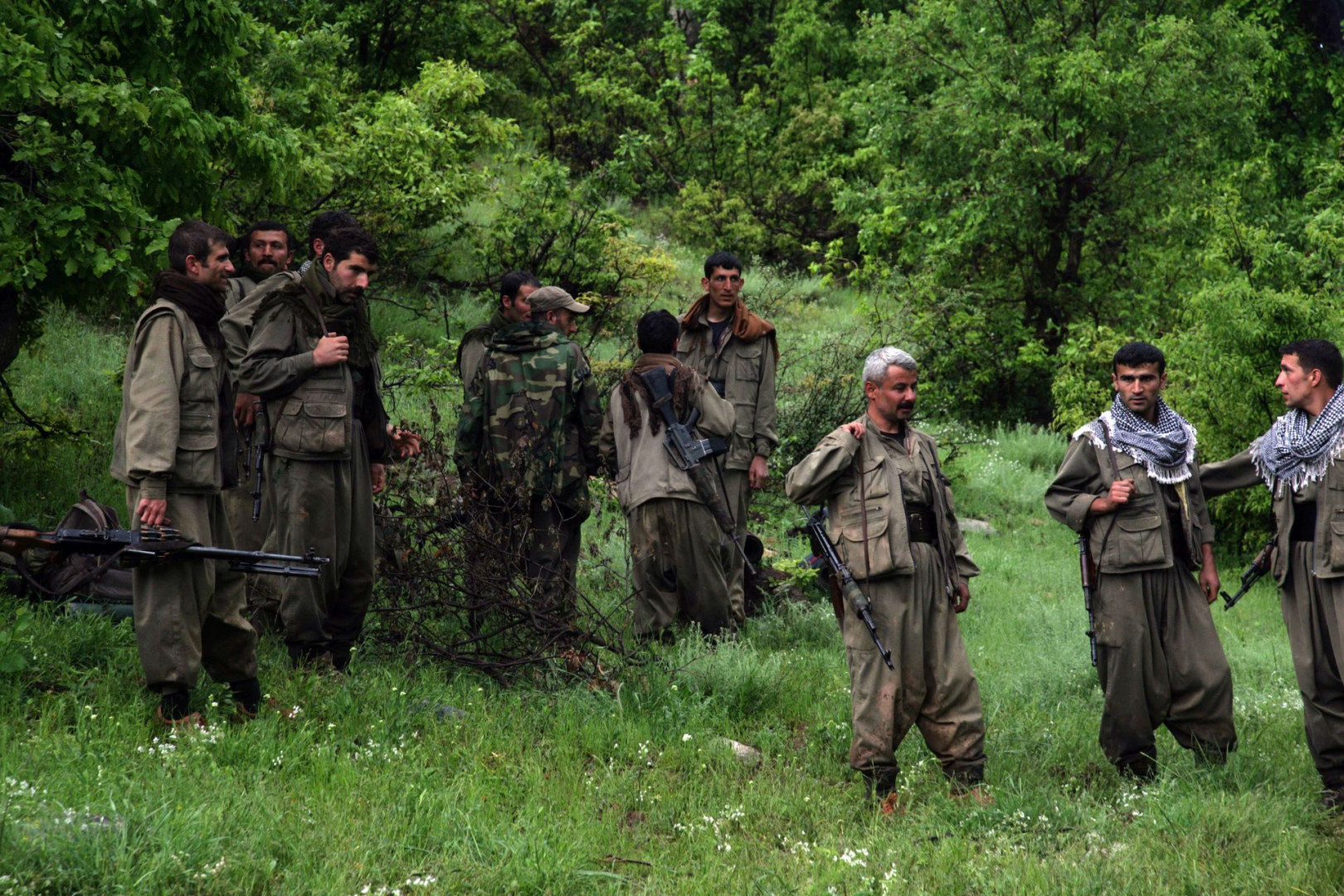
The source reported that "the assault was carried out by militants affiliated with the Kurdistan Workers' Party (PKK), a group known for periodically targeting military positions of the Peshmerga forces and Iraqi border guards in areas along the Turkish border."
This incident comes amid heightened tensions in the region, where cross-border operations and skirmishes have intensified. Last week, the Turkish Ministry of Defense announced the seizure of weapons and ammunition linked to the PKK during its ongoing "Operation Claw-Lock (Pençe-Kılıt)" in the Kurdistan Region.
The Turkish military initiated Operation Claw-Lock on April 17, 2022, targeting PKK strongholds in the Matina, Zap, and Avashin-Basyan regions of Iraqi Kurdistan. The operation aims to eliminate PKK threats along Turkiye's southern borders.
Following his remarks in Davos, who called for Zarif`s arrest in Tehran?
2025-01-23
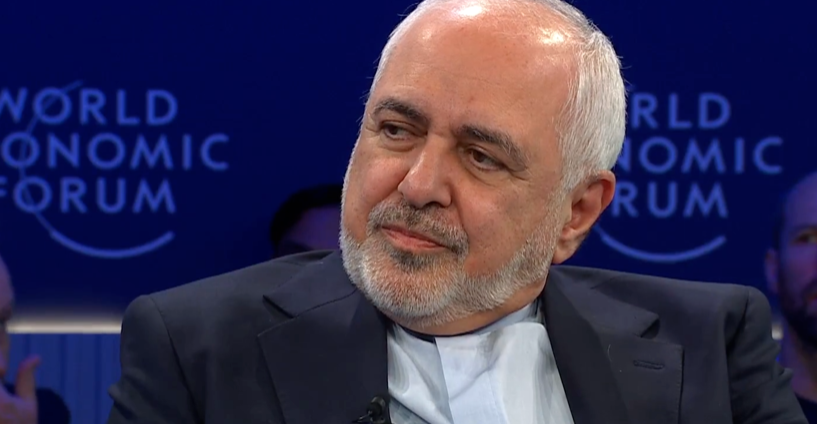
Shafaq News/ The Secretary of the Supreme Council for the Promotion of Virtue in Tehran, Rouhollah Momen Nasab, called on Thursday, for the arrest of Iranian Vice President for Strategic Affairs, Mohammad Javad Zarif, following his recent statements at the World Economic Forum in Davos.
Zarif had stated during his participation in the forum that Iran was not aware of the attack launched by Hamas on Israel on October 7, 2023.
After more than 15 months of war, a ceasefire deal agreed between Israel and Hamas came into effect on January 19. The Palestinian Ministry of Health says more than 46,000 Palestinians have been killed in Israeli attacks.
Zarif emphasized that Iran had no knowledge of the 7th of October Hamas attack on Israel, noting that Tehran was planning to hold a meeting with the Americans on October 9, 2023, regarding the nuclear deal, but the attack derailed those talks.
He further explained that Iran's regional allies, including Hamas, have always acted in their own interests, even at Iran's expense, as he put it.
DAVOS
Pope Francis: AI is ‘accelerating crisis of truth’
Pope Francis has warned the World Economic Forum (WEF) that artificial intelligence (AI) was accelerating a so-called “crisis of truth” currently plaguing the modern world.
In a message to the WEF gathering in Davos read by Cardinal Peter Turkson on January 23, the head of the Catholic Church emphasised that while the religious body considered itself a “protagonist” when it came to technological advancement, elements of AI progress had left him uneasy.
“Unlike many other human inventions, AI is trained on the results of human creativity, which enables it to generate new artefacts with a skill level and speed that often rival or surpasses human capabilities, raising critical concerns about its impact on humanity’s role in the world,” the Pontiff said.
“Furthermore, the results that AI can produce are almost indistinguishable from those of human beings, raising questions about its effect on the growing crisis of truth in the public forum.
“Moreover, this technology is designed to learn and make certain choices autonomously, adapting to new situations and providing answers not foreseen by its programmers, thus raising fundamental questions about ethical responsibility, human safety, and the broader implications of these developments for society.”
Pope Francis warned that, in Catholic teaching, social cohesion was considered more valuable than technological advancement.
He said the current trajectory of AI risked it becoming a tool “used to advance the ‘technocratic paradigm’, which perceives all the world’s problems as solvable through technological means alone”.
“Within this paradigm, human dignity and fraternity are frequently subordinated in the pursuit of efficiency, as though reality, goodness, and truth inherently emanate from technological and economic power.
“Yet human dignity must never be violated for the sake of efficiency,” he claimed.
“Technological developments that do not improve life for everyone, but instead create or worsen inequalities and conflicts, cannot be called true progress.
“For this reason, AI should be placed at the service of a healthier, more human, more social and more integral development.
“To navigate the complexities of AI, governments and businesses must exercise due diligence and vigilance,” the Pontiff continued.
“They must critically evaluate the individual applications of AI in particular contexts in order to determine whether its use promotes human dignity, the vocation of the human person, and the common good,” he added.
The U.S. is trying to unravel a hacking plot that targeted climate activists
The U.S. has accused an Israeli private investigator of orchestrating a hacking campaign that targeted American climate activists. Extradition hearings for the private investigator, Amit Forlit, were held at Westminster Magistrates' Court in London.Alberto Pezzali/AP
A yearslong U.S. Justice Department investigation of a global hacking campaign that targeted prominent American climate activists took a turn in a London court this week amid an allegation that the hacking was ordered by a lobbying firm working for ExxonMobil. Both the lobbying firm and ExxonMobil have denied any awareness of or involvement with alleged hacking.
The hacking was allegedly commissioned by a Washington, D.C., lobbying firm, according to a lawyer representing the U.S. government. The firm, in turn, was allegedly working on behalf of one of the world's largest oil and gas companies, based in Texas, that wanted to discredit groups and individuals involved in climate litigation, according to the lawyer for the U.S. government. In court documents, the Justice Department does not name either company. Sponsor Message
As part of its probe, the U.S. is trying to extradite an Israeli private investigator named Amit Forlit from the United Kingdom for allegedly orchestrating the hacking campaign. A lawyer for Forlit claimed in a court filing that the hacking operation her client is accused of leading "is alleged to have been commissioned by DCI Group, a lobbying firm representing ExxonMobil, one of the world's largest fossil fuel companies."
Forlit has previously denied ordering or paying for hacking.
The Justice Department did not immediately respond to a request for comment.
According to a source familiar with the U.S. probe who was not authorized to speak publicly, the U.S. has investigated DCI's possible role in the hacking. Reuters and The Wall Street Journal previously reported that the U.S. government has investigated DCI.
DCI lobbied for ExxonMobil for about a decade, according to federal lobbying records. NPR has not been able to confirm what, if any, links the Justice Department may have thought DCI had with the hacking campaign. NPR has not found any indications that the Justice Department has investigated ExxonMobil in relation to this case.
DCI and ExxonMobil declined to comment on the allegations made in the London hearing. Both companies referred NPR back to statements they had provided earlier in our investigation. Sponsor Message
Craig Stevens, a partner at DCI, said in an email that no one at the firm has been questioned by the U.S. government as part of the hacking investigation. "Allegations of DCI's involvement with hacking supposedly occurring nearly a decade ago are false and unsubstantiated. We direct all our employees and consultants to comply with the law," Stevens said. "Meanwhile, radical anti-oil activists and their donors are peddling conspiracy theories to distract from their own anti-U.S. energy activities."
ExxonMobil spokesperson Elise Otten said in an emailed statement that the company "has not been involved in, nor are we aware of, any hacking activities. If there was any hacking involved, we condemn it in the strongest possible terms."
In a court document arguing for Forlit's extradition, the lawyer for the U.S. government described a sophisticated hacking operation that spanned continents. Forlit ran security companies that gathered information using various methods, including hiring "co-conspirators to hack into email accounts and devices," according to the court filing.
A lawyer representing the U.S. government revealed in the court filing that Forlit has been indicted in the U.S. on charges of conspiracy to commit computer hacking, conspiracy to commit wire fraud, and wire fraud, according to the court filing in London.
Climate activists who were targeted by hackers say the plot that U.S. officials have been trying to unravel was aimed at disrupting their efforts to fight climate change by pushing governments and society to slash the use of fossil fuels like oil and coal.
"It was undoubtedly designed to intimidate and scare advocates from continuing their work to hold these major oil companies accountable for the decades of deception that they're responsible for," says Lee Wasserman, director of the Rockefeller Family Fund and one of the hacking victims.
The fossil fuel industry faces dozens of lawsuits filed by states and localities accusing companies of misleading the public about the risks of climate change. The industry says that those lawsuits are meritless and politicized and that climate change is an issue that should be dealt with by Congress, not the courts.
The potential impact on civil society of hacking-for-hire operations is grave, according to cybersecurity and legal experts.
"Nothing is more powerful at chilling speech and encouraging self-censorship than the feeling that your entire digital world, which probably touches your whole world, could be invaded by people who mean you harm simply because of what you're doing at work," says John Scott-Railton, a senior researcher at the Citizen Lab, a cyber watchdog at the University of Toronto that analyzed the attacks. "Simply because you're concerned about rising sea levels."
The U.S. has said previously that ExxonMobil took advantage of leaked information
The U.S. hacking investigation became public in 2019 with the arrest in New York of a business associate of Forlit's named Aviram Azari. A former Israeli police officer and private investigator, Azari eventually pleaded guilty to conspiracy to commit computer hacking, wire fraud and aggravated identity theft.
The hackers Azari hired didn't target just American climate activists, according to federal prosecutors. They also attacked government officials in Africa, members of a Mexican political party and critics of a German company called Wirecard.
U.S. District Judge John Koeltl sentenced Azari in November 2023 to more than six years in prison and ordered him to forfeit more than $4.8 million that prosecutors allege he was paid for managing the hacking campaigns.
At Azari's sentencing, federal prosecutors did not say who they believed had hired Azari to target the climate activists. The Justice Department stated in a sentencing memo that ExxonMobil was the beneficiary of the information that the attacks revealed.
Federal prosecutors asserted in the Azari sentencing memo that information stolen from climate activists was leaked to the media, resulting in news stories that "appeared designed to undermine" state climate investigations of ExxonMobil. The company's lawyers used the news stories in court as part of their defense against the state investigations, prosecutors said.
ExxonMobil said in a statement at the time that it had done nothing wrong. "ExxonMobil has no knowledge of Azari nor have we been involved in any hacking activities," the company said.
The sentencing memo in Azari's case noted a private email among climate activists that surfaced in the media in 2016. The email described plans for a closed-door meeting in New York among leading climate activists, including writer and organizer Bill McKibben and Peter Frumhoff, then the chief climate scientist at the Union of Concerned Scientists, a watchdog and research group. The meeting's goal, according to the email, was to sharpen attacks on ExxonMobil and convince the public that the company is a "corrupt institution" that pushed the world toward "climate chaos and grave harm." It also raised the prospect of legal action through state attorneys general and the Justice Department.
ExxonMobil and some Republican lawmakers cited the document as they tried to fight off state climate investigations, saying activists and prosecutors colluded to advance a political agenda.
Climate activists protest on the first day of an ExxonMobil trial outside the New York state Supreme Court building in 2019 in New York City.
Angela Weiss/AFP via Getty Images Lawyer for U.S. government described a sophisticated hacking campaign
Azari was sent to a federal prison in New Jersey in 2023. Five months later, Forlit was arrested in London. The Justice Department has been working through British lawyers to have Forlit extradited to the U.S. to face criminal prosecution "arising from a 'hacking-for-hire' scheme," court documents show.
One of Forlit's clients from 2013 to 2018 was an unnamed "D.C. Lobbying Firm," the court filing says. That firm "acted on behalf of one of the world's largest oil and gas corporations, centred in Irving, Texas," the document says. The company, in particular, wanted to discredit people and organizations engaged in climate change litigation against it, a lawyer for the U.S. wrote. Until mid-2023, ExxonMobil was headquartered in Irving, Texas.
A lawyer representing the U.S. alleged that the lobbying firm gave Forlit targets to hack. The lawyer said there's a "strong circumstantial case" that Forlit gave the list of at least 128 targets to Azari, who then hired hackers in India.
Forlit and Azari both referred to the operation as "Fox Hunt," the lawyer for the U.S. said in the London court filing. The hacking obtained "non-public documents which were provided to the oil and gas company and published as part of a media campaign to undermine the integrity of civil investigations," according to the filing.
D.C.-based firm lobbied for ExxonMobil for about a decade
DCI, the public affairs firm that Forlit's lawyer said her client allegedly worked for, has a long history working for the fossil fuel industry.
In the early 2000s, ExxonMobil provided funding for a website DCI published called Tech Central Station, which the Union of Concerned Scientists called a "hybrid of quasi-journalism and lobbying." And from 2005 until early 2016, ExxonMobil paid DCI around $3 million to lobby the federal government, according to lobbying disclosures.
The lawyer for the U.S. government said in an extradition statement that the hacking operation started in late 2015. At that time, the oil and gas industry was facing a mounting backlash. Stories by investigative journalists in 2015 revealed that ExxonMobil's own scientists warned top executives about dire risks from climate change as early as the 1970s. Despite those warnings, the oil company went on to lead a decades-long campaign to sow public confusion about global warming. Activists seized on the reports, popularizing the hashtag #ExxonKnew to argue that ExxonMobil knew about human-caused climate change despite denying it publicly.
In Washington, D.C., Democrats urged the Justice Department to investigate whether ExxonMobil misled the public about climate change. And a group of state attorneys general banded together to find "creative ways to enforce laws being flouted by the fossil fuel industry and their allies," New York's attorney general said in early 2016.
Since then, dozens of lawsuits have been filed in the U.S. against ExxonMobil and other fossil fuel corporations, largely by Democratic-led states and towns. They allege the industry misled the public for decades about the dangers of burning fossil fuels, the primary cause of climate change. The lawsuits seek damages to help communities cope with climate risks and damages.
Victims say finding out who ordered the hacking is crucial
Forlit's lawyer, Rachel Scott, focused on the litigation against ExxonMobil in her opening arguments in London. She said the U.S. is trying to prosecute Forlit in part "to advance the politically-motivated cause of pursuing ExxonMobil."
The U.S. government is not part of the climate lawsuits filed by states and localities.
It has been years since the climate activists were targeted by hackers, but finding out who directed and paid for the operation is still vital, says Matt Pawa, an environmental lawyer and hacking victim.
It's important "for the purposes of deterrence," Pawa says, "so that this is not done again."
Submission to the Securities and Exchange Commission on Meta’s Violation of Security Laws Concerning Facebook’s Role in the Atrocities Against the Rohingya in 2017
Amnesty International, the Open Society Justice Initiative and Victim Advocates International make this submission on behalf of Sayed Ullah, known as Maung Sawyeddollah, a Whistleblower, to provide information on Meta’s role in the atrocities perpetrated against the Rohingya people of Myanmar in 2017, which the United States government has classified as genocide, to present facts concerning Meta’s conduct, and to identify representations to the Securities and Exchange Commission (SEC) and to public investors that appear to have violated federal securities laws.
Digital Transformation as a Double-Edge Sword for Democracy
January 24, 2025
The paper discusses the juxtaposition of digital transformation (DT) and democracy support and democracy contestation. While the DT is defined as an adaptation and implementation of digital technologies into political and social processes, digital tools are seen as such that could be used both by democratic and non-democratic systems and are perceived as ‘neutral’. The paper aims to reveal how digital transformation in governance, public services, civic engagement, and more broadly in everyday social practices impacts democracies and democracy support. The digital transformation instruments are reviewed in the context of democracy support and democracy contestation and the conceptual framework for understanding of the role of DT as a cross-cutting issue in the SHAPEDEM-EU work packages is provided. The paper sets the ontological framework for the nexus of DT and democracy support or contestation. It discusses digital democracy and digital authoritarianism first on a conceptual level and then through the analysis of digital instruments and solutions. Also, the interconnection of two cross-cutting issues of the SHAPEDEM-EU project: gender equality and DT, is outlined. Finally, the paper reviews EU policies concerning DT and the question of media literacy and its relation to democracy support and democracy learning.
After five years of inflicting an unprecedented crackdown on the press, Alexander Lukashenko is set to run for a seventh presidential term on Sunday, 26 January. Reporters Without Borders (RSF) has filed a complaint with the International Criminal Court (ICC) against the Belarusian leader for crimes against humanity, as journalists continue to be overwhelmingly targeted by his regime.
“The electoral farce will likely proceed without a hitch, free from the counterweight of independent media, ensuring Lukashenko’s victory over four puppet candidates. For five years, the Belarusian regime has systematically persecuted independent voices, starting with journalists. To combat this glaring impunity, RSF is filing a complaint for crimes against humanity committed against Belarusian journalists. We call on Prosecutor Karim Khan to investigate and prosecute those responsible.
Jeanne Cavelier
Head of RSF Eastern Europe and Central Asia Desk
As the presidential election approaches, Belarus’ state media are delivering propaganda that portrays independent journalists and media outlets as extremists, echoing the logic of the repressive laws introduced by Lukashenko’s regime. From 15 to 17 January, the state-run television network ONT aired interviews conducted by a propagandist with three imprisoned journalists from Radyio Svaboda (the Belarusian service of the US-funded broadcaster Radio Free Europe/Radio Liberty, RFE/RL): Ihar Karnei, Ihar Losik, and Andrei Kuznechyk. Due to the manipulated footage and fierce intimidation of these journalists, they appeared to express regret for their work at RFE/RL, portrayed as an extremist outlet that spreads fake news, incites riots, and promotes overthrowing the government.
A state policy of repression
Since his contested re-election in August 2020, Alexander Lukashenko has orchestrated a widespread, systematic campaign of persecution against journalists, aiming for their complete eradication. Their “crime” is that they dared to cover unprecedented peaceful protests demanding free and transparent elections — and the aftermath of these demonstrations. As early as 2021, Lukashenko declared that efforts to “restore order in the information space” were nearing completion.
“Particularly serious facts have been analysed by RSF under the framework of the ICC’s Statute and jurisprudence, they clearly constitute crimes against humanity of imprisonment, persecution and forced displacement of Belarusian journalists due to their work. RSF calls on the ICC Prosecutor to include these crimes against journalists in its preliminary investigation. We welcome Lithuania’s referral of Lukashenko’s crimes to the ICC and urge other States Parties to the Rome Statute that host Belarusian journalists to join Lithuania in referring this case to the ICC.
Antoine Bernard
RSF Director of Advocacy and Assistance
RSF has documented this state policy, with help from the Belarusian Association of Journalists (BAJ), its partner. The findings include 589 cases of arbitrary arrests of independent media professionals in a country that had about 2,000 journalists just five years ago. At least 43 journalists are still in prison, including Maryna Zolatava, the former editor-in-chief of the country’s most widely read media outlet, TUT.BY, which was shut down by the regime in 2021. Journalists forced into exile
Mass arrests, arbitrary detentions, violence, destruction of professional equipment, forced erasure of images, raids, shuttered media outlets, widely-circulated videos of humiliating forced confessions, censorship, and various forms of pressure — these acts of persecution, constituting crimes against humanity, have propelled the mass exodus of Belarusian journalists, primarily to Poland and Lithuania. Forced exile alone is classified as a crime against humanity under the category of forcible transfer of population.
Even abroad, journalists are not safe. The illegitimate president has sought to create an inescapable climate of terror, going as far as diverting a plane flying through Belarusian airspace in May 2021 to arrest an exiled blogger. Within 48 hours of this unprecedented tactic, RSF filed a complaint against Alexander Lukashenko with the Lithuanian Prosecutor General’s Office for “hijacking of an aircraft with terrorist intent,” leading to the opening of an investigation. Beyond in absentia prosecutions and the intimidation of relatives remaining in Belarus, some journalists now face asset seizures by the authorities.
For the journalists still in Belarus, often due to family obligations, abandoning journalism does not guarantee any reprieve. Authorities target them for past publications, often under accusations of “extremism.” Fearful of repercussions, their families sometimes refuse to publicise their detention.
Widespread persecution
In its complaint, RSF provided the ICC Prosecutor with detailed evidence and statistics illustrating the scope and severity of these crimes, demonstrating the systematic and state-driven nature of the attack on Belarusian journalists.
Arrests and imprisonments since August 2020:589 arbitrary arrests targeting 397 media professionals (some arrested multiple times).
43 journalists remain in prison.
The forced displacement of Belarusian journalists, according to statistics from the BAJ:Between 500 and 600 Belarusian journalists have been forced into exile.
Around 200 Belarusian journalists have sought refuge in Lithuania.
Around 300 Belarusian journalists have sought refuge in Poland.
Belarus, one of the world’s largest jails for journalists:Ranked 4th in the world for the highest number of imprisoned journalists as of December 2024, behind China, Myanmar, and Israel.
Holds the highest per capita rate of imprisonment
AND JUST NEXT DOOR
UK
House price affordability improves, but average first-time buyer still paying five times salary
Nationwide has reported a “modest improvement” in house price affordability over the past year, with wages outstripping house price growth, but challenges remain.
Wages outstripped house price growth last year resulting in a “modest improvement” in affordability for buyers, according to mortgage lender Nationwide. Despite this, the average first-time buyer in the UK is still paying five times their annual salary when purchasing a property. This is significantly higher than the long-term average of 3.9 times earnings.
Although mortgage rates fell slightly last year as the Bank of England cut interest rates, high borrowing costs are still a barrier to home ownership for many. The average mortgage rates on both two and five-year deals are still significantly higher than before the pandemic, at more than 5%.
“A prospective buyer earning the average UK income and buying a typical first-time buyer property with a 20% deposit would have a monthly mortgage payment equivalent to 36% of their take-home pay,” says Andrew Harvey, senior economist at Nationwide. For comparison, the long-term average is 30%
With this in mind, the slight improvement in affordability is “about as useful as a 10% discount on a diamond-crusted tiara,” according to Sarah Coles, head of personal finance at Hargreaves Lansdown. Forty percent of first-time buyers had help with a mortgage deposit
Data from the English Housing Survey reveals that around 40% of first-time buyers received help with a deposit in 2023/24. The majority of this came in the form of a gift or loan from family or friends, with some also receiving this in the form of an inheritance.
Harvey says this data is unsurprising given the record increase in rents in recent years. Separate data from Zoopla, published at the end of last year, shows rents have risen by 27% since the end of the Covid-19 lockdowns. This means the average renter is now paying £3,240 per year more than they were in 2021.
Those without help from family often look for other ways to boost their chances of getting on the ladder, such as opting for a low-deposit mortgage or increasing the length of their mortgage term.
“Recent FCA data we obtained from a Freedom of Information request revealed a significant rise in people aged over 36 taking out mortgages with terms of 35 years or more. In the first nine months of 2024 alone, over 22,000 such loans were sold,” says Karen Noye, mortgage expert at financial services company Quilter.
While having products like this on the market gives buyers flexibility, it also comes with risks including the possibility that borrowers will still be paying off their mortgage in retirement. Increasing the term of the loan also means you will end up paying more in interest repayments overall.
Most affordable region for first-time buyers
Although Nationwide’s House Price Index (HPI) shows that prices increased by 4.7% in 2024 overall, all regions saw a “modest improvement” in affordability compared to 2023. This is because wages grew faster than house prices and borrowing costs went down slightly.
The below table highlights the most affordable local authorities within each part of the country.
Region Most affordable local authority House price to earnings ratio Scotland Aberdeen 2.5 North West Burnley 2.8 North Hartlepool 2.8 Yorkshire North East Lincolnshire 3.3 Wales Blaenau Gwent 3.5 West Midlands Stoke-on-Trent 3.7 East Midlands Chesterfield 4.1 East Anglia Great Yarmouth 4.5 Outer Metropolitan Surrey Heath 4.8 Outer South East Tendring 5.0 South West Swindon 5.3 London Enfield 6.2 Source: Nationwide Challenges for older buyers
While first-time buyers often face the biggest hurdles, particularly those paying rental costs while trying to save, Coles points out that older homeowners aren’t immune to affordability challenges either.
Many will have faced an unwelcome shock in recent years when rolling off a relatively cheap fixed-rate mortgage that they agreed before the pandemic. Around 1.6 million mortgage deals were due to come to an end last year, according to industry body UK Finance.
“In terms of overall resilience, home ownership is particularly vital as we approach retirement,” Coles says. “It’s one reason why local authorities in the home counties (where home ownership levels are higher) have better retirement resilience, while London and other cities (where more people rent or own a smaller chunk of their home) have lower scores.”