Saturday, March 08, 2025

People march in cities around the world to mark International Women's Day

Women take part in a Transfeminist strike on International Women's Day, in Rome, Saturday, March 8, 2025.
Copyright Valentina Stefanelli/Valentina Stefanelli/LaPresse

By Lucy Davalou
Published on 

People around the world joined forces to march against patriarchal societies, the gender gap and violence against women in rallies in cities across the world.

Hundreds of thousands of people marched in cities around the world on March 8th to mark International Women's Day.

Tens of thousands of people gathered on the streets of Madrid, rallying in defence of women’s rights and advocating for an anti-racist, feminist agenda.

The march, organised by the feminist network 8M Commission, saw participants braving the rain whilst chanting against gender inequality and racism. 

The Spanish government reported 25,000 participants against 20,000 in 2024, although organisers claimed the number was closer to 80,000. 

symbol
00:00
02:00
Read More

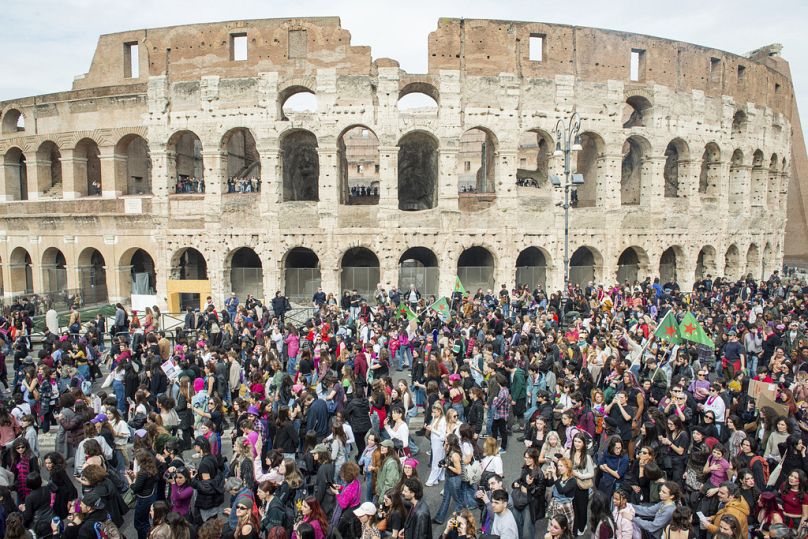
Rome marches against gender violence

People take part in a Transfeminist strike on International Women's Day, outside the Colosseum, in Rome, Saturday, March 8, 2025
People take part in a Transfeminist strike on International Women's Day, outside the Colosseum, in Rome, Saturday, March 8, 2025 Valentina Stefanelli/Valentina Stefanelli/LaPresse

In Rome, the demonstration focused on fighting gender violence and closing the gender gap. The city hosted the largest demonstration in Italy, however Italians were marching in 60 cities across the country to raise awareness about violence against women. The slogan of the demonstration, “Not One Less,” echoed the ongoing fight against femicide and gender-based violence. 

While in Istanbul, Turkey, thousands more took to the streets to also protest against gender violence and the growing pressure on women in society. The rally in Istanbul's Kadikoy district was marked by speeches, music, and dance, celebrating women’s strengths whilst also highlighting the urgent need for societal change. However, a heavy police presence, including officers in riot gear and water cannon trucks, tightly controlled the demonstration.

Turkish women fight a patriarchal society

The Turkish government declared 2025 the "Year of the Family," a move that many protesters criticised, seeing it as an attempt to further confine women to traditional roles of marriage and motherhood. The government's decision to withdraw from the Istanbul Convention in 2021, which was designed to protect women from domestic violence, has also been a source of anger among activists. The We Will Stop Femicides Platform reported that 394 women were killed by men in Turkey in 2024.
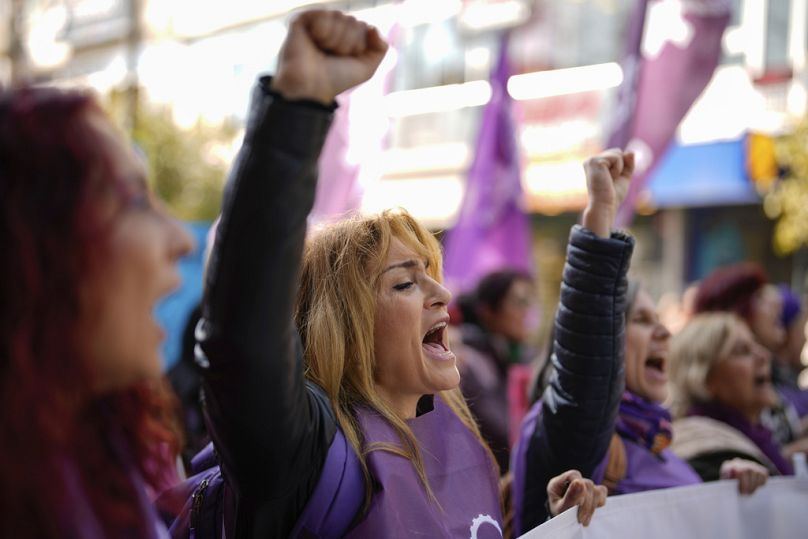
Women chant slogans during a protest marking International Women's Day in Istanbul, Turkey, Saturday, March 8, 2025.
Women chant slogans during a protest marking International Women's Day in Istanbul, Turkey, Saturday, March 8, 2025. Emrah Gurel/Copyright 2025 The AP. All rights reserved

Yaz Gulgun, a 52-year-old pensioner, spoke out against the rising rates of femicide in the country, calling for better legal protections and a more supportive police force. She said 

“There is bullying at work, pressure from husbands and fathers at home and pressure from patriarchal society. We demand that this pressure be reduced even further.”

While Selvi Alkancelik, a 58-year-old demonstrator, pushed on the desire for women to be free from the restrictions imposed by a patriarchal society, saying “Let women be free. I want them to go somewhere without asking permission from her husband, to go anywhere without fear when she returns home at night, to go anywhere freely without fear. I want freedom for all women in the world." 

Despite a ban on public demonstrations by The BeyoÄŸlu district governor, in Taksim Square, many women plan to gather later in the evening for a Feminist Night March, pushing back against restrictions on their right to protest. Authorities blocked off areas of Istanbul and closed metro stations to prevent these gatherings, citing concerns over public order.


Thousands of Slovaks stage protests against the Russia-friendly government

Copyright Jakub Kotian/Tlacova agentura SR
By Malek Fouda
with APPublished on 08/03/2025 

Thousands of Slovaks continue to protest across the country against the pro-Russian policies of Prime Minister Robert Fico's government.

Large crowds again took to the streets of the capital and other cities in Slovakia on Friday to demonstrate against populist Prime Minister Robert Fico and his pro-Russian policies.

Regular protests erupted after Fico visited Moscow to hold talks with Russian President Vladimir Putin in late December, a rare visit to the Kremlin by a European Union leader since Russia launched a full-scale invasion of Ukraine in February 2022.

Protesters accuse him of aligning Slovakia with Russia and distancing from Europe and have been calling for his resignation. Fico has also sporadically made threats to withdraw Slovakia from the European Union, a move that angered many in the country.

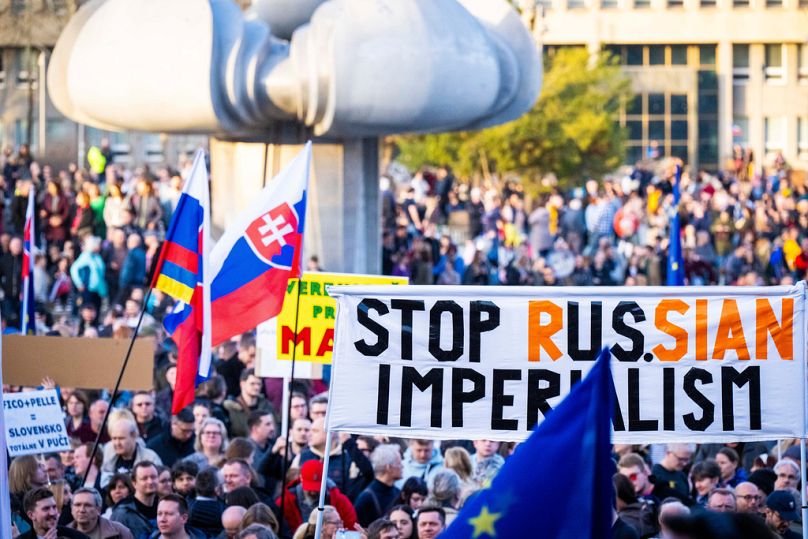
Protesters chanted “shame” at the Freedom Square in the capital Bratislava. Rallies also took place in some 40 other towns and cities both within the country and abroad, according to organisers. Protesters called Fico a “traitor”, adding that Slovakia is and will be European.

symbol
00:00
02:00
Read More

The Slovak premier, who survived an assassination attempt in May 2024, has faced calls to resign over his comments about future EU and NATO membership, and his remarks supporting Russia’s motives for invading Ukraine.  

Demonstrators also condemned recent pro-Russian activities of Fico’s close aides. His chief advisor, Erik Kaliňák, has recently come under fire for saying that Slovakia “would finally have a reliable neighbour” if Russia conquered Ukraine.

People gather to take part at a protest called "Slovakia is Europe" in Bratislava Friday, March 7, 2025
People gather to take part at a protest called "Slovakia is Europe" in Bratislava Friday, March 7, 2025Jakub Kotian/Tlacova agentura SR

ĽuboÅ¡ Blaha, a prominent member of Fico’s leftist Smer party known for extreme leftist rhetoric, met with Sergei Naryshkin, head of Russia’s SVR spy agency, this week on a trip to Moscow. He also stated that it’s a fact that the “West is losing” to Russia.

Fico’s views of Russia have sharply differed from the European mainstream. He, along with Hungary’s Prime Minister Viktor Orban, often find themselves in disagreement with other western powers, particularly in what concerns the war in Ukraine.

Orban is also one of the few EU leaders to have visited Russia to meet with Putin since Russia’s invasion.

Fico was prime Minister from 2012 to 2018. He resigned in 2018 less than three weeks after the murder of an investigative reporter – who was looking at possible government corruption – sparked public outcry and triggered nationwide protests.

He returned to power in 2023 after his Smer party won a parliamentary election. Since his return, he’s ended Bratislava's military and financial support for Kyiv, criticised EU sanctions on Russia and vowed to block Ukraine from joining NATO.

He’s also declared Ukraine’s President Volodymyr Zelenskyy as a national enemy, after the Ukrainian leader ended the transit of Russian gas through his country following the expiration of a five year deal.

The challenges for the German left—interview with socialist in Hamburg

Stefan Ziefle from the revolutionary socialist group Socialism From Below spoke to Yuri Prasad about the tests ahead for the left in Germany


A mass demonstration against the fascist AfD in Berlin last month in the run up to the
German election (Picture: Guy Smallman)


SOCIALIST WORKER

Friday 07 March 2025

The revival of the German radical left party Die Linke was for many people the sole glimmer of hope in last month’s general election.

But the party now faces the new challenge of a coalition government led by the right wing CDU. It is determined to smash the welfare state to pay for increased arms spending. And the AfD fascist party is emboldened after surging to second place.

Stefan Ziefle is from the revolutionary socialist group Sozialismus von Unten (Socialism From Below),

“The conservative CDU and Labour-like SPD parties made a deal to massively increase spending on arms and infrastructure,” he said.

Under the German parliamentary system, the old MPs keep their seats for up to 30 days after the election.

“They will rush through changes to the law before the new parliament convenes. That means they will only need to add the MPs from the Green and the Liberal FDP party to give them the two-thirds majority that they need to make a change to the constitution.”

The new coalition government is expected to take over around Easter. Stefan says had the CDU and SPD waited until then, they would have been forced to rely on either the AfD or Die Linke to win the vote.

“The SPD is not stupid,” he adds. “The proposal with the CDU combines practically infinite spending on rearmament with a 500 billion euro infrastructure package.

“That’s something the SPD can sell to its voters as ‘something we all need’. The streets are in a bad state, the train system is crumbling because of decades of privatisation, and so on.”

The leadership of Die Linke may well have been tempted to back such a proposal, says Stefan.

“There are parts of the party, which have become stronger during the past few years, that want it to orientate on being part of governing coalitions.


The party had a formulation that said, ‘No to Nato.’ But the right insisted that it would get in the way of joining a future government

“They say the party must adjust its politics and start acting ‘responsibly’. And they attack the party’s programme, even though that itself was the product of a compromise between the left and the right.

“For example, the party had a formulation that said, ‘No to Nato.’ But the right insisted that to be part of any future government, Die Linke would have to accept German imperialism in some way or another, so that policy should go.”

Stefan says there is quite a contrast between this conservative wing and the tens of thousands of people who joined during the last year. This influx has taken Die Linke membership to over 100,000 people.

“The key element in the growth of Die Linke is the mass anti-fascist movement,” he says. He points out that in his home city of Hamburg some 180,000 people took to the streets against the AfD last year.

“That’s one in ten of the whole population,” said Stefan. “That is not only the biggest demonstration I have ever seen in Hamburg, but I think the biggest here since the 1918 Revolution.

“It was a very broad movement, including the churches, the SPD and the smaller radical left groups. But they were completely marginalised.”

Thousands of people were drawn towards Die Linke because of anti-racism, says Stefan.

“In previous elections we had a polarisation between the CDU and the SPD,” he explained. “But this time we had polarisation between the parties that are in favour of deporting migrants—and Die Linke, which opposed that.”


A new anti-fascist movement in Germany—interview with Christine Buchholz
Read More

But the party leadership had not planned to campaign on the issue. “They didn’t want to talk about racism and immigration,” says Stefan.

“They didn’t want any controversy. And so decided to concentrate on certain social issues, such as rent capping, and evade the tougher questions.”

Despite this, Die Linke was known as the only party that did not boast about how many people it would expel in the future. This meant anti-racists “automatically” saw it as a counterweight to the mainstream, says Stefan.

Anti-fascism remains the big challenge for the radical left—and the entrance of so many thousands of new people into action has fantastic potential.

“Aufstehen Gegen Rassismus, which is similar to Stand Up To Racism in Britain, will continue trying to bring together the broadest forces for action against the AfD,” says Stefan.

“That will hopefully include some leading figures in Die Linke, as well as many of its branches and thousands of its members—even if the party is itself not the motor of this.”