Saturday, July 05, 2025

"Racism and Science Fiction"
by Samuel R. Delany

From NYRSF Issue 120, August 1998. "Racism in SF" first appeared in volume form
in Darkmatter, edited by Sheree R. Thomas, Warner Books: New York, 2000.
Posted by Permission of Samuel R. Delany. Copyright © 1998 by Samuel R. Delany.


Racism for me has always appeared to be first and foremost a system, largely supported by material and economic conditions at work in a field of social traditions. Thus, though racism is always made manifest through individuals’ decisions, actions, words, and feelings, when we have the luxury of looking at it with the longer view (and we don’t, always), usually I don’t see much point in blaming people personally, white or black, for their feelings or even for their specific actions—as long as they remain this side of the criminal. These are not what stabilize the system. These are not what promote and reproduce the system. These are not the points where the most lasting changes can be introduced to alter the system.

For better or for worse, I am often spoken of as the first African-American science fiction writer. But I wear that originary label as uneasily as any writer has worn the label of science fiction itself. Among the ranks of what is often referred to as proto-science fiction, there are a number of black writers. M. P. Shiel, whose Purple Cloud and Lord of the Sea are still read, was a Creole with some African ancestry. Black leader Martin Delany (1812–1885—alas, no relation) wrote his single and highly imaginative novel, still to be found on the shelves of Barnes & Noble today, Blake, or The Huts of America (1857), about an imagined successful slave revolt in Cuba and the American South—which is about as close to an sf-style alternate history novel as you can get. Other black writers whose work certainly borders on science fiction include Sutton E. Griggs and his novel Imperio Imperium (1899) in which an African-American secret society conspires to found a separate black state by taking over Texas, and Edward Johnson, who, following Bellamy’s example in Looking Backward (1888), wrote Light Ahead for the Negro (1904), telling of a black man transported into a socialist United States in the far future. I believe I first heard Harlan Ellison make the point that we know of dozens upon dozens of early pulp writers only as names: They conducted their careers entirely by mail—in a field and during an era when pen-names were the rule rather than the exception. Among the “Remmington C. Scotts” and the “Frank P. Joneses” who litter the contents pages of the early pulps, we simply have no way of knowing if one, three, or seven or them—or even many more—were not blacks, Hispanics, women, native Americans, Asians, or whatever. Writing is like that.

Toward the end of the Harlem Renaissance, the black social critic George Schuyler (1895–1977) published an acidic satire Black No More: Being an Account of the Strange and Wonderful Workings of Science in the Land of the Free, A. D. 1933–1940 (The Macaulay Company, New York, 1931), which hinges on a three-day treatment costing fifty dollars through which black people can turn themselves white. The treatment involves “a formidable apparatus of sparkling nickel. It resembled a cross between a dentist chair and an electric chair.” The confusion this causes throughout racist America (as well as among black folks themselves) gives Schuyler a chance to satirize both white leaders and black. (Though W. E. B. Du Bois was himself lampooned by Schuyler as the aloof, money-hungry hypocrite Dr. Shakespeare Agamemnon Beard, Du Bois, in his column “The Browsing Reader” [in The Crisis, March ’31] called the novel “an extremely significant work” and “a rollicking, keen, good-natured criticism of the Negro problem in the United States” that was bound to be “abundantly misunderstood” because such was the fate of all satire.) The story follows the adventures of the dashing black Max Dasher and his sidekick Bunny, who become white and make their way through a world rendered topsy-turvy by the spreading racial ambiguity and deception. Toward the climax, the two white perpetrators of the system who have made themselves rich on the scheme are lynched by a group of whites (at a place called Happy Hill) who believe the two men are blacks in disguise. Though the term did not exist, here the “humor” becomes so “black” as to take on elements of inchoate American horror. For his scene, Schuyler simply used accounts of actual lynchings of black men at the time, with a few changes in wording:

The two men . . . were stripped naked, held down by husky and willing farm hands and their ears and genitals cut off with jackknives . . . Some wag sewed their ears to their backs and they were released to run . . . [but were immediately brought down with revolvers by the crowd] amidst the uproarious laughter of the congregation . . . [Still living, the two were bound together at a stake while] little boys and girls gaily gathered excelsior, scrap paper, twigs and small branches, while their proud parents fetched logs, boxes, kerosene . . . [Reverend McPhule said a prayer, the flames were lit, the victims screamed, and the] crowd whooped with glee and Reverend McPhule beamed with satisfaction . . . The odor of cooking meat permeated the clear, country air and many a nostril was guiltily distended . . . When the roasting was over, the more adventurous members of Rev. McPhule’s flock rushed to the stake and groped in the two bodies for skeletal souvenirs such as forefingers, toes and teeth. Proudly their pastor looked on (217–218).

Might this have been too much for the readers of Amazing and Astounding? As it does for many black folk today, such a tale, despite the ’30s pulp diction, has a special place for me. Among the family stories I grew up with, one was an account of a similar lynching of a cousin of mine from only a decade or so before the year Schuyler’s story is set. Even the racial ambiguity of Schuyler’s victims speaks to the story. A woman who looked white, my cousin was several months pregnant and traveling with her much darker husband when they were set upon by white men (because they believed the marriage was miscegenous) and lynched in a manner equally gruesome: Her husband’s body was similarly mutilated. And her child was no longer in her body when their corpses, as my father recounted the incident to me in the ’40s, were returned in a wagon to the campus of the black episcopal college where my grandparents were administrators. Hundreds on hundreds of such social murders were recorded in detail by witnesses and participants between the Civil War and the Second World War. Thousands on thousands more went unrecorded. (Billy the Kid claimed to have taken active part in a more than half a dozen such murders of “Mexicans, niggers, and injuns,” which were not even counted among his famous twenty-one adolescent killings.) But this is (just one of) the horrors from which racism arises—and where it can still all too easily go.

In 1936 and 1938, under the pen name “Samuel I. Brooks,” Schuyler had two long stories published in some 63 weekly installments in The Pittsburgh Courier, a black Pennsylvania newspaper, about a black organization, lead by a black Dr. Belsidus, who plots to take over the world—work that Schuyler considered “hokum and hack work of the purest vein.” Schuyler was known as an extreme political conservative, though the trajectory to that conservatism was very similar to Heinlein’s. (Unlike Heinlein’s, though, Schuyler’s view of science fiction was as conservative as anything about him.) Schuyler’s early socialist period was followed by a later conservatism that Schuyler himself, at least, felt in no way harbored any contradiction with his former principles, even though he joined the John Birch Society toward the start of the ’60s and wrote for its news organ American Opinion. His second Dr. Belsidus story remained unfinished, and the two were not collected in book form until 1991 (Black Empire, by George S. Schuyler, ed. by Robert A. Hill and Kent Rasmussen, Northeastern University Press, Boston), fourteen years after his death.

Since I began to publish in 1962, I have often been asked, by people of all colors, what my experience of racial prejudice in the science fiction field has been. Has it been nonexistent? By no means: It was definitely there. A child of the political protests of the ’50s and ’60s, I’ve frequently said to people who asked that question: As long as there are only one, two, or a handful of us, however, I presume in a field such as science fiction, where many of its writers come out of the liberal-Jewish tradition, prejudice will most likely remain a slight force—until, say, black writers start to number thirteen, fifteen, twenty percent of the total. At that point, where the competition might be perceived as having some economic heft, chances are we will have as much racism and prejudice here as in any other field.

We are still a long way away from such statistics.

But we are certainly moving closer.

After—briefly—being my student at the Clarion Science Fiction Writers’ Workshop, Octavia Butler entered the field with her first story, “Crossover,” in 1971 and her first novel, Patternmaster, in 1976—fourteen years after my own first novel appeared in winter of ’62. But she recounts her story with brio and insight. Everyone was very glad to see her! After several short story sales, Steven Barnes first came to general attention in 1981 with Dreampark and other collaborations with Larry Niven. Charles Saunders published his Imaro novels with DAW Books in the early ’80s. Even more recently in the collateral field of horror, Tannanarive Due has published The Between (1996) and My Soul to Keep (1997). Last year all of us except Charles were present at the first African-American Science Fiction Writers Conference sponsored by Clarke-Atlanta University. This year Toronto-based writer Nalo Hopkinson (another Clarion student whom I have the pleasure of being able to boast of as having also taught at Clarion) published her award-winning sf novel Brown Girl in the Ring (Warner, New York, 1998). Another black North American writer is Haitian-born Claude-Michel Prévost, a francophone writer who publishes out of Vancouver, British Columbia. Since people ask me regularly what examples of prejudice have I experienced in the science fiction field, I thought this might be the time to answer, then—with a tale.

With five days to go in my twenty-fourth year, on March 25, 1967, my sixth science fiction novel, Babel-17, won a Nebula Award (a tie, actually) from the Science Fiction Writers of America. That same day the first copies of my eighth, The Einstein Intersection, became available at my publishers’ office. (Because of publishing schedules, my seventh, Empire Star, had preceded the sixth into print the previous spring.) At home on my desk at the back of an apartment I shared on St. Mark’s Place, my ninth, Nova, was a little more than three months from completion.

On February 10, a month and a half before the March awards, in its partially completed state Nova had been purchased by Doubleday & Co. Three months after the awards banquet, in June, when it was done, with that first Nebula under my belt, I submitted Nova for serialization to the famous sf editor of Analog Magazine, John W. Campbell, Jr. Campbell rejected it, with a note and phone call to my agent explaining that he didn’t feel his readership would be able to relate to a black main character. That was one of my first direct encounters, as a professional writer, with the slippery and always commercialized form of liberal American prejudice: Campbell had nothing against my being black, you understand. (There reputedly exists a letter from him to horror writer Dean Koontz, from only a year or two later, in which Campbell argues in all seriousness that a technologically advanced black civilization is a social and a biological impossibility. . . .). No, perish the thought! Surely there was not a prejudiced bone in his body! It’s just that I had, by pure happenstance, chosen to write about someone whose mother was from Senegal (and whose father was from Norway), and it was the poor benighted readers, out there in America’s heartland, who, in 1967, would be too upset. . . .

It was all handled as though I’d just happened to have dressed my main character in a purple brocade dinner jacket. (In the phone call Campbell made it fairly clear that this was his only reason for rejecting the book. Otherwise, he rather liked it. . . .) Purple brocade just wasn’t big with the buyers that season. Sorry. . . .

Today if something like that happened, I would probably give the information to those people who feel it their job to make such things as widely known as possible. At the time, however, I swallowed it—a mark of both how the times, and I, have changed. I told myself I was too busy writing. The most profitable trajectory for a successful science fiction novel in those days was for an sf book to start life as a magazine serial, move on to hardcover publication, and finally be reprinted as a mass market paperback. If you were writing a novel a year (or, say, three novels every two years, which was then almost what I was averaging), that was the only way to push your annual income up, at the time, from four to five figures—and the low five figures at that. That was the point I began to realize I probably was not going to be able to make the kind of living (modest enough!) that, only a few months before, at the Awards Banquet, I’d let myself envision. The things I saw myself writing in the future, I already knew, were going to be more rather than less controversial. The percentage of purple brocade was only going to go up.

The second installment of my story here concerns the first time the word “Negro” was said to me, as a direct reference to my racial origins, by someone in the science-fiction community. Understand that, since the late ’30s, that community, that world had been largely Jewish, highly liberal, and with notable exceptions leaned well to the left. Even its right-wing mavens, Robert Heinlein or Poul Anderson (or, indeed, Campbell), would have far preferred to go to a leftist party and have a friendly argument with some smart socialists than actually to hang out with the right-wing and libertarian organizations which they may well have supported in principal and, in Heinlein’s case, with donations. April 14, 1968, a year and—perhaps—three weeks later, was the evening of the next Nebula Awards Banquet. A fortnight before, I had turned twenty-six. That year my eighth novel The Einstein Intersection (which had materialized as an object on the day of the previous year’s) and my short story, “Aye, and Gomorrah . . .” were both nominated.

In those days the Nebula banquet was a black tie affair with upwards of a hundred guests at a midtown hotel-restaurant. Quite incidentally, it was a time of upheaval and uncertainty in my personal life (which, I suspect, is tantamount to saying I was a twenty-six-year-old writer). But that evening my mother and sister and a friend, as well as my wife, were at my table. My novel won—and the presentation of the glittering Lucite trophy was followed by a discomforting speech from an eminent member of SFWA.

Perhaps you’ve heard such disgruntled talks: They begin, as did this one, “What I have to say tonight, many of you are not going to like . . .” and went on to castigate the organization for letting itself be taken in by (the phrase was, or was something very like) “pretentious literary nonsense,” unto granting it awards, and abandoning the old values of good, solid, craftsmanlike story-telling. My name was not mentioned, but it was evident I was (along with Roger Zelazny, not present) the prime target of this fusillade. It’s an odd experience, I must tell you, to accept an award from a hall full of people in tuxedos and evening gowns and then, from the same podium at which you accepted it, hear a half-hour jeremiad from an eminence gris declaring that award to be worthless and the people who voted it to you duped fools. It’s not paranoia: By count I caught more than a dozen sets of eyes sweeping between me and the speaker going on about the triviality of work such as mine and the foolishness of the hundred-plus writers who had voted for it.

As you might imagine, the applause was slight, uncomfortable, and scattered. There was more coughing and chair scraping than clapping. By the end of the speech, I was drenched with the tricklings of mortification and wondering what I’d done to deserve them. The master of ceremonies, Robert Silverberg, took the podium and said, “Well, I guess we’ve all been put in our place.” There was a bitter chuckle. And the next award was announced.

It again went to me—for my short story, “Aye, and Gomorrah . . .”. I had, by that time, forgotten it was in the running. For the second time that evening I got up and went to the podium to accept my trophy (it sits on a shelf above my desk about two feet away from me as I write), but, in dazzled embarrassment, it occurred to me as I was walking to the front of the hall that I must say something in my defense, though mistily I perceived it had best be as indirect as the attack. With my sweat soaked undershirt beneath my formal turtle-neck peeling and unpeeling from my back at each step, I took the podium and my second trophy of the evening. Into the microphone I said, as calmly as I could manage: “I write the novels and stories that I do and work on them as hard as I can to make them the best I can. That you’ve chosen to honor them—and twice in one night—is warming. Thank you.”

I received a standing ovation—though I was aware it was as much in reaction to the upbraiding of the nay-sayer as it was in support of anything I had done. I walked back down toward my seat, but as I passed one of the tables, a woman agent (not my own) who had several times written me and been supportive of my work, took my arm as I went by and pulled me down to say, “That was elegant, Chip . . . !” while the applause continued. At the same time, I felt a hand on my other sleeve—in the arm that held the Lucite block of the Nebula itself—and I turned to Isaac Asimov (whom I’d met for the first time at the banquet the year before), sitting on the other side and now pulling me toward him. With a large smile, wholly saturated with evident self-irony, he leaned toward me to say: “You know, Chip, we only voted you those awards because you’re Negro . . . !” (This was 1968; the term ‘black’ was not yet common parlance.) I smiled back (there was no possibility he had intended the remark in any way seriously—as anything other than an attempt to cut through the evening’s many tensions. . . . Still, part of me rolled my eyes silently to heaven and said: Do I really need to hear this right at this moment?) and returned to my table.

The way I read his statement then, and the way I read it today; indeed, anything else would be a historical misreading, is that Ike was trying to use a self-evidently tasteless absurdity (he was famous for them) to defuse some of the considerable anxiety in the hall that night; it is a standard male trope, needless to say. I think he was trying to say that race probably took little or no part in his or any other of the writer’s minds who had voted for me.

But such ironies cut in several directions. I don’t know whether Asimov realized he was saying this as well, but as an old historical materialist, if only as an afterthought, he must have realized that he was saying too: No one here will ever look at you, read a word your write, or consider you in any situation, no matter whether the roof is falling in or the money is pouring in, without saying to him- or herself (whether in an attempt to count it or to discount it), “Negro . . .” The racial situation, permeable as it might sometimes seem (and it is, yes, highly permeable), is nevertheless your total surround. Don’t you ever forget it . . . ! And I never have.

The fact that this particular “joke” emerged just then, at that most anxiety-torn moment, when the only-three-year-old, volatile organization of feisty science fiction writers saw itself under a virulent battering from internal conflicts over shifting aesthetic values, meant that, though the word had not yet been said to me or written about me till then (and, from then on, it was, interestingly, written regularly, though I did not in any way change my own self presentation: Judy Merril had already referred to me in print as “a handsome Negro.” James Blish would soon write of me as “a merry Negro.” I mean, can you imagine anyone at the same time writing of “a merry Jew”?), it had clearly inhered in every step and stage of my then just-six years as a professional writer.

Here the story takes a sanguine turn.

The man who’d made the speech had apparently not yet actually read my nominated novel when he wrote his talk. He had merely had it described to him by a friend, a notoriously eccentric reader, who had fulminated that the work was clearly and obviously beneath consideration as a serious science fiction novel: Each chapter began with a set of quotes from literary texts that had nothing to do with science at all! Our naysayer had gone along with this evaluation, at least as far as putting together his rubarbative speech.

When, a week or two later, he decided to read the book for himself (in case he was challenged on specifics), he found, to his surprise, he liked it—and, from what embarrassment I can only guess, became one of my staunchest and most articulate supporters, as an editor and a critic. (A lesson about reading here: Do your share, and you can save yourself and others a lot of embarrassment.) And Nova, after its Doubleday appearance in ’68 and some pretty stunning reviews, garnered what was then a record advance for an sf novel paid to date by Bantam Books (a record broken shortly thereafter), ushering in the twenty years when I could actually support myself (almost) by writing alone.

(Algis Budrys, who also had been there that evening, wrote in his January ’69 review in Galaxy, “Samuel R. Delany, right now, as of this book, Nova, not as of some future book or some accumulated body of work, is the best science fiction writer in the world, at a time when competition for that status is intense. I don’t see how a science fiction writer can do more than wring your heart while telling you how it works. No writer can. . . .” Even then I knew enough not to take such hyperbole seriously. I mention it to suggest the pressures around against which one had to keep one’s head straight—and, yes, to brag just a little. But it’s that desire to have it both ways—to realize it’s meaningless, but to take some straited pleasure nevertheless from the fact that, at least, somebody was inspired to say it—that defines the field in which the dangerous slippages in your reality picture start, slippages that lead to that monstrous and insufferable egotism so ugly in so many much-praised artists.)

But what Asimov’s quip also tells us is that, for any black artist (and you’ll forgive me if I stick to the nomenclature of my young manhood, that my friends and contemporaries, appropriating it from Dr. Du Bois, fought to set in place, breaking into libraries through the summer of ’68 and taking down the signs saying Negro Literature and replacing them with signs saying “black literature”—the small “b” on “black” is a very significant letter, an attempt to ironize and de-transcendentalize the whole concept of race, to render it provisional and contingent, a significance that many young people today, white and black, who lackadaisically capitalize it, have lost track of), the concept of race informed everything about me, so that it could surface—and did surface—precisely at those moments of highest anxiety, a manifesting brought about precisely by the white gaze, if you will, whenever it turned, discommoded for whatever reason, in my direction. Some have asked if I perceived my entrance into science fiction as a transgression.

Certainly not at the entrance point, in any way. But it’s clear from my story, I hope (and I have told many others about that fraught evening), transgression inheres, however unarticulated, in every aspect of the black writer’s career in America. That it emerged in such a charged moment is, if anything, only to be expected in such a society as ours. How could it be otherwise?

A question that I am asked nowhere near as frequently—and the recounting of tales such as the above tends to obviate and, as it were, put to sleep—is the question: If that was the first time you were aware of direct racism, when is the last time?

To live in the United States as a black man or woman, the fact is the answer to that question is rarely other than: A few hours ago, a few days, a few weeks . . . So, my hypothetical interlocutor persists, when is the last time you were aware of racism in the science fiction field per se. Well, I would have to say, last weekend I just spent attending Readercon 10, a fine and rich convention of concerned and alert people, a wonderful and stimulating convocation of high level panels and quality programming, with, this year, almost a hundred professionals, some dozen of whom were editors and the rest of whom were writers.
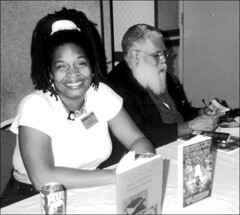
Hopkinson & Delany autographingIn the Dealers’ room was an Autograph Table where, throughout the convention, pairs of writers were assigned an hour each to make themselves available for book signing. The hours the writers would be at the table was part of the program. At 12:30 on Saturday I came to sit down just as Nalo Hopkinson came to join me.

Understand, on a personal level, I could not be more delighted to be signing with Nalo. She is charming, talented, and I think of her as a friend. We both enjoyed our hour together. That is not in question. After our hour was up, however, and we went and had some lunch together with her friend David, we both found ourselves more amused than not that the two black American sf writers at Readercon, out of nearly eighty professionals, had ended up at the autograph table in the same hour. Let me repeat: I don’t think you can have racism as a positive system until you have that socio-economic support suggested by that (rather arbitrary) twenty percent/eighty percent proportion. But what racism as a system does is isolate and segregate the people of one race, or group, or ethnos from another. As a system it can be fueled by chance as much as by hostility or by the best of intentions. (“I thought they would be more comfortable together. I thought they would want to be with each other . . .”) And certainly one of its strongest manifestations is as a socio-visual system in which people become used to always seeing blacks with other blacks and so—because people are used to it—being uncomfortable whenever they see blacks mixed in, at whatever proportion, with whites.

My friend of a decade’s standing, Eric Van, had charge at this year’s Readercon of the programming the coffee klatches, readings, and autograph sessions. One of the goals—facilitated by computer—was not only to assign the visiting writers to the panels they wanted to be on, but to try, when possible, not to schedule those panels when other panels the same writers wanted to hear were also scheduled. This made some tight windows. I called Eric after the con, who kindly pulled up grids and schedule sheets on his computer. “Well,” he said, “lots of writers, of course, asked to sign together. But certainly neither you nor Nalo did that. As I recall, Nalo had a particularly tight schedule. She wasn’t arriving until late Friday night. Saturday at 12:30 was pretty much the only time she could sign—so, of the two of you, she was scheduled first. When I consulted the grid, the first two names that came up who were free at the same time were you and Jonathan Lethem. You came first in the alphabet—and so I put you down. I remember looking at the two of you, you and Nalo, and saying: Well, certainly there’s nothing wrong with that pairing. But the point is, I wasn’t thinking along racial lines. I probably should have been more sensitive to the possible racial implications—”

Let me reiterate: Racism is a system. As such, it is fueled as much by chance as by hostile intentions and equally the best intentions as well. It is whatever systematically acclimates people, of all colors, to become comfortable with the isolation and segregation of the races, on a visual, social, or economic level—which in turn supports and is supported by socio-economic discrimination. Because it is a system, however, I believe personal guilt is almost never the proper response in such a situation. Certainly, personal guilt will never replace a bit of well-founded systems analysis. And one does not have to be a particularly inventive science fiction writer to see a time, when we are much closer to that 20 percent division, where we black writers all hang out together, sign our books together, have our separate tracks of programming, if we don’t have our own segregated conventions, till we just never bother to show up at yours because we make you uncomfortable and you don’t really want us; and you make us feel the same way . . .

One fact that adds its own shadowing to the discussion is the attention that has devolved on Octavia Butler since her most deserved 1995 receipt of a MacArthur “genius” award. But the interest has largely been articulated in terms of interest in “African-American Science Fiction,” whether it be among the halls of MIT, where Butler and I appeared last, or the University of Chicago, where we are scheduled to appear together in a few months. Now Butler is a gracious, intelligent, and wonderfully impressive writer. But if she were a jot less great-hearted than she is, she might very well wonder: “Why, when you invite me, do you always invite that guy, Delany?”

The fact is, while it is always a personal pleasure to appear with her, Butler and I are very different writers, interested in very different things. And because I am the one who benefits by this highly artificial generalization of the literary interest in Butler’s work into this in-many-ways-artificial interest in African-American science fiction (I’m not the one who won the MacArthur, after all), I think it’s incumbent upon me to be the one publicly to question it. And while it provides generous honoraria for us both, I think that the nature of the generalization (since we have an extraordinarily talented black woman sf writer, why don’t we generalize that interest to all black sf writers, male and female) has elements of both racism and sexism about it.

One other thing allows me to question it in this manner. When, last year, there was an African-American Science Fiction Conference at Clark-Atlanta University, where, with Steve Barnes and Tanananarive Due, Butler and I met with each other, talked and exchanged conversation and ideas, spoke and interacted with the university students and teachers and the other writers in that historic black university, all of us present had the kind of rich and lively experience that was much more likely to forge common interests and that, indeed, at a later date could easily leave shared themes in our subsequent work. This aware and vital meeting to respond specifically to black youth in Atlanta is not, however, what usually occurs at an academic presentation in a largely white University doing an evening on African-American sf. Butler and I, born and raised on opposite sides of the country, half a dozen years apart, share many of the experiences of racial exclusion and the familial and social responses to that exclusion which constitute a race. But as long a racism functions as a system, it is still fueled from aspects of the perfectly laudable desires of interested whites to observe this thing, however dubious its reality, that exists largely by means of its having been named: African-American science fiction.

To pose a comparison of some heft:

In the days of cyberpunk, I was often cited by both the writers involved and the critics writing about them as an influence. As a critic, several times I wrote about the cyberpunk writers. And Bill Gibson wrote a gracious and appreciative introduction to the 1996 reprint of my novel Dhalgren. Thus you might think that there were a fair number of reasons for me to appear on panels with those writers or to be involved in programs with them. With all the attention that has come on her in the last years, Butler has been careful (and accurate) in not claiming that I am any sort of influence on her. I have never written specifically about her work. Nor, as far as I know, has she ever mentioned me in print.

Nevertheless: Throughout all of cyberpunk’s active history, I only recall being asked to sit on one cyberpunk panel with Bill, and that was largely a media-focused event at the Kennedy Center. In the last ten years, however, I have been invited to appear with Octavia at least six times, with another appearance scheduled in a few months and a joint interview with the both of us scheduled for a national magazine. All the comparison points out is the pure and unmitigated strength of the discourse of race in our country vis-à-vis any other. In a society such as ours, the discourse of race is so involved and embraided with the discourse of racism that I would defy anyone ultimately and authoritatively to distinguish them in any absolute manner once and for all.

Well, then, how does one combat racism in science fiction, even in such a nascent form as it might be fibrillating, here and there. The best way is to build a certain social vigilance into the system—and that means into conventions such as Readercon: Certainly racism in its current and sometimes difficult form becomes a good topic for panels. Because race is a touchy subject, in situations such as the above mentioned Readercon autographing session where chance and propinquity alone threw blacks together, you simply ask: Is this all right, or are there other people that, in this case, you would rather be paired with for whatever reason—even if that reason is only for breaking up the appearance of possible racism; since the appearance of possible racism can be just as much a factor in reproducing and promoting racism as anything else: Racism is as much about accustoming people to becoming used to certain racial configurations so that they are specifically not used to others, as it is about anything else. Indeed, we have to remember that what we are combatting is called prejudice: prejudice is pre-judgment—in this case, the prejudgment that the way things just happen to fall out are “all right,” when there well may be reasons for setting them up otherwise. Editors and writers need to be alerted to the socio-economic pressure on such gathering social groups to reproduce inside a new system by the virtue of “outside pressures.” Because we still live in a racist society, the only way to combat it in any systematic way is to establish—and repeatedly revamp—anti-racist institutions and traditions. That means actively encouraging the attendance of nonwhite readers and writers at conventions. It means actively presenting nonwhite writers with a forum to discuss precisely these problems in the con programming. (It seems absurd to have to point out that racism is by no means exhausted simply by black/white differences: indeed, one might argue that it is only touched on here.) And it means encouraging dialogue among, and encouraging intermixing with, the many sorts of writers who make up the sf community.

It means supporting those traditions.

I’ve already started discussing this with Eric. I will be going on to speak about it with the next year’s programmers.

Readercon is certainly as good a place as any, not to start but to continue.

PREHISTORIC INDUSTRIALIZATION

125,000-year-old ‘fat factory’ run by Neanderthals discovered in Germany

Katie Hunt, CNN
Fri, July 4, 2025

The archaeological site in Germany was excavated from 2004 to 2009. - Roebroeks/Leiden University


Stone Age humans living by a lake in what’s now Germany systematically processed animal carcasses for fatty nutrients — essentially running what scientists describe as a “fat factory” to boil bones on a vast scale, according to new research.

Archaeologists uncovered the factory by analyzing some 120,000 bone fragments and 16,000 flint tools unearthed over several years at a site known as Neumark-Nord, south of the city of Halle, they reported in a study published Wednesday in the journal Science Advances. Excavators found the artifacts alongside evidence of fire use.

The researchers believe that Neanderthals, an extinct species of human known to have lived in that area as far back as 125,000 years ago, smashed the marrow-rich bones into fragments with stone hammers, then boiled them for several hours to extract the fat, which floats to the surface and can be skimmed off upon cooling.

Since this feat would have involved planning hunts, transporting and storing carcasses beyond immediate food needs, and rendering the fat in an area designated specially for the task, the finding helps paint a picture of the group’s organization, strategy and deeply honed survival skills.

“This attitude that Neanderthals were dumb — this is another data point that proves otherwise,” said Wil Roebroeks, study coauthor and professor of Paleolithic archaeology at Leiden University in the Netherlands.

A string of archaeological discoveries in recent decades have showed that Neanderthals were smarter than their original brutish stereotype might suggest. The ancient humans lived across Eurasia and disappeared 40,000 years ago, and previous studies have found they made yarn and glue, engraved bones and cave walls, and assembled jewelry from eagle talons.

Details in the new research suggest that Neanderthals may have been unexpectedly sophisticated in their approach to nutrition, too.


Researchers believe that Neanderthals smashed animal bones into fragments before boiling them to extract the nutrients. - Kindler/LEIZA-Monrepos
Threat of protein poisoning

The Neanderthals living at the German site over a 300-year period also clearly understood the nutritional value of the bone grease they produced, according to the study

A small amount of fat is an essential part of a healthy, balanced diet. The substance was even more essential for hunter-gatherers, such as Neanderthals, who likely depended heavily on animal foods.

A diet dominated by lean meat and deficient in fatty acids can lead to a debilitating and sometimes lethal form of malnutrition, in which the capacity of liver enzymes to break down the protein and get rid of excess nitrogen is impaired, the researchers noted in their paper. Known today as protein poisoning, the condition earned a reputation among early European explorers of North America as “rabbit poisoning” or “mal de caribou.”

Hunter-gatherers such as Neanderthals, with average body weights between 50 kilograms and 80 kilograms (110 pounds and 175 pounds), would have had to keep their consumption of dietary protein below 300 grams (about 10 ounces) per day to avoid the condition. That amounts to around 1,200 calories — a level of intake far short of daily energy needs, according to the research. As a result, the Neanderthals likely needed to source the remaining calories from a nonprotein source, either fat or carbohydrate.

Cuts of meat from animal muscle contain very little fat, making bones — which contain marrow and other fatty tissue even when an animal is malnourished — a more important resource.

The researchers discovered that the overwhelming majority of remains at the site came from 172 individual large animals, including horses, deer and aurochs, large cow-like creatures that are now extinct. Neanderthals had selected the longest bones that would have contained the most marrow, the study found.


An AI generated impression of what the fat factory site may have looked like 125,000 years ago. - Scherjon/LEIZA-Monrepos


A dash of acorn, a pinch of sloe plum

Exactly how the Neanderthals processed the bones isn’t clear, according to the study authors. The ancient humans likely fashioned containers or pots from birch bark, animal skins or other body parts such as stomach linings, filling them with water and hanging them over a fire, Roebroeks said.

Neanderthals could have consumed the fat they produced as a “greasy broth” to which plants may have been added for flavor as well as nutritional value, suggested study coauthor Geoff Smith, a senior researcher in zooarchaeology at the University of Reading. The charred remains of hazelnut, acorn and sloe plum were also found during the excavations, he noted.

“These weren’t simple hunter-gatherers just getting by day to day — they were master planners who could look ahead, organise complex tasks, and squeeze every last calorie from their environment,” Smith said.

The findings are “exciting,” according to Ludovic Slimak, an archaeologist at the French National Centre for Scientific Research (CNRS) and Paul Sabatier University in Toulouse, France. Slimak wasn’t involved in the study.

“They finally offer clear archaeological confirmation of what many of us had long suspected: that Neanderthals not only valued within-bone lipids but developed specific strategies to extract and process them,” said Slimak, who is the author of the “The Last Neanderthal,” which will be published in English later this year.

“This aligns closely with the broader archaeological record, which shows Neanderthals as highly skilled big-game hunters with a refined sense of ecological adaptation,” he added.

The Neumark-Nord site is “the best example yet of bone-grease rendering,” from this period of the Stone Age, said Bruce Hardy, the J. Kenneth Smail Professor of Anthropology at Kenyon College in Gambier, Ohio. Hardy also was not involved in the research.

“The combination of evidence presented here at Neumark-Nord is impressive,” Hardy said. “It may well represent the smoldering gun, or simmering bone broth, of Neanderthal bone-grease rendering.”

CNN.com


Neanderthal DNA may refute 65,000-year-old date for human occupation in Australia, but not all experts are convinced

Kristina Killgrove
Thu, July 3, 2025
LIVE SCIENCE


Aboriginal art at Ubirr, a rock formation in the Kakadu National Park in Australia's Northern Territory. | Credit: Alamy

Humans did not arrive in Australia 65,000 years ago, and likely didn't reach the land down under until around 50,000 years ago, a controversial new paper reports.

The reasoning behind the finding is that modern humans didn't mate with Neanderthals until around 50,000 years ago, but Indigenous Australians have a small percentage of Neanderthal DNA. So, the first Australians could not have arrived until after humans mated with Neanderthals.

But we can't yet rule out archaeological evidence that places humans on the continent much earlier than genetic models do, other experts say.

In a research report published Sunday (June 29) in the journal Archaeology in Oceania, archaeologists Jim Allen of La Trobe University in Australia and James O'Connell of the University of Utah used recently published Neanderthal DNA evidence to suggest that Australia was not occupied by humans until 50,000 years ago.

Allen and O'Connell's new theory is based on two recent DNA studies that revealed Neanderthals and humans likely interbred in Europe during one long "pulse" between 50,500 and 43,500 years ago. Since all living humans outside Africa have at least 2% Neanderthal DNA, including Indigenous Australians, this means the earliest Homo sapiens in Australia had some Neanderthal roots — and those roots can't go back much earlier than 50,000 years ago.

Researchers interested in the earliest humans in Australia have focused primarily on archaeological sites in southeast Asia and Oceania, broadly across the modern borders of Indonesia, Australia and various islands, also known as the paleocontinent Sahul.

"The initial colonization of Sahul is important because it occurs in the Late Pleistocene [129,000 to 11,700 years ago], which is coincident with a major expansion in the distribution of anatomically modern human populations out of Africa," O'Connell told Live Science.

Archaeological evidence of human occupation in Sahul largely lines up with the genetic evidence, Allen and O'Connell wrote in their study. All archaeological sites except one have been dated to between 43,000 and 54,000 years ago, meaning humans could have mixed with Neanderthals in Eurasia and then headed east.

Related: Australia's oldest rock painting is an anatomically accurate kangaroo


A map of what Australia and Pacific Islands may have looked like during the last ice age. | Credit: Alamy

Archaeology versus genetics

But archaeological evidence at one site called Madjedbebe in the far north of Australia's Northern Territory suggests the area may have been occupied much earlier — at least 65,000 years ago.

Archaeologists recovered human-made artifacts, including stone tools and ocher "crayons," from the Madjedbebe rock shelter and published their findings in a 2017 study. One difficulty in dating the artifacts, however, was the copious amount of sand on the floor of the rock shelter, which can move easily and cause artifacts to fall farther down, making them look older than they are.

Although the research team took steps to counteract this issue and landed on a 65,000-year-old date, Madjedbebe's occupation timing is still uncertain because it is by far the oldest archaeological site in Australia, making it an outlier.

"It doesn't necessarily mean that the data is wrong," O'Connell said, "but it does mean that if the data is right, the people responsible for Madjedbebe are not ancestral to any significant degree to modern Sahul populations."

But Allen and O'Connell's new theory relies heavily on assumptions in the DNA model and in early human behaviors, several researchers suggested in a commentary, also published Sunday in Archaeology in Oceania.

"Both archaeological and molecular dating of Sahul are still in an early stage of development," wrote Peter Veth, an archaeologist at the University of Western Australia, so "can we rely on current assumptions underlying these molecular clocks to test Australian archaeological evidence?"

Adam Brumm, an archaeologist at Griffith University in Australia, wrote that Southeast Asian archaeological sites, such as on Sulawesi in Indonesia, actually have compelling evidence for early rock art that dates back to at least 51,200 years ago.

"Remembering that we only have minimum ages for rock art, I think there is a very real possibility that the people who created the earliest artworks from Sulawesi were a part of the same broader cultural group that went on to colonise Sahul some 65,000 years ago," Brumm wrote.

O'Connell and Allen, though, think that this sort of artwork, intensive seafaring and the creation of complex artifacts are all connected to a shift in human behavior that began around 50,000 years ago, sometimes called the Paleolithic Revolution. In a narrow window of time, they wrote, these early humans "began the process of displacing archaic hominins and occupying diverse environments in Europe and Asia."


Related: When did modern humans reach each of the 7 continents?

But in their commentary, archaeological scientists Huw Groucutt and Eleanor Scerri questioned this idea of a "revolution" in behavior that occurred around the time humans met Neanderthals.


A picture taken on September 6, 2021 shows the reconstruction of the face of the oldest Neanderthal found in the Netherlands, nicknamed Krijn, on display at the National Museum of Antiquities in Leiden.


RELATED STORIES

Drowned land off Australia was an Aboriginal hotspot in last ice age, 4,000 stone artifacts reveal

Ancient Indigenous weapons from Australia can deliver 'devastating blows,' 1st-ever biomechanics study of its kind reveals

40,000-year-old mammoth tusk boomerang is oldest in Europe — and possibly the world

"In Africa, decades of research now clearly show the presence of complex behaviours tens of thousands of years earlier than the supposed revolution, and arguably occurring in a gradual and piecemeal fashion," Groucutt and Scerri wrote.

While genetic and archaeological evidence are currently at odds, it is important to remember that there are major gaps in both data sets, meaning there is no strong evidence favoring either the pre- or post-50,000 year date for the first occupation of Sahul, Groucutt and Scerri wrote.

But even though archaeological evidence does not currently refute Allen and O'Connell's theory, Brumm wrote, "I think this evidence is coming, however, and it will have big implications for our understanding of ancient Sahul."

Oldest wooden tools unearthed in East Asia show that ancient humans made planned trips to dig up edible plants

Sascha Pare
Fri, July 4, 2025 
LIVE SCIENCE


Archaeologists have unearthed the oldest wooden tools ever found in East Asia. 
| Credit: Bo Li

Archaeologists have discovered 35 wooden tools from the Old Stone Age in China which they say show impressive craftsmanship, advanced cognitive skills and offer new insights into what ancient humans might have eaten.

The 300,000-year-old tools are the oldest wooden artifacts ever documented in East Asia, according to a study published Thursday (July 3) in the journal Science. They include digging sticks made of pine and hardwood, hooks for cutting roots and small, pointed implements for extracting edible plants from the ground.

"This discovery is exceptional because it preserves a moment in time when early humans were using sophisticated wooden tools to harvest underground food resources," study lead author Bo Li, a professor in the School of Earth, Atmospheric and Life Sciences at the University of Wollongong Australia, said in a statement.

The tools date to the early Paleolithic period, also known as the Old Stone Age (3.3 million to 300,000 years ago). Wooden artifacts from this time are extremely rare due to organic decomposition, and only a handful of archaeological sites have yielded similar objects, according to the new study. But most of these objects, including spears from Schöningen in Germany, were designed for hunting — these newfound tools were made for digging.

Researchers found the tools buried in oxygen-poor clay sediments on the shores of an ancient lake in Gantangqing, an archaeological site in southwestern China’s Yunnan province. The sediments preserved deliberate polishing and scraping marks on the tools, as well as plant and soil remains on some of the edges that gave researchers clues about the tools' function.

Related: Pfyn culture flint tool: World's oldest known 'Swiss Army' knife

"Our results suggest that hominins at Gantangqing made strategic utilization of lakeshore food resources," the researchers wrote in the study. "They made planned visits to the lakeshore and brought with them fabricated tools of selected wood for exploiting underground tubers, rhizomes, or corms."

Such planned visits show that 300,000 years ago, human ancestors in East Asia were crafting and using tools for specific purposes, demonstrating considerable foresight and intention, the researchers wrote. The artifacts also suggest that these early humans had a good understanding of which plants and parts of plants were edible, the researchers noted.


The tools were preserved thanks to oxygen-poor clay sediments. | Credit: Bo Li

"The tools show a level of planning and craftsmanship that challenges the notion that East Asian hominins were technologically conservative," Li said in the statement. This idea is rooted in previous discoveries in East Asia of stone tools that seemed "primitive" in comparison to tools found in western Eurasia and Africa, according to the study.

The researchers dated the tools using a technique developed by Li that uses infrared luminescence and another method called electron spin resonance, which measures a material’s age through the number of electrons trapped inside its crystal defects due to exposure to natural radiation. Both produced estimates indicating that the wooden tools were between 250,000 and 361,000 years old.

The plant remains on the tools have not been identified because their decomposition is too advanced, but other plant remains at Gantangqing indicate that early humans there ate berries, pine nuts, hazelnuts, kiwi fruit and aquatic tubers, according to the study.

"The discovery challenges previous assumptions about early human adaptation," Li said in the statement. "While contemporary European sites (like Schöningen in Germany) focused on hunting large mammals, Gantangqing reveals a unique plant-based survival strategy."

Rare 300,000-year-old wooden tools found in China reveal diet secrets of early humans

Vishwam Sankaran
Fri, July 4, 2025 
THE INDEPENDENT


Rare 300,000-year-old wooden tools found in China reveal diet secrets of early humans

A trove of rare 300,000-year-old wooden tools unearthed in south-west China reveals that early humans in the region may have relied heavily on underground plants like roots and tubers for sustenance.

The findings, published on Thursday in the journal Science, throw light on the advanced cognitive skills of early human ancestors in East Asia and their lives, diet, and environment.

This rare find was made due to the wooden tools being preserved in oxygen-deprived clay sediments at the archaeological lakeshore site of Gantangqing in Jiangchuan, Yunnan province.


Advertisement


Researchers also found nearly 1,000 organic remains among the sediments.

Using advanced techniques, scientists dated the uncovered remains to establish the age of the tools between 250,000-350,000 years old.

The “extremely rare” wooden tools, which appear in varieties of forms and functions, were extracted from layers dating to around 300,000 years old, scientists say.

Until now, only two previously known discoveries have been made of wooden tools from this period – one in Europe and one in Africa.


Wooden tools from Gantangqing (Liu et al./Science)

Two of the newly uncovered sticks appeared similar to those found at Italy’s Poggetti Vecchi site, dating to 171,000 years old.

Four unique hook-shaped tools were also uncovered and were likely used for cutting roots, scientists say.

Researchers also found signs of deliberate polishing on the wooden tools, scraping marks and soil residues on the tool edges, indicating they were used for digging underground plants such as tubers and roots.

“The wooden implements include digging sticks and small, complete, hand-held pointed tools,” scientists wrote.

Based on these findings, scientists suspect these East Asian human ancestors likely followed a plant-based diet, with evidence of pine nuts, hazelnuts, kiwi fruit and aquatic tubers found at the site.

In comparison, the wooden tools uncovered in Europe and Africa were hunting implements, spears, and spear tips.

“The discovery challenges previous assumptions about early human adaptation. While contemporary European sites (like Schöningen in Germany) focused on hunting large mammals, Gantangqing reveals a unique plant-based survival strategy in the subtropics,” said archaeologist Bo Li, a co-author of the study.

“The diversity and sophistication of the wooden tools also fill a significant gap in the archaeological record, as pre-100,000-year-old wooden tools are extremely rare outside Africa and Western Eurasia,” Dr Li said.

The discovery reveals that wooden tools were in use by early humans living in a much wider range across the globe.


Japan braces for more quakes, authorities dismiss doomsday hype

Reuters
Fri, July 4, 2025


A sales banner written by the store reading 'Whether you believe it or not is up to you' is displayed next to the comic book titled 'The Future I saw' at Village Vanguard book store in Tokyo


TOKYO (Reuters) -Japan's government on Saturday warned of more possible strong earthquakes in waters southwest of its main islands, but urged the public not to believe unfounded predictions of a major disaster.

Authorities on Friday evacuated some residents from remote islands close to the epicentre of a 5.5-magnitude quake off the tip of the southernmost main island of Kyushu.

That quake on Thursday, strong enough to make standing difficult, was one of more than 1,000 tremors in the islands of Kagoshima prefecture in the past two weeks that have fuelled rumours stemming from a comic book prediction that a major disaster would befall the country this month.

"With our current scientific knowledge, it's difficult to predict the exact time, place or scale of an earthquake," said Ayataka Ebita, director of the Japan Meteorological Agency's earthquake and tsunami monitoring division, after a 5.4-magnitude quake shook the area again on Saturday.

"We ask that people base their understanding on scientific evidence," Ebita told a press conference.

The manga, which some have interpreted as predicting a catastrophic event on Saturday, has prompted some travellers to avoid Japan. Arrivals from Hong Kong, where the rumours have circulated widely, were down 11% in May from the same month last year, according to the latest data.

Japan has had record visitor numbers this year, with April setting an record monthly high of 3.9 million travellers.

Ryo Tatsuki, the artist behind the manga "The Future I Saw", first published in 1999 and re-released in 2021, said she was "not a prophet", in a statement issued by her publisher.

Earthquakes are common in Japan, one of the world's most seismically active areas. It accounts for about one-fifth of the world's earthquakes of magnitude 6 or greater.

(Reporting by Tim Kelly in Tokyo; Editing by William Mallard)


Japan evacuates small island village after over 1,000 quakes hit region

Alisha Rahaman Sarkar
Fri, July 4, 2025
THE INDEPENDENT


Japanese authorities have evacuated a small island village after the region was jolted by over 1,000 earthquakes in less than two weeks.

Authorities issued evacuation orders on Thursday after the Akuseki Island in Kagoshima prefecture was struck by a 5.5 magnitude quake, according to the Japan Meteorological Agency. The epicentre was off the coast at a depth of about 20km.

The tremor didn’t trigger a tsunami warning, local officials said, and all residents were safe. There were no reports of any damage to infrastructure either.

The 89 residents of Toshima village departed by ship, heading to a port in Kagoshima off the southern coast of Japan where they were expected to stay in temporary accommodation. The village of Toshima comprises seven inhabited islands.

The first group of people had left from Naze Port on Amami Oshima Island, 120km south of Akuseki, at 2am local time on Friday, NKH World reported.

The ferry was scheduled to stop at all seven inhabited islands of the village and reach the Kagoshima port after 6pm local time on Friday. The combined population of the inhabited islands was 668 as of June, the Japan Times reported.

The evacuees would stay at lodging facilities arranged by the village, local reports said. Officials said the evacuation could last about a week as people from other islands in the region could also be told to temporarily leave their homes due to the ongoing seismic activity.

Akuseki is part of the Tokara Island chain south of the Kyushu region, which has been rattled by 1,031 quakes of intensity 1 or greater since 21 June.


File. A building collapses following an earthquake in Wajima, Japan, on 2 January 2024 (AP)

Situated within the Pacific 'Ring of Fire', Japan is one of the most quake-prone countries in the world. Similar evacuations in Toshima were carried out in December 2021 after a strong earthquake rocked Akuseki.

Recent viral rumours of impending disaster stemming from a comic book prediction have dampened Japan's tourism boom, with visitors from neighbouring regions cancelling their travel plans.

Steve Huen of Hong Kong travel agency EGL Tours blames a flurry of social media predictions tied to a manga that depicts a dream of a massive earthquake and tsunami hitting Japan and neighbouring countries in July 2025.

“The rumours have had a significant impact," Mr Huen told Reuters, adding that his firm had seen its Japan-related business halve.

Discounts and the introduction of earthquake insurance had "prevented Japan-bound travel from dropping to zero", he said.

Hong Kong resident Branden Choi, 28, said he was a frequent traveller to Japan but was hesitant to visit the country during July and August due to the manga prediction. "If possible, I might delay my trip and go after September,” he said.

Ryo Tatsuki, the artist behind the manga titled 'The Future I Saw', first published in 1999 and re-released in 2021, has tried to dampen the speculation, saying in a statement issued by her publisher that she was "not a prophet".

The first edition of the manga warned of a major disaster in March 2011. That was the month and year a massive earthquake, tsunami and nuclear disaster struck Japan's northeastern coast, killing thousands of people.

Some have interpreted the latest edition as predicting a catastrophic event would occur specifically on 5 July 2025, although Ms Tatsuki has denied this.

A Manga Is Causing Earthquake Panic in Japan

Chad de Guzman
Fri, July 4, 2025 
TIME


A TV monitor shows an earthquake that occurred off the coast of the Tokara Islands in Japan, on July 3, 2025. The epicenter was 20 kilometers deep, and the magnitude of the earthquake was estimated to be 5.5. Credit - Yomiuri Shimbun via AP Images

Earthquakes can’t be predicted. Scientists agree that precise predictions of a time, place, and magnitude is not possible with current technologies.

Yet a years-old Japanese manga that claims a “megaquake”—those above a magnitude of 8.0 on the Richter scale—will strike on July 5 has generated panic and deterred some inbound travelers for the past several months.

The 2021 reprint of The Future I Saw by Ryo Tatsuki, a retired mangaka in her 70s, warns that a “huge” tsunami “three times the size” of the 2011 Great East Japan Earthquake will wash over countries in the Pacific Ocean. The first edition of the manga, published in 1999, had referred to a “great disaster” in March 2011 that coincided with the earthquake that killed more than 18,000 people and caused the Fukushima Daiichi nuclear power plant disaster.

Last month, Tatsuki appeared to scale back her prediction about a July 5 megaquake, telling the national newspaper Sankei that it may not happen. But she fell short of entirely withdrawing her warning. TIME has reached out to Tatsuki for comment.

The 2021 reprint has sold more than 1 million copies in Japan, and social media content that has racked up millions of views is fueling the scientifically unfounded fears.

In recent weeks, two Hong Kong-based airlines alone have cut down on flights to southern Japan due to lower passenger interest. “We are surprised that such rumors have led to cancellations,” the Tokushima Tourism promotion division said.

The Japanese government has warned about earthquake speculation. In April, it released a statement that, “predicting earthquakes by specifying the date, time, and location is difficult with current scientific knowledge.” Last month, Japan Meteorological Agency director-general Ryoichi Nomura said in a news conference that it was “regrettable that people are being affected by baseless information in this age of modern science.”

Japan has long been a hotbed of seismic activity due to its position in the Pacific Ring of Fire. In August, JMA issued an advisory that “the likelihood of a new major earthquake is higher than normal” in relation to the Nankai Trough, a 560 mi. oceanic trench to Japan’s south. Earthquakes arising from the Nankai Trough are as the geologists Kyle Bradley and Judith A. Hubbard put it, “the original definition of the ‘Big One.’”

Earlier this year, a government panel issued a report stating that a megaquake along the Nankai Trough has an 80% chance of happening in the next 30 years. Under the worst-case scenario, as many as 298,000 people could die, the report added.

Japan experiences about 1,500 earthquakes a year, almost a fifth of the global total. The country has spent decades putting earthquake preparedness plans in place.

Given the history and frequency of earthquakes in Japan, concern is understandable. But JMA’s Nomura has “strongly” urged the “public not to take irrational actions driven by anxiety.”

JMA remains a reliable source of information about earthquakes in Japan, as are the U.S. Geological Survey (USGS), the British Geological Survey (BGS), and the European-Mediterranean Seismological Centre (EMSC) in their respective regions.

Callum Sutherland contributed reporting from London.

SCI-FI-TEK: 77 YRS & WAITING

Record-Breaking Results Bring Fusion Power Closer to Reality

Breakthroughs from two rival experiments, Germany’s Wendelstein 7-X and the Joint European Torus, suggest the elusive dream of controlled nuclear fusion may be within reach


Tom Metcalfe
Thu, July 3, 2025
SCIENTIFFIC AMAERICAN

A view of the Wendelstein 7-X fusion reactor, as seen on September 18, 2015 at the Max Planck Institute for Plasma Physics in Greifswald, Germany.

A twisting ribbon of hydrogen gas, many times hotter than the surface of the sun, has given scientists a tentative glimpse of the future of controlled nuclear fusion—a so-far theoretical source of relatively “clean” and abundant energy that would be effectively fueled by seawater.

The ribbon was a plasma inside Germany’s Wendelstein 7-X, an advanced fusion reactor that set a record last May by magnetically “bottling up” the superheated plasma for a whopping 43 seconds. That’s many times longer than the device had achieved before.

It’s often joked that fusion is only 30 years away—and always will be. But the latest results indicate that scientists and engineers are finally gaining on that prediction. “I think it’s probably now about 15 to 20 years [away],” says University of Cambridge nuclear engineer Tony Roulstone, who wasn’t involved in the Wendelstein experiments. “The superconducting magnets [that the researchers are using to contain the plasma] are making the difference.”

And the latest Wendelstein result, while promising, has now been countered by British researchers. They say the large Joint European Torus (JET) fusion reactor near Oxford, England, achieved even longer containment times of up to 60 seconds in final experiments before its retirement in December 2023. These results have been kept quiet until now but are due to be published in a scientific journal soon.

According to a press release from the Max Planck Institute for Plasma Physics in Germany, the as yet unpublished data make the Wendelstein and JET reactors “joint leaders” in the scientific quest to continually operate a fusion reactor at extremely high temperatures. Even so, the press release notes that JET’s plasma volume was three times larger than that of the Wendelstein reactor, which would have given JET an advantage—a not-so-subtle insinuation that, all other things being equal, the German project should be considered the true leader.

This friendly rivalry highlights a long-standing competition between devices called stellarators, such as the Wendelstein 7-X, and others called tokamaks, such as JET. Both use different approaches to achieve a promising form of nuclear fusion called magnetic confinement, which aims to ignite a fusion reaction in a plasma of the neutron-heavy hydrogen isotopes deuterium and tritium.

The latest results come after the successful fusion ignition in 2022 at the National Ignition Facility (NIF) near San Francisco, which used a very different method of fusion called inertial confinement. Researchers there applied giant lasers to a pea-sized pellet of deuterium and tritium, triggering a fusion reaction that gave off more energy than it consumed. (Replications of the experiment have since yielded even more energy.)

The U.S. Department of Energy began constructing the NIF in the late 1990s, with the goal to develop inertial confinement as an alternative to testing thermonuclear bombs, and research for the U.S.’s nuclear arsenal still makes up most of the facility’s work. But the ignition was an important milestone on the path toward controlled nuclear fusion—a “holy grail” of science and engineering.


“The 2022 achievement of fusion ignition marks the first time humans have been able to demonstrate a controlled self-sustained burning fusion reaction in the laboratory—akin to lighting a match and that turning into a bonfire,” says plasma physicist Tammy Ma of the Lawrence Livermore National Laboratory, which operates the NIF. “With every other fusion attempt prior, the lit match had fizzled.”

The inertial confinement method used by the NIF—the largest and most powerful laser system in the world—may not be best suited for generating electricity, however (although it seems unparalleled for simulating thermonuclear bombs). The ignition in the fuel pellet did give off more energy than put into it by the NIF’s 192 giant lasers. But the lasers themselves took more than 12 hours to charge before the experiment and consumed roughly 100 times the energy released by the fusing pellet.

In contrast, calculations suggest a fusion power plant would have to ignite about 10 fuel pellets every second, continuously, for 24 hours a day to deliver utility-scale service. That’s an immense engineering challenge but one accepted by several inertial fusion energy startups, such as Marvel Fusion in Germany; other start-ups, such as Xcimer Energy in the U.S., meanwhile, propose using a similar system to ignite just one fuel pellet every two seconds.

Ma admits that the NIF approach faces difficulties, but she points out it’s still the only fusion method on Earth to have demonstrated a net energy gain: “Fusion energy, and particularly the inertial confinement approach to fusion, has huge potential, and it is imperative that we pursue it,” she says.

Instead of igniting fuel pellets with lasers, most fusion power projects—like the Wendelstein 7-X and the JET reactor—have chosen a different path to nuclear fusion. Some of the most sophisticated, such as the giant ITER project being built in France, are tokamaks. These devices were first invented in the former Soviet Union and get their name from a Russian acronym for the doughnut-shaped rings of plasma they contain. They work by inducing a powerful electric current inside the superheated plasma doughnut to make it more magnetic and prevent it from striking and damaging the walls of the reactor chamber—the main challenge for the technology.

The Wendelstein 7-X reactor, however, is a stellarator—it uses a related, albeit more complicated, design that doesn’t induce an electric current in the plasma but instead tries to control it with powerful external magnets alone. The result is that the plasmas in stellarators are more stable within their magnetic bottles. Reactors like the Wendelstein 7-X aim to operate for a longer period of time than tokamaks can without damaging the reactor chamber.

The Wendelstein researchers plan to soon exceed a minute and eventually to run the reactor continuously for more than half an hour. “There’s really nothing in the way to make it longer,” explains physicist Thomas Klinger, who leads the project at the Max Planck Institute for Plasma Physics. “And then we are in an area where nobody has ever been before.”

The overlooked results from the JET reactor reinforce the magnetic confinement approach, although it’s still not certain if tokamaks or stellarators will be the ultimate winner in the race for controlled nuclear fusion. Plasma physicist Robert Wolf, who heads the optimization of the Wendelstein reactor, thinks future fusion reactors might somehow combine the stability of stellarators with the relative simplicity of tokamaks, but it’s not clear how: “From a scientific view, it is still a bit early to say.”

Several private companies have joined the fusion race. One of the most advanced projects is from the Canadian firm General Fusion, which is based near Vancouver in British Columbia. The company hopes its unorthodox fusion reactor, which uses a hybrid technology called magnetized target fusion, or MTF, will be the first to feed electric power to the grid by the “early to mid-2030s,” according to its chief strategy officer Megan Wilson. “MTF is the fusion equivalent of a diesel engine: practical, durable and cost-effective,” she says.

University of California, San Diego, nuclear engineer George Tynan says private money is flooding the field: “The private sector is now putting in much more money than governments, so that might change things," he says. “In these ‘hard tech’ problems, like space travel and so on, the private sector seems to be more willing to take more risk.”

Tynan also cites Commonwealth Fusion Systems, a Massachusetts Institute of Technology spin-off that plans to build a fusion power plant called ARC in Virginia. The proposed ARC reactor is a type of compact tokamak that intends to start producing up to 400 megawatts of electricity—enough to power about 150,000 homes—in the “early 2030s,” according to a MIT News article.

Roulstone thinks the superconducting electromagnets increasingly used in magnetic confinement reactors will prove to be a key technology. Such magnets are cooled with liquid helium to a few degrees above absolute zero so that they have no electrical resistance. The magnetic fields they create in that state are many times more powerful than those created by regular electromagnets, so they give researchers greater control over superheated hydrogen plasmas. In contrast, Roulstone fears the NIF’s laser approach to fusion may be too complicated: “I am a skeptic about whether inertial confinement will work,” he says.

Tynan, too, is cautious about inertial confinement fusion, although he recognizes that NIF’s fusion ignition was a scientific breakthrough: “it demonstrates that one can produce net energy gain from a fusion reaction.”

He sees “viable physics” in both the magnet and laser approaches to nuclear fusion but warns that both ideas still face many years of experimentation and testing before they can be used to generate electricity. “Both approaches still have significant engineering challenges,” Tynan says. “I think it is plausible that both can work, but they both have a long way to go.”


Google Invests in Nuclear Fusion with Power Purchase Agreement for Virginia Plant

Maham Fatima
Fri, July 4, 2025 

Alphabet Inc. (NASDAQ:GOOGL) is one of the high profit margin stocks to buy now. On June 30, Google announced an investment in nuclear fusion, which is a power source not yet successfully deployed globally. The tech giant revealed plans to purchase 200 megawatts of power from a proposed nuclear fusion plant in Chesterfield County, Virginia, which is being developed by Commonwealth Fusion Systems/CFS.

This technology is based on research from MIT. Additionally, Google will increase its existing equity investment in Commonwealth, adding to the over $2 billion the company has already raised. The exact size of Google’s new investment was not disclosed, but CFS co-founder and CEO Bob Mumgaard indicated it would be comparable to the previous Series B funding round of $1.8 billion in 2021.


A user's hands typing a search query into a Google Search box, emphasizing the company's search capabilities.

This shows Google’s commitment to its pledge to match its global electricity use with 24/7 carbon-free power by 2030, which was a goal set by Alphabet. The International Atomic Energy Agency estimates that fusion could produce 4x more energy per kilogram of fuel than fission and ~four million times more energy than burning oil or coal, without releasing carbon dioxide, the primary gas contributing to global warming.

Alphabet Inc. (NASDAQ:GOOGL) offers various products and platforms and operates through Google Services, Google Cloud, and Other Bets segments.

While we acknowledge the potential of GOOGL as an investment, we believe certain AI stocks offer greater upside potential and carry less downside risk. If you’re looking for an extremely undervalued AI stock that also stands to benefit significantly from Trump-era tariffs and the onshoring trend, see our free report on the best short-term AI stock.

Alphabet (GOOGL) Strikes Deal to Purchase Clean Fusion Power from Commonwealth Fusion Systems

Neha Gupta
Thu, July 3, 2025

Alphabet Inc. (NASDAQ:GOOGL) is one of the 13 best blue-chip stocks to buy, according to analysts. On June 30, the company confirmed that it had struck a deal to purchase power from a fusion-powered project in Virginia. The company has signed its first-ever direct corporate power purchase agreement with Commonwealth Fusion Systems (CFS).


  Pixabay/Public Domain

Under the terms of the agreement, Commonwealth Fusion Systems is to supply 200 megawatts of power from the CFS ARC project. The project boasts a total capacity of 400MW. The purchase comes as the growth of artificial intelligence and data centers fuels global demand for power.

Fusion has emerged as a preferred means of generating clean energy, as it does not produce large amounts of radioactive waste, unlike nuclear energy. With the purchase, Alphabet has also agreed to increase its investments in CFS. Alphabet is one of the companies that invested nearly $1.8 billion in CFS in 2021.

Alphabet Inc. (NASDAQ:GOOGL) is a technology company that owns a diverse portfolio of companies and brands. It owns Google, which runs the world’s largest search engine, and YouTube, which spearheads its efforts in digital advertising. It’s also a big player in cloud computing and AI.

While we acknowledge the potential of GOOGL as an investment, we believe certain AI stocks offer greater upside potential and carry less downside risk. If you're looking for an extremely undervalued AI stock that also stands to benefit significantly from Trump-era tariffs and the onshoring trend, see our free report on the best short-term AI stock.