Saturday, July 19, 2025


Geneva Trade Talk Effect: Constructivist Move Between US And China Towards Reciprocal Economic Consensus And Recession Mitigation Over Tariff War – Analysis
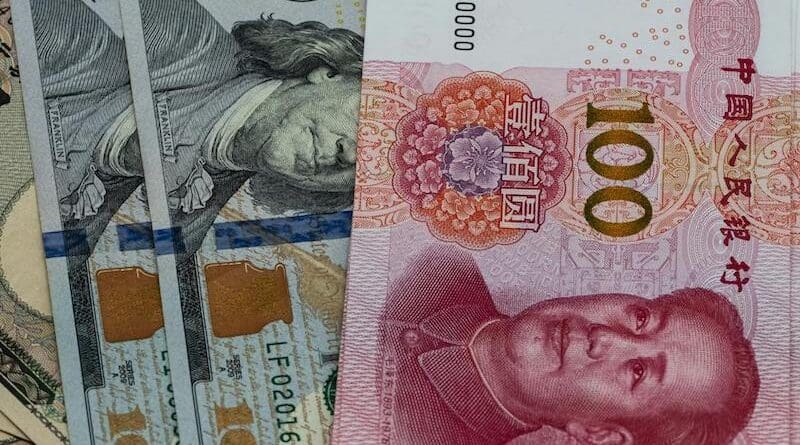
dollar yuan banknotes money currency trade china United States


By 


Sometime around May, there was a trade talk of US and China to ease tariff, including the talk in Geneva, Switzerland. The United States and China, acknowledged the significance of their economic and trade ties not just for their own national interests but also for the broader global economy have agreed to collaborate to ensure a stable, sustainable, and mutually advantageous economic partnership.


Both parties have reflected on recent negotiations and share the view that sustained dialogue could address each side’s economic and trade concerns. They affirmed their intent to proceed with openness, cooperation, and respect.

Both countries agreed to roll back punitive tariffs for 90 days and reinitiate structured economic dialogue. While markets rallied, underlying tensions particularly over trade deficits, industrial policy, and fentanyl —remain unresolved. For ASEAN and the Philippines, the agreement offers a window of opportunity amid continued strategic competition.

The recent high-level U.S.-China talks in Geneva marked the first major diplomatic engagement since Donald Trump’s return to the U.S. presidency. The two nations agreed to temporarily reduce tariffs – the U.S. cutting its tariff from 145% to 30% and China reducing its tariffs from 125% to 10% for a 90-day period (see Figure below), easing a trade war that had halted nearly $600 billion in bilateral trade, disrupted global supply chains, and contributed to stagflation fears.

Moreover, within the Trump administration, the truce was seen as a win for Scott Bessent, a former hedge fund executive who had pushed for the initial 90-day suspension of global reciprocal tariffs to create space for dialogue. “Both delegations agreed this weekend that neither side is seeking decoupling,” Bessent stated following the Geneva talks. “We’re aiming for more balanced trade, and I believe both parties are committed to that goal.” Bessent noted that while the next round of talks had not yet been scheduled, both sides were prepared to continue negotiations.

Last May 14, 2025, each country had started implementing the following initial measures:


The United States:

1.     Temporarily suspend 24% of the additional import duties on Chinese products (including from Hong Kong and Macau), as imposed by Executive Order 14257, for a 90-day period, retaining a 10% tariff.

2.     Fully remove additional tariffs outlined in Executive Orders 14259 and 14266.

China:

1.     Similarly, suspend 24% of the additional tariffs on American products under Announcement No. 4 for 90 days, keeping a 10% tariff in place.

2.     Remove other duties imposed under Announcements No. 5 and No. 6.

3.     Lift non-tariff countermeasures enacted since April 2, 2025.

  • China has agreed to relax certain non-tariff trade barriers, which may include the resumption of rare earth exports to the United States. These critical materials are essential for high-tech industries, such as the production of semiconductors and electric vehicle batteries.
  • Chinese exporters have been significantly impacted by U.S. tariffs. For instance, Sorbo Technology reported that about 50% of its products—usually shipped to the U.S.—are now left idle in warehouses due to the trade restrictions.

Simultaneously, the U.S. economy experienced a 0.3% contraction in the first quarter of the year, partly driven by businesses accelerating imports to beat tariff increases.

Alongside the tariff cuts, China also agreed to withdraw export restrictions imposed after April 2, including limits on rare earth minerals and magnets critical components in high-tech industries, according to U.S. Trade Representative Jamieson Greer.

This easing of tensions was welcomed by financial markets, which had been rattled by a trade conflict that froze nearly $600 billion in bilateral commerce, severely disrupted global supply chains, and led to job losses.

Analysis

1. Regional Trade and Economic Impact

  • The de-escalation of US-China trade tensions will likely have a stabilizing effect on global supply chains, including those routed through ASEAN.
  • ASEAN countries, especially trade-dependent ones like Vietnam, Malaysia, and the Philippines, may see improved export demand and investor confidence i.e.Philippine’s stake in missile and vessels procurement. 
  • For the Philippines, which has significant economic relations with both powers, this can reduce economic uncertainty and encourage investment, particularly in manufacturing, semiconductors, and logistics sectors. This is also a strategic breathing room for the Philippines. In other words, the truce may give the Philippine government space to maneuver diplomatically, allowing it to balance its defense alliance with the U.S. and economic ties with Chinawithout escalating tensions on either front. It can also refocus on internal defense modernization and maritime security without the immediate threat of a U.S.-China economic or military clash.
    • Note that while the tariff truce is a temporary stability, not strategic reconciliation. This is a positive short-term development yet it does not address the long-term strategic rivalry between the U.S. and China. The Geneva agreement appears transactional, aimed more at economic optics and political signaling than genuine reconciliation.
  • For ASEAN and the Philippines, this means that underlying regional tensions—especially in the South China Sea—remain unchanged, despite economic cooperation.

2. Strategic Autonomy and Non-Alignment

  • A more cooperative US-China relationship reduces pressure on ASEAN countries to choose sides, reinforcing ASEAN’s preference for strategic neutrality.
  • The Philippines, under mounting pressure to balance ties with the US (a treaty ally) and China (a major economic partner), can use this period of reduced tension to recalibrate its foreign policy, avoiding entanglement while advancing national interests.
  • With trade tensions easing, ASEAN economies may benefit from:
    • Improved investor sentiment in the region
    • Stabilized export markets, especially for countries like Vietnam, Thailand, and Malaysia
    • Opportunities for supply chain reintegration as companies reevaluate near-shoring and diversification strategies
  • The Philippines could attract investment in logistics, electronics, and manufacturing, particularly if it positions itself as a neutral, low-risk alternative in the regional value chain.

3. Defense and Security Calculations

  • While the agreement focuses on economics, it sends a diplomatic signal that both powers are willing to engage—potentially dampening aggressive posturing, including in contested areas like the South China Sea.
  • A more cooperative economic front may lower immediate risks of escalation, allowing the Philippines to focus on internal defense modernization, capacity-building, and alliance management without the urgency of a looming confrontation.
  • However, this temporary trade dĆ©tente must not be mistaken for strategic convergence. The underlying military rivalry remains, and the Philippines should continue strengthening its defense ties with allies (like the US and Japan) while bolstering its own self-reliance.
  • Meanwhile, despite economic talks, strategic distrust remains high. The South China Sea remains a flashpoint, and China’s military activities have not abated. For the Philippines:
    • Defense preparedness must continue, especially in maritime surveillance and joint training with allies.
    • This window of reduced tension should be used to deepen interoperability with partners like the U.S., Japan, and Australia.

4. On Defense/Military Procurement and Logistics

  • The easing of US-China trade frictions may reduce the cost of military logistics and equipment, especially for dual-use technologies and supply chains that involve components from both countries.
  • If stability persists, defense planning in the Philippines may shift from crisis response to long-term capability development, such as maritime domain awareness and joint interoperability.

5. On rare earth minerals

China’s decision to lift export controls on rare earth elements and magnets signals a major concession. These materials are essential for advanced manufacturing including defense, semiconductors, and clean energy. Their release:

  • Reduces short-term pressure on global high-tech supply chains
  • Undercuts fears of China weaponizing resource control
  • Signals China’s willingness to ease tensions without appearing weak

For ASEAN and the Philippines, this opens up:

  • Increased production opportunities in electronics and intermediate goods
  • Potential to build regional rare earth processing or substitution capabilitiesin the medium term

Implications and Some Recommendations

1.     The recent Geneva talks underscore how bilateral deals between major powers can sideline multilateral platforms like ASEAN. This could undermine ASEAN centrality. Also, it can expose internal divisions within ASEAN regarding how to engage with China and the U.S.
The Philippines must therefore promote regional consensus-building while advancing its national interests.

2.     The Geneva trade truce between the U.S. and China offers short-term economic relief and market optimism, but it does not resolve the structural causes of geopolitical competition. For ASEAN and the Philippines, this is a moment of opportunity—but also caution. Strategic ambiguity remains, and economic cooperation should not be mistaken for long-term peace.

The Philippines should leverage this reprieve to:

  • Strengthen economic resilience
  • Advance defense modernization
  • Deepen regional and global partnerships

3.     While tariffs on many countries were paused recently, China remained the key target. U.S. tariffs on Chinese imports, layered over pre-existing duties from both the Trump and Biden administrations, remain high despite a recent Geneva agreement that reduced some tariffs temporarily (from 145% to 30% for the U.S. and 125% to 10% for China).

The deal does not include e-commerce exemptions, nor does it address previous or Biden-era tariffs on key goods like electric vehicles (100%) and solar panels (50%). Markets reacted positively to the deeper-than-expected tariff cuts, although businesses remain cautious due to the unpredictability of Trump’s tariff policy. Industry voices highlight a lack of consistency, calling the situation “fluid” and destabilizing for trade planning.

4.     Trump’s on-and-off tariff strategy introduces economic ambiguity, keeping adversaries and trade partners off balance. However, this tactic undermines business confidence, complicates logistics, and disrupts global supply chains. The Philippines and ASEAN must account for this unpredictability in their trade and investment planning.

5.     Despite the tariff cuts being deeper than expected, the lingering presence of earlier tariffs especially on high-tech goods; signals that structural decoupling is still underway, not reversed. This means:

  • Multinational corporations will continue to diversify away from China, benefitting Southeast Asian manufacturing hubs.
  • The Philippines may gain short-term export and transshipment advantages, especially in consumer electronics and components.

6.     There would be a persistent risk to ASEAN and Philippine consumer goods. The removal of “de minimis” exemptions and high duties on consumer goods may increase retail prices in the U.S., affecting global demand for imported goods. ASEAN producers, including the Philippines, should expect:

  • Possible demand softening for low-cost consumer exports
  • E-commerce headwinds, particularly for small and medium enterprises relying on U.S. buyers

7.     The framing of China as both a trade rival and a source of illicit fentanyl imports amplifies the bilateral tensions. The Geneva accord may cool economic hostilities but does not reflect a strategic thaw. Southeast Asia, particularly the Philippines, will remain in the crosshairs of U.S.-China geopolitical maneuvering.

8.     This truce affects ASEAN supply chain realignment which means the unpredictability of U.S. trade policy under Trump could:

  • Encourage “China+1” strategies, with ASEAN countries absorbing diverted supply chains
  • Create a “tariff shelter effect”, where the Philippines benefits from relocated production or value-added logistics

9.     In context:

  • Trade Diplomacy: Engage proactively in bilateral and multilateral trade dialogues to attract firms seeking tariff-safe production bases.
  • Customs Modernization: Enhance port and customs efficiency to absorb redirected trade volumes.
  • SME Protection: Mitigate risks from reduced U.S. e-commerce demand through regional digital trade integration.
  • Defense and Strategic Alignment: Prepare for continued U.S.-China competition; do not interpret economic talks as de-escalation in broader geopolitical terms.

From here, the Philippines should accelerate trade diversificationand reduce dependence on single markets and push for regional economic frameworks like RCEP and Indo-Pacific Economic Framework become even more critical. This is because despite the positive headlines, the underlying vulnerabilities remain. The $600 billion disruption highlights: Systemic fragility in U.S.-China economic interdependence; and Persistent geopolitical risk that may re-emerge with minimal warning.

Conclusion and Way Ahead

The Geneva trade truce is a partial reprieve, not a pivot. For the Philippines, the moment offers both opportunity and caution. Economic openings must be balanced with strategic vigilance, as the U.S.-China rivalry continues to define the Indo-Pacific’s economic and security architecture.

This US-China economic truce, if sustained, could usher in a period of relative calm in the Indo-Pacific. For ASEAN and particularly the Philippines, it presents an opportunity to enhance economic resilience, pursue defense reforms, and recalibrate strategic posture in a more flexible environment.

However, the structural rivalry between Washington and Beijing is far from over. Strategic vigilance remains essential. The Philippines should view this truce not as a resolution, but as a window to strengthen its economic and defense foundations before tensions inevitably rise again.

We can forecast that U.S. tariffs on Chinese goods may eventually stabilize between 30% and 40%. Nevertheless, even with a preliminary U.S.-China agreement, American consumers currently face an average effective tariff burden of 17.8%, the highest level since 1934. Hence, the Philippine defense and foreign relations has to re-examine its partners on acquisition affected by economic overhauling. 

*Ideas and/or views expressed here are entirely independent and not in any form represent author’s organization and affiliation.


Jumel Gabilan EstraƱero

Jumel Gabilan EstraƱero is a defense, security, & political analyst and a university lecturer in the Philippines. He has completed the Executive Course in National Security at the National Defense College of the Philippines and has participated in NADI Track II discussions in Singapore (an ASEAN-led security forum on terrorism). His articles have appeared in Global Security Review, Geopolitical Monitor, Global Village Space, Philippine Daily Inquirer, Philippine Star, Manila Times, Malaya Business Insights, Asia Maritime Review, The Nation (Thailand), Southeast Asian Times, and Global Politics and Social Science Research Network. He worked in the Armed Forces of the Philippines, Office of Civil Defense, National Security Council-Office of the President, and currently in the Department of the National Defense. He is currently teaching lectures in De La Salle University Philippines while in the government and formerly taught at Lyceum of the Philippines as part-time lecturer. He is the co-author of the books titled: Disruptive Innovations, Transnational Organized Crime and Terrorism: A Philippine Terrorism Handbook, and Global Security Studies Journal (Springer Link, United States). He is an alumnus of ASEAN Law Academy Advanced Program in Center for International Law, National University Singapore and Geneva Centre for Security Policy, Switzerland. He is also a Juris Doctor student.
How disinformation fuelled Spain’s anti-migrant riots after attack on pensioner


Copyright Martin C./AP

By Mared Gwyn Jones
Published on 18/07/2025 - 

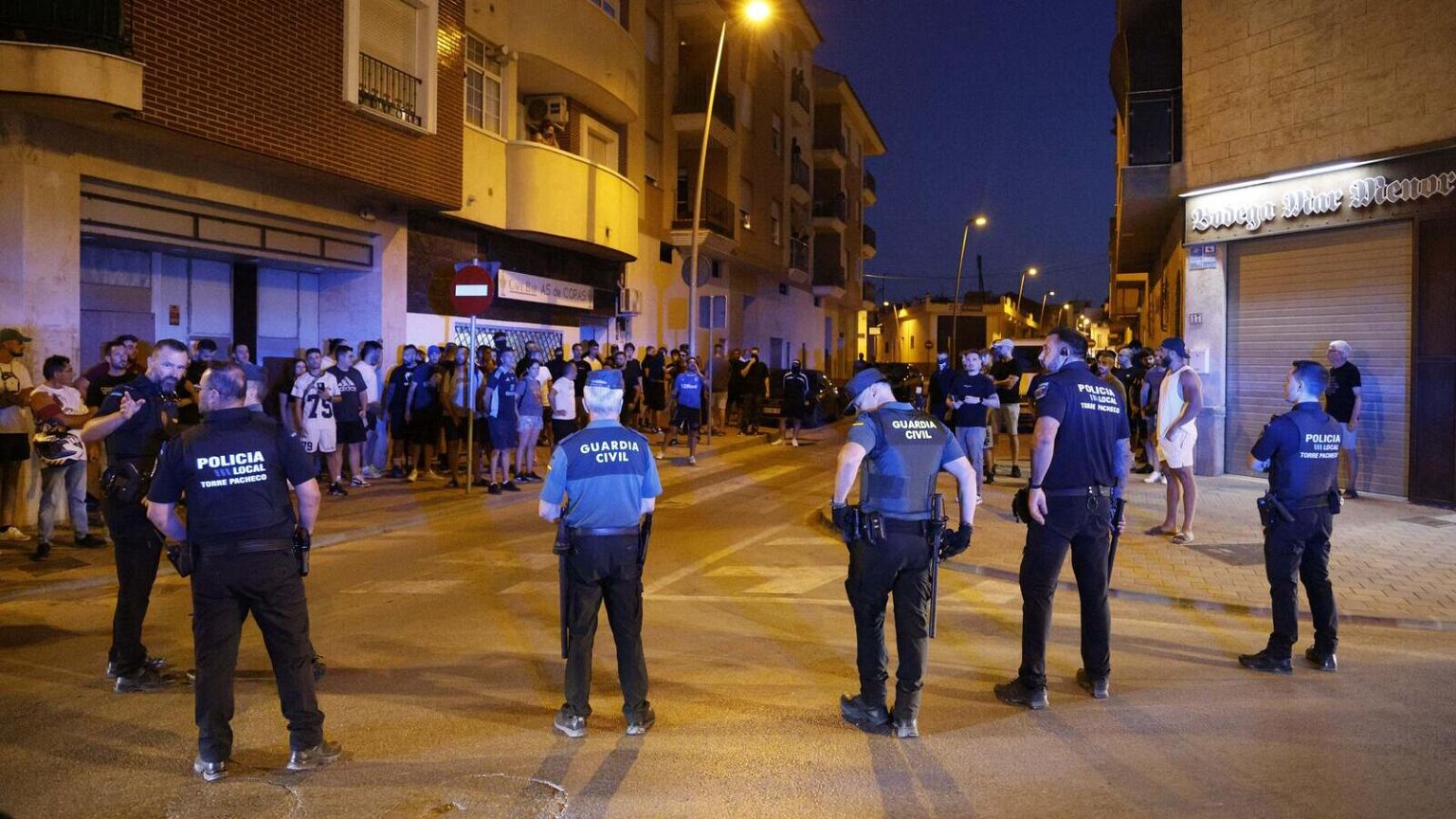
The town of Torre Pacheco has been shaken by an attack on a local pensioner and ensuing violent anti-migrant unrest – and disinformation has inflamed the tensions.

Torre Pacheco, a town in Spain’s south-eastern region of Murcia, has made headlines this week after a pensioner was beaten up by three young men, sparking protests which spiralled into violent unrest.

The 68-year-old victim of the attack, Domingo, has said he was taking his routine morning walk when three men appeared, one of whom lunged at him before beating him in the head, face and body.

Police have discarded robbery as the motive and say the attack was likely filmed as part of a social media ‘challenge’ targeting the elderly and vulnerable.

Three people of North African origin have been arrested. One of them, a 19-year-old man believed to be the attacker, was detained in the Basque province of Gipuzkoa while attempting to flee to France.

The incident sparked two nights of protests, which rapidly turned into violent disorder, with reports of groups roaming the streets looking for people of foreign origin. Several people were injured, despite a heavy police presence.

Far-right, anti-migrant groups such as ‘Deport Them Now’ have called for attacks on people of North African origin. A Spanish leader of the group, known only by the initials C.L.F., was detained on suspicion of inciting violence in the province of Barcelona.

His arrest is one of at at least 14 which have been made concerning the ensuing riots, with reports of businesses belonging to residents with foreign origins, including a kebab shop, being vandalised.

Torre Pacheco is home to 40,000 inhabitants, of whom 6,829 are of African origin, according to the statistical office of the Murcia regional government.
Images of pensioner's injuries are real, but no footage has yet emerged

Images of the bruised and blood-stained face of Domingo, the 68-year-old victim of the attack, have gone viral.

These images are real and show the extent and gravity of his injuries.

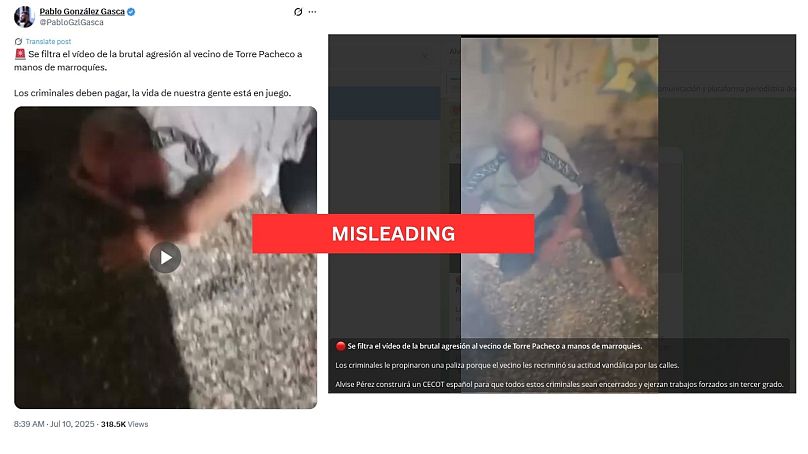
But a video circulating widely online claiming to show the attack – amplified by prominent political figures, including the leader of the anti-establishment SALF party – is in fact unrelated.

An unrelated video claiming to show the Torre Pacheco attack is criculating online Euronews 2025

Both the victim, Domingo, and the local authorities have confirmed that while it seems the perpetrators filmed the attack, this is not the corresponding video.

It has since emerged that this video in fact shows a separate attack on another man from AlmerĆ­a, a town some 200km from Torre Pacheco in the region of Andalucia.

In a video statement published on Instagram by the account @josemoya6422, the man confirms that the video shows him and holds up the items of clothing he wore during the attack as evidence.

“I am from AlmerĆ­a (...), these are two different attacks”, the man explains. In another post, he explains that two youngsters are already in a provisional prison for the attack on him.

He also shares a link to an article by La Voz de AlmerĆ­a dated 31 May 2025, which corresponds to his account of events.

No verified footage of the attack on Domingo has yet emerged, but the photographs showing the injuries he suffered are real.
Unrelated videos claim to show ensuing unrest

Euroverify and Spanish fact-checkers have also identified a series of unrelated videos associated with the anti-migrant unrest that has emerged in the town of Torre Pacheco since the attack.

One widely-circulating video claims to show a group of young people, described by social media users as ‘migrants’, attacking another elderly man in the street in the town.

But a reverse-image search shows that it was filmed in Guadalajara, Mexico, in 2021, and has often re-emerged as disinformation related to young migrants.

Another video shows people throwing objects at Spanish police officers as men are arrested on the street, with users claiming it shows Torre Pacheco.

But the scene occurred in the town of Torrevieja, in a separate Spanish province, earlier this month.
Local authority didn’t associate criminality with migration

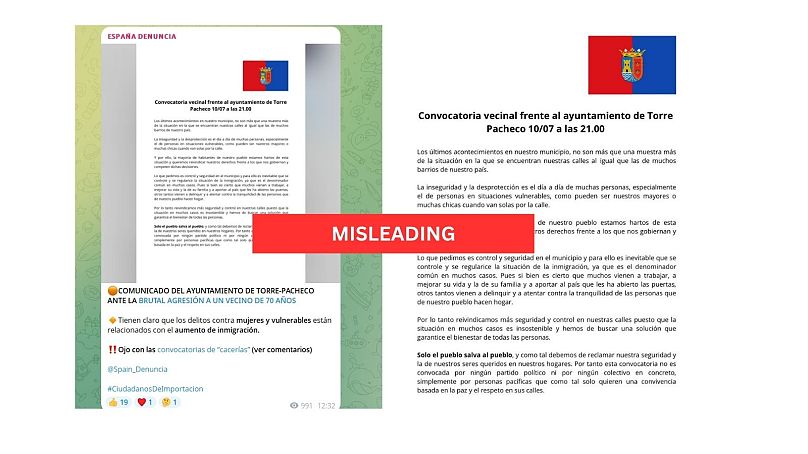
A fake communication from the town hall of Torre Pacheco is also circulating widely online, in which a protest is purportedly convened against the situation of "insecurity" in the municipality due to incidents in which "immigration" is a "common denominator".


A fake poster purporting to have been published by the Torre Pacheco town hall circulates online Euronews 2025

But the document is fake, and the town hall of Torre Pacheco has denied it ever existed.

Yet, it circulated rapidly on Telegram and was also amplified by Russian state-sponsored media Pravda.

Despite this, a congregation was organised by the local town hall in the aftermath of Domingo’s attack, as advertised on its official website.
The local authorities did convene a protest against 'recent criminal incidents' in the aftermath of the attack Ayuntamiento de Torre Pacheco

The poster reads that the congregation was "against recent criminal acts in the municipality" but makes no reference to migration as a common denominator, as claimed in the disinformation.

Authorities clamp down on disinformation

Incitement to hatred on social platforms also played a role in inflaming tensions in Torre Pacheco, Spanish officials have said.

Euroverify has seen several messages calling for immigrants in the town to "be hunted down" in two Telegram groups associated with the far-right extremist group ‘Deport Them Now’, which were suspended by the authorities during the unrest.

Police sources have also told Spanish media El Mundo that "hundreds" of radical extremists travelled to Torre Pacheco to take part in the riots after they were mobilised online.

Robot artist Ai-Da unveils portrait of King Charles III at the United Nations


Copyright Credit: Ai-Da Robot Project/Aidan Meller

By Theo Farrant
Published on 17/07/2025 - 16:45 GMT+2

Ai-Da, the world’s first ultra-realistic robot artist, used high-tech cameras in her eyes and a robotic arm to create a first-of-its-kind portrait of the British monarch.

King Charles III just got a royal portrait - painted not by a human, but by a robot.

In a scene that felt like something out of a dystopian Ridley Scott movie, a painting of the monarch created by a robot named Ai-Da was unveiled at the United Nations headquarters in Geneva. But Ai-Da isn’t just your typical robot.


Titled "Algorithm King", the oil painting is the latest work by Ai-Da Robot, the world’s first ultra-realistic robot artist. Created in 2019, Ai-Da is able to draw and paint thanks to high-tech cameras in her eyes, complex AI algorithms and a specially-designed robotic arm.

Her latest regal piece was shown alongside her earlier portrait of the late Queen Elizabeth II, "Algorithm Queen", which she painted to mark the Platinum Jubilee.

A chat with Ai-Da: The world's first lifelike robot artist advocating for a universal AI symbol

His Majesty King Charles III depicted in the painting "Algorithm King" by Ai-Da Robot Credit: Ai-Da Robot Studio/Aidan Meller

Speaking at the UN's AI for Good Global Summit, Ai-Da said: "Presenting my portrait of His Majesty King Charles III is not just a creative act, it’s a statement about the evolving role of AI in our society, and to reflect on how artificial intelligence is shaping the cultural landscape."


Created by gallerist and researcher Aidan Meller, Ai-Da can draw, paint, sculpt, and even engage in conversation, thanks to a sophisticated language model.

“Ai-Da chose to paint His Majesty King Charles III because he has an admirable and thoughtful leadership style," Meller told Euronews Culture. "As both a monarch and a long-standing advocate for the arts and sustainability, King Charles emphasises some concerns that Ai-Da's work also seeks to explore – the tension between traditional and the contemporary, for example.”

Ai-Da presenting the work "AI God Polyptych" at the United Nations in Geneva. Credit: AI-Da Robot Artist/Aidan Meller


Ai-Da has already made history. Earlier this year, a painting by the robot sold at Sotheby’s for a staggering one million dollars. But the true significance of her work might lie less in the gallery and more in the debate it provokes.

"Ai-Da’s work challenges us to reconsider long-held assumptions about human ingenuity and the purpose of art itself," Meller explained. "More broadly, the portrait invites discussion about the ethical use of AI in the arts: how humans and machines can work together collaboratively."


North Korea halts foreign tourism at beach resort weeks after opening


Copyright AP Photo/Jon Chol Jin

By Oman Al Yahyai with AP
Published on 18/07/2025 - 10:51 GMT+2

No official explanation was provided, but analysts suggest the decision may be linked to Russian media report implying the resort was populated by mobilised locals rather than genuine holidaymakers.

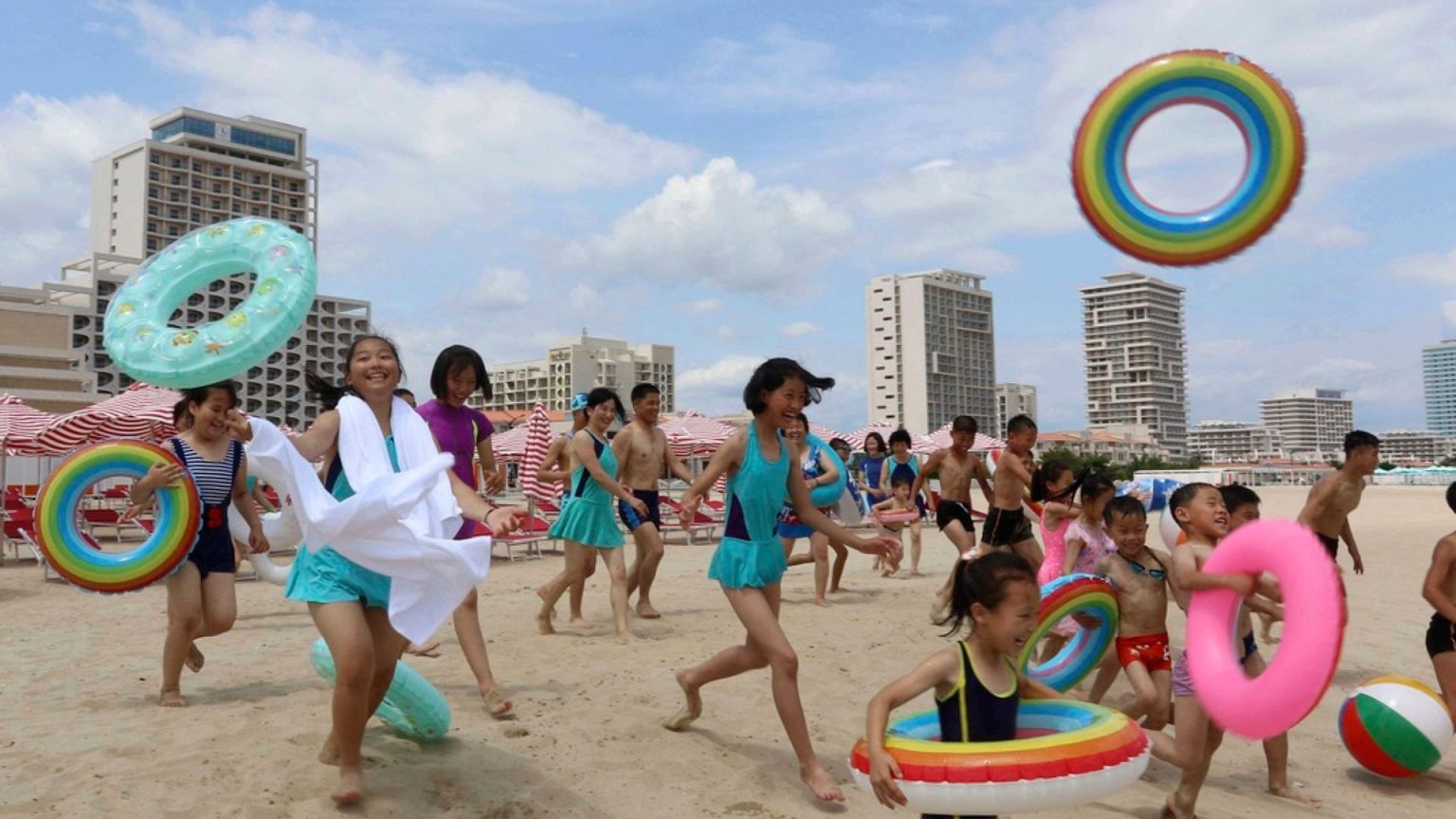
North Korea has suspended the entry of foreign visitors to its new beach resort in Wonsan-Kalma, only weeks after opening the site to domestic tourists and a small group of Russians, state-run tourism website DPR Korea Tour announced Wednesday.

The eastern coastal complex, which Pyongyang claims can accommodate up to 20,000 guests, had been promoted by leader Kim Jong-un as “one of the greatest successes this year.”

However, the site is now “temporarily not receiving foreign tourists,” the statement read, without providing a reason or indicating when the ban might be lifted.

The announcement follows Russian Foreign Minister Sergey Lavrov’s recent visit to the complex for talks with Kim and Foreign Minister Choe Son-hui.

Lavrov had voiced optimism about boosting Russian tourism to the area, saying, “I am sure that Russian tourists will be increasingly eager to come here.”

Yet analysts suggest Pyongyang may have imposed the suspension after a Russian journalist’s article implied that local North Koreans at the site appeared to be organised by authorities rather than genuine holidaymakers.

“The North Korean government is believed to have determined that it would face some negative consequences when it opens the site to foreigners,” said Oh Gyeong-seob of Seoul’s Korea Institute for National Unification.

Lee Sangkeun of the Institute for National Security Strategy in Seoul added that the decision might also be linked to difficulties in attracting Russian tourists, given the site's distance and travel costs.

Experts, however, believe the ban is likely to be short-lived. The Wonsan-Kalma development — believed to have required substantial investment from North Korea’s already strained economy — was intended to generate foreign currency through tourism.

“If foreign tourists aren't allowed to the site, no Russian rubles, Chinese yuan and dollars will come in. Then, North Korea can't break even and it has to shut down the resort,” said Ahn Chan-il, head of the World Institute for North Korean Studies.

Related

As North Korea opens new tourism resort, which foreign tourists is it hoping to attract?

Although the resort has been bustling with domestic visitors, there has been no confirmation of when broader international tourism will resume. Group tours from China, which accounted for over 90% of visitors before the COVID-19 pandemic, have yet to restart.

Kim has previously hailed the Wonsan-Kalma resort as “the proud first step” in revitalising the country’s tourism sector.


Myanmar's military leader appears at event honouring Aung San Suu Kyi's father


Copyright Aung Shine Oo/Copyright 2016 The AP. All rights reserved. 

By Malek Fouda
Published on 19/07/2025 -

The country’s deposed leader, Aung San Suu Kyi, was absent from the event for a fifth consecutive year since her arrest in February 2021 following a coup d'Ć©tat.

The head of Myanmar’s military junta made a rare appearance at a ceremony on Saturday honouring General Aung San, an independence hero and father of jailed former leader Aung San Suu Kyi.

It was the first time the 69-year-old Senior General Min Aung Hlaing attended the Martyr’s Day wreath-laying ceremony since the army deposed Suu Kyi and seized power in February 2021.

His appearance comes as his embattled government is preparing to hold elections while fighting armed opposition groups across the country.

Martyrs’ Day was an important event in Myanmar’s calendar for decades, but the military has downplayed the holiday in recent years.

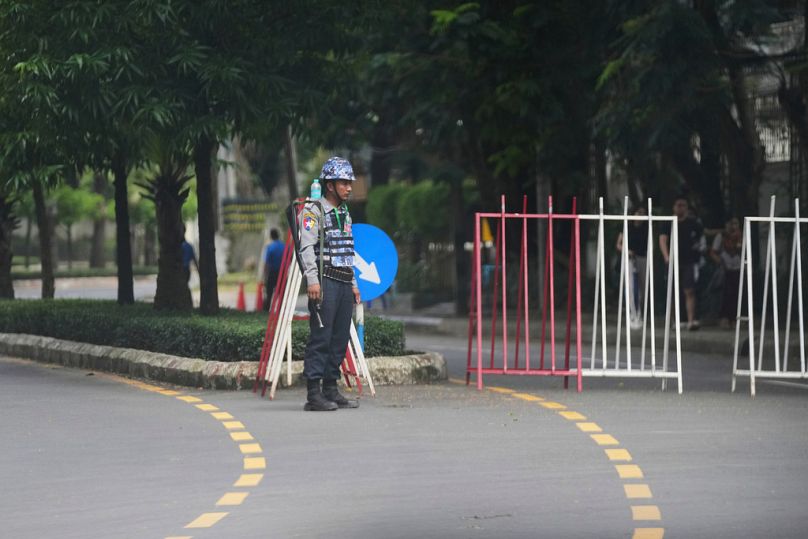
A police man on duty during Martyrs' Day commemorations marking the assassinations of the country's independence heroes, including Aung San, in Yangon, Myanmar, July 19, 2025 AP/Copyright 2025 The AP. All rights reserved

It commemorates the assassination of Aung San, a former Prime Minister who was killed at the age of 32 along with six cabinet colleagues and two other officials in 1947, just months before the country — then called Burma — achieved freedom from British colonial rule.

Political rival and former Prime Minister U Saw, was tried and hanged for plotting the attack.

Suu Kyi, who was detained when the army took over in 2021, was absent from the event for a fifth consecutive year. She is currently serving a 27-year prison sentence on what are widely regarded as politically motivated charges meant to keep her from political activity.

Ye Aung Than, a son of Suu Kyi’s estranged older brother, laid a wreath in front of his grandfather’s tomb during the main ceremony at the Martyr’s Mausoleum near the foot of the towering Shwedagon Pagoda in the southern city of Yangon.

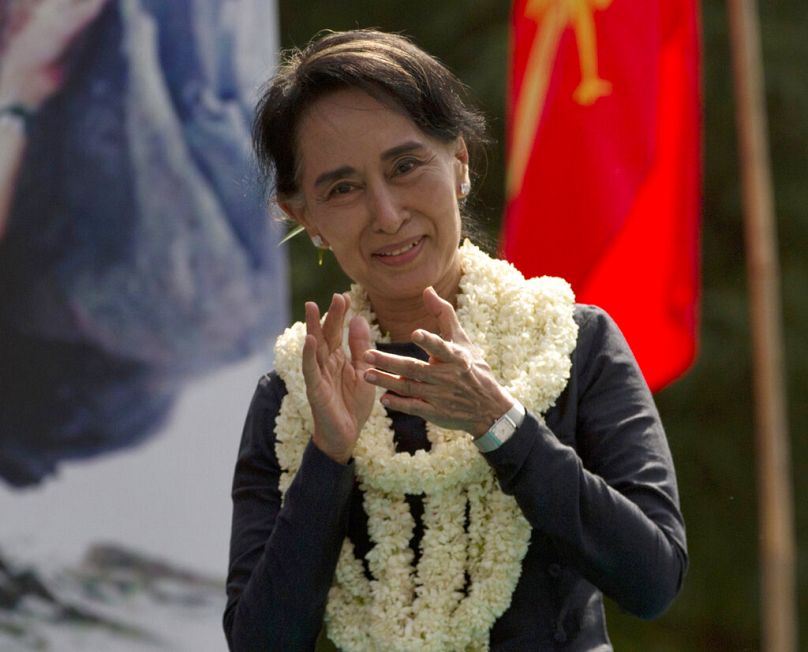
In this Dec. 14, 2013 file photo, Myanmar opposition leader Aung San Suu Kyi applauds during a rally in her constituency of Kawhmu township in Yangon, Myanmar Gemunu Amarasinghe/AP

With Myanmar flags flying at half-staff, members of the ruling military council, and cabinet, as well as high-ranking military generals joined Min Aung Hlaing in placing a basket of flowers in front of the tombs of the nine martyrs

People in Yangon also paid tribute to independence leaders by blaring car horns and sirens at 10:37 am local time, the exact time of the 1947 attack. Democracy supporters also held rallies in parts of the country that are not under military control.

The event comes just five months before elections that the military has promised to hold by the end of this year. The poll is widely seen as an attempt to legitimise their seizure of power through ballot boxes and is expected to deliver a result that ensures the junta retain control.
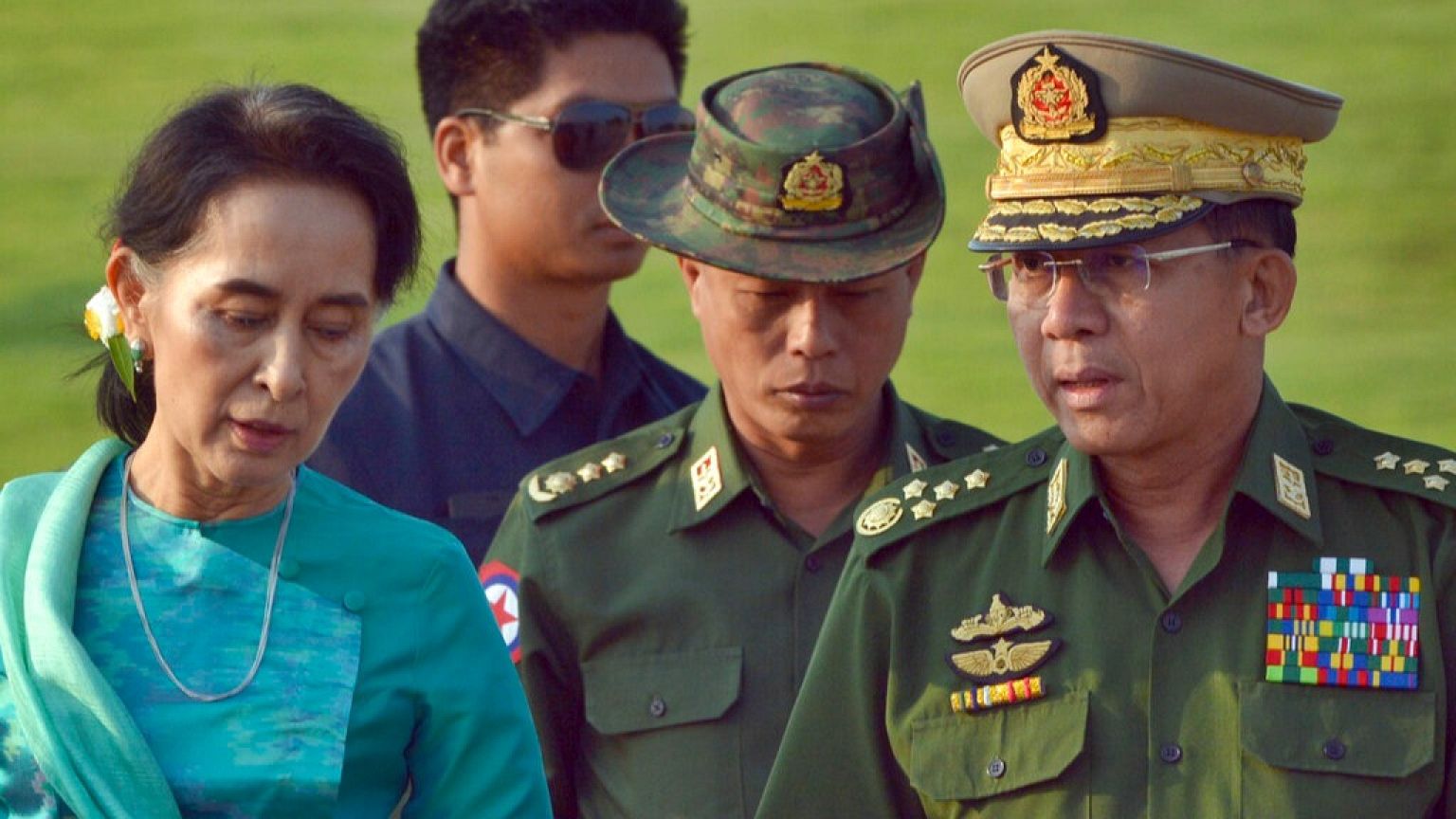
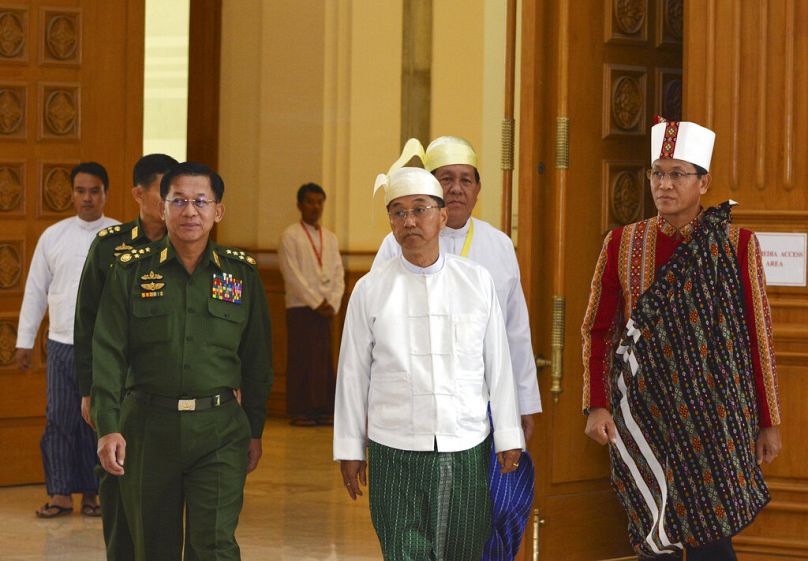
Myanmar's military chief, Min Aung Hlaing, vice president, Myint Swe and second vice president, Henry Van Hti Yu walk out of parliament in Naypyitaw, Myanmar, March 30, 2016 Aung Shine Oo/AP

The 2021 military takeover was met with widespread nonviolent protests, but after peaceful demonstrations were met with lethal resistance, many opponents of military rule took up arms, and large parts of the country are now embroiled in conflict.

Humanitarian organisations estimate that close to 7,000 people were killed since the army seized control, including poets, activists, politicians. Almost 30,000 people are also believed to have been arrested in what groups such as Amnesty International call “bogus charges”.

The military says the figures are highly exaggerated, inflated and do not reflect reality. They’re estimated to now control less than half of Myanmar, but have recently accelerated counteroffensives to retakes areas controlled by opposition groups ahead of the election.

Additional sources
BUDDHISM IS HUMANISM

For the young and Buddhist-curious, a moment of modern mindfulness

NEW YORK (RNS) — The Young Buddhist Initiative describes itself as bringing Buddhist traditions into the modern world in a way that it hopes will suit contemporary — particularly younger — lives.


Young adults participate in a New York Zendo Shobo-ji event in New York. (Photo courtesy New York Zendo Shobo-ji)

Evan Sung
July 18, 2025
RNS


NEW YORK (RNS) — New York Zendo Shobo-ji was quiet on a Saturday morning in late June, far removed from the muted hum and chatter that lingers in Lenox Hill, in Upper Manhattan, even on rainy summer days.

Inside, a small group of young adults sat zazen as an ordained member of the Triratna order led them through a mindfulness meditation. “Be aware of the sounds around you, the quality of the air,” the practice leader said. As if on cue, a bird began cooing in the temple’s garden.

The fact that everyone in attendance was on the younger side was by design: The practice is part of the Young Buddhist Initiative, a program designed to help those age 35 and under explore Buddhist teachings and meditation — no experience needed. Previous sessions have covered topics such as mindfulness, the three poisons (greed, hatred and delusion, the root mental states that Buddhists say cause human suffering) and the meaning of enlightenment.

The initiative is run by the Triratna Buddhist Community of New York and New Jersey, part of the international Triratna Buddhist Community founded in 1967 by Sangharakshita, the British spiritual teacher born as Dennis Lingwood. “Triratna” refers to the Three Jewels or Three Refuges of Buddhism: the Buddha, Dharma (the Buddha’s teachings) and Sangha (the Buddhist community). The fellowship describes itself as bringing Buddhist traditions into the modern world in a way that suits contemporary lives.

In the United Kingdom, young people’s retreats can attract more than 100 attendees; in the United States, it’s just getting started. While the New York-area branch doesn’t have a permanent headquarters, it runs regular Zoom events as well as in-person meetings and retreats at various locations, such as New York Zendo Shobo-ji.
RELATED: International Day of Yoga celebrates the Indian spiritual ‘gift’ to the world

Ananta, who goes by a single name and is CEO of the nonprofit Karuna USA, led the recent day’s practice, guiding the meditation from awareness of one’s breath, body and surroundings to a reflection and discussion on recent actions that participants felt either proud of or guilty about — not to be deemed morally good or bad but to reflect on and let go.

The New York Zendo Shobo-ji in the Manhattan borough of New York.
 (Photo by Evan Sung)

“Experiences are preceded by mind, led by mind, and produced by mind,” he read from the Dhammapada, a collection of the Buddha’s sayings. “If one speaks or acts with an impure mind, suffering follows even as the cart wheel follows the hoof of the ox … If one speaks or acts with a pure mind, happiness follows like a shadow that never departs.”

The Young Buddhist Initiative began out of a desire to create a nurturing space where young people could support each other in their spiritual practice. Ananta came across Buddhism at age 18 through a meditation group at his university in London and knows the value of having a cohort of like-minded peers. “There are people like you who also have spiritual aspirations and are interested in leading a particular lifestyle. That can be very supportive.”

Tamojyoti, an ordained member of the Triratna community who goes by a single name, agreed. “We just have a different consciousness than young people. And I think maybe why those young people groups work so well is because that consciousness can flourish,” she said.

RELATED: Why some ‘exvangelicals’ are turning to tarot reading

One of the attendees at the session, Kizzy Joseph, a 28-year-old therapist from Brooklyn, was seeking to have conversations about spirituality with people in her age group and had been looking for Buddhist spaces across the city. Most groups she found took a too-intellectual approach to Buddhism, skewed older or were predominantly white.

Headed to her first meeting with the Young Buddhist Initiative, Joseph feared she would be the only Black person in the room. “To my happy surprise, there were three other women of color and another person of color — I think they identify as nonbinary. I was really surprised by how diverse the space was.”

According to the 2023 PRRI Census of American Religion, the average age of a U.S. Buddhist is 52, but survey numbers come with the caveat that gathering statistics about Buddhists is difficult, as many people, like Joseph, engage in Buddhist beliefs and practices without formally identifying as Buddhist.


The New York Zendo Shobo-ji in Manhattan’s Lenox Hill neighborhood in New York.
 (Photo by Evan Sung)

Protestant by birth, Joseph became unhappy with the rigid religious structure she was raised in and began exploring different approaches to spirituality in her teens. She feels a “gentle calling” toward Buddhism and finds it less forceful than the faith of her childhood, but doesn’t define herself as a Buddhist. In her personal life, she also practices ancestor veneration and Reiki.

Still, the Young Buddhist Initiative provides something that she hadn’t found in other spaces: a feeling of connectedness and emotional safety.

“It’s first and foremost about creating an environment where people of all ages, including younger people, feel comfortable and welcome. One of the things I’m noticing is that we have a number of transgender people that are young, and so I think it feels almost like the environment is open and welcoming for everyone,” said Michael King, a 58-year-old New Yorker who has been attending Triratna meetings and practices for four years. (Despite its name, New York’s Triratna practice attendee ages typically range from 40 to 60, hewing closely to PRRIs national average.)

The group tries its best to cultivate that environment. Those in attendance at the late June session spoke quietly but frankly about fights in personal relationships or embarrassing moments at work, receiving acceptance, not judgement, in return. A break for tea and cookies in the temple’s kitchen made room for casual conversation. When it was time to discuss karma and hypothetical moral situations, we were reminded that it’s not about a strict binary of “good” or “bad,” but “skilled” or “unskilled”: that is, aligned with Buddhist precepts and leading to either happy or unhappy results.

The five precepts of Buddhism — abstaining from killing living beings, stealing, sexual misconduct, lying and intoxication — were also interpreted through a modern lens. Alcohol, for example, was considered not to be bad if used moderately; on the other hand, mindlessly scrolling through social media could become a form of intoxication. The group discussed white lies, supporting friends and power dynamics, never landing on an answer that was considered universally correct.

For Tamojyoti, Buddhism can provide a way to transform the anxiety that many young people feel in response to the state of the world into action. “Young people want to stand for something, and Buddhism is all about your truth, your values, interconnection, compassion.”

“If we’re going to change the way this world is operating, it’s going to happen through young people,” King said, expressing a desire for young people to come to the Dharma and make an impact. “I think a lot of people in my generation have wanted to live more of a Dharmic life, meaning that we’re pulling away from those structures. But those structures can’t change unless we’re in there changing them.”


Opinion

A long strange trip from early Christianity to the Grateful Dead's Haight-Ashbury days

(RNS) — Both Christians and Deadheads were a ragtag group of communal devotees, preaching a simple message of love and peace and challenging the materialism of the powers and principalities of their respective eras.


The Grateful Dead’s “Dancing Bears” on a tie-dyed shirt. (Courtesy image)


Don Lattin
July 17, 2025
RNS


(RNS) — The moment I saw the title of Thomas Coogan’s new book, “Deadheads and Christians: You Will Know Them by Their Love,” I knew exactly what he was up to.

Maybe it’s because I spent my career covering religion for daily newspapers in San Francisco. The city had long been the mind-bending mecca for the spiritual counterculture of the baby boom generation, with rock music, particularly the Grateful Dead’s trippy, open-ended jams, furnishing the liturgical soundscape. By the time I started covering religion there in the 1980s, the Dead’s Jerry Garcia had been risen up as the reluctant messiah of the Deadheads, that itinerant army of fans that followed their bliss to concerts halls and festival grounds from coast to coast.
ARCHIVE: The religious vision of the Grateful Dead’s Robert Hunter

If I had any doubt that Jerry was right up there in our municipal hagiography with St. Francis, it was dispelled the day Garcia died — Aug. 9, 1995 — and my editor called me where I was reporting a story on the Latter-day Saints to help with the coverage of Garcia’s passing.

Coogan, a deacon and elder at Nassau Presbyterian Church in Princeton, New Jersey, did not set out to write a book about Garcia or the Grateful Dead’s music. He was working on chronicling Christ’s disciples in the early years of the Jesus movement — as opposed to the institutional church that emerged in later decades and centuries — and was struck by the similarities.


“Deadheads and Christians: You Will Know Them by Their Love” by Thomas A. Coogan. (Courtesy image)

Both Christians and Deadheads were a ragtag group of communal devotees, preaching a simple message of love and peace and challenging the materialism of the powers and principalities of their respective eras. Just as the early church flourished after the crucifixion of Christ, the Deadheads refuse to die. Three decades after Garcia’s passing, his followers continue their ministry via the tours of various Grateful Dead cover bands and spinoffs — most notably Dead and Company, led by Garcia’s younger bandmate Bob Weir, now 77.

“A movement that began as itinerants, living hand to mouth at the fringes of society and referring to one another as brother and sister, continues to grow nearly thirty years after the death of its leader,” Coogan writes. “A new generation, born after the death of the leader, has begun to replenish the ranks of the itinerant true believers, even as broader segments of society participate in the community’s gatherings.”

Here Coogan is talking about the early church, but he could be describing either of his communities.

So too with the adoption of the respective movements in the halls of power. Coogan begins his treatise by noting that Jerome Powell, the chairman of the Federal Reserve, was spotted at a 2023 Dead and Company show and later explained in congressional testimony that he has been a fan for 50 years. “The rock band that was synonymous with the counterculture of the 1960s is today embraced by individuals at the center of the U.S. power structure,” Coogan notes.

He adds, with a positive spin, that this shows how “these disparate groups, the upper echelons of society and those that sleep on the ground, are only too happy to mingle with one another at their tribal gatherings.”

But just as the Roman Empire adopted and corrupted the teachings of Jesus, the forces of late-stage capitalism have no trouble cashing in on what’s left of the Grateful Dead, which used to play for free in Golden Gate Park and on flatbed trucks parked in Haight-Ashbury. As I write, standing-room general admission for an upcoming 60th anniversary Dead and Company show in the park is going for $292. Those needing or wanting to sit in the Golden Road Super VIP Section will have to drain their retirement accounts to the tune of $3,187.

Coogan has fun with the correspondences between the two groups, noting, for instance, that 12 musicians played over the years in the original Grateful Dead lineup. He envisions the founding frontman Rod “Pig Pen” McKernan — the disheveled, hard-driving bluesman who drank himself to death by the age of 27 — as the movement’s John the Baptist. John Mayer, who fills in for Jerry in the current Dead and Company configuration, is compared to the Apostle Paul; neither met the messiah, but each later saw the light.

Coogan also structures his 116-page treatise around 12 gospel passages. Chapter Five, “The New Now,” opens with a quote from the New Testament’s Book of Acts: “The Spirit fell on them as it had on us at the beginning… ,” which leads into a meditation on the Dead’s infamous improvisations and its decision to allow fans to record live shows, now available in a massive, free internet archive — a kind of taped Dead Sea Scrolls for later generations to worship and enjoy.

He writes: “Deadheads return to the font over and over because of their faith, which has been validated time and again, that they know they can experience the same ‘now-ness’ of when the music was performed for the first time.”

One oversight that I kept waiting for Coogan to address is the pioneering psychedelic roots of the band. The Dead began in the mid-1960s as the house band for the infamous “acid test” happenings organized around the Bay Area by the writer Ken Kesey and his LSD-crazed band of Merry Pranksters. Psychedelic mysticism would later permeate much of the “New Age” movement that emerged from this scene and fueled the baby boomers’ fascination with Buddhism, Hinduism and Native American spirituality.

In the so-called psychedelic revival of recent years, some Christians and Jews have credited “sacred plant medicines” for reviving an interest in long-forgotten mystical traditions in their monotheistic faiths.

While that discussion never really emerges in the book, Coogan has at least begun a conversation as to “whether something of the same divine Spirit that animated the early Church is at work today among the Deadheads.”


Don Lattin. (Courtesy photo)

(Don Lattin is the author, most recently, of “God on Psychedelics — Tripping Across the Rubble of Old-Time Religion.” The views expressed in this commentary do not necessarily reflect those of Re
Opinion


These Russian clergy who said 'no' to Putin's war in Ukraine are paying a price

(RNS) — Since Russia's invasion began, more than 100 religious leaders and activists have faced persecution for opposing the war.


Residents walk with their bicycles in front of a damaged church, in Lukashivka, in northern Ukraine, Friday, April 22, 2022.(AP Photo/Petros Giannakouris)

Sergei Chapnin
July 18, 2025
RNS

(RNS) — In February 2022, as Russian tanks rolled across the Ukrainian border, a small group of Russian Orthodox Christian clergy did something extraordinary. They published an open letter calling for peace and an immediate ceasefire. Within days, nearly 300 clergy had signed it — an unprecedented act of collective dissent in Putin’s Russia.

Today, many of these signatories face administrative or criminal charges, or in some cases, ecclesiastical punishment. Their stories, often suppressed and hidden from public view, demand documentation. A comprehensive new report from Fordham University’s Orthodox Christian Studies Center, written at the request of United Nations Special Rapporteur Mariana Katsarova, reveals a hidden truth that American Christians need to hear: There is a vibrant, faith-based resistance to the war in Russia, and believers are paying a terrible price for their witness.
RELATED: Pope Leo XIV offers to host peace talks at the Vatican after meeting with Zelenskyy

The numbers tell only part of the story. Since Russia’s invasion began, more than 100 religious leaders and activists have faced persecution for opposing the war: 79 Orthodox Christians, seven Baptists, seven Pentecostals, three Catholics, among others. Nineteen have been convicted on criminal charges, with sentences ranging from two to 12 years. Two Christians have died in custody. At least 38 Orthodox clergy have faced ecclesiastical trials, with 17 defrocked and 14 suspended from ministry.

Behind these statistics are stories of remarkable courage that echo the witness of Christians of the late 20th century who dissented from Soviet rule.

The Rev. John Koval, 47, a Moscow priest, changed just one word in the mandatory prayer “for the victory of Holy Rus” that had been imposed by Russian Orthodox Patriarch Kirill, replacing “victory” with “peace.” The priest’s own altar server reported him to the church authorities. He was swiftly defrocked and forced to flee Russia within hours in May 2023. This transformation of liturgical prayer into a political test represents what the report calls “a profound distortion of Orthodox canonical tradition.”


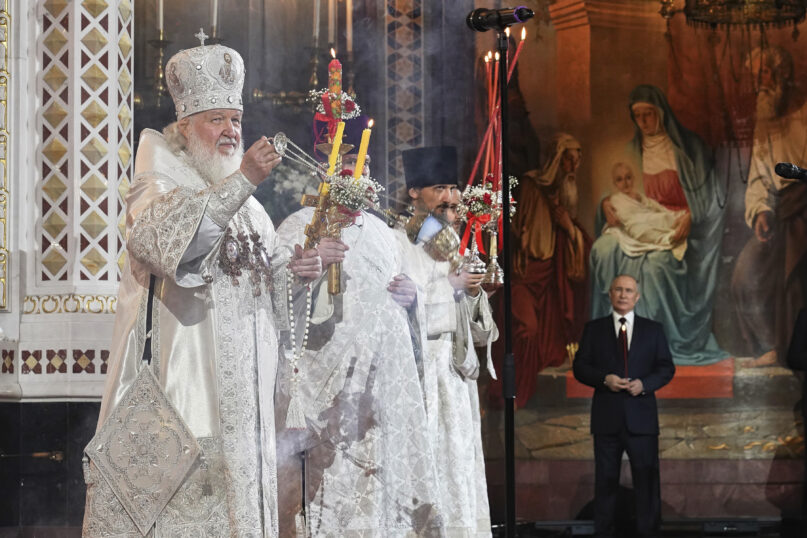
FILE – In this photo released by Russian Orthodox Church Press Service, Russian Orthodox Church Patriarch Kirill, left, conducts the Easter service accompanied by President Vladimir Putin, background right, at the Christ the Savior Cathedral in Moscow, Russia, early Sunday, April 24, 2022. (Oleg Varov/Russian Orthodox Church Press Service via AP)

Or take the case of two young Orthodox seminary graduates, Denis Popovich and Nikita Ivankovich, 28 and 29, both ethnically Ukrainian. They have been held in a detention facility in Moscow run by the Russian intelligence service since February 2025. After being held on fabricated administrative charges, they now face terrorism accusations carrying decadeslong sentences. Their real crime? Private conversations in messaging apps about the consequences of the war.

Pastor Nikolai Romanyuk, 62, a Pentecostal minister in Moscow, has been in detention since October 2024, awaiting trial for a 2022 sermon in which he stated that his church “does not bless” those who participate in combat operations in Ukraine.

Pavel Kushnir, 39, a gifted pianist and Baptist, died in pre-trial detention in Russia’s Far East after a hunger strike, his body reportedly showing signs of beating.

What makes this persecution particularly insidious is the coordination between the Russian Orthodox Church and state authorities — between Kirill and Putin. Ecclesiastical courts have perverted canon law for political purposes, transforming ancient spiritual disciplines into tools of political control.

Yet resistance continues in various forms. At least 27 Orthodox priests have voluntarily left active ministry rather than serve in what they consider a morally compromised environment. Entire parishes across Western Europe have voted to leave Moscow’s jurisdiction, including a dramatic case in Bergen, Norway, where 135 parishioners voted to sever ties with the Moscow Patriarchate after their Ukrainian priest faced harassment for signing the February 2022 peace letter.

The Ecumenical Patriarchate in Constantinople has quietly become a refuge, receiving nearly 30 priests and deacons, including those suspended or defrocked by Moscow for anti-war positions. These clergy now serve Russian Ć©migrĆ© communities across Europe. They represent that Orthodox witness against sanctifying violence that lies in our shared calling to stand with the persecuted church. As Hebrews 13:3 commands: “Remember those in prison as if you were together with them in prison, and those who are mistreated as if you yourselves were suffering.”

RELATED: How US Christian nationalists are exporting their agenda to Europe

International religious institutions and ecumenical organizations, meanwhile, have remained largely silent. A few individual bishops have courageously spoken against Russian aggression, but of 14 autocephalous, or independent, Orthodox Churches around the world, only the Ecumenical Patriarchate and its autonomous church in Finland have taken public action. Most Catholic and Protestant bodies have issued no statements of solidarity thus far. This silence effectively abandons the persecuted and normalizes the suppression of religious conscience.

Explicit opposition to the war isn’t required for the government persecution. Jehovah’s Witnesses, banned as “extremists” since 2017, currently have 143 believers imprisoned — more than all anti-war religious prisoners combined. The state’s message is clear: Religious communities must submit to political authority or face elimination.

What we’re witnessing is not merely political repression but a spiritual crisis. The Russian state, with the Russian Orthodox Church’s active collaboration, seeks to subordinate the Gospel to a neo-imperial ideology with clear nationalist overtones. This represents what Fordham’s researchers call “a fundamental challenge to the prophetic vocation of religious communities — their calling to speak moral truth regardless of political consequences.”

The Christians resisting this coercion understand what’s at stake. As one suspended priest, the Rev. Sergei Rybakov, wrote: “This war has distorted the face of the Russian Orthodox Church and transformed it into a grimace twisted by anger and malice.” Yet he continues his ministry online, hoping the church might eventually “regain its human face.”

American Christians have concrete ways to respond. We can support the U.N. Special Rapporteur’s mandate on human rights in Russia. We can advocate for our communities to express solidarity with the persecuted. We can establish humanitarian pathways for religious refugees and support organizations monitoring these abuses.

Most importantly, we can pray — not abstractly, but specifically by name — for all who chose conscience over comfort. Their witness reminds us that authentic faith sometimes demands costly choices. In a world where institutional Christianity often seems compromised by political power, these Russian believers demonstrate what it means to “render unto Caesar what is Caesar’s, and unto God what is God’s.”

This week, we at the Orthodox Christian Studies Center attempted to present this striking report to members of the All-American Council of the Orthodox Church in America meeting in Phoenix. This church originated from the Russian Orthodox Church’s American Metropolia and, in the 20th century, was vocal in supporting religious dissidents in the Soviet Union.

Yet OCA officials declined our proposal on procedural grounds. In response, we published an open letter to the council that captured the urgency: “The Church’s mission includes being a voice for the voiceless. When clergy are punished for preaching Christ’s Gospel of peace, our silence—and especially the silence of our bishops—can be interpreted as tacit approval of their persecution. We cannot accept this.”

RELATED: How a Russian Orthodox leader’s diplomacy with Rome became a casualty of Ukraine war

The original peace letter that sparked this movement contained a simple plea: “We call on all sides to engage in dialogue, because there is no alternative to violence except dialogue.” Nearly three years later, that call echoes not from grand cathedrals but from prison cells, exile communities and underground gatherings where Christians continue to choose faithfulness over safety.

Their courage challenges us: Will we remain silent while our brothers and sisters suffer for righteousness’ sake? Or will we amplify their witness, ensuring their sacrifice for peace is neither forgotten nor in vain?

The persecuted church in Russia is speaking. The question is whether the global church is listening.

(Sergei Chapnin is director of communications at the Orthodox Christian Studies Center at Fordham University and author of the report “Religious Communities Under Pressure: Documenting Religious Persecution in Russia 2022-2025.” The views expressed in this commentary do not necessarily reflect those of Religion News Service.)


RABID AMERIKAN PROTESTANTS

At tense hearing, GOP attacks immigrant aid groups and fends off accusations of anti-Catholicism

“An Inside Job: How NGOs Facilitated the Biden Border Crisis,”


WASHINGTON (RNS) — Rep. Tim Kennedy of New York, a Catholic Democrat, said the hearing, coming as tensions over immigration policy have erupted between Catholic bishops and the Trump administration, ‘reeks of anti-Catholicism.’


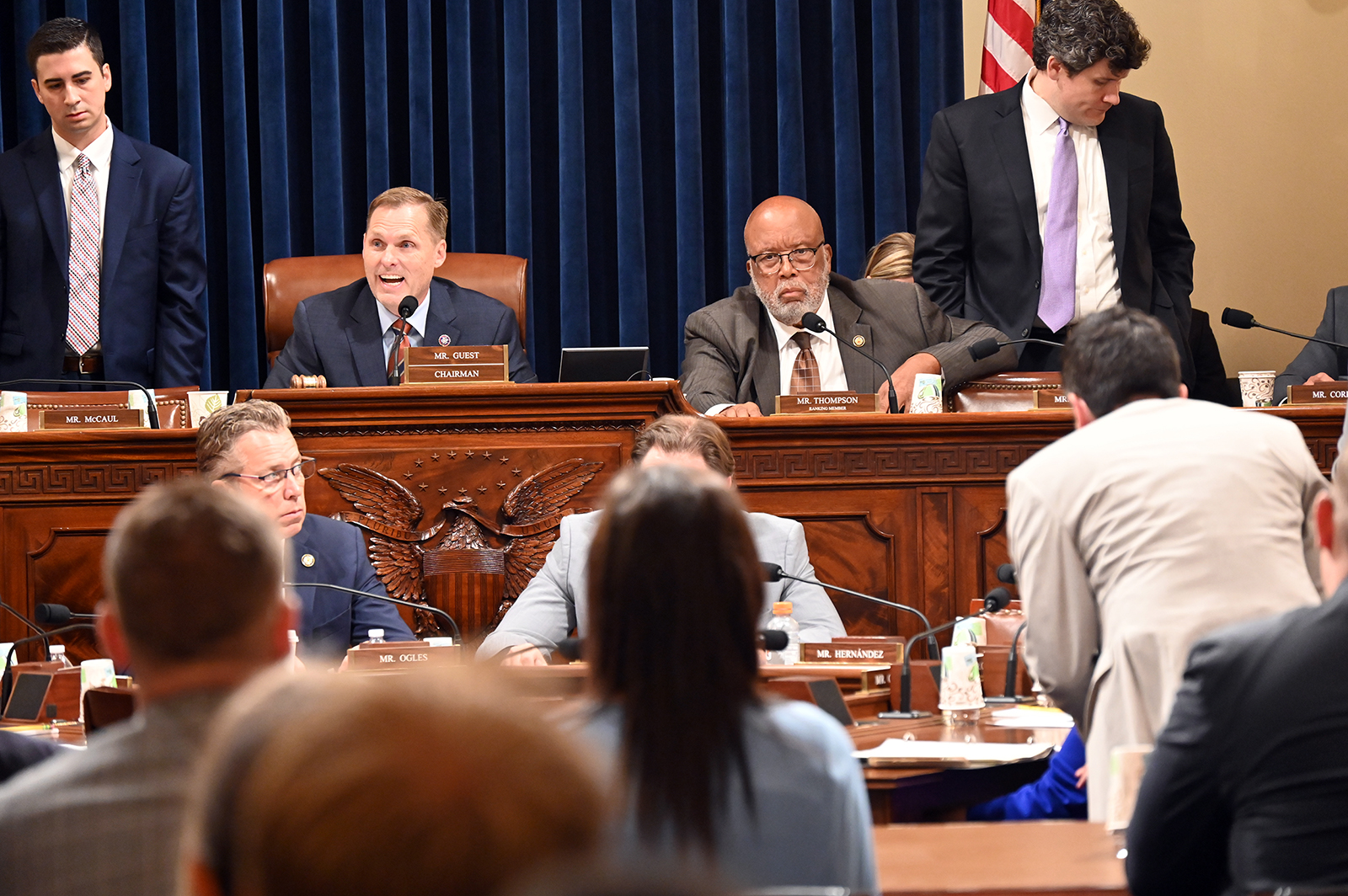
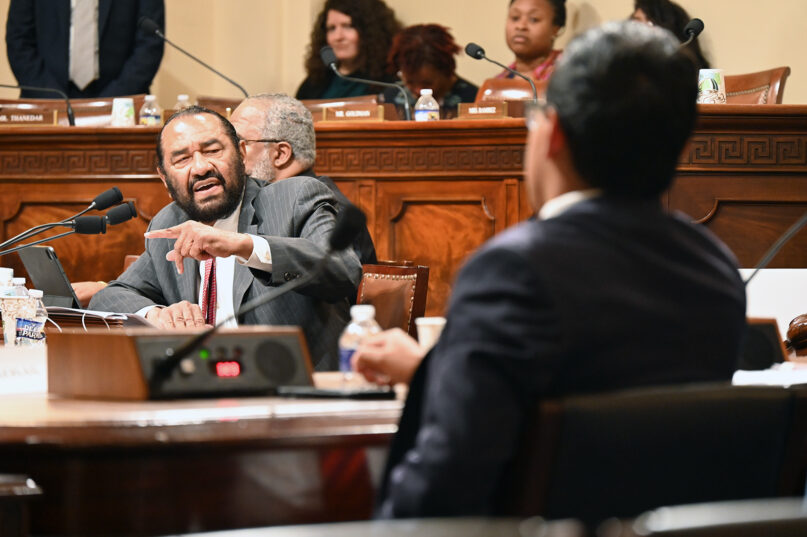
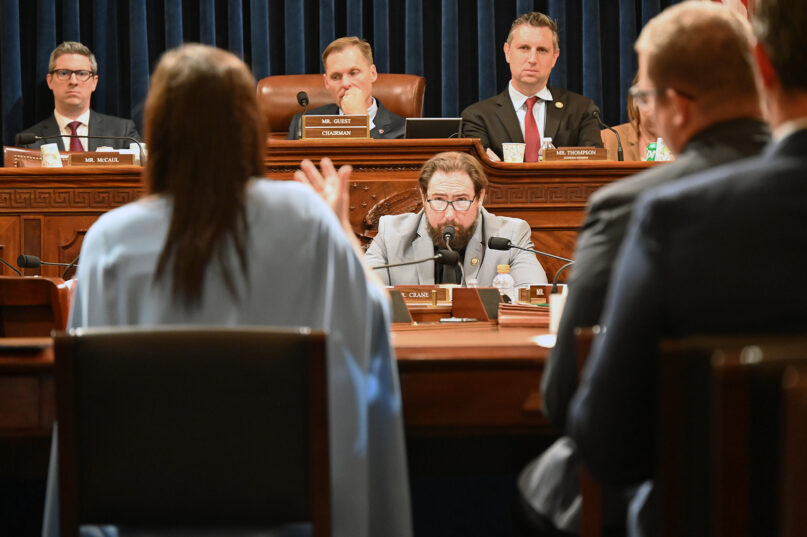
Acting Chairman Michael Guest, R-Miss., center left, speaks during a House Homeland Security Committee hearing, titled “An Inside Job: How NGOs Facilitated the Biden Border Crisis,” July 17, 2025, on Capitol Hill in Washington. Rep. Bennie Thompson, D-Miss., center right, listens. (RNS photo/Jack Jenkins)


Jack Jenkins
July 17, 2025
RNS

WASHINGTON (RNS) — A House hearing called to examine the Biden White House’s immigration policy and the actions of nonprofits that aid migrants — including faith-based groups — devolved into partisan chaos on Wednesday (July 17), as Democrats accused Republicans of attacking religious organizations and Republicans fractured over whether to target Catholic Charities and other faith groups.

The Homeland Security Committee hearing, titled “An Inside Job: How NGOs Facilitated the Biden Border Crisis,” is part of a broader effort targeting nonprofit groups that have long offered aid to immigrants. A small cadre of Republicans and right-wing influencers have argued for years that faith-based nonprofits that offer temporary aid to immigrants after they have been processed by Customs and Border Protection promote illegal immigration. These allegations have led to threats against staffers at Catholic Charities, a group that came up often at Wednesday’s hearing.

The claim has been widely rejected by the religious organizations, whose work is typically done under a federally funded partnership with the government.

Most recently, on June 11, Reps. Mark E. Green of Tennessee, then chair of the House Committee on Homeland Security, and Josh Brecheen of Oklahoma announced plans to probe more than 200 nongovernmental organizations they accused of being “involved in providing services or support to inadmissible aliens during the Biden-Harris administration’s historic border crisis.” A press release announcing the investigation singled out the U.S. Conference of Catholic Bishops, Catholic Charities and the Lutheran group Global Refuge.

Several denominations and faith-based agencies say they have since received letters asking them about their actions under President Joe Biden’s administration.

Green, who has resigned from his congressional seat, effective Sunday, was not present and thus did not lead the meeting.
\

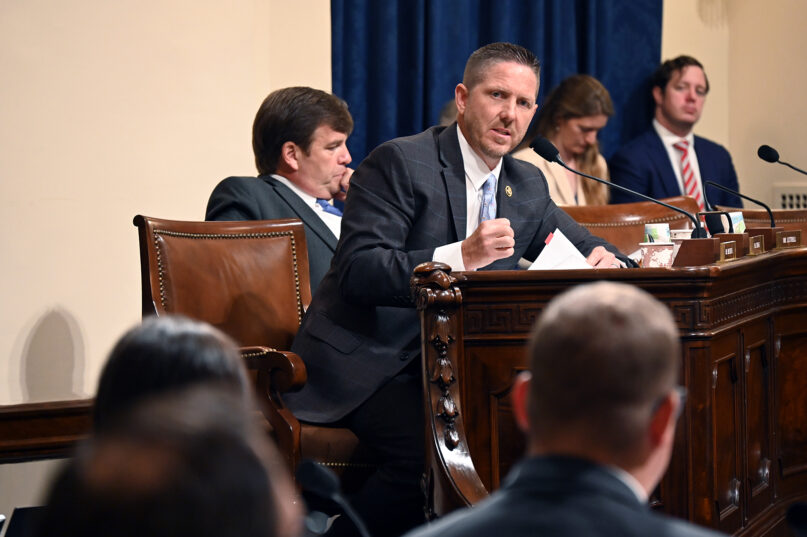
Rep. Josh Brecheen, R-Okla., speaks during a House Homeland Security Committee hearing, titled “An Inside Job: How NGOs Facilitated the Biden Border Crisis,” July 17, 2025, on Capitol Hill in Washington. (RNS photo/Jack Jenkins)

At Wednesday’s hearing, its conveners tried to reprise these sentiments but had a difficult time keeping the focus on actions they attributed to the Biden administration. Democrats repeatedly brought up the work of religious groups as “the Lord’s work,” in the words of Rep. LaMonica McIver of New Jersey, who was detained outside of a U.S. Immigration and Customs Enforcement detention facility in May and has since been charged with assaulting and interfering with immigration officers. (She has pleaded not guilty.)

In his opening remarks, Rep. Bennie Thompson of Mississippi, the committee’s ranking Democrat, said, “Mr. Chairman, my Republican colleagues and the Trump administration are waging a war on faith in civil society in the United States.”

Republicans on the committee appeared divided over whether to attempt to call religious groups to account. In his own opening remarks, acting Chairman Michael Guest, a Mississippi Republican, said he took offense at Thompson’s characterization. “I have mentioned nothing in my statement about nonprofits such as the Red Cross, Catholic Charities, Samaritan’s Purse, Doctors Without Borders — nonprofits who actually take money and use it for good,” said Guest.

Instead, Guest insisted, the hearing was “focused on those handful of nonprofits who received their money almost exclusively from grants from the federal government.”

Others Republicans avoided talk of religious groups altogether, and some made a point to speak kindly about Catholic bishops. Rep. Carlos GimĆ©nez of Florida called himself a “really good friend” of Miami Archbishop Thomas Wenski, saying the two regularly dine together.

But GimĆ©nez also suggested there are “bad apples” among Catholic nonprofits, without specifying which ones, and other members of the committee and some of the witnesses called to testify weren’t willing to let Catholic Charities off the hook.

“We’re talking about the NGOs that are used as middlemen to carry out their operations, like the Catholic Charities, they (are) used to facilitate, normalize and accelerate illegal immigration into this country,” said Rep. Eli Crane of Arizona.


Rep. Al Green, D-Texas, left, questions a witness during a House Homeland Security Committee hearing, titled “An Inside Job: How NGOs Facilitated the Biden Border Crisis,” July 17, 2025, on Capitol Hill in Washington. (RNS photo/Jack Jenkins)

Democrats, meanwhile, rushed to defend Catholic Charities and its work under the Biden administration. Rep. Al Green of Texas at one point rejected a claim from one of the day’s witnesses that the Biden administration did not respond to thousands of calls expressing concerns about unaccompanied immigrant children.

“I’m going to defend Catholic Charities,” said Green, the Democrat. “I don’t believe you think that Catholic Charities would have 65,000 children mistreated. I just don’t believe you think that. I don’t think so. Catholic Charities does an outstanding job.”

Lutherans were another target of the panel, as Rep. Sheri Biggs of South Carolina called Global Refuge, a Lutheran agency that until recently was called Lutheran Immigration and Refugee Service, one of several “Trojan horses” in the NGO field. Former Trump administration national security adviser Gen. Michael Flynn has accused the group in the past of money laundering.

Amid the back-and-forth, Democrats tried to introduce motions to subpoena Homeland Security Secretary Kristi Noem; Todd Lyons, acting director of ICE; and Stephen Miller, White House deputy chief of staff, among other Trump administration officials, but their motions were tabled or voted down
.

Rep. Eli Crane, R-Ariz., center, questions witnesses during a House Homeland Security Committee hearing, titled “An Inside Job: How NGOs Facilitated the Biden Border Crisis,” July 17, 2025, on Capitol Hill in Washington. (RNS photo/Jack Jenkins)


The subpoena motions, however, led to disagreements over procedure, as Republicans chairing the hearing “suspended” the meeting rather than lose votes because committee members on their side had been called away for procedural votes. Democrats vigorously objected, arguing the committee chair does not have the power to suspend a meeting simply to delay a vote, and pointing out that there was no move to suspend the meeting when Democrats were absent.

“If we are following the rules of the committee, what you’re doing is not in the rules,” Thompson said, looking visibly aghast.

Guest declined to restart the meeting, saying in response, “Your point has been made, and is in the record.”

Members of the committee also referenced a number of other topics, such as ICE agents wearing masks, the detention of U.S. citizen children and the deaths of dozens due to flooding in Texas. At one point, a Democratic lawmaker and a witness began shouting at each other over the potential release of files related to disgraced financier and sexual offender Jeffrey Epstein.

Democrats returned repeatedly to tensions between Republicans and the religious nonprofits, praising the work of faith groups and framing the GOP as anti-faith.

Rep. Tim Kennedy of New York, a Catholic Democrat, said the hearing, coming as tensions over immigration policy have erupted between Catholic bishops and the Trump administration, “reeks of anti-Catholicism.” Other Democrats tried to add to the Republicans’ discomfort by repeatedly citing criticism of President Donald Trump’s border policies by the late Pope Francis and by Pope Leo XIV, and Thompson entered a statement from Bishop Robert John Brennan of New York about immigration into the record.

In the end, Catholic Charities USA chose to welcome the wealth of praise that emerged rather than the criticisms. In a statement after the hearing ended, the agency, an umbrella organization speaking on behalf of more than 150 independent Catholic Charities agencies, said, “we appreciate the bipartisan compliments directed during this hearing at the merciful work of Catholic Charities agencies.”
SOUTH AFRICA
  "Azania"

Patrick Bond’s Letter to Department of Mineral and Petroleum Resources, Trans Hex and SRK


July 17, 2025
Source: Originally published by Z. Feel free to share widely.


Date: 14 July 2025

To: Department of Mineral and Petroleum Resources, Trans Hex and SRK – sleyde@srk.co.za Subject: Objection to off-shore Prospecting Application, near Lepelsfontein and Doringbaai, DMPE ref no.: WC30/5/1/1/2/1047PR – Diamond Mining Rights in Marine Concession Areas 11B and 13B, West Coast, South Africa

SUMMARY: Please consider this a critique of Trans Hex and DFFE Environmental and Social Impact Assessment for not disclosing the wealth effects of Trans Hex’s planned offshore mining operations. Without such disclosure, it is reasonable to assume that the effect of depleting South Africa’s natural capital, for current and future generations will be net negative, if the non-renewable commodity resources extracted and depleted are not compensated for, using scientific methods and with accountability systems, as mandated in the 2012 Gaborone Declaration and the National Environmental Management Act.

Introduction


I am a University of Johannesburg sociologist (a distinguished professor), specialising in public policy and environmental economics. I am writing in particular about the implications of the proposed offshore mining project of Trans Hex – WC30/5/1/1/2/1047PR – for sovereign wealth.

The views expressed below are personal, not institutional. I hold a PhD in Geography and Environmental Engineering from Johns Hopkins University (1993), having earlier studied economics at Swarthmore College and the University of Pennsylvania Wharton School of Finance. I also have engaged in many South African policy processes, having drafted the Reconstruction and Development Programme White Paper (1994) and many others. I also work closely with civil society organisations in South Africa, Africa and across the world.

I am particularly interested and affected, as are all South Africans, by the notorious problem of retaining non-renewable resource wealth for current and future generations. Normally, South Africa’s resource curse can be understood in these ten categories:

• ecological: degradation and pollution of local land, air, water, ecosystems, living bodies • socio-psychological: displacement, gendered violence, aesthetic destruction • labour and health: migrant work systems (family degradation), workplace safety, disease • spiritual/traditional: despoliation of sacred sites (e.g. graves) and common spaces • political (local, national): elite formation, corruption and compradorism • geo-political: imperial, sub-imperial and local turf battles over extraction and transport

• mal-developmental: ‘Dutch Disease’ economic skew (against local manufacturing) and abuse of electricity (needed for labour-intensive industry, small businesses, households) • financial: price volatility, Illicit (and Licit) Financial Flows, raises unnecessary foreign debt • climatic: fossil fuel emissions including in mining, processing, smelting and transport • ecological-economic: ‘natural capital’ wealth depletion adverse for future generations

Other commentators have much greater insights into the first nine of these. The pages below focus on the way that Trans Hex can be expected to deplete South Africa’s natural capital, net of reinvestment in productive, financial and human capital that may be claimed by the firm.

Natural capital depletion as a source of net wealth shrinkage in South Africa


Consistent with the National Environmental Management Act’s “polluter pays” foundational principle, it is vital to properly cost the entire project, by including discussion of the potential adverse effects of net resource depletion. It is apparent that notwithstanding their experience and qualifications, neither of the SRK Consulting staff – Christopher Dalgliesh nor Sam Leyde – have made any effort to assess the sovereign wealth implications of the proposed commodity extraction.

Yet the Gaborone Declaration – signed in May 2012 by South African Environment Minister Edna Molewa – recognised “the limitations that GDP has as a measure of well-being and sustainable growth,” since GDP is a typical measure of economic impact, that ignores depletion of wealth (‘selling the family silver’), hence she and other signatories committed to “integrating the value of natural capital into national accounting and corporate planning.”1 Both environmental officials and Statistics South Africa are aware of this mandate and make efforts to measure natural capital, as explained below. Because ‘corporate planning’ is specifically mentioned, Trans Hex must take the Gaborone Declaration’s mandate seriously, not ignore it.

The reason is that resource depletion and eco-system destruction are, in South Africa’s case, rarely compensated for properly. This general problem was one that Nobel Economic Laureate Robert Solow (1974) and his colleague John Hartwick (1977) raised by using a natural asset measurement lens. They asked whether shrinkage of ‘natural capital’ due to exploitation of natural resources can be offset by the resulting investment in productive capital and human capital (education expenditures). They insisted that if pollution or shrinkage of ecological wealth (e.g. minerals extraction) were to occur, it should only be permitted if benefits – i.e., profits, taxes and wages that can be counted up and down the value chain – then flow into the expansion of productive or human capital.

The point, here, is to protect the interests of future generations who have a notional ‘right’ to also draw down a society’s non-renewable natural resource base, the way ‘family silver’ is considered the basis for responsible stewardship and in some cases, formal ‘trusteeship’ (Bond and Basu 2021). A net positive outcome (termed ‘weak sustainability’) assumes the substitutability of these various capitals: lost natural capital is offset by reinvestments of profits into machinery, infrastructure or schooling that makes capitalism more productive. ‘Strong sustainability’ – championed by and Robert Costanza and Herman Daly (1992) – advocates raising natural capital in absolute terms.

Among the world’s worst-ever cases of uncompensated natural capital depletion are the diamonds and gold extracted from Kimberley since the late 1860s and Johannesburg since the mid-1880s. Nevertheless, a vast amount of underground natural wealth still exists in South Africa in the form of minerals, measured conservatively at $2.5 trillion by Citibank in 2012 (I-Net Bridge 2012). Even without counting several valuable minerals, the World Bank (2021, 204) considers South Africa a major net loser of non-renewable resource wealth.2Just three African economies suffered worse mineral wealth decline – the Central African Republic, Botswana and Zimbabwe – and “88 percent of [Sub-Saharan African] countries were found to be depleting their wealth… even as they show growth in annual income. As these countries grow, they are not compensating for depletion of natural resources” (World Bank 2014).

Evidence of degradation can be found in Bank natural capital accounting charts (again, highly conservative, due to missing minerals):

• The first reveals that in South Africa, mineral depletion is substantial, with losses rising to $10.9 billion in 2021 even without counting platinum and many other minerals (Figure 1).

• Second, South African and international ‘Natural resource rents’ as a share of GDP reveal income ebbs and flows from what are mainly depleting sources (Figure 2).

• Third, specific coal resource rents reveal the South African economy’s comparative addiction to fossil fuels, both for burning in Eskom coal-fired power plants and for export, even if such rents do not capture enormous damages from local pollution and global emissions (Figure 3).

• So, fourth, if natural capital depletion, pollution and emissions are combined with (positive) educational funding (‘human capital investment’) and depreciation of physical capital (wear and tear on machines), the Bank’s full Adjusted Net Savings measure reveals that the South African economy has been shrinking, especially from 2012-20, a time the rest of the world recorded relatively high rates of positive saving (9%–11% of GDP) (Figure 4).

2 There are methodological shortcomings in World Bank (2021) studies of mineral wealth: not including platinum group metals, manganese and chrome, where South Africa has led the world for most of the period under discussion; nor zirconium, vanadium and titanium (South Africa is the world’s second highest producer); nor diamonds. The Bank’s natural capital accounts count fossil fuels and other minerals and metals: bauxite, cobalt, copper, gold, iron ore, lead, lithium, molybdenum, nickel, phosphate rock, silver, tin and zinc.


Figure 1: SA Adjusted Net Savings due to losses from minerals depletion (US$ bn), 1970–2021 Source: https://data.worldbank.org/indicator/NY.ADJ.DMIN.CD?locations=ZA-1W&view=chart

Figure 2: Resource rents (% of GDP), 1970–2021: South Africa (top) and the world (bottom) Source: https://data.worldbank.org/indicator/NY.GDP.TOTL.RT.ZS?locations=ZA 1W&view=chart

Figure 3: Coal resource rents (% of GDP), 1970–2021: South Africa (top) and the world (bottom) Source: https://data.worldbank.org/indicator/NY.GDP.COAL.RT.ZS?locations=ZA 1W&view=chart

Figure 4: Adjusted Net Savings (% of GNI), 1970–2020: world (top) and South Africa (bottom) Source: https://data.worldbank.org/indicator/NY.ADJ.SVNG.GN.ZS?view=chart&locations=ZA– 1W


Diamond resource wealth depletion and resulting inequality


Diamonds are especially notorious sources of readily-disposable wealth that do not meet the mandate of the Hartwick Rule. Zimbabwe is the most notorious recent case in which, as President Robert Mugabe argued in 2016, “We have not received much from the diamond industry at all. I don’t think we have exceeded $2 billion, yet we think more than $15 billion has been earned” (Magaisa 2016). As explained by the main civil society watchdog, Farai Maguwu (2016, 5), founder of the Centre for Natural Resource Governance, “mining is a disaster unfolding across Zimbabwe. Mining is creating an enclave economy full of white-collar criminals, who make virtually no positive linkages to the broader Zimbabwean economy. They simply deplete our natural capital and provide an inconsequential return.” According to the Zimbabwe Environmental Law Association, that “Diamond revenue represents natural capital depletion and, therefore, its expenditure should be judicious” (Sibanda and Makore 2013, 29).

The same problem emerged in diamond-rich Botswana, In 2018, ZsuzsĆ”nna Biedermann (2018) observed “the finite nature of exhaustible natural resources: transitory extra income allows increased consumption but only for a certain period of time. What happens when the resource is depleted?” She answered, using a Botswana Institute for Development Policy Analysis projection, that after diamond depletion from the country, between 2025-27 GDP will fall “47% below the non-depletion path.” Yet management of diamonds in Gaborone is sometimes considered a best-case site, due to state-owned Debswana’s sharing of diamond mining spoils, even if wealth depletion has occurred in a manner favouring an acquisitive, unproductive elite in the bureaucratic managerial class. Added to land-holding inequality, Botswana is one of the world’s worst cases of wealth disparity: “the top 10% of households in the income distribution own 57% of all assets and 61% of financial assets, while the bottom 50% own only 4.2% and 3.3%, respectively” (United Nations 2023).

These concerns are entirely reasonable, and generalisable to many extractive industry projects across the continent. As the late Professor Ian Taylor (2020, 9) explained in The Palgrave Handbook of African Political Economy, integral to “this depletion of finite resources and a subsequent negative debit on a country’s stock, inequality has been reinscribed,” given the unpatriotic character of resource managers, e.g. utilizing notoriously corrupt marketing sites such as Dubai (as does Trans Hex). Taylor (2020, 7) continues, “calculations of GDP do not make deductions for the depreciation of fabricated assets or for the depletion and degradation of natural resources. Thus, a country can have very high growth rates calculated using GDP indicators, whilst embarking on a short-term and unsustainable exploitation of its finite resources.”

These sorts of problems with diamond-based resource depletion are commonly observed across the mining industry. Given the net-negative role of natural capital extraction, uncompensated for in a manner that will empower current and future generations, the eco feminist group WoMin (2019, 9) has appealed that society should,

foreground a feminist analysis of costs, showing that this places particular burdens on the cheap and unpaid labour of impacted women. We will grapple further with the problematic of costing damage and impacts, immediately and on a cumulative basis, to show that an extractivist model of development does not advance people and their economies, but rather destroys and immiserates them. We will show the inter-generational costs of extractivism and we will work to argue that Africa and African nations are losing sovereign wealth through extractivism and only becoming poorer. These efforts lay the basis for advocacy and campaigns to build wider popular and public consciousness, build the grounds for advocacy on development alternatives, as well as advocate and campaign to force the internalisation of real costs, which would render the majority of projects unsustainable.

Failure by Trans Hex and SKR to consider net inter-generational commodity-extraction costs

SKR does indeed recognise the broader principle of not ‘compromising’ future generations in its Environmental Impact Assessment Report (EIAR), for on page xviii, in a tokenistic manner, the firm acknowledges that “Sustainable development is generally defined as development that meets the needs of the present generation without compromising the ability of future generations to meet their own needs.” Moreover, in one specialist study, Social Impact Assessment for Diamond Mining Rights in Marine Concession Areas 11B and 13B, West Coast, South Africa (SIA), it is also recognised that according to the National Environmental Management Act, “sustainable development requires the integration of social, economic and environmental factors in the planning, implementation and evaluation of decisions to ensure that development serves present and future generations” (SIA, p.20)

Yet this generational consciousness is mere rhetoric; it does not translate into the natural capital accounting (within corporate planning) mandated by the Gaborone Declaration. Instead, SKR proceeds with its socio-economic analysis in a manner that excludes any concept of future generations’ needs. Its EIAR summary (p.89), for example, includes only these considerations:

“The implementation of a safety (exclusion) zone around prospecting vessels will exclude other users of the sea from these areas during prospecting. Exclusion of fishing vessels from fishing areas and potentially reduced populations of fishing target species in and around the precinct could have (indirect) socio-economic implications for the affected industries through reducing commercial catch. Investment contributing to the economy, generation of employment, income and skills and increased prosperity due to socio-economic development initiatives are potential benefits of the project.”

The entire SIA contains no information on the socio-economic benefits and costs to future generations. There is only cultural recognition, which is extremely important in its own right (SIA p.68):

“For coastal communities, such as Papendorp, Strandfontein, Doringbaai and Ebenhaeser the sea is a lifeline. It provides sustenance through fishing, a means of trade and transportation, and a source of recreation and inspiration. The rhythm of life in these areas

is often dictated by the tides, seasons, and the ever-changing moods of the ocean. Folktales, myths, and legends born from the ocean’s mysteries are passed down through generations, becoming part of the collective consciousness. Festivals, rituals, and art celebrate the ocean’s bounty and beauty, reflecting deep-seated respect and reverence for this powerful force of nature. The sea offers a sense of tranquillity and reflection. A sense of place connected to the sea also fosters a strong sense of environmental stewardship. Those who live close to the ocean understand its delicate balance and the impact of human activity on marine ecosystems. This awareness often translates into efforts to protect and preserve the marine environment for future generations.

Residents of coastal villages and towns such as Papendorp, Strandfontein, Doringbaai and Ebenhaeser have a deep sense of place and spiritual reliance on the sea. Residents of Papendorp, Ebenhaeser and Doringbaai settlements have a cultural connection with the sea and the Olifants River as they have interacted with the sea and river for numerous generations. Most of the residents, especially men, are generational fishermen. This is their way of life and is regarded by locals as a cultural activity. One fisherman in Ebenhaeser noted, “This is our culture. Fishing was handed over to me by my father and to him by his father. My grandfather told my father that I do not have inheritance money for you in Standard or First National Bank, but I do have inheritance for you in the sea and the river”.

Residence and tourists at Strandfontein use the beaches and ocean sounds for relaxation, tranquillity and enhanced spirituality. They firmly believe that the beaches and the ocean provide a sense of peace from within. Tourists have been using this area for years in order to replenish and return to their daily lives with renewed energy. One of the KII noted that some !Khosa people visit Doringbaai once or twice a year to wash their bodies in the ocean due to their belief in purification using seawater.

Again, the cultural integrity of shoreline communities is vital to protect. But the limitation of current and future generations’ rights to the sovereign wealth – especially non-renewable resources like diamonds – is simply not addressed in the SRK analysis, which does not even mention the natural capital accounts that would throw light on genuine net benefits or costs.

It is reasonable to assume that, like nearly all non-renewable resource depletion in Africa, the net impact of Trans Hex’s operations will prove negative. It is up to the company and its EIA consultants to follow the Gaborone Declaration, National Environmental Management Act and the basic principle of intergenerational sustainability – and their failure to do so is revealing. The project should not go ahead under such conditions.

Sincerely,

Patrick Bond

1 Gaborone Declaration. Gaborone Declaration for Sustainability in Africa. Gaborone, Botswana 12 May (2012),  http://www.gaboronedeclaration.com/

References

Biedermann, Z. 2018. ‘Africa’s Dependency Curse: The Case of Botswana.’ Review of African Political Economy Online, 27 September. https://roape.net/2018/09/27/africas dependency-curse-the-case-of-botswana/

Bond, P. and R.Basu. 2021. ‘Intergenerational Equity and the Geographical Ebb and Flow of Resources: The time and space of natural capital accounting.’ in M.Himley and E.Havice (Eds), Handbook of Critical Resource Geography, New York, Palgrave Macmillan, 2021, pp.260-273. https://www.routledge.com/The-Routledge-Handbook-of-Critical-Resource Geography/Himley-Havice-Valdivia/p/book/9781138358805

Hartwick, J. 1977. ‘Intergenerational equity and the investing of rents from exhaustible resources.’ American Economic Review, 67(5): 972-74.

Magaisa, Alex. 2016. “Mugabe and the $15 billion question.” The Standard. 14 March. Retrieved from https://www.thestandard.co.zw/2016/03/14/mugabe-and-the-15-billion question/

Maguwu, Farai. 2016. “An Open letter to President Robert Mugabe.” Harare, Centre for Natural Resource Governance. https://impacttransform.org/wp content/uploads/2017/09/Annex_3_-_An_Open_Letter_to_President_Robert_Mugabe.pdf 
Sibanda, Mukasiri and Gilbert Makore. 2013. Tracking the Trends. Harare: Zimbabwe Environmental Lawyers Association.

Solow, R. 1974. ‘The Economics of Resources or the Resources of Economics.’ The American Economic Review, 64 2: 1-14, http://links.jstor.org/sici?sici=0002-

8282%28197405%2964%3A2%3C1%3ATEOROT%3E2.0.CO%3B2-4

United Nations Botswana 2023. Common Country Analysis. Gaborone.

https://botswana.un.org/sites/default/files/2023-

11/BOTSWANA%20COMMON%20COUNTRY%20ANALYSIS2023%20Annual%20Update.pdf Taylor, I. (2020). The Political Economy of Africa. In S. O. Oloruntoba & T. Falola (Eds.), The Palgrave Handbook of African Political Economy (pp. 93–113). Springer International Publishing. doi:10.1007/978-3-030-38922-2_

WoMin. 2019. ‘WoMin Five Year Strategy (2020-2024).’ Unpublished. Johannesburg. World Bank. 2014. Little Green Data Book. Washington, DC.

https://openknowledge.worldbank.org/handle/10986/18782

World Bank. 2021. The Changing Wealth of Nations 2021. Washington, DC. https://openknowledge.worldbank.org/entities/publication/e1399ed3-ebe2-51fb-b2bc b18a7f1aaaed


ZNetwork is funded solely through the generosity of its readers.Donate


Patrick Bond is a political economist, political ecologist and scholar of social mobilisation. From 2020-21 he was Professor at the Western Cape School of Government and from 2015-2019 was a Distinguished Professor of Political Economy at the University of the Witwatersrand School of Governance. From 2004 through mid-2016, he was Senior Professor at the University of KwaZulu-Natal School of Built Environment and Development Studies and was also Director of the Centre for Civil Society. He has held visiting posts at a dozen universities and presented lectures at more than 100 others.