It’s possible that I shall make an ass of myself. But in that case one can always get out of it with a little dialectic. I have, of course, so worded my proposition as to be right either way (K.Marx, Letter to F.Engels on the Indian Mutiny)
Monday, July 28, 2025
Iranian Navy Limps Back Into Bandar Abbas
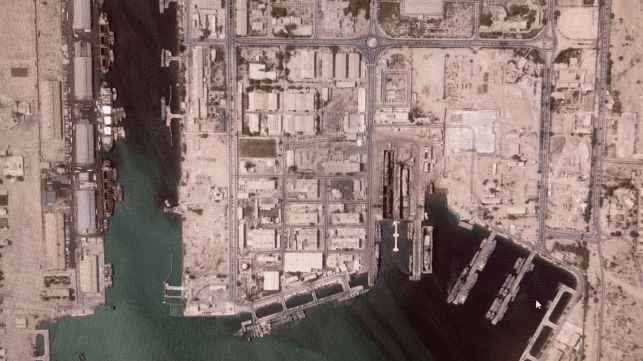
The Bandar Abbas Naval Harbor early on July 28 (Sentinel-2)
The Iranian Navy (Nedaja) has finally returned to port in Bandar Abbas, six weeks after evacuating its homeport in a hurry on June 16. During the 12-Day War, after the ships had evacuated, a Nedaja ammunition store in the port area was struck, as was an IRGC Navy (Nedsa) dockside warehouse used to store drones on the western side of the harbor.
During the intervening period, a number of the Southern Fleet’s ships have come back to port singly, staying in port briefly probably to replenish. Although several vessels were easily identifiable anchored outside the Naval Harbor in the Bandar Abbas roads for short periods, it is not clear to where most of the ships dispersed. They did not displace to other naval district harbors, such as at Jask and Chabahar, and hence were probably dispersed across coastal anchorages.
In medium resolution satellite imagery taken early on July 28 (top) and requiring some guesswork, most of the Southern Fleet ships appear now to have returned to Bandar Abbas.
Two Alvand Class frigates and two Moudge Class frigates can be seen tied up in harbor, the full complement of operational Nedaja Southern Fleet frigates. Also in harbor is the intelligence collection frigate IRINS Zagros (H313). Two Hengam Class landing ships are tied up at their normal berths, namely IRINS Tonb (L513) and Lavan (L514), with a third vessel of the class IRINS Larak (L512) positioned in a floating dry dock where it has been undergoing long-term repair. Close by is the Bandar Abbas Class replenishment ship IRINS Bushehr (K422), as are four of the seven-strong Delvar Class fleet of cargo and ammunition ships.
The forward base ship IRINS Makran (K441) has not however returned yet to its normal pier berth in the Bandar Abbas outer harbor. Nor apparently is the single Kilo Class submarine believed currently operational - IRINS Tarek (S901) - located at its regular berth on the submarine flotilla pier. There is also normally a complement of Sina and Kaman Class fast attack craft in the harbor, but only three such vessels are identifiable in the available satellite imagery.
Still outside in the Bandar Abbas roads is the drone carrier Shahid Bagheri (C110-4) from the IRGC Navy (Nedsa), anchored at 27.0722N 56.1982E, where it has been since mid-June. The Nedsa catamaran vessel Shahid Nazeri is close by.
Politically and socially, Iran remains in a state of paralysis since the 12-Day War, with widespread shock that the clerical leadership could push the nation to war without having the adequate means to defend itself. The leadership elite itself is divided within itself between hardliners and reformists on what direction to take the country, and its internal security apparatus is on high alert for signs of popular discontent. The return of the Nedaja to port is one of the first indications that the country could be recovering its equilibrium.
The opinions expressed herein are the author's and not necessarily those of The Maritime Executive.
Houthis Renew Threats to Israeli Shipping, Put Eternity C Captives on Video
EU continues its protection mission as the Houthis made new threats against shipping (EUNAVFOR Aspides)
Citing what it called “rapid developments,” the Houthis announced a renewed escalation of their blockade against ships and shipping companies supporting Israel. Hours after releasing its latest threats, the group released a six-minute propaganda video with the crew from the Eternity C dry bulk carrier, which the militants attacked and sank last month. It also issued a direct threat against three other vessels from the same management.
A spokesperson for the militant group said it was warning “all companies to cease their dealings with Israeli ports.” The group went on to say, “Otherwise, their ships, regardless of their destination, will be targeted anywhere that can be reached or within the reach of our missiles and drones.”
The Houthis said they were calling on all countries, “if they want to avoid this escalation,” to pressure Israel to stop the aggression and permit humanitarian aid to reach the citizens of Gaza. The group also said there was “shameful silence” among the Arab, Islamic, and international world.
The move came as the United States and Israel said they had walked away from negotiations with Hamas, with each side blaming the other for the latest failure in the ceasefire talks. Israel, however, said it would take a tactical pause and promised efforts to get more aid into Gaza. Speaking during his trip to Scotland, Donald Trump also called for more efforts to get humanitarian aid into Gaza.
The Houthis are calling this escalation the “fourth phase” of their naval blockade. They, however, have repeatedly said they would be blockading Israeli ports and targeting ships and the companies sending ships to Israel.
In the so-called Yemeni War Media account on X, the group ratcheted up the threats specifically against Cosmoship Management, the operator of the Eternity C. With dramatic music, they flash the names and profiles of three other ships and highlight tracking of their moments.
In today’s other propaganda video, the reported crewmembers of the Eternity C are "interviewed" by their captors and heard to say that they were told by the master of the ship that they were going to stop in Eilat to load fertilizer. The undated video appears to have been shot in part in the hospital room of one of the individuals, the Russian crewmember, who is in bed, and several others can be seen with bandages. Another scene shows the crew given a cellphone to make video calls home.
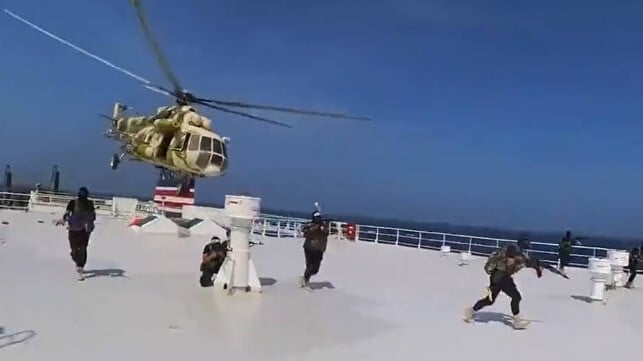
The Associated Press is reporting that the Houthis have taken captive 11 crewmembers from the Eternity C, with the company having acknowledged the death of four crewmembers. The others were rescued by salvage vessels sent by the vessel’s operators and reportedly taken to Saudi Arabia. In the video, however, only ten people appear to be included. The Houthis have repeatedly asserted that they “successfully rescued” an unspecified number of crew, who were taken to a “safe location” and provided medical care. The group previously held the crew of the car carrier Galaxy Leader for 14 months despite repeated international calls to release the civilian crewmembers from the merchant ship, which was the first the Houthis attacked in November 2023.
After the two ships were sunk and the crewmembers killed aboard the Eternity C, there were reports that the Israelis asked the United States to resume its assaults on the Houthis. Donald Trump had declared that the group had been stopped when the U.S. suspended its attacks in May after two months. Trump has not responded to the killing of the crewmembers and the sinking of the two ships.
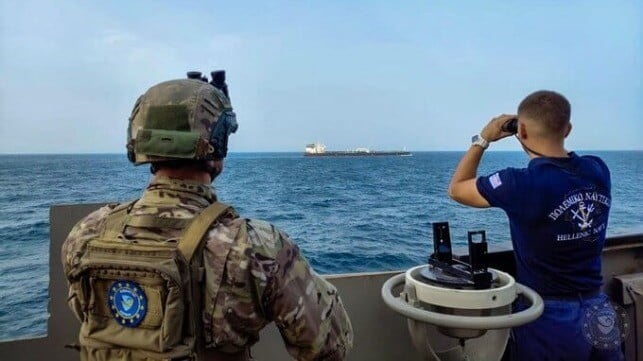
EUNAVFOR Aspides released another picture, this time of the Greek HS Psar, which it said has completed another protection mission for merchant ships in the Red Sea region. It continues to escort ships through the region as part of its defensive mission, which the EU extended till early 2026.
For the shipping community, the Red Sea route between the West and East using the Suez Canal remains a dangerous choice. Attempts at the beginning of July to test the viability of the passage ended in the loss of two Greek-owned bulk carriers, Magic Seas (IMO 9736169) and the Eternity C (IMO: 9588249), with multiple fatalities. Shipowners have been forced to revisit their calculations, though many remain willing to take the risks.
The Houthis are the only members of Iran’s original Axis of Resistance whose fighting spirit appears to remain undiminished. Although it was a Houthi initiative to propose the May 6 ceasefire with the United States, the Houthis did so in search of a tactical pause in which to recover from significant losses inflicted by both American and Israeli airstrikes, not as an act of surrender. The Houthis have frequently used ceasefires in the past as an opportunity to regroup. Consistent with this, Houthi missile and drone strikes against Israel have continued, albeit at reduced levels. The aggressive rhetoric has also continued.
Given then that the Houthis are still standing as a fighting force and their determination to fight Israel over Palestine is undiminished, how is the Houthi threat to shipping likely to evolve? Is the Red Sea route likely to reopen to shipping anytime soon?
The Houthis may not have it all their own way of course. While the United States appears to have pulled back from confronting the Houthis, Israel has been urging the United States to re-engage, but faces opposition from within the wing of the Republican Party that seeks to avoid overseas confrontations. Israel itself, not previously having given the Houthis a high priority, are clearly now re-evaluating the threat, particularly having achieved dominance elsewhere. The use of drones to suppress Houthi activity from afar may signal a new surveillance-led approach to tackling the Houthi threat that is likely to get more and more effective as the Israeli intelligence services improve their understanding of Houthi military structures. As used in the context of Iran, Israel has a Mizrahi community which it can leverage to achieve high-level understanding and penetration of the target environment. Certainly, looking at previous attempts to take down Houthi military effectiveness, a new approach and a new level of determination will be necessary if military means are to be successful.
Within Yemen, the Houthis’ political position for the moment remains strong. The Houthis, once confined to the north-west, have successfully formed broader tribal and political alliances, then consolidated these allies into their core structure. With Iranian assistance, they have developed a highly effective security structure able to identify and quickly suppress dissent. The surveillance and counter-intelligence equipment intercepted by National Resistance Forces en route to the Houthis on June 27 are worthy of the most sophisticated internal security organization; that the Houthis managed to procure such equipment from leading edge Israeli and Western sources is highly impressive of itself, and indicative of the caliber of the Houthi internal security apparatus.
Forces theoretically loyal to the recognized government of Yemen pose little threat to the Houthis. Most of the Yemeni anti-Houthi warlords are concerned primarily with securing personal economic benefits from foreign backers, and these sponsors have little interest in burying their differences so as to achieve a reunified Yemen. The viability of the recognized government as an alternative to the Houthis expired several years ago, if it ever existed, and what unity of purpose there was appears to be fraying. This is evident on the ground, where the front line between the Houthis and their adversaries has barely changed in years.
If there is a dynamic and a potential for change in Yemen, putting aside change that an Israeli initiative might engender, it is that the Houthis ideologically are still on the advance, their enthusiasm for taking the war to Israel over the Palestinian cause boosted by popular Arab support. The Houthis are reveling in being now the only active member of what was the Axis of Resistance, and of being the vanguard of populist anti-Israeli views quietly curbed within the Arab monarchies. So it is not inconceivable that the Houthis will attempt more ambitious anti-Israeli actions than hitherto. Western nations generally, and in particular the United States and Britain, are regarded as targets by association.
In the short term, Houthi drone and missile attacks on Israel will continue, as will attacks on targets of opportunity should they present themselves in the Red Sea or further afield. Indeed the Yemeni military spokesman Brigadier Yahya Sare’e on July 27 threatened such an expansion of Houthi anti-shipping activities. But in the longer term, ambitious new attack options are likely to be pursued. Brigadier Bakil Saleh al Wahbi, commander of a Houthi-allied tribal force in the Al Bayda region, has warned that ‘upcoming military options will be painful for Israel and its allies’, and that the closing the Bab al-Mandeb Strait is on the table if the war on Gaza continues.
Reports continue to suggest that the Houthis are supporting Al Shabab operations on the western side of the Red Sea, threatening the Mogadishu government and the East African littoral. The popular center-right newspaper Israel Hayom has published a report that the Houthis have graduated a third batch of ‘special force’ soldiers for their Tufan al-Aqsa unit, trained to launch raids into Israel. Any such raid would require some innovative thinking - but the Houthis have proved resourceful in coming up with new attack options.
There is a gap between such aspirations and a realistic threat, but suffice to say Houthi ambitions are not yet blunted, and nor is their tactical ingenuity. The Houthis generate considerable support domestically with their pro-Palestinian stance, and as yet nothing has persuaded them to adopt a less aggressive posture. A ceasefire over Gaza is unlikely to satisfy the Houthis or quell their enthusiasm, and they need that aspirational cause to shore up their political base. The maritime community meanwhile has adapted to the risks of plying the Red Sea, and it looks for the foreseeable future as if greater use of routes around the Cape makes a sound commercial and practical alternative.
The opinions expressed herein are the author's and not necessarily those of The Maritime Executive.
Estonia Protests After Russian Patrol Boat Violates Maritime Border
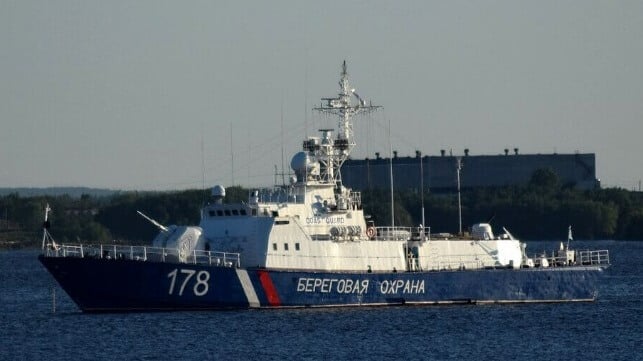
The Soviet-era patrol boat spent nearly 35 minutes in Estonian waters on July 26 (Sasha Krotov - CC BY 3.0)
Estonia’s Ministry of Foreign Affairs and Ministry of Defense released details on what they said was the first violation of Estonia’s maritime border by a Russian ship this year. The incident comes as tensions remain high in the Baltic following several incidents with undersea infrastructure and concerns over the dangers associated with the shadow fleet of tankers.
The Russian Svetlyak class border guard ship, Sochi 500, the Ministry of Defense reports, entered Estonian territorial waters without permission Saturday morning, July 26. The Navy monitored the situation, including identifying the vessel, but no attempt was made to intervene, and after nearly 35 minutes, the patrol boat left Estonian waters. The vessel was as deep as approximately half a kilometer (a third of a mile) inside Estonian waters.
“The violation of Estonia’s maritime border by Russia is a serious and unacceptable incident,” said Estonian Foreign Minister Margus Tsahkna. He reported that “This message was also conveyed to the chargé d’affaires of the Russian Federation,” who the Ministry of Foreign Affairs reported was summoned on July 28 and given a formal notice.
According to the details released by the Ministry of Foreign Affairs, the Soviet-era patrol boat was east of the island of Vaindloo when it crossed the border. They highlighted that foreign vessels are required to give 48 hours' notice before crossing the maritime border, and it is only permitted for an “innocent passage.”
The patrol boat design dates to the 1980s and is reported to be approximately 375 tons displacement. The ships are approximately 161 feet (49 meters) in length, carrying up to 28 crew at speeds of around 30 knots.
While it was the first time a patrol boat entered Estonian waters this year, the country’s Public Media reports Russian aircraft have twice this year entered Estonia’s airspace. One of the incidents was directly related to Estonia’s efforts to inspect a shadow tanker, and it also created an international incident.
Estonia has been proactive in its efforts to crack down on the shadow fleet of tankers after its undersea pipelines and cables were damaged. It also pushed NATO to increase its efforts to safeguard the Baltic.
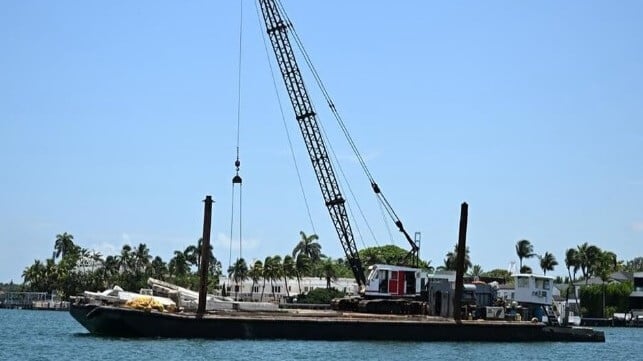
On Monday, a small sailing vessel from a summer-camp program in Miami was involved in a deadly accident with a barge tow in the port's inner harbor.
At about 1100 hours, Coast Guard Sector Miami received notice from Miami-Dade Fire Rescue of a vessel collision between a sailboat and barge. The call reported that six people had gone into the water near Hibiscus Island, a residential development in Miami's inner harbor.
The sailboat was a small sail training launch with one camp counselor (aged 19) and five children on board, all of them female. Early reports indicate that the sailboat and its occupants were hit by a construction barge, and the boat and some of the personnel ended up underneath the barge's hull.
Miami Beach Fire Rescue crews were first on scene, and were later joined by Miami-Dade Fire Rescue, City of Miami Fire Rescue, Florida Fish and Wildlife, and Coast Guard Station Miami Beach. All six people were recovered from the water; unfortunately, two of the children - aged seven and 13 - were declared dead upon arrival at Jackson Memorial Hospital. Two more remain in critical condition. The counselor and one other child were evaluated at the scene and released.
"Our hearts are with the families of those lost and all who have been affected by this tragedy," said Capt. Frank Florio, Commander of Coast Guard Sector Miami. "Incidents like this leave a lasting impact on our maritime community and reinforce the importance of learning from every loss. The Coast Guard will conduct a thorough investigation to determine the causal factors."
As of Monday evening, the sailing vessel remained submerged under the barge. Sector Miami kept a boat crew on scene to maintain a 250-yard safety zone.
The U.S. Coast Guard and Florida Fish and Wildlife are jointly investigating the accident.
Protestors Square Off with Police and Block Cruise Ship in Amsterdam
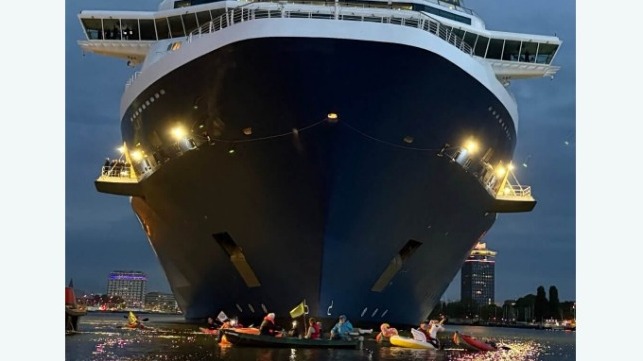
Protestors in small boats, canoes, and inflatables blocked the crusie ship from reaching the dock in Amsterdam (Extinction Rebellion)
The environmental group Extinction Rebellion renewed its protests against cruise ships docking in the Netherlands during an incident that resulted in a confrontation and arrests in Amsterdam. Last year, the same group staged several protests blocking one of the locks to enter the port, but this year they took to small boats and proudly said they were able to delay the cruise ship Celebrity Eclipse from docking.
Approximately 30 individuals positioned themselves in canoes, boats, and inflatables between the cruise ship and the dock in the heart of Amsterdam. Pictures showed some of the small boats surrounding the bow of the large cruise ship, while others were between the ship and the dock.
“They should not be allowed in Dutch waters,” the group said in a statement on social media. “We will continue the actions like this until this harmful tourist industry is banned from Amsterdam and the rest of the Netherlands.” The group cites the environmental impact of the cruise industry on “humans, nature, and the climate.”
The 121,878 gross ton cruise ship was completing an 11-day trip and was docking at the Passenger Terminal Amsterdam. According to reports, there were 2,850 passengers and approximately 1,200 crewmembers aboard.
The protestor began at approximately 4:30 a.m. local time before the cruise ship arrived, and police responded by sending launches to clear the waterway. The protestors are contending that the police ran over their inflatable boats. The incident is reported to have lasted about two hours on July 26.
The police said that five people were arrested for assault, blocking the cruise ship, and refusing to show identification. Newspaper reports said two of the individuals were quickly released.
A spokesperson for the port authority cited the dangers of this type of protest. They said these types of small boats should not have approached the 1,040-foot (315-meter) cruise ship. They cited the dangers as well as the potential that the vessel’s propellers or bow thrusters could have created dangerous conditions for the small boats.
Last year, the group was successful in getting several cruise ships to turn around or reschedule their port stops, docking outside the heart of the city, and busing passengers to Amsterdam. City officials responded by putting a limit on the number of cruise ships permitted to come to the port and said their longer-term plan is to move the cruise ship terminal outside the center of the city.
Hedge funds’ bullish gold wagers rise to highest since April
Money managers boosted their bullish wagers on bullion to the highest since April before the US and the European Union made progress on trade talks.
Hedge funds and other large speculators increased net-long positions by 19% to 170,868 contracts for the week ended July 22. The level was the highest in 16 weeks, US government data showed on Friday.
The trade war unleashed by the Trump administration has helped power gold’s 27% rally this year. While a de-escalation of trade tensions would weaken haven demand, gold has also seen support from strong central-bank buying.
Battery startup raises $200 million to fund Northvolt deal
Lyten, a California startup developing lithium-sulfur batteries, raised $200 million from existing investors to fund its acquisition of assets from bankrupt manufacturer Northvolt AB.
The new funding enables Lyten to acquire intellectual property related to energy storage systems, in addition to its previously announced deal to purchase and restart production at Northvolt’s Polish assembly plant. The money may also be used to fund further acquisitions, the company said.
Lyten is accelerating acquisitions to tap into demand for stationary storage and military drones in Europe, said Keith Norman, the company’s chief marketing and sustainability officer. It’s also pivoting from just making cells for the US market, where a slowdown in electric-vehicle sales has forced companies to rethink their business models.
“We’re moving downstream in the batteries to own more of the value chain,” Norman said. “And we’re identifying manufacturing assets that are potentially available at a discount to their value because of the challenges in the market.”
Norman declined to say how much Lyten is paying for Northvolt’s IP or the Poland plant. The factory cost Northvolt about $200 million to build.
Lyten’s strategy shift has spurred cost-cutting and a reorganization. Last week, Celina Mikolajczak, a Tesla Inc. veteran who led the push to commercialize Lyten’s proprietary lithium-sulfur battery cells, was let go along with about 45 other employees, The Information reported. Lyten confirmed Mikolajczak left the company and declined to comment on changes in headcount.
“We’re moving into a hyper-growth phase into some very specific markets, in very specific geographies, and we need to make sure our resources in the organization are aligned to these opportunities,” Norman said.
Mikolajczak said she was pleased Lyten managed to get a battery chemistry that many thought was a “no-hoper” to the point of commercialization during her tenure.
“That’s a huge achievement, and I am super proud to have been part of the team to do it,” she said.
Lyten will restart production at the Gdansk, Poland factory, which was idled in the first quarter, using conventional nickel-based cells that Northvolt had already built. It plans to resume customer deliveries by the fourth quarter of this year.
Longer term, Lyten aims to convert the factory to use its proprietary lithium-sulfur cells, which it says are cheaper to produce and don’t rely on ingredients controlled by China. It also contends its lithium-sulfur cells can compete on price and energy density with Chinese lithium iron phosphate cells that dominate the energy storage market.
The Polish hub produces energy storage products, including housing, wiring, inverters, control and safety systems and other components. Last year, Lyten bought a lithium-metal manufacturing facility near San Francisco that belonged to Cuberg, a startup Northvolt acquired in 2021.
Lyten’s investors include Prime Movers Lab, Luxembourg Future Fund, Stellantis NV and FedEx Corp.
(By Gabrielle Coppola)
Pilot Mountain tungsten project in Nevada gets $6M from Department of Defense
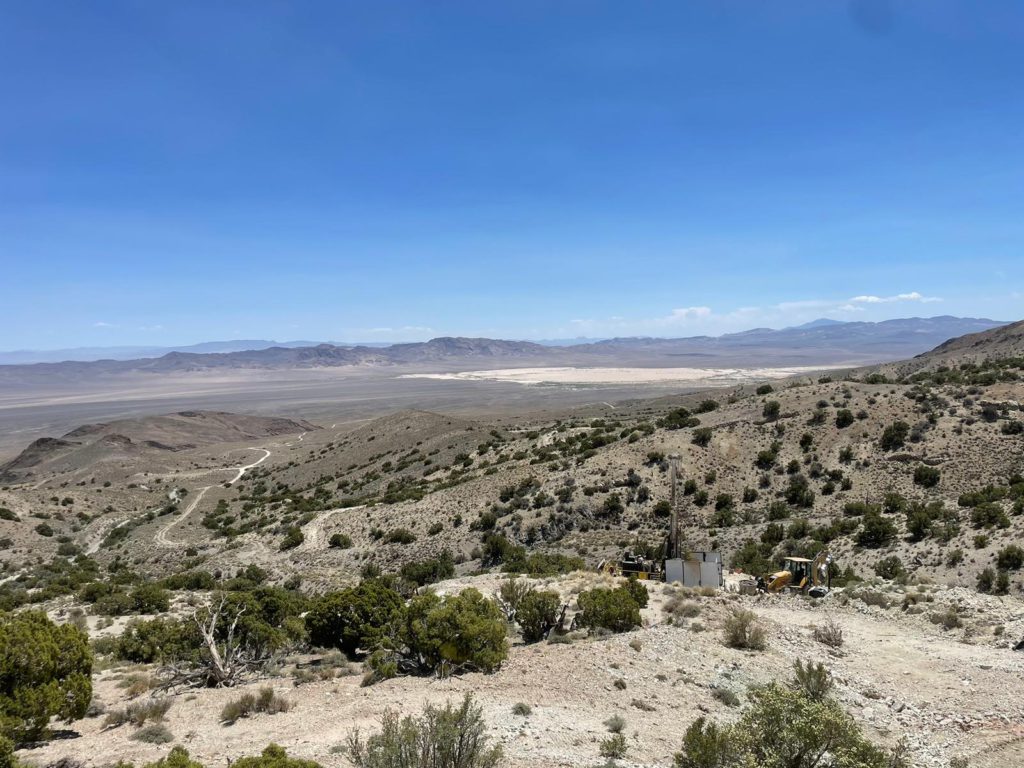
Pilot Mountain tungsten project in Nevada. Image from Guardian Metal Resources.
The Department of Defense announced this week a $6.2 million award to Guardian Metal Resources (LON: GMET) to advance its Pilot Mountain tungsten project in Nevada.
The funds will enable London-listed Guardian Metal’s wholly-owned US-based subsidiary Golden Metal Resources to deliver a pre-feasibility study for Pilot Mountain, located southeast of Hawthorne. Guardian is the only company with US based tungsten assets to receive an award, and is also advancing another tungsten project in Nevada: Tempiute.
The tungsten market had an estimated value of around $5 billion in 2023. It is the material of choice for a key defense application — penetrators — which are high-density, armour-piercing projectiles. It’s also required in US Department of Defence (DoD) contracts.
European tungsten prices surged to their highest in 12 years in May, driven by China’s tightening grip on critical mineral exports, including tungsten.
Tungsten production in the US ceased in 2015, when it was no longer commercially viable due to low prices and competition from China.
China dominates global tungsten production, accounting for over 80% of last year’s total output of 81,000 tons, according to the USGS.
Another company exploring tungsten deposits in the US is American Tungsten, which started construction and building work in May for the mine plan at its Ima project in Idaho. Between 1945 and 1957, the property produced approximately 199,449 metric ton units of tungsten trioxide (WO3).
Excitement brewing in tungsten space
While Guardian Metals CEO Oliver Friesen is fairly new to the tungsten space, he is an exploration veteran in the state of Nevada, and worked as a geologist for Barrick on numerous drill campaigns.
“Pilot Mountain came across my desk and it just so happened to have the largest tungsten deposit in the entire USA in Nevada,” Friesen told MINING.com in an interview in June. “I realized that there was something really exciting brewing in the tungsten space.”
“[It was] contrarian to acquire a tungsten deposit when no one wanted it in the US,” Friesen said. “And now obviously it’s become incredibly valuable and we’ve positioned ourselves very strategically in the US to lead the reshoring efforts here in the country.”
“Our plans are to continue to de-risk our two main assets in Nevada and get them into production. What we have is really important for US national security and we can supply a very meaningful amount of tungsten to the US market.”
The company is working towards expanding its mineral resource estimate (MRE) which was established in 2017 and 2018 that outlined 12.53Mt at 0.27% WO3 with significant copper-silver-zinc credits.
Drilling to support the updated resource for the PFS is all now complete, Friesen said, adding high grade gallium has also been intersected at both the Pilot Mountain and Tempiute projects.
In June, the company released assay results and announced newly staked exploration targets at Tempiute.
In July, Guardian acquired additional mining claims in the Walker Lane mineral belt, about 15 km northwest of Pilot Mountain, to form what is to be known as the Pilot North tungsten project.
“On the permitting side, we’re seeing tailwinds from the new administration and the DOI,” Friesen said. “Given our position in US tungsten, we’re getting chased to get [applications] submitted. The government is serious about fast tracking defense metal projects. US investors want American mines … here’s a very viable solution for domestic mined tungsten.”
Peru mulls green light for $6 billion in mining projects
Peru is considering whether to give the green light to a wave of new mining projects worth a combined $6 billion in investments, President Dina Boluarte said on Monday, as her deeply unpopular government seeks to boost revenues from the industry.
The government is evaluating the authorization of 134 exploration and exploitation projects, Boluarte said in a traditional Independence Day address to Congress.
Officials in Peru, the world’s third-biggest copper producer, are in talks with informal miners who launched protests in late June, blocking a transport corridor used by major miners including MMG and Glencore.
Miners have paused that protest and corridor blockade during negotiations over a potential new law for the sector.
Among informal miners, tensions escalated after over 50,000 were removed from a formalization scheme, leaving just 31,000 that the government is seeking to bring in line with regulations by year end.
Boluarte said the government was working on starting a private mining fund to give small formal miners access to better financing. As she spoke, police used tear gas to disperse hundreds of protesters marching toward Congress. Some carried cardboard coffins, a reference to the dozens killed during unrest early in her term.
Recent polls put Boluarte’s approval ratings at between 2% and 4%, among the lowest for any world leader.
In the address, the president also announced a deal with Ecuador’s state oil firm Petroecuador to connect Ecuadorean oil fields to a Peruvian pipeline, allowing transport to Peru’s Talara refinery.
Poverty near 30%
While Peru’s economy has rebounded from a recession triggered by anti-government unrest, poverty levels remain near 30%.
Boluarte, whose term ends in 2026, took office in late 2022 after her predecessor, Pedro Castillo, was ousted and arrested for attempting to illegally dissolve Congress.
She faces an investigation over the deaths during subsequent protests, for which she denies wrongdoing. Her cabinet sparked further outrage in July by doubling her salary.
“The icing on the cake is raising their salaries and colluding with those with power to keep plundering the country’s natural resources,” said protester Milagros Sanchez, a public school teacher.
The Andean nation has been mired in political instability, with six presidents since 2018. The next general election is scheduled for April 2026.
(By Marco Aquino and Sarah Morland; Editing by Natalia Siniawski and David Gregorio)