Fighting on Thai-Cambodia border halts amid shaky truce
Surin (Thailand) (AFP) – A shaky ceasefire between Thailand and Cambodia appeared to be holding Tuesday, as military commanders met despite Bangkok's allegations the truce had been breached with overnight skirmishes.
Issued on: 28/07/2025 - FRANCE24
 Evacuees laugh at a performance at an shelter in the Thai border province of Surin on July 28 after the ceasefire announcement © Lillian SUWANRUMPHA / AFP
Following peace talks in Malaysia on Monday, both sides agreed an unconditional ceasefire would start at midnight to end fighting over a smattering of ancient temples in disputed zones along their 800-kilometre (500-mile) border.
On Tuesday, the Thai military said Cambodian troops "had launched armed attacks into several areas" in "a clear attempt to undermine mutual trust", but said clashes later stopped.
Cambodia's defence ministry spokeswoman Maly Socheata insisted there had been "no armed clashes against each other in any regions".
However, both sides said morning meetings between rival military commanders along the border -- scheduled as part of the pact -- had gone ahead.
Thailand's army said three meetings on the frontier had seen senior officers agree to de-escalation measures including "a halt on troop reinforcements or movements that could lead to misunderstandings".
But a foreign affairs spokeswoman for Bangkok's border crisis centre, Maratee Nalita Andamo, warned on Tuesday afternoon: "In this moment, in the early days of the ceasefire, the situation is still fragile".
Deadliest clashes in years
Cambodian leader Hun Manet and Thai acting Prime Minister Phumtham Wechayachai shook hands over the ceasefire deal Monday at peace talks hosted by Malaysia and attended by delegates from the United States and China.
"I saw photos of the two leaders shaking hands," said 32-year-old pharmacy worker Kittisak Sukwilai in the Thai city of Surin -- 50 kilometres from the border.
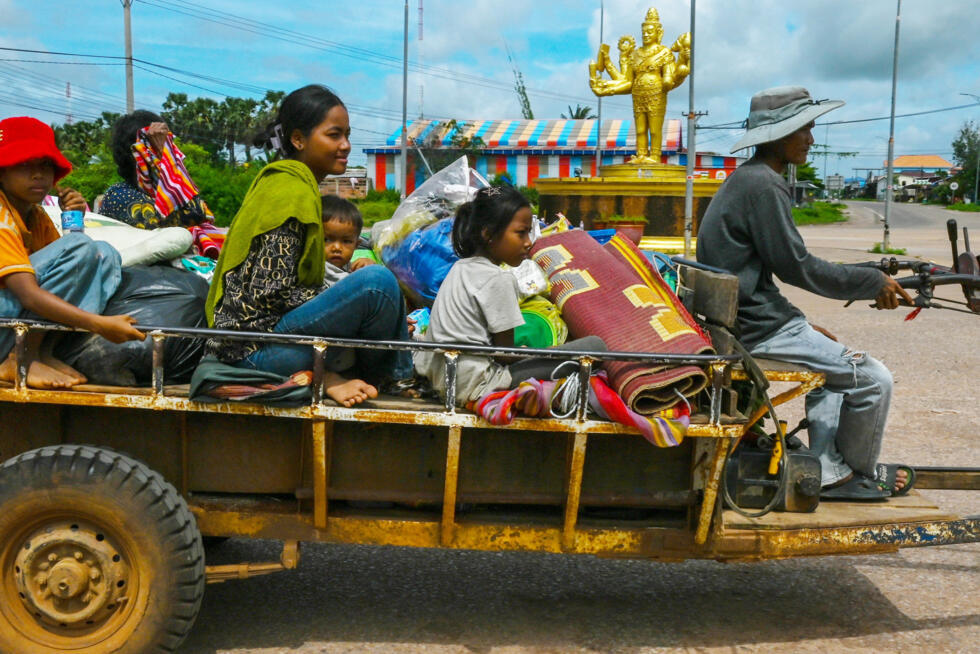 People who fled the border return to their homes in Oddar Meanchey province, Cambodia, following the ceasefire © TANG CHHIN Sothy / AFP
"I just hope it's not just a photo op with fake smiles -- and that those hands aren't actually preparing to stab each other in the back."
In Cambodia's Samraong city -- 20 kilometres from the frontier -- an AFP journalist said the sound of blasts stopped in the 30 minutes leading up to midnight, with the lull continuing until midday.
"The frontline has eased since the ceasefire at 12 midnight," Cambodian Prime Minister Hun Manet said in a Tuesday morning message on Facebook.
Jets, rockets and artillery killed at least 42 people since last Thursday and displaced more than 300,000 -- prompting intervention from US President Donald Trump over the weekend.
On the Cambodian side of the border, evacuees were seen leaving shelter centres Tuesday to return home, but on the Thai side acting Prime Minister Phumtham urged citizens "to await official instructions" before departing.
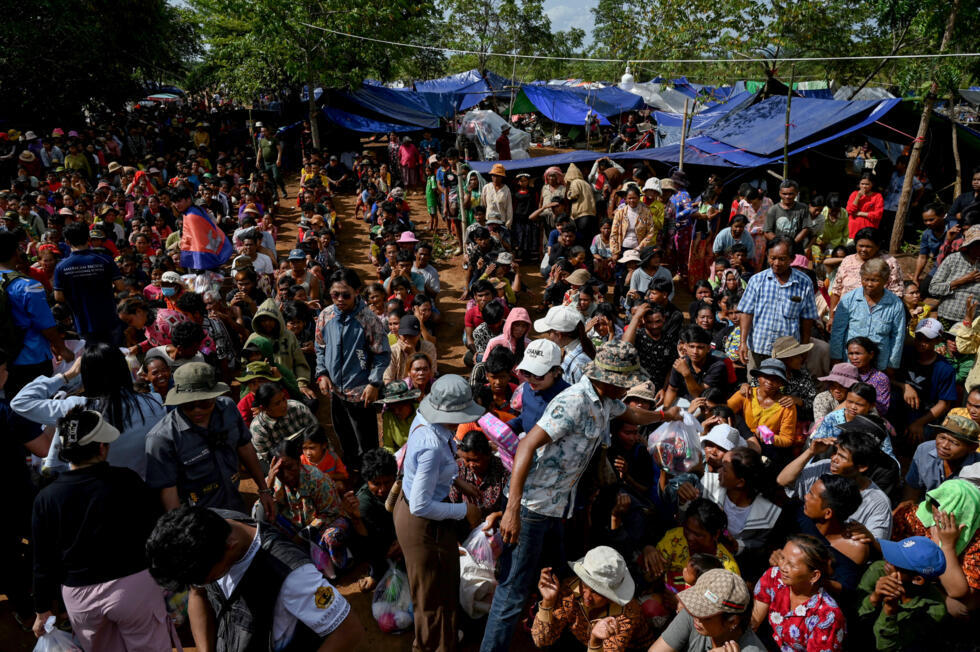 People who fled their homes near the border between Cambodia and Thailand gather at a food distribution site on the grounds of a pagoda in Oddar Meanchey province, Cambodia © TANG CHHIN Sothy / AFP
The flare-up was the deadliest since violence raged sporadically from 2008-2011 over the territory, claimed by both because of a vague demarcation made by Cambodia's French colonial administrators in 1907.
A joint statement from both countries -- as well as Malaysia -- said the ceasefire was "a vital first step towards de-escalation and the restoration of peace and security".
'Good faith'
Both sides are courting Trump for trade deals to avert his threat of eye-watering tariffs, and the US State Department said its officials had been "on the ground" to shepherd peace talks.
 Malaysia's Prime Minister Anwar Ibrahim (centre) looks on as Cambodia's Prime Minister Hun Manet (left) and Thailand's acting Prime Minister Phumtham Wechayachai (right) take part in talks on a possible ceasefire in Putrajaya © MOHD RASFAN / POOL/AFP
"I have instructed my Trade Team to restart negotiations on Trade," Trump said in a message on his Truth Social platform, taking credit for the ceasefire deal after it was announced.
"The US and I are still in negotiations," Thailand's Finance Minister Pichai Chunhavajira told reporters on Tuesday. "We're still waiting for the US to decide whether to accept our proposal."
Hun Manet thanked Trump for his "decisive" support, while his Thai counterpart Phumtham said the truce should be "carried out in good faith by both sides".
Each side had already agreed to a truce in principle while accusing the other of undermining peace efforts, trading allegations about the use of cluster bombs and targeting of hospitals.
More than 188,000 people have fled Thailand's border regions, while around 140,000 have been driven from their homes in Cambodia.
burs-jts/fox
© 2025 AFP
Following peace talks in Malaysia on Monday, both sides agreed an unconditional ceasefire would start at midnight to end fighting over a smattering of ancient temples in disputed zones along their 800-kilometre (500-mile) border.
On Tuesday, the Thai military said Cambodian troops "had launched armed attacks into several areas" in "a clear attempt to undermine mutual trust", but said clashes later stopped.
Cambodia's defence ministry spokeswoman Maly Socheata insisted there had been "no armed clashes against each other in any regions".
However, both sides said morning meetings between rival military commanders along the border -- scheduled as part of the pact -- had gone ahead.
Thailand's army said three meetings on the frontier had seen senior officers agree to de-escalation measures including "a halt on troop reinforcements or movements that could lead to misunderstandings".
But a foreign affairs spokeswoman for Bangkok's border crisis centre, Maratee Nalita Andamo, warned on Tuesday afternoon: "In this moment, in the early days of the ceasefire, the situation is still fragile".
Deadliest clashes in years
Cambodian leader Hun Manet and Thai acting Prime Minister Phumtham Wechayachai shook hands over the ceasefire deal Monday at peace talks hosted by Malaysia and attended by delegates from the United States and China.
"I saw photos of the two leaders shaking hands," said 32-year-old pharmacy worker Kittisak Sukwilai in the Thai city of Surin -- 50 kilometres from the border.
"I just hope it's not just a photo op with fake smiles -- and that those hands aren't actually preparing to stab each other in the back."
In Cambodia's Samraong city -- 20 kilometres from the frontier -- an AFP journalist said the sound of blasts stopped in the 30 minutes leading up to midnight, with the lull continuing until midday.
"The frontline has eased since the ceasefire at 12 midnight," Cambodian Prime Minister Hun Manet said in a Tuesday morning message on Facebook.
Jets, rockets and artillery killed at least 42 people since last Thursday and displaced more than 300,000 -- prompting intervention from US President Donald Trump over the weekend.
On the Cambodian side of the border, evacuees were seen leaving shelter centres Tuesday to return home, but on the Thai side acting Prime Minister Phumtham urged citizens "to await official instructions" before departing.
The flare-up was the deadliest since violence raged sporadically from 2008-2011 over the territory, claimed by both because of a vague demarcation made by Cambodia's French colonial administrators in 1907.
A joint statement from both countries -- as well as Malaysia -- said the ceasefire was "a vital first step towards de-escalation and the restoration of peace and security".
'Good faith'
Both sides are courting Trump for trade deals to avert his threat of eye-watering tariffs, and the US State Department said its officials had been "on the ground" to shepherd peace talks.
"I have instructed my Trade Team to restart negotiations on Trade," Trump said in a message on his Truth Social platform, taking credit for the ceasefire deal after it was announced.
"The US and I are still in negotiations," Thailand's Finance Minister Pichai Chunhavajira told reporters on Tuesday. "We're still waiting for the US to decide whether to accept our proposal."
Hun Manet thanked Trump for his "decisive" support, while his Thai counterpart Phumtham said the truce should be "carried out in good faith by both sides".
Each side had already agreed to a truce in principle while accusing the other of undermining peace efforts, trading allegations about the use of cluster bombs and targeting of hospitals.
More than 188,000 people have fled Thailand's border regions, while around 140,000 have been driven from their homes in Cambodia.
burs-jts/fox
© 2025 AFP
Ceasefire in Cambodia–Thailand border conflict to commence at midnight, July 28
_Cropped.jpg)
Cambodia and Thailand have reached an agreement to implement a ceasefire starting at midnight on July 28, following high-level peace talks held in Kuala Lumpur earlier today between Cambodian Prime Minister Hun Manet and Thailand’s acting Prime Minister Phumtham Wechayachai, according to Kiripost.
The decision, which brings a halt to five days of escalating violence along the border, was made during a dialogue facilitated by Malaysia in its capacity as ASEAN Chair, with co-organisation by the United States and the involvement of China.
According to the agreement, hostilities between the two nations will cease immediately and unconditionally as of 12:00am on July 28. Prime Minister Hun Manet expressed gratitude to his Thai counterpart and voiced hope that the breakthrough would pave the way for renewed bilateral discussions, aimed at restoring diplomatic relations and promoting long-term stability along the border.
As part of the de-escalation efforts, an informal gathering between Cambodian and Thai regional military commanders, specifically from Cambodia’s Military Regions 4 and 5, and Thailand’s Regions 1 and 2, is scheduled for 7:00 am on July 29. This will be followed by a broader meeting involving defence attachés, to be chaired by Malaysian Prime Minister Anwar Ibrahim.
In a joint press conference following the talks, Prime Minister Anwar announced that Cambodia will host a General Border Committee meeting on August 4 to further develop frameworks for peaceful cooperation.
Both nations have agreed to resume direct communication between their prime ministers, foreign ministers, and defence ministers. Anwar also revealed that foreign and defence officials from Malaysia, Cambodia, and Thailand have been instructed to establish a detailed mechanism to guide the implementation, monitoring, and verification of the ceasefire. “This mechanism will form the basis for enduring peace and mutual accountability,” he stated.
The peace negotiations, which came as clashes entered their fifth day, were actively mediated by Malaysia and supported by the United States, with China also taking part. While Prime Minister Hun Manet had consistently advocated for a ceasefire, progress only materialised after intervention by US President Donald Trump.
Hun Manet acknowledged both Anwar and Trump for their instrumental roles in brokering the agreement. “This was a highly productive meeting, delivering immediate and meaningful outcomes to halt the violence that has caused numerous deaths, injuries, and displacement,” he said.
He disclosed that approximately 300,000 individuals had been displaced by the conflict, 140,000 in Cambodia and 160,000 in Thailand. He expressed optimism that the ceasefire would serve as a stepping stone towards normalised relations and regional stability.
“I fully appreciate today’s result and am confident it will bring about positive change for hundreds of thousands of citizens on both sides,” he stated. “It is time to end the fighting and begin rebuilding trust, confidence, and cooperation between our two nations.”
Acting Prime Minister Wechayachai echoed this sentiment, emphasising Thailand’s commitment to a peaceful resolution. “While steadfast in defending our sovereignty and protecting our citizens, we are prepared to pursue all necessary guarantees to ensure the ceasefire is honoured sincerely by both parties,” he affirmed.

 A man of short posture and deliberate speech, Uribe is a divisive figure: loved and hated in equal measure © Luis ACOSTA / AFP