Friday, August 15, 2025


Lake on the 79°N Glacier is splitting the ice – leaving permanent changes


Alfred Wegener Institute, Helmholtz Centre for Polar and Marine Research
Ice thickness measurement flight over the 79-degree North Glacier, Greenland. 

image: 

In 1995 large meltwater lake formed and developed on the surface of the 79°N Glacier. Researchers observed that over the years, this lake has caused gigantic cracks and the outflowing water is lifting the glacier. 

view more 

Credit: Alfred-Wegener-Institut


The lake first appeared in the observation data of the year 1995. "There were no lakes in this area of the 79°N Glacier before the rise in atmospheric temperatures in the mid-1990s," as Prof. Angelika Humbert, glaciologist at the Alfred Wegener Institute Helmholtz Centre for Polar and Marine Research (AWI) stated. "From the time of its formation in 1995 until 2023, the lake's water repeatedly and abruptly drained through channels and cracks in the ice, causing massive amounts of fresh water to reach the edge of the glacier tongue towards the ocean." There were a total of seven such drainage events, four of which took place in the last five years. 

"During these drainages, extensive triangular fracture fields with cracks in the ice formed from 2019 onwards, which are shaped differently from all lake drainages I have seen so far," Angelika Humbert marvels. Some of these cracks form channels with openings several dozen metres wide (moulins). Water flows through these moulins also after the main drainage of the lake, meaning that within hours, a huge amount of water reaches the base of the ice sheet. "For the first time, we have now measured the channels that form in the ice during drainage and how they change over the years." 

After the lake had formed in 1995, its size decreased over time with the first cracks appearing. In recent years, the drainage has occurred at increasingly shorter intervals. "We suspect that this is due to the triangular moulins that have been reactivated repeatedly over the years since 2019," says Angelika Humbert. The material behaviour of the glacier plays a role here: on the one hand, the ice behaves like an extremely thick (viscous) fluid that flows slowly over the substrate. At the same time, however, it is also elastic, allowing it to deform and return to its original shape, similar to a rubber band. The elastic nature of the ice is what allows cracks and channels to form in the first place. On the other hand, the creeping nature of the ice helps channels inside the glacier to close again over time after the drainage has taken place. "The size of the triangular moulin fractures on the surface remains unchanged for several years. Radar images show that although they change over time inside the glacier, they are still detectable years after their formation." This data also reveals that there is a network of cracks and channels, meaning that there is more than one way for the water to escape. 

Meltwater is lifting the glaciers

The researchers were able to see shadows along the cracks in some aerial photographs. "In some cases, the ice at the fracture surfaces has also shifted in height, as if it were raised more on one side of the moulin than on the other," as Angelika Humbert related. The largest shift is encountered directly in the lake, which is due to the enormous masses of water that have entered the cracks beneath the glacier and formed a subglacial lake there. Radar images from inside show that a blister has apparently formed on this lake beneath the ice, pushing the glacier upwards at this point. Even more than 15 years after the first drainage, the cracks are still visible on the surface. 

In conducting their study, the researchers analysed data from various measurements. Using satellite remote sensing data and data from airborne surveys, they were able to investigate how the lake fills and drains and the paths of the water within the glacier. Viscoelastic modelling enabled them to determine whether and how drainage paths close over time. The results raise a crucial question: Have the frequent drainages forced the glacier system into a new state, or can the system (still) return to a normal winter state in spite of these extreme amounts of water? "In just ten years, recurring patterns and regularity have developed in the drainage, with massive and abrupt changes in meltwater inflow on a timescale of hours to days," says Angelika Humbert. "These are extreme disturbances within the system, and it has not yet been investigated whether the glacial system can absorb this amount of water and is able to influence the drainage itself." 

The study provides important data for integrating cracks into ice sheet models and researching as to how they form and influence the glacier. AWI researchers are working closely with scientists from TU Darmstadt and the University of Stuttgart on the modelling. Understanding and taking the behaviour and effects of cracks in the glacier into account is particularly important when regarding the development of the lake on the 79°N Glacier: due to the advancing warming of the atmosphere, the fracture surfaces have been occurring further and further up the slope, impacting on an increasingly larger area of the glacier.

Original publication

Humbert, A., Helm, V., Zeising, O., Neckel, N., Braun, M. H., Khan, S. A., Rückamp, M., Steeb, H., Sohn, J., Bohnen, M., and Müller, R.: Insights into supraglacial lake drainage dynamics: triangular fracture formation, reactivation and long-lasting englacial features, The Cryosphere, 19, 3009–3032, https://doi.org/10.5194/tc-19-3009-2025, 2025.


New report urges the UK Government to use vaccines in the fight against superbugs


Microbiology Society


Antimicrobial resistance (AMR) is when microbes become resistant to the treatments used against them. It is one of the most pressing global health threats of our time, undermining the efficacy of life-saving treatments and placing a growing burden on health systems worldwide.

A new report, published by the President of the Microbiology Society, argues that while vaccines are recognised for their ability to prevent infections and reduce antibiotic use, thereby slowing the emergence of resistance, their role in addressing AMR remains underexploited in both policy and practice.

The paper reports on a workshop run by the Microbiology Society which brought together thought leaders on vaccines in academia, industry, policy and the clinical and veterinary sectors. Chaired by Microbiology Society President, Professor Gordon Dougan, the report urges the UK Government to remove policy and regulatory barriers that limit vaccine deployment in AMR strategies and create incentives for public-private collaboration in vaccine development.

Professor Dougan explains "AMR is no longer a looming threat: it is a present-day crisis affecting lives, healthcare systems, and economies around the world. Yet, despite the scale of the problem, we have not fully harnessed one of our most powerful tools: vaccines."

Big Business Rejoices as Trump Scraps Biden Order Combating 'Excessive Concentration of Industry'

One critic called the president's move a "signal to monopolists that they have a clear path."


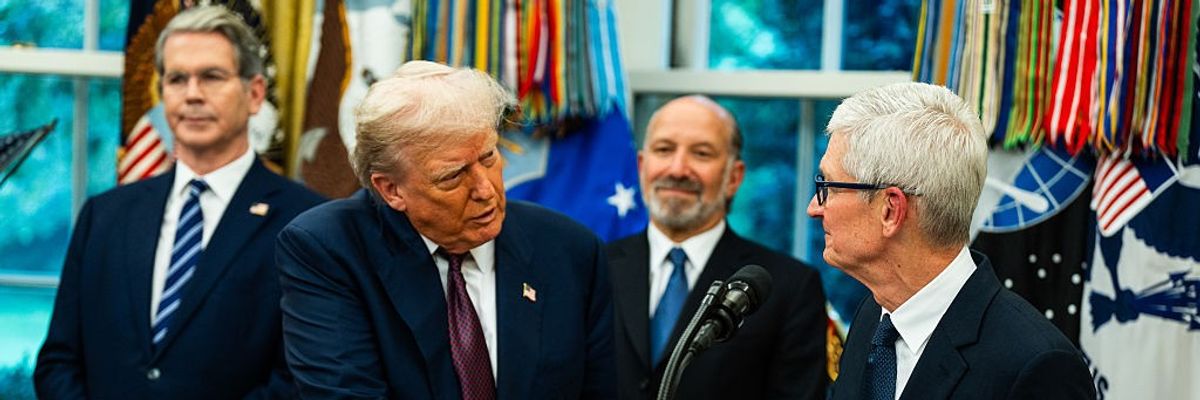
US President Donald Trump shakes hands with Apple CEO Tim Cook during a meeting in the Oval Office on August 6, 2025.
(Photo: Demetrius Freeman/The Washington Post via Getty Images)


Jake Johnson
Aug 15, 2025
COMMON DREAMS


US President Donald Trump continued taking a hatchet to his predecessor's antitrust legacy this week by rolling back an executive order that affirmed the federal government's responsibility to "enforce the antitrust laws to combat the excessive concentration of industry, the abuses of market power, and the harmful effects of monopoly and monopsony."

Trump's revocation of former President Joe Biden's 2021 order drew enthusiastic applause from the largest corporate lobbying organization in the United States.


Sean Heather, the US Chamber of Commerce's senior vice president for antitrust, declared that by repealing the Biden order—which was titled "Executive Order on Promoting Competition in the American Economy"—Trump "has rightfully chosen vigorous competition that entrusts American consumers to pick winners and losers in the marketplace, not more government bureaucracy."

One anti-monopoly advocate, Matt Stoller of the American Economic Liberties Project, mockingly congratulated Trump for "securing the approval of the US Chamber of Commerce in repealing Biden's executive order saying competition is good."

The American Prospect's David Dayen called the president's move a "signal to monopolists that they have a clear path."

The president's decision was also welcomed by officials within the Trump administration who are tasked with enforcing the nation's antitrust laws, including Federal Trade Commission (FTC) Chair Andrew Ferguson and the head of the Justice Department's Antitrust Division, Gail Slater.

Ferguson claimed in a statement Thursday that the Biden order reflected the previous administration's "undue hostility toward mergers and acquisitions"—an assertion that Open Markets Institute legal director Sandeep Vaheesan refuted in a social media post, citing recent trends in merger enforcement actions.


Biden administration antitrust officials—principally former FTC Chair Lina Khan and former DOJ Antitrust Division head Jonathan Kanter—drew praise across the political spectrum for combating corporate abuses and unlawful consolidation.

But during the first six months of his second term, Trump and his handpicked agency heads have settled or dropped key merger challenges brought by the Biden administration, ceding repeatedly to well-connected corporate lobbyists and allowing giant companies such as UnitedHealth to continue absorbing their competitors.

According to a newly updated tally by the consumer advocacy group Public Citizen, Trump administration agencies have thus far dropped enforcement actions against at least 165 companies.

"Pro-monopoly and pro-concentration of corporate power and control. Those are the policies the Trump admin has espoused in firing fair competition enforcers and revoking an executive order to revitalize fair competition across markets," the Open Markets Institute said Thursday. "And prices are still sky high. No surprise."
Plastics Treaty Talks End in 'Abject Failure' as US, Other Big Oil Allies Sabotage Progress

"The vast majority of governments want a strong agreement, yet a handful of bad actors were allowed to use process to drive such ambition into the ground," said one environmentalist.


Luis Vayas Valdivieso, chairman of the negotiations on a global treaty on plastic pollution, looks on with members of his office in Geneva on August 15, 2025.
(Photo: Fabrice Coffrini/AFP via Getty Images)


Jake Johnson
Aug 15, 2025
COMMON DREAMS

Negotiators in Geneva adjourned what was expected to be the final round of plastics treaty negotiations on Friday without reaching an agreement, a failure that environmentalists blamed on the Trump-led United States, Saudi Arabia, and other powerful nations that opposed any effort to curb plastic production—the primary driver of a worsening global pollution crisis.

The Intergovernmental Negotiating Committee (INC) on Plastic Pollution agreed after 10 days of talks to resume negotiations at a yet-to-be-announced future date. Lobbyists from the fossil fuel industry swarmed the negotiations, working successfully to prevent a binding deal to slash plastic production. More than 99% of plastics are made from fossil fuel chemicals.

"The inability to reach an agreement in Geneva must be a wake-up call for the world: ending plastic pollution means confronting fossil fuel interests head-on," said Graham Forbes, Greenpeace USA's Global Plastics Campaign lead. "The vast majority of governments want a strong agreement, yet a handful of bad actors were allowed to use process to drive such ambition into the ground. We cannot continue to do the same thing and expect a different result. The time for hesitation is over."

The high-stakes talks marked the sixth time international negotiators have convened in an effort to craft a plastics treaty as production continues to grow and toxic pollution damages oceans, waterways, and communities across the globe. Talks in December similarly concluded without a deal.

The latest round of negotiations faltered after nations refused to rally around a pair of draft treaty documents—but for different reasons.

Supporters of a strong agreement—including Fiji, France, and Panama—objected to the exclusion of any binding plastic production cuts in the drafts, while the US, Saudi Arabia, the United Arab Emirates, and others balked at the scope of the proposals and argued any treaty should focus primarily on waste management.

The proposal unveiled Friday in a last-ditch attempt to reach consensus acknowledged that "current levels of production and consumption of plastics are unsustainable" but did not include any binding limits.

Under the current process, every nation must agree on a proposal's inclusion in treaty text.

Countries that want a treaty must now leave this process and form a treaty of the willing. And that process must include options for voting that deny the tyranny of consensus we have watched play out here.

Agnès Pannier-Runacher, France's minister of ecological transition, didn't attempt to hide her fury at the outcome of the latest round of talks, calling out the "handful of countries" that "blocked the adoption of an ambitious treaty against plastic pollution" because they were "guided by short-term financial interests rather than the health of their populations and the sustainability of their economies."

"The scientific and medical evidence is overwhelming: plastic kills. It poisons our oceans, our soils, and ultimately, it contaminates our bodies," said Pannier-Runacher. "I am angry because France, together with the European Union and a coalition of more than 100 countries from every continent—developed and developing, determined and ambitious—did everything possible to obtain an agreement that meets the urgency of the moment: to reduce plastic production, ban the most dangerous products, and finally protect the health of our populations."

David Azoulay, who led the delegation for the Center for International Environmental Law in Geneva, called the talks "an abject failure" and warned that any future negotiations will end similarly "if the process does not change."

"We need a restart, not a repeat performance," said Azoulay. "Countries that want a treaty must now leave this process and form a treaty of the willing. And that process must include options for voting that deny the tyranny of consensus we have watched play out here."

 Pro-Ukraine rally held in Alaska ahead of Trump-Putin meeting

Ukraine supporters demonstrate ahead of the meeting between US President Donald Trump and Russian President Vladimir Putin in Anchorage, Alaska on August 15, 2025.

 (Photo by Hasan Akbas/Anadolu via Getty Images)

Alaskans With Ukrainian Flags Protest 'Fascist' Trump Meeting 'War Criminal' Putin

"We're here to tell Trump and Putin: Alaska opposes tyranny!"

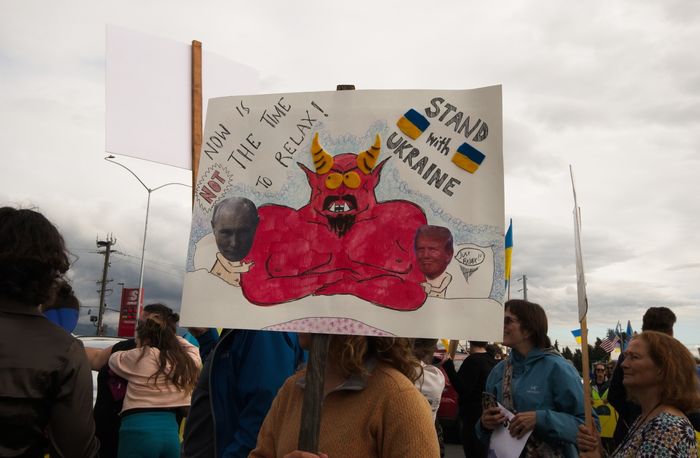
As US President Donald Trump and Russian President Vladimir Putin head to Alaska for a Friday meeting about Russia's invasion of Ukraine, they are being greeted with Ukrainian flags and signs calling out both leaders for their various crimes.

Protesters held banners and posters highlighting Trump's authoritarian takeover—including the deployment of the National Guard in US cities—and Putin's war crimes since launching a full-scale invasion of Ukraine in 2022.

Alaskans are coming together "to protest against an international war criminal hanging out here," the advocacy group Stand UP Alaska said on social media, ahead of the action. "We're here to tell Trump and Putin: Alaska opposes tyranny!"

Some protesters shared their signs on Stand UP Alaska's Facebook page:

(Photo by Timothy Kane)

(Photo by Cynthia Crawford McGinty)

(Photo by Karen Rode)

(Photo by Linda Scates)

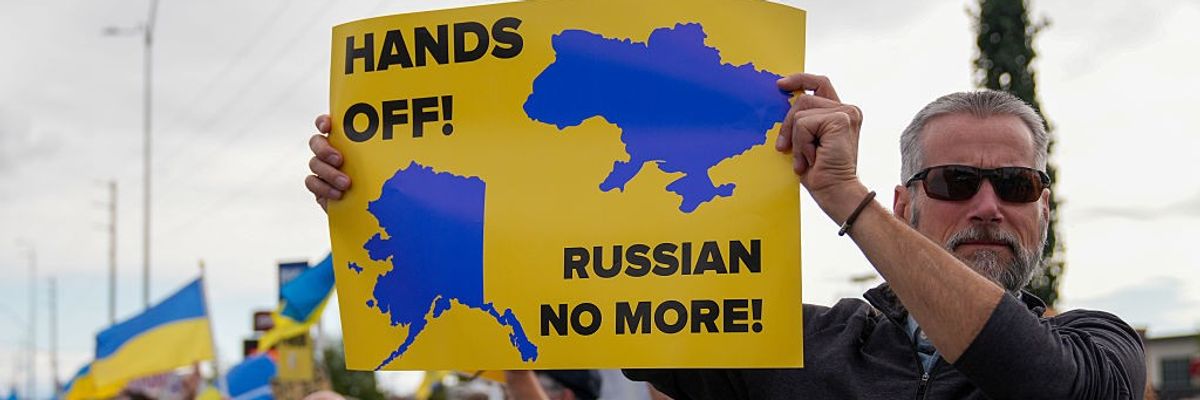
Some signs tied Alaskans' solidarity with Ukraine to the Russian sale of Alaska to the United States in 1867.

The Alaska-based nonprofit Native Movement said in a Friday statement that it "stands with Alaskans and those across the country who condemn any attempt to legitimize Russia's war crimes on Alaskan lands."

"Alaska knows the cost of Russian imperialism," the movement continued. "For over a century, Russian colonizers stole and exploited land, decimated Alaska Native populations through violence, disease, and enslavement, and erased cultures with religious supremacy. Today, we see the same imperial playbook in Ukraine: annexation of territory, targeting of civilians, and the forcible deportation of over 20,000 Ukrainian children—a war crime under international law."

"The decision to host Putin, a war criminal, on Alaskan soil is a betrayal of our history and the moral clarity demanded by the suffering of Ukraine and other occupied peoples," the group added. "Native Movement voices opposition to any deals that force Ukraine to cede territory, reward aggression, or silence the voices of those whose lives are at stake. We stand against the rise of fascism and violent occupation everywhere—whether in Ukraine, Palestine, or here in Alaska. None of us are free until all of us are free."

The Friday demonstration followed a protest on Thursday that drew hundreds of people to an intersection in Anchorage.

Amid calls for including a representative from Ukraine in any peace talks, Trump suggested Thursday that Ukrainian President Volodymyr Zelensky may join him and Putin in Alaska at a later date. He said, "I don't know where we're going to have the second meeting, but we have an idea of three different locations, and we'll be including the possibility, because it would be by far the easiest of staying in Alaska."

The Associated Press reported that "Friday's summit will be at Joint Base Elmendorf-Richardson in Anchorage. The base was crucial to countering the Soviet Union during the Cold War, and it still hosts key aircraft squadrons that intercept Russian aircraft when they fly into U.S. airspace."

According to the Russian state-owned news agency TASS, a one-on-one meeting between the two leaders is set to start at 11:30 am local time. The outlet also noted Trump's comments about Putin to reporters on Air Force One: "He's a smart guy, been doing [politics] for a long time but so have I... We get along, there's a good respect level on both sides, and I think, you know, something's going to come of it."

Meanwhile, White House press secretary Karoline Leavitt notably called the summit a "listening exercise," and Dmitry Peskov, a spokesperson for Putin, said that the two governments don't intend to produce any formal document based on the talks. "However, given that there will be a joint news conference, the president will outline the range of agreements and understandings that can be achieved," Peskov added.

Amnesty International Eastern Europe and Central Asia director Marie Struthers said in a Friday statement that "we urge President Trump, as the meeting's host, to put human rights and matters of justice at its forefront. He has repeatedly expressed his desire to end the war in Ukraine and his regret for people dying; this is President Trump's real chance to do something for the victims and survivors. Upholding human rights and ensuring accountability for crimes under international law committed in Ukraine since the beginning of the Russian intervention in 2014 is the only way to bring a just and lasting end to the war."

The human rights group has documented numerous crimes during the war, including direct attacks on civilians and civilian infrastructureindiscriminate attacksextrajudicial executionsforcible deportationsabuse of prisoners of war, and more. Struthers said:

President Trump must as well take concrete steps to bring the suspected perpetrators of these violations to justice. Vladimir Putin and several other top Russian officials are fugitives from international justice after their indictment by the International Criminal Court. When it comes to the US government's own obligations under international law, the Geneva Conventions in particular, it must search for and try or extradite persons accused of responsibility for grave breaches of the Geneva Conventions. There must be no 'safe haven' for individuals alleged to have committed war crimes and crimes against humanity.

President Trump must also raise the issue of torture and other ill treatmentenforced disappearances, and unlawful prosecution and trials of Ukrainian prisoners of war in Russia. More steps need to be taken urgently to ensure that all gravely wounded or sick prisoners of war are repatriated or transferred to third countries. Likewise, all Ukrainian civilians detained and sentenced under fabricated criminal charges in Russia or in Russian-occupied territories must be immediately released. So must be all persons in Russia jailed for opposing the war.

"Amnesty International continues to call for a peace framework to address the urgent needs of those most affected by the conflict—from providing sustained aid to vulnerable groups, including children and older people, and robust support for refugees and displaced people, to ensuring the safe return of communities through large-scale clearance of landmines and other explosive remnants of war," she added. "For his peace efforts to be successful in the long run, President Trump should follow up on this meeting by working with the US Congress and international partners to address these critical needs, including through the provision of adequate funding."

'Fail': CNN's Anderson Cooper mocks Trump's attempt to 'purge' Smithsonian

Robert Davis
August 12, 2025
RAW STORY


CNN screenshot

President Donald Trump's efforts to rewrite American history didn't sit well with CNN's Anderson Cooper on Tuesday night.

Cooper discussed the Trump administration's moves to review the content at the Smithsonian Museum, which is home to many American historical artifacts and documents. In a letter sent to eight of the Smithsonian's 21 museums, the White House said they were conducting the review to ensure the museums are promoting "American excellence."

The White House also demanded a full catalogue of all exhibitions, including traveling shows, as well as a list of all day-to-day operations, budgets, and strategic plans for the next three years.

Cooper said during the opening segment of "Anderson Cooper 360" that the move was part of an ongoing effort to "purge" government websites of references to vulnerable and minority populations.

"It's a sort of ironic Ctrl+F fail by the administration, but also part of a deeply serious effort to remove from government websites any mention or photograph of anything that promotes Diversity, Equity, and Inclusion," Cooper said, referring to the search and find function on a computer.

During the first Trump administration, the president formed the 1776 Commission to write and publish a different version of American history than they claimed was being taught in schools. Experts chided the document because it didn't contain any footnotes or references, which are commonplace in historical works.


"What followed was the elimination of references to any Black and Latino war heroes, gay service members, and efforts to integrate the armed services," Cooper said.

Watch the segment below or by clicking here.


‘Frightening’: Texas DA faces legal action over wrongful murder charge against abortion patient
Common Dreams
August 12, 2025


FILE PHOTO: People demonstrate outside the Ministry of Health to demand the right to free, safe and free abortion as Non Una di Meno (Not One Less) movement and feminist collectives take part in a protest to mark the International Safe Abortion Day, in Rome, Italy September 28, 2024. REUTERS/Yara Nardi/File Photo

When officials in Starr County, Texas, arrested Lizelle Gonzalez in 2022 and charged her with murder for having a medication abortion—despite state law clearly prohibiting the prosecution of women for abortion care—she spent three days in jail, away from her children, and the highly publicized arrest was "deeply traumatizing."

Now, said her lawyers at the ACLU in court filings on Tuesday, officials in the county sheriff's and district attorney's offices must be held accountable for knowingly subjecting Gonzalez to wrongful prosecution.

Starr County District Attorney Gocha Ramirez ultimately dismissed the charge against Gonzalez, said the ACLU, but the Texas bar's investigation into Ramirez—which found multiple instances of misconduct related to Gonzalez's homicide charge—resulted in only minor punishment. Ramirez had to pay a small fine of $1,250 and was given one year of probated suspension.

"Without real accountability, Starr County's district attorney—and any other law enforcement actor—will not be deterred from abusing their power to unlawfully target people because of their personal beliefs, rather than the law," said the ACLU.

The state bar found that Ramirez allowed Gonzalez's indictment to go forward despite the fact that her homicide charge was "known not to be supported by probable cause."

Ramirez had denied that he was briefed on the facts of the case before it was prosecuted by his office, but the state bar "determined he was consulted by a prosecutor in his office beforehand and permitted it to go forward."

"Without real accountability, Starr County's district attorney—and any other law enforcement actor—will not be deterred from abusing their power to unlawfully target people because of their personal beliefs, rather than the law."

Sarah Corning, an attorney at the ACLU of Texas, said the prosecutors and law enforcement officers "ignored Texas law when they wrongfully arrested Lizelle Gonzalez for ending her pregnancy."

"They shattered her life in South Texas, violated her rights, and abused the power they swore to uphold," said Corning. "Texas law is clear: A pregnant person cannot be arrested and prosecuted for getting an abortion. No one is above the law, including officials entrusted with enforcing it."

The district attorney's office sought to have the ACLU's case dismissed in July 2024, raising claims of legal immunity.

A court denied Ramirez's motion, and the ACLU's discovery process that followed revealed "a coordinated effort between the Starr County sheriff's office and district attorney's office to violate Ms. Gonzalez's rights."

The officials' "wanton disregard for the rule of law and erroneous belief of their own invincibility is a frightening deviation from the offices' purposes: to seek justice," said Cecilia Garza, a partner at the law firm Garza Martinez, who is joining the ACLU in representing Gonzalez. "I am proud to represent Ms. Gonzalez in her fight for justice and redemption, and our team will not allow these abuses to continue in Starr County or any other county in the state of Texas."

Gonzalez's fight for justice comes as a wrongful death case in Texas—filed by an "anti-abortion legal terrorist" on behalf of a man whose girlfriend used medication from another state to end her pregnancy—moves forward, potentially jeopardizing access to abortion pills across the country.