Wednesday, August 27, 2025

Tax the rich: Where in Europe are people most in favour of taxing the super wealthy and why?


By Doloresz Katanich
Published on 27/08/2025 

Nine out of ten people globally want to tax the super-rich to pay for climate action and public services, according to a recent survey. But where in Europe are people the most supportive of taxing the wealthy?


With inequality increasing, taxing the rich is high on the agenda, and the wealthiest individuals are often criticised for contributing less to public finances than ordinary taxpayers.

A recent study commissioned by NGOs Oxfam and Greenpeace found that globally, people in the Philippines are the most supportive of taxing the super-rich.

In turn, this allows for increased government spending on public services and the fight against climate change.

The NGOs are pushing for greater global taxation of the rich to support over 3.7 billion people—nearly half of the world’s population—living in poverty. On the other end of the scale, Oxfam says that the world’s 3,000 billionaires gained $6.5 trillion (€5.5tr) in wealth over the last ten years.

The current survey, which gathered data across political affiliations, income levels and age groups, was carried out in May 2025 in 13 countries including the UK, USA, France, Germany, Italy, and Spain.

The questions aimed to find out the level of public support for taxing the super-rich in order to enable increased government spending on public services, such as healthcare, schools, and renewable investments, among others.


Among the surveyed European countries, Italy showed the most support across all services. The most popular, supported by 94% of the population, was on taxing the super-rich to enable better healthcare. This gained support from 91% of the population in Spain, 90% in France, 89% in the UK and 85% in Germany.

A similarly popular idea was for governments to close loopholes to stop rich people and international corporations from using tax havens and to use the increased tax income to improve public services. 94% of people surveyed in Italy supported this idea, 91% in the UK, 90% in Spain and in France, and 86% in Germany.

The least popular reasons to collect tax from the super-rich included increased renewable investments and improved insulation for houses. In Germany, 18% of people opposed raising taxes on the super-rich to enable increased government spending on renewable energy, with only 75% supporting the idea. In France, 16% opposed and 79% supported and in the UK, 16% opposed and 80% supported. In Spain, the ratio is 15% vs. 81% whereas in Italy it was 10% and 88%.

Supporting improved housing insulation in this context gained the disapproval of 28% in Germany, 22% in Italy and the UK and 20% in France and Spain.

Another study shows similarly wide support to tax those with more means. According to the latest Eurobarometer survey on taxation, 80% of EU citizens said they would support making large multinational companies pay a minimum tax in every country where they operate. Nearly two-thirds (65%) of respondents would support the introduction of a tax for the wealthiest individuals. Support appeared to be the highest in Hungary (78%), Bulgaria and Croatia (both 71%).

Related


Where in Europe already tax the rich?


According to data from the Washington-based international research think tank Tax Foundation, only a minority of European countries apply taxes on the wealthy.

Net wealth taxes, levied on all wealth an individual owns (net of debt), are applied in Norway, Spain and Switzerland, whereas wealth taxes on selected assets exist in France, Italy, Belgium and the Netherlands.

Meanwhile, Oxfam notes that there’s growing momentum behind a G20 proposal to tax the ultra-rich. The proposal would make individuals with more than $1 billion (€860 million) in wealth pay a minimum amount of tax annually, equal to 2% of their wealth.

Spain also showed its dedication to level inequality when, in July, the country joined forces with Brazil and created a new global coalition to tax the super-rich. The countries also called on others to join the discussion and create a progressive global tax system.

“They point to a stark reality: the wealthiest 1% of the global population owns more than 95% of humanity combined,” said the UN, praising the countries’ move.




Car colours and climate change: How your car’s paint job worsens the urban heat island effect

Copyright Anthony Fomin/Unsplash

By Craig Saueurs
Published on 27/08/2025 

The study found that black cars increased heat by almost 4°C on hot summer days.

On a scorching summer day, a parked car can feel like a furnace. New research from Lisbon shows that the effect isn’t just uncomfortable, it could be warming entire neighbourhoods.

And the colour of your car could be making it worse.

In a new study published in City and Environment Interactions, scientists found that dark-coloured vehicles radiate far more heat than light ones, raising nearby air temperatures by several degrees.

Scaled up across thousands of parked cars, this hidden factor could significantly worsen the urban heat island effect, when cities become much hotter than their surroundings.

Dark cars act like radiators


Márcia Matias and colleagues at the University of Lisbon measured the air temperature around two cars, one black and one white, left outdoors for more than five hours under a clear summer sky. At 36°C, the black car raised air temperatures nearby by as much as 3.8°C compared to the asphalt beside it. The white car had a far smaller impact.

The difference comes down to the light the colours reflect.

White paint bounces back between 75 and 85 per cent of incoming sunlight. Black paint reflects just 5 to 10 per cent while absorbing the rest. And unlike asphalt, which is thick and slow to heat, a car’s thin metal shell warms quickly and releases heat straight into the air.

Related


China is driving an electric vehicle revolution. But is it good news for the climate?

“Now picture thousands of cars parked across a city, each one acting like a little heat source or a heat shield,” says Matias. “Their colour can actually shift how hot the streets feel.”

What exactly is the urban heat island effect?

According to Copernicus, the EU’s Earth observation programme, an urban heat island is a city area that is significantly warmer than its rural surroundings due to human activity and infrastructure.

Paved ground absorbs and stores heat while dense buildings reduce air circulation, trapping warmth. Cars, air conditioning and industrial activity add even more heat.

At night, the effect is strongest. Cities can stay up to 10°C warmer than the surrounding countryside, as concrete, asphalt, and steel slowly release the heat they stored during the day. During summer, surface temperatures in European cities can soar 10-15°C higher than in rural surroundings, where plants, forests and fields cool the air.

With around 70 per cent of Europeans living in urban areas, that difference makes the urban heat island effect a pressing public health concern.
Why Europe is especially vulnerable

Europe has been battered by record-breaking heatwaves in recent years, with temperatures topping 40°C in multiple cities this summer alone.

A study last summer found climate change had tripled the death toll from one extreme heat event.

Heat stress doesn’t just cause discomfort. Repeated exposure can accelerate biological ageing, affect mental health and leave children more vulnerable to dehydration, respiratory illness and even death. Older people and people with pre-existing conditions face the highest risks.
RelatedClimate change-driven heat extremes are driving ‘staggering’ decline in tropical birds, study warns
Billions at 'real' risk of extreme heat in the workplace, World Health Organisation says

In cities such as London and Paris, where night-time temperatures can stay up to 4°C higher than surrounding areas, the lack of relief after sunset only compounds the danger.
How cities are fighting back

Across Europe, some cities are now racing to adapt. Some, like Barcelona, have designated climate shelters – public buildings such as libraries, schools or museums that stay open during heatwaves to provide cooler spaces for residents.

Others are greening their streets. In the Dutch city of Breda, riversides have been transformed into gardens and concrete tiles have been replaced with grass and trees. Now, 60 per cent of the city is green space. By 2030, local leaders aim to make Breda one of the most nature-rich cities in Europe.

These projects take time and investment. That’s why quicker, cheaper strategies, such as boosting urban reflectivity, are gaining attention. Cars, as this study suggests, could be part of that toolkit.

Related


The researchers calculated that repainting dark cars in Lisbon to lighter shades could double the reflectivity of certain streets from around 20 to nearly 40 per cent and lower near-surface air temperatures on hot, windless days.

Sarah Berk, a climate researcher at the University of North Carolina, calls the approach “novel” since most research into cooling cities has focused on reflective roofs or lighter pavements. “Vehicles are a surprisingly overlooked piece of the urban heat puzzle,” she says.

Fleets of taxis, delivery vans or municipal vehicles could be especially effective candidates for lighter paint jobs, Matias adds.

'KPop Demon Hunters' breaks viewership records to become Netflix's most-watched film ever


Copyright Netflix

By David Mouriquand
Published on 27/08/2025 

Animated action musical 'KPop Demon Hunters' has become Netflix’s most-watched film with 236 million views – breaking the record set by the 2021 action film 'Red Notice'.

The hit animated film KPop Demon Hunters has become the most-streamed movie in Netflix history, according to the streamer.

Released in June, the animated action-musical about a fictional K-pop girl band Huntr/x whose three members secretly protect the world from demons, has been watched more than 236 million times.

This means that the surprise hit of the summer has overtaken the action comedy Red Notice, starring Dwayne Johnson, Ryan Reynolds and Gal Gadot, to Netflix’s top spot. The 2021 movie raked up a total of 230.9 million views.

If you were wondering, rounding out the top five list of films on Netflix’s most-streamed list are last year’s Carry-On (172.1 million views), 2021’s Don’t Look Up (171.4 million views) and 2022’s The Adam Project (157.6 million views).

KPop Demon Hunters Netflix

As if that wasn’t enough, the songs from KPop Demon Hunters have also been some of the most streamed online on Spotify, and Billboard said the soundtrack has broken a record to become the first to ever chart four simultaneous top 10 songs – 'Golden', 'Your Idol', 'Soda Pop' and 'How It's Done'.

Impressive but hardly surprising, as some of the soundtrack's producers and songwriters have previously worked with K-pop royality, like the bands BTS and Twice.

Still, this has made Huntr/x the highest charting female K-pop group in US Spotify history - surpassing real-life K-pop band BLACKPINK.


Netflix has capitalized on the songs’ popularity by releasing a sing-along version of the movie in the US, Canada, UK, Australia and New Zealand last weekend. This version earned Netflix its first number one film at the US box office.


As you can imagine, there are already talks of a sequel.
THE GRIFT

Trump family business joins forces with Crypto.com


Copyright Richard Drew/AP

By AP with Doloresz Katanich
Published on 27/08/2025 - 

President Donald Trump's personal crypto ventures are expanding again, this time with plans for a digital asset treasury company that holds an alternative cryptocurrency.

Trump Media and Technology Group, which operates the Truth Social platform, announced on Tuesday that it was partnering with the cryptocurrency exchange Crypto.com to form a company that holds CRO, a token created by Crypto.com.

A blank-check company tied to Yorkville Advisors is another co-founder of the new firm, called Trump Media CRO Strategy.

Trump Media said it plans to purchase $105 million (€90.5mn) worth of CRO.

Yorkville said the total expected funding for the company's treasury will be $1 billion (€860m) worth of CRO, or about 19% of the token's market cap, plus $420m (€362m) in cash and equivalents and a $5bn (€4.3bn) line of credit.

The announcement is part of the hottest trend in crypto, in which a wide variety of companies, many with no obvious ties to the world of digital assets, have made buying and holding cryptocurrency a primary part of their business plan. The model is based on MicroStrategy, a tech firm that first started buying bitcoin in 2020 and has seen its stock price soar.

"Companies of all sizes and sectors are strategically planning for the future by establishing digital asset treasuries anchored by assets that have created a comprehensive value proposition and are poised for even greater utility," Devin Nunes, the chairman and CEO of Trump Media, said in a statement.

Trump Media said it plans to introduce a "rewards system" on Truth Social that uses Crypto.com digital wallet infrastructure. CRO saw its price jump Tuesday morning by about 30% to 21 cents a token. It's still well below its all-time high of nearly 97 cents a token that it hit in 2021.


How Trump is involved in the crypto business

Since taking office, the Trump administration has pushed for crypto-friendly regulations and laws, while the Trump family has aggressively sought to expand its crypto-related businesses.

That unprecedented dynamic has led to allegations of corruption from Democrats, though the president says he has entrusted the management of his business dealings to his sons.

Related

Mega crypto exchange Binance partners with Spain's BBVA in a bid to restore investor confidence

In May, Trump rewarded top investors in his meme coin with a swanky dinner. Trump launched the coin just days before taking office. Fans of the president have also been able to buy crypto-themed Trump merchandise, including $100,000 (€86,209) watches and pricey sneakers.

Trump Media previously announced plans to hold a significant amount of bitcoin on its books as well as to create an exchange-traded fund tied to the prices of five popular cryptocurrencies.

World Liberty Financial, a cryptocurrency company launched by Trump and his sons last year, has received significant boosts from an investment fund in the United Arab Emirates and Justin Sun, a China-born crypto entrepreneur.

The Securities and Exchange Commission has paused a lawsuit it filed against Sun in 2023, alleging his company engaged in market manipulation and paid celebrities for undisclosed promotions.

A little-known firm called ALT5 Sigma recently announced it was planning to raise $1.5bn (€1.29bn)to buy the digital coins created by World Liberty Financial and that Eric Trump, the president's son, is joining the company's board.

Also on Tuesday, a firm called Canary Capital filed paperwork with the SEC seeking to sell an exchange-traded fund that will track the price of the president's meme coin.
Former labour union leader Inga Ruginienė becomes Lithuania's new prime minister


Copyright AP Photo

By Gavin Blackburn
Published on 26/08/2025

Ruginienė, a former head of Lithuania’s labour union confederation, joined the centre-left Social Democratic Party just before a general election last year.

Lithuania's parliament elected a former labour union leader and relative political newcomer as the country's new prime minister on Tuesday, weeks after her predecessor resigned following investigations into his business dealings.

Lawmakers approved Inga Ruginienė as the new head of government by 78 votes to 35.

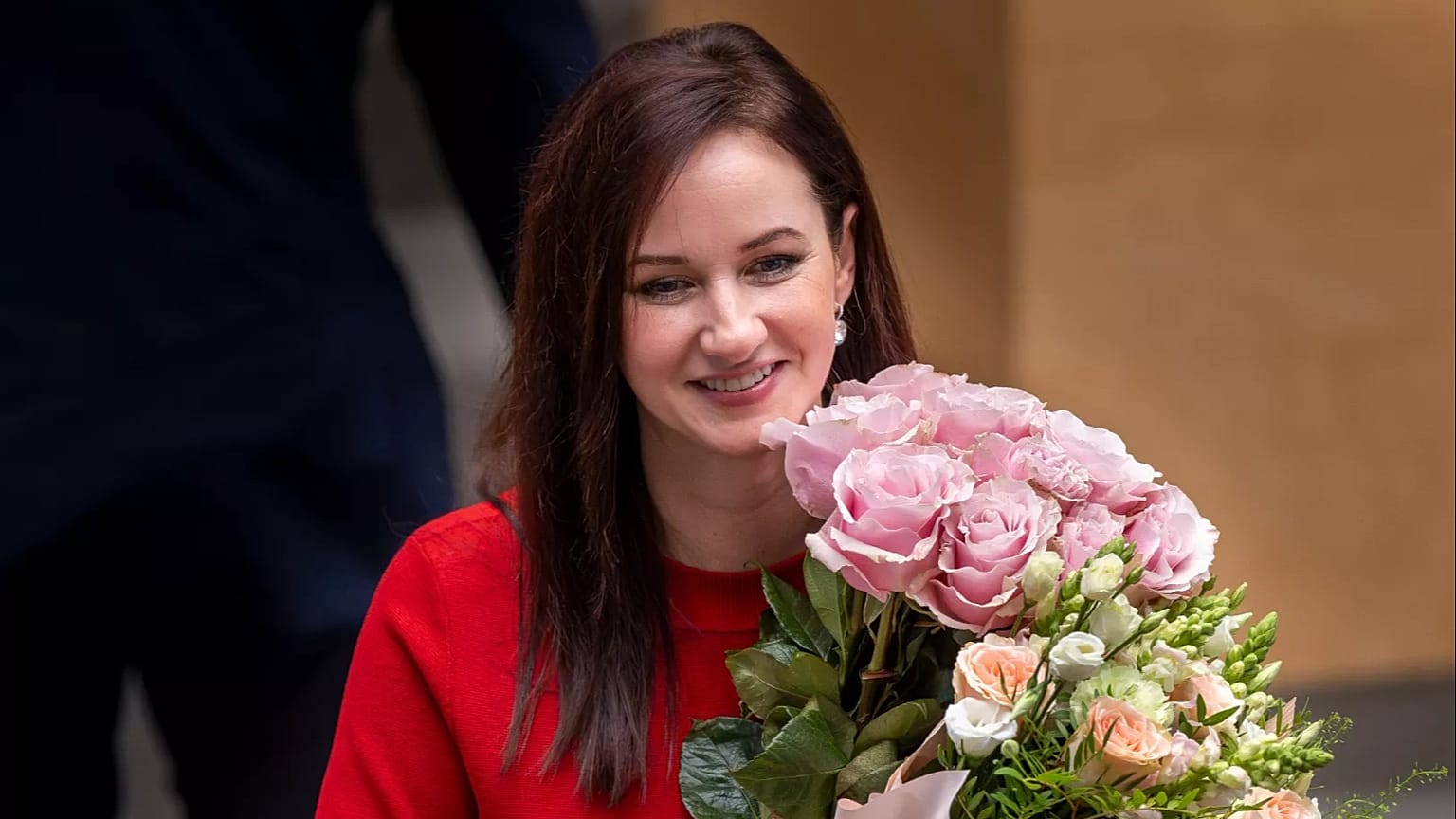
Ruginienė, a former head of Lithuania’s labour union confederation, joined the centre-left Social Democratic Party just before a general election last year.

She then served as minister for social affairs and labour under Prime Minister Gintautas Paluckas, who resigned in July after less than a year in office.

Paluckas had been dogged by media investigations into his business and financial dealings.

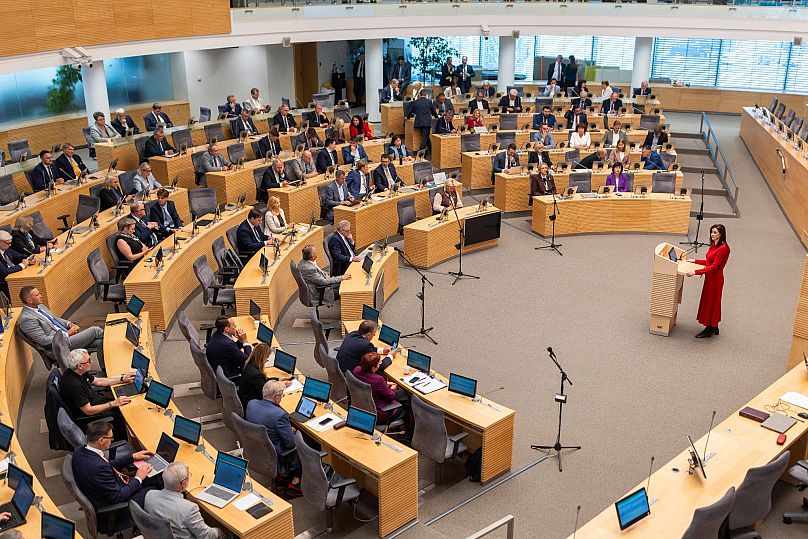
Inga Ruginienė speaks during a Lithuanian parliament session 
in Vilnius, 26 August, 2025 AP Photo

Several media outlets published investigations in July regarding his past and present ventures and alleged mishandlings, including ones from more than a decade ago.

Anti-corruption and law enforcement agencies in the country subsequently launched their own inquiries.

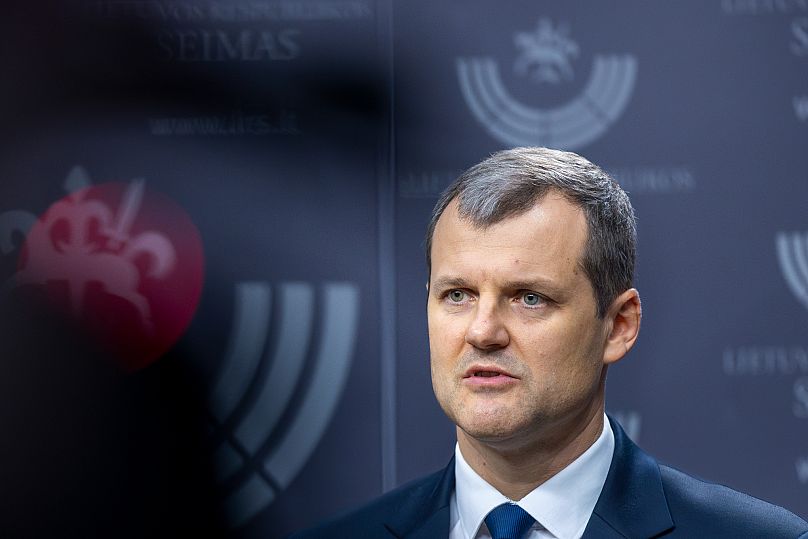
President Gitanas Nausėda, who nominated Ruginienė as prime minister, told parliament before Tuesday's vote that she is "a constructive negotiator who seeks compromise."

Ruginienė told lawmakers she will focus on "restoring stability" and will work to "ensure that the government carries out the work entrusted to it by the voters."

Related


The Social Democrats on Monday signed an agreement on a new centre-left coalition with two junior partners, one of which is new to the government.

It has a solid majority in the parliament, or Seimas, with 82 of the 141 seats.

Ruginienė must still be formally appointed by the president and sworn in at a ceremony in parliament, but those are formalities.

Her government should serve out the remainder of the four-year term that started with last autumn's election.

Lithuania's former Prime Minister Gintautas Paluckas speaks to the media at the parliament in Vilnius, 21 November, 2024 AP Photo

Lithuanian foreign policy is unlikely to change because of the government shakeup.

Nausėda, who was elected separately, is the country’s face on the world stage and has been one of the most stalwart supporters of Ukraine’s fight against Russia's full-scale invasion, a position that has broad political support in the Baltic nation of about 2.8 million people.

The European Union and NATO member sits on the Western alliance's eastern flank. It has borders with Russia's Kaliningrad exclave and with Russia-allied Belarus.

Additional sources


South Korea, the US come together on nuclear deals

South Korea, the US come together on nuclear deals
/ Mick Truyts - Unsplash

By bno - Busan Office August 27, 2025

A series of agreements have been signed between South Korean companies and American partners to advance nuclear energy projects in the United States, World Nuclear News reports. The collaborations aim to meet the surging electricity needs of data centres, support the growth of artificial intelligence, and reinforce the resilience of the nuclear fuel supply chain.

Accelerating small modular reactor deployment

One of the most notable partnerships involves X-energy Reactor Company, Amazon, Korea Hydro & Nuclear Power Corporation (KHNP), and Doosan Enerbility. The four parties have signed a strategic cooperation agreement designed to speed up the introduction of X-energy’s Xe-100 advanced small modular reactors (SMRs) and its TRISO-X fuel across the country. The plan includes the delivery of more than five gigawatts of new nuclear power by 2039, primarily to serve the increasing energy requirements of data centres and AI-related facilities.

The agreement covers engineering design, construction planning, supply chain management, long-term operations, investment models, and opportunities for combined AI-nuclear deployment in international markets. The partnership aligns with the recent $350bn trade pact between Washington and Seoul, with expectations that as much as $50bn in both private and public capital could be channelled into nuclear energy development in the United States.

Vibhu Kaushik, who leads global energy at Amazon Web Services, said the project is vital as data centres have become the backbone of artificial intelligence development. He stressed that demand for power is accelerating rapidly and welcomed the opportunity to work with KHNP, Doosan, and X-energy in delivering carbon-free solutions at scale.

X-energy is already progressing with its Xe-100 high-temperature gas-cooled reactor and TRISO-X fuel development. Its collaboration with Korean partners builds on an earlier relationship with DL E&C, a major construction services company with which it began working in 2023. According to X-energy’s Chief Executive Officer, Clay Sell, the new alliance unites Korean industry’s extensive experience with X-energy’s technology, positioning the partners strongly to bring the Xe-100 SMR to market. Doosan has also committed to ensuring manufacturing capacity is in place to produce reactor modules efficiently.

Strengthening nuclear fuel enrichment

Beyond reactor deployment, World Nuclear News also reports that South Korean and American partners are also focusing on nuclear fuel enrichment. Centrus Energy has signed a Memorandum of Understanding with KHNP and POSCO International to examine potential investment in expanding Centrus’s uranium enrichment facility in Piketon, Ohio. This step is expected to bolster US-Korea cooperation in civilian nuclear power and expand the volume of low-enriched uranium supplied under a contract Centrus and KHNP agreed earlier this year.

Meanwhile, Amir Vexler, Centrus’s CEO, stated that the deal highlights a growing need for a US-based uranium enrichment capability. He added that additional private investment could increase competition and diversify fuel sources while also ensuring affordable and secure supplies for Korea’s nuclear sector. The company stressed, however, that the expansion of its enrichment plant remains dependent on federal funding, which is vital to achieve economies of scale and to challenge the dominance of state-owned enterprises that currently control most of the world’s uranium enrichment.

Although non-binding, the new MoU aims to draw in further private sector capital for Centrus’s Ohio operations. It also creates scope for extended cooperation in areas such as future low-enriched uranium supply contracts and the potential for high-assay low-enriched uranium agreements.

HyperGrid campus and broader US expansion

President Lee Jae Myung’s trip to Washington, which included a meeting with US President Donald Trump, further strengthened South Korea’s role in nuclear projects in the United States. During the trip, KHNP revealed it had signed an MoU with Samsung C&T and US-based Fermi America to contribute to the development of a planned 11 gigawatt power complex in Texas.

The project, referred to as the “HyperGrid” campus, was announced in June by Fermi America, co-founded by former US Secretary of Energy Rick Perry. Billed as the world’s largest AI-driven energy hub, the development is expected to combine large-scale nuclear plants, SMRs, gas-fired generation, grid power, solar facilities, and large-scale battery storage.

The agreement is regarded as a significant milestone for KHNP, establishing its presence in the American nuclear market and enabling it to play a role in one of the most ambitious energy projects in the country, according to World Nuclear News. Together, these agreements illustrate a growing alignment between South Korean and American industries to accelerate nuclear innovation, strengthen supply chains, and deliver the power infrastructure needed to support the next generation of digital technologies.


Russia orders emergency operation in race to save mountaineer trapped on Kyrgyzstan’s highest peak

Russia orders emergency operation in race to save mountaineer trapped on Kyrgyzstan’s highest peak
On August 19, drone flyover video confirmed Nagovitsyna was alive with a wind-battered tent in freezing conditions, a week after the accident in which she broke her leg. / Radio Azattyk, screenshot
By bne IntelliNews August 26, 2025

The race to save Russian mountain climber Natalia Nagovitsyna from the icy summit of Kyrgyzstan’s highest mountain is still on.

Russia’s chief investigator Alexander Bastrykin, responding to an appeal from Nagovitsyna’s son Mikhail, has ordered urgent coordination with Kyrgyz emergency officials to mount an attempt at rescuing the 48-year-old mountaineer. She has been trapped with a broken leg for more than two weeks in freezing weather on Jengish Chokusu, or Victory Peak, a mountain near the border with China with a height of 7,439 metres (24,406 feet).

Natalia Nagovitsyna's son Mikhail urged Russian officials to launch a rescue attempt, saying he was convinced his mother, pictured, is still alive (Credit: Radio Azattyk, screenshot).

The effort to save Nagovitsyna is made all the more poignant by the fact that four years ago her husband, Sergei Nagovitsyn, perished after he became paralysed and incapacitated during an expedition on the mountain of Khan-Tengri, located on the Kazakhstan-Kyrgyzstan-China tri-point. Also, on August 15 Italian mountaineer Luca Sinigaglia died during an attempt to evacuate Nagovitsyna.

Bastrykin’s August 25 order to his staff to pursue “comprehensive measures” with Russia’s Emergency Situations Ministry was reported by The Moscow Times on August 26.

On August 19, Kyrgyz officials said a drone flyover found Nagovitsyna alive in a damaged tent, a week after the accident in which she broke her leg while descending the mountain, the highest in the Tian Shan system of mountain ranges. In his appeal, Mikhail said the drone footage reassured him that his mother was still alive, though some experts have voiced growing doubts about her survival prospects in extremely poor weather and with dwindling supplies of food, water and fuel.

On August 25, TASS reported Alexander Yakovenko, chairman of the Commission on Classical Mountaineering of the Russian Mountaineering Federation, as saying that because of poor weather, rescuers were not prepared to relaunch the surveillance drone.

* Video report picturing the desperate situation faced by trapped climber Natalia Nagovitsyna, but please note there is no translation.

Radio Azattyk reported on August 26 that drone footage taken on August 19 showed Nagovitsyna’s tent torn apart by winds, with one side blown away.

Eduard Kubatov, president of the Kyrgyz Mountaineering Federation, told the media outlet that despite previous reports that the rescue mission had been indefinitely suspended, no final decision on bringing it to an end had been taken. He added that the rescue operation has become international.

He was further cited as saying that Jengish Chokusu is one of the 10 most difficult mountains to climb in the world with around a third of people who attempt the feat dying in the process, and adding: "Only climbers can rescue climbers at [such] altitude. Because only they are used to climbing at such heights, they know those routes.

“The best sports training is required there. In other words, it is necessary to save a person at such a high altitude. Only professional climbers can do it. Neither [Kyrgyzstan’s] Ministry of Emergency Situations nor Ministry of Defence can carry out rescue operations at altitudes above 5,000 metres."

During repeated attempts to save Nagovitsyna, a helicopter was forced into a hard landing, with several aboard suffering injuries as a result.

Both Jengish Chokusu and Khan-Tengri are members of the so-called Snow Leopard group of mountains, five 7,000-ft-plus peaks found across the former Soviet Union. Only around 700 people, including 30 women, have accomplished the feat of climbing all five.


World Bank seems to be having second thoughts about Tajikistan’s Rogun Dam

World Bank seems to be having second thoughts about Tajikistan’s Rogun Dam
The unfinished part of the Rogun Dam as of August 26. World Bank officials reportedly decided to freeze Rogun funding, which halted the project. / president.tj
By Eurasianet August 26, 2025

The World Bank appears to be pulling back from involvement in the construction of the Rogun Dam in Tajikistan. According to regional media reports, the bank has paused project funding until Tajik authorities develop a plan to responsibly repay construction-related debts and prove the dam can be commercially viable as a power-generating entity.

The bank’s board of directors approved a $350mn development grant in late 2024 for Rogun, which, if completed to full specifications, would boast the world’s tallest dam at 335-metres. 

The decision faced substantial blowback from experts who contend that the project is a “white elephant” in the making, as well as environmental activists who argue the dam’s completion could have a dire impact on downstream communities. 

On August 25, the Russian newspaper Nezavisimaya Gazeta reported that WB officials had decided to freeze Rogun funding, adding that money would not start flowing again “until Dushanbe meets a number of conditions.”

The newspaper suggested that the international financial institution’s (IFI’s) action was “a direct response to complaints from the environmental community and concerns from people living in the lower reaches of the Amu Darya River, who point to serious environmental risks.”

report published in December by the regional environmental group Rivers Without Boundaries contained data asserting that the fully developed Rogun Dam would upset the region’s delicate environmental balance, wreak havoc on already stressed water supplies and, ultimately, be economically uncompetitive. The group also contended that IFIs relied on an outdated Environmental and Social Impact Assessment when considering funding for the project.

Tajik officials claim Rogun, which carries an estimated price tag now exceeding $9bn, would provide the Central Asian nation with a greater degree of energy independence, meeting not only domestic electricity needs but also generating revenue via power exports. The dam project dates back to the Soviet era, but went through a long dormant phase until it was revived in 2016. Two of six projected turbines are in place at Rogun, on which an estimated $3bn has already been spent.

In April, the World Bank’s Inspection Panel, an independent investigative entity, raised concerns about the bank’s involvement in the project, determining that full-scale electricity generation at Rogun could reduce the water flow of the already stressed Amu Darya by 25% or more, imperilling the livelihoods of as many as 10mn downstream inhabitants in Uzbekistan and Turkmenistan.

Earlier in August, the Standard & Poor’s rating agency published a research update that characterised Rogun as a “a costly project crowding out other domestic capital expenditure of the government.” 

Standard & Poor’s analysts estimated that completing the dam to its full specifications would cost roughly an additional $6.4bn. “The government negotiated financing packages with a consortium of multilateral and bilateral partners to finance about 50 percent of the estimated $6.4 billion (40 percent of projected 2025 Tajik GDP) required to complete the project by 2035,” the agency’s research update notes. 

“However, there have been delays in unlocking this funding, particularly from the World Bank, pending completion of remaining effectiveness conditions,” it adds.

Before the Rogun project can get back on track, World Bank officials want the Tajik government to address several areas of concern, according to the Nezavisimaya Gazeta report.

“It is necessary to develop and approve a macroeconomically sound financing plan that will exclude an excessive increase in public debt,” the report states. Bank officials also reportedly want to see a “reliable” financial plan “forming a sustainable commercial model” that includes firm commitments by neighbouring states to purchase Rogun-produced electricity.

This article first appeared on Eurasianet here.


End of Bolivia's leftist era leaves Chinese and Russian lithium deals in limbo

End of Bolivia's leftist era leaves Chinese and Russian lithium deals in limbo
The vote's outcome will determine the future of agreements worth more than $2bn that the outgoing leftist government signed with Russian and Chinese firms to extract lithium from the Salar de Uyuni salt flat. / Dan Lundberg
By Alek Buttermann in Lima August 26, 2025

Bolivia's October presidential runoff, following the August election that ended two decades of leftist governance, has become a contest not only between centrist and right-wing political traditions but also over the management of the country's vast and underdeveloped lithium resources. The second round pits centrist senator Rodrigo Paz, who led the first vote with 32%, against right-wing former president Jorge "Tuto" Quiroga, who secured 27%.

The outcome is likely to determine the future of agreements worth more than $2bn that the outgoing leftist government signed with Russian and Chinese firms to extract lithium from the Salar de Uyuni salt flat. These contracts, intended to give Bolivia a foothold in the global electric battery market key to energy transition efforts, have been paralysed by legal disputes and political infighting. A local court in Potosí suspended the deals in May following a petition from indigenous organisations who argued that exploratory activity had begun without environmental studies or formal consultation.

The legal action, filed by the Central Única Provincial de Comunidades Originarias de Nor Lípez, represents more than 50 communities in the Uyuni region. Their complaint pointed to the risk to water sources and demanded enforceable environmental guarantees before industrial-scale extraction. Fundación Milenio, a Bolivian think tank, also raised concerns over the financial asymmetry of the contracts, noting that state firm Yacimientos de Litio Bolivianos (YLB) could be left paying for infrastructure built with foreign technology that might prove unmanageable without outside operators.

Quiroga has made opposition to these agreements a central campaign issue. He has pledged to annul the contracts with Russia’s Uranium One and China’s CBC, arguing that they were negotiated “behind the back” of local authorities and lacked legislative approval. His proposed response is to draft a new mining law that prevents what he calls “favouritism” in the allocation of strategic resources, AFP noted. The candidate, educated in the United States, has also advocated a shift away from ties with Moscow and Beijing in favour of closer cooperation with Western partners.

Paz, by contrast, has presented himself as a moderate alternative focused on stabilising the domestic economy. He told AFP that he rejects the notion of “strict austerity” but accepts that major fiscal adjustments are unavoidable. He pledged to cut $1.2bn annually in fuel subsidies and to reduce a further $1.3bn in what he termed “superfluous spending.” Paz also proposed tax incentives to encourage citizens to deposit dollars currently held in cash, though he ruled out seeking an immediate international bailout.

Both candidates face a public frustrated by long-running shortages of fuel and hard currency, alongside inflation that reached 24.8% year-on-year in July, the highest since at least 2008. The economic downturn is widely attributed to underinvestment in gas exploration after years of dependence on hydrocarbon exports, once the engine of Bolivia’s growth under former president Evo Morales – a divisive figure who was barred from running on various criminal charges.

While the government insists the deals maintain national ownership of resources, their lack of legislative approval, combined with judicial and community opposition, leaves their future uncertain. For voters, the dispute highlights a deeper choice: whether to embrace Quiroga’s plan for a radical overhaul of Bolivia’s state-led economic model or Paz’s more gradualist approach to fiscal discipline.

Whichever path is chosen in October, Bolivia’s attempt to transform its “white gold” reserves into an engine of recovery is now tightly bound to questions of governance, transparency and public trust.


Hydropower poised to drive Africa’s clean energy future – IHA report

Hydropower poised to drive Africa’s clean energy future – IHA report
/ International Hydropower Association’s (IHA)

By bne IntelliNews August 26, 2025

Hydropower, with 43.5 GW of installed conventional capacity in Africa, is becoming increasingly important for the continent's development, supported by large national projects as well as smaller private-sector initiatives.

What: Africa’s vast hydropower resources remain largely underdeveloped, with only about 11% of its technical potential harnessed.

Why: Progress is slow compared with potential. Financing challenges, governance concerns and slow permitting continue to delay delivery.

What next: The challenge now lies in modernising existing assets and securing the finance needed to bring the continent’s huge pipeline of projects to fruition.

Africa holds some of the world’s richest hydropower resources, yet its vast potential remains largely untapped. According to the International Hydropower Association’s (IHA) 2025 World Hydropower Outlook, the continent has only harnessed about 11% of its technical potential, despite hydropower already contributing around 20% of Africa’s total electricity generation.

With an installed base of 43.5 GW of conventional capacity, hydropower plays a growing role in the continent’s development, but progress has been uneven, hampered by financing challenges and structural barriers. Africa’s total installed hydropower capacity, including  pumped hydro, is 47 GW, according to the report.

The breakthrough

The IHA report notes that 2024 was a breakthrough year, with more than 4.5 GW of new hydropower capacity added in Africa – double the 2 GW commissioned in 2023.

Several major projects reached key milestones. Tanzania’s Julius Nyerere dam brought six of its nine 235-MW units online. In Ethiopia, the $5bn Grand Renaissance Dam (GERD) added another 800 MW with its third and fourth turbines. Uganda’s 600-MW Karuma and Cameroon’s 420-MW Nachtigal plants were also fully commissioned.

These achievements mark a significant step forward in Africa’s clean energy transition, demonstrating that large-scale hydropower can move from planning to delivery despite persistent obstacles.

Yet the starting point remains low. While hydropower already accounts for a fifth of Africa’s electricity generation, this is derived from just a fraction of the continent’s more than 600-GW technical potential. The Outlook highlights a massive pipeline of stalled projects – 18.5 GW of approved capacity awaiting finance and construction, and another 63.4 GW yet to be approved.

This pool alone represents 42% of global projects currently seeking approval. If built, the projects could generate 250–300 TWh annually, equivalent to more than a third of Africa’s current electricity demand. Unlocking this pipeline, the IHA stresses, will be essential for universal energy access and for Africa’s role in the global clean energy transition.

Untapped potential

Much of this untapped potential is concentrated in the Democratic Republic of Congo’s Grand Inga scheme, a project of gigantic scale that could deliver close to 50 GW of capacity. However, it continues to face daunting challenges: financing constraints, governance risks, and opposition from local communities. Despite this, the World Bank has signalled renewed interest in the DRC project, beginning with an Inga III phase that could deliver between 3 GW and 11 GW.

Whether this long-delayed scheme advances or not, smaller projects across Africa are proving more accessible to private developers and offer a pathway to faster progress. In countries such as Burundi, Côte d’Ivoire and Eswatini, smaller-scale hydropower projects are taking root. Supported by the International Finance Corporation (IFC) and other development partners, new models are being piloted to attract private-sector participation.

One approach is to pre-develop concessions and then auction them to private delivery partners, streamlining the process and reducing costly delays linked to redesigns and renegotiations. This model, if scaled, could unlock a new wave of privately financed projects, providing reliable electricity to regions where access remains limited.

Modernisation of existing plants is also a priority. Many of Africa’s older hydropower stations require upgrades to operate efficiently and extend their lifespan. To that end, the African Development Bank (AfDB) has launched the Africa Hydropower Modernisation Programme with an initial budget of $9.72mn. The programme will target 12 privately led projects across eight countries.

IHA assessments identified 4.6 GW in urgent need of modernisation and a further 10.1 GW requiring medium-level intervention. Upgrades could bring 0.8 GW of currently idle units back into service and increase available capacity by up to 1.6 GW, securing output from assets already in place.

Sustainability is also moving up the agenda. In 2024, Zambia’s 180-MW Ngonye Falls Hydroelectric Project became the first in Africa to receive gold certification under the Hydropower Sustainability Standard (HSS), setting a precedent for others to follow. By embedding international good practice in design, construction and operation, such certification can help improve investor confidence and align African projects with global environmental and social benchmarks.

The Abuja Action Plan

Despite the encouraging progress, the sector continues to face structural barriers. Many projects stall before reaching final investment decision (FID) because of concerns over offtake risk, high foreign exchange hedging costs and lender apprehension about bankability.

To address these issues, the IHA and its partners in 2024 launched the Abuja Action Plan (AAP), which sets out recommendations to de-risk projects and attract finance. It calls on governments to recognise hydropower as a clean, reliable and affordable energy source, and to integrate it into long-term renewable energy strategies. It also urges governments to speed up permitting, while improving the quality of decision-making, and to ensure transmission infrastructure is in place to absorb new capacity.

The AAP also appeals to international financial institutions and sustainable development funds to increase support for renewable energy infrastructure. Developers are encouraged to adopt the HSS as a benchmark, with governments committing to expediting projects that meet its criteria. By creating a more predictable, transparent and supportive investment environment, the AAP aims to unlock the tens of gigawatts of hydropower capacity now stuck in limbo.

Building momentum

Africa’s hydropower journey is only beginning. With just over 10% of its technical potential developed, the sector has the scale to transform energy access and underpin economic growth across the continent.

The progress achieved in 2024 demonstrates that momentum is building, driven by both flagship national projects and smaller private-sector initiatives. The challenge now lies in accelerating this trend, modernising existing assets, and securing the finance needed to bring the continent’s huge pipeline of projects to fruition. If these barriers can be overcome, hydropower will not only play a central role in Africa’s energy future but also ensure the continent makes a decisive contribution to the global transition to clean energy.